BLOCK FEATURE BASED IMAGE
FUSION USING MULTI WAVELET
TRANSFORMS
Maziyar Khosravi (a)
Department of electronics and communications JNTU, Hyederabad, India- 500028
Mazaheri Amin(b)
Department of electronics and communications JNTU, Hyederabad, India- 500028
Abstract:
In recent years image fusion plays a vital role in the image processing area. Fusion mean creating an image in which all the objects are in focus, this would help in doing many application in image processing like segmentation ,image enhancement and many. In this paper we present a block feature based image fusion for the images which are in focus and out of focus using Multi wavelet transforms. A qualitative analysis is done for test images and found best when integrated with the feed forward probabilistic neural networks.
Keywords: Fusion, Multi wavelets, Neural Networks I. INTRODUCTION
Fig 1: Generalized Block diagram for Multi scale Image fusion
In this paper two images which are in focus and out of focus, mean that in one image the concentration is made on one object in the image and in the other, the other part of object. For example figure2 shows these two images in the figure 2(a) the concentration is done on the clock and in the figure 2(b) the concentration is done on the box but not on the clock. So similar images are prevalent in our day to day life [8], such images are considered as the input for the algorithm proposed in this paper
Fig 2: a) Right Blur Image b) Left Blur image
II. Multi Wavelet Tranforms
Let a scaling function Φ(t) generates a multi resolution analysis then
∑ 2 (1)
Where Ck are the coefficients, associated with these scaling functions there are ‘r’ wavelets W0(t),...Wr-1(t)
satisfying the matrix wavelet equation
∑ 2 (2)
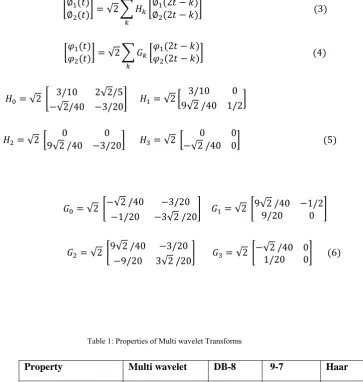
In this paper GHM multi wavelet transform is considered for the multi scale transformation. To implement Multi wavelet transforms a new filter bank structure where the low pass and high pass filter banks are matrices rather than the scalars. That is, the two scaling and wavelet functions satisfy the following two-scale dilation equations [6][8][10]
√2 22 3
√2 22 4
√2 3/10 2√2/5
√2/40 3/20 √2
3/10 0
9√2 /40 1/2
√2 9√2 /400 3/200 √2 √2 /40 00 0 5
√2 √2 /40 3/20
1/20 3√2 /20 √2 9√2 /40
1/2
9/20 0
√2 9√2 /40 3/20
9/20 3√2 /20 √2
√2 /40 0
1/20 0 6
Table 1: Properties of Multi wavelet Transforms
Property Multi wavelet DB-8 9-7 Haar
Orthogonality Yes Yes No Yes
Symmetry Yes No Yes Yes
Compact support Yes Yes Yes Yes
III. Neural Networks
Neural network models are used for tackling a diverse range of problems, including pattern classification, function approximation and regression. The fusion problem examined here can be considered as a classification problem. In this paper, consider neural network models, namely, the probabilistic neural network (PNN). The typical architecture consists of one hidden layer and one output layer. Each hidden unit corresponds to a basis or kernel function of the input vector x, and is usually of the Gaussian form [7]:
H(x)=exp(-||x-c||2/σ2) (13)
In the proposed method, we trained the neural network using the block features of different pair of multi-focus images. Once the classifier is obtained then it can be used to fuse any pair of multi focus images.
IV. Experiment analysis
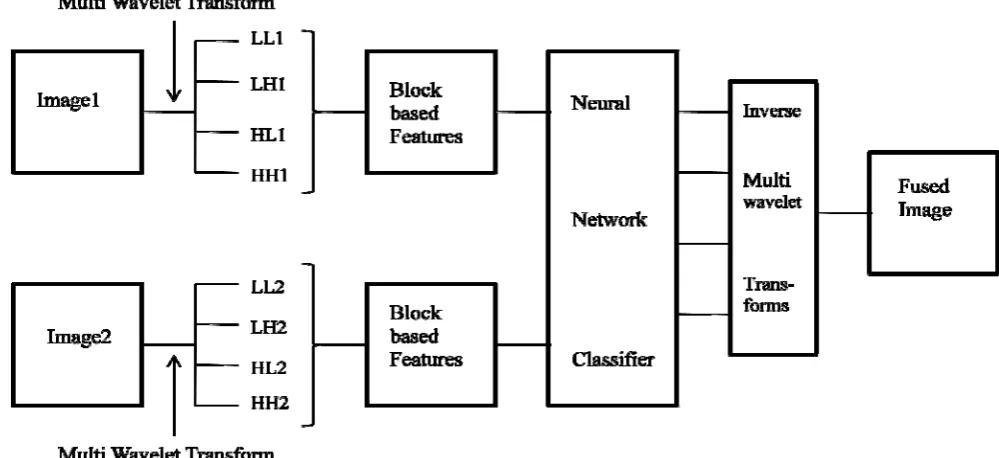
Figure 3 shows the proposed method for the image fusion, both the images (out of focus and in focus) as the input. Approximations and detailed coefficients are obtained on applying the multi wavelet transform; in this case GHM multi wavelet transform is used. These coefficients are divided into MxN blocks, feature vector for these blocks are obtained which are labeled and trained for neural network. A decision is made based on the value of the classifier like if the out of the classifier is greater than zero than the block from image1coeffcients is selected or else from image2 coefficients. Thus obtained fused coefficients are transformed with inverse multi wavelet transform to get fused image.
Fig 3: Proposed method for Block feature based image fusion
Evaluation criteria
Table 2: Performance analysis for the proposed method
Image MI Qf Q0 Qw Qe
Clock 0.1897 0.7894 0.1751 0.1966 0.0344 Leopard 0.2405 0.7898 0.2231 0.2789 0.0622 Pepsi 0.2642 0.8506 0.2012 0.2486 0.05
Average 0.2315 0.8099 0.1988 0.2414 0.0489
Fig 4: Test images used for the experimental analysis
V. Conclusion
In this paper a new approach for block feature based image fusion is implemented using multi wavelet transform and neural networks and a qualitative analysis has been done for the several test image and found better results. The experimental results indicate that the appropriate setting for the number of decomposition levels is two. It is a trade-off between the capability of catching spatial details and the sensitivity to noise and transform artifacts. When the number of decomposition levels is too large, one coefficient in coarse resolutions responds to a large group of pixels of fused image. An optimum block size of 3x3 or 4x4 is used for block feature extraction.
VI. REFERENCES
[1] Abdul siddiqui,M.Arfan Jaffar, ”Block based feature level multi focus image fusion “,2010 5th international conference on future
information technology pg.no:1-7
[2] Fernando Perez Nava Antonio Falcon Martel,”Planar representation based on multi Wavelets”.
[3] G.Piella ,”New quality measures for image fusion”
[4] H.Zheng,D.Zheng,Yanxiang Hu,Sheng Li, ”Study on the optimal parameters of image fusion based on wavelet transform”, journal of
computational information systems vol:1,2010 pg.no: 131-137
[5] Ishita De,Bhabatosh Chanda, ”A simple and efficient algorithm for multi focus image fusion using morphological wavelets”, Elsevier,
vol:86, 2006, pg 924-936
[6] Kai chieh Liang,Jin Li and C-c Jay Juo, ”Image compression with embedded multi wavelet Coding
[7] Shitao Li,James.TKwok,Yaonan Wang ,”Multi focus image using artificial neural networks”, pattern recognition letters, Elsevier,
Vol:23,2002 ,pg 985-997.
[8] Shih Gu Huang ,”A tutorial on wavelets for image fusion “
[9] Shutao Li ,Bun yang, Jianwen,Hu, ”Performance comparison of different multi resolution transforms for image fusion “, Elsevier,
vol:12, 2011, pg 74-84.
[10] Sudhakar R,Jayaram S ,”Fingerprint compression using multi wavelets”, International journal of signal processing,World Academy of
Science, Engineering and Technology vol:2 2006
[11] Tanish Zaveri,Mukesh Zaveri, ”A novel Two step region based multi focus image fusion method”, International journal of computer
and electrical engineering,vol:2,no.1,feb 2010.
[12] W.Wang,Faliang Chang,Tao JI, ”Fusion of multi focus images based the 2-Generation Curve let transform “, International journal of