Effect of Exercise on Immunologic Factors in Breast Milk
Cheryl A. Lovelady, PhD*; Christie P. Hunter, MS‡; and Cissy Geigerman, BS§
ABSTRACT. Objective. Although it is well docu-mented that breast milk provides optimal nutrition and immune benefits to the infant, factors that influence the immunologic composition of breast milk are less under-stood. A recent study reported that immunoglobulin A (IgA) levels in breast milk are lower after exercise com-pared with resting concentrations. However, the women exercised until exhaustion. The effect of moderate exer-cise on immunologic components in breast milk has not been reported. Therefore, the purpose of this study was to 1) compare the levels of immunologic compounds in breast milk of exercising women with the milk of seden-tary women and 2) determine whether 30 minutes of moderate exercise affects immunologic properties of breast milk.
Methods. Exclusively lactating women were studied at 3 months’ postpartum. Women in the exercise group (EG; nⴝ 29) reported exercising aerobically at least 30 minutes/d for 3 days/wk, and women in the sedentary group (SG; nⴝ 24) had exercised once a week or less during the previous 6 weeks. Cardiovascular fitness lev-els and concentrations of IgA, lactoferrin, and lysozyme in milk were measured. A subsample of the EG (nⴝ17) participated in a 30-minute exercise session at 75% of maximum heart rate and a rest session of 30 minutes of sitting rest on 2 separate days. Breast milk samples were collected before and 10 and 60 minutes after exercise and rest sessions. IgA, lactoferrin, and lysozyme concentra-tions were measured.
Results. Women in the EG had a higher level of car-diovascular fitness than women in the SG (39.7ⴞ1.0 vs 32.4ⴞ 1.0 mL O2/kg/min). Milk concentrations of IgA, lactoferrin, or lysozyme were not significantly different between groups. In addition, there were no significant differences in the concentrations of IgA, lactoferrin, or lysozyme after moderate exercise compared with sitting rest.
Conclusion. Moderate exercise during lactation im-proves cardiovascular fitness without affecting levels of IgA, lactoferrin, or lysozyme in breast milk.Pediatrics
2003;111:e148 –e152. URL: http://www.pediatrics.org/cgi/ content/full/111/2/e148;immunologic compounds in breast milk, lactation, postpartum exercise, IgA, lactoferrin, ly-sozyme.
ABBREVIATIONS. sIgA, secretory IgA; HRP, horseradish perox-idase; PBS, phosphate-buffered saline.
B
reast milk not only provides optimal nutrition to infants but also supplies a range of bioactive factors that are involved in the protection against many invading pathogens. This latter func-tion is reflected by the immunologic composifunc-tion of breast milk and is vital for newborns as their muco-sal and systemic immune systems are primarily un-developed at birth. The importance of these com-pounds in breast milk has led the American Academy of Pediatrics to recommend that all infants be exclusively breastfed for the first 6 months and that breastfeeding continue with supplements of solid foods during the next 6 months of life.1Three proteins that are found in relatively high concentrations in breast milk and confer immuno-logic benefits to infants are secretory immunoglobu-lin A (sIgA), lactoferrin, and lysozyme. IgA in breast milk is in the molecular form of sIgA and is therefore more resistant to proteolytic activity of the gastroin-testinal tract.2sIgA prevents the adherence of bacte-ria to mucosal surfaces and neutralizes toxins from microorganisms.2Lactoferrin also works at the mu-cosal sites and has demonstrated antiinflammatory and antimicrobial activities, such as competing with bacteria for ferric iron and preventing the growth of microorganisms.3 Lysozyme is a protein that lyses bacteria and may work synergistically with lactofer-rin and sIgA in antibacterial functions.3
Although the immunologic benefits of lactation are well known, the effect of maternal nutritional status on components in breast milk is questionable. Chang4 reported that milk concentrations of sIgA and lysozyme from malnourished Chinese women were only half of those of well-nourished women during the first 7 days of lactation. Similarly, Miranda et al5reported that colostrum of malnour-ished Colombian women had significantly lower lev-els of sIgA, IgG, and complement C4 compared with well-nourished women. However, other researchers have failed to see an effect of maternal nutritional status on immunologic properties of breast milk.6 – 8 Another factor that may affect the immunologic properties of breast milk is maternal exercise. The effects of exercise on the immune system are depen-dent on the level of fitness of the subjects, the degree of intensity, and the duration of exercise. Heavy exertion usually results in lower resistance, impaired immunity, and increased risk of upper respiratory tract infections, whereas moderate exercise can con-From the *Department of Nutrition, University of North Carolina at
Greens-boro, GreensGreens-boro, North Carolina; ‡Wake Forest Unviersity Baptist Medical Center, Winston-Salem, North Carolina; and §Department of Pathology and Laboratory Medicine, Emory University, Atlanta, Georgia.
All authors were affiliated with University of North Carolina at Greensboro at the time of the research.
Received for publication Jul 15, 2002; accepted Sep 24, 2002.
Address correspondence to Cheryl A. Lovelady, PhD, Department of Nu-trition, Box 26170, University of North Carolina at Greensboro, Greensboro, NC 27402-6170. E-mail: cheryl㛭[email protected]
fer resistance to infection.9A recent study by Klen-trou et al10 found that participants in a 12-week moderate exercise training program reported signif-icantly lower number of days with influenza and light upper respiratory tract infection symptoms compared with sedentary control subjects. In addi-tion, concentrations of salivary IgA increased signif-icantly after training.
There is a paucity of information on the influence of exercise on the immune properties in breast milk. Gregory et al11examined sIgA concentrations before and after randomized maximal exercise and resting control periods. They reported that milk samples taken 10 and 30 minutes after exercise were signifi-cantly lower in sIgA levels than the corresponding control samples but were similar to control samples by 60 minutes. The authors suggested that breast-feeding immediately after exercise may not be ben-eficial to the infant. However, this study consisted of exercise to exhaustion, and the results may not be applicable to women who exercise at a moderate intensity level.
During moderate exercise, stress hormones, which can suppress immunity, are not elevated to the same extent as during prolonged or heavy exertion.12 However, a study by Altemus et al13demonstrated an interesting response of stress hormones during intense exercise in postpartum women. Lactating and nonlactating women exercised for 20 minutes on a treadmill, with the speed and grade increasing progressively, reaching 90% of the maximal oxygen uptake during the last 5 minutes. Although the non-lactating women showed the expected increase in stress hormones, the plasma adrenocorticotropic hormone, cortisol, and glucose responses to exercise were significantly blunted in the lactating women. These investigators concluded that the stress-respon-sive neurohormonal systems are restrained during lactation and that this inhibition may enhance im-mune function in lactating women.
McCrory et al14reported that short-term (11 days) dieting with aerobic exercise seemed to be safe dur-ing lactation. They found no differences in milk vol-ume, lipid, protein, or energy output between the dieting/exercising group and the control group. We recently reported that 10 weeks of moderate exercise and energy restriction did not affect the growth of infants during the first 3 months’ postpartum.15 However, neither study measured any immunologic components in the breast milk to determine whether their concentrations were affected. Therefore, the purpose of this study was to 1) compare the basal levels of immunologic compounds in breast milk of exercising women with the milk of sedentary women and 2) determine whether 30 minutes of moderate exercise affects immunologic properties of breast milk. Although it is acknowledged that there are a host of bioactive compounds that compose the com-plex immune system in breast milk, the 3 proteins (sIgA, lactoferrin, and lysozyme) described above were selected for the study on the basis of their relatively high concentrations in breast milk and their important immunologic benefits to the nursing infant.
METHODS Participants
Healthy (free from chronic disease or illness in the past week), nonsmoking, exclusively breastfeeding women with a body mass index between 20 and 30 kg/m2were studied at 3 months’ post-partum. The women delivered healthy, term infants (birth weight:
⬎2500 g; gestational age: 37– 42 weeks). All infants were larger than the 10th percentiles of the Centers for Disease Control and Prevention growth charts for weight and length at 3 months of age.16 Women were recruited through advertisements and an-nouncements of the study in obstetricians’ offices and in childbirth and parenting classes offered at the local hospital. Participants were asked about their physical activity in the postpartum period and grouped according to their exercise habits. Women who re-ported exercising aerobically at least 30 minutes per day for a minimum of 3 days a week for the previous 6 weeks were placed in the exercise group. The sedentary group consisted of women who reported exercising once a week or less. The institutional review board at the University of North Carolina at Greensboro approved the study protocol, and all study participants gave written informed consent.
Experimental Design
On the day of the laboratory measurements, women expressed 30 mL of breast milk during the first morning feed after 5am. Mothers brought the samples to the Human Performance Labora-tory, where they were frozen at⫺70°C until analysis. Body com-position and cardiovascular fitness were then measured on all women.
A subsample of exercising women returned to the laboratory 2 additional times for either a rest or an exercise session to deter-mine the acute effects of exercise on concentrations of sIgA, lac-toferrin, and lysozyme in their breast milk. These sessions were approximately 2 days apart, and the order was randomized. The exercise session consisted of brisk walking or jogging for 30 min-utes on the treadmill at a speed and grade to elicit an intensity of approximately 75% of predicted maximum heart rate. This work-load was determined from the previous measurement of cardio-vascular fitness. Heart rate was measured with a heart rate mon-itor (Polar Inc, Woodbury, NY). The rest session was 30 minutes of sitting quietly. Breast milk samples were collected before and then 10 and 60 minutes after the exercise and rest sessions. Women expressed all milk from both breasts with a Medela electric breast pump (McHenry, IL) at each time point. The milk was weighed, and samples were frozen at⫺70°C until analysis.
Anthropometrics
Women were measured in bathing suits to the nearest tenth of a kilogram on a stationary beam balance scale. Maternal height without shoes was measured with the use of a stationary stadi-ometer. Body density was measured by underwater weighing. Residual lung volume was measured with an oxygen dilution technique before submersion in the water tank.17Body density and the percentage of body fat were calculated with the formulas of Brozek et al.18
Cardiovascular Fitness
Cardiovascular fitness was measured by a submaximal graded treadmill test using a modified Balke protocol.19Before the test, a seated resting heart rate was measured with a heart rate monitor (Polar, Inc, Woodbury, NY). Women then warmed up with 2 minutes of walking on the treadmill. The speed was then in-creased to a brisk walk or jog (self-selected by the subjects, de-pending on their ability) and remained constant for the duration of the test. The women’s heart rates and perceived levels of exertion were recorded every minute. Every 2 minutes, the grade of the treadmill was increased by 2.5%. The test continued until the heart rate reached 85% of the predicted maximal heart rate reserve: [(maximal heart rate⫺resting heart rate) ⫻(0.85)] ⫹
Walking: (3.5 mL of oxygen/kg/min) ⫹ (speed in meters/ min⫻0.1)⫹(grade⫻meters/min⫻1.8)
Jogging: (3.5 mL of oxygen/kg/min) ⫹ (speed in meters/ min⫻0.2)⫹(grade⫻meters/min⫻0.9).
The predicted oxygen consumption at the maximal heart rate was calculated with a linear regression equation, with heart rate as the independent variable and oxygen consumption as the depen-dent variable.
Analyses of Immunologic Compounds
Total IgA rather than sIgA was measured in the milk. However, because⬎95% of the IgA in breast milk is in the secretory form of IgA, total IgA is a reasonable proxy for sIgA.20Total IgA, lacto-ferrin, and lysozyme concentrations were analyzed using a sand-wich enzyme-linked immunosorbent assay procedure. Milk sam-ples were defatted by cold centrifugation, and the lipid layer was removed. The polyclonal antibody pairs and standards used were goat anti-human IgA (No. I0844; Sigma Chemical Co, St Louis, MO) and horseradish peroxidase (HRP)-conjugated rabbit anti-human IgA (No. P0216; DAKO, Carpinteria, CA) with breast milk IgA standard (No. BP 148; Binding Site, Birmingham, England); rabbit anti-lactoferrin (No. A0186; DAKO); and HRP-conjugated rabbit anti-human lactoferrin (No. K99172P; Biodesign, Saco, ME) with breast milk lactoferrin standard (No. L0520, Sigma); and rabbit anti-human lysozyme (No. A0099; DAKO), sheep anti-hu-man lysozyme (No. K90073C; Biodesign), and donkey anti-sheep/ goat IgG HRP-conjugated (No. W90063P, Biodesign) with breast milk lysozyme standard (No. L6394; Sigma).
Polystyrene microtiter enzyme-linked immunosorbent assay plates were coated with the appropriate antibodies (sIgA, lacto-ferrin, or lysozyme) and incubated at room temperature over-night. The plates were then washed 4 times with phosphate-buffered saline (PBS) with 0.05% Tween 20 and blocked for 1 hour with PBS/bovine serum albumin. The standards and samples were then added to the wells, and the plates were incubated for 1 hour. After the plates were washed with PBS/Tween, the appro-priate anti-human HRP-conjugate was added and the plates were incubated at room temperature for 1 hour. Finally, the plates were washed another 4 times and color was developed with tetram-ethyl-benzidine (S1599, DAKO) and stopped with H2SO4. The absorbance was measured at 450 nm using a Powerwave micro-plate scanning spectrophotometer (Bio-Tek Instruments, Wi-nooski, VT). All samples were measured in triplicate. Each exer-cise and rest session sample was analyzed on the same plate. For assessing interplate variation, a quality-control sample from a single collection was included on every plate.
Statistical Analysis
Data were analyzed with the use of SPSS-PC software (SPSS, Chicago, IL). The characteristics of the groups were compared with Student t test. Lactoferrin and lysozyme data were log-transformed to normalize distributions. Data from the exercise and rest sessions were analyzed using repeated measures analysis of variance. Statistical significance was set atP⬍.05.
RESULTS
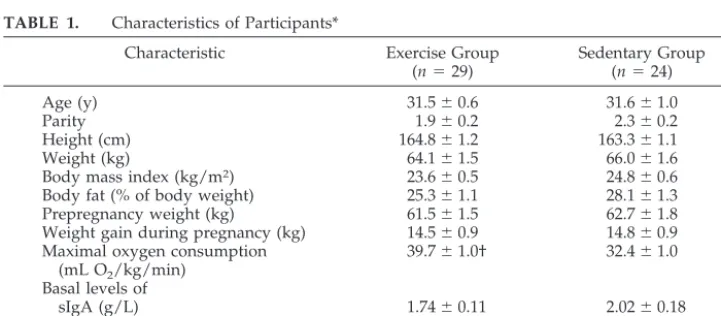
Fifty-three women participated in the study: 29 in the exercising group and 24 in the control group. There were no significant differences between the 2 groups in baseline characteristics except for their cardiovascular fitness level (Table 1). The mean pre-dicted maximal oxygen consumption of the exercise group was in the 80th percentile of fitness, compared with the 40th percentile for the control group, ac-cording to normative values of the American College of Sports Medicine.21 This confirmed the women’s self-reports of physical activity level. The majority of women in the exercise group stated that they exer-cised 30 to 60 minutes per day 3 to 5 days per week. No women were excluded as a result of conducting exercise to the point of exhaustion.
Despite the higher cardiovascular fitness level of the exercising women, there were no significant dif-ferences in body weight or percentage of body fat between the 2 groups. In addition, the breast milk of exercising women had similar basal concentrations of sIgA, lactoferrin, and lysozyme as the milk of sedentary women.
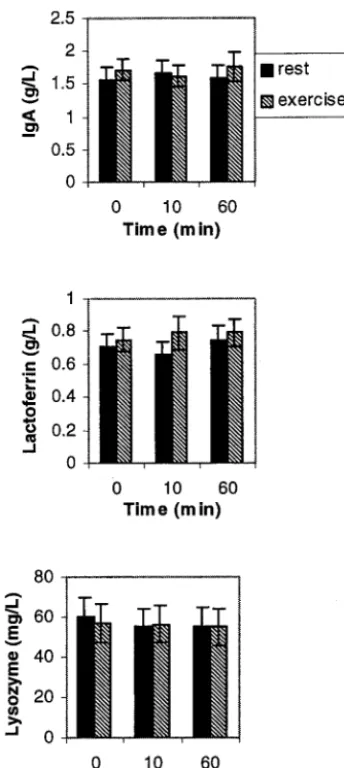
A subsample of 17 women from the exercise group completed the second study to evaluate the acute effects of exercise on concentrations of bioactive compounds in breast milk. They had similar charac-teristics as the other women in the exercise group except that their baseline lactoferrin levels were sig-nificantly higher (1.20 ⫾ 0.07 vs 0.89 ⫾ 0.10 g/L). However, these differences are probably not clini-cally significant as both means are within the nor-mal value for lactoferrin concentrations at 3 months’ postpartum. Concentrations of sIgA, lac-toferrin, and lysozyme were not different between rest and exercise sessions (Fig 1). sIgA and lacto-ferrin levels did not change significantly during each session; however, lysozyme concentrations decreased significantly from baseline to 60 minutes after both rest and exercise sessions (P ⫽ .04). There was no difference in the amount of milk pumped during the rest or exercise session (data not shown).
TABLE 1. Characteristics of Participants*
Characteristic Exercise Group (n⫽29)
Sedentary Group (n⫽24)
Age (y) 31.5⫾0.6 31.6⫾1.0
Parity 1.9⫾0.2 2.3⫾0.2
Height (cm) 164.8⫾1.2 163.3⫾1.1
Weight (kg) 64.1⫾1.5 66.0⫾1.6
Body mass index (kg/m2) 23.6⫾0.5 24.8⫾0.6 Body fat (% of body weight) 25.3⫾1.1 28.1⫾1.3 Prepregnancy weight (kg) 61.5⫾1.5 62.7⫾1.8 Weight gain during pregnancy (kg) 14.5⫾0.9 14.8⫾0.9 Maximal oxygen consumption
(mL O2/kg/min)
39.7⫾1.0† 32.4⫾1.0
Basal levels of
sIgA (g/L) 1.74⫾0.11 2.02⫾0.18
Lactoferrin (g/L) 1.06⫾0.06 1.08⫾0.12
Lysozyme (mg/L) 50.5⫾6.4 45.9⫾6.2
DISCUSSION
This study demonstrates that moderate exercise during lactation does not affect the sIgA, lactoferrin, or lysozyme concentrations in breast milk. Levels of these immunologic compounds in early-morning milk samples from women who had been exercising regularly for at least 6 weeks were not different from milk of women who had been sedentary during the postpartum period. Furthermore, sIgA, lactoferrin, and lysozyme concentrations were not affected by a 30-minute moderate exercise session. In contrast, Gregory et al11 reported that breast milk sIgA con-centrations were lower 10 and 30 minutes after a graded maximal exercise test (exercising until ex-haustion) compared with samples at 10 and 30 min-utes after a rest session. By 60 minmin-utes after exercise, the concentrations of sIgA were similar to those after 60 minutes of rest. These authors recommended that mothers discard their milk produced during the first 30 minutes after exercise. However, their study may
be applicable only to lactating women who engage in very strenuous activities at maximal intensities. The moderate intensity of our exercise session is proba-bly more representative of exercise done daily by lactating women. In addition, Gregory et al11 re-ported baseline sIgA values of approximately 0.013g/L as compared with our baseline concentra-tions of 1.56 to 1.72 g/L. Other researchers6,8,22–26 have reported concentrations ranging from averages of 0.7 to 2.0 g/L in milk from women at approxi-mately 10 to 12 weeks’ postpartum. The very low levels of sIgA reported by Gregory et al11 may be attributable to methodological problems with the as-say.
The average concentrations of lactoferrin in our study were 1.07 g/L for exercising and sedentary women, similar to those of healthy US women as reported by Butte et al.26Herias et al24reported mean lactoferrin concentrations of 0.98 and 1.07 g/L among Guatemalan women who were at 25 weeks’ postpartum and receiving high-calorie supplements and low-calorie supplements, respectively. Davids-son et al27 observed lactoferrin concentrations in milk to range from 1.2 to 2.4 g/L among 8 lactating US women between 2 and 10 months’ postpartum. However, Filteau et al22found higher lactoferrin con-centrations (3.17 g/L) in the milk of Bangladeshi women at 3 months’ postpartum. They suggested that the high concentration of lactoferrin was attrib-utable to the high prevalence of infection among these women. Furthermore, they found increased mammary permeability, which may have been asso-ciated with increased leakage of lactoferrin across the epithelium into the milk.
Mean lysozyme concentrations in this study were approximately 47 mg/L. These values are somewhat lower than the range reported in the literature: 50 to 300 mg/L.28 Higher concentrations of lysozyme are observed as lactation progresses, as well as in the presence of maternal infection and increased mam-mary permeability.22,26 Although the decreases in mean lysozyme concentrations during the rest ses-sion from 60 to 56 mg/L and the exercise sesses-sion from 57 to 55 mg/L were statistically significant, it is doubtful that they were clinically significant.
Women in our exercising group had a cardiovas-cular fitness level in the 80th percentile of fitness, whereas the sedentary group’s average fitness level was in the 40th percentile. These levels of fitness indicate that the self-reports of women regarding their exercise activity in the postpartum period were accurate. The moderate physical activity level of the exercising women is similar to that recommended by the Centers for Disease Control and Prevention and the American College of Sports Medicine to improve cardiovascular fitness and prevent chronic diseas-es.29In previous studies, we have reported that this level of physical activity can improve serum lipids, cardiovascular fitness, and insulin response to a test meal in lactating women.30,31We have also found no differences in protein, fat, lactose, calorie, or vitamin B6concentrations in milk of exercising mothers com-pared with milk of sedentary women.32,33The find-ings in this study demonstrate no need to discard Fig 1. Concentrations of sIgA, lactoferrin, and lysozyme in milk
of women before (minute 0) and after (minutes 10 and 60) a 30-minute rest session or exercise session. Values are means⫾
milk produced within the first hour after moderate exercise. In addition, these results suggest that lac-tating women may engage in regular moderate exer-cise to improve their cardiovascular fitness level without affecting the immunologic components of their breast milk.
ACKNOWLEDGMENTS
This work was supported by grants from the North Carolina Institute of Nutrition and from the North Carolina Agricultural Research Service.
We are grateful to the women who participated in this study; to Theresa Kinsella, Ciara Bradley, Kate Synnott, and Arlene Bowles for assistance in laboratory measurements; and to the team of student research assistants who assisted us with data collection.
REFERENCES
1. American Academy of Pediatrics, Work Group on Breastfeeding. Breastfeeding and the use of human milk.Pediatrics. 1997;100:1035–1039 2. Rodriguez-Palmero M, Koletzko B, Kunz C, Jensen RG. Nutritional and biochemical properties of human milk: lipids, micronutrients, and bio-active factors.Clin Perinatol.1999;26:335–359
3. Garofalo RP, Goldman AS. Expression of functional immunomodula-tory and antiinflammaimmunomodula-tory factors in human milk.Clin Perinatol.1999; 26:361–377
4. Chang S-J. Antimicrobial proteins of maternal and cord sera and milk in relation to maternal nutritional status.Am J Clin Nutr.1990;51:183–187 5. Miranda R, Saravia NG, Ackerman R, Murphy N, Berman S, McMurray DN. Effect of maternal nutritional status on immunological substances in human colostrum and milk.Am J Clin Nutr.1983;37:632– 640 6. Hennart PF, Brasseur DJ, Delogne-Desnoeck JB, Dramaix MM, Robyn
CE. Lysozyme, lactoferrin, and secretory immunoglobulin A content in breast milk: influence of duration of lactation, nutrition status, prolactin status, and parity of mother.Am J Clin Nutr.1991;53:32–39
7. Lonnerdal B, Zavaleta N, Kusunoki L, Lanata CF, Peerson JM, Brown KH. Effect of postpartum maternal infection on proteins and trace elements in colostrum and early milk.Acta Paediatr.1996;85:537–542 8. Reddy V, Bhaskaram C, Raghuramulu N, Jagadeesan V. Antimicrobial
factors in milk.Acta Paediatr Scand.1977;66:229 –232
9. Nieman DC. The effect of exercise on immune function.Bul Rheumatic Dis.1994;43:5– 8
10. Klentrou P, Cieslak T, MacNeil M, Vintinner A, Plyley M. Effect of moderate exercise on salivary immunoglobulin A and infection risk in humans.Eur J Appl Physiol.2002;87:153–158
11. Gregory RL, Wallace JP, Gfell LE, Marks J, King BA. Effect of exercise on milk immunoglobulin A.Med Sci Sports Exerc.1997;29:1596 –1601 12. Nieman DC. Exercise immunology: nutritional countermeasures.Can
J Appl Physiol.2001;26(suppl):S45–S55
13. Altemus M, Deuster PA, Galliven E, Carter CS, Gold PW. Suppression of hypothalmic-pituitary-adrenal axis responses to stress in lactating women.J Clin Endocrinol Metab.1995;80:2954 –2959
14. McCrory MA, Nommsen-Rivers LA, Mole PA, Lonnerdal B, Dewey KG. A randomized trial of the short-term effects of dieting vs dieting with aerobic exercise on lactation performance. Am J Clin Nutr.1999;69: 959 –967
15. Lovelady CA, Garner KE, Moreno KL, Williams JP. The effect of weight loss in overweight, lactating women on the growth of their infants. N Engl J Med.2000;342:449 – 453
16. Centers for Disease Control and Prevention, National Center for Health Statistics. CDC growth charts: United States. Available at www.cdc.gov/nchs/about/major/nhanes/growthcharts/charts.htm. Accessed May 30, 2000
17. Wilmore J. A simplified method for determination of residual volume. J Appl Physiol.1969;27:96 –100
18. Brozek J, Grande F, Anderson JT, Keys A. Densitometric analysis of body composition: revision of some quantitative assumptions.Ann N Y Acad Sci.1963;110:113–140
19. American College of Sports Medicine.Guidelines for Exercise Testing and Prescription. 5th ed. Baltimore, MD: Williams & Wilkins; 1995 20. Goldman AS, Goldblum RM. Immunoglobulins in human milk. In:
Atkinson SA, Lonnerdal B, eds. Protein and Non-Protein Nitrogen in Human Milk. Boca Raton, FL: CRC Press; 1989:43–51
21. American College of Sports Medicine.ACSM’s Guidelines for Exercise Testing and Prescription. 6th ed. Philadelphia, PA: Lippincott Williams & Williams; 2000
22. Filteau SM, Rice ML, Ball JJ, et al. Breast milk immune factors in Bangladeshi women supplemented postpartum with retinol or B-carotene.Am J Clin Nutr.1999;69:953–958
23. Goldman AS, Garza C, Nichols BL, Goldblum RM. Immunologic factors in human milk during the first year of lactation.J Pediatr.1982;100: 563–567
24. Herias MV, Cruz JR, Gonzalez-Cossio T, Nave F, Carlsson B, Hanson L. The effect of caloric supplementation on selected milk protective factors in undernourished Guatemalan mothers.Pediatr Res.1993;34:217–221 25. Weaver LT, Arthur HML, Bunn JEG, Thomas JE. Human milk IgA
concentrations during the first year of lactation.Arch Dis Child.1998;78: 235–239
26. Butte NF, Goldblum RM, Fehl LM, et al. Daily ingestion of immunologic components in human milk during the first four months of life.Acta Paediatr Scand.1984;73:296 –301
27. Davidsson L, Katenmayer P, Yuen M, Lonnerdal B, Hurrell RF. Influ-ence of lactoferrin on iron absorption from human milk in infants. Pediatr Res.1994;35:117–124
28. Filteau S, Tomkins A. Infant feeding and infectious disease. In: Walker AF, Rolls BA, eds.Infant Nutrition. London, England: Chapman and Hall; 1994:143–162
29. Pate RR, Pratt M, Blair SN. Physical activity and public health. A recommendation from the Centers for Disease Control and Prevention and the American College of Sports Medicine.JAMA.1995;273:402– 407 30. Dewey KG, Lovelady CA, Nommsen-Rivers LA, McCrory MA, Lonner-dal B. A randomized study of the effects of aerobic exercise by lactating women on breast-milk volume and composition.N Engl J Med.1994; 330:449 – 453
31. Lovelady CA, Nommsen-Rivers LA, McCrory MA, Dewey KG. Effects of exercise on plasma lipids and metabolism of lactating women.Med Sci Sports Exerc.1995;27:22–28
32. Lovelady CA, Lonnerdal B, Dewey KG. Lactation performance of exer-cising women.Am J Clin Nutr.1990;52:103–109
DOI: 10.1542/peds.111.2.e148
2003;111;e148
Pediatrics
Cheryl A. Lovelady, Christie P. Hunter and Cissy Geigerman
Effect of Exercise on Immunologic Factors in Breast Milk
Services
Updated Information &
http://pediatrics.aappublications.org/content/111/2/e148
including high resolution figures, can be found at:
References
http://pediatrics.aappublications.org/content/111/2/e148#BIBL
This article cites 28 articles, 8 of which you can access for free at:
Subspecialty Collections
b
http://www.aappublications.org/cgi/collection/infectious_diseases_su
Infectious Disease
following collection(s):
This article, along with others on similar topics, appears in the
Permissions & Licensing
http://www.aappublications.org/site/misc/Permissions.xhtml
in its entirety can be found online at:
Information about reproducing this article in parts (figures, tables) or
Reprints
http://www.aappublications.org/site/misc/reprints.xhtml
DOI: 10.1542/peds.111.2.e148
2003;111;e148
Pediatrics
Cheryl A. Lovelady, Christie P. Hunter and Cissy Geigerman
Effect of Exercise on Immunologic Factors in Breast Milk
http://pediatrics.aappublications.org/content/111/2/e148
located on the World Wide Web at:
The online version of this article, along with updated information and services, is
by the American Academy of Pediatrics. All rights reserved. Print ISSN: 1073-0397.