CALIFORNIA STATE UNIVERSITY, NORTHRIDGE
AN ANALYSIS OF THE APPLICATION OF SELECTED SEARCH ENGINE OPTIMIZATION (SEO) TECHNIQUES AND THEIR EFFECTIVENESS ON GOOGLE’S
SEARCH RANKING ALGORITHM
A thesis submitted in partial fulfillment of the requirements For the degree of Master of Science
In Computer Science
By
Edgar Damian Ochoa
II The thesis of Edgar Damian Ochoa is approved:
Gloria Melara, Ph.D. Date
John Noga, Ph. D. Date
Rick Covington, Ph. D., Chair Date
III
Acknowledgements
IV Dedication
V
Table of Contents
Signature Page ………II Acknowledgements ………...III Dedication ……….IV Abstract ………..X
Chapter 1 - Introduction ... 1
1.1 Topic ... 1
1.2 Purpose and Motivation ... 1
1.3 Target Readers ... 5
1.4 Key Definitions ... 6
1.5 Overview of the Rest of the Paper ... 8
Chapter 2 - Background ... 9
2.1 Related Work ... 9
2.1.1 Study and Analysis of Key Influence Web Search Factors ... 9
2.1.2 An Empirical Study on the SEO Technique and Its Outcomes ... 11
2.1.3 SEO Research Based on Six Sigma Management ... 13
2.1.4 How to Improve Your Google Ranking: Myths and Reality ... 15
2.1.5 The Application of SEO for Internet Marketing: An Example of the Motel Websites 16 2.1.6 Summary ... 17
2.2 History of the Internet ... 18
2.2.1 The Beginning ... 18
2.2.1 Internet History Timeline ... 19
2.2.2 The First Top-level Domains ... 22
2.2.3 Early Browsers ... 23
2.2.4 Explosive Growth of the Internet ... 24
2.2.5 Early Rise of Search Engines ... 25
2.2.6 Summary ... 27
2.3 Birth of Google ... 27
2.3.1 How It All Started ... 28
VI
2.3.3 Google PageRank Explained ... 29
2.3.4 Links: The Currency of the Internet ... 31
2.3.5 Link Importance: A Case Study ... 32
2.3.6 Summary ... 34
2.4 Search Engine Optimization (SEO) ... 34
2.4.1 SEO Early Beginnings ... 35
2.4.2 SEO Goals ... 36
2.4.3 On-page SEO ... 39
2.4.4 Off-page SEO ... 39
2.4.5 White-hat SEO ... 40
2.4.6 Black-hat SEO ... 40
2.4.7 Summary ... 41
Chapter 3 - Problem Statement ... 43
3.1 Research Questions and Aim ... 44
3.2 Objectives ... 44
3.3 Data Collection and Analysis ... 45
Chapter 4 - Description of Approach and Methods ... 46
4.1 Topic Website Research ... 46
4.2 Domain Name and Website Setup ... 49
4.2.1 Domain name selection ... 49
4.2.2 Web hosting service ... 50
4.2.3 Website setup ... 53
4.3 Keyword Research ... 53
4.3.1 Long-tail Keywords ... 56
4.3.2 Keyword Research Process ... 57
4.3.3 Keyword Selection for SEO ... 63
4.4 Data Collection ... 67
4.4.1 Google Analytics installation ... 67
4.5 On-Page SEO Strategies ... 69
4.5.1 Title tag ... 70
VII
4.5.3 Effective use of robots.txt ... 75
4.5.4 Optimized URLs ... 77
4.5.5 Content first ... 80
4.5.6 Headings tags ... 81
4.5.7 Images ... 83
4.5.8 Effective use of the “rel=nofollow” attribute ... 84
4.5.9 Keyword Placement ... 87
4.5.10 Sitemaps ... 90
4.6 Off-Page SEO Strategies ... 93
4.6.1 Background ... 93
4.6.2 Importance of backlinks ... 94
4.6.3 Importance of a gradual link-building process ... 96
4.6.4 Importance of quality content ... 97
4.6.5 Writing articles to establish domain authority ... 98
4.6.6 Personal networking to establish a reputation ... 99
4.6.7 Finding your website’s natural affinity group ... 99
4.6.8 Other link-building methods ... 100
4.6.9 Riskier link-building methods ... 100
4.6.10 Summary ... 101
Chapter 5 - Result Analysis ... 102
5.1 Number of Visitors ... 102
5.2 Pageviews ... 108
5.3 Reaching the First Page of Google ... 112
Chapter 6 - Conclusion ... 115
6.1 Summary ... 115
6.2 SEO Process ... 116
6.3 Results ... 120
6.4 Limitations of Research ... 121
6.5 Future Research ... 121
VIII
List of Figures
Figure 1.0: Google as the critical link that connects searchers to information. ... 3
Figure 2.1: % of Internet users who do each activity. ... 3
Figure 2.1: ARPANET: Four-node network in 1969 [30]. ... 19
Figure 2.2: Growth in the number of Internet hosts worldwide. ... 22
Figure 2.3: Screenshot of the first web browser called WorldWideWeb launched in 1990. ... 23
Figure 2.4: Number of Internet users the United States vs the World. ... 25
Figure 4.1: Trend analysis search for alpiste keyword. ... 46
Figure 4.2: Search volume trend for the keyword: alpiste... 47
Figure 4.3: Regional interest for the keyword: alpiste ... 48
IX
List of Tables
X ABSTRACT
AN ANALYSIS OF THE APPLICATION OF SELECTED SEARCH ENGINE OPTIMIZATION (SEO) TECHNIQUES AND THEIR EFFECTIVENESS ON GOOGLE’S
SEARCH RANKING ALGORITHM
By
Edgar Damian Ochoa
Master of Science in Computer Science
Due to the exponential growth of the Internet in recent years, search engines have the complex task of sorting through billions of pages and displaying only the most relevant pages for the submitted search query. Google has become an essential link between people and the
information they seek online. For this reason, any webmaster or search engine optimization (SEO) engineer should be actively learning the techniques that drive visitors to their site.
This paper describes the application of selected Search Engine Optimization (SEO) techniques to a newly created website across the entire website lifecycle, from inception, through development, and finally to launch and optimization of the site. Several SEO experiments were defined and evaluated by collecting and analyzing real traffic and visitor data through the use of Google Analytics. This research further analyzes search engine ranking factors and their
effectiveness on Google’s search ranking algorithm by analyzing the number of users who visit the site and site rankings. The metrics for effectiveness of the SEO techniques were Number of Visitors, Pageviews and Ranking.
XI
1
Chapter 1 - Introduction
This chapter provides the introduction to my research paper and is structured as follows: Section 1.1 presents the topic of the paper. Section 1.2 covers the purpose and motivation. Section 1.3 describes the target readers. Section 1.4 presents key terms and their definitions. Finally, section 1.5 gives an overview of this research paper’s structure and outline.
1.1 Topic
This paper describes the application of selected Search Engine Optimization (SEO) techniques for a website and analyzes its effectiveness in the context of the Google search engine. It covers the entire development lifecycle of a newly created website and the effect the techniques have on the number of users who visit the site. Search engine rankings are also analyzed
1.2 Purpose and Motivation
Searching online has become part of the everyday lives of most people. Whether to look for information about the latest gadget to getting directions to a popular restaurant, most people have made search engines part of their daily routine. Beyond trivial applications, search engines are increasingly becoming the sole or primary source directing people to essential information. For this reason, search engines occupy “a prominent position in the online world” [2]; they have made it easier for people to find information among the billions of web pages on the Internet.
Due to the large number of websites, search engines have the complex task of sorting through the billions of pages and displaying only the most relevant pages in the search engine results page (SERP) for the submitted search query.
With the continued growth of the Internet and the amount of websites available, it has become increasingly difficult for sites looking for an audience to achieve visibility. According to a recent study, there are about 3 million new websites appearing on the Internet every month [4]. As a result of this continued growth, it has made it increasingly difficult for websites to stay visible among all the other competing sites.
2
65% hardly ever click on paid or sponsored results” [3]. These studies show how achieving top rankings in the search engine results is key to a site’s continued visibility. Therefore, getting top positions in the search engine results is critical to the constant flow of users to the websites, and this is where the value of SEO comes in.
In order for search engines to determine the most relevant pages, the search engine algorithm has the daunting task of parsing and analyzing HTML pages in order to categorize them. These steps are needed so that when searchers type their keyword (or search query) into the search engine text box, the pages most relevant to that keyword are displayed.
To bring order to the Internet by helping to categorize web pages and increase their visibility, search engine optimization (SEO) has increased dramatically in popularity in recent years. SEO is the process of optimizing a website by “editing its content and HTML to boost its relevance with the specific keywords” [3] to gain high rankings in the major search engines such as Google, Yahoo and Bing.
Most people are not using traditional guides to “brick and mortar” businesses such as the Yellow Pages anymore. If businesses are not adapting to the rapid changes taking place in the Internet, they’re destined to become non-existent. Appearing on the first page of Google can make or break a business. According to one source, “SEO generates around 78% of site traffic” [11] to websites, increasing traffic by a factor of 3.
As the Internet continues to grow, SEO techniques will become essential, as will increased research into these techniques. Google has transitioned from a novelty used by small group of technical insiders to an essential link in the process by which customers and business locate each other.
3
Figure 1.0: Google as the critical link that connects searchers to information.
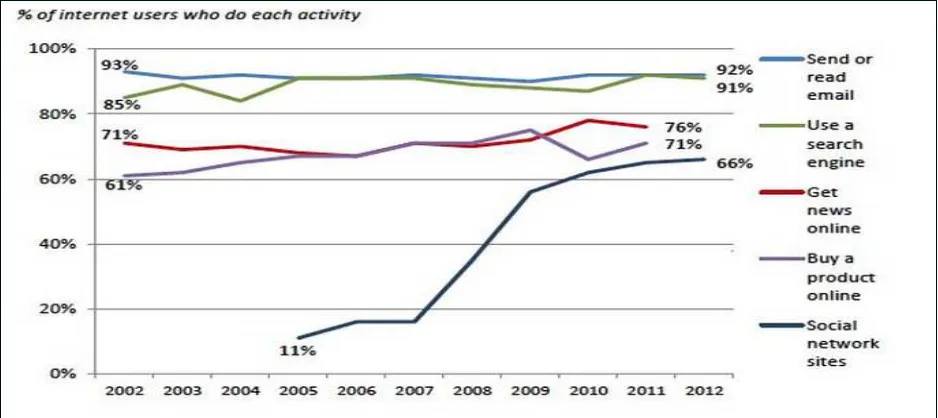
Statistics show a high level of use of selected online services. A recent survey determined that “in January 2002, 52% of all Americans used search engines. In February 2012 that figure grew to 73% of all Americans. On any given day in early 2012, more than half of adults using the Internet use a search engine (59%). That is double the 30% of internet users who were using search engines on a typical day in 2004. And people’s frequency of using search engines has jumped dramatically” [48]. This means that search engines will only become more prevalent in the lives of people looking for information online. Figure 1.1 below shows the online activity of users according to the survey. You can see that search engine use is high; 91% of the people said they use search engines every time they go online.
4
Search engine use is an important subcategory of online services. “Asked how often they use a search engine to find information online, just over half of all search engine users (54%) say they do this at least once a day, a significant increase over 2004” [48]. Figure 1.2 shows
[image:15.612.71.541.196.406.2]additional results of the survey; as you can see, more than half of the people said they used search engines at least once a day, or more.
Figure 1.2: % of adult search users who use search engines to find information.
Given the high percentage of people who depend on search engine services, detailed accurate knowledge of SEO techniques will become essential for anyone who depends on the Internet.
In this paper, natural search engine ranking factors and their effectiveness on the Google search engine algorithm will be analyzed. I will use my experience with the creation and
development of an actual website as a platform for the trial application of a set of selected SEO techniques. These SEO experiments will be evaluated by collection and analysis of real data from the website through the use of Google Analytics; furthermore, their effectiveness on the number of users who visit the site and search engine rankings will be analyzed.
5
earlier work by taking important factors (as determined from previous studies) and applies them to the development of a brand new site and analyzes the results.
To help the reader understand the overall process of SEO, this paper describes the entire website cycle, from initial inception, through development, and finally to the launch of the website. It goes through the entire SEO process focusing on the most important factors
mentioned on previous research (for an overview, see [3,8,9]). It further analyzes and examines the effectiveness of SEO by taking important factors from previous research and applying them to the new site.
Search engines have become the primary vehicle people use to look for information online. As a result, search engines and their ranking algorithms have generated “great interest to the information science community” [1]. What role should SEO play? With the growth of the Internet and the availability of billions of web pages, competition for the top few positions of the search results is fierce; it may also be impossible for all users to find what they’re looking for.
For this reason, search engines aim to display the most relevant pages for the user’s search query. Therefore, the goal of SEO engineers is to make sure those key pages get indexed and if possible to get the pages onto the first page of the search results. Most of the popular search engines display 10 results on the first page. Fewer and fewer people go past the first page when looking for something, so if a website is not in the top 10 results, it is effectively invisible.
1.3 Target Readers
This paper focuses on the application of selected SEO techniques and their effectiveness on Google’s PageRank search ranking algorithm. The results and analysis will be of interest to Computer Scientists because it provides an introduction to the science of information retrieval in Web search. With the increasing amount of information on the Web, this creates new challenges for people searching online and for web search engines striving to provide the most relevant search results.
6
1.4 Key Definitions
Here are some key definitions and basic preliminaries that will be important to understand the ideas presented in this paper:
• Search Engine Optimization (SEO): “SEO is the science of customizing elements of your website to achieve the best possible search engine ranking”[7] when a web user searches on a keyword.
• Google Search: Google is “a web search engine owned by Google Inc. Google Search is the most-used search engine on the World Wide Web” [49], which receives about 34,000 searches every second [50]. Its main purpose is to provide users with relevant web pages based on the search query used.
• Search Engine Results Page (SERP): the page that displays a list web pages
based on the user’s search query. “The results normally include a list of web pages with titles, a link to the page, and a short description showing where the keywords have matched content within the page. A SERP may refer to a single page of links returned, or to the set of all links returned for a search query” [51]. • Ranking: the position of the webpage within the search engine results page
(SERP).
• Organic search results: listings that are generated directly from the search engine’s ranking algorithm based on search query relevancy, which the search engine policy promises were attained free from commercial payments.
• Paid listings: also known as sponsored listings, these are advertisements that appear adjacent or above the organic search results. These are paid advertisings that are displayed whenever a searcher’s “keyword query matches an advertiser's keyword list” [52].
• PageRank: the proprietary search ranking algorithm used by Google Search “that assigns a numerical weighting to each element of a hyperlinked set of documents, such as the World Wide Web, with the purpose of ‘measuring’ its relative
7
• Alpiste: the subject of the experimental website being optimized in this paper. Alpiste, known in English as canaryseed is primarily used as bird food, but in recent years people have begun to consume it for its potential health benefits. • Pay-per-click (PPC): it’s an advertising model where search users are sent to the
advertiser’s page via paid listings. Each time a user clicks on any of the paid listings, the advertiser pays a certain amount for each click. An example of a PPC program is Google Adwords (explained next).
• Google Adwords: Google’s main online advertising platform. It is Google’s main source of revenue. Whoever wants to advertise on Google, can create their ads and choose the keywords that are related to their business. Whenever someone looking enters those keywords into the Google search engine, the ads may appear to the right side or the very top of the ‘organic search results.’
• Google Adsense: A free service for publishers, or website owners, which allows them to earn money by displaying Google ads on their site. Website owners have to ability to choose which ads to display and in what format to display them. For example, the owner of a site about gardening called www.gardeningtips.com can signup with Google Adsense, create ads to be displayed on the site, install the Javascript code in the web pages and in a short time the site will have Google ads being displayed. Whenever a user arrives to the site and clicks on any of the ads, the owner will receive a certain percentage of the cost Google charges the advertiser.
• Web crawler / bot: a program that is “mainly used to create a copy of all the visited pages for later processing by a search engine that will index the downloaded pages to provide fast searches” [54] for users searching for information online.
8
• Keyphrase / Keyword / Search query: these terms are used interchangeably; it is the word or set of words that a web user enters into the search engine text box for searching.
• Inbound links / Backlinks / External links: these terms are used
interchangeably; these are links from other sites that point (or link) to your website.
• Long-tail keywords: these search queries that contain three or more words; a very specific search for which there is less competition. For example, search queries such as “roses” and “red roses for mother's day”; the latter would be considered a long-tail keyword because it’s more specific. More on this subject will be covered in Section 4.3.1.
• Web-based Content Management System (CMS): it’s “a bundled or stand-alone application used to create, manage, store, and deploy content on Web pages” [14] such as video, text, images, etc… Examples of web-based CMS platforms are Drupal, Joomla and Wordpress.
1.5 Overview of the Rest of the Paper
This chapter has described the role played by search engines, the importance of SEO techniques, and has presented an overview of the research that was done. Here is an outline of the remaining chapters. Chapter 2 covers previous research done on the subject of SEO, a brief summary on the history of the Internet, the early beginning of Google and the importance of hyperlinks in its proprietary PageRank search ranking algorithm, and a brief summary on the early beginnings of SEO; its goals and key ideas such as white-hat SEO, black-hat SEO, on-page SEO and off-page SEO will be covered. Chapter 3 defines the questions and aims addressed by the research, research objectives, and data collection and analysis. Chapter 4 describes in detail the SEO approaches and methods implemented in this research: website topic research, website development, keyword research, data collection and implementation of SEO strategies. Chapter 5 presents the results of selected SEO experiments, and finally Chapter 6 provides some
9
Chapter 2 - Background
This Chapter covers previous research done on the topic of SEO, search engine fundamentals, and a brief overview of the history of the Internet. This will help give a much better understanding of the importance of SEO in the current state of the Internet and in information search. Moreover, an analysis of the importance of becoming relevant and maintaining visibility among a large number of websites will also be discussed.
This Chapter is structured as follows: Section 2.1 will cover related research in the SEO field. Section 2.2 describes important events that took place for the development and history of the Internet, early browsers, the dramatic growth of the Internet and rise of search engines. Section 2.3 provides a brief summary of the beginnings of Google, how it ranks pages using its proprietary PageRank algorithm and the importance of hyperlinks in the scheme of the Internet. Section 2.4 discusses the history of SEO and its goals, the different types of SEO
implementations (on-page SEO and off-page SEO), and the difference between white-hat SEO and black-hat SEO.
2.1 Related Work
This section analyzes the work of previous research done on the field of SEO. To get a better understanding of the critical role SEO plays in web search, a quick overview will be given on each of the studies, highlighting the importance of the research.
2.1.1 Study and Analysis of Key Influence Web Search Factors
The study in [3] used a reverse engineering approach to “study and analyze the key influence factors in the process of web search.” Using this methodology, the researchers
determined top five factors for SEO. The researchers developed a system that crawled all website factors (e.g. HTML structure, URL length, etc…) for 200,000 web pages using 10,000 search keywords as their sample set. Moreover, the keywords in the sample set were divided into the following three segments according to their Google search volume in the past three months:
1. Hot – high search volume
2. Middle – medium search volume
3. Cold – low search volume
10
keywords with different search volumes (i.e. low search volume, medium search volume and high search volume) required different SEO strategies; it may be case that more competitive keywords (the Hot segment), the ones with the highest search volume, required a different SEO approach than the less competitive keywords (the Cold segment).
Using an empirical approach to develop a series of analysis, their study determined top five factors for SEO that have the greatest influence in the natural or organic search for
increasing high search rankings. Based on their research, they obtained certain SEO rules and provided valuable guidelines for SEO engineers to help improve website rankings. Table 2.1 lists the top five factors from their research.
Table 2.1: Top 5 SEO factors in study [3].
As you can see from Table 2.1, the study showed URL length as the most important factor. Another important factor was the importance of placing the keyword within important web page elements: within the URL, heading tags, domain name and title tag. This means that the content of the web page must be relevant to the keyword.
11
In conclusion, this paper offers valuable insight and suggestions for SEO engineers to follow when optimizing websites; and if implemented correctly, high rankings for specific keywords can be achieved. Similar to my research and as will be seen in Section 4.5, the
following three SEO techniques were also implemented: keyword appearing in the site domain, keyword appearing in the H1 tag, and keyword in the HTML title tag.
2.1.2 An Empirical Study on the SEO Technique and Its Outcomes This study is based on use of the Chinese search engine Baidu; Google’s PageRank algorithm is not considered. Instead, the authors defined a metric (Page Interest) and consider whether certain SEO methods have any influence on it. Even though this study doesn’t apply to Google, I felt its relevancy was important to analyze similarities from selected SEO factors from different search engines.
Using data collected from 116 websites, the researchers sought to “analyze the impact of SEO techniques” and determine “which technique strategy was more effective” [2]. The
following metrics were selected to measure the effectiveness of their SEO methods. The researchers believed these metrics were positive indicators of the SEO implementation:
• Indexed pages: the number pages crawled by the search engine bot.
• Number of independent IP address (IP): the number of different IP addresses accessing the web site.
• Pageview (PV): a user request to load a single HTML file. • Reach: the percent of global Internet users who visit the site.
• Page view per user (PV/U): the average number of pages viewed by the total number of visitors to the web site.
Furthermore, the researchers also tested any correlation of SEO techniques on Page Interest, an
additional metric they derived, which will be explained next. Page Interest “indicates the interest users show on Page” [2]; this means that the higher
12
they were looking for; the keyword used for searching was found to be highly relevant to the content of the web page.
The authors defined a candidate metric, Page Interest, and then investigated the effect of several SEO techniques on this metric. Below is the formal definition of Page Interest (I):
• I = URL.pv x URL.time / URL.bounce
• URL.pv = the number of page views on average per day • URL.time = the time users spend on the website (in minutes) • URL.bounce = the bounce rate
From the above definition of Page Interest, one can see that if there is a high number of
Pageviews, an increase of time spent on the website and a low Bounce Rate, there will be a high Page Interest. As stated previously, a high Page Interest can be seen as positive interest the users show on the website; in other words, the website in question is highly relevant to the user’s search query.
Below were the six SEO techniques that the researchers implemented and analyzed in their research:
1. Overall Links – The total number of web pages linking to another website. This has been a huge determining factor on how search engines determine a site’s position in the search results.
2. Website Title Length – Most search engines use the title tag on the search results page. Search engines also use the title tag to determine the theme or what the web page is about. Therefore, optimizing the title tag is important.
3. Keyword Density – This is defined as the percentage of times the keyword appears on the web page compared to the total number of words on the web page. 4. Layer Number – This is “related to the logical structure of a website designed
according to the relationship between content relevance and link position” [2]. 5. Page Size – The researchers defined it as “the sum of the file sizes for all the
13
6. Customization of 404 Error Pages – An Error 404 “Page not found” is displayed whenever a visitor requests a web page that no longer exists. The final results of their study indicated that Page Size, Customization of 404 Error Pages and Overall Links are significant factors in the effectiveness of SEO. But as stated before, it’s important to note that this study was focused on Baidu, China’s most popular search engine. Although the research was performed on a different search engine, Overall Links seemed to coincide with Google’s ranking algorithm as an important factor (more detail on this will be covered in Section 2.3.2). Furthermore, Pageview and Bounce Rate metrics were also used in my study to measure the effectiveness of SEO on my experimental website (more on this will be covered in Chapter 5).
2.1.3 SEO Research Based on Six Sigma Management
The authors of this paper conducted research and empirical analysis to determine what factors had the most positive effect on SEO and proposed a method for its implementation. The goal of the study was to help SEO engineers identify the most influential factors for SEO and how to manage the execution of these strategies by using Six Sigma Management model.
14
Table 2.2: Top 5 SEO influence factors in study [55].
Based on their Six Sigma approach and their research, the researchers propose a “basic flow of the website search engine optimization (SEO)” [55] process using the following strategic steps:
1. Keyword selection and application – their tests suggests that keyword selection is the “most important factor which influences the search results ranking” [55]. This is similar to my SEO implementation in Section 4.3.
2. Building external links – According to their tests, they confirmed that “the number of external links, backward links and websites indexed have a positive correlation with the search results ranking” [55]. This idea is similar to Google’s proprietary PageRank algorithm which will be covered in Section 2.3.2.
15
The above suggestions for more effective SEO do correlate with my research. As stated in Section 2.1.2, although the research was done on Baidu and not on Google, it’s important to know the similarities between different search engines and the critical page elements that have the greatest influence on search engine rankings. This knowledge will help SEO engineers
understand the different algorithms and compare the most factors used in their ranking algorithm.
2.1.4 How to Improve Your Google Ranking: Myths and Reality This study focused on the Google’s ranking algorithm; the researchers sought to
systematically “validate assumptions others have made about this popular ranking algorithm” [8] and identify what page factors or other criteria, had the most influence in its ranking algorithm. They designed and developed a ranking system to determine the most important factors Google uses to rank pages.
Using a reverse engineering approach, the paper showed how their ranking system “can be used to reveal the relative importance of ranking factors in Google’s ranking function” [8]. Thus, the paper provides guidelines for SEO engineers on what factors are the most critical for optimizing web pages in order to achieve higher rankings.
Although it has been known that Google uses more than “200 factors” [57] in their search engine ranking algorithm, this study determined a subset of those factors. The researchers’ top 5 SEO factors are listed below:
1. PageRank – how authoritive is the site (as determined by Google’s algorithm) 2. Domain – the keyword appearing in the domain name
3. Title Tag – the keyword appearing in the title tag
4. Description Tag – the keyword appearing in the description tag 5. URL – the keyword appearing in the URL
PageRank was the dominant factor of what determines high page rankings (PageRank is discussed in more detail in Section 2.3.2). Most of the results of research paper [8] correlate with my findings and implementation of the SEO process. With the exception of PageRank, the SEO methods I used were focused on having the keyword within the domain name, title tag,
16
2.1.5 The Application of SEO for Internet Marketing: An Example of the Motel Websites This study conducted an experiment similar to mine in that they used selected SEO techniques and applied them on a website over the course of a year and then analyzed the effects of the SEO. What was different from my study was that the authors implemented their
techniques on an existing website; in my research, I developed a website (from the ground-up), applied selected SEO tactics and then measured the effectiveness of the SEO.
The authors used an existing website mymotel.com.tw as a case study to apply the SEO techniques and selected Janfusum as their target keyword to optimize the site. The motel is located in southern Taiwan and it’s in close proximity to the Jansufum World, a famous amusement park in Taiwan [9].
[image:27.612.74.537.385.616.2]Table 2.3 below shows the research variables and their definitions that were used as metrics to measure and analyze the effectiveness of the SEO. In my research, Number of Visits and Ranking variables were also tracked and analyzed; Pageviews is another metric that was measured in my study (Section 3.1 goes into more detail about the metrics used).
Table 2.3: Research variables and operational definitions of study [9].
17 1. Keyword was put in the HTML Title tag
2. Added the keyword to the ALT property of the image tags 3. Added keyword to the H1 header tags
4. Registered the website to the DMOZ open website catalog (DMOZ.org) 5. Directly submitted the website to the main search engines: Yahoo, Google and
Bing
6. Executed WEB PING to the main search engines. Pinging notifies the search engines that the website has been updated; this increases the chance that the search engines will find and index the pages much faster.
7. Created profiles in popular discussion boards (forums) and put keywords into the signature lines (e.g. Janfusum)
8. Created a sub-domain with the keyword in it, http://janfusum.mymotel.com.tw 9. Created an XML sitemap for the search engines. Sitemaps lists all the pages in the
website. Sitemaps tell search engines information about your site, how it’s structured and how often to index (or crawl) certain pages.
According to their research results, the experimental website (mymotel.com.tw) moved higher in Google’s search rankings results for the jansufum keyword; the bandwidth also
increased after applying SEO. The ranking for mymotel.com.tw went from the No. 14 position to No. 2 positionfor their target keyword, and the bandwidth increased as a result of an increase of users who visited to the site.
This study in effect shows the importance of SEO as a way to increase website rankings and traffic. The only back-linking strategy discussed in the study was the creation of profiles in forums and back-linking from the signature. While this may help in the rankings, there are more effective back-linking strategies that can be used and they will be illustrated in Chapter 4.
2.1.6 Summary
18
factors are that determine website rankings. As a result, SEO engineers have relied on their experience, or any research performed in this field, to determine the factors for a more effective SEO implementation.
Two of the five papers ([2,55]) discussed the Baidu search engine and sought to identify what factors were important in its ranking algorithm. Although the results were not collected from Google, it’s important to analyze any similarities from certain SEO factors between different search engines. In this case, hyperlinks were seen as a critical factor in both search engines for determining high website rankings.
More on the importance of links will be discussed in Section 2.3, but in order to get a better understanding of hyperlinks and the importance search engines play in the current state of the World Wide Web, we need to discuss the history of the Internet and its beginnings.
2.2 History of the Internet
In this Section, a brief summary of history of the Internet and important events that laid the foundation to the development of the World Wide Web will be covered. The discussion is arranged as follows: a brief summary to the beginnings of the Internet, a timeline of key events, creation of the first top-level domains, early browsers, and explosive growth of the Internet and the rise of the search engines.
2.2.1 The Beginning
The history of the Internet begins during the 1950s and 1960s with the development of computers. It came about as a result of early visionaries who saw a great value sharing scientific and military research information via computers.
With the launch of the Sputnik by the USSR in 1957, the United States established the Advanced Research Projects Agency (ARPA) with the goal of becoming a leader in science and developing new technologies. In 1962, Dr. J.C.R. Licklider was chosen to lead ARPA’s research efforts and was a key figure in laying the foundation for ARPANET, which would eventually become the Internet.
19
Figure 2.1: ARPANET: Four-node network in 1969 [30].
The Internet was designed to be a communications network among a network of computers and to be fault-tolerant against a possible nuclear attack. The idea was that it would continue sharing information even if some nodes were destroyed; routers would be able to transmit data through the network via different routes.
2.2.1 Internet History Timeline
Below is a list of key events in the history of the Internet taken from [29]:
• 1957 – After the successful launch of the Sputnik by the USSR, the USA saw the need to create Advanced Research Projects Agency (ARPA ) “with the mission of becoming the leading force in science and new technologies.”
• 1962 – J.C.R. Licklider of MIT proposes the concept of a “Galactic Network,” then later elected to head ARPA's research efforts.
• 1962 - Paul Baran, a member of the RAND Corporation, determines a way for the Air Force to control bombers and missiles in case of a nuclear event. His results call for a decentralized network comprised of packet switches.
• 1968 - ARPA contracts out work to BBN. BBN is called upon to build the first switch.
20
the University of California at Santa Barbara, one at Stanford and one at the University of California at Los Angeles.
• 1972 - Ray Tomlinson working for BBN creates the first program devoted to email.
• 1972 - ARPA officially changes its name to DARPA Defense Advanced Research Projects Agency.
• 1972 - Network Control Protocol is introduced to allow computers running on the same network to communicate with each other.
• 1973 - Vinton Cerf working from Stanford and Bob Kahn from DARPA begin work developing TCP/IP to allow computers on different networks to
communicate with each other.
• 1974 - Kahn and Cerf refer to the system as the Internet for the first time. • 1976 - Ethernet is developed by Dr. Robert M. Metcalfe.
• 1976 – SATNET, a satellite program is developed to link the United States and Europe. Satellites are owned by a consortium of nations, therby expanding the reach of the Internet beyond the USA.
• 1979 - USENET, the first news group network is developed by Tom Truscott, Jim Ellis and Steve Bellovin.
• 1981 - The National Science Foundation releases CSNET 56 to allow computers to network without being connected to the government networks.
• 1983 - Internet Activities Board released.
• 1983 - TCP/IP becomes the standard for internet protocol.
• 1983 - Domain Name System introduced to allow domain names to automatically be assigned an IP number.
• 1984 - MCI creates T1 lines to allow for faster transportation of information over the internet.
• 1984- The number of Hosts breaks 1,000 • 1987- The number of hosts breaks 10,000
21 • 1989- Arpanet ceases to exist
• 1990 - Advanced Network & Services (ANS) forms to research new ways to make internet speeds even faster. The group develops the T3 line and installs in on a number of networks.
• 1990 - A hypertext system is created and implemented by Tim Berners-Lee while working for CERN.
• 1990- The first search engine is created by Mcgill Univeristy, called the Archie Search Engine
• 1991- U.S greenlight for commerical enterprise to take place on the Internet • 1991 - The National Science Foundation (NSF) creates the National Research and
Education Network (NREN).
• 1991 - CERN releases the World Wide Web publicly on August 6th, 1991 • 1992- Number of hosts breaks 1,000,000
• 1993 - InterNIC released to provide general services, a database and internet directory.
• 1993- The first web browser, Mosaic (created by NCSA), is released. Mosaic later becomes the Netscape browser which was the most popular browser in the mid 1990's.
• 1994 - First internet ordering system created by Pizza Hut.
• 1994 - Comet Shoemaker Levy photos distributed by NASA on the Internet • 1994 - First internet bank opened: First Virtual.
• 1995 - NSF contracts out their access to four internet providers. • 1995 - NSF sells domains for a $50 annual fee.
• 1995- Registration of domains is no longer free.
• 1996 - Internet Service Providers begin appearing such as Sprint and MCI. • 1996 - Nokia releases first cell phone with internet access.
• 1998- Netscape releases source code for Navigator.
22
• 1999 - A wireless technology called 802.11b, more commonly referred to as Wi-Fi, is standardized.
2.2.2 The First Top-level Domains
In 1985, the first top-level domains introduced were gov, mil, edu, org, net, and
com; this introduction occurred when the Domain Name System (DNS) was first
implemented. Before the DNS was established, the way to access documents in the Internet was by typing the hostname or the IP address; this was somewhat difficult to do and for people to remember. When the DNS system was introduced, it made it easier for people to remember domain names and easier to access documents by translating “human-friendly” names into IP addresses. For example, the domain name example.com translates to the IP address 192.0.43.10 [58].
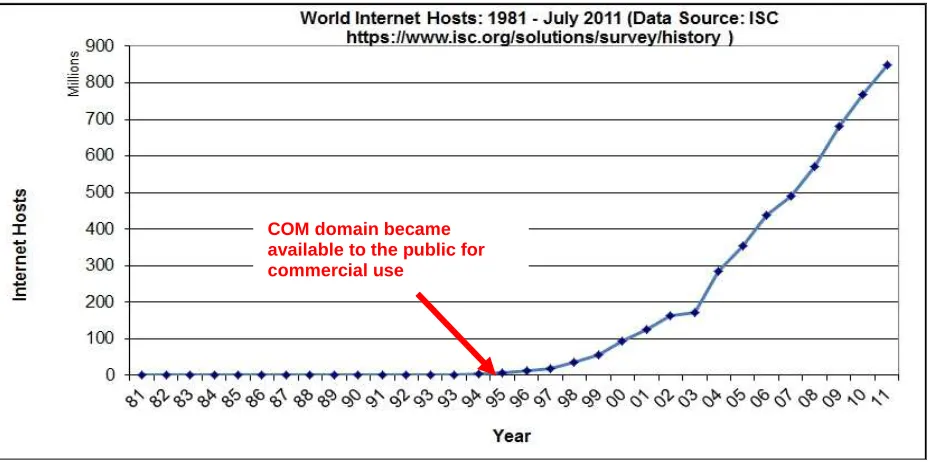
[image:33.612.78.542.459.690.2]Although the com domain was first established in 1985, it was not until 1995 that it became available to the public for commercial use. “With commercialization and popularization of the Internet, the com domain was opened to the public and quickly became the most common top-level domain for websites, email, and networking.” As seen from Figure 2.2, the Internet begun to experience its tremendous growth in 1995. This was due to its popularity and commercialization.
Figure 2.2: Growth in the number of Internet hosts worldwide. COM domain became
23
2.2.3 Early Browsers
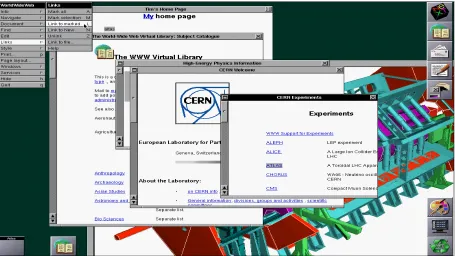
[image:34.612.74.529.269.525.2]In 1990, Tim Berners-Lee created the first Web browser (and Web editor) originally called the WorldWideWeb and later renamed to Nexus in order to avoid “confusion between the program and the abstract information space (which is now spelled World Wide Web with spaces)” [31]; it was written in Objective-C using the NeXT computer. And at the time, this was the only way to browse the web. You can see a screenshot of the first browser in Figure 2.3 below.
Figure 2.3: Screenshot of the first web browser called WorldWideWeb launched in 1990.
24
A year later, Andreesen “started his own company, named Netscape, and released the Mosaic-influenced Netscape Navigator in 1994, which quickly became the world's most popular browser, accounting for 90% of all web use at its peak” [34]. Then in 1995, Microsoft got involved in the web browser business and released Internet Explorer which was “heavily influenced by Mosaic, initiating the industry's first browser war. Bundled with Windows, Internet Explorer gained dominance in the web browser market” [34].
2.2.4 Explosive Growth of the Internet
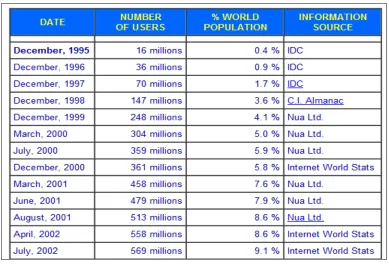
[image:35.612.112.501.329.596.2]As explained before, during the mid-nineties the Web started experiencing a tremendous growth in both, number of users and number of websites. You can see in Figure 2.4 the growth of the Internet in its early years; by 1997 there were about 70 million users on the Internet and by 1998 this number had doubled.
Figure 2.4: Growth of Internet users worldwide.
25
Figure 2.4: Number of Internet users the United States vs the World [36].
2.2.5 Early Rise of Search Engines
With the continued exponential growth of the Internet, it became apparent the need for classification of the content of the Internet. As result, search engines and Web directories started to appear in the early 1990s to organize pages and to make it easy for people to find information online.
In 1994, WebCrawler became the first widely popular “full text crawler based search engine” [37] which allowed users to search for words within the HTML page. This led to what “has become the standard for all major search engines” [37], to let users find information via search queries. Prior to WebCrawler, earlier search engines relied on the page titles and page headings.
Lycos, which was created in 1994 by Michael Loren from Carnegie Mellon University, began as a research project and then in 1995 became commercial. It was a search engine and a web portal that provided email, news, entertainment in addition to web search [38].
Soon after, other search engines started to appear and gain popularity among web surfers to find information scattered all over the web, some of these earlier search engines “included Magellan, Excite, Infoseek, Inktomi, Northern Light, and AltaVista. Yahoo! was among the most popular ways for people to find web pages of interest” [37].
It was during this time that Web directories and Web portals were becoming very popular. For example, Yahoo!’s “search function operated on its web directory, rather than
26
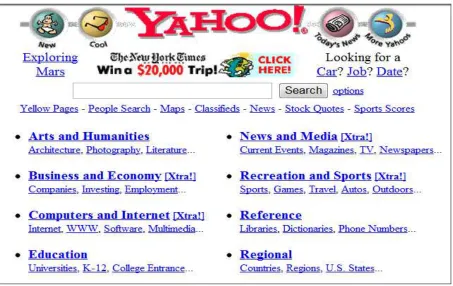
[image:37.612.78.531.213.499.2]text copies of web pages” [37]. Users had the ability to browse the directory in the Web portal instead of doing a keyword-based search. This became widely popular and web portals became the starting point of the user’s web browser experience. Since many web portals provided additional services such as email, news and entertainment in addition to search, people found themselves spending a lot of time in there. Figure 2.6 shows a screenshot of Yahoo! directory circa 1997.
Figure 2.6: Yahoo! directory circa 1997.
27
2.2.6 Summary
As you have seen, the early development of computers during the 1950s and 1960s laid the foundation for the US-Government backed ARPANET agency, which would become the Internet. Key events such as the invention of the TCP/IP in 1983 made it easy for hosts to connect and communicate, making it the standard Internet protocol for communication. In the same year, the Domain Name System (DNS) was introduced which automatically assigned IP numbers to “human-friendly” domain names.
Then in 1990, with the introduction of the hypertext system by Tim Berners-Lee, interlinked documents could be easily accessible via the Internet. But it was the introduction of Mosaic web browser three years later that helped fuel tremendous World Wide Web usage; it was one of the first browsers to provide graphical support and made it easy for regular people to navigate the interlinked hypertext documents on the Internet.
During the 1990s, the Internet experienced a huge increase in the number of users and number of websites; ISPs brought the Internet to every home. As a result of this, early search engines and web directory portals started to appear; search engines became popular because they made it easier for people to find information and web portals (e.g. early Yahoo!) became the starting point into the web browsing experience for most users.
By the late 1998, the number of Internet users had reached about 147 million users and the number of websites had increased dramatically. Furthermore, new approaches to web search became available; this paved the way to relevancy ranking of web pages. But it was the launch of Google in 1998 (and the introduction of its proprietary PageRank algorithm) that would have the greatest impact on web search.
2.3 Birth of Google
28
2.3.1 How It All Started
Google was started by Larry Page and Sergey Brin while they were both students at Stanford University. The idea for Google came about as part of a doctoral research project that they began in 1996. Then in 1998 Google was incorporated.
The ranking algorithm behind Google was what differentiate it from other search engines and it was the key to its early success. Based on their experience while conducting their
“academic research,” they hypothesized.
The following statement, taken from [59] explains it best:
“Based on Larry and Sergey’s experience with the process of academic research, they believed that Web page authority and relevance could be derived algorithmically by indexing the entire Web, and then analyzing who links to whom. This idea came from the fact that in academia authority is derived when researchers advance their own research by citing one another as part of the research process. Indeed, each piece of published scholarly work (including Larry and Sergey’s dissertation) has a works-cited page at the end of each finished piece of written research, which includes a list of resources that were cited as relevant to the work being advanced.”
“Larry and Sergey took the process of citing in academic research, and
hypothesized that Web pages with the most links to them from other highly relevant Web pages must be the most relevant pages associated with a particular search.”
“To further bolster the concept, Larry and Sergey created PageRank (named after Larry Page), which not only counts how many links point to any given page, but also determines the quality of those links.”
“Although the Google algorithm is more complex than just analyzing who links to whom, the process of algorithmically analyzing links was a great idea that has separated Google from its competition.”
29
2.3.2 How Google Ranks Pages
As discussed earlier, search engines use their own proprietary algorithm to rank web pages to be displayed in the search results page. Search engine companies will never reveal the exact mathematical formula or algorithm that powers their search engine because it is one of their most guarded secrets. This is what Google has said about their ranking algorithm:
“Traditional search engines rely heavily on how often a word appears on a Web page. Google uses PageRank to examine the entire link structure of the Web and
determine which pages are most important. It then conducts hypertext-matching analysis to determine which pages are relevant to the specific search being conducted. By
combining overall importance and query-specific relevance, Google is able to put the most relevant and reliable results first.”
As you can see from the previous quote, Google does not place great emphasis on how many times the keyword being searched appears on the web page, just like other traditional search engines, instead it uses its proprietary ranking algorithm PageRank to examine the link structure of the page to determine the relevancy and importance of web pages. The next section will cover PageRank in more detail.
2.3.3 Google PageRank Explained
In a research paper published in 1998, Larry Page and Sergey Brin write about how their ranking algorithm takes “advantage of the link structure of the Web to produce a global
‘importance’ ranking of every web page. This ranking, called PageRank, helps search engines and users quickly make sense of the vast heterogeneity of the World Wide Web” [23]. PageRank defines the weight, or level of importance, of a given web page or set of pages. It’s similar to a voting system, but within Google search, it’s based on a large scale voting system where web sites vote for one another.
30
www.msn.com will contain thousands of links (or citations) pointing to it from other sites. From this, one can conclude that www.msn.com is important because it contains thousands of
backlinks, or votes, from other sites.
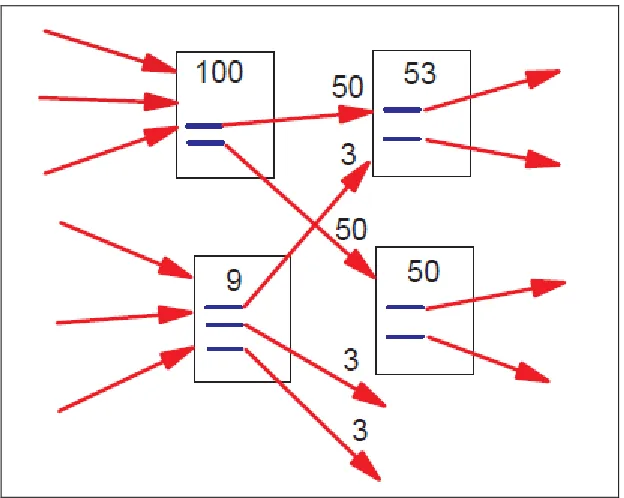
[image:41.612.151.463.297.546.2]Here’s a brief description of PageRank: “a page has high rank if the sum of the ranks of its backlinks is high. This covers both the case when a page has many backlinks and when a page has a few highly ranked backlinks” [23]. Trying to explain the exact definition of PageRank and how it works is beyond the scope of this paper, but a simplified PageRank explanation of how it’s calculated and it’s transferred can be seen in Figure 2.7 as taken from [23]. Keep in mind that PageRank assigns a weight value between 0 and 10; the large numbers in Figure 2.7 are used for demonstration only.
Figure 2.7: How PageRank gets transferred.
In this simplified version, note how the PageRank of a page is divided among its
outgoing links evenly “to contribute to the ranks of the pages they point to.” Furthermore, notice the transfer of rank from one page to another, which is determined by the total number of
31
We can see the importance of links and how a critical role they play in Google’s ranking algorithm. Links are important factors in how Google’s search engine algorithm determines relevancy and importance from pages that are displayed in the first page. Therefore, links are still one of the most important factors used in its ranking algorithm. As the web evolves, new ranking factors will continue to be introduced, but links and how they are configured will also continue to play a critical role in the Google search engine.
2.3.4 Links: The Currency of the Internet
As discussed, links pointing from one page to another can be considered as a “vote”, so a page receiving the most links will always rank higher. In theory, this is the case, but it’s not as simple as this because not all links have the same weight or value; some links have more weight (more PageRank) than others. For example, if a website with PageRank 6 places a link to your site, this single link has more value than if your page were to receive hundreds of links from sites with PageRank 1. In other words, what you’re looking for is not just thousands of votes, but votes from high authority websites with a high PageRank because getting links from high PageRank sites can be the determining factor of whether your site achieves top rankings in the search results or not.
Getting thousands of links pointing to your web site doesn’t automatically guarantee that your site will rank higher and achieve top placements in the search results. As you will see later in Chapter 4, in order to influence search rankings into your favor by getting higher positions in the search results, links that point to your site need to be from relevant and authority web sites; this means that they must be related to what your site is about and should have a high PageRank.
32
Figure 2.8: Visual representation of backlinks.
As Google performs its hypertext-matching analysis, it also analyzes the content of the pages within the website to determine their relevancy and make sure that all pages are all related. This analysis is performed to detect fraudulent links or any “black-hat” methods, optimization techniques that attempt game the search engine in order to gain top rankings. As will be discussed in the next section, these techniques are not approved and are condoned by all major search engines.
2.3.5 Link Importance: A Case Study
In early 2011, The New York Times published an article involving major retailer J.C. Penny (JCP) which was accused of using black-hat SEO methods in order to maintain top rankings for competitive keywords. The article talks about how JCP outranked millions of other sites for popular searches such as “dresses, bedding and area rugs. For months, it was
consistently at or near the top in searches for ‘skinny jeans,’ ‘home decor,’ ‘comforter sets,’ ‘furniture’ and dozens of other words and phrases” [39], it even says that JCP’s website appeared on top of manufactures’ sites “in searches for the products of those manufacturers” [39]. For example, whenever users typed samsonite carry on luggage on Google, JCP would appear at the top of the search results, ahead of samsonite.com.
33
most of the 2,015 links pointing to the JCP site were from totally unrelated pages. The article states that “the phrase ‘black dresses’ and a JCP link were tacked to the bottom of a site called nuclear.engineeringaddict.com. ‘Evening dresses’ appeared on a site called casino-focus.com. ‘Cocktail dresses’ showed up on bulgariapropertyportal.com. ‘Casual dresses’ was on a site called elistofbanks.com. ‘Semi-formal dresses’ was pasted, rather incongruously, on
usclettermen.org” [39].
Figure 2.9 shows the HTML source code of how these links might have been
implemented along with the keywords. The target web site is the destination site (or page) that’s receiving the backlink, and the keyword is the anchor text that’s visible to the users. Having thousands of backlinks in this format (with a keyword as the anchor text), JCP was able to position its website in the top search listings, besting millions of other sites for popular and competitive keywords.
Figure 2.9: Backlink with keyword as anchor text.
The article further states that even though links to your site may come from unrelated pages, these backlinks “can bolster your profile if your site is barnacled with enough of them. And here’s where the strategy that aided JCP comes in. Someone paid to have thousands of links placed on hundreds of sites scattered around the Web, all of which lead directly to
JCPenney.com” [39]. JCP denied any involvement in this, saying that it was against their search policies and would work on taking all those links down.
When The NY Times sent Google the evidence it had collected about the JCP “link scheme,” Matt Cutts (the head of the Search Quality Group in Google), stated that the links pointing to JCP did violate their search guidelines and that they would “take strong corrective action” [39]. And they did, because according to the article, a few days later JCP went from being at No. 1 for “samsonite carry on luggage” to No. 71 in the search results. Also, from being at No. 1 for “living room furniture” it had dropped to No. 68.
34
2.3.6 Summary
What started as a doctoral research project for Larry Page and Sergey Brin while they were both students at Stanford University in 1996, paved the way to the creation of the Google search engine which was founded in 1998. Its introduction and the implementation of the PageRank algorithm for displaying the most relevant pages in the search engine results page (SERP) would have the greatest impact on web search.
As was discussed, Google does not place great emphasis on how many times the keyword being searched appears on the web page to determine its ranking on the search results. Instead, it uses its PageRank algorithm to examine the link structure of the page to determine its relevancy and importance, which is the determinant factor of where it ranks within the search results.
In addition, the important takeaway from the JCP “link scheme” incident is that links are critical and will continue to play an important factor in how Google determines relevancy and importance of web sites. Search engines will continue to update and refine their algorithms in order to provide the most relevant results to its users, free from any deliberate manipulations to game the search engine and influence top rankings
Furthermore, as the Internet keeps expanding, search engines will continue to grow in importance because they are the main starting point of most users looking for information online. And in order to continue meeting user’s search needs, search engines will continue updating their search algorithm for displaying the most relevant and unbiased results. So much that a whole new industry has emerged: search engine optimization (SEO) with the goal of influencing the ranking algorithm to help websites improve their rankings for selected keywords being searched for.
2.4 Search Engine Optimization (SEO)
SEO methods are not meant to deceive or manipulate the search engines in an unethical way; they are implemented to help improve the visibility and relevancy of a website in the organic search results by helping them achieve high rankings. SEO can be thought of as a collection of techniques for the strategic editing of the webpage; this process exposes the most relevant page factors to search engines and helps increase its importance in the search engine results page.
35
ranking algorithms constantly being update and enhanced; so it’s the job of the SEO engineer to keep up-to-date and stay current.
As discussed in section 2.1.4, Google has stated that its ranking algorithm takes into account more than 200 factors when determining website rankings. It is therefore important for SEO engineers to know what the most important factors in order to undertake a successful SEO implementation.
Although Google will not fully disclose all the factors that are taken into consideration, it does however provide guidelines for SEO engineers or webmasters to follow for improving the overall rankings of websites. The SEO strategies used in my research and their implementation are covered in Chapter 4.
This section is structured as follows: Section 2.4.1 covers the early beginnings of SEO. Section 2.4.2 discusses the importance of SEO and its goals on website rankings. Section 2.4.3 explains on-page SEO. Section 2.4.4 explains off-page SEO. Section 2.4.5 discusses white-hat SEO. Finally, Section 2.4.6 explains black-hat SEO.
2.4.1 SEO Early Beginnings
As was discussed in Section 2.2.5, the early 1990s marked the debut of the earliest search engines; some of the popular ones were Infoseek, Alta Vista and Yahoo!, which was more of a directory than what most people think of a search engine. “Like Yellow Page influencers, early SEOs took advantage of alphabetical order to get to the top of rankings. This included listed pages with names like ‘AAA,’ ‘1ForU,’ and similar titles. In addition to this rudimentary tactic, early SEOs took advantage of chronological order by submitting websites at certain times (midnight), thus attaining the first result for the given query” [40]. Early SEOs devised and implemented tricky tactics in order to gain more visibility and appear on top of competing pages.
36
SEO engineers evolved as well by finding creative ways to influence search rankings, either by using unethical (black-hat SEO) or ethical (white-hat SEO) tactics.
In an article published by The New York Times that dates back to November 1996, it talks about how web developers went “to great lengths to try to get their Web site to appear at the top of the list that is displayed after a user submits a search query” [41] using a black-hat SEO technique called keyword stuffing. The article describes how web developers simply loaded “a site with certain keywords often hidden behind graphics or in black type on a black
background,” so that ''a search engine that simply counts the number of times a certain keyword appears in a single site will display such sites higher in the relevancy ranking” [41]. It’s
interesting to see how these tactics were taking place in 1996, just as the Internet was experiencing its tremendous growth (as seen in Section 2.2.4), and two years before Google launched.
As you see, gaining high rankings for certain keywords was a much simpler task in the early days than it is today. Implementing tactics such as keyword stuffing on the web page would almost certain guaranteed top page placements of the page. Nowadays the algorithms of the search engines have become more complex and thus making it more difficult for SEO engineers to manipulate the search algorithms as before, but the “cat and mouse game between SEOs and search engines continues” [41] to this day, and it will continue to be the case.
2.4.2 SEO Goals
The goal of SEO is to help websites or web pages achieve top placement in the organic search results by increasing the relevancy of a website or web page to the search query that users type on the search engine. Displaying the most relevant pages for the search query has many benefits to both the user and the search engine providing the results: the user finds the most relevant results for the keyword used, and the search engine is perceived as reliable and trustworthy because its algorithm displays the most relevant pages.
Since SEO is concerned with improving a site’s rankings on the organic or natural search results, the process requires time and knowledge of tactics to implement. Time is a huge initial investment to be made to the website or page being optimized, and an ongoing maintenance to maintain the site’s top rankings.
37
the results of the SEO may not be seen immediate, the long-term benefits of SEO can mean top rankings and a high volume of user visiting the site. According to [43], “it’s critical for websites to appear on Page 1 of Google, especially in one of the top three organic positions, as these spots receive 58.4 percent of all clicks from users.” In Figure 2.10, you can see the results of the recent study; it’s interesting to note how being in the No. 1 position in Google is the equivalent to receiving all the traffic that goes from the second all the way through the fifth position.
Figure 2.10: % of clicks received by the top 10 search results.
It is no wonder that websites with products or services to sell are all vying to reach to the coveted No. 1 spot. As an example, when a highly competitive keyword such as “auto insurance” that gets 1.5 million Google searches every month, means that the top three positions receive 876,000 (or 58.4%) of all the visitors, with 546,000 (or 36.4%) of the visitors going to the No. 1 position according to [43]. This can be extremely lucrative for sites appearing at the top of the results, especially when they have this constant flow of visitors going to their site every month, many of which become clients.
Another study determined that searchers are most likely to click on organic links as opposed to paid listings; it determined that “72.3% of Google users clicked on links generated through searching compared to 27.3%, who clicked on paid listings” [8]. This is another reason why companies that know the effectiveness of SEO spend time and money implementing
38
[image:49.612.73.543.134.460.2]strategies so that their site achieves top rankings. Figure 2.11 shows the different areas between organic results and paid listings.
Figure 2.11: Organic results versus paid listings locations.
The previous studies show that if websites want to maintain visibility and a continuous flow of visitors, they need to start paying attention on ways to achieve top rankings through effective SEO execution. But before undertaking any SEO process and start implementing specific search engine optimization methods, it’s important to distinguish between on-page SEO and off-page SEO methods. The next sections explain both implementations, along with their main differences and a brief summary of the techniques within each method. Then on Section 4.5 and Section 4.6, I introduce in detail the steps required for effective SEO implementation that were performed on the experimental site.
Organic search results Paid listings
39
2.4.3 On-page SEO
On-page SEO deals with anything you have direct control of, in the code or content of your web site (e.g. text, headings, images, links, etc…); basically anything that you implement or upload to your site is considered on-page SEO. On-page SEO lays the foundation of all your SEO efforts because this is where you have most of the control; and as you will see in Chapter 4, any updates implemented on your site can either work for you or against you on the search results. Therefore it’s important to get on-page correct before launching into off-page SEO.
As discussed in Section 2.4, Google uses over 200 factors to determine page relevancy and importance for deciding what pages will be displayed in the top search results; you will see that many of these factors are in direct control of the SEO engineer. The following list shows important factors that will be the focus of the on-page SEO strategies implemented in Chapter 4 for this study:
• Keyword research • Title tag
• Description meta tag • Robots.txt
• Optimized URLs • Content
• HTML headings • Images
• Correct use of the “rel=nofollow” attribute • Keyword placement
• Sitemap
In Section 4.5 I will go into more detail into the importance of the previous list of factors and their on-page SEO implementation. In the next section, off-page SEO will be explained.
2.4.4 Off-page SEO

![Table 2.2: Top 5 SEO influence factors in study [55].](https://thumb-us.123doks.com/thumbv2/123dok_us/905676.603112/25.612.223.428.68.283/table-top-seo-influence-factors-in-study.webp)
![Table 2.3: Research variables and operational definitions of study [9].](https://thumb-us.123doks.com/thumbv2/123dok_us/905676.603112/27.612.74.537.385.616/table-research-variables-operational-definitions-study.webp)
![Figure 2.4: Number of Internet users the United States vs the World [36].](https://thumb-us.123doks.com/thumbv2/123dok_us/905676.603112/36.612.73.540.71.293/figure-number-internet-users-united-states-vs-world.webp)