_____________________________________________________________________________________________________
*Corresponding author: E-mail: [email protected];
Optimization of Foam-Mat Drying Process of
Watermelon Pulp Using Response Surface
Methodology
J. Isa
1*and A. P. Olalusi
11Department of Agricultural Engineering, Federal University of Technology, Akure, Nigeria.
Authors’ contributions
This work was carried out in collaboration by both authors. Author JI designed the study, performed
the statistical analysis, wrote the protocol and wrote the first draft of the manuscript. Author APO managed the analyses of the study and the literature searches. Both authors read and approved the final manuscript.
Article Information
DOI: 10.9734/JENRR/2019/v3i130087
Editor(s):
(1)Dr. Ewa Kowalska, Associate Professor, Plasmonic Photocatalysis in Institute for Catalysis, Hokkaido University, Japan.
Reviewers:
(1) Azza Anwar Abou-Arab, Egypt. (2)Patpen Penjumras, Maejo University Phrae Campus, Thailand. Complete Peer review History:http://www.sdiarticle3.com/review-history/48958
Received 03 March 2019 Accepted 16 May 2019 Published 27 May 2019
ABSTRACT
Introduction: Foam mat drying involves the change of agricultural material from a high moisture content level to a stable foam which is achieved by moisture reduction mechanism.
Aim: In this study, foam-mat drying process of watermelon was optimized using response surface
methodology. Foaming conditions (carboxyl methyl cellulose and egg albumen) and the drying system parameters (air velocity and air temperature) were optimized using response surface methodology.
Methodology: To evaluate the drying behaviour, the drying experiment was designed using design expert software using a central composite design setting variable of drying temperature (60°C – 80°C), air velocity (0.5 m/s – 2 m/s), carboxyl methyl cellulose (0.5% - 2.5%), egg albumen (5% - 15%). Twenty-two runs of the experiment were performed using different levels of variables combinations. Based on the statistical tests performed, the best model that described each response was selected using a polynomial analysis.
Results: The optimum values for the drying conditions were: 77.42OC, 0.5m/s, 0.5% and 5% for temperature, air velocity, carboxyl methylcellulose and egg albumen respectively and the optimum
values for the drying characteristics were: 25.07 KJ/mol, 1.7345E-10 m2/s, 29.019% (wet-basis).
0.742 g/cm3 and 540 minutes (approximately 9hrs) for activation energy, effective diffusivity,
moisture content, foam density and the drying time respectively.
Conclusion: The study of the foam-mat drying of watermelon pulp revealed that the inlet temperature, air velocity, CMC and egg albumen has a significant effect on its drying characteristics.
Keywords: Watermelon pulp; foam-mat drying; optimization; response surface methodology; activation energy.
1. INTRODUCTION
Foam mat drying involves the transformation of biological material from a liquid to a stable foam which is accomplished by air drying [1]. Azizpour et al. [2] reported that foam mat drying dates back to 1917. Foam mat drying which is an example of a novel drying technique [3] has received attention by its characterization through faster drying, and drying of material that contain high moisture content [2]. Foam mat drying can be used in the removal of moisture in juice, milk, fruits, beverages, jams [4]. Application of foam mat drying can be extended to the large-scale production of fruit powders.
Watermelon (Citrullus lanatus) belongs to the
family Cucurbitaceae and in the same family with cucumber and pumpkin. There are more than 100 varieties of watermelon ranging in weight from less than 1.4 kg to more than 32 kg and may be round or oblong in shape. It has smooth skin and may vary in color from light green to dark green [5]. Watermelon contains 91% water and 7% of carbohydrates. It is rich in lycopene a very powerful antioxidant, and also in citrulline [6]. [7] made a report that watermelon is a valued source of natural antioxidants with special reference to lycopene, ascorbic acid, and citrulline and these functional ingredients act as protection against chronic health problems like cancer insurgence and cardiovascular disorders. Many research works agreed with that fact that
watermelon contains two health benefit
component that cannot be ignored. Fruits have been said to be a major source of concentrated natural components that help in maintaining human health; Lycopene, a red pigment of the carotenoid class found in only a few fruits and vegetables, is a powerful oxygen radical scavenger and highly effective antioxidant. A high dietary intake of tomatoes, rich in lycopene content, is associated with a lower risk of certain cancers, primarily of the prostate [8].
Citrulline is described by [8] as a non-essential amino acid, its medication through oral method to
children and adolescents with sickle cell disease resulted in improvement in symptoms and raised plasma arginine levels. It was concluded that watermelon rind is a rich source of amino acid and also might produce a good product from agricultural waste.
Drying is a heat treatment method of food processing technology (Jayas and Singh, 2011). The method most time reduces water activities in the material. Drying is applied to lower the
moisture content of fruit to a level that can prevent the growth of mold and fungi and
thus minimize microbial degradation [2]. In drying, two processes occur simultaneously which involve the transfer of heat and removal of
a water molecule [1]. Recent techniques of drying include; vacuum drying, freeze drying,
supercritical CO2 drying, centrifugal drying/ dewatering, ultrasonic drying, heat pump drying, superheated steam drying, spray drying, hybrid drying/combination drying [9]. Another method of drying which is most economical than any other drying technique is foam mat drying [1].
This research work is focused on optimization of the drying characteristics of foam dried
watermelon as a function of drying system parameters (temperature and air velocity) and structural parameters (foaming and stabilizing agent). Response surface methodology (RSM); a
collection of mathematical and statistical
technique that are useful for modeling and analysis of problems in which the response is influenced by several variables. The most extensive applications of RSM are in the particular situations where several input variables potentially influence some performance measure or quality characteristic of the process [10].
2. MATERIALS AND METHODS
The experiment to accomplish the desired
objectives was performed in the Department of Agricultural and Environmental Engineering of
2.1 Selection and Sample Preparation
The watermelon fruit used for this study were purchased in local retail store around the south gate of the Federal University of Technology, Akure. The fruits were wash and store until use. The watermelon rind was removed, sliced into cubes and the seeds were removed. The fruits were blended into juice using Binatone blending machine.
2.1.1 Foam treatment
The foamed watermelon concentrate was prepared by giving foaming treatment to the prepared concentrated juice by adding different levels of foaming agents, foaming stabilizer. The foaming agent and foaming stabilizer was added to watermelon concentrate at room temperature. The formation of foam was formed by whipping with a mixer. The foaming agent: Egg albumen (5-15%), foaming stabilizer: carboxyl methyl-cellulose (0.5-2.5%) and whipping time: 3-15 minutes. The foamed watermelon concentrates were prepared by varying the levels of foaming agent and the foaming stabilizer.
2.2 Experimental Design for Optimization of Foamed Watermelon Pulp
The central composite experimental design was selected for the optimization of process variables i.e. egg albumen, carboxyl methylcellulose, air
velocity, and drying temperature using Response
surface methodology. Response surface
methodology or RSM; a collection of
mathematical and statistical technique that are useful for modeling and analysis of problems in which the response is influenced by several variables. The most extensive applications of RSM are in the particular situations where several input variables potentially influence some performance measure or quality characteristic of the process [10]. The design experiment runs were generated by using a central composite design using a variable of air velocity, temperature, egg albumen as a foaming agent and carboxyl methyl cellulose as the stabilizing agent and giving a response variable of Activation Energy, Moisture Diffusivity, foam density, drying time and Final moisture.
2.2.1 Determination of foam density
The density of the foamed watermelon pulp was
determined in terms of mass per volume (g/cm3).
The density was determined by measuring the foam volume in a cylindrical beaker and measuring the mass with the use of weighing balance.
Foam density ρ = g/cm (2.1)
2.2.2 Determination of the drying parameter
The experiment sample was spread on an aluminum foil and placed in a mechanical dryer.
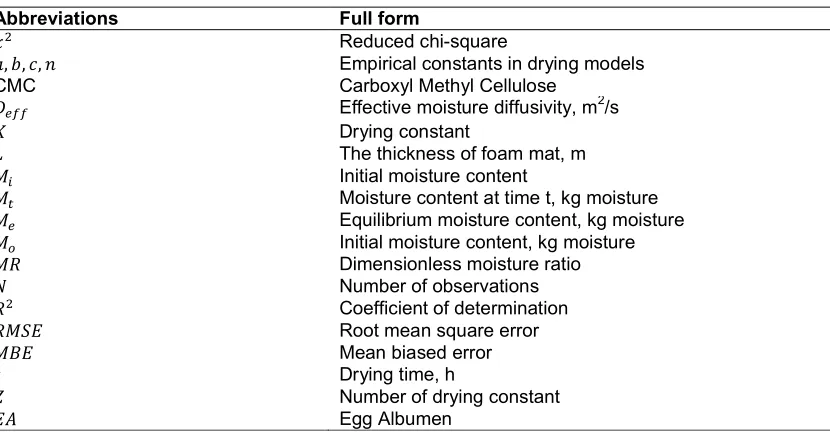
Table 1. Nomenclature of drying parameters
Abbreviations Full form
Reduced chi-square
, , , Empirical constants in drying models
CMC Carboxyl Methyl Cellulose
Effective moisture diffusivity, m2/s
Drying constant
The thickness of foam mat, m Initial moisture content
Moisture content at time t, kg moisture Equilibrium moisture content, kg moisture Initial moisture content, kg moisture Dimensionless moisture ratio Number of observations Coefficient of determination Root mean square error Mean biased error Drying time, h
The weight of the sample weight of each sample was checked every half an hour to determined drying rate and other drying parameters (Table 1).
2.2.3 Determination of Drying Rate (DR)
The drying rate is one of the important parameters that help in the understanding of drying characteristics of a material. The drying rate is calculated using expression described by Salahi et al. [11]
= ∆
∆ (2.2)
where Mt+Δt is moisture content at t + Δt (kg
water/kg dry solid), t is the time (min) and Δt is time difference (min).
2.2.4 Determination of moisture ratio
The moisture content of the samples was expressed in term of moisture ratio (MR) using the expression described by salahi et al. [11]
= (2.3)
2.2.5 Determination of moisture diffusivity
Fick’s diffusion equation was used for calculation of effective diffusivity as described by Wilson et al. [12]
= 8/ exp (2.4)
Which can be rewritten as
= (2.5)
The slope (Ko) is calculated by plotting ln(MR)
against time to determine the effective diffusivity for different temperatures.
= (2.6)
2.2.6 Determination of activation energy
The relationship between the diffusion coefficient with the temperature can often be described by the Arrhenius-type relationship Equation as described by Azizpour et al. [13] in equation 2.7
D = D exp − (2.7)
where D0 is the constant in Arrhenius equation
(m2 s-1); Ea is the activation energy (KJ mol-1); R
is the universal gas constant (kJ mol-1 K-1). It can
be rearranged in the form of:
ln (D ) = ln (D ) (2.8)
The activation energy was calculated by plotting
the ln(Deff) against the reciprocal of absolute
temperature (1/T)
3. RESULTS AND DISCUSSION
3.1 Model Fitting
The central composite design (CCD) data were analyzed using multiple regression analysis and
the correlation between the independent
variables of foam mat drying viz., Temperature
(60-80°C), air velocity (0.5-2.5 m/s), carboxyl methylcellulose (0.5-2.5%) and egg albumen (5-15%) and dependent variables such as activation energy, effective diffusivity, moisture content, foam density and drying time. After the analysis,
a polynomial relationship was developed
between the dependent and independent variable.
3.2 Model Equations
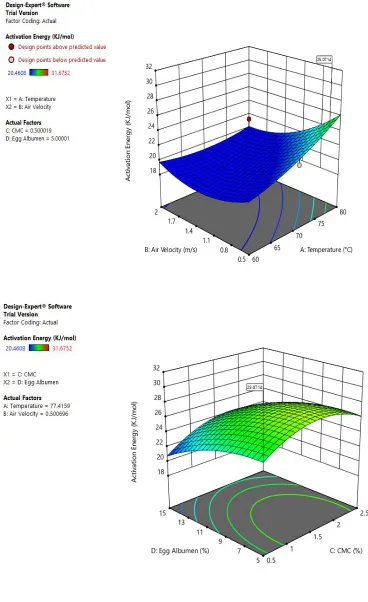
From equation 3.1, the coefficients of the first order terms variables indicated that the activation energy increased with the increased in inlet air temperature, decreased in air velocity, increased in CMC, decreased in egg albumen and increased in combination of both CMC and egg albumen concentration.
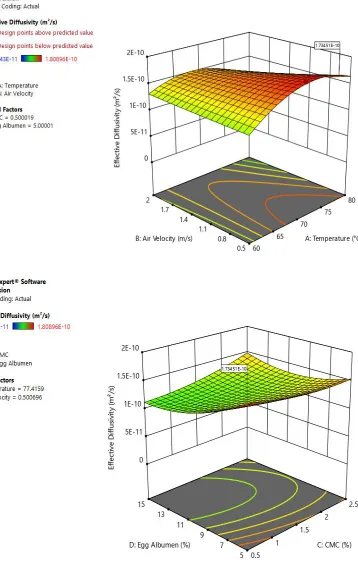
From equation 3.2, the coefficients of the first order terms variables indicated that the effective
diffusivity increased with increased in
temperature, decreased in air velocity,
decreased in CMC, decreased in egg albumen.
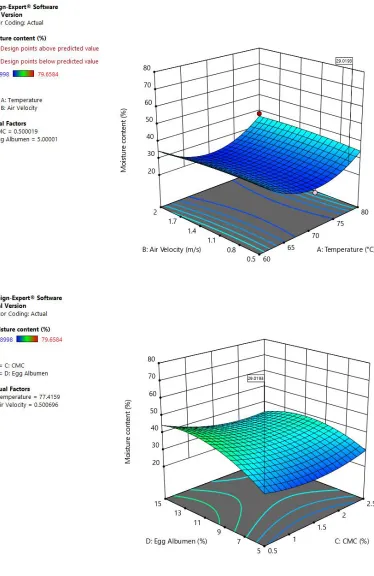
From equation 3.3, the coefficients of the quadratic equation variables indicated that the moisture content increased with decreased in temperature, increased in air velocity, increased in CMC, increased in egg albumen and decreased with combination of CMC and egg albumen.
velocity, decrease in CMC and egg albumen concentration.
= 22.15 + 1.17 −
0.8808 + 0.4647 − 0.3717 − 1.43 +
0.9196 (3.1)
= 9.6267 − 11 + 2.636 − 11 − 1.442 − 11 − 1.17 −
11 − 1.899 − 11 + 1.657 − 11 +
1.395 − 11 (3.2)
= 40.52 − 9.86 + 1.15 + 2.44 + 8.40 + 1.35 − 2.90 (3.3)
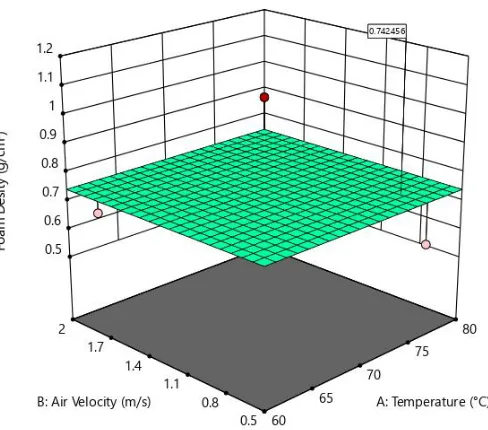
= 0.7425 (3.4)
= 684 − 36.12 + 47.8 −
32.98 − 2.86 + 51.77 + 2.77 (3.5)
Where,
A = Temperature B = Air velocity
C = Carboxyl methylcellulose concentration D = Egg albumen
3.3 Optimization of Drying Characteristics of Watermelon Pulp
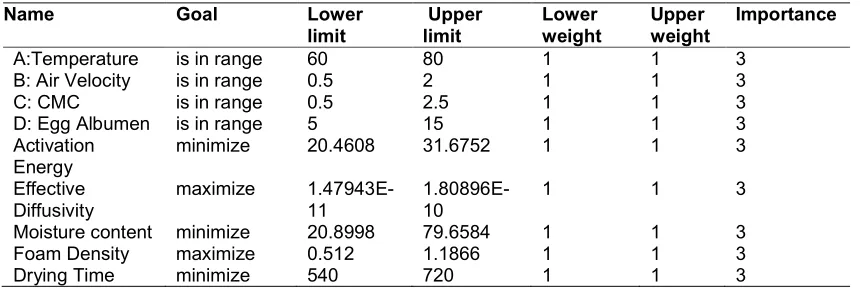
Numeric optimizations were carried out for the drying system parameters and the structural parameters of foam dried watermelon pulp. The desirability of the independent variables and the dependent variables was summarized in the Table 2. The goal was to put the dependent factors; temperature, air velocity, CMC and egg albumen in range. The independent factors; effective diffusivity and foam density to be
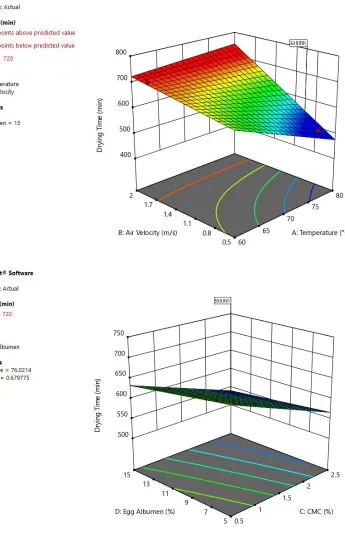
maximized. Activation energy, moisture content and drying time to be minimized. The optimum conditions for the independent variables were found to be temperature 77.42°C, air velocity 0.5 m/s, carboxyl methylcellulose of 0.5%, Egg albumen 5% for achieving minimized activation energy of 25.07 KJ/mol, maximized effective
diffusivity of 1.74345 X 10⁻¹⁰ m2/s, minimized
moisture content to be 29.19% wet-basis,
maximized foam density of 0.742 g/cm3,
minimized drying time of 9hrs with a desirability of 70.2%. The effective diffusivity of the
foam-mat dried watermelon increases with
temperature as shown on the model plot. This behavior is also observed in foam mat drying of watermelon pulp by Wilson et al. [12]. The moisture content of foam dried watermelon reduces with increasing temperature and at a range of air velocity of 1.1 – 1.4 m/s. keeping the carboxyl methyl cellulose and egg albumen at 1.5% and 10% respectively. This may be due to the generation of high hot air during drying, which might have trapped the moist air that was found in the fed product and it might have reduced the moisture content to a greater extent which was also reported by Jaya and Das [14]. The drying time of the foam dried watermelon
reduces with increasing temperature and
reducing air velocity. The drying time 600 minutes (10hrs) was recorded between a temperature of 74 °C – 80 °C and an air velocity of 0.5 m/s and 8 m/s. moisture content reduces with a decrease in egg albumen concentration but increases with increases in carboxyl methylcellulose concentration. Maciel et al. [15] also reported that moisture loss was faster in
samples containing higher albumen
con-centration.
Table 2. Optimization goal table
Name Goal Lower
limit Upper limit Lower weight Upper weight Importance
A:Temperature is in range 60 80 1 1 3
B: Air Velocity is in range 0.5 2 1 1 3
C: CMC is in range 0.5 2.5 1 1 3
D: Egg Albumen is in range 5 15 1 1 3
Activation Energy
minimize 20.4608 31.6752 1 1 3
Effective Diffusivity
maximize
1.47943E-11
1.80896E-10
1 1 3
Moisture content minimize 20.8998 79.6584 1 1 3
Foam Density maximize 0.512 1.1866 1 1 3
Fig. 5. Optimized graph of foam density
4. CONCLUSION
The foam-mat drying of watermelon pulp was
successfully carried out using a central
composite design followed by response surface methodology. The optimum process conditions of foam-mat drying of watermelon pulp were activation energy of 25.07 KJ/mol, effective
diffusivity of 1.73 X 10⁻¹⁰ m2/s, the moisture
content of 29.02 % (wet basis), a foam density of
0.74 g/cm3, drying time of 540 minutes. A
polynomial analysis was carried out, were quadratic model best described the activation energy, effective diffusivity, moisture content. mean model best described the foam density, whilst linear and 2FI model described the drying time. The study of the foam-mat drying of
watermelon pulp revealed that the inlet
temperature, air velocity, CMC and egg albumen concentration has a significant effect on the drying characteristics of the process.
COMPETING INTERESTS
Authors have declared that no competing interests exist.
REFERENCES
1. Sangamithra A, Venkatachalam S, John
SG, Kuppuswamy K. Foam mat drying of
food materials: A review. Journal of Food Processing and Preservation. 2014;745-4549.
2. Ratti C, Kudra T. Drying of foamed
bio-logical materials: Opportunities and
challenges. Drying Technology. 2006; 1101-1108.
3. Balaswamy K, Rao PGP, Rao GN,
Satyanarayana A. Physico-chemical and antioxidant properties of foam mat dried
muskmelon (Cucumis melo) and
application in dairy products. Journal of Scientific & Industrial Research. 2016;225-230.
4. Hardya Z, Jideani VA. Foam-mat drying
technology: A review. Critical Reviews in Food Science and Nutrition; 2015.
5. Anikwe MAN, Agu JC, Ikenganyia EE.
Agronomic evaluation of four exotic tropical varieties of watermelon (Citrullus lanatus L.) in two agro-environments in Nigeria. International Journal of Plant & Soil Science. 2016;1-10.
6. Reetu Verma, Maharishi Tomar.
Watermelon: A valuable horticultural crop with nutritional benefits. Popular Kheti. 2017;5-9.
7. Naz A, Masood Sadiq Butt MTS, Mir
8. Perkins-Veazie P, Collins JK, Wu Guoyao, Clevidence Beverly. Watermelons and Health. Acta Horticulturae. 2007;121-128.
9. Sangamithra A, Venkatachalam S, John
SG, Kuppuswamy K. Foam mat drying of food materials: A review. Journal of Food Processing and Preservation. 2014;745-4549.
10. Carley KM, Natalia YK, Reminga J.
Response surface methodology. Pitts-burgh: Carnegie Mellon University; 2004.
11. Salahi MR, Mohebbi M, Taghizadeh M.
Foam-mat drying of cantaloupe (Cucumis melo): Optimization of foaming parameters and investigating drying characteristics.
Journal of Food Processing and
Preservation; 2014.
12. Wilson RA, Kadam DM, Chadha S,
Sharma M. Foam mat drying
characteristics of mango pulp. International
Journal of Food Science and Nutrition Engineering. 2012;63-69.
13. Azizpour M, Mohebbi M, Khodaparast
MHH, Varidi M. Foam-mat drying of
shrimp: Characterization and drying
kinetics of foam. Agricultural Engineering International: CIGR Journal. 2013;159- 165.
14. Jaya S, Das H. Effect of maltodextrin,
glycerol monostearate and tricalcium
phosphate on vacuum dried mango powder properties. Journal of Food Engineering. 2004;123-134.
15. Maciel RMG, Afonso MRA, da Costa José
MC, Severo LS, de Lim ND. Mathematical modeling of the foam-mat drying curves of
guava pulp. Revista Brasileira de
Engenharia Agrícola e Ambiental. 2017; 721-725.
_________________________________________________________________________________ © 2019 Isa and Olalusi; This is an Open Access article distributed under the terms of the Creative Commons Attribution License (http://creativecommons.org/licenses/by/4.0), which permits unrestricted use, distribution, and reproduction in any medium, provided the original work is properly cited.
Peer-review history: