An Efficient GTS Allocation Scheme for IEEE
802.15.4 MAC Layer
Der-Chen Huang, Yi-Wei Lee and Hsiang-Wei Wu
National Chung Hsing University, Taiwan, R.O.C.
Abstract. Based on IEEE 802.15.4, the contention-free period (CFP) adopts a guarantee time slot (GTS) mechanism to ensure each device can access the radio channel. However, it is hard to get the authority to access the radio channel due to more competitor access the radio channel simultaneously. To cope with this issue, we proposed a guarantee time slot mechanism to enhance the performance and utilization by using CFP. Our proposed method ensures each device has the authority to access the radio channel without any additional step. By comparing with the method of IEEE 802.15.4, the experimental results show that data average transmission delay and energy consumption can be reduced dramatically. In addition, the bandwidth and performance of network is improved since the pre-allocation mechanism can reduce the number of control packets. Several experiments have been conducted to demonstrate the performance of our work
Keywords: ZigBee, GTS, Cluster Tree, Beacon, MAC Layer.
1.
Introduction
In recent decade, Wireles Sensor Networks (WSNs) have been improved and applied popularly in many fields because of low cost, low power consumption, small size and short transmission distance [1-4]. Hence, the ZigBee standard has been proposed to satisfy these requirements to achieve the goal of longer lifetime with higher reliability [5]. In general, the ZigBee tree routing is a popular mechanism and has been applied in many applications. Because the routing table is not necessary when transmitting data, the tree routing mechanism is suitable for small, cost oriented and resource limited network applications. However, the number of intermediate nodes is increased dramatically while applying to a large range network. It requires more energy consumption and delay time such that the performance and life cycle of total system are decrease. To cope with this issue, [6] provides a shortcut tree routing method. This paper provides a shot cut path for transmission to save more energy and reduce delay time.
policy of CSMA/CA to access the radio channel. [7] presents a back off assignment mechanism to avoid collision while accessing radio channel. The IEEE 802.15.4 proposes a guarantee time slot (GTS) mechanism to ensure the requirement of bandwidth and delay can be satisfied. However, the channel access successful possibility is highly related with the number of access nodes while using CSMA/CA mechanism. Moreover, the CAP is used to obtain the authority of using the radio channel in GTS mechanism. This increases the difficulty of accessing radio channel. In our method, we propose a pre-allocation time slot mechanism to ensure the radio channel to be accessed without considering the contention activities. By means of cancelling the contention access period (CAP) in CSMA/CA, this paper proposes a new concept of guarantee time slot (GTS) to ensure the total superframe to be occupied by contention free period (CFP) to increase the bandwidth of GTS. This method has the advantage of: (1) to reduce the energy consumption caused by the CSMA/CA mechanism, (2) to decrease the number of control packets and (3) to improve the delay effect.
2.
Related Works
Regarding the GTS mechanism, NGA [8] and i-GAME [9] provide bandwidth allocation method to decrease the waste of bandwidth. NGA divides the CFP into 16 time slots with equal size to allocate the time slot to decrease the waste of CFP. Its drawback is to compete with other devices to acquire the access authority by means of CAP. Hence, the bandwidth of CFP becomes small and the probability of allocation is smaller due to more competitors. In contrast, the i-GAME provides a mechanism to allow more devices in one GTS. It induces more delay if there are more devices in one time slot. Most of the previous mentioned papers are focused on using the CFP area to allocate the GTS. Following the CSMA/CA protocol, each device must get the authority of allocating one time slot during the period of CAP to access the channel. However, the access probability is decrease if more devices want to access the channel such that more energy consumption is required during this compete period. Thus, a new GTS allocation scheme had been proposed to reduce the transmission power consumption and delay time [10]. [11] presented a slotted beacon scheduling to reduce the power consumption while considering the hierarchical tree topology and beacon-enabled network. The energy efficiency for each different method had been compared and analyzed in [12]. It proposed several new schemes to reduce power consumption for personal area network (PAN).
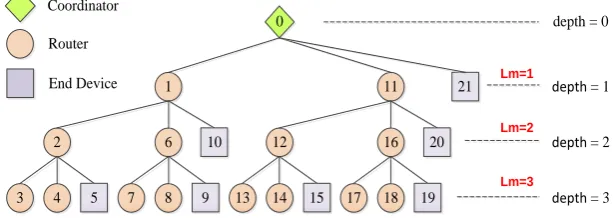
consumption. Here, we have illustrated the cluster tree based network as an example to demonstrate the performance of our proposed method for simplicity. In addition, our method can be easily further applied to different network topology. However, the node number calculation algorithm is required to develop again for each different network.
5
3 4 7 8 9
0
15
13 14 17 18 19
2 6 10 12 16 20
1 11 21
Coordinator
Router
End Device
depth = 0
depth = 1
depth = 2
depth = 3
Lm=1
Lm=2
Lm=3
Fig. 1 Zigbee tree topology
3.
New GTS Allocation Scheme
Based on the network address allocation method of IEEE 802.15.4 specification, we assign each device in the Zigbee network with a dedicate network address. After that, the topologic relation between each device can be constructed. The router or coordinate device (i.e. parent device) can assign time slot to each child device as a GTS for communication. In Zigbee, the device network address assigned mechanism is fulfilled in a distributed manner. To obtain network address, there are three topological parameters to be defined: the number of child devices (Cm), the network maximum depth value (Lm) and the maximum number of router under parent node (Rm). In Equation 3.1, the PAN coordinator (i.e. parent) can compute the Cskip(d) as an offset to derive network starting address for each child device if three parameters have been provided for any given parent device with depth value d.
(3.1)
one is already dedicated to beacon. In other words, each allocated GTS size is identical to one time slot size in superframe as the Cm is equal to 15.
According to the specification of IEEE 802.15.4, beacon interval (BI), superframe duration (SD), beacon order (BO) and superframe order (SO) can be used to described the relation between beacon frame and superframe. The superframe duration and beacon interval can be computed as Equations 3.2 and 3.3, where aBaseSuperframeDuartion is a time unit. The length of each time slot can be obtained by using Equation 3.4. Superframe Duration can be denoted as FS(SO) ,which can be divided into 16 portions. The new
superframe contention free period can be found as Equation 3.5 in which one time slot is already used by beacon signal. Thus, the allocated GTS size for each device can be computed as Equation 3.6 for the case with Cm child device.
FS(SO)=Superframe Duration(SD)
=aBaseSuperframeDuartion*2SO (3.2)
FB(BO)=Beacon Interval(BI)
= aBaseSuperframeDuartion*2BO (3.3)
Length of Time Slot : LTS(SO) =
(3.4)
newCFP(SO) = LTS(SO) (3.5)
Length of GTS : LGTS(Cm,SO)= (3.6)
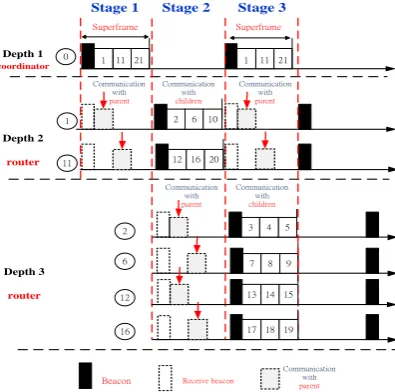
We propose a method to compute the GTS for each device. The device can be divided as coordinator, router and end device, where only the coordinator and router can issue the beacon signal and the GTS to their corresponding child device. We illustrate the tree topologic structure as our basis to demonstrate our proposed method.
Algorithm 1 GTS communication scheme in the coordinator
1. MAC layer use GTS allocation scheme 2. define the Superframe Duration(SD) =FS(SO)
3. define the Beacon Interval(BI) =FB(BO)
4. define the length of time slot LTS(SO) =
5. newCFP (SO) = LTS(SO)
6. Each length of GTS : LGTS(Cm,SO) =
8. Starting time of =
9. end for
10. Send a beacon signal for synchronization
To ensure the integration operations smoothly, we have presented three algorithms in corresponding to coordinator, router and end device, respectively. First, for the coordinator algorithm as shown in algorithm 1, the row 2 to 4 gives the definition of parameter used in this algorithm. The row 5 finds the size of new CFP. The size of allocated GTS for each device is obtained by the row 6, where Cm represents the number of child devices under the coordinator. The starting time of GTS for each device can be obtained in the row 7 and 8. The Equation 3.7 indicates that the starting time of GTS for each device is related to the assigned network address of child device (i.e. i). The assigned sequence of GTS for each child device follows the network address of joining parent net. The parent device can communicate with the child device during this GTS period after the synchronization is initialized by the beacon signal.
= ,where i = i th Cm (3.7)
Algorithm 2 GTS communication scheme in the router
1. MAC layer use GTS communication scheme 2. define the Superframe Duration(SD) = FS(SO)
3. define the Beacon Interval(BI) = FB(BO)
4. define the length of time slot LTS(SO) =
5. newCFP (SO) = LTS(SO)
6. Each length of GTS : LGTS(Cm,SO) =
7. if receive a Beacon signal with synchronization 8. then k is computed by:
9. Starting time of
10. end if
11. After SDparent of period then Allocate GTS for children
12. for =1 to ≤ Cm
13. Starting time of =
14. end for
15. Send a beacon signal for synchronization
find the starting time of GTS of router device, which is assigned by the parent device.
, where k = k th Router (3.8)
(3.9)
In Equation 3.8, Ak is the network address of router, Aparent is the network
address of parent and Cskipparent(d) is the offset address for each different
router. The k denotes the kth router of parent device. Thus, we can compute
the starting time of accessing channel for each different router in terms of k as Equation 3.9 shows. The router communicates with its parent during time slot
. The row 11 indicates that the processing sequence is from parent
to child. After the Superframe Duration of parent, the router assigns GTS to its child device by following the sequence of network address. The rows 12, 13 and 14 compute the starting time of GTS for each child device. We can assign each different starting time for each child device based on a different ,
where the denotes the number of child device for a router. The router communicates with its child device during time slot .
Algorithm 3 GTS communication scheme in the end device
1. MAC layer use GTS communication scheme with parent 2. define the Superframe Duration(SD) = FS(SO)
3. define the Beacon Interval(BI) = FB(BO)
4. define the length of time slot LTS(SO) =
5. CFPparent = newCFP(SO) = LTS(SO)
6. Each length of GTSparent =
7. if receive a beacon signal with synchronization 8. then
9. Starting time of
10. end if
Similarly, for the algorithm 3, the row 2 to 6 gives definitions regarding superframe duration, beacon interval and length of time slot to find the size of CFPparent and GTSparent. The row 7 indicates that the beacon signal is received
n = end device (3.10)
In Equation 3.10, An is the network address of end device assigned by its
parent device, Aparent is the network address of parent device, Cskipparent(d) is
the offset and Rm is the number of router in child devices. The n+Rm can be used to represent the ith Cm child device in parent net. We can compute the
staring time of GTS for each child device based on Equation 3.11. The end device communicates with its parent in time slot .
=
,where n+Rm=ith Cm (3.11)
Fig. 2 The relation between coordinator and child device
Fig. 3 The relation between router and child device
Fig. 4 The relation between depth 1 to 3 for tree-topology
Communication with coordinator 0 0 Coordinator Router Beacon Interval time
Contention free period
Beacon Beacon
Inactive period GTS2 GTS3
Contention free period Beacon Send Beacon Inactive period 1 GTS1 Receive Beacon time Beacon
1 11 21
2 6 10
0
Beacon Interval
time
Contention free period
Beacon Beacon
Inactive period
Contention free period Beacon
Send Beacon
Inactive period GTS1 GTS2 GTS3
Router 6 Receive Beacon time Beacon 1 Communication with router 1
2 6 10
7 8 9
1
GTS1 GTS2 GTS3
0
2 6 10
1
11 12 16 20
3 4 5
7 8 9
Stage 1 Stage 2 Stage 3
13 14 15 2 6 12 16 Communication with parent Communication with children Communication with parent Communication with children Communication with parent
17 18 19
1 11 21 1 11 21
Beacon Receive beacon
4.
Experimental Results
To evaluate our proposed method, our simulation environment is based on NS2 version 2.34 as a basis to demonstrate the performance and correctness of our work. In this experiment, we illustrate a tree type sensor network as an example shown in Fig. 1, where its corresponding parameters can be set as Cm=3, Rm=2 and Lm=3. For simplicity, we assume that the traditional GTS allocation mechanism (OSA GTS) with CSMA/CA can be 100% success without any loss. In other words, the compared method with us is an optimal case. In here, we assume SO from 2 to 4 and BO various from 3 to 5 to observe the variation after increasing the beacon interval.
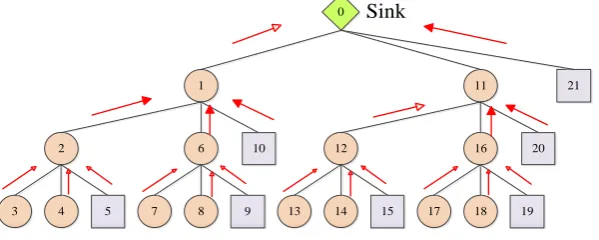
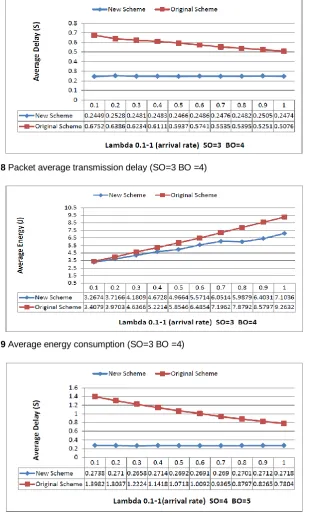
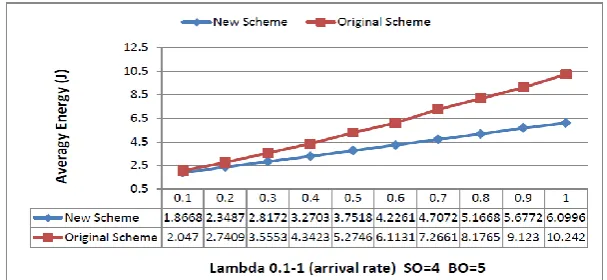
To examine the delay effects in our method, we treat the coordinate as a sink node to accept the signal from other nodes. First, we assume depth=3 to simulate the packet is transmitted from the node with depth=3 to the sink node. Similarly, the rest nodes follow the same way by transmitting data repeatedly along with the directions as Fig. 5. The simulation results can be shown in Fig. 6 to 11 with assigning SO=2~4 and BO=3~5, where the input data arrival rate can vary from 0.1 to 1. The Fig. 6, 8 and 10 show the transmit delay with respect to BO=3, BO=4 and BO=5, respectively. Similarly, the Fig. 7, 9 and 11 show the energy consumption for the BO=3, BO=4 and BO=5. First, for the average delay results, the OSA GTS average delay is larger than the NSA GTS over 100 % becau e the NSA GTS oe n’t nee ‘acqu re’ an ‘cancel’ act vities because of pre-allocate GTS scheme. Hence, the communication can be executed immediately between parent and child ev ce after rece v ng the arent ev ce’ beacon gnal. However, the OSA GTS needs to wait for beacon signal in the next superframe and then receive the related GTS information to allocate the radio channel. After that, the communication between parent and child devices can be started. Therefore, the delay overhead of OSA GTS is more than the NSA GTS. For the OSA GTS, the delay is increased as if the arrival rate is becoming greater (i.e. 0.1 to 1) since the arrival packets during the CAP period will be totally handled in the next GTS. In contrast, the NSA GTS keeps the uniform delay regardless of the change of arrival rate. The energy consumption of OSA GTS is larger than NSA GTS scheme because OSA GTS requires one more superframe to transmit data packet if the radio channel is allocated successfully. To implement such a system, we need to modify the sensor node by adding our proposed algorithm.
To further compare the delay effects, we propose the formula:
ADRI=
arrival rate=0.1, where its improve rate is 80%. It is obviously to indicate that low transmission delay can be obtained by the NSA GTS method.
Fig. 5 Data packet transmission path
Fig. 6 Packet average transmission delay (SO=2 BO =3)
Fig. 7 Average energy consumption (SO=2 BO =3)
5
3 4 7 8 9
0
15
13 14 17 18 19
2 6 10 12 16 20
1 11 21
Fig. 8 Packet average transmission delay (SO=3 BO =4)
Fig. 9 Average energy consumption (SO=3 BO =4)
Fig. 11 Average energy consumption (SO=4 BO =5)
Fig. 12 SO=2 BO=3 ADRI
Fig. 14 SO=4 BO=5 ADRI
5.
Conclusions
This paper proposes a new pre-allocation mechanism to resolve the drawbacks of traditional time slot access mechanism in the IEEE 802.15.4 specification. This method ensures each device to allocate a fix bandwidth based on the pre-allocat on cenar o. Our ro o e metho oe n’t nee control mechanism to obtain guarantee time slot such that the control packet can be reduced to decrease delay and power consumption. We adopts pre-allocation schema to allocate the time slot in advance to increase the utilization of bandwidth and keep data transmission in real-time manner. Based on the experimental results, the proposed GTS mechanism is better than the IEEE 802.15.4 for the delay effect and energy consumption. To further enhance the performance of our method, we will propose an algorithm to improve the counting of sensor node number more precisely so that the power consumption and transmission delay can be optimized.
References
1. L. Q. Zhuang, K. M. Goh and J. B. Zhang:The wireless sensor networks for factory automation: Issue and challenges. In Proceeding of Emerging Technologies & Factory Automation, 141-148. (2007)
2. K. Sha, W. Shi and O. Watkins: Using Wireless Sensor Networks for Fire Rescue Applications: Requirements and Challenges. In Proceeding of Electro/information Technology, 239-244.(2006)
3. Hu. Jingtao: The Application of Wireless Sensor Networks to In-Service Motor Monitoring and Energy Management. In Proceeding of Intelligent Networks and Intelligent Systems, 165-169. (2008)
5. IEEE 802 Working Group: Standard for Part 15.4: Wireless Medium Access Control (MAC) and Physical Layer (PHY) Specifications for Low Rate Wireless Personal Area Networks (LR-WPANs). ANSI/IEEE 802.15.4 (2003)
6. T. Kim, D. Kim, N. Park, S. E. Yoo and T. S. Lopez: Shortcut tree routing in ZigBee networks. In Proc. IEEE International Symposium on Wireless Pervasive Computing, San Juan, Puerto Rico (2007)
7. Jae Yeol Ha, Kim, T.H., Hong Seong Park, Sunghyun Choi and Wook Hyun Kwon: An Enhanced CSMA-CA Algorithm for IEEE 802.15.4 LR-WPANs. In Communications Letters, Vol. 11, No. 5, 461- 463. (2007)
8. Liang Cheng, A. G. Bourgeois and Xin Zhang: A new GTS allocation scheme for IEEE 802.15.4 networks with improved bandwidth utilization. In Proceeding of Communications and Information Technologies, 1143-1148. (2007)
9. A. Koubaa, M. Alves and E. Tovar: i-GAME: an implicit GTS allocation mechanism in IEEE 802.15.4 for time-sensitive wireless sensor networks. In Proceeding of the 18th Euromicro Conference on Real-Time Systems, 183-192. (2006)
10. Der-Chen Huang, Yi-Wei Lee and Hsiang-Wei Wu: A Cluster-Tree-Based GTS Allocation Scheme for IEEE 802.15.4 MAC Layer. In the third International Workshop on Mobility Modeling and Performance Evaluation (MoMoPE), Palermo, Italy. (2012)
11. Saeyoung Ahn, Jaejoon Cho and Sunshin An: Slotted Beacon Scheduling Using ZigBee Cskip Mechanism. In the second International Conference on Sensor Technologies and Applications, 103-108. (2008)
12. Liang Cheng and Bourgeois, Anu G.: Energy efficiency of different data transmission methods in IEEE 802.15.4: study and improvement. In the 2nd International Symposium on Wireless Pervasive Computing. (2007)
Yi-Wei Lee received the M.S. degree from the Department of Computer Science and Engineering, National Chung Hsing University, Taichung, Taiwan, R.O.C.. His research interests include computer network and communication.
Hsiang-Wei Wu received his B.S. degree from the Department of Electronic Engineering of National Chin-Yi University of Technology and M.S. degree from the Department of Electronic Engineering of Fung-Chia University, Taichung, Taiwan, R.O.C.. Currently, he is Ph.D. Candidate of the Department of Computer Science and Engineering, National Chung Hsing University. His research interests include computer network and communication.