Original Research Article
Patterns and problems of menstruation among the adolescent
school girls of Delhi: a cross-sectional study
Monika Singh
1, Om Prakash Rajoura
2, Raghavendra A. Honnakamble
1*
INTRODUCTION
Adolescence is the period of rapid physical growth, psychological and social changes.1 Adolescents in India comprise 19.3% of the total Indian population.2
Menstruation is a natural, normal biological process experienced by all adolescent girls and women in reproductive age. Amongst the entire developmental milestones associated with the adolescent years, menarche is the most important. Menarche is the onset of first menstruation among girls. Menstruation is a continuous process and occurs once a month as a regular rhythmic period. Throughout the childbearing years of
the women, it remains as a normal physiological phenomenon and discontinues permanently at menopause approximately between the ages of 45-55 years.3,4 The menstrual cycle is often irregular during first few years after menarche. These are generally anovulatory cycles. Although at the age of 17-18 years, regular menstrual cycle becomes established.5,6
Menstruation in majority is asymptomatic bleeding per vaginum. Even then some may experience pain in abdomen, gastrointestinal disturbances like anorexia and vomiting, leg pain and backache. Dysmenorrhoea is a major problem during menstruation, affecting their daily activities including school absenteeism.7-9 Menstrual
ABSTRACT
Background: Adolescence is the period of rapid physical growth, psychological and social changes. This period is marked by the onset of menarche in the girls. Menstruation is a natural biological process experienced by all adolescent girls and women in reproductive age. The menstrual cycle is characterized by variability in volume, pattern and regularity. Conversely, variability in menstrual cycle characteristics and menstrual disorders are common among adolescent girls. The objectives of the study were to determine patterns of menstruation, prevalence of menstrual disorders and hygienic practices during menstruation in the adolescent school girls.
Methods: A cross-sectional study was conducted among 210 adolescent school girls of Delhi.
Results: The mean age at menarche in the study subjects was 13.47±0.87 years. Average menstrual interval was days. Dysmenorrhea was reported by 76.1% of the girls, body ache was experienced by 64 (30.4%). Majority of girls 174 (82.8%) used sanitary pads as absorbent during cycle.
Conclusions: Menstrual problems are frequent among adolescent girls. Dysmenorrhoea was the commonest problem
among the adolescents. Adolescent girls withstand their pain and think it as a normal phenomenon. Educating students about menstrual health by health professionals and teachers can help in reducing their psychological and physical stress.
Keywords: Menstrual pattern, Adolescent girl, Dysmenorrhoea
Department of Community Medicine, 1SN Medical College, Bagalkot, Karnataka, 2UCMS and GTBH, Delhi, India
Received: 26 March 2019
Revised: 12 May 2019
Accepted: 13 May 2019
*Correspondence:
Dr. Raghavendra A. Honnakamble, E-mail: [email protected]
Copyright: © the author(s), publisher and licensee Medip Academy. This is an open-access article distributed under the terms of the Creative Commons Attribution Non-Commercial License, which permits unrestricted non-commercial use, distribution, and reproduction in any medium, provided the original work is properly cited.
disturbances were among first and fourth most commonly reported causes of morbidity among adult women.10,11 Consequently, healthcare providers are of immense importance for these adolescent girls who are going through pubertal transition. Healthcare providers have an opportunity to discuss reproductive health issues with adolescent girls and their mothers.12
Objectives
To determine patterns of menstruation, prevalence of menstrual disorders and hygienic practices during menstruation in the adolescent school girls.
METHODS
This is a cross sectional study carried out among 210 adolescent school girls of Delhi from January to June 2011. Prior permission was obtained from the Principal of the school. Ethical clearance was obtained from ethics committee of University College of Medical Sciences Delhi. All the girls in the age group of 10-19 years, who had attained menarche & were willing to participate in the study, were included as study participants were included in the study. Students who were seriously ill were excluded from the study. Pretested, semi-structured questionnaire consisted of issues like age at menarche, patterns and problems and hygienic practices related to menstruation.
Sample size was calculated after considering review of literature. It was observed that prevalence of menstrual disorders ranged from 13% to 91%.13-15 Therefore taking prevalence of menstrual disorder of 87.7%. At 95% confidence interval, 10% allowable error and non-response rate of 10%, the sample size worked out to 210. Data collected in MS Excel were analyzed to identify age of menarche, menstrual patterns and associated problems.
RESULTS
Adolescent school girls age group ranged from 11- 19 years. Mean age of menarche was 13.45±0.86, only one girl attained menarche at 11 year and majority attained menarche at 12to 14 years age group (Table 1). When analyzed for inter-menstrual gap, majority 159 (75.7%) girls were in the group of 21-35 days. Days of flow of blood was classified as less 3 days, 3-5 days and more than 5 days. Most of the girls were in 3-5 days 155 (73.8%), few girls 10 (4.7%) in less than 3 days group and remaining were having blood flow for more 5 days. In menstrual symptoms (Table 2), abdominal pain or cramps was experienced by most of the girls 176 (83.8%), body ache was experienced by 64 (30.4%) and 56 (26.6%) were irritable during cycle. Adolescent school girls were analyzed for hygienic practices during their cycle (Table 3). Sanitary pads were used by 174 (82.8%) girls and remaining used both sanitary napkins and cloth.
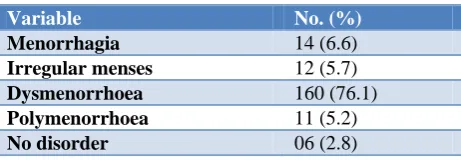
times and remaining changed more than 4 times. Majority 150 (71.5%) cleaned their genitalia only with water during cycles and remaining cleaned with soap and water. Dysmenorrhea was experienced by 160 (76.1%) adolescent girls (Table 4). Irregular menstrual cycle was observed in 12(5.7%) and polymenorrhea in 11 (5.2%). Some girls had experienced menorrhagia 14 (6.6%).
Table 1: Distribution of adolescent school girls according to their menstrual pattern (n=210).
Variable No. (%)
Age (menarche)
11 01 (0.5)
12 27 (12.9)
13 77 (36.7)
14 85 (40.5)
15 18 (8.6)
16 02 (1.0)
Inter-menstrual interval
Less than 21 days 11 (5.2) 21 to 35 days 159 (75.7) More than 35 days 40 (19.0)
Amount of blood flow
Scanty 09 (4.3)
Moderate 148 (70.5)
Heavy 53 (25.2)
Days of blood flow
Less than 3 days 10 (4.7) 3 – 5 days 155 (73.8) More than 5 days 45 (21.5)
Table 2: Distribution of adolescent school girls according to menstrual symptoms (n=210).
Variable No. (%)
Body ache 64 (30.4)
Backache 42 (20.0)
Abdominal pain/cramps 176 (83.8)
Headache 12 (5.7)
Irritability 56 (26.6)
Table 3: Menstrual hygiene practices among adolescent school girls (n=210).
Variable No. (%)
Type of absorbent
Only sanitary napkin 174 (82.8) Both sanitary napkin and clothes 36 (17.2)
Absorbent change times
≥ 4 times 50 (23.8) < 4 times 160 (76.2)
Cleaning of genitalia during last menstrual cycle
≥ 4 times 51 (24.2) < 4 times 159 (75.8)
Cleaning of genitalia with
Table 4: Distribution of adolescent school girls according to menstrual disorders (n=210).
Variable No. (%)
Menorrhagia 14 (6.6)
Irregular menses 12 (5.7)
Dysmenorrhoea 160 (76.1)
Polymenorrhoea 11 (5.2)
No disorder 06 (2.8)
DISCUSSION
Adolescence is a period of transition from puberty to early adulthood. This phase involves major physical and emotional changes in the individual.1,2
Age at menarche
The mean age of menarche in this study was 13.45±0.95 years, which is similar finding studies conducted in other parts of the country.14,16,17
Length of cycle
The average menstrual flow was 3.5±1.2 days in the present study, other studies have observed 4.5±1.6 days and 3.95±0.7 days as duration of menstrual flow.16,18 There is no much difference between findings of the study done in other parts of the country.
On studying the menstrual pattern of these 210 adolescent girls, it was observed that only 5.7% had irregular cycles. In a study conducted in recent times on adolescent girls in rural area of Maharashtra, 5.6% had irregular cycles which is comparable to our study.16,19 In another study conducted on adolescent girls in rural area of Karnataka showed comparable results with 7.5% having irregular cycles.16 On the contrary, a study reported 11.2% of the adolescent girls had irregular cycle which is higher than our observation.20
In the present study, 73.8% of the girls experienced blood flow for 3-5 days. Study findings observed the mean duration of menstrual blood flow was 4.84±1.27 days and 93.6% had normal menstrual blood flow between 3-7 days. The current study findings are comparable with the other studies conducted in other parts of the nation.21,22 Inter-menstrual period was categorized into three groups, girls who had cycles less than 21 days, whose cycle was in the range 0f 21-35 days and who cycle more than 35 days. Majority of the study participants were in the 21-35 days group 159(75.7%) days. Another study observed the inter-menstrual period of the girls was 30.21±5.86 days, which is similar to the current study.21,22
The mean inter-menstrual interval in study conducted in Maharashtra was 28.7±3.26 days.19
The results are lesser in respect to the study done in Karnataka with 92.7% having inter-menstrual interval 28-35 days and 6.8% having >28-35 days inter-menstrual interval. The present study showed that duration of blood flow was <3 days in 4.7% and >5 days in 21.5% of the girls which is again comparable to other studies.16,19 Problems associated with menstruation
Dysmenorrhea is one of the most common menstrual disorders among adolescents in, current study observed that 76.1% school going adolescent girls were suffering from dysmenorrhoea. Incidence of dysmenorrhoea was less in other studies.16,19 Other study had reported 53.6% and 49.13% incidence of dysmenorrhoea. The tolerance of pain is better in rural girls compared to urban girls.20,23 Studies revealed high percentage of medical students suffering from different kinds of menstrual disorders. Students (5.7%) were suffering from irregular menstrual cycle lesser than other studies.17,24-26 In contrast, in another study there was very high prevalence (64.2%) of irregular menstrual cycle.21 Another study observed that 93.8% girls had average 2.1 menstrual complaints. Furthermore, maximum number of girls (68.3%) had abdominal pain during menstruation and other symptoms were pain in legs, backache, psychological upset, headache, constipation etc.16,17 The other problems associated with menstruation were menorrhagia (6.6%), polymenorrhoea (5.2%) and irregular cycles (4.7%). Similar incidence of problems associated during menstruation was reported in other studies.16,27,28
Type of absorbent used
The present study revealed that 82.8% of girls was using sterile sanitary pads as an absorbent, whereas 17.2% used cloth and sanitary pads as absorbent. The study findings were similar to the study where 89.5% of girls were using sterile sanitary pads as absorbent, while 10.5% used old home cloth as absorbant.19
A study done in an urban setting among adolescent school girls elicited that 52.34% used only sanitary napkins as menstrual absorbent while 44.53% used both cloth and pad.29,30 Another study done in the villages observed that only 38% girls used sanitary pads during menstruation and 63.7% girls dried their clothes in the corner of the house. The use of sanitary pads was higher in our study.
Hygienic practices regarding menstruation among adolescent school girls
Cleaning of external genitalia with soap & water was present in 28.5%. Other studies observed that cleaning of external genitalia with soap & water was present in 63% and rest used only water for cleaning.31,34
CONCLUSION
Attainment of menarche at correct age is an important milestone during adolescence, which signifies the normal functioning of the female reproductive system. Study revealed that majority of adolescent girls had attained menarche at appropriate age. The duration of blood flow and the cycle interval was normal in three-fourth of the adolescent girls. Menstrual problems are frequent among adolescent girls. Dysmenorrhoea was the commonest problem among the adolescents. Adolescent girls withstand their pain and think it as a normal phenomenon. The use of hygienic -sanitary pads as an absorbant was prevalent in majority of adolescent girls. Educating students about menstrual health by health professionals and teachers can help in reducing their psychological and physical stress.
Funding: No funding sources Conflict of interest: None declared
Ethical approval: The study was approved by the Institutional Ethics Committee
REFERENCES
1. WHO. World Health Organization. World Health Organization. Adolescent health. Available at: http://www.who.int/topics/adolescent_health/en/ Statistics. Accessed on 21 November 2018.
2. UNICEF. Available at: https://www.unicef.org/info bycountry/india_statistic s.html Accessed on 24 November 2018.
3. Adolescence. The critical phase, the challenges and the potential published by W.H.O. Regional office for South-East Asia, New Delhi 1997.
4. National Institute of Health and Family Welfare, Reproductive and Child Health. Module for Medical Officer. New Delhi 2000: 662-670.
5. Dawn CS. Undergraduate and postgraduate textbook of Gynecology and Contraception 10th edition. Dawn Books, Kolkata. 1990.
6. ACOG Committee on Adolescent Health Care: Menstruation in girls and adolescents using the menstrual cycle as a vital sign. Obstet Gynecol 2006;108(5):1323–8.
7. Banerjee D, Mukherjee SP. The menarche in Bengalese Hindu girls. J Indian Med. 1961;37(6):261-70.
8. Deo DS, Ghattargi CH. Menstrual problems in adolescent school girls: A comparative study in urban and rural areas. Indian J Prev Soc Med. 2007;38(1):64-8.
9. Durain D. Primary dysmenorrhea: assessment and management update. J Midwifery Womens Health. 2004;49(6):520–8.
10. Kumar R, Singh M, Kaur A, Kaur M. Reproductive health behavior of rural women. J Indian Med Assoc. 1994;93:128-31.
11. Bhatia JC, Cleland J. Reported symptoms of gynecological morbidity and their treatment in South India. Stud Fam Plann. 1995;26:203-16. 12. Quint EH. Menstrual issues in adolescents with
physical and developmental disabilities. Ann N Y Acad Sci. 2008;1135:230‑6.
13. George A, Bhaduri A. Dysmenorrhea among adolescent girls- symptoms experienced during menstruation. Health Promotion Educ. 2002;17:4. 14. Kural M, Noor NN, Pandit D, Joshi T, Patil A.
Menstrual characteristics and prevalence of dysmenorrhea in college going girls. J Fam Med Prim Care. 2015;4(3):426-31.
15. Sangwan G, Vashisht BM. Menstrual pattern and prevalence of dysmenorrhea among school going adolescent girls in a rural block of Haryana: A cross sectional study. GJMEDPH. 2017;6(2):1-5.
16. Patil MS & Angadi MM. Menstrual pattern among adolescent girls in rural area of Bijapur. Al Ameen J Med Sci. 2013;6(1):17-20.
17. Prasad BG, Sharma P. A study on menstruation of medical college girls at Lucknow. Journal of Obstetrics and Gynecology of India. 1972;22:690-4. 18. Koshi EP. A study of health status of adolescent school girls in an urban area of Almabagh, Lucknow. Indian J Med Sci. 1970: 377-383.
19. Kanotra SK, Bangal VB, Bhavthankar DP. Menstrual pattern and problems among rural adolescent girls. IJBAR. 2013;04(8):551-4.
20. Kulkarni M, Durge PM. Reproductive Health morbidities among adolescent girls: Breaking the silence. Ethno Med. 2011;5(3):165-8.
21. Sharma S, Deuja S, Saha CG. Menstrual pattern among adolescent girls of Pokhara Valley: a cross sectional study. BMC Women's Health. 2016;16:1-6.
22. Keda K, Jain I. Menstrual problems in first, second and third year medical students – A concern! Int J Current Res. 2017;9:49878-84.
23. Mohite RV et al. Common Menstrual Problems among Slum Adolescent Girls of Western Maharashtra, India. JKIMSU. 2013;2(1):89-97. 24. Aref N, Rizwan F, Abbas M M. Frequency of
Different Menstrual Disorders among Female Medical Students at Taif Medical College. World J. Med. Sci. 2015;12:109-14.
25. Nabila HAA, Elsayda HNAE, Azza MFA. The Body Mass Index and Menstrual Problems among Adolescent Students. IOSR J Nursing Health Sci. 2016;5:13-21.
27. Fakeye O, Adegoke A. The characteristics of the menstrual cycle in Nigerian school girls and the implications for school health programmes. Afr J Med Med Sci. 1994;23:13–7.
28. Verma P, Ahmad S, Srivastava RK. Knowledge and practices about menstrual hygiene among higher secondary school girls. Indian J Community Health. 2013;25(3):265-71.
29. Damor R, Kantharia SL. Original article menstrual hygiene: Gaps in the knowledge and practices. J Evidence Based Med Healthcare. 2015;2:2290-5. 30. Singh AK, Bhandani A, Mallik N. Knowledge,
attitude and practices about menstruation among adolescent female in Uttarakhand. Panacea J Med Sci. 2013;3:19-22.
31. Dasgupta A, Sarkar M. Menstrual Hygiene: How Hygienic is the Adolescent Girl? Indian J Community Med. 2008;33(2):77-80.
32. Khanna A, Goyal RS, Bhavsar R. Menstrual practices and reproductive problems: a study of adolescent girls in Rajasthan. J Health Manag. 2005;7:91-107.
33. Agarwal A, Agarwal AK. A Study of Dysmenorrhea among Adolescent Girls (15‑20 years). Indian J Prev Soc Med. 2008;39:45‑8.
34. Sarkar I, Dobe M, Dasgupta A, Basu R, Shahbabu B. Determinants of menstrual hygiene among school going adolescent girls in a rural area of West Bengal. J Family Med Prim Care. 2017;6:583-8.