ISSN: 2334-2366 (Print), 2334-2374 (Online) Copyright © The Author(s). 2014. All Rights Reserved. American Research Institute for Policy Development 42 Monticello Street, New York, NY 12701, USA. Phone: 1.347.757.4901 Website: www.aripd.org/jcsit
Verification & Validation of a Multi Agent Meeting Scheduling
Simulation Model
Abid Saeed Khattak1, Malik Sikander Hayat Khiyal2 and Sanam Shahla Rizvi3
Abstract
The advancement in the information and communication (ICT) technologies have resulted in the improvement of number of time consuming tasks and activities. These tasks have been automated with the help of advance information and communication (ICT) technologies. The artificial intelligence and multi-agents systems have made possible to automate number of tasks which required human decisions and complex calculations. This paper presents a system design approach for the development of Multi Agent Meeting Scheduling Simulation model and the VOMAS framework have being utilized for the verification and validation (V&V) of this simulation Model. The verification and validation (V&V) of the Meeting simulation model is based on VOMAS techniques. Our technique will permit the validation of agent based simulations using (VOMAS) a Virtual Overlay Multi-agent System. This overlay multi-agent system can comprise various types of agents, which form an overlay on top of the agent based simulation model that needs to be validated. To demonstrate the effectiveness of Multi agent meeting scheduling system and VOMAS approach, the research have shown its broad applicability in a wide variety of simulation models ranging from social sciences to computer networks in spatial and non-spatial conceptual models.
Keywords: VOMAS framework, artificial intelligence, Multi Agent, verification and
validation.
1 Preston University, Faculty of Computer Sciences, No 85, Street 3, Sector H-8/1, Islamabad, Pakistan, E-mail: [email protected]
2 Preston University, Faculty of Computer Sciences, No 85, Street 3, Sector H-8/1, Islamabad, Pakistan, E-mail: [email protected]
I. Introduction
Today world, the workspace requires number of interactions as the meeting is considered as one of the common task. However, proper scheduling of these meetings helps in the completion of the tasks and activities on time. The scheduling meeting within different or similar group of people is a time consuming and a critical task. In past, different tools, techniques and technologies have been developed for the auto simulation of the meeting scheduling system [1].
The growth in the multi agents has helped the scientist or researcher to solve the real time critical problems. The multi agents systems have been utilized in number of application and system to solve real time and critical problems. These real time problems includes “online trading [2], disaster response, [3] and modelling social structures [4], Complex Adaptive Environments [5]” and many others. The automated e-learning system and multi agent application are always considered as the centre piece of attention. as these applications help in the automation of the environments and simulation of the required tasks without the interaction of the human decision. Usually the multi agent’s environment consists of the intelligent agents who communicate and interact with each other and the tasks the decision are made according the environment conditions. The term “Intelligence” is not limited to the specific domain, however, the Intelligence in terms of agent based model or software agents may include some “methodic, functional, procedural or algorithmic search, find and processing approach” [6]. There are number of different type of agents such as “Executive agents, Collaborative agents, Contributory agents, Communications agents, Service agents and learning agents” each of these agents have been utilized for performing different tasks. However, these agents can be programmed to perform required activities. If programed efficiently, these agents can also perform duties and activities of other agents.
There are number of frameworks which have been developed for the Verification and validation (V&V) of different solution [10]. These approaches and techniques have been designed and developed with the help of different software technologies. The validation have number of aspects including “Selectivity/specificity, Accuracy and precision, System suitability, Repeatability, Reproducibility, Limit of detection especially for trace elements Limit of quantification, Curve fitting and its range” [11]. The validation of the simulation based model needs time and a unified framework to test the requirement and the system functionality. The Verification and validation (V&V) of the proposed solution required number of different tests. These tests perform the different operation to get the required output of the proposed solution [12].
Scheduling is considering one of the old problems in the field of the computer science. This problem has been identified in number of computing filed in response, number of unified solutions have been developed. The multi agent based applications are also facing lot of issues in terms of the scheduling. If the agent based application are not scheduled, the issue may raise and results in the overall failure of the application or proposed solution. A large number of the research works and implementations of different algorithms have been designed, developed and simulated for solving the critical problems linked with the scheduling. There are number of common algorithms which have been utilized for solving the scheduling issues such as “Round Robin (RR), Priority Scheduling, Shortest-Job-First (SJR) Scheduling, First-Come, First-Served (FCFS) Scheduling and many others” [13].
The paper structure is as followed:
The next section presents the literature review of the researches conducted in the domain of Verification and Validation (V&V) of a Multi Agent Meeting Scheduling Simulation Model. In the next section, the system architecture and the core components have been presented, this section is followed by analysis and the simulation of the Multi Agent Meeting Scheduling Simulation Model. The last section comprises of the conclusion and future work.
II. Literature Review
In last ten years, the domain of computer science has been extended to large number of new and innovative areas. A continuous research work is being conducted in these areas. In the modern life style more of these domains of computer science have been involved in the design and development of automation environments [15]. The vision of the fully automating environment cannot be turned in to reality without the proper utilization of the intelligence system. The artificial intelligence and multi agent have been integrated in number of different applications to provide the intelligence and help then to take the decision on their behalf. However, still a huge work and researcher are required in order to fully automate the complex environment where as continues decision are required or predicating or forecasting different sorts of applications. This section of the research paper focuses on different research and framework which have been simulated in the past for the design and development of the multi agent meeting scheduling systems. These tools have been simulated and developed using different languages and technologies.
A. Negotiation and Market based Approaches
The market based approaches are also another approach which have been utilized in number of researches for communication and coordination between the agents for solving different tasks and activates. “In this approach, the agents are simulated to perform a self-interest and attempt to implement social welfare maximizing mechanisms” [18].
The [19] have conducted the analysis on both the approaches. The simulation environments have been developed for the analysis, verification and validation of both the approaches. The goal of the analysis are to find what conductions that approach should be applied to get the effective and efficient outputs.
The analysis of the approach was simulated. The results identified that during communication and coordination many iterations of the communication protocol are required. The researches were based on the selection of the best meeting times. “It is worth noting here, that many other notions of efficiency are valid in this domain. For instance, the percentage of meetings successful scheduled, and how much the agents like the schedules are both useful metrics” [20].
The research presents the software framework for the design of the multi agent application. The framework was known as JADE. The basis of the framework was established in the acquiescence with the FIPA terms for interoperable intellectual multi-agent structures. The objective of the framework was the endurance that the structure service and the improved agent should be deployed in the environment. The proposed framework had the ability of dealing with the factors of the multi agent environment. There are various factors which have been integrated for the reliability and validation of the proposed solution discussed in the research study however, proposed framework is verified on the independent applications such as “encoding, parsing, scheduling and transport” [21]. The offered framework can be improved for the analysis of the proposed solution which is developed with the assistance of this research study.
“The goal of the research study is to encourage further research in this area so that we can overcome the most significant challenges that remain in cognitive networking” (Haigh & Partridge, 2011).
The next section of the research paper presents the system architecture and utilization of the VOMAS approach for the verification and validation (V&V) of the agent based simulation model.
III. System Architecture
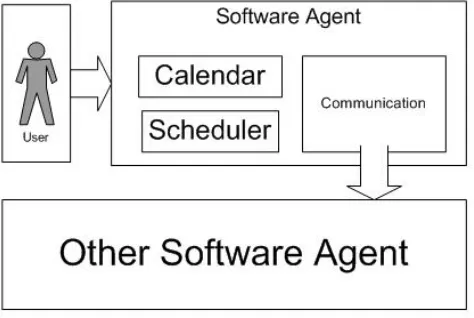
The system architecture is presented in this section. The multi agent meeting scheduling system architecture have been designed and developed using the layer architecture. The layers of VOMAS have been added for the verification and validation of the proposed Multi Agent Meeting Scheduling Simulation Model. The system architecture and the working of the main components of the meeting scheduler agent are presented. The three main components of the software agent are calendar, scheduler and the communication components.
Fig. 1 System Architecture of Multi Agent Meeting Scheduling
The meeting agent communicates and coordinates with each other through a Negotiation protocol. The meeting agent sends a message with the help of the Negotiation protocol to the meeting attendee. The message contains a data and time slot, availability and other parameters. The other parameters contain the string information which will not be utilized during the Negotiation. When the other meeting agents receive the message, these agents check their personal calendar and mark some time and send the message back to the initiator meeting agents. If the available time is rejected by the agents, the best or nearest time and date are provided by that agent.
As the attendant agent receives the message of containing the date and time, the agent check that is the meeting date and time accepted by other agent or not. The attendant agent also checks the based available time marked by the other agents. In some cases, the agent main attach the priorities with the message. If the meeting data and time are rejected by the large number of agents, the attendant agent generates new date and time for meeting. This process is continuous till the specific time is negated between the agents. The time is confirmed through the email or SMS alerts send to the user.
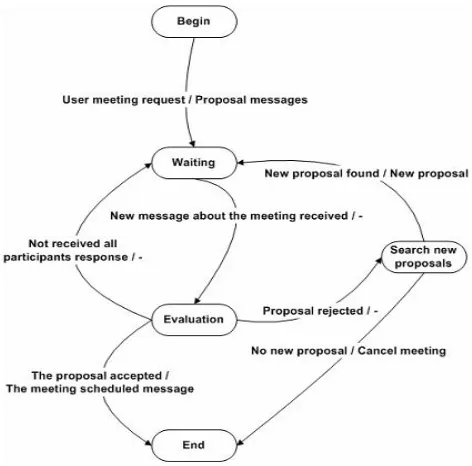
We use the state transition diagram to describe state evolution of agent during the negotiation protocol. For each transition, there is a input and output message. When a software agent is in the initial state, it receives a meeting scheduling request from its user. It sends a proposal message to the invitee agent and the agent enter in waiting state on a newly received message the agent passes it into an evaluated and the presence of certain condition are checked it all the reply are not received the agent goes back in waiting state. If message from the entire attendant are received and the proposed time is accepted it sends the confirmation message to the entire attendant and goes to the end state. If the proposed is rejected, then it will go to search a new proposal system.
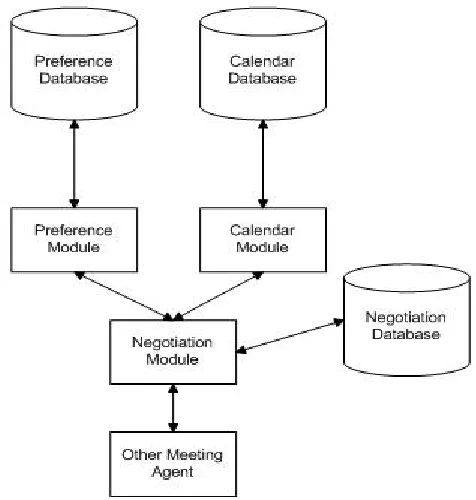
Fig. 3 Internal Architecture of Scheduler Agent
The architecture of the scheduler agent consists of the following components:
Calendar Module
Calendar Database
It contains personal calendar information.
Preferences Module
This module receives request from the negotiation module and from the user interface to query users’ preferences about calendars and meeting.
Preference Database
It holds user’s meeting preference as it provides information on calendar days or time interval when the user wants no meeting
Negotiation Module
It receives request and data as input from the user and coordinates the scheduling process by communication proposals to other agent in the system it also negotiates with other agent on their further meeting request as on invite it keeps the information that it receives from other agent for a certain meeting scheduling session at the negotiation database and use them to produce a new meeting time proposal and counter meeting time proposal. If acting as an invitee it produces acceptance and rejection respond to other agent.
Negotiation Database
This database holds the information gathered from the message of other agent for meeting scheduling session. This negotiation module uses these data to reason about other calendar information
Verification and Validation
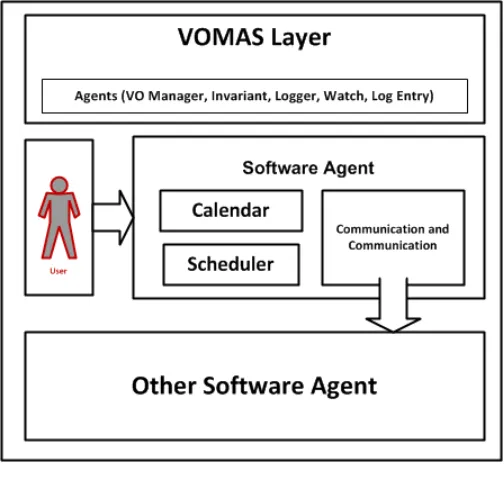
The simulation of Multi Agent Meeting Scheduling system contains new agent of the VOMAS approach which have been added for the verification and validation (V&V) of the simulation [22]. Each agent in the simulation has to perform different tasks and activities. There are five main agents which have be implemented in the multi agent meeting scheduling for the verification and validation purpose these agents includes “VO Manager, Invariant, Logger, Watch, Log Entry”. These agents have been developed on the research conducted by [23].
Fig. 4 Virtual Overlay Multi-agent System
Evaluation
In the multi agent meeting scheduling system, different meeting scheduling agents were located on different network peer. The software agent communicates with each other over the network in order to schedule meeting in a distributed environments.
The verification and validation of the proposed solution have been based on number of experiments. Different parameters have been utilized for the verification and validation (V&V) of simulator
Testing of the simulator includes parameters such as “duration, number of meeting agent scheduled, number or location where the meeting can be held”. The scheduling process is simulated between 60-80 software agents that act on the behalf of their users. Each agent owns a free available time slot depending on the meeting is to be scheduled in the next 1, 2 or 5 days.
Experiments
These results have been extracted from the both agents deployed in the simulation model. These experiments are utilized to find the relationship between the different components.
Fig. 5 Number of Meeting agents Vs. Agents accepted meeting time
The experiment was conducted to calculate the acceptance rate of the meeting agents. There are one hundred experiments which have been conducted to calculate the probability of the acceptance rate of agents which have accepted the time. It is analyzed from the results that the experiment have been successful.
0 50 100 150
1 18 35 52 69 86
I n d e x
V a l u e
Number of Experiments
Fig. 6 Number of meeting agents Vs. Free time slots
The experiment was conducted to analyze the meeting agents and the available free slots. It can be analyzed from the experiment that the meeting agents have direct proportion with each other. As the free slots increases, the meeting agents also increases.
Fig. 7 Number of Agents accepted and time intensity
The time intensity is considered as the core parameter. The time intensity measures the time, the agents take the decision to accept and reject the time slots. It can be analyzed from the graph that each group of agent takes different times. It can be assumed that the time intensity parameter doesn’t depends upon any other parameter but it still have a linkage.
0 50 100 150
1 18 35 52 69 86
I n d e x V a l u e
s Number of Experiments
Number of Meeting Agents Meeting Agent Free Time Slots 0 50 100 150
1 16 31 46 61 76 91
In d e x V a lu e
Number of Experiments
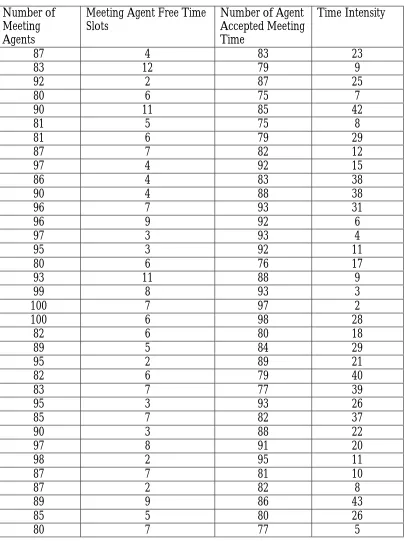
Table 1 Simulation Results
Number of Meeting Agents
Meeting Agent Free Time Slots
Number of Agent Accepted Meeting Time
Time Intensity
87 4 83 23
83 12 79 9
92 2 87 25
80 6 75 7
90 11 85 42
81 5 75 8
81 6 79 29
87 7 82 12
97 4 92 15
86 4 83 38
90 4 88 38
96 7 93 31
96 9 92 6
97 3 93 4
95 3 92 11
80 6 76 17
93 11 88 9
99 8 93 3
100 7 97 2
100 6 98 28
82 6 80 18
89 5 84 29
95 2 89 21
82 6 79 40
83 7 77 39
95 3 93 26
85 7 82 37
90 3 88 22
97 8 91 20
98 2 95 11
87 7 81 10
87 2 82 8
89 9 86 43
85 5 80 26
87 3 84 33
80 5 77 42
90 8 84 26
90 8 86 14
97 12 95 37
88 9 84 42
84 11 81 43
93 2 87 22
96 6 94 36
94 3 91 10
86 5 84 30
95 12 92 18
92 12 88 37
90 6 86 31
96 10 93 5
85 7 80 26
84 5 80 23
94 7 92 9
93 2 91 20
90 3 88 33
84 8 79 26
88 5 83 33
87 6 85 27
90 7 84 4
98 9 95 18
96 2 92 27
95 6 89 18
88 8 84 30
94 7 90 20
83 3 81 15
82 4 77 32
98 7 94 29
99 4 95 8
86 12 80 33
100 11 97 15
88 11 85 4
99 5 97 10
88 6 86 20
80 11 76 5
94 9 91 28
85 3 80 14
97 8 94 3
84 7 79 42
89 8 85 17
80 6 78 9
82 2 77 38
80 4 77 19
80 6 77 16
98 7 93 35
87 7 85 30
82 12 76 8
91 8 85 13
85 5 83 18
95 7 90 34
100 10 97 34
100 12 97 13
83 10 79 29
81 7 79 41
100 8 95 41
89 10 83 19
94 9 90 30
83 7 77 41
86 5 80 7
88 4 83 17
Conclusion
In the future, we hope to present results of E-VOMAS conceptual framework. The E-VOMAS conceptual framework will be the enhance version of the VOMAS. The E-VOMAS will have number of new agents as compared to the VOMAS.
References
Elisabeth Crawford and Manuela Veloso, "Learning to select negotiation strategies in multi-agent meeting scheduling," in Progress in Artificial Intelligence.: Springer, 2005, pp. 584-595.
Chrysanthos Dellarocas, "Reputation mechanism design in online trading environments with pure moral hazard," Information Systems Research, vol. 16, no. 2, pp. 209-230, 2005. Daniel Massaguer, Vidhya Balasubramanian, Sharad Mehrotra, and Nalini
Venkatasubramanian, "Multi-agent simulation of disaster response," in ATDM workshop in AAMAS, vol. 2006, 2006.
Cristiano Castelfranchi, "Modelling social action for AI agents," Artificial Intelligence, vol. 103, no. 1, pp. 157-182, 1998.
Muaz A Niazi and Amir Hussain, "A novel agent-based simulation framework for sensing in complex adaptive environments," Sensors Journal, IEEE, vol. 11, no. 2, pp. 404-412, 2011.
Leonardo Garrido and Katia Sycara, "Multi-agent meeting scheduling: Preliminary experimental results," in Proceedings of the Second International Conference on Multiagent Systems, 1996, pp. 95-102.
Charles M Macal, "Model verification and validation," in Proceedings of the Workshop on Threat anticipation: social science methods and models, The University of Chicago and Argonne National Laboratory, 2005.
Paul Ormerod and Bridget Rosewell, "Validation and verification of agent-based models in the social sciences," in Epistemological Aspects of Computer Simulation in the Social Sciences.: Springer, 2009, pp. 130-140.
W-T Tsai, Rama Vishnuvajjala, and Du Zhang, "Verification and validation of knowledge-based systems," Knowledge and Data Engineering, IEEE Transactions on, vol. 11, no. 1, pp. 202-212, 1999.
Xiaorong Xiang, Ryan Kennedy, Gregory Madey, and Steve Cabaniss, "Verification and validation of agent-based scientific simulation models," in Agent-Directed Simulation Conference, 2005, pp. 47-55.
R Engelbrecht, A Rector, and W Moser, "Verification and validation," Assessment and evaluation of information technologies, pp. 51-66, 1995.
Levent Yilmaz, "Validation and verification of social processes within agent-based computational organization models," Computational \& Mathematical Organization Theory, vol. 12, no. 4, pp. 283-312, 2006.
Christian Gerber, Jorg Siekmann, and Gero Vierke, "Holonic multi-agent systems," 2011. Raz Nissim and Ronen Brafman, "Distributed Heuristic Forward Search for Multi-Agent
Systems," arXiv preprint arXiv:1306.5858, 2013.
Andreas Lux, "A multi-agent approach towards group scheduling," 2011.
T Logenthiran, D Srinivasan, AM Khambadkone, and HN Aung, "Multi-Agent System (MAS) for short-term generation scheduling of a microgrid," in Sustainable Energy Technologies (ICSET), 2010 IEEE International Conference on, 2010, pp. 1-6. M Bernardine Dias and Anthony Stentz, "Opportunistic optimization for market-based
multirobot control," in Intelligent Robots and Systems, 2002. IEEE/RSJ International Conference on, vol. 3, 2002, pp. 2714-2720.
Sandip Sen and Edmund H Durfee, "A formal study of distributed meeting scheduling," Group Decision and Negotiation, vol. 7, no. 3, pp. 265-289, 1998.
Gilson Yukio Sato, Hilton Jose Azevedo, and Jean-Paul A Barthes, "Agent and multi-agent applications to support distributed communities of practice: a short review," Autonomous Agents and Multi-Agent Systems, vol. 25, no. 1, pp. 87-129, 2012. David E Irwin, Laura E Grit, and Jeffrey S Chase, "Balancing risk and reward in a
market-based task service," in High performance Distributed Computing, 2004. Proceedings. 13th IEEE International Symposium on, 2004, pp. 160-169.
Michael J North, Tom R Howe, Nicholson T Collier, and Jerry R Vos, "A declarative model assembly infrastructure for verification and validation," in Advancing Social Simulation: The First World Congress, 2007, pp. 129-140.
Muaz A Niazi, Amir Hussain, and Mario Kolberg, "Verification & validation of agent based simulations using the VOMAS (virtual overlay multi-agent system) approach," in MASS at Multi-Agent Logics, Languages, and Organisations Federated Workshops (MALLOW), vol. 494, 2009.
Uri Wilensky. (1999) NetLogo. [Online]. http://ccl.northwestern.edu/netlogo/
Gerd Kortuem et al., "When peer-to-peer comes face-to-face: Collaborative peer-to-peer computing in mobile ad-hoc networks," in Peer-to-Peer Computing, 2001. Proceedings. First International Conference on, 2001, pp. 75-91.
Muaz A Niazi, Qasim Siddique, Amir Hussain, and Mario Kolberg, "Verification \& validation of an agent-based forest fire simulation model," in Proceedings of the 2010 Spring Simulation Multiconference, 2010, p. 1.
Nicholas R Jennings, "On agent-based software engineering," Artificial intelligence, vol. 117, no. 2, pp. 277-296, 2000.
Ciaran Faircheallaigh, "Making social impact assessment count: a negotiation-based approach for indigenous peoples," Society and Natural Resources, vol. 12, no. 1, pp. 63-80, 1999.
Xiao Feng Yin, Li Pheng Khoo, and Chun-Hsien Chen, "A distributed agent system for port planning and scheduling," Advanced Engineering Informatics, vol. 25, no. 3, pp. 403-412, 2011.
Mohammad Amin Rigi and Farid Khoshalhan, "Eliciting user preferences in multi-agent meeting scheduling problem," International Journal of Intelligent Information Technologies (IJIIT), vol. 7, no. 2, pp. 45-62, 2011.
T Logenthiran, Dipti Srinivasan, and Ashwin M Khambadkone, "Multi-agent system for energy resource scheduling of integrated microgrids in a distributed system," Electric Power Systems Research, vol. 81, no. 1, pp. 138-148, 2011.
Laura Klein et al., "Coordinating occupant behavior for building energy and comfort management using multi-agent systems," Automation in Construction, vol. 22, pp. 525-536, 2012.