Caroline M. Eckardt. Meeting the Information Needs of Studio Art Students in the Academic Library: A Survey Conducted at the University of North Carolina-Chapel Hill. A Master’s Paper for the M.S. in L.S. degree. November 2014. 32 pages. Advisor: Barbara B. Moran.
This study looks at the information-seeking behaviors of students enrolled in studio art courses at the University of North Carolina-Chapel Hill and the students’ perceptions of the effectiveness of the library instruction session within their art courses. In an effort to contribute new findings to the established discourse on this topic, surveys were
distributed to graduate and undergraduate students to determine similarities and
differences in behaviors and perceptions. The results of the survey echo the findings of earlier literature on the information-seeking behaviors of studio art students, reinforcing the idea that this population seeks creative inspiration for their works from a variety of sources. Survey results also reveal that a majority of responders have attended library instruction sessions as part of a studio art course and have found these sessions useful in various ways when conducting research for art-based projects.
Headings:
Art/ Information services
Art research
Information-seeking behavior
MEETING THE INFORMATION NEEDS OF STUDIO ART STUDENTS IN THE ACADEMIC LIBRARY: A STUDY CONDUCTED AT THE UNIVERSITY OF
NORTH CAROLINA-CHAPEL HILL
by
Caroline M. Eckardt
A Master’s paper submitted to the faculty of the School of Information and Library Science of the University of North Carolina at Chapel Hill
in partial fulfillment of the requirements for the degree of Master of Science in
Library Science.
Chapel Hill, North Carolina
November 2014
Approved by
_______________________________________
Table of Contents
Introduction……….……… 2
Literature Review……….……5
Information needs of student artists……….…5
The library instruction session as it applies to Studio Art……….……..8
Methodology……….….13
Survey Findings……….17
Graduate Participants’ Results………..……….17
Undergraduate Participants’ Results………..20
Discussion of Findings………..……….24
Conclusion……….28
References………..………29
Introduction
As a graduate research assistant in the Sloane Art Library focusing on reference
and instruction, I see many people come through the doors of the library seeking out
information: undergraduates in art history courses needing help with their formal analysis
papers, students in introductory level courses coming in for library instruction, Ackland
Art Museum docents gathering information for their tours on photography, visiting
researchers utilizing the vast collection of art resources the Sloane Art Library has to
offer. Some are able to locate the resources they need on their own with ease, while
others seek help from the librarians and assistants in learning how to find various
materials that might be helpful in their research.
There is one type of library patron that continually interests me, though: the studio
art student. In my time working at Sloane Art Library, I have come to realize I have not
interacted with them as often as I do with other types of patrons. There have been
seemingly few studio art classes coming to the library for instruction, an area of
librarianship about which I feel very strongly. When these students do come to the
library, they sometimes sprawl out in the stacks with piles of books surrounding them as
they scribble in notebooks, while at other times, they pop in and out after quickly
scanning images. In my own judgment, they seem to be much more cautious and
independent in terms of conducting their own research without assistance from
surrounding the student enrolled in studio art courses that lies at the crux of this study:
how do students enrolled in studio arts courses conduct research that informs their work,
and how can an art library, in particular the instruction session, fit in with this process?
One of the goals in any academic library is to satisfy the research and information
needs of its intended user group. Each academic discipline has its own set of
particularities and challenges associated with it that the library must rise to and meet to
ensure its user population is being fully served to the best of the library’s ability. Studio
art students are a particular kind of user group whose information needs are not
necessarily met in the traditional ways. In creating their artistic works, the research
process for this group seems to be much more serendipitous than methodical and
conducting studio art “research” can be defined differently according to varying user
personalities; both of these can be very individualistic processes. No two artists have the
same information needs, nor will they seek that information in the same ways.
However, the importance of the instruction session still needs to be underscored
when discussing the creative research in which these students are partaking. It cannot be
forgotten that the members of this particular group are first and foremost students, who
are continuously learning and refining their research skills throughout their academic
careers, and librarians need to be prepared to help with this task, whether it is more
“traditional” research or something more out-of-the-box. Using myself as an example, I
am certainly more comfortable helping a student studying art history find a source for an
academic paper than assisting an artist find something to inspire his or her next art piece
for a class assignment. It needs to be understood how these students view the library in
process. It is the intention of this study to look at the information needs of the studio art
student, in particular the needs of those students studying at the University of North
Carolina at Chapel Hill (UNC-CH), and how the academic library is able to serve those
Literature Review
The literature review is divided into two sections and will address the topics of the
information needs of student artists and the library instruction session as it applies to
studio art.
Information needs of student artists
Literature concerning the information needs of student artists begins in the
mid-1970s with publications by Toyne concerning the information-seeking behavior of
student artists at the Falmouth School of Art in Cornwall, England (Toyne, 1975 and
1977). Toyne was the first librarian at Falmouth, which existed without a library for its
students from its founding in 1902 until 1967, when Toyne was hired to build and
manage the collection. His writings on the information needs of student artists were the
first of their kind, and featured simple surveys to gauge what the students would need and
want to help them with their art. His later publication titled “A philosophy for Falmouth”
advocates for libraries to “give stimulus and support to the whole spectrum of the
students’ work,” meaning collections should be built to not only serve the students’
physical activities as artists, but also to fuel their inspirational needs that are many times
beyond the traditional “art” scope (Toyne, 1977, p. 25).
Pacey, an art librarian at Preston Polytechnic, worked in a similar vein as Toyne.
Whereas Toyne was more systematic in his approach to gauging and reporting on
students’ needs, Pacey used anecdotes throughout his article to convey the information
conveys a similar message to Toyne, in that he stresses the idea of being able to provide
art students with creative stimuli and visual information across a wide variety of subjects;
this idea of providing creative stimuli is emphasized heavily in the early literature
surrounding this topic and will continue to resurface in much of the literature that
follows. Pacey also made note that these students were seeking out a great deal of visual
material in comparison to text-based resources, so much so that the language the
materials were written in was not necessarily important. In addition, he found that
browsing the collections was an important component in the student artists’ method of
research. (Pacey, 1982)
Frank went into great detail in her investigation of student artists in Minnesota
and their use of the library (1999). The main questions that guided her study were “What
are student artists seeking? What do they need? Why are they searching?” (Frank, 1999,
p. 445). In interviewing a selection of both art students and professors from numerous
colleges and universities across Minnesota, Frank learned a great deal about these user
groups. Frank first spoke with the professors to determine, from their standpoint, why
students were seeking information in the library setting; these professors made mention
of students seeking “creative stimulus” (Frank, 446) in the materials found at the library,
as well as a basis for comparison with works being created and exhibited in the
contemporary art world.
When Frank transitioned from speaking with professors to interviewing students
about their general use of the library, the studio students communicated that they more
“discovered the library” than was it presented to them through their studio art classes;
session, but learned through their own efforts what the library held and how it could help
in their development (1999, p. 447). The author also established that studio art students
mainly used the library through browsing its collection rather than conducting
pre-planned searches. They were not necessarily looking for specific items in most cases, but
for items that provided, as their professors previously stated, “creative stimulus.” This
point was stressed greatly throughout the article.
Frank also identified three kinds of materials that studio art students were
primarily looking for when they visited the library, the first being artworks, or images,
more generally. Many of these students used the examples as inspiration for their own
creative works, but they also referred to these images as a way to build a base knowledge
in the discipline. The second area that students sought information in was art narratives
and texts; they used these chiefly to learn ways in which to talk about art, either their own
or work created by someone else. The last major area in which studio students were
interested when they visited the library was more general materials that serve as
influences for their art. These materials included periodicals, newspapers, reference
items, audiovisual objects, and fictional texts, such as novels (Frank, 1999, p. 448-449).
More recently published was Bennett’s “Bringing the studio into the library:
addressing the research needs of studio art and architecture students.” Bennett, a librarian
at Yale University’s Art and Architecture Library, was struggling with ways to advertise
the library’s services and bring in studio art and architecture students to the library. Her
consideration of the studio art student echoes some of the issues raised by Frank and
later, by Mayer; early in her article, she stated, “The unassuming studio student might
(Bennett, 2006, p. 38). In the article, Bennett relayed the results of polling the needs of
her students and also provided ways in which she inserted herself into the studio art and
architecture courses (and their syllabi) to better serve the population.
In terms of surveying the studio art students, primarily second year MFA
candidates, and their information needs, Bennett found that these students were interested
in seeking more “practical” information, such as help finding grants and fellowships or
information regarding grant writing, issues surrounding copyright and digital images, and
free resources available to them after they graduated and no longer had access to the
resources provided by Yale (2006, p. 39). These are new information needs that have not
been addressed in previous literature, as many texts have focused on the undergraduate
student as opposed to the graduate student. Bennett also collaborated with faculty and
helped them incorporate the library more into classes’ syllabi and assignments, thereby
requiring students to attend library instruction sessions as necessary components of the
course. In these sessions, the studio art and architecture students learned of various
resources available to them and they were taught certain skills that would be beneficial in
completing future assignments.
The library instruction session as it applies to Studio Art
The library instruction session, or more simply the library session, is an important
component in meeting the information needs of any user group. During these sessions,
students can be introduced to new ways of conducting research, particularly within a
specialized collection, such as the collection of the Sloane Art Library at UNC-CH; they
can also be introduced to the collections themselves, or in this instance, students can learn
practice. The literature surrounding this topic has been more recently published compared
to the general information needs of this user group and in comparison, is considerably
less.
At Western Carolina University (WCU), the librarian-professor team of
Zanin-Yost and Tapley observed studio art students throughout their creative process and
determined that “students tend not to find the process of learning and creating art
compatible with library research because the majority have not learned how, or been
encouraged, to meld the two” (Zanin-Yost and Tapley, 2008, p. 40). In their article
“Learning in the art classroom: making the connection between research and art,”
Zanin-Yost and Tapley highlighted some the issues they saw at their institution concerning
student artist research; specifically, students at WCU needed to learn how to use
resources provided by their library to be more successful in their work, and instructors
needed to express to their students how important it is to conduct research as part of their
artistic practice. The authors also pointed to the idea that instructors cannot just assume
that students know how to conduct research already.
Zanin-Yost and Tapley highlighted ways in which a librarian would be able to
help mitigate these issues, namely in working more closely with faculty to make the
library experience more meaningful to the students. For example, before research
assignments are given to a class, students partake in a library session to learn how
research is conducted so they at least have a base understanding of what it is they are
expected to do within that field. Not only should students attend these sessions as part of
their courses, but they should attend them with some level of frequency to reinforce these
Especially enlightening was Mayer’s article “Embedding information literacy into
a studio art course” (2010). In this text, Mayer, who serves as an associate librarian
specializing in the areas of Fine Arts and Women’s Studies at the University of
Wyoming- Laramie, outlined the survey she conducted in 2009 concerning information
literacy and library instruction as it pertained to studio art students, namely how libraries
were leading these instruction sessions to this group with specialized needs. She collected
statistics from both national and international institutions.
Several elements of Mayer’s study were particularly interesting. She looked at
the common topics covered within an instruction session and analyzed the responses
received. Common topics (and the percentage of librarians who taught them) included:
art-related databases (83%), how to locate images (75%), searching techniques and
concepts (65%), evaluating information sources for credibility (64%), how to define a
research question/problem (48%), interdisciplinary resources (41%), legal and ethical
issues (43%), open-access resources for post-graduation (23%), visual literacy (19%),
and professional-related competencies (17%) (Mayer, 2010, p. 150). The topics covered
do appear to be “common” enough, to use Mayer’s wording, but what is surprising is the
lack of attention paid to the studio art student’s need of browsing, as mentioned by
authors such as Toyne, Pacey, and Frank. Browsing the collection as a way of gathering
inspiration is such a large component of the creative process that many professors, even
within the art department at UNC-CH, require their students to do so as part of various
studio classes. While the librarians who responded to Mayer’s survey may have
considered browsing under the more general topic of “searching techniques” and
separate skill, especially as it applies to studio art students, that should be included as its
own element in an instruction session.
Other elements of note in Mayer’s study were the challenges librarians feel they
face in trying to provide instruction to this group of students, as well as the lack of
assessment in determining the effectiveness of the instruction (2010, p. 151-152). In
terms of the challenges, some librarians cited lack of support from faculty in
incorporating the library and information literacy into their coursework, as well as
students finding difficulty in applying the skills taught within a library session to their use
of art techniques and finding inspiration for their work. Indeed, both are challenges in
developing and delivering to this audience that librarians must work to overcome.
The lack of assessment in determining the effectiveness or impact of such a
session was surprising detail. From the results collected, 55% of institutions surveyed do
not conduct any type of assessment following their instruction sessions (Mayer, 2010, p.
151). That is a significant percentage, and may explain some of the challenges librarians
face from both faculty and students, as described above. Without polling the students and
seeking their opinion of which elements of an instruction session either work or do not
work for them, or asking what they would like addressed in those same sessions, there
will continue to be dissatisfaction, ignorance, or both coming from those students
regarding the library and how it can fit in with their studio art education.
In “Touch, see, find: serving multiple literacies in the art and design library,”
Wilson and McCarthy emphasized the difficulty student artists and designers can
sometimes have in the context of the library instruction session because of their
tend to have a deep-seated aversion to, or fear of, the library and research in general”
(Wilson and McCarthy, 2010, p. 183). Many of these students tend to be more visual
learners, and librarians working with this user population should think outside the box for
ways that might connect the idea of performing research with the students’ own artistic
needs. In the example they provide, librarians began the library session by asking
students to draw their interpretation of the information-seeking experience. As a
population that “fears” the library and performing research, this task introduced the idea
of performing research to art and design students in a way that was more familiar to them
and may have made it less intimidating as they visualized, and then verbalized, their
interpretation of the experience. This also gave the librarian an opening to address the
ideas of performing research, and the research process more generally, and in ways that
are more recognizable to the student.
While the literature available on these related topics is not necessarily abundant, it
is thoroughly researched and includes studies on which generalizable information can be
gleaned. In all the studies, the methods student artists use to conduct research and gain
inspiration for their creative works appear to be well understood, while the ways in which
Methodology
In attempting to address the questions of how students conduct research for their
studio art courses and how the library instruction session plays a part in that, I used the
above literature review to inform and shape a survey (see Appendix A) distributed to
graduate and undergraduate students enrolled in studio art courses at the University of
North Carolina-Chapel Hill (UNC-CH). In conducting my research in this manner, I was
able to draw upon past investigations of these topics and contribute new findings. From
there, I compared established research with the reality of the local population, either
confirming past research or open up new avenues for librarians to consider.
The studio art program at UNC-CH is a nationally ranked program that offers
degrees at both the graduate and undergraduate levels. At all levels, students are
encouraged to “develop both skill acquisition and a personal creative vision” and explore
working in a variety of media including, but not limited to, painting, drawing, ceramics,
photography, sculpture, and mixed media. Graduate students focus on preparing for
careers as professional artists, as well as teaching positions related to their media
emphasis, while “refining the intellectual content within the work.” (University of North
Carolina at Chapel Hill Art Department)
The decision to craft a survey was not an easy one. In reading through the
published literature, it became evident that while researchers were interested in how this
population conducted research, the literature concerning students did not explore a
population being studied is university students, who enter into higher education with a
varied skill set; they continually learn and modify this skill set throughout their time at
their respective university or college. I came to the decision that the best way to
understand this user group would be to distribute a survey and get a first person response
from the population being studied.
The survey itself is concerned with understanding what student artists use for
inspiration in their creative works and how they conduct their research. Questions seek
out what materials students use in their research and if they use the library to access these
materials. The survey also asks if the library instruction session played any part in their
research process, and if it did, was the session helpful to the student. These were gaps I
identified in previously published literature.
The survey conducted was a pen-and-paper survey that was distributed to students
during class time with prior approval and cooperation with the course instructor. Classes
were chosen to participate in this survey based on several factors. These included class
level (introductory, intermediate, advanced/graduate) and artistic medium. This was done
to ensure both a varied response from students and that one particular group was not
being oversampled. Another factor considered was the scheduled meeting times of studio
art classes. Because this was a paper-based survey, classes chosen to participate were
limited to those that fit within the schedule and time constraints of the principal
investigator.
This survey was conducted from October 21 to October 29, 2014. In all, 6 studio
art classes at UNC-CH were chosen and able to participate in this survey out of 30
of the survey, students were informed of the intent behind the survey and that
participation was completely voluntary, but limited to those over the age of 18 due to
parental consent stipulations; of 70 distributed surveys, 66 were completed for a response
rate of 94.2%. In seeking responses to this survey, both graduates and undergraduates at
UNC-CH were surveyed. This was done to understand the similarities and differences in
their needs and perceptions of how the library serves them, as well as seek possible ways
in which the library might be better able to serve these two populations moving forward.
Approaching this study through both a literature review and distributed survey
had several advantages. While somewhat narrow in scope in comparison to other areas of
library and information science research, the literature that is available concerning the
information needs of student artists, and the associated instruction sessions that can
accompany this discipline, are well-researched and provide a solid grasp on the evolution
of understanding in this area. In addition, the survey itself allowed for a direct response
from the population being studied. Students were able to freely express their experiences
and opinions, giving librarians working with this group a glimpse into how this particular
group operates in the context of the library and how they view the effectiveness of the
library in their creative process.
As with any method, there are certain disadvantages associated with conducting a
survey. This survey was delivered to participants via paper-and-pencil and did not allow
for follow up clarification to the answers supplied by the participants. The survey also
included many questions that were open-ended, which, while allowing students to explain
generalizability of the results. In addition, due to schedule and time constraints of the
principal investigator, not all studio art courses participated in the survey.
This study is not meant to be generalizable because it is based on only a small
sample of the population being studied. It does, however, contribute to the discussion
surrounding the topic of serving the needs of studio art students. While some of the
responses may seem anecdotal in nature, they represent the real experiences of students
Survey Findings
In conducting this survey, responses were gathered from 66 students enrolled in
studio art courses at UNC-CH. Question One of the survey asked student to identify their
student status at the University. Of these 66 responses, 13 self-identified as being a
graduate student, while the remaining 53 self-identified as undergraduates. For
comparison purposes, survey results were divided and will be reported in two categories:
graduate and undergraduate. The questions contained in the survey will be addressed
below individually.
Graduate Participants’ Results
Question Two of the survey asked students to identify and list any and all
materials used to gain inspiration and conduct research for his/her own artworks.
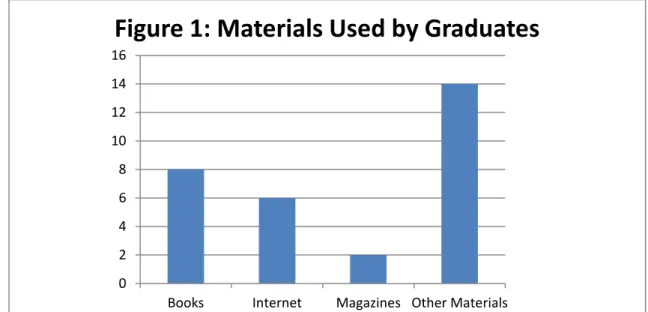
Graduate students identified a wide selection of materials used to gain inspiration and
conduct research for their own artistic projects (see Figure 1). The most popular
responses were books (8 responses) and the Internet (6 responses). More precisely in
reference to books, responders offered more specificity in terms of subject matter,
answering with: photography; painting; sculpture; drawing; contemporary art; landscape;
relevant artists- both contemporary and historical; catalogues; and artist books.
Magazines received 2 responses. Other inspirational materials used that received one
response included: films/documentaries; video interviews; art blogs; family history;
family stories; talking and listening; observations and interactions with people;
philosophical and theoretical texts; art making materials, including oil paint, pencils/pens,
paper, canvas, panels, camera equipment, lighting equipment, resin; nature; works of art;
and relevant readings/texts.
Question Three asked students if they used the UNC Libraries to locate/access
these materials. In gaining access to these materials, 11 graduates responded saying they
use the UNC Libraries to access these materials, while 2 graduates responded saying they
do not use the UNC Libraries.
Question Four asked if students have participated in a library session as part of a
studio art course. All 13 graduate students reported as having participated in a library
session as part of a studio art course. Question Five asked if there was a specific
assignment being worked on when the studio class had a library session. Again, all 13
students were working on a specific assignment when that studio course visited the
library for an instruction. Question Six asked if students found this session valuable in
helping to complete research. Of the 13 responders, 12 found the session useful in 0
2 4 6 8 10 12 14 16
helping to complete research, while one graduate student believed the session was
unhelpful.
Question Seven asked students to identify how they found this session valuable in
the student’s own research, either generally or for the assignment being completed. Many
students commented on how helpful the session was in learning how to navigate the UNC
Libraries’ website, how to carry out more effective search strategies when completing
research, and which resources and services the library provides to students, including
freely available online resources and services like interlibrary loan (ILL) and
CarolinaBLU, UNC Libraries’ document delivery system.
Question Eight asked students to identify any faults they perceived in the library
session. Several students commented that it was difficult to feel engaged with the session,
one student stating s/he has a “hard time following along unless I do it or it’s one-on-one”
and another student commenting there was “too much clicking and talking- not engaging
enough.” In the same vein another graduate student offered that “talking about how we
could hypothetically use the resources doesn’t stay in my brain as well as if I am actually
seeking something and being guided through in a way that’s specific to my research.”
Question Nine asked students to state any ways in which they think the library
and/or the library session can better serve the students’ general information needs as
students and artists. The graduate students offered several ideas on how the library and
the library sessions might be able to serve their needs as practicing artists. Several
mentioned the difficulty of conducting research as contemporary artists, as many
resources needed for their research are not available in hard format (book) and that they
field of study; one student in particular commented “most students these days, including
myself, prefer electronic resources and communication. Maybe implement that a little
more?” Other ideas offered include a more visual, intuitive search interface that offers
suggestions for related resources, like what is done on Amazon.com or Pandora Internet
Radio, as well as a collection of resources related to artistic opportunities, such as
fellowships and residencies. One graduate stated: “it would be wonderful to have a vetted
aggregator of artistic opportunities- residencies, calls, proposals, openings/positions.”
Question Ten asked students to provide any additional comments they wished to
share. In general, graduate students seemed satisfied and very appreciative of the
information offered during the session and the services provided by the library,
particularly by the staff at the Sloane Art Library. As one graduate responded, “Thanks to
the awesome Sloane Art Library staff- consistently positive and helpful!”
Undergraduate Participants’ Results
Question Two of the survey asked students to identify and list any and all
materials used to gain inspiration and conduct research for their own artworks.
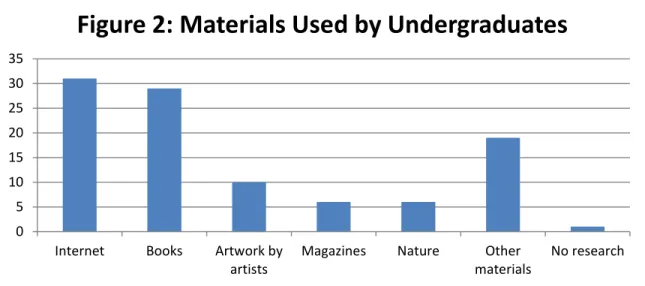
Undergraduates also identified a wide variety of materials used to gain inspiration and
conduct research in their artistic practice (see Figure 2). The most popular responses were
the Internet (31 responses) and books (29 responses), followed by artworks by other
artists (10 responses), magazines (6 responses), and nature (6 responses). Related
responses that would fall under the umbrella term of the “Internet” include Pinterest (2
responses), Tumblr (3 responses), artist websites (3 responses), social media (2
responses), blogs (2 responses), YouTube (1 response), art museum websites (1
used that received one response include: class lecture notes; conversations with people;
graffiti; journal articles; campus art; art galleries; images; video/film; cover art; “the
void;” fashion magazines; art making materials, such as pencils, oils, canvas; works of
fiction, such as fairy tales and myths; music; old photographs and pictures; sentimental
objects; television; “things around me;” and daily life. One undergraduate responded that
s/he “doesn’t really do research.”
In response to Question Three, 31 undergraduates responded that they use UNC
Libraries to access these materials, although some responders qualified their answers with
“sometimes” or “not often,” while 22 undergraduates responded they do not use the
library to gain access to their materials.
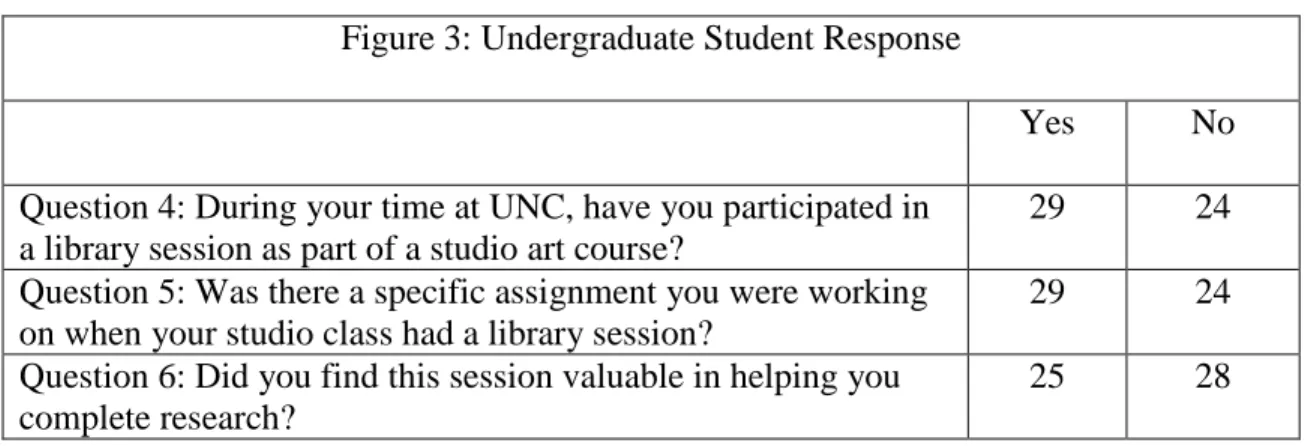
In response to Question Four, 29 undergraduates reported they participated in a
library session as part of a studio art class, while 24 undergraduates did not. Similar
numbers were recorded for Question Five: 29 undergraduates replied there was a specific
assignment, while 24 undergraduates replied there was no assignment or this question
was not applicable as they had not participated in a library session. Question Six saw
some variation in response, as 25 undergraduates replied the library session was helpful, 0
5 10 15 20 25 30 35
Internet Books Artwork by artists
Magazines Nature Other materials
while 28 undergraduates replied it was not. See Figure 3 below for a visualization of
Questions Four, Five, and Six.
Figure 3: Undergraduate Student Response
Yes No
Question 4: During your time at UNC, have you participated in a library session as part of a studio art course?
29 24
Question 5: Was there a specific assignment you were working on when your studio class had a library session?
29 24
Question 6: Did you find this session valuable in helping you complete research?
25 28
Question Seven asked students to identify how they found this session valuable in
the student’s own research, either generally or for the assignment being completed. Of
those students who identified as having attended a library session as part of a studio art
class and found it helpful, they replied with a variety of answers as to how it was helpful.
Several students (7 responses) recorded that it was useful when the librarian pulled books
to look at for their individual classes ahead of time. In these cases, students were new to
the field being studied and these books helped provide “direction and inspiration” for the
assignments they were working on. Other students answered they found the session
helpful in that it introduced them to the UNC Libraries website and resources and
services available to them, including databases, tools, and course pages. Additionally
others noted the session was helpful in exposing them to how to effectively search the
catalog and databases for resources and images.
Question Eight of the survey dealt with the perceived faults in the library session.
the library session. One student wished for a more interactive presentation, while another
student remarked “it just seems easier to use Google.”
Question Nine asked students to state any ways in which they think the library
and/or the library session can better serve the students’ general information needs as
students and artists. Undergraduates offered a few ways in which this could occur. Of
those who reported not having a library session, 4 students requested that their class
actually have a session, and one student went as far to say a library session should be
required in the instance of introductory courses. Another student suggested an
information session specifically for freshmen “so that I would use the library earlier;”
s/he identified themselves as a senior on the completed survey. Other suggestions
include: emphasize using the internet more during the session, especially with digital
media; make more library resources available online; and create a “student review
section” where students can demonstrate how certain books are useful in their own
research/projects.
Question Ten asked students to provide any additional comments they wished to
share. For those undergraduates who have used the library and have attended a library
session, they seem pleased with the services and resources available to them; 3 students
replied that they find the staff at the art library really helpful, and several remarked that
they would use the library in the future. Conversely, 4 students commented they had
never been to the library, with one student declaring s/he did not realize there was an art
Discussion of Findings
The findings of this survey echo several of the conclusions reached in the
published literature, and several of the general points and specific comments deserve
further discussion.
Both graduates and undergraduates utilize a wide array of materials for creative
inspiration and conducting research. Some of those materials are more traditional in
nature, including books and relevant texts/readings, but as technology continues to
develop and artists explore different avenues of inspiration, students are experimenting
with the newer resources available to them.
As Toyne, Pacey, and Frank all point out, students need inspiration for their art
practice in a variety of subjects and in a variety of media, and students who completed
this survey illustrate that this is still holds true today. In addition to a wide assortment of
physical and electronic source material, the graduate students exhibited a higher ratio of
incorporating books and materials more likely to be found within the library into their
creative process; this could be due to the graduate program’s emphasis on conducting
research as part of the students’ artistic development. It should also be noted that all
graduate students who contributed to this survey responded they had participated in a
library session and use the library. It is possible, and likely, that there is a correlation
between this exposure and the integration of print material into their practice.
On the other hand, the undergraduate students displayed a higher ratio of
undergraduates offering “the Internet” as one way in which they seek inspiration for their
work. Also, while graduate students were more explicit with the types of books used,
such as books on photography, painting, sculpture, and artists’ books, undergraduates
were more specific with the types of Internet resources used in their practice, including
Pinterest, Tumblr, blogs, and artists’ websites. Both types of students also seem to turn
equally to more non-traditional materials in conducting research for their artwork,
including lived experiences, conversations with other people, art-making materials, and
sentimental objects.
It is also reassuring to discover a majority of students, both graduate and
undergraduate, use the UNC Libraries, and in particular the Sloane Art Library, to access
these materials: in total 42 of 66 responders answered they turn to the library for these
items. While my initial perceptions were unclear about student artists using the library to
find items, this survey of students confirms that they do indeed use the resources
available to them.
Turning the discussion to the library session, it is again encouraging to discover
such a large majority of students surveyed have participated in a library session as part of
a studio art course: 42 of 66 total responders answered affirmatively when asked. This
suggests that not only do professors in the art department at UNC-CH recognize the
importance of incorporating learned research skills into their classes, they recognize the
importance of performing research as a way to inform one’s creative practice. This is a
finding echoed in Zanin-Yost and Tapley; instructors cannot just assume students know
skills that can be taught and reinforced in working with a librarian during a library
session.
From these library sessions, the elements found most helpful by all students
surveyed were the introduction to the library’s website, various library resources and
services, and how to effectively search for resources. This echoes Mayer’s findings,
where art-related databases (83%) and searching techniques and concepts (65%) were
two of the more common concepts taught during an instruction session. Those concepts
that were less common in Mayer’s research, including legal and ethical issues, visual
literacy and professional-related competencies, did not appear at all in this survey’s set of
responses.
Librarians pulling related books for a specific class to browse and look through
during an information session and gain inspiration for an assigned project was also
believed to be helpful. Wilson and McCarthy advocate for librarians to think outside of
the box when it comes to planning library instruction for art students. While pulling
books is not as out-of-the-box as the example they offer of students drawing their idea of
performing research, I cannot think of another academic discipline where librarians
approach instruction in this manner. This act also echoes the earlier studies of Toyne,
Pacey, and Frank, where the authors comment on the student-artist’s need to browse
materials for inspiration.
Lastly, graduate and undergraduate students offered several plausible suggestions
as to how the library could improve its services, including the library session, for students
enrolled in studio art courses at all levels. One graduate offered the idea of “a vetted
This idea almost exactly reiterates the concern of a graduate student at Yale in Bennett’s
article. In the upper levels of higher education, students are looking for more practical
information, such as available artistic opportunities, and it is within the scope of the
library to at least inform students how to locate these opportunities. Perhaps the library
could cooperate with University Career Services at UNC-CH or other campus resources
to make this a possibility.
Several undergraduates commented on the idea of actually having a library
session for their studio art class, with one student going as far to say that it should be
required in the instance of an introductory course. This seems quite extraordinary for
students to recognize how the library session could be useful to them as students in a
course with a creative emphasis. Both Bennett and Zanin-Yost & Tapley write about the
benefit of incorporating the librarian and an instruction session into the context of a
studio art course. Again, instructors cannot just assume that their students will know how
to do research, especially considering the artistic focus of these courses. Many of the
undergraduate students enrolled in these classes are not actually studio art majors and
simply use the classes to fulfill the general education requirements as established by the
University. In having a librarian involved, students would gain knowledge in not only
how to effectively conduct research, but how to conduct research that would inform their
Conclusion
Simply stated, students taking studio art classes at the university-level have
unique information needs. In looking holistically at both the published literature and the
findings of this survey, it can be daunting to any librarian to not only anticipate those
needs in building a collection of resources that will serve their population well, but then
also deliver helpful instruction on how to conduct effective research using those same
resources, some of which may be very non-traditional in nature.
The survey conducted for this study reached only a small segment of the student
population to be served, that population being all students enrolled in studio art courses at
universities across the country. While it is not meant to be a generalizable survey, I
believe it gives an accurate snapshot of how students enrolled in studio art courses
conduct research for their artistic assignments, as well as how they feel the library session
has or has not been able to contribute to that. In learning about what kinds of information
students seek and how they seek it, which in this case is a wide variety of information
coming through many different media, it is hoped that the library will be better able to
meet their student needs through the collections they offer and library sessions tailored to
References
Bennett, H. (2006). Bringing the studio into the library: addressing the research needs of studio art and architecture students. Art Documentation: Journal of the Art Libraries Society of North America, 25(1), 38-42.
Frank, P. (1999). Student artists in the library: an investigation of how they use general academic libraries for their creative needs. The Journal of Academic
Librarianship, 25(6), 445-455.
Mayer, J. (2010). Embedding information literacy into a studio art course. The handbook of art and design librarianship (p. 145-158). London: Facet Pub.
Pacey, P. (1982). How art students use libraries- if they do. Art Libraries Journal, 7(1), 33-38.
Toyne, D. (1975). Requests at Falmouth School of Art. ARLIS Newsletter, 24, 7-9.
Toyne, D. (1977). A philosophy for Falmouth. Art Libraries Journal, 2(4), 24-30.
University of North Carolina at Chapel Hill Art Department. (2014). Studio Art. Retrieved from http://art.unc.edu/Studio_Art/index.htm.
Appendix A: Survey for Studio Art Students
1. Please indicate your student status: UNDERGRADUATE GRADUATE
2. What kinds of materials do you use to gain inspiration and conduct research for your own artworks? Please list any and all materials.
3. Do you use the UNC Libraries to locate/access these materials? YES NO
4. During your time at UNC, have you participated in a library session as part of a studio art course? YES NO
5. Was there a specific assignment you were working on when your studio class had a library session? YES NO
6. Did you find this session valuable in helping you complete research? YES NO
7. If so, how did you find this session valuable? What sorts of things were covered by the librarian that you were able to use in your own research, either generally or for the assignment being completed?
8. If not, what did you think were faults with the library session?
9. Are there other ways you feel the library and/or the library session can better serve your general information needs as students and artists? For example, are there other kinds of resources you would find beneficial or other ways of delivering information to you?