Hepatitis B Infection, Viral Load and
Resistance in HIV-Infected Patients in
Mozambique and Zambia
Gilles Wandeler1,2,3*, Kalo Musukuma4, Samuel Zürcher5, Michael J. Vinikoor4,6,
Jara Llenas-García7, Mussa M. Aly8, Lloyd Mulenga4, Benjamin H. Chi9, Jochen Ehmer10, Michael A. Hobbins10, Carolyn Bolton-Moore4,6, Christopher J. Hoffmann11,
Matthias Egger2,12, IeDEA-Southern Africa
1Department of Infectious Diseases, Bern University Hospital, University of Bern, Bern, Switzerland,
2Institute of Social and Preventive Medicine, University of Bern, Bern, Switzerland,3Department of Infectious diseases, University of Dakar, Dakar, Senegal,4Centre for Infectious Disease Research in Zambia, Lusaka, Zambia,5Institute for Infectious Diseases, University of Bern, Bern, Switzerland,
6Department of Medicine at University of Alabama, Birmingham, United States of America,7SolidarMed, Ancuabe, Mozambique,8Nucleo do investigacão Operational de Pemba, Pemba, Mozambique,
9Department of Obstetrics and Gynecology, University of North Carolina, Chapel Hill, United States of America,10 SolidarMed, Lucerne, Switzerland,11Johns Hopkins University School of Medicine, Baltimore, United States of America,12 Centre for Infectious Disease Epidemiology and Research, University of Cape Town, Cape Town, South Africa
¶ Membership of the IeDEA-Southern Africa is provided in the Acknowledgments. *[email protected]
Abstract
Background
Few data on the virological determinants of hepatitis B virus (HBV) infection are available from southern Africa.
Methods
We enrolled consecutive HIV-infected adult patients initiating antiretroviral therapy (ART) at two urban clinics in Zambia and four rural clinics in Northern Mozambique between May 2013 and August 2014. HBsAg screening was performed using the Determine1rapid test. Quantitative real-time PCR and HBV sequencing were performed in HBsAg-positive patients. Risk factors for HBV infection were evaluated using Chi-square and Mann-Whit-ney tests and associations between baseline characteristics and high level HBV replication explored in multivariable logistic regression.
Results
Seventy-eight of 1,032 participants in Mozambique (7.6%, 95% confidence interval [CI]: 6.1– 9.3) and 90 of 797 in Zambia (11.3%, 95% CI: 9.3–13.4) were HBsAg-positive. HBsAg-posi-tive individuals were less likely to be female compared to HBsAg-negaHBsAg-posi-tive ones (52.3% vs. 66.1%, p<0.001). Among 156 (92.9%) HBsAg-positive patients with an available measure-ment, median HBV viral load was 13,645 IU/mL (interquartile range: 192–8,617,488 IU/mL) OPEN ACCESS
Citation:Wandeler G, Musukuma K, Zürcher S, Vinikoor MJ, Llenas-García J, Aly MM, et al. (2016) Hepatitis B Infection, Viral Load and Resistance in HIV-Infected Patients in Mozambique and Zambia. PLoS ONE 11(3): e0152043. doi:10.1371/journal. pone.0152043
Editor:Isabelle A Chemin, CRCL-INSERM, FRANCE
Received:January 15, 2016
Accepted:February 22, 2016
Published:March 31, 2016
Copyright:© 2016 Wandeler et al. This is an open access article distributed under the terms of the
Creative Commons Attribution License, which permits unrestricted use, distribution, and reproduction in any medium, provided the original author and source are credited.
Data Availability Statement:Due to ethics restrictions regarding consent to share participant data, data are available upon request. Requests for the data may be sent to Prof Matthias Egger ([email protected]), Dr. Mary-Ann Davies ([email protected]), and Dr. Gilles Wandeler ([email protected]).
Funding:This study was supported by the National Institute of Allergy and Infectious Diseases (Grant number 5U01-AI069924-05) and Fogarty
and 77 (49.4%) had high values (>20,000 UI/mL). HBsAg-positive individuals had higher lev-els of ALT and AST compared to HBsAg-negative ones (both p<0.001). In multivariable anal-yses, male sex (adjusted odds ratio: 2.59, 95% CI: 1.22–5.53) and CD4 cell count below 200/μl (2.58, 1.20–5.54) were associated with high HBV DNA. HBV genotypes A1 (58.8%) and E (38.2%) were most prevalent. Four patients had probable resistance to lamivudine and/or entecavir.
Conclusion
One half of HBsAg-positive patients demonstrated high HBV viremia, supporting the early initiation of tenofovir-containing ART in HIV/HBV-coinfected adults.
Introduction
Chronic hepatitis B virus (HBV) infection is present in approximately 3 million HIV-infected
persons worldwide [1]. HIV/HBV-coinfected individuals are at higher risk of death and are
more likely to develop hepatic complications and to have an impaired immunological recovery
during antiretroviral therapy (ART), compared to HIV-monoinfected patients [2–4]. Although
approximately 10% of HIV-infected patients are estimated to be HBsAg-positive in
sub-Saha-ran Africa (SSA) [5], only few studies have assessed the level of HBV replication and drug
resis-tance in this part of the world.
HBV viral load is a strong predictor of the risk of developing hepatocellular carcinoma and plays an important role in treatment success. Time to HBV suppression under tenofovir (TDF) is delayed with increasing baseline HBV DNA and the risk of persistent viral replication after
two years of therapy is highest with an elevated pre-ART HBV viral load [6,7]. In one of few
published reports on HBV outcomes following TDF-containing ART in SSA, pre-therapy
HBV-DNA was the only factor independently associated with sub-optimal HBV response [8].
In that study, which included 55 HIV/HBV-coinfected individuals from Zambia, HBV geno-type A1 predominated (76%) and only 2 patients had drug-resistance mutations in the HBV polymerase. Although several small studies from other countries in southern Africa have
reported HBV sequencing data among ART-naïve HIV/HBV-coinfected populations [9–11],
no large study has been conducted in Mozambique and Zambia to evaluate the HBV genotype distribution and drug resistance mutations.
We assessed the prevalence of HBV infection in HIV-infected individuals from an interna-tional collaboration including ART programs in Mozambique and Zambia, and performed a detailed analysis of demographic, clinical and virological characteristics associated with high pre-ART HBV DNA. We also studied the distribution of HBV genotypes and the prevalence of
pre-ART HBV drug resistance mutations to add to the scarce data from Southern Africa [9,
12].
Materials and Methods
Study population
Consecutive HIV-infected adults initiating ART at two urban clinics in Lusaka, Zambia, and four rural clinics in Cabo Delgado, Northern Mozambique were enrolled between May 2013 and August 2014. They were classified as HIV/HBV-coinfected if HBsAg-positive. Routine pre-ART assessment consisted of a physical examination and measurements of CD4 cells, liver
supported by an Ambizione-PROSPER fellowship from the Swiss National Science Foundation (PZ00P3_154730). Support for Zambian laboratory capacity building came from the HIV Research Trust. The funders had no role in study design, data collection and analysis, decision to publish, or preparation of the manuscript.
transaminases, creatinine and full blood count according to national recommendations. All data were entered into an electronic database, using the protocol of the International
epidemio-logical Databases to Evaluate AIDS in Southern Africa (IeDEA-SA) [13]. Written informed
consent was obtained from all patients. Ethics approval was obtained from the Biomedical Research Ethics Committee of the University of Zambia School of Medicine, the Institutional Review Board of University of North Carolina at Chapel Hill, USA, and from the Comité Nacional de Bioética para a Saúde, República de Moçambique.
Laboratory analyses
HBsAg was assessed using the Determine1(Alere, Yavne, Israel) rapid test on whole blood
using finger prick sampling. To determine HBV DNA levels, quantitative real-time polymerase chain reaction (PCR) was performed on plasma samples from Zambian participants and on dried blood spots (DBS) from Mozambican participants using the COBAS Ampliprep/TaqMan System (Roche diagnostics, Indianapolis, USA). We recently showed that the use of DBS to
measure HBV DNA level in southern Africa was feasible and reliable [14]. As in our Zambian
laboratory DNA measurements from paired plasma samples were in average 1.59 log higher than those from DBS, we converted DNA values from DBS to generate estimated plasma values using a multiplication factor of 39. DNA extraction and amplification procedures used for DBS
are explained in detail elsewhere [14]. An in-house protocol was used for HBV sequencing:
HBV DNA was extracted using the QIAamp DNA mini kit (Qiagen, Hilden, Germany), a pri-mary PCR covering the codons 18 to 330 of the RT-domain of the Pol gene was conducted
using publically available primers [15] and, if necessary, a nested PCR (codons 83–288) was
performed using published primers [16]. DNA was purified using QIAquick PCR purification
kit (Qiagen, Hilden, Germany). Sanger sequencing was performed using an AB3130 genetic analyzer (Life Technologies, California, USA) and nucleotide sequences analyzed with
Sequencher version 5.0 (Gene Codes Corporation, Michigan, USA). Geno2Pheno (www.
geno2pheno.org) was used to predict HBV genotypes and drug resistances. HBeAg serology was only available from participants in Zambia. Laboratory analyses were performed at the Centre for Infectious Disease Research in Zambia Central Laboratory and at the Institute for Infectious Diseases, University of Bern.
Statistical analyses
HBV prevalence estimates were calculated with 95% confidence intervals (CI). Factors associ-ated with HBsAg-positivity were evaluassoci-ated using Chi-square and Mann-Whitney tests. Associ-ations between demographic, clinical and virological characteristics with the presence of high
HBV viral load (20,000 IU/mL [17]) were evaluated using the Chi-square test. An
AST-to-platelet-ratio-index (APRI) score>1.5 was used to define significant liver fibrosis [18,19].
Fac-tors associated with high HBV DNA level were further explored in multivariable logistic regression analyses adjusted for sex, age, stage of HIV disease and CD4 cell counts. All statisti-cal analyses were performed using Stata software version 13.1 (College Station, Texas, USA).
Results
Demographic and clinical characteristics
Seventy-eight of 1,032 participants in Mozambique (7.6%, 95% confidence interval [CI]: 6.1–
9.3) and 90 of 797 in Zambia (11.3%, 95% CI: 9.3–13.4) were HBsAg-positive. HBsAg-positive
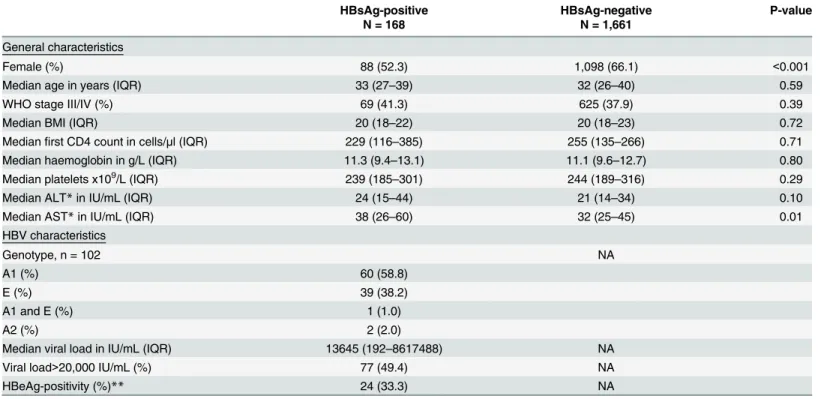
individuals were less likely to be female compared to those who tested HBsAg-negative (52.3%
both groups (Table 1). The results were consistent when comparisons were stratified by coun-try. Median ALT and AST levels were slightly higher in HBsAg-positive patients compared to negative ones.
HBV replication at ART initiation
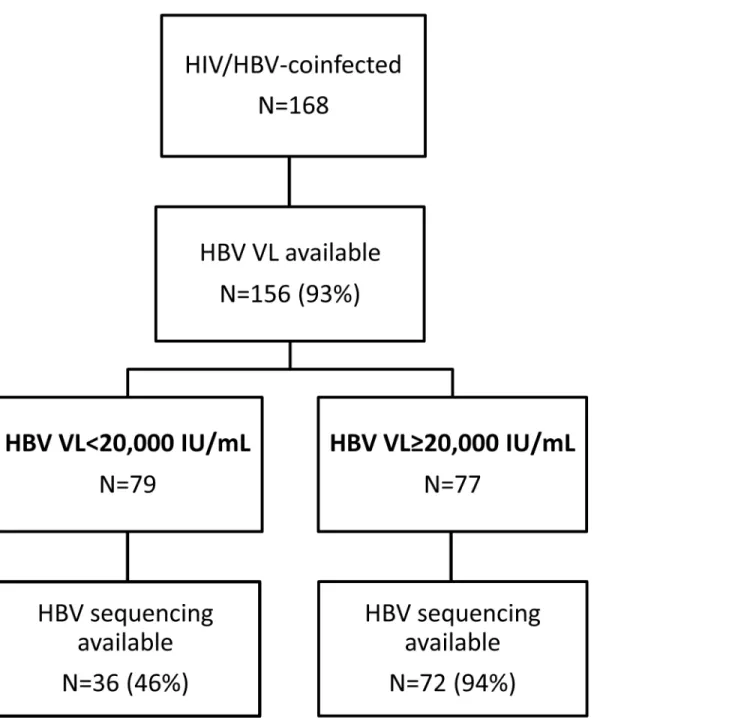
Among HBsAg-positive patients, 156 (92.9%) had an available pre-ART HBV DNA
measure-ment (Fig 1). Median DNA level was 13,645 IU/mL (interquartile range [IQR]: 192–8,617,488).
Overall, 26 (16.7%) had an undetectable viral load (<20 IU/mL) and 77 (49.4%) had high values
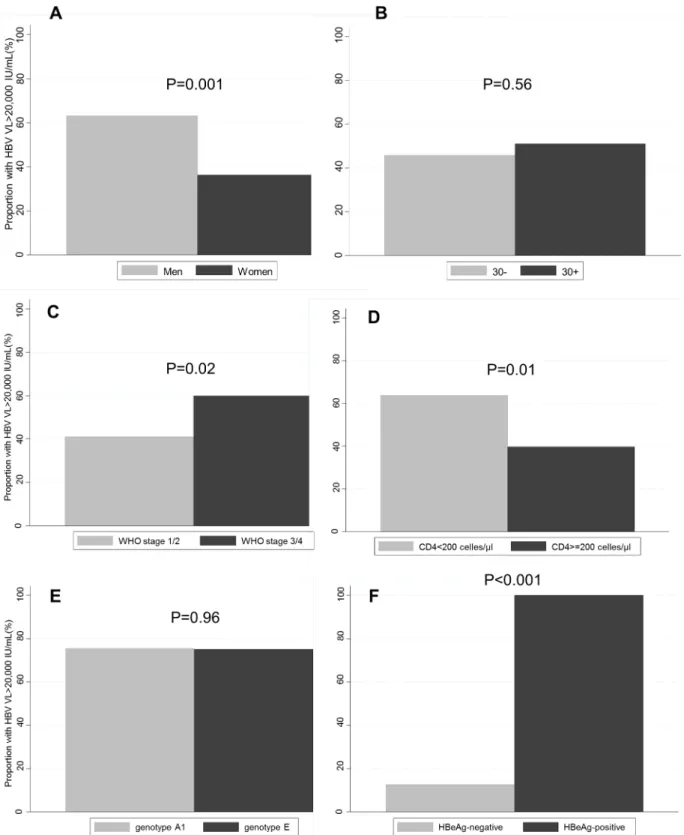
(>20,000 IU/mL). Men were more likely to have high HBV DNA than women (p = 0.01),
whereas the proportion of patients with high DNA was highest in patients with advanced WHO
stage of HIV disease (p = 0.02) and low CD4 cell counts (p = 0.001,Fig 2). Age and HBV
geno-type were not associated with the presence of a high HBV DNA level. Of 72 patients with avail-able HBeAg serology, 33.3% had a positive result. All HBeAg+ participants had an HBV
DNA>20,000 IU/mL, whereas a high HBV DNA level was only present in 12.8% of
HBeAg-individuals (p<0.001,Fig 2). In multivariable analyses, male sex (adjusted odd ratio [aOR]:
2.59, 95% CI: 1.22–5.53) and CD4 cell count below 200/μl (aOR: 2.58, 95% CI: 1.20–5.54)
remained associated with having a high pre-ART HBV viral load.
Median transaminase levels were higher in participants with high HBV DNA compared to
those with low levels: median ALT: 38 IU/mL (IQR: 19–64) in high HBV DNA vs. 18 (12–24)
in low DNA (p<0.001), median AST: 45 IU/mL (32–71) in high HBV DNA and 29 (22–51)
in low DNA (p<0.001). Among individuals with high DNA levels, 8 (13.8%) had an APRI
Table 1. Baseline characteristics, by HBsAg-positivity status.
HBsAg-positive HBsAg-negative P-value
N = 168 N = 1,661
General characteristics
Female (%) 88 (52.3) 1,098 (66.1) <0.001
Median age in years (IQR) 33 (27–39) 32 (26–40) 0.59
WHO stage III/IV (%) 69 (41.3) 625 (37.9) 0.39
Median BMI (IQR) 20 (18–22) 20 (18–23) 0.72
Medianfirst CD4 count in cells/μl (IQR) 229 (116–385) 255 (135–266) 0.71
Median haemoglobin in g/L (IQR) 11.3 (9.4–13.1) 11.1 (9.6–12.7) 0.80
Median platelets x109/L (IQR) 239 (185–301) 244 (189–316) 0.29
Median ALT*in IU/mL (IQR) 24 (15–44) 21 (14–34) 0.10
Median AST*in IU/mL (IQR) 38 (26–60) 32 (25–45) 0.01
HBV characteristics
Genotype, n = 102 NA
A1 (%) 60 (58.8)
E (%) 39 (38.2)
A1 and E (%) 1 (1.0)
A2 (%) 2 (2.0)
Median viral load in IU/mL (IQR) 13645 (192–8617488) NA
Viral load>20,000 IU/mL (%) 77 (49.4) NA
HBeAg-positivity (%)** 24 (33.3) NA
*only available for 66% of the study population **only available in Zambia (n = 72)
NA: not applicable
score>1.5, whereas this was only the case for 4 (6.7%) patients with low HBV DNA levels (p = 0.20).
Drug resistance
Among 102 patients with available HBV sequencing results, 58.8% had genotype A1, 38.2%
genotype E, one patient had a dual A1/E infection and two had genotype A2 (Table 1). In
Mozambique, the prevalence of genotype A1 was higher than in Zambia (72.1% vs. 49.2%). There was no difference in the proportion of HBeAg-positive patients by genotype in Zambia (43.5% in genotype A1 and 60.9% in genotype E, p = 0.24). Three patients showed evidence of
Fig 1. Flow chart of patients included in virological analyses.(HBV: hepatitis B virus; VL: viral load)
Fig 2. Proportion of patients with high HBV viral load (>20,000 IU/mL), by sex (Panel A), age (B), WHO stage (C), CD4 cell count (D), HBV genotype (E) and HBeAg-positivity (F).
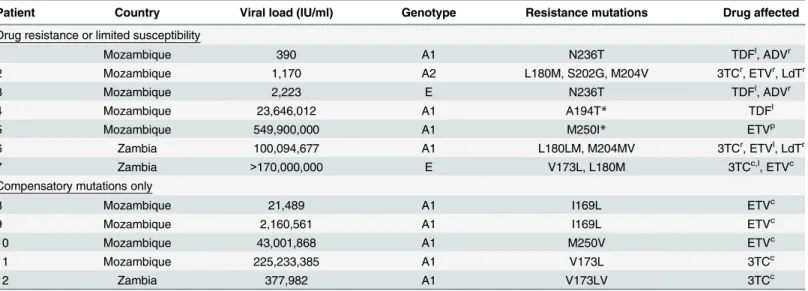
lamivudine (3TC)-resistances, three had potential resistance to entecavir (ETV) and five had
3TC or ETV compensatory mutations (Table 2). Three participants had HBV viruses with
potentially limited susceptibility to TDF.
Discussion
In this cohort of HIV-infected individuals starting ART in two distinct settings in southern Africa, HBV prevalence was 8% in rural Mozambique and 11% in urban Zambia.
Approxi-mately one half of HBV-coinfected patients had an HBV DNA level20,000 IU/mL, with male
sex, low CD4 cell counts and HBeAg-positivity being the most important risk factors for hav-ing a high viral load. Patients with high HBV DNA levels had higher transaminase levels and were more likely to have significant liver fibrosis thank those with low HBV DNA.
According to a recent meta-analysis, the prevalence of HBsAg-positivity among
HIV-infected populations in southern Africa is estimated to reach 5.4% [20]. However, this study
considered a large number of reports which were not generalizable to the general population and included only one study from Zambia and none from Mozambique. The higher estimates found in our study were based on the findings of the systematic HBsAg-screening in two large cohorts of general HIV outpatient care. They are comparable to previous findings from an out-patient cohort (9% of HBsAg-positivity in HIV-infected individuals) and inout-patient study (10%) in Zambia as well as to the results of a blood donor study in urban Mozambique (10%)
[8,21,22]. One small study of blood donor candidates from Tete Province in rural
Mozam-bique found an even higher prevalence of HBV-infection among HIV-positive individuals.
(14%) [23]. Large prevalence studies are needed from other regions in Mozambique and
Zam-bia to better characterize local epidemiological patterns for HBV infection.
Table 2. Baseline HBV drug resistance mutations,
Patient Country Viral load (IU/ml) Genotype Resistance mutations Drug affected
Drug resistance or limited susceptibility
1 Mozambique 390 A1 N236T TDFl, ADVr
2 Mozambique 1,170 A2 L180M, S202G, M204V 3TCr, ETVr, LdTr
3 Mozambique 2,223 E N236T TDFl, ADVr
4 Mozambique 23,646,012 A1 A194T* TDFl
5 Mozambique 549,900,000 A1 M250I* ETVp
6 Zambia 100,094,677 A1 L180LM, M204MV 3TCr, ETVl, LdTr
7 Zambia >170,000,000 E V173L, L180M 3TCc,l, ETVc
Compensatory mutations only
8 Mozambique 21,489 A1 I169L ETVc
9 Mozambique 2,160,561 A1 I169L ETVc
10 Mozambique 43,001,868 A1 M250V ETVc
11 Mozambique 225,233,385 A1 V173L 3TCc
12 Zambia 377,982 A1 V173LV 3TCc
TDF: tenofovir, ETV: entecavir, 3TC: lamivudine, ADV: adefovir, LdT: telbivudine ppossible resistance,
llimited susceptibility, ccompensatory mutation, rresistance
*Only according to the Stanford Database for HBV Drug Resistance
Most studies which assessed HBV replication in patients starting ART in SSA reported high
proportions (>50%) of HIV/HBV-coinfected patients with low HBV DNA levels [24–26]. In
our study, one half of HIV/HBV-coinfected patients had a viral load20,000 IU/mL. We found
that all HBeAg-positive Zambian patients had a high DNA levels, whereas the majority of HBeAg-negative individuals had a low DNA levels, a known association also recently reported
in Malawi [9]. Thus, in settings with limited access to HBV DNA assays, HBeAg testing could
be a valuable tool to identify HBV-infected patients at high risk of liver disease. However, these results need to be confirmed in other clinical settings as other studies from sub-Saharan Africa reported lower correlation between HBeAg-positivity and level of HBV replication.
Like other studies in Southern Africa, we found a high prevalence of HBV genotype A1 [8,
9]. However, over one-third of HBsAg-positive patients were infected with genotype E, which
contrasted with the 1% reported in Malawi [9]. Recent studies have shown very low
propor-tions of relevant HBV drug resistance mutapropor-tions in ART-naïve individuals in Malawi and
Zam-bia [8,9], whereas 10% of patients had significant drug resistance mutations in an earlier
report from South Africa [11]. In our study, 7% (7/102) of patients had potential resistance
mutations to 3TC, ETV or TDF, which would most likely not affect treatment outcomes if patients were prescribed TDF. The rtA194T HBV polymerase mutation, recently described in TDF-treated HIV/HBV-coinfected patients in Spain and present in one of our participant
from Mozambique was shown to confer no or only partial resistance to TDF in vitro [27–29].
Furthermore, the mutation N236T was associated with reduced activity of TDF in vitro but
these data were never confirmed in clinical samples [30]. However, the presence of
entecavir-related mutations, present in two patients from Mozambique and one from Zambia, might be important if access to this drug improves in the future, especially for patients with TDF-related
nephropathy [31].
Our study contributes detailed virological and clinical data from a large sample of HIV/ HBV-coinfected patients starting ART in Mozambique and Zambia, two countries with very limited data available to date. However, our results were limited by missing data on HBeAg in patients from Mozambique and on non-invasive liver fibrosis scores in both countries. Although there were no major differences in clinical characteristics between patients with and without measurements, care must be taken when interpreting data relating to these parameters. Our findings underline the importance of universal HBV testing for HIV-infected populations and early ART including TDF in HIV/HBV-coinfected patients as the level of HBV replication is increased in patients with low cellular immunity and is associated with liver inflammation and fibrosis. With TDF becoming increasingly available for HIV-infected individuals through-out SSA, more data on the main determinants of HBV-infection are needed to inform treat-ment guidelines.
Acknowledgments
We thank all study participants and staff of all participating sites. This study was supported by the National Institute of Allergy and Infectious Diseases (Grant number 5U01-AI069924-05) and Fogarty International Center (Grant number 1K01TW009998) of the National Institutes of Health. GW was supported by an Ambizione-PROSPER fellowship from the Swiss National Science Foundation (PZ00P3_154730). Support for Zambian laboratory capacity building came from the HIV Research Trust.
de Investigação em Saúde de Manhiça, Mozambique; Robin Wood, Desmond Tutu HIV Cen-tre (Gugulethu and Masiphumelele clinics), South Africa; Kathryn Stinson, Khayelitsha ART
Programme and Médecins Sans Frontières, South Africa; Geoffrey Fatti, Kheth’Impilo
Pro-gramme, South Africa; Sam Phiri, Lighthouse Trust Clinic, Malawi; Cleophas Chimbetete, Newlands Clinic, Zimbabwe; Kennedy Malisita, Queen Elizabeth Hospital, Malawi; Brian Eley,
Red Cross War Memorial Children’s Hospital and Department of Paediatrics and Child
Health, University of Cape Town, South Africa; Jochen Ehmer, Solidarmed, Switzerland; Christiane Fritz, SolidarMed SMART Programme, Lesotho; Michael Hobbins, SolidarMed SMART Programme, Mozambique; Kamelia Kamenova, SolidarMed SMART Programme, Zimbabwe; Matthew Fox, Themba Lethu Clinic, South Africa; Hans Prozesky, Tygerberg Aca-demic Hospital, South Africa; Karl Technau, Empilweni Clinic, Rahima Moosa Mother and
Child Hospital, South Africa; Shobna Sawry, Harriet Shezi Children’s Clinic, Chris Hani
Barag-wanath Academic Hospital, South Africa.
Author Contributions
Conceived and designed the experiments: GW CH ME. Performed the experiments: GW KM SZ MV. Analyzed the data: GW. Contributed reagents/materials/analysis tools: GW KM SZ MV. Wrote the paper: GW CH ME. Critical review of the manuscript: GW KM SZ MV JLG MA LM BC JE MH CB CH ME.
References
1. Alter MJ. Epidemiology of viral hepatitis and HIV co-infection. J Hepatol. 2006; 44(1 Suppl):S6–9. Epub 2005/12/15. doi:10.1016/j.jhep.2005.11.004PMID:16352363.
2. Hawkins C, Christian B, Ye J, Nagu T, Aris E, Chalamilla G, et al. Prevalence of hepatitis B co-infection and response to antiretroviral therapy among HIV-infected patients in Tanzania. AIDS. 2013; 27 (6):919–27. Epub 2012/12/01. doi:10.1097/QAD.0b013e32835cb9c8PMID:23196935.
3. Hoffmann CJ, Charalambous S, Thio CL, Martin DJ, Pemba L, Fielding KL, et al. Hepatotoxicity in an African antiretroviral therapy cohort: the effect of tuberculosis and hepatitis B. AIDS. 2007; 21 (10):1301–8. Epub 2007/06/05. doi:10.1097/QAD.0b013e32814e6b08PMID:17545706.
4. Wandeler G, Gsponer T, Bihl F, Bernasconi E, Cavassini M, Kovari H, et al. Hepatitis B virus infection is associated with impaired immunological recovery during antiretroviral therapy in the Swiss HIV cohort study. J Infect Dis. 2013; 208(9):1454–8. Epub 2013/08/01. doi:10.1093/infdis/jit351PMID:23901088.
5. Barth RE, Huijgen Q, Taljaard J, Hoepelman AI. Hepatitis B/C and HIV in sub-Saharan Africa: an asso-ciation between highly prevalent infectious diseases. A systematic review and meta-analysis. Interna-tional journal of infectious diseases: IJID: official publication of the InternaInterna-tional Society for Infectious Diseases. 2010; 14(12):e1024–31. Epub 2010/09/28. doi:10.1016/j.ijid.2010.06.013PMID:20870439.
6. Lacombe K, Gozlan J, Boelle PY, Serfaty L, Zoulim F, Valleron AJ, et al. Long-term hepatitis B virus dynamics in HIV-hepatitis B virus-co-infected patients treated with tenofovir disoproxil fumarate. AIDS. 2005; 19(9):907–15. Epub 2005/05/21. PMID:15905671.
7. Childs K, Joshi D, Byrne R, Bruce M, Carey I, Agarwal K, et al. Tenofovir-based combination therapy for HIV/HBV co-infection: factors associated with a partial HBV virological response in patients with undetectable HIV viraemia. AIDS. 2013; 27(9):1443–8. Epub 2013/02/26. doi:10.1097/QAD. 0b013e32836011c2PMID:23435302.
8. Hamers RL, Zaaijer HL, Wallis CL, Siwale M, Ive P, Botes ME, et al. HIV-HBV coinfection in Southern Africa and the effect of lamivudine- versus tenofovir-containing cART on HBV outcomes. J Acquir Immune Defic Syndr. 2013; 64(2):174–82. Epub 2013/07/31. doi:10.1097/QAI.0b013e3182a60f7d PMID:23892239.
9. Aoudjane S, Chaponda M, Gonzalez Del Castillo AA, O'Connor J, Noguera M, Beloukas A, et al. Hepa-titis B Virus Sub-genotype A1 Infection Is Characterized by High Replication Levels and Rapid Emer-gence of Drug Resistance in HIV-Positive Adults Receiving First-line Antiretroviral Therapy in Malawi. Clin Infect Dis. 2014; 59(11):1618–26. Epub 2014/08/08. doi:10.1093/cid/ciu630PMID:25100867.
11. Makondo E, Bell TG, Kramvis A. Genotyping and molecular characterization of hepatitis B virus from human immunodeficiency virus-infected individuals in southern Africa. PLoS One. 2012; 7(9):e46345. doi:10.1371/journal.pone.0046345PMID:23029487; PubMed Central PMCID: PMC3460816.
12. Day SL, Odem-Davis K, Mandaliya KN, Jerome KR, Cook L, Masese LN, et al. Prevalence, clinical and virologic outcomes of hepatitis B virus co-infection in HIV-1 positive Kenyan women on antiretroviral therapy. PLoS One. 2013; 8(3):e59346. Epub 2013/03/26. doi:10.1371/journal.pone.0059346PMID: 23527168; PubMed Central PMCID: PMC3601052.
13. Egger M, Ekouevi DK, Williams C, Lyamuya RE, Mukumbi H, Braitstein P, et al. Cohort Profile: The international epidemiological databases to evaluate AIDS (IeDEA) in sub-Saharan Africa. Int J Epide-miol. 2011. Epub 2011/05/20. dyr080 [pii] doi:10.1093/ije/dyr080PMID:21593078.
14. Vinikoor MJ, Zurcher S, Musukuma K, Kachuwaire O, Rauch A, Chi BH, et al. Hepatitis B viral load in dried blood spots: A validation study in Zambia. J Clin Virol. 2015; 72:20–4. doi:10.1016/j.jcv.2015.08. 019PMID:26356987.
15. Mallory MA, Page SR, Hillyard DR. Development and validation of a hepatitis B virus DNA sequencing assay for assessment of antiviral resistance, viral genotype and surface antigen mutation status. Jour-nal of virological methods. 2011; 177(1):31–7. doi:10.1016/j.jviromet.2011.06.009PMID:21723325.
16. Schildgen O, Sirma H, Funk A, Olotu C, Wend UC, Hartmann H, et al. Variant of hepatitis B virus with primary resistance to adefovir. N Engl J Med. 2006; 354(17):1807–12. doi:10.1056/NEJMoa051214 PMID:16641397.
17. EASL Clinical Practice Guidelines: management of chronic hepatitis B. J Hepatol. 2009; 50(2):227–42. Epub 2008/12/05. doi:10.1016/j.jhep.2008.10.001PMID:19054588.
18. World Health Organization. Guidelines for the prevention, care and treatment of persons with chronic hepatitis B infection. 2015.
19. Wai CT, Greenson JK, Fontana RJ, Kalbfleisch JD, Marrero JA, Conjeevaram HS, et al. A simple nonin-vasive index can predict both significant fibrosis and cirrhosis in patients with chronic hepatitis C. Hepa-tology. 2003; 38(2):518–26. Epub 2003/07/29. doi:10.1053/jhep.2003.50346PMID:12883497.
20. Stabinski L, O'Connor S, Barnhart M, Kahn RJ, Hamm TE. Prevalence of HIV and hepatitis B virus co-infection in sub-Saharan Africa and the potential impact and program feasibility of hepatitis B surface antigen screening in resource-limited settings. J Acquir Immune Defic Syndr. 2015; 68 Suppl 3:S274– 85. doi:10.1097/QAI.0000000000000496PMID:25768867.
21. Kapembwa KC, Goldman JD, Lakhi S, Banda Y, Bowa K, Vermund SH, et al. HIV, Hepatitis B, and Hepatitis C in Zambia. J Glob Infect Dis. 2011; 3(3):269–74. doi:10.4103/0974-777X.83534PMID: 21887060; PubMed Central PMCID: PMC3162815.
22. Cunha L, Plouzeau C, Ingrand P, Gudo JP, Ingrand I, Mondlane J, et al. Use of replacement blood donors to study the epidemiology of major blood-borne viruses in the general population of Maputo, Mozambique. J Med Virol. 2007; 79(12):1832–40. doi:10.1002/jmv.21010PMID:17935167.
23. Stokx J, Gillet P, De Weggheleire A, Casas EC, Maendaenda R, Beulane AJ, et al. Seroprevalence of transfusion-transmissible infections and evaluation of the pre-donation screening performance at the Provincial Hospital of Tete, Mozambique. BMC infectious diseases. 2011; 11:141. doi: 10.1186/1471-2334-11-141PMID:21605363; PubMed Central PMCID: PMC3120673.
24. Idoko J, Meloni S, Muazu M, Nimzing L, Badung B, Hawkins C, et al. Impact of hepatitis B virus infection on human immunodeficiency virus response to antiretroviral therapy in Nigeria. Clin Infect Dis. 2009; 49 (8):1268–73. Epub 2009/09/24. doi:10.1086/605675PMID:19772386; PubMed Central PMCID: PMC2753765.
25. Hoffmann CJ, Charalambous S, Martin DJ, Innes C, Churchyard GJ, Chaisson RE, et al. Hepatitis B virus infection and response to antiretroviral therapy (ART) in a South African ART program. Clin Infect Dis. 2008; 47(11):1479–85. Epub 2008/10/22. doi:10.1086/593104PMID:18937580; PubMed Central PMCID: PMC2670447.
26. Chadwick D, Ankcorn M, Sarfo F, Phillips R, Fox Z, Garcia A, et al. Outcomes of starting first-line antire-troviral therapy in hepatitis B virus/HIV-coinfected patients in Ghana. J Antimicrob Chemother. 2012; 67(12):2939–42. doi:10.1093/jac/dks333PMID:22915461.
27. Sheldon J, Camino N, Rodes B, Bartholomeusz A, Kuiper M, Tacke F, et al. Selection of hepatitis B virus polymerase mutations in HIV-coinfected patients treated with tenofovir. Antivir Ther. 2005; 10 (6):727–34. PMID:16218172.
28. Delaney WEt, Ray AS, Yang H, Qi X, Xiong S, Zhu Y, et al. Intracellular metabolism and in vitro activity of tenofovir against hepatitis B virus. Antimicrob Agents Chemother. 2006; 50(7):2471–7. doi:10.1128/ AAC.00138-06PMID:16801428; PubMed Central PMCID: PMC1489769.
hepatitis B e antigen-negative hepatitis B virus strains. Hepatology. 2009; 49(4):1158–65. doi:10.1002/ hep.22790PMID:19263474.
30. Brunelle MN, Jacquard AC, Pichoud C, Durantel D, Carrouee-Durantel S, Villeneuve JP, et al. Suscep-tibility to antivirals of a human HBV strain with mutations conferring resistance to both lamivudine and adefovir. Hepatology. 2005; 41(6):1391–8. doi:10.1002/hep.20723PMID:15915463.