Accreditation –
Self Study
PART-‐2
Part-‐
2
Instructional
Program
s
2.1
Master of Public Health Degree
2.1.a. Instructional Matrix
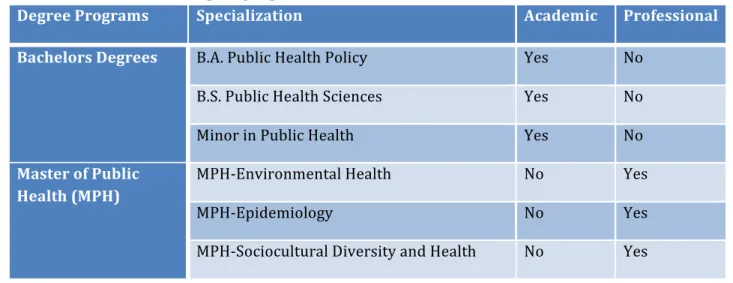
The degrees offered by the program are presented in Table 2.1. Table 2.1 Instructional degree programs
Degree Programs Specialization Academic Professional
Bachelors Degrees B.A. Public Health Policy Yes No
B.S. Public Health Sciences Yes No
Minor in Public Health Yes No
Master of Public Health (MPH)
MPH-‐Environmental Health No Yes
MPH-‐Epidemiology No Yes
MPH-‐Sociocultural Diversity and Health No Yes
2.1.b Catalogue of Instruction
The official university catalogue is published online1. A hard copy will be available to reviewers.
2.1.c
Our program meets the criterion of the Master of Public Health degree.
2.2. Program Length
2.2.a Definition of Credit
A course at UC Irvine normally offers 4 quarter-‐units of credit. The unit value is modeled on the Carnegie unit, which allows one unit of credit for three hours of work by the student per week. One hour of lecture or discussion may be included in the three hours. It is expected that, on the average, a student will spend two hours in preparation for each hour of lecture. Two to three of laboratory or individual practice are equivalent to one unit of credit. A two-‐hour laboratory with one unit of credit would not require outside work.
2.2b Minimum Degree Requirements for the MPH
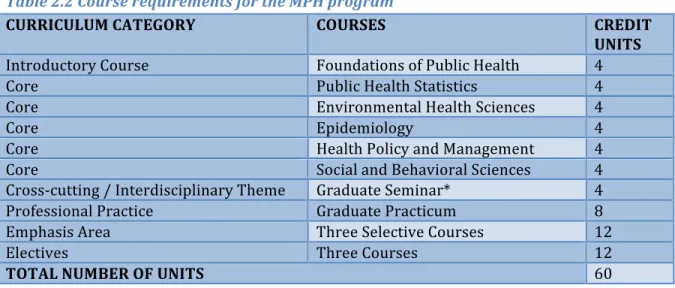
The Master of Public Health (MPH) is a 60-‐unit degree with fourteen (14) courses taken over 5 quarters. Part-‐time enrollment is also allowed. All students must take eight (8) common courses. In addition, each student chooses three courses in his/her emphasis and the remaining three are elective courses. The common requirements are: Foundations of Public Health (PH-‐200), 5 core courses (one in each of the five competency areas), a practicum course, and the graduate seminar. All students are required to take a comprehensive exam, write a paper detailing their experience at the practicum site, and give a presentation on their practicum project.
Table 2.2 Course requirements for the MPH program
CURRICULUM CATEGORY COURSES CREDIT
UNITS
Introductory Course Foundations of Public Health 4
Core Public Health Statistics 4
Core Environmental Health Sciences 4
Core Epidemiology 4
Core Health Policy and Management 4
Core Social and Behavioral Sciences 4
Cross-‐cutting / Interdisciplinary Theme Graduate Seminar* 4
Professional Practice Graduate Practicum 8
Emphasis Area Three Selective Courses 12
Electives Three Courses 12
TOTAL NUMBER OF UNITS 60
*Each quarter of the seminar class is 2 units.
2.2c.
No MPH degrees have been awarded for less than 60 units of course credit.2.2d.
Our program meets the program length criterion.2.3
Public Health Core Knowledge
2.2a Public Health Core Knowledge
All MPH students must take and pass courses in the five areas of knowledge basic to public health. The core curriculum of the MPH program consists of courses in the core subjects of public health, participation in a seminar series that emphasizes translational and cross-‐cutting case studies in public health, and a 240-‐hour practicum course. After completing the core curriculum students will be able to accomplish the following. The specific required course(s) that contribute to the learning outcomes are listed after each objective.
i. Explain the interrelationships between a multitude of factors that can impact on a public health problem, including scientific, medical, environmental, cultural, social, behavioral, economic, political, and ethical factors.
PH-‐200 Foundations of Public Health (4 units)
ii. Demonstrate fundamental knowledge in the public health sub-‐disciplines of biostatistics, epidemiology, health systems and public policy, social and behavioral sciences, and environmental health. Courses that fulfill this objective are:
PH -‐206 Graduate Epidemiology in Public Health (4 units) PH-‐207 Public Health Statistics (4 units)
PH-‐222 Health Policy and Management (4 units) PH-‐244 Health Behavior Theory (4 units) PH-‐264 Environmental Health Science (4 units)
iii. Review, critique, and evaluate public health reports and research articles. Critically evaluate programs, interventions, and outcomes that relate to public health practice.
PH-‐291A-‐B-‐C Graduate Seminar: Advances and Challenges in Public Health (2-‐2-‐2 units).
iv. Apply public health concepts, principles, and methodologies obtained through formal course work to actual problems experienced in the community or work environment. Apply ethical standards and professional values as they relate to the practice of public health. Demonstrate sensitivity to the social context within which public health professionals practice.
PH-‐ 295 Graduate Practicum in Public Health (8 units).
2.4
Practical Skills
2.4.a Program policies regarding the graduate practicum in public health
Detailed information on the policies and procedures for students to develop practical skills in our MPH program is published on our website2. The site also includes a video instruction featuring the Chair explaining these guidelines and policies so that students and the prospective practicum agencies can access the information at any time.Our community in Orange County, California has a rich selection of public health agencies from which we have selected the best to serve as our collaborators in the practicum course. All prospective practicum sites must complete our practicum site application form (included in the appendix). Moreover, we visit practicum sites to verify that the opportunities are suitable for meeting the learning objectives of the practicum course. We also appoint preceptors who are typically public health practitioners who are knowledgeable about public health training and the challenges involved in integrating knowledge and translating knowledge into practice toward benefitting population health and preventing disease.
All MPH students must pass complete all core courses and pass the comprehensive examination before they are allowed to enroll in the practicum course. And before they enroll, they must write a proposal for the practicum period. A faculty member reviews the proposal and provides feedback to the student. The preceptor at the external agency must also approve the proposal before the practicum period can commence. The practicum is designed as an 8-‐unit course with the
supervising faculty member as the instructor of record. During the practicum period, students are expected to report periodically to the faculty member.
After completing the required minimum of 240 hours at the public health agency, students must write a comprehensive report to be reviewed by faculty members who can provide feedback on improvement, and checking that all the learning objectives are satisfied. If all goes well, the faculty member gives a “satisfactory” grade. It is possible to “fail” the practicum course with an
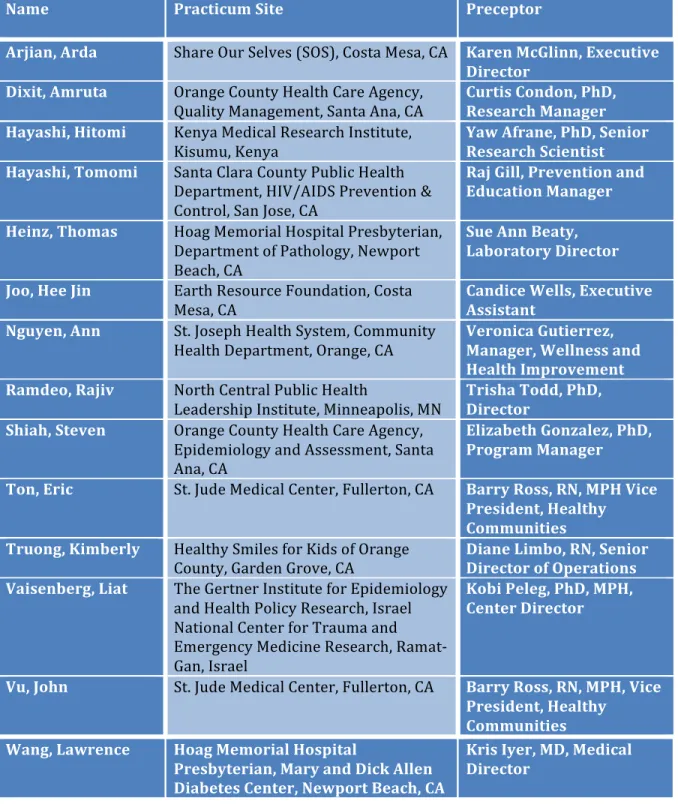
“Unsatisfactory” grade if there are deficiencies in the student meeting the learning objectives. Information on practicum placements for our first cohort of MPH students is presented in Table 2.3. We have no policies for students to waive the practicum course and experiences. At this point, we expect all our students to enroll in the course before they can graduate.
2 UCI MASTER OF PUBLIC HEALTH GRADUATE PRACTICUM
Table 2.3. Practicum placement for first cohort of MPH students. Name
Practicum Site Preceptor
Arjian, Arda Share Our Selves (SOS), Costa Mesa, CA Karen McGlinn, Executive Director
Dixit, Amruta Orange County Health Care Agency, Quality Management, Santa Ana, CA
Curtis Condon, PhD, Research Manager Hayashi, Hitomi Kenya Medical Research Institute,
Kisumu, Kenya
Yaw Afrane, PhD, Senior Research Scientist Hayashi, Tomomi Santa Clara County Public Health
Department, HIV/AIDS Prevention & Control, San Jose, CA
Raj Gill, Prevention and Education Manager Heinz, Thomas Hoag Memorial Hospital Presbyterian,
Department of Pathology, Newport Beach, CA
Sue Ann Beaty, Laboratory Director Joo, Hee Jin Earth Resource Foundation, Costa
Mesa, CA Candice Wells, Executive Assistant
Nguyen, Ann St. Joseph Health System, Community Health Department, Orange, CA
Veronica Gutierrez, Manager, Wellness and Health Improvement Ramdeo, Rajiv North Central Public Health
Leadership Institute, Minneapolis, MN
Trisha Todd, PhD, Director
Shiah, Steven Orange County Health Care Agency, Epidemiology and Assessment, Santa Ana, CA
Elizabeth Gonzalez, PhD, Program Manager
Ton, Eric St. Jude Medical Center, Fullerton, CA Barry Ross, RN, MPH Vice President, Healthy
Communities Truong, Kimberly Healthy Smiles for Kids of Orange
County, Garden Grove, CA Diane Limbo, RN, Senior Director of Operations Vaisenberg, Liat The Gertner Institute for Epidemiology
and Health Policy Research, Israel National Center for Trauma and Emergency Medicine Research, Ramat-‐ Gan, Israel
Kobi Peleg, PhD, MPH, Center Director
Vu, John St. Jude Medical Center, Fullerton, CA Barry Ross, RN, MPH, Vice President, Healthy
Communities Wang, Lawrence Hoag Memorial Hospital
Presbyterian, Mary and Dick Allen Diabetes Center, Newport Beach, CA
Kris Iyer, MD, Medical Director
2.4.b Practicum Agencies
A compendium of our practicum sites and preceptors is published online3, but it is password
protected. All students, faculty, and staff counselors have access to the database. We have provided a hardcopy in the appendix. Currently, we have approved 37 sites for the graduate practicum course. An example of a typical entry in the graduate practicum catalogue is reproduced below.
______________________________________________________________________________________________________________________________ County of Orange Health Care Agency
[Print]
Epidemiology & Assessment Program
1719 W. 17th Street, Santa Ana, CA 92706 Web: http://www.ochealthinfo.com/epi
About the Organization: COHCA-‐Epidemiology & Assessment (E&A) investigates individual cases and outbreaks of specified communicable diseases in order to prevent their transmission and monitor trends. We are also responsible for the registration of all vital events (births and deaths) that occur in Orange County. We often provide current statistics and other information to doctors, hospitals, the public, and news media. We may also provide education or preventive treatment in some circumstances. Although other units handle reports of HIV/AIDS, tuberculosis (TB) or sexually transmitted diseases (STDs), we do monitor their trends in Orange County. The program is transitioning to electronic and automated systems, such as an electronic disease reporting system; an automated system for forms design, processing, and data management; and online reporting for certain syndromes. E&A contributes annually to published reports, including the
Conditions of Children in Orange County and the Orange County Community Indicators reports. We also have significant responsibilities in terms of participating in the Health Care Agency’s preparedness for and response to critical situations involving threats to public health. Our program regularly collaborates in planning for and participating in drills, exercises, and events to test the readiness to respond to a major outbreak or other disaster. Students could also contact this site to ask about opportunities in health promotion, HIV/AIDS prevention, cancer as a chronic disease, tuberculosis, and emergency management work.
Skills Required: We require basic skills in the use of data management and analysis software, such as Microsoft Excel and Access. Experience with statistical packages such as SPSS and SAS are desirable. Knowledge acquired through coursework in Epidemiology and Biostatistics.
Types of Activities/Projects for Students at this Site: The role of the MPH student will be comprised of tasks suitable for an Epidemiology intern or surge staff member. The specific project assigned to an MPH student will depend upon the student’s level of interest, expertise, and availability as well as the current needs of the Epidemiology Program. The responsibilities may include providing support for the surveillance, investigation, and reporting of reportable communicable diseases and/or outbreaks. The tasks a graduate student might have include surveillance activities, data management and analysis, and collaboration on written reports. Responsibilities and tasks may also be related to public health preparedness and response
3 http://publichealth.uci.edu/admin
activities. Specific projects may include a community-‐based study to determine factors affecting rates of vaccination for a vaccine preventable disease; analysis of data regarding deaths due to particular causes (such as pneumonia and influenza); or time series or geographic information systems analyses (for appropriate data such as certain events reported by Animal Care Services). If the student is assisting with surge staff activities, the student would be designated to perform in a specific role and provided just-‐in-‐time training. Training Provided: Training will be provided by orientation and observation, and may include in-‐service or specific training. Ongoing hands-‐on training is provided for interns and surge staff as a function of the Epidemiology team. Attendance at weekly staff meetings is offered to MPH interns. Attendance at briefings (when appropriate to role) is offered to surge staff participating in exercises or events. Supervision may be provided by a Senior Epidemiologist, Research Analyst, or other program staff and will include regular (e.g., weekly) meetings to provide guidance and feedback and assess progress.
How to Apply: Students should express their interest by submitting a resume and a cover letter describing the types of activities they might want to do at the site. Interviews will be conducted with candidates prior to selection. Students who are selected as interns are required to register with HCA Volunteer Services, which assures that interns are eligible for County service and complete initial training on basic County policies. Likely interview periods would be April 1-‐May 15 for Summer practicum and Sept 1-‐Oct. 15 for Fall
practicum. Students could do their practicum in other quarters with site permission. Students will likely work 15-‐20 per week as an intern.
Contact Person Elisabeth Gonzalez, Ph.D. Program Manager Email: [email protected] Phone: 714-‐834-‐8180 Fax: 714-‐834-‐8196
2.4.c Practicum Waivers
We have not waived the practicum course for any MPH student.
2.4.d Medical Residency
We have not yet had medical residents completing the practicum rotations in the program
2.4.e
Our program meets the practical skills criterion.2.5.
Culminating Experience
2.5.a Description of Culminating Experience
The culminating experience required for all MPH students is the practicum course (PH-‐295) where students are expected to synthesize knowledge acquired in coursework and seminars into a strong proposal for field placement, and to integrate that knowledge with their experience in a situation that approximates professional practice, into a comprehensive report where students assess how well they met the objectives. The practicum course objects are published in the course syllabus, which is available online4. The objectives are that students will:
i. Apply public health concepts, principles, and methodologies obtained through formal course work to actual problems experienced in the community or work environment.
ii. Apply ethical standards and professional values as they relate to the practice of public health.
iii. Demonstrate sensitivity to the social context within which public health professionals practice.
Preceptors also review, and must approve the practicum proposal, and evaluate the student’s performance at the end of the course. In addition, faculty members review and must approve both the proposal and the final report, and the required oral presentation by the student before a grade is assigned for the course.
2.5.b
Our program meets the culminating experience criterion.
2.6. Required Competencies
2.6.a Core public health competencies
The core public health competencies for our MPH program are as follows. After completing the core courses common to all MPH students, the students will be able to:
i. Explain the interrelationships between a multitude of factors that can impact on a public health problem, including scientific, medical, environmental, cultural, social, behavioral, economic, political, and ethical factors.
4 SYLLABUS FOR THE GRADUATE PRACTICUM IN PUBLIC HEALTH -‐ http://publichealth.uci.edu/ph_docs/show_form/ph_295_syllabus
ii.
Demonstrate fundamental knowledge in the public health sub-‐disciplines of biostatistics, epidemiology, health systems and public policy, social and behavioral sciences, and environmental health.iii. Review, critique, and evaluate public health reports and research articles. Critically evaluate programs, interventions, and outcomes that relate to public health practice. iv. Apply public health concepts, principles, and methodologies obtained through formal
course work to actual problems experienced in the community or work environment. Apply ethical standards and professional values as they relate to the practice of public health. Demonstrate sensitivity to the social context within which public health professionals practice.
2.6.b Matrix of learning experiences for core competencies
The matrix that identifies the learning experiences through which the core public health competencies are met is presented in Table 2.4.
Table 2.4 Matrix of core competencies and learning experiences
Core competency Learning Experience (Course Catalogue Description) Explain the interrelationships
between a multitude of factors that can impact on a public health
problem, including scientific, medical, environmental, cultural, social, behavioral, economic, political, and ethical factors.
PH-‐200 Foundations of Public Health (4). Presents the overarching framework, principles, and core responsibilities of public health research and practice from a multidisciplinary perspective. Provides necessary foundation for further studies toward advanced cross cutting approaches essential for public health practice. Prerequisite: graduate standing or consent of instructor.
Demonstrate fundamental knowledge in the public health sub-‐disciplines of biostatistics, epidemiology, health systems and public policy, social and behavioral sciences, and
environmental health.
PH-‐206 Graduate Epidemiology in Public Health (4). Presents descriptive and experimental approaches to the recognition of the causal association of disease in the general populations, as these approaches apply to populations using different student designs and models from the literature. Prerequisite: graduate standing or consent of instructor.
PH-‐207 Public Health Statistics (4). Surveys statistical methods for public health. Topics include descriptive statistics, probability models, likelihood functions, estimation, and
hypothesis testing for categorical and continuous data. Students will learn to use statistical software to perform epidemiologic data analysis.
PH-‐222 Health Policy and Management (4).
Multidisciplinary inquiry into theory and practice concerned with delivery, quality, cost of health care for individuals and populations. Explores managerial and policy concerns regarding structure, process, outcomes of health services
PH244 Health Behavior Theory (4). Introduces Health Behavior/Education and segues into major theoretical perspectives. Focuses on health behavior change from the perspectives of individual, interpersonal, community, and ecological theories. Relates theories of behavior change at these levels to the construction of health promotion intervention programs.
PH-‐264 Introduction to Environmental Health Science (4). Convergence of agents (chemical, physical, biological, or psychosocial) in the environment can emerge as diseases influenced by social, political, and economic factors, allowing them to become rooted in society. How these agents from various spheres come together and impact human health. Prerequisite: graduate standing or consent of instructor.
Review, critique, and evaluate public health reports and research articles. Critically evaluate programs,
interventions, and outcomes that relate to public health practice.
PH-‐291A-‐B-‐C Graduate Seminar: Advances and Challenges in Public Health (2-‐2-‐2). Forum for exploring recent advances and challenges in all disciplines of public health research and practice. Features case studies exemplifying the integration of core competencies with cross-‐cutting interdisciplinary themes of public health. Prerequisite: graduate standing or consent of instructor. Satisfactory/ Unsatisfactory only.
Apply public health concepts,
principles, and methodologies
obtained through formal course work to actual problems experienced in the community or work environment. Apply ethical standards and
professional values as they relate to the practice of public health.
Demonstrate sensitivity to the social context within which public health professionals practice.
PH-‐295 Graduate Practicum in Public Health (8). Provides opportunities for hands-‐on experience for graduate students at agencies or organizations engaged in public health practice. Students are matched with placement sites based on academic preparation and students’ career goals. The practicum
experience culminates in a comprehensive written report. Prerequisites: Public Health 290 and 291.
Satisfactory/Unsatisfactory only.
2.6.c Competencies for Emphasis Areas
Students enrolled in each emphasis area are required to take a minimum of three courses (12 units) in the emphasis topics. In addition, they are encouraged to explore related topics or deepen their knowledge in one topic through the selection of three elective courses (12 units). Part-‐II of the required comprehensive examination, proposal writing for the practicum course (PH-‐295), selection of practicum agency, and final practicum report are all expected to reflect and contribute to the learning objectives in the emphasis areas.
Emphasis in Environmental Health
After earning the MPH degree with an emphasis in Environmental Health, students will be able to assess, manage, and communicate issues related to environmental factors in public health:
i. Assessment of environmental risk factors in populations through scientific information and literature research, data analysis and interpretation.
ii. Management of environmental health concerns through articulation in the broader context of public health, defining and evaluating preventive strategies, and collaboration on
decision-‐making processes.
iii. Communicate environmental health information to public and professional audiences.
Emphasis in Epidemiology
After earning the MPH degree with an emphasis in Epidemiology, students will be able to: i. Describe the role of epidemiology in public health, and evaluate the scientific merit and
feasibility of epidemiologic study designs.
ii. Conduct data collection, analysis, and reporting in support of surveillance and epidemiologic investigations.
iii. Communicate epidemiologic information to public and professional audiences.
Emphasis in Sociocultural Diversity and Health
After earning the MPH degree with an emphasis in Sociocultural Diversity and Health, students will be able to assess, manage, and communicate issues related to social and cultural diversity factors in public health:
i. Critically apply social and behavioral theory to analyze determinants and correlates of public health problems at the intrapersonal, interpersonal, and community levels.
ii. Identify, describe, and analyze the effects of social, cultural, and behavioral factors on the health of populations.
iii. Apply social and behavioral theories in the design, implementation, and evaluation of disease prevention and health promotion programs.
iv. Communicate social, cultural and behavioral health information to public and professional audiences.
2.6.d Development of Competencies
Competencies for the MPH program are developed by faculty members in consultation with members of the community, including preceptors, and through the evaluation of the Core
Competency Project results from the Association of Schools of Public Health5. The competencies are used primarily to establish learning objectives for courses in the curriculum, to set
comprehensive examinations, and to test the effectiveness with which students meet curriculum requirements.
2.6.e Assessment of Changing Needs of Public Health Practice
One of the charges to our external advisory board members is to inform the faculty about changing needs in the public health workforce so that we can use the information in reviewing competencies in the MPH curriculum.
We also require that preceptors give us feedback on the competency of our students who have completed the practicum course. This provides us with the opportunity to review our curriculum and the competencies. An example of evaluation form completed by preceptors is included in the appendix.
2.6.f
our program meets the criterion on required competencies.2.7 Assessment Procedures
2.7a Procedures
Competency in the core curriculum is monitored and tested the first part of the comprehensive examination (Breadth of Knowledge) with 200 questions on core public health subjects. We have produced an online videotape of guidelines for this examination to help student prepare for it as soon as they enroll in the program6.
Competency in the emphasis areas is monitored through the second part of the comprehensive examination (Depth of Knowledge), where students are presented with case studies in their area of emphasis to analyze over a two week period; and in the evaluation of the proposal that they submit for their practicum, and finally, the competency is tested after the culminating experience where students submit and defend a report of their practicum experience.
2.7.b Outcome measures
In order to advance to candidacy for the MPH degree, students must pass both parts of the comprehensive examination with scores of 70% or better. We review the margin with which students pass these examinations, and how many times they have to retake the examination as outcome measures. We also include degree completion rate, successful internships, and employment placement after graduation as outcome measures.
The first time that we gave the comprehensive examination in Spring, 2010, the average score on Part-‐1 was 73.5%; and the average score on Part-‐II was 89.6%. Three students did not pass, and retook the examination during the Fall quarter, 2010. The average score for Part-‐I of the
examination given in Fall 2010 was 84.4%, implying the strong advantage of studying for examination during the summer session. We have used this data to counsel students about the timing of students taking the examination.
6 MASTER OF PUBLIC HEALTH COMPREHENSIVE EXAMINATION -‐
2.7.c Degree completion
So far, all MPH students have completed their degree within the normative time to completion, except for a student who enrolled part-‐time at the beginning of the program. Hence we have a degree completion rate of more than 90%.
2.7.d Destination of graduates
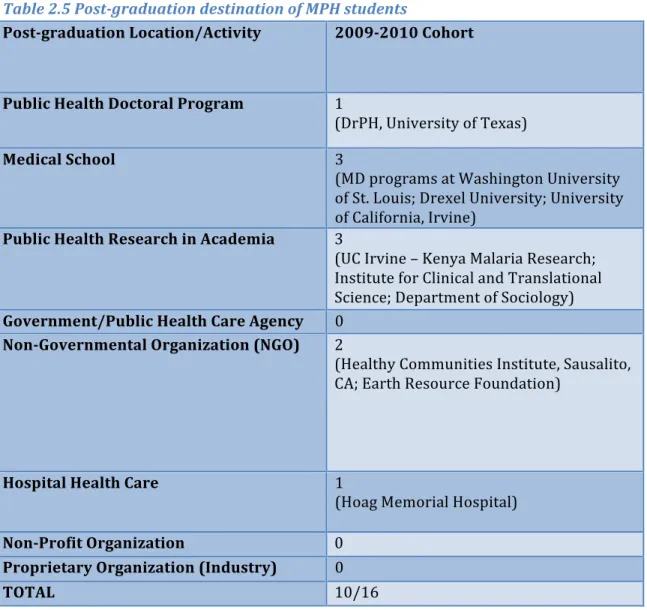
Table 2.5 shows the destination of graduates from our first cohort of MPH students who enrolled in Fall 2009.
Table 2.5 Post-‐graduation destination of MPH students
Post-‐graduation Location/Activity 2009-‐2010 Cohort
Public Health Doctoral Program 1
(DrPH, University of Texas)
Medical School 3
(MD programs at Washington University of St. Louis; Drexel University; University of California, Irvine)
Public Health Research in Academia 3
(UC Irvine – Kenya Malaria Research; Institute for Clinical and Translational Science; Department of Sociology) Government/Public Health Care Agency 0
Non-‐Governmental Organization (NGO) 2
(Healthy Communities Institute, Sausalito, CA; Earth Resource Foundation)
Hospital Health Care 1
(Hoag Memorial Hospital) Non-‐Profit Organization 0
Proprietary Organization (Industry) 0
TOTAL 10/16
2.7.e Certification
There is no national examination certification required for our graduates.
2.7.f Alumni-‐Employer Assessment
We are in the process of formalizing periodic assessment regarding the ability of our graduates to perform effectively.
2.7.g
Our program meets the criterion of assessment procedures. By the time we submit the final self-‐study, we should have some data to report under 2.7.f.
2.8 Academic Degrees
2.8.a Identification of Academic Degree Programs
The B.A. in Public Health Policy and B.S. in Public Health Science degrees are academic (Table 2.1).
2.8.b Public Health Orientation of Academic Degrees
All students in the undergraduate program are required to enroll and pass Public Health-‐1 (Principles of Public Health), Public Health-‐2 (Case Studies in Public Health), Statistics-‐7 (Introductory Statistics), Public Health-‐101 (Introduction to Epidemiology), and Public Health-‐ 195W (Undergraduate Practicum in Public Health, with Upper Division Writing). The complete requirements for the two undergraduate degrees are published on our website7, and included in the appendix.
Students minoring in Public Health must take and pass PH-‐1 and PH-‐2, and six additional upper division courses in public health, selected from five topic areas, and a research course (PH-‐198 or PH-‐199). The upper division topic areas are as follows:
Epidemiology, Genetics and Health Informatics (Public Health 101-‐119) Health Policy and Management (Public Health 120-‐139)
Social and Behavioral Health Science (Public Health 140-‐159) Environmental and Global Health Science (Public Health 160-‐179) Infectious and Chronic Diseases (Public Health 180-‐189)
The complete requirements for the Minor in Public Health is published on our website8.
7 UNDERGRADUATE PROGRAMS IN PUBLIC HEALTH -‐ http://publichealth.uci.edu/ph_docs/new_ugrad 8 PUBLIC HEALTH MINOR -‐ http://publichealth.uci.edu/ph_docs/new_ugrad/phminor
2.8.c Culminating Experience
The culminating experience for the undergraduate academic program is the Public Health Practicum (PH 195W), an 8-‐unit required course for those majoring in Public Health Policy or Public Health Science. The course allows students to gain hands-‐on experience through an
approved site at an organization in the field of public health. Practicum requires that each student interview and select a site through the online catalog of approved Public Health sites. The catalog includes sites that have agreed to accept, train and supervise Public Health students in the ongoing activities of the organization. Students must choose a placement site listed only in the practicum catalog. All students are required to dedicate 100 hours for the practicum quarter (10 hours a week).
In addition to completing their work at the external agency, students fulfill their upper division writing requirements by attending lecture for 3 hours a week and completing three major writing assignments associated with their practicum experience: writing for public presses, scholarly review article, and research or program implementation proposal writing.
2.8.d
our program meets the criterion for academic degrees.2.9. Doctoral Degrees
Doctoral degrees are not included in the program at this time.
2.10. Joint Degrees
There are no joint degree programs at this time.
2.11. Distance Education
We do not offer distance education programs at this time.