ISSN: 2147-611X
www.ijemst.com
Evolution of Mathematics Teachers’
Pedagogical Knowledge when They are
Teaching Through Modeling
Arzu Aydogan Yenmez1, Ayhan Kursat Erbas2, Cengiz Alacaci3, Erdinc Cakiroglu2, Bulent Cetinkaya2
1Omer Halisdemir University 2Middle East Technical University 3Istanbul Medeniyet University
To cite this article:
Aydogan Yenmez, A., Erbas, A.K., Alacaci, C., Cakiroglu, E. & Cetinkaya, B. (2017).
Evolution of mathematics teachers‟ pedagogical knowledge when they are teaching through
modeling.
International Journal of Education in Mathematics, Science and Technology
(IJEMST), 5(4), 317-332. DOI:10.18404/ijemst.296552
This article may be used for research, teaching, and private study purposes.
Any substantial or systematic reproduction, redistribution, reselling, loan, sub-licensing,
systematic supply, or distribution in any form to anyone is expressly forbidden.
Authors alone are responsible for the contents of their articles. The journal owns the
copyright of the articles.
Volume 5, Number 4, 2017
DOI:10.18404/ijemst.296552
Evolution of Mathematics Teachers’ Pedagogical Knowledge when They
are Teaching through Modeling
Arzu Aydogan Yenmez, Ayhan Kursat Erbas, Cengiz Alacaci, Erdinc Cakiroglu, Bulent Cetinkaya
Article Info
Abstract
Article History
Received: 19 February 2016
Use of mathematical modeling in mathematics education has been receiving significant attention as a way to develop students‟ mathematical knowledge and skills. As effective use of modeling in classes depends on the competencies of teachers we need to know more about the nature of teachers‟ knowledge to use modeling in mathematics education and how this knowledge evolves. The aim of this study is to investigate how teachers‟ pedagogical knowledge to use modeling in the classroom is formed and modified through professional development activities based on lesson study cycle from modeling perspective. The professional development program reported in this study included five monthly cycles consisted of meeting before the implementation, implementation of the activity and a follow up meeting. The participants were four in-service mathematics teachers. Results showed that the program provided opportunities for teachers to test, revise, and refine their knowledge. More specifically, teachers generated effective strategies for proper implementation of the modeling activities in the classroom.
Accepted: 18 November 2016
Keywords
Professional development Teacher education Mathematical modeling Mathematics education Pedagogical knowledge
Introduction
An increasing number of research studies in mathematics education have begun focusing on mathematical modeling as a way of developing mathematical ideas, knowledge and skills for students (Kaiser, Blomhøj, & Sriraman, 2006; Lesh, Kaput, & Hamilton, 2007; Sriraman & Lesh, 2006). Along with this attention, there has been a variety of ways that mathematical modeling has been utilized in education (Kaiser, 2006; Kaiser, Blomhøj, & Sriraman, 2006). While some educators conceptualize modeling as a new approach for learning, others embrace it as a way of expressing real-life situations in mathematical language. In the broadest sense, on the other hand, modeling is defined as a process of understanding phenomena and the relations in it with mathematical tools and bringing out the mathematical patterns in this situation (Verschaffel, Greer, & De Corte, 2002).
Modeling
According to Lingefjard (2002), mathematical modeling is the process of mathematizing, interpreting, verifying, revising, and generalizing real-life situations or complex systems. From this point of view, processes seeking to establish any kind of link between real-life and mathematics could be related with mathematical modeling (Erbaş, Kertil, Çetinkaya, Çakıroğlu, Alacacı, & Baş, 2014). With this perspective, researchers have done studies on developing mathematical modeling skills of individuals in the domains of engineering, economics, business etc. (Crouch & Haines, 2004; Haines & Crouch, 2001; Houston, 2002; Izard, Haines, Crouch, & Neill, 2003; Jensen, 2007; Lingefjard, 2000).
According to Lesh and Doerr (2003b), on the other hand, modeling is an approach where models are “conceptual systems (consisting of elements, relations, operations, and rules governing interactions) that are expressed using external notation systems, and that are used to construct, describe, or explain the behaviors of other system(s) perhaps so that the other system can be manipulated or predicted intelligently” (Lesh & Doerr, 2003a, p.10). The difference between the terms model and modeling is analogous to the difference between product and process. While modeling is a process of creating a model for a situation, a model is the product of this process (Lesh & Sriraman, 2005). Modeling includes the number of iterative cycles that students move through (Lesh & Doerr, 2003a). Generally, students go through the following steps: (a) using one‟s own informal knowledge, understanding and simplifying the problem by interpreting the given information, (b) developing a model in which relationships among variables are decided, and hypotheses are constructed, (c) by analyzing the model, deciding if the system has a gap or if it satisfies the goals, (d) checking the model and reflecting on the solution from different perspectives, and restructuring the solution if needed to improve it (Lesh & Doerr, 2003a, 2003b). From this point of view, while referring to modeling activities in mathematics education, Lesh and Doerr (2003a) use the term “model eliciting” to embrace both the model and modeling processes. In fact, the tools used to promote students‟ and teachers‟ externalization of their thinking and conceptualization for problem situations are called as model-eliciting activities (MEAs) (Lesh, Cramer, Doerr, Post, & Zawojewski, 2003; Lesh & English, 2005; Lesh & Sriraman, 2005). In this sense, pedagogical purposes of the MEAs are to help students to create mathematical models of the real-life situations and to better understand the mathematical concepts that are embedded in the activity (Lesh & Sriraman, 2005). The main characteristics of MEAs are to give a chance to learners to develop a model for a real-life situation, to describe, revise, and refine students‟ ideas, and to explain their conceptual systems (Lesh & Doerr, 2003a). These activities are designed for uncovering learners‟ multiple ways of thinking while they are creating a model (Doerr, 2006). In this way, MEAs create an environment conducive to document their own thinking and learning (Lesh & Doerr, 2003a). Moreover, model eliciting activities enable learners to develop their communication skills, mathematical language, and conceptual understanding (Battye & Challis, 1997; English, 2003; English & Lesh, 2003; Lesh & Doerr, 2003a, 2003b).
According to Erbaş et al. (2016), modeling process provides a rich learning environment for both students and teachers. Working on modeling activities, students can produce various conceptual models depending on their thinking ways and, thus, develop a deeper understanding of concepts, as well as gradually gain mathematical process skills such as problem solving and reasoning. Furthermore, learners can develop positive attitudes towards mathematics as they see the daily life problems and applications of mathematics. As they might work in groups during the modeling process, they would be encouraged to express their thinking and ideas and learn from each other. For teachers, on the other hand, modeling activities serve as a non-traditional approach to teaching mathematics through real-life problem situations. As such activities require students to think and approach the problem situations in significantly different ways, teachers would have more opportunities to observe and reflect on how students think.
(Hiebert, Gallimore, & Stigler, 2002; Stein, Smith, & Silver, 1999). In this sense, the activity of designing purposeful plans with in-service teachers can serve as an inquiry into curriculum, pedagogy and students thinking (Hiebert, Gallimore, & Stigler, 2002; Stein, Smith, & Silver, 1999).
Lesson Study
Japanese lesson study, a professional development approach where teachers learn about teaching by developing, examining, and revising collectively, has become the focus of increasing attention in recent years (e.g., see Fernandez, 2002; Fernandez & Yoshida, 2004; Perry & Lewis, 2009; Wang-Iverson & Yoshida, 2005; Watanabe, 2002; Wilms, 2003). Lesson study typically has three parts; choosing and designing lessons on a particular topic and teaching the “research lesson” to students; discussing the lessons based on observations and other data from the conducted class; and revising the lesson plan based on these observations and discussions (Shimizu 2002; Yoshida 2002). The analysis of student work and the analysis of actual classroom instruction has a central role in the lesson study (Lewis, 2002b; Perry & Lewis, 2009). The opportunities provided to teachers by lesson study include developing knowledge and learning how to reason mathematically (Fernandez, 2005). Lesson study provides a fertile ground by enabling teachers to talk about topics like what problems to use in the lesson and what questions to ask students (Fernandez, 2005; Lewis 2002b). Additionally, this experience gives them a chance to think collectively about students‟ thinking. (Fernandez, 2005; Lewis 2002b). Moreover, lesson study provides an opportunity to discuss unexpected events in the research lesson and ways of handling these situations (Fernandez, 2005; Lewis 2002b). Teachers discuss the data from the actual classroom after careful planning and it provides a temporal reflection in lesson studies (Fernandez, 2005). Lesson study‟s contributions to instruction include (a) providing professional development (b) helping teachers to gain new approaches (c) spreading knowledge of content (d) connecting the practices to broader goals (e) giving a chance to discuss new visions and new pedagogical strategies (f) providing an opportunity to discuss competing visions (g) creating a fertile ground in order to discuss effective instruction and (h) helping teachers to understand students‟ thinking (Fernandez, 2002; Lewis, 2002b; Lewis, Perry, & Murata, 2006; Shimizu, 2002; Wang-Iverson, & Yoshida, 2005; Watanabe, 2002). The last item in the list is about helping teachers to understand students‟ thinking that “develop the eyes to see students”. In research lessons, teachers carefully observe students‟ behaviors, learning and engagement and teachers have a chance to think more deeply about students‟ thinking than daily classroom environment through careful analysis of student work (Lewis, 2002a).
Students’ Thinking
In the Principles and Standards for School Mathematics, National Council of Teachers of Mathematics (NCTM) emphasizes that “effective teaching involves observing students, listening carefully to their ideas and explanations, having mathematical goals and using the information to make instructional decisions” (NCTM, 2000, p. 19) . Teachers can analyze students‟ work on their own. However, analyzing such information with a leader who has an advanced pedagogical (content) knowledge could lead a deeper understanding of students‟ thinking and reasoning (Sowder, 2007). Furthermore, students‟ written work can be used as a source to strengthen teacher knowledge, as a basis for developing instruction and an evidence of student learning (Little, 2004). The benefits of the teachers attending to students‟ thinking include helping transition instruction from teacher centered to student centered, changing understandings of students from operational to conceptual, teachers selecting appropriate mathematical tasks and changing beliefs of teachers and students to more positive toward mathematics. Teachers who are trained to attend students‟ thinking can integrate their knowledge in their teaching plans and contribute to the success of the students (Fennema, Franke, Carpenter, & Carey, 1993; Gearhart & Saxe, 2004; Schifter, Russell, & Bastable, 1999).
Teacher Knowledge
to transcend subject matter” (p. 8). The complex nature and the sources of teachers‟ pedagogical knowledge was investigated under three major areas; namely, classroom organization and management, instructional models and strategies, and classroom communication and discourse by Morine-Dershimer & Kent (1999). The varieties of sources that contribute to classroom organization and management are consistent with general principles of teacher behavior that promote student achievement (Brophy & Good, 1986; Evertson, Emmer, Sanford, & Clements, 1983; Evertson & Harris , 1992). Student achievement predictors are given such as “students learn more when teachers use time efficiently, implement group and instructional strategies with high levels of involvement, communicate rules and expectations clearly, and prevent problems by introducing a management system at the beginning and implement it consistently” (Morine-Dershimer & Kent, 1999, p. 25).
Method
The current study made use of a case study approach. As described by Creswell (2009), “case studies are a strategy of inquiry in which the researcher explores in depth a program, event, activity, process, or one or more individuals” (p. 13). As Gomm, Hammersley, and Foster (2000) suggested, the case can be any phenomenon involved in the bounded system being studies, which can be “a programme, a responsibility, a collection, a phenomenon or a population” (p.23). The case in this study was the phenomenon that is teachers‟ evolving knowledge through professional development activities based on lesson study cycle from the modeling perspective.
Participants and Context
The participants of the study were selected among the teachers who participated in a larger project. The participants of the in-service professional development project were 10 secondary mathematics teachers (6 female, 4 male) from two high schools in a metropolitan city in Turkey. The teachers, who participated in data collection, were selected from the parent study. There were two teachers from each school. The participating teachers (4) did not have former experience in using model eliciting activities and all were female.
Implementation Design
This research involved a cyclical professional development program. The process based on lesson study approach can be summarized in three phases: (i) meetings with teachers before the activities; (ii) implementing the model eliciting activity; and (iii) meeting after the implementation. Data collection phase of the study took five months, with one model eliciting task being used in each month.
Monthly Cyclical Process of Professional Development Program
The MEAs were selected according to the grade level the participating teachers are currently teaching, and based on the consultation meetings with teachers. Teachers were asked to prepare a teaching plan and propose suggestions for the MEA that were to be used.
Meeting before the Implementation of the Model Eliciting Activity
Implementation of the Model Eliciting Activity
Following the first meeting, two teachers from each school used the model eliciting activity. Interviews were done with teachers, who would actually use the model-eliciting activities, before and after the implementation. Implementations generally took two-course periods (i.e., 90 minutes) and continued during the breaks. During the implementation of model-eliciting activities, students worked in groups. Groups made posters and presented their solutions to the class. Teachers observed their students during the group work, and took notes (including their thoughts) and referred to those notes during the interviews after implementation. During the implementation, fellow teachers were invited to attend classes to observe. At the end of the classroom activity, students‟ reports were copied and distributed to all teachers. Teachers evaluated the solutions of students. Interviews after the implementation were recorded, and they were used in third week‟s meeting as a tool of discussion. Teachers were also observed by researchers, based on their interactions with students. In addition, researchers noted down some conversations and other noteworthy evidence related to the focus of their observations. Audio-visual records were collected for future analysis.
The Meeting after the Implementation of the Model Eliciting Activity
Teachers brought their observation notes for model eliciting activity and students‟ solution papers to the third week meeting which lasted about two hours. This meeting aimed to enable teachers to evaluate what they had assumed prior to the implementation in the light of the implementations with teachers. Teachers tended to revise what they had thought based on the observations notes, which were taken during the model eliciting activity, and solution papers of students. After discussions, teachers proposed a common „student-thinking‟ template, which included the errors and solutions of students. During discussions, the facilitator asked the following questions; how did the student groups attempt to solve the questions and what errors did they make in the solution process? What teachers discussed varied in terms of solutions and errors. The main purpose of creating „student-thinking‟ template was to support teachers to develop new ways to reveal students‟ mathematical thinking in model-eliciting activity. After the activity, teachers reviewed the individual teaching plans that they had made before the implementation. Teachers reviewed each part of the teaching plan and changed some according to the assumptions of the first week including thoughts on the implementation; observations during the implementation; and, discussions with other teachers. For further analysis, audio-visual records were collected for the session.
Data Collection
Data were collected within a five-month intervention period in order to address the research question. Data included audio-visual materials of meetings; field notes; teaching plans; semi-structured interviews with teachers before and after each implementation; and observation notes of researchers on teachers‟ interaction during model eliciting activity in class and discussions for students‟ solution papers.
Data Analysis
Findings
Based on cross-case analyses, the evolving knowledge of teachers throughout the study was described under the sub-categories of knowledge of classroom organization and management.
Class Setting
In order to get insight into the evolution of teachers‟ knowledge of classroom setting in modeling activities, a cross-case analysis of data was conducted in order to seek the similarities and differences among the cases. In their first implementations, teachers tried to shape the group structure by assigning high-achiever students to each group since they thought that these students might have helped produce effective solution approaches. In addition, teachers tried to combine the introvert and extrovert students in the hopes that the group could express their solutions more clearly. However, in latter implementations, teachers decided that students could select their own groups as they thought that “when students construct the groups they feel more like a group and they pay more attention to communication and cooperation”. Moreover, small group size of three or four students was preferred by all teachers, because in large groups they could not observe students in sufficient detail and the groups did not work effectively. Besides, teachers believed that groups should include both boys and girls. Teachers wanted this structure because boys and girls had different characteristics and experiences which could add to the quality of solution process. A comparison of each case‟s evolving knowledge on class setting is given in Table 1.
Table 1. Case ratings of class setting themes for all implementations Representative teacher statement based on class setting structure
and its reasons
Teachers*
Figen Rezzan Semra Melda “Students who express themselves well (who have verbal
ability-language ability) will be distributed to the groups so that students could express their solutions more clearly” “[…]groups may be constructed by mixing the different traits like more introvert and extrovert students so that students could express their solutions more clearly.”
1, 2 2
“Students who have good scores in math exams will be distributed to each group since they may have produced different approaches[…]”
1, 2 1 1
“[…] Students should create the groups their own since the students characteristics are very different when it is compared with the traditional class times and MEAs solution process […]” […] groups should be constructed by students when students construct the groups they feel more that they are group and they pay attention mostly on communication, cooperation...e.g., […]” “[…] it is meaningless for a teacher to construct the groups because it is different process students has not the same characteristics with the traditional class times.”
3, 4, 5
3, 4, 5 3, 4, 5 2, 3, 4, 5
“[…]number of the students in the group should be three or four since group will work cooperatively and I (teacher) can control the groups‟ solution process more in detail.”
3, 4, 5
3, 4, 5 3, 4, 5 2, 3, 4, 5 “[…] mixed groups with boys and girls should be constructed since
boys and girls have different experiences in their real life and this experiences had important impacts on the modeling questions […]”
3, 4, 5
2, 3, 4, 5
4, 5 1, 2, 3, 4, 5
*
The numbers 1 through 5 indicate that the related theme was observed in the MEA implementation at least once, while“1” refers to the implementation of the first MEA, “5” refers to the implementation of the fifth MEA throughout the study.
The following excerpts were taken from conversations among the teachers in the meeting before the third implementation (Pseudonyms were used for the study‟s participants and other teachers who participated in a larger project were specified as teacher A, teacher B, etc. in the excerpts).
Teacher A: Students behave differently in the group work, students who you would say would not work, would participate in the group work actively.
Rezzan: But I am not sure that if we did not assign high achieverstudents [students who have good grades in the math exams] to the groups, some groups may not be able to solve and then they feel bad.
Teacher B: I did not assign high achiever students and all groups reached a result, okay some of them [groups] reached more complicated results but it did not seem to be related to the success in regular exams.
Teacher A: All of our students were successful so we did not need to distribute the high achieverones.
Rezzan: Yes, I observed this in my class also. For example, Yeşim thought very differently and explained and supported her ideas in the presentations, I heard this students‟ voice for the first time and she had not gotten good grades in the exams… I think the appropriate strategy may be to not interfere the group structure, and let it be formed by the students.
This excerpt exemplified that the teachers‟ group structure strategies changed from actively assigning students to groups such as assigning high achiever students and combining introvert and extrovert students; to let the students select the groups‟ themselves.
Introducing the Implementation
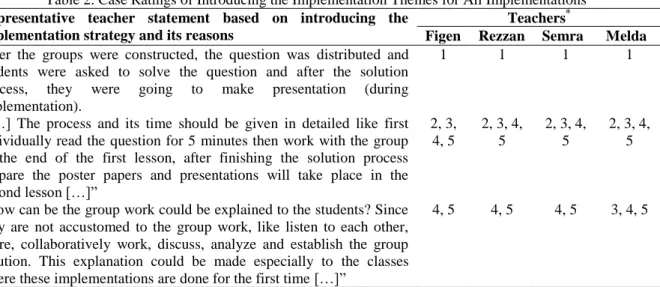
Results showed that the ways teachers introduced the model eliciting activities that described the process of implementation before the students began to solve the MEAs changed in the cyclic process of the study. In the first implementation, teachers stated that they did not know how to introduce the task and during the implementations they only distributed the problem to the groups, wanted them to solve the problem, and added they were going to make a presentation. However, after the first implementation all teachers stated that the directions regarding the process of the activity should be given in detail like “First, individually read the question for 5 minutes then work with the group to the end of the first lesson, after finishing the solution process prepare the poster papers and presentations will take place in the second lesson.”
Moreover, participants indicated that expectations from the group work could be explained to the students like “listen to each other, share, and work collaboratively, discuss, analyze and establish the group solution.” The reason was given as students were not accustomed to the group work. It was added that this explanation could be made especially to the classes where such activities were to take place for the first time. Each case‟s evolving knowledge on introducing the implementation was compared in Table 2.
Table 2. Case Ratings of Introducing the Implementation Themes for All Implementations Representative teacher statement based on introducing the
implementation strategy and its reasons
Teachers*
Figen Rezzan Semra Melda After the groups were constructed, the question was distributed and
students were asked to solve the question and after the solution process, they were going to make presentation (during implementation).
1 1 1 1
“[…] The process and its time should be given in detailed like first individually read the question for 5 minutes then work with the group to the end of the first lesson, after finishing the solution process prepare the poster papers and presentations will take place in the second lesson […]”
2, 3, 4, 5
2, 3, 4, 5
2, 3, 4, 5
2, 3, 4, 5
“How can be the group work could be explained to the students? Since they are not accustomed to the group work, like listen to each other, share, collaboratively work, discuss, analyze and establish the group solution. This explanation could be made especially to the classes where these implementations are done for the first time[…]”
4, 5 4, 5 4, 5 3, 4, 5
* The numbers 1 through 5 indicate that the related theme was observed in the MEA implementation at least once, while“1”
refers to the implementation of the first MEA, “5” refers to the implementation of the fifth MEA throughout the study.
Semra: I think it should be explained step by step what they are going to do, since they are not accustomed they thought that they could solve in five or ten minutes, so it will be good to give the process and the times so students can know what are expected from them and how much time they will have.
Teacher F: All students were accustomed to the multiple choice questions so they are accustomed to think that the solution takes 5 minutes at maximum and they can solve individually.
Melda: So we [teachers] should express that we want them first to read the question and find ways of solution individually then work in group and then make presentation and should take their times in order to organize themselves.
Excerpts showed that teachers‟ explaining the process changed from explaining the process roughly; to explaining the process in detail with the times attached to each step based on the observations in the implementations and with the discussions with colleagues during meetings.
Providing and Understanding of the MEA and to Warm up the MEA
Analysis of data showed that teachers‟ conception of how to introduce MEA changed during the process of study. In the first implementation, teachers stated that they did not know how to introduce the activity. They were concerned that too much direction may limit students‟ creativity to attack the problem. However, in the latter implementations, teachers developed the idea of introducing the context of the problem to the students by giving an example close to the MEA‟s context and explained to the students‟ actual task based on this example. Teachers indicated that the questions about the MEA [What is asked? What are the givens?] and encouraging the use of concrete models [water bottle covers in “pack them in” problem and three dimensional figures like conics, cylinder and water for the “water tank” question] help students to warm-up and understand the MEA. Besides, other teachers added that if the concrete models were not appropriate then the simulations and other real life examples could be used to help students. The following excerpts were taken from the meetings before the second and third implementations.
Rezzan: We [teachers] can give an example like when they see the parking spaces in front of their home and in the markets, how we can benefit from these areas and how we can place maximum number of cars, now you have a chance to think deeper, I see that students need to consider these kinds of examples in order to start with more enthusiasm.
Teacher A: We can also ask them to think about our school parking spaces, it will motivate them.
Figen: Or we [teachers] can say that you have a parking space and do you want to create maximum parking space, by this way I think we [teachers] can focus on what they are asked to do.
…
Semra: I see that in order to prevent time consuming misunderstandings of the problem, we [teachers] should ask questions so that we have a chance to see if they understood the task.
Teachers E: We can ask what they are going to do. What are the givens?
Melda: What is your task?, We should also explain the unclear parts in order to help eliminate the uncertainty, for example in here we can explain the part time and full time workers so that we can prevent the misunderstandings.
As seen in these excerpts that one of the component of providing an understanding of the MEA and to warm up the MEA strategy which was introducing the context of the problem to the students by giving an example close to the MEA‟ context and explained students‟ actual task again on this sample problem were changed from not warming up period; to giving an example close to the MEA‟s context and explained students‟ actual task again on this example question. Moreover, the other component of providing an understanding of the MEA and to warm up to the MEA strategy [What is your task? What are givens?], were changed from not querying the students‟ understanding of the MEA; to asking questions on MEA and facilitating understanding based on the observations in the implementations and discussions with colleagues.
Organizing the Presentations of the Solutions (groups’ order, groups’ presentation process)
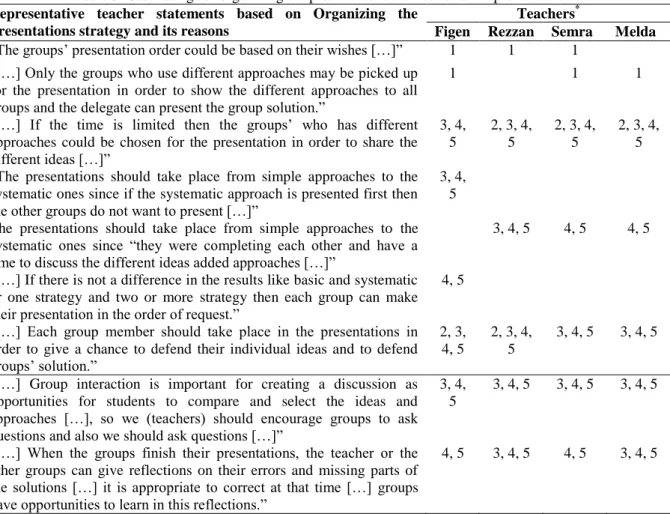
teachers, they stated that the groups‟ presentation order could be arbitrary or only the groups who used different approaches might be picked up for the presentation in order to “show the different approaches to all groups.” It was also indicated by the teachers that a delegate could present the group‟s solution. However, in the latter implementations, they came up with different strategies. All teachers denoted that each group should present their approaches since “they spent so much time on the solution and they need to express themselves but if the time is limited then the groups who have different approaches can be chosen for the presentation in order to share the different ideas”. The presentation order that was preferred by all the teachers in the last implementations was from simpler approaches to more sophisticated ones. This was explained, “if a more systematic approach is presented first, then the other groups may not want to present” by one teacher as “they are complementing each other and have time to discuss the different ideas and new approaches” by three teachers. Other presentation orders that were indicated; if there was not a difference like basic and systematic or one strategy and two or more strategies, then groups could make their presentation in the order requested by the teacher. Moreover, all teachers indicated that each group member should be involved in the presentations; in order to give a chance to defend their individual ideas and to defend groups‟ solution. Additionally, all teachers also indicated that group interaction was important for creating a discussion in order to give opportunities for students to compare and select the ideas and approaches. Teachers stated that teacher should encourage groups to ask questions and teacher should ask questions and play a dynamic role in the discussion. Furthermore, it was denoted that incomplete and incorrect solutions should be reflected upon to help groups to see these deficiencies. Each case‟s evolving knowledge on organizing the presentations of the solutions was compared in Table 3.
Table 3. Case ratings of organizing the presentations themes for all implementations Representative teacher statements based on Organizing the
Presentations strategy and its reasons
Teachers*
Figen Rezzan Semra Melda “The groups‟ presentation order could be based on their wishes […]” 1 1 1
“[…] Only the groups who use different approaches may be picked up for the presentation in order to show the different approaches to all groups and the delegate can present the group solution.”
1 1 1
“[…] If the time is limited then the groups‟ who has different approaches could be chosen for the presentation in order to share the different ideas […]”
3, 4, 5
2, 3, 4, 5
2, 3, 4, 5
2, 3, 4, 5 “The presentations should take place from simple approaches to the
systematic ones since if the systematic approach is presented first then the other groups do not want to present […]”
3, 4, 5 The presentations should take place from simple approaches to the systematic ones since “they were completing each other and have a time to discuss the different ideas added approaches […]”
3, 4, 5 4, 5 4, 5
“[…]If there is not a difference in the results like basic and systematic or one strategy and two or more strategy then each group can make their presentation in the order of request.”
4, 5
“[…] Each group member should take place in the presentations in order to give a chance to defend their individual ideas and to defend groups‟ solution.”
2, 3, 4, 5
2, 3, 4, 5
3, 4, 5 3, 4, 5
“[…] Group interaction is important for creating a discussion as opportunities for students to compare and select the ideas and approaches […], so we (teachers) should encourage groups to ask questions and also we should ask questions […]”
3, 4, 5
3, 4, 5 3, 4, 5 3, 4, 5
“[…] When the groups finish their presentations, the teacher or the other groups can give reflections on their errors and missing parts of the solutions […] it is appropriate to correct at that time […] groups have opportunities to learn in this reflections.”
4, 5 3, 4, 5 4, 5 3, 4, 5
* The numbers 1 through 5 indicate that the related theme was observed in the MEA implementation at least once, while“1”
refers to the implementation of the first MEA, “5” refers to the implementation of the fifth MEA throughout the study.
The following excerpts that were from the meetings after the second and third implementations exemplify the changes in teachers‟ strategies for organizing the presentations.
Rezzan: Yes, also when we [teacher] and other groups ask questions based on their approach at that time only the representative tries to explain but it is not good because other members should also have a chance of defending the group solution.
Teacher A: Time is used better when all group members defend their approach. …
Semra: In my implementations, I always had limited time for the presentations so I used to not let groups ask questions since their discussions take considerable time. However, I later realized that it is important to ask questions and discuss since when they ask questions they may see different points of views that I could not realize beforehand and there would a good discussion.
Melda: I let the groups ask questions to each other after the group finished their presentation, students asked really good questions to clarify groups‟ approach and found out if any, wrong or the missing parts. So, according to me the group interaction was important for sharing ideas.
Teacher F: All groups spend so much time to find solutions and they can see the missing parts of the solutions easily since they might have thought about the same approach but given up or they might have never thought about that approach and ask questions about it.
Melda: Yes, I agree with you, they can ask very good questions.
Excerpts displayed one of the components of how teachers organized the classroom setting during MEAs that is the presentations of the MEA solutions. Data showed that teachers thought each group member should play a role in the presentations in order to give a chance to defend their individual ideas and groups‟ solutions. This was a change from having the presentation made by the delegates to making the presentation with entire group members. Moreover, the other component was about group interaction for creating a discussion in class. This would give opportunities for students to compare ideas and approaches.
Ending the Implementation
Data analysis of this study revealed that the teachers‟ ways of ending the implementation to conclude the lesson changed from the first implementations of the study to the last. In earlier implementations, all teachers commented that the teacher could explain the result of the MEA based on the solution approaches emerged. However, in latter implementations, these ideas changed. All teachers stated that the main mathematical concepts involved in the task, should be summarized and students should be questioned about where to use and how to use the mathematical models they produced. Teachers thought that this would help for long term learning and students would have more positive approaches to math since “they see their model usage in different situations in real life”. Furthermore, teachers indicated that the approaches that could not be figured out by the students could be explained in order to help them see different points of views and the approaches which were thought but not improved much in the solution process could be given as homework. This would help to direct students to think more on the problem beyond the actual lesson for considering alternative approaches. The following excerpts that were taken from the meeting before the fourth implementation exemplify the components of teachers‟ strategies for ending the MEA that were summarizing the main mathematical concepts and asking the students where to use their mathematical models in similar situations. Moreover, Other components of ending the implementation strategy that was assigning homework for the approaches that was thought about but not implemented was also mentioned.
Figen: The concept of change should be explained here [water tank] students should understand the height changes based on the water in the tank.
Teacher A: They learned increasing graphs, we [teachers] can also ask the decreasing graphs as homework.
Rezzan: We [teachers] can ask them to draw the graphs while the tanks are releasing water rather than filling.
Figen: By this way, they will learn the concept of change more permanently.
Melda: We [teachers] can want students to re-consider their solution. For example, in the summer job one of the groups attempted to use standard deviation but did not complete this approach and gave up but then I wanted them to solve this problem using this approach for homework and I am looking forward to seeing their solution.
Teacher F: When students tried to solve this problem using different points of views, they began to see that math is not a stack of formulas.
Semra: Contrary to conventional, students began to look more positively towards math because they have a chance to see the feasible areas for the situation in the problem; it is a good idea to give the incomplete approaches for homework.
Findings showed that unusual pedagogical approaches on the implementation of the modeling activities were initially challenging for the teachers. It was especially difficult for the teachers to change the application of class setting. Furthermore, the strategies on organizing the presentations of the solutions sub-category formed in a longer period than other sub-categories. Development of the process was more detailed since after each implementation different proposals on strategies were discussed. However, looking through the more general frame, findings indicated that pedagogically more powerful strategies were generated by the teachers during the implementations through reflections with their colleagues. These strategies became more conceptually grounded as rationales for the strategy became articulated, as teachers modified and adapted particular strategies across a range of contexts and problem situations during the implementations.
Discussion and Conclusion
The current study investigated the evolution of teachers‟ pedagogical knowledge on the classroom organization and management during model-eliciting activities. Findings showed that unusual pedagogical approaches on the implementation of the modeling activities were initially not so easy for teachers. In other studies, this result is also mentioned as a concern and also being asked for direct help by teachers in order to use modeling in their classes (García & Ruiz-Higueras, 2011; Wake, 2011). However, professional development activities in this study gave teachers a chance; (i) to form and develop alternative teaching strategies by creating a framework for planning, enacting, reflecting through integrating their knowledge and experiences; (ii) to engage in multiple cycles of testing and revising those ways of thinking in particular contexts for specific goals and sharing their ideas with colleagues for replication and reuse in multiple problem contexts; (iii) to implement broad spectrum of MEAs covering various topics, contexts and cognitive levels in their classes; (iv) to listen and discuss students‟ ways of thinking, and to understand students‟ emerging questions. This learning environment provides crucial contributions to teachers‟ pedagogical knowledge on teaching mathematics.
From early to latter implementations, teachers‟ strategies for managing class setting changed towards letting small groups to be formed by students themselves and towards forming mixed groups. These pedagogical strategy components were supported by the previous studies (Bracke & Geiger, 2011; Galbraith & Clatworthy, 1990; Ikeda & Stephens, 2001; Lesh &Yoon, 2004). Lesh and Yoon (2004) stated that using small groups with three or four students in the implementation of mathematical modeling activities give chance to learners in order to develop, describe, explain, manipulate the model and control important conceptual systems and also offered by Bracke and Geiger (2011) that modeling teams should consist of three to four students. Besides, a variety of studies have shown that working in small groups, support the development of modeling competencies (e.g., Galbraith & Clatworthy, 1990; Ikeda & Stephens, 2001). Moreover, mixed group structure was emphasized by Biccard and Wessels (2011) that “students should also be exposed to a broader range of peers in their groups. This will allow for a wider scaffold for interaction, communication and reflection between the group members. This interaction and reflection will support the development of many cognitive and meta-cognitive processes and competencies” (p. 382).
Data revealed that teachers‟ pedagogical strategies changed regarding providing an understanding of the MEA and to warm up to the MEA. The change was towards introducing the context of the problem to the students by giving an example similar to the MEA‟ context and explaining students‟ actual task again based on this example question; the questions about the MEA [ What is your task? What are givens?] and encouraging the use of concrete models. If the concrete models are not appropriate, then the simulations and other real life examples could be used in order to help students to warm-up and understand the MEA. Similarly, giving an example close to the MEA‟s context was emphasized by Lesh and Doerr (2003a). They stated that students can become familiar with the situations of the case by reading the newspaper articles on MEA‟s context or talking on similar situations from real life. Doerr and Lesh (2011) reported that teacher‟s use of a physical model to demonstrate the relationship of the real life situation, as a particular “pedagogical strategy (or procedure),” for engaging the students with the task at hand. In the project DISUM “Didactical intervention modes for mathematics teaching oriented towards self-regulation and directed by tasks”; see Blum and Leiß (2008) for a description of this project., teachers asked students to read the text precisely, imagine the situation clearly, think about what is required from them and make a sketch for understanding the task (Blum, 2011).
The results showed that teachers generated pedagogical strategy on organizing the presentations of the solutions. It was agreed by teachers that all student-groups should present their work since they spend so much time and they need to express themselves, but if the time is limited then the groups who have different approaches could be chosen for the presentation in order to share different ideas. Strategy on groups‟ order was; presentations should take place from simpler approaches to more sophisticated ones since by these way approaches completing each other and have a time to discuss the different ideas, added approaches; if there was not a difference like basic and systematic or one strategy and two or more strategies then each group could make their presentation in the order of request. Groups‟ presentation process was decided to be as each group member should take place in the presentations in order to give a chance to defend their individual ideas and to defend groups‟ solution. Also, it was decided that group interaction was important for creating a discussion in order to give opportunities for students to compare the ideas and approaches, which meet the needs of the question so the teacher should encourage groups to ask questions and take a dynamic role in the discussion. Moreover, other agreed idea was that reflections should be given on incomplete or incorrect parts of the approaches. Similar pedagogical strategy components were observed in previous studies (Blum, 2011; Doerr & Lesh, 2011; Lesh & Doerr, 2003a; Mousoulides, Sriraman, & Christou, 2007). Likely, Doerr and Lesh (2011) support the finding as they reported that
When students work through the kinds of model development sequences, most often the process produces a diversity of ideas. From the teachers‟ perspective, encouraging a diversity of ideas will “make for good discussion” and discussing students‟ solutions to modeling tasks is a useful heuristic (or procedure). The underlying rationales for such discussion become visible as teachers use these discussions as opportunities for students to sort, select, and compare ideas (p. 262).
In addition, Mousoulides, Sriraman and Christou (2007) and Lesh and Doerr (2003a) state that, in the presentations, communication should take part and all groups need to describe their thinking and the teacher should be the dynamic domain of groups‟ interaction. Moreover, the reflection component of the pedagogical strategy is supported by Blum (2011) who reports that it is important to give retrospective reflections after the students‟ presentations in order to help them understand their weaknesses or strengths.
Data indicated that one of the pedagogical strategies on ending the implementation was to ask students to summarize the main mathematical concepts involved in the situation and to explain possible situations for using their mathematical models. Also, teachers agreed that the approaches, which could not be thought by the students in order to give different points of views, should be explained to students. Moreover, the approaches which were thought but not improved in the solution process in order to direct students to think more on the question out of the school for producing more appropriate approaches should be assigned as a homework. Similar components of the pedagogical strategy were reported as a possible didactic technique that teachers can summarize the big ideas embedded in the MEA and teacher can make the students use their models in similar situations since the solution of the activity should be simple but significant and provides useful prototypes for interpreting analogous situations by García and Ruiz-Higueras (2011) and Lesh and Doerr (2003a).
Conclusions
acting in the classroom. Teachers‟ decisions should be grounded in rationales and interpretations of a diversity of approaches since one cannot generally decide the appropriate action without specifying the necessary variation in advance. Teachers‟ patterns of teaching decisions should include ways of engaging students in expressing their own thinking, abilities to plan, highlighting underlying mathematical concepts and the relations between them and prompting students to make connections between diverse ideas and productive use of them. Nevertheless, teachers need the ability to recognize productive approaches versus less useful approaches, to engage the students in specifying what sorts of ideas are more useful than those that are less useful in advance, and to support students to make connections between diverse ideas. Pedagogical strategies, refined through experimentation in practice and by discussing among teachers as the strategies are shared in different problem situations. Moreover, strategies that are specific responses to problem situations shift from being simply local procedures to becoming conceptually grounded as rationales are structured and as modified for different problem context by teachers for responding to the tasks of teaching. However, teachers need learning environments in order to refine their pedagogical strategies. This study is expected to contribute the research field through providing such a learning environment that is supported with the professional development activities using lesson study cycle from the modeling perspective.
Acknowledgement
This work was supported by the Scientific and Technological Research Council of Turkey (TÜBİTAK) under grant number 110K250. Ayhan Kürşat ERBAS is supported by the Turkish Academy of Sciences through the Young Scientist Award Program (A.K.E./TÜBA-GEBİP/2012-11). This work is based on the thesis of the first author entitled “An Investigation of In-Service Secondary Mathematics Teachers‟ Evolving Knowledge through Professional Development Activities based on Modeling Perspective”.
References
Battye, A., & Challis, M. (1997). Deriving learning outcomes for mathematical modelling units within an undergraduate programme. In S. Houston, W. Blum, I. Huntley, & N. Neill (Eds.), Teaching and learning mathematical modelling – Innovation, investigation and applications (pp. 11-42) Chichester, UK: Ellis Horwood.
Blum, W. (2011). Can modelling be taught and learnt? some answers from empirical research. In G. Kaiser, W. Blum, R. B. Ferri, & G. Stillman (Eds.), Trends in teaching and learning of mathematical modelling (pp. 15-30). New York, NY: Springer.
Biccard, P., & Wessels, D. C. J. (2011). Documenting the development of modelling competencies of grade 7 mathematics students. In G. Kaiser, W. Blum, R. B. Ferri, & G. Stillman (Eds.), Trends in teaching and learning of mathematical modelling (pp. 375-384). New York, NY: Springer.
Board of Education. (2013). Ortaöğretim matematik (9-12. sınıflar) dersi öğretim programı [Mathematics curriculum for secondary schools: (9-12th grades]. Ankara: Ministry of National Education of the Republic of Turkey.
Bracke, M. & Geiger, A. (2011). Real-world modelling in regular lessons: a long-term experiment. In G. Kaiser, W. Blum, R. B. Ferri, & G. Stillman (Eds.), Trends in teaching and learning of mathematical modelling
(pp. 529-550). New York, NY: Springer.
Brophy, J., & Good, T. L. (1986). Teacher behavior and student achievement. In M. C. Wittrock (Ed.),
Handbook of research on teaching (pp. 328-375). New York, NY: Macmillan.
Carpenter, T. P., Fennema, E., & Frank, M. L. (1996). Cognitively guided instruction: A knowledge base for reform in primary mathematics instruction. The Elementary School Journal, 97(1), 3-20.
Chamberlin, M. T. H. (2002). Teacher investigations of students’ work: The evolution of teachers’ social
processes and interpretations of students’ thinking (Unpublished doctoral dissertation). Purdue University, West Lafayette, IN.
Clark, K. K., & Lesh, R. (2003) A modeling approach to describe teacher knowledge. In Lesh, R., & Doerr, H. M. (Eds.), Beyond constructivism: Models and modeling perspectives on mathematics problem solving, learning, and teaching (pp. 159- 174). Mahwah, NJ: Lawrence Erlbaum Associates.
Cohen, D. K., & Ball, D. L. (1990). Policy and practice: An overview. Educational Evaluation and Policy Analysis, 12, 347-353.
Crouch, R., & Haines, C. (2004). Mathematical modeling: transitions between real world and the mathematical model. International Journal of Mathematical Education in Science and Technology, 35(2), 197-206. Darling-Hammond, L. & Young, P. (2002). Defining “highly qualified teachers”: What does “scientifically
Doerr, H. M. (2006). Examining the tasks of teaching when using students‟ mathematical thinking, Educational Studies in Mathematics, 62, 3–24.
Doerr, H. M., & Lesh, R. (2003). A modelling perspective on teacher development. In R. Lesh and H. M. Doerr (Eds.), Beyond constructivism: Models and modeling perspective on mathematics problem solving, learning, and teaching (pp. 125–140). Hillsdale, NJ: Lawrence Erlbaum Associates.
Doerr, H. M., & Lesh, R. (2011). Models and modelling perspectives on teaching and learning mathematics in twenty-first century. In G. Kaiser, W. Blum, R. B. Ferri and G. Stillman (Eds.), Trends in teaching and learning of mathematical modelling (pp. 247-269). New York, NY: Springer.
English, L. D. (2003). Reconciling theory, research, and practice: A models and modelling perspective.
Educational Studies in Mathematics, 54, 225–248.
English, L., & Lesh, R. (2003). Ends-in-view problems. In R. Lesh, & H. M. Doerr (Eds.), Beyond constructivism: Models and modelling perspective on mathematics problem solving, learning, and teaching (pp. 297–316). Hillsdale, NJ: Lawrence Erlbaum Associates.
Erbaş, A. K., Çetinkaya, B., Alacacı, C., Çakıroğlu, E., Aydoğan Yenmez, A., Şen Zeytun, A., . . . Şahin, Z. (2016). Lise matematik konuları için günlük hayattan modelleme soruları. Ankara: Türkiye Bilimler Akademisi.
Erbaş, A. K., Kertil, M., Çetinkaya, B., Çakıroğlu, E., Alacacı, C., & Baş, S. (2014). Matematik eğitiminde matematiksel modelleme: Temel kavramlar ve farklı yaklaşımlar Mathematical modeling in mathematics education: Basic concepts and different approaches. Educational Sciences: Theory and Practice, 14(4), 1607–1627.
Evertson. C. M., Emmer, E. T., Sanford, I. P., & Clements, B. S. (1983). Improving classroom management: An experiment in elementary school classrooms. The Elementary School Journal, 84 (2),173-188.
Evertson, C. M., & Harris, A. (1992). What we know about managing classrooms. Educational Leadership, 7,
74-78.
Fennema, E., Franke, M. L., Carpenter, T. P., & Carey, D. A. (1993). Using children‟s mathematical knowledge in instruction. American Educational Research Journal, 30(3), 555-583.
Fernandez, C. (2002). Learning from Japanese approaches to Professional development. Journal of Teacher Education, 53, 393-405.
Fernandez, C. (2005). Lesson Study: A means for elementary teachers to develop the knowledge of mathematics needed for reform-minded teaching. Mathematical Thinking and Learning, 7(4), 265-289.
Fernandez, C., & Yoshida, M. (2004). Lesson study: A case of a Japanese approach to improving instruction through school-based teacher development. Mahwah, NJ: Lawrence Erlbaum.
Ferri, B. R. (2011). Effective mathematical modelling without blockages –a commentary. In G. Kaiser, W. Blum, R. B. Ferri and G. Stillman (Eds.), Trends in teaching and learning of mathematical modelling
(pp. 181-186). New York, NY: Springer.
Galbraith, P., & Clatworthy, N. J. (1990). Beyond standard models – Meeting the challenge of modelling.
Educational Studies in Mathematics, 21(2), 137–163.
García, J. F., & Ruiz-Higueras, L. (2011). Modifying teachers‟ practices: the case of a European training course on modelling and applications. In G. Kaiser, W. Blum, R. B. Ferri, & G. Stillman (Eds.), Trends in teaching and learning of mathematical modelling (pp. 569-578). New York, NY: Springer.
Gearhart, M., & Saxe, G. B. (2004). When teachers know what students know: Integrating assessment in elementary mathematics teaching. Theory into Practice, 43, 304-313.
Haines, C. R., & Crouch, R. M. (2001). Recognising constructs within mathematical modelling. Teaching Mathematics and its Applications, 20(3), 129-138.
Hiebert, J., Gallimore, R., & Stigler, J. (2002). A knowledge base for the teaching profession: What is would look like and how can we get one? Educational Researchers, 31(5), 3-15.
Houston, K. (2002). Assessing the “phases” of mathematical modeling. In W. Blum, P. L. Galbraith, H.-W. Wenn, & M. Niss (Eds.), Modeling and applications in mathematics education (pp. 249-256). New York, NY: Springer.
Ikeda, T., & Stephens, M. (2001). The effects of students‟ discussion in mathematical modelling. In J. F. Matos, W. Blum, K. Houston, & S. P. Carreira (Eds.), Modelling and mathematics education (ICTMA 9): Applications in science and technology (pp. 381–390). Chichester, UK: Horwood.
Izard, J., Haines, C., Crouch, R., Houston, K., & Neill, N. (2003). Assessing the impact of teachings mathematical modeling: Some implications. In S. J. Lamon, W. A. Parker, & S. K. Houston (Eds.),
Mathematical modelling: A way of life ICTMA 11 (pp. 165-177). Chichester, UK: Horwood.
Jensen, T.H. (2007). Assessing mathematical modeling competency. In C. Haines, P. Galbraith, W. Blum and S. Khan (Eds.), Mathematical modeling (ICTMA 12) education, engineering and economic (pp. 141-148). Chichester, UK: Horwood.
Kaiser, G., Blum, W., Borromeo Ferri, R., & Stillman, G. (2011). Preface. In G. Kaiser, W. Blum, R. BorromeoFerri, & G. Stillman (Eds.), Trends in teaching and learning of mathematical modelling: ICTMA14 (pp. 1-5). Dordrecht, the Netherlands: Springer.
Kaiser-Messmer, G. (1993). Results of an empirical study into gender differences in attitudes towards mathematics. Educational Studies in Mathematics, 25, 209–233.
Lanier, J. E., & Little, J. W. (1986). Research on teacher education. In M. C. Wittrock (Ed.), Handbook of research on teaching (3rd ed.) (pp. 527-569). New York, NY: Macmillan.
Lesh, R., Cramer, K., Doerr, H. M., Post T., & Zawojewski, J. S. (2003). Model development sequences. In Lesh, R., & Doerr, H. (Eds.), Beyond constructivism: Models and modeling perspectives on mathematics problem solving, learning and teaching (pp. 35-58). Mahwah, NJ: Lawrence Erlbaum Associates, Inc. Lesh, R., & Doerr, H. M. (2003a). Beyond constructivism: A models and modelling perspective on mathematics
problem solving, learning and teaching. Mahwah, NJ: Lawrence Erlbaum Associates, Inc.
Lesh, R., & Doerr, H.M. (2003b). In what ways does a models and modelling perspective move beyond constructivism? In R. Lesh and H. M. Doerr (Eds.), Beyond constructivism: Models and modelling perspective on mathematics problem solving, learning & teaching (pp. 519–556). Hillsdale, NJ: Lawrence Erlbaum Associates, Inc.
Lesh, R., & English, L (2005). Trends in the evolution of the models-modelling perspective on mathematical learning and problem solving. International Reviews on Mathematical Education, 37 (6), 487–489. Lesh, R., Kaput, J., & Hamilton, E. (2007). Foundations for the future: The need for new mathematical
understandings & abilities in the 21st century. Hillsdale, NJ: Lawrence Erlbaum Associates.
Lesh, R., & Sriraman, B. (2005). John Dewey Revisited- Pragmatism and the models-modeling perspective on mathematical learning. In A. Beckmann, C. Michelsen, & B. Sriraman (Eds.), Proceedings of the 1st International Symposium on Mathematics and its Connections to the Arts and Sciences (pp. 32-51). University of Schwaebisch Gmuend, Germany: Franzbecker Verlag..
Lesh, R., & Yoon, C. (2004). Evolving communities of mind – in which development involves several interacting and simultaneously developing strands. Mathematical Thinking and Learning, 6(2), 205–226. Lewis, C. (2002a). Does lesson study have a future in the United States? Nagoya Journal of Education and
Human Development, 1(1), 1-23.
Lewis, C. (2002b). Lesson study: A handbook of teacher-led instructional change. Philadelphia, PA: Research for Better Schools.
Lewis, C., Perry, R., & Murata, A. (2006). How should research contribute to instructional improvement? The case of lesson study. Educational Researcher, 35(3): 3-14.
Lingefjärd, T. (2000). Mathematical modeling by prospective teachers using technology (Unpublished PhD Dissertation). Athens, GA, University of Georgia.
Lingefjärd, T. (2002). Mathematical modeling for pre-service teachers: a problem from anesthesiology.
International Journal of Computers for Mathematical Learning, 7, 117-143.
Little, J. W. (2004). “Looking at student work” in the United States: A case of competing impulses in professional development. In C. Day, & J. Sachs (Eds.), International handbook on the continuing professional development of teachers (pp. 94-118). Berkshire, UK: Open University Press.
Morine-Dershimer, G., & Kent, T. (1999). The complex nature and sources of teachers‟ pedagogical knowledge. In Gess-Newsome, J., & Lederman N. G (Eds.), PCK and science education (pp.21-50). Dordrecht, the Netherlands: Kluwer.
Mousoulides, N., Sriraman, B., & Christou, C. (2007). From problem solving to modelling: The emergence of models and modelling perspectives. Nordic Studies in Mathematics Education, 12(1), 23–47.
National Council of Teachers of Mathematics. (2000). Principles and standards for school mathematics. Reston, VA: Author.
Niss, M., Blum, W., & Galbraith, P. L. (2007). Introduction. In W. Blum, P. Galbraith, H. Henn, & M. Niss (Eds.), Modelling and applications in mathematics education: The 14th ICMI study (pp. 3-32). New York, NY: Springer.
Perry, R., & Lewis, C. (2009). What is successful adaptation of lesson study in the U.S.? Journal of Educational Change, 10(4), 365-391.
Schifter, D., Russell, S. J., & Bastable, V. (1999). Teaching to the big ideas. In M. S. Solomon (Ed.), The diagnostic teacher: Constructing new approaches to professional development (pp. 22-47). New York, NY: Teacher College Press.
Schorr, R., & Lesh, R. (2003). A modelling approach for providing teacher development. In R. Lesh, & H. M. Doerr (Eds.), Beyond constructivism: Models and modelling perspectives on mathematics problem solving, learning, and teaching (pp. 141-158). Mahwah, NJ: Lawrence Erlbaum Associates.
Shimizu, Y. (2002). Lesson study: What, why, and how? In H. Bass, Z. P. Usiskin, & G. Burrill. (Eds.),
Studying classroom teaching as a medium for professional development: Proceedings of a U.S.-Japan Workshop (pp. 53-57). Washington, DC: National Academy Press.
Shulman, L. S. (1986). Those who understand: Knowledge growth in teaching. Educational Researcher, 15(2), 4-14.
Shulman, L. S. (1987). Knowledge and teaching: Foundations of the new reform. Harvard Educational Review, 57(1), 1-22.
Sriraman, B., & Lesh, R. (2006). Beyond Traditional conceptions of modelling. ZDM-Mathematics Education, 38(3), 247-254.
Stein, M. K., Smith, M. S., & Silver, E. A. (1999). The development of professional developers: Learning to assist teachers in new settings in new ways. Harvard Educational Review, 69(3), 273-269.
Sowder, J. T. (2007). The mathematical education and development of teachers. In F. K. Lester (Ed.), Second handbook of research on mathematics teaching and learning (pp. 157-223). Charlotte, NC: Information Age Publishing.
Verschaffel, L., Greer, B., & De Corte, E. (2002). Everyday knowledge and mathematical modeling of school word problems. In Gravemeijer, K., Lehrer, R., Oers, B., van, & Verschaffel, L. (Eds.), Symbolizing, modeling and tool use in mathematics education (pp. 171-195). Dordrecht, the Netherlands: Kluwer Academic Publishers.
Wake, G. (2011). Teachers‟ professional learning: modelling at the boundaries. In G. Kaiser, W. Blum, R. B. Ferri and G. Stillman (Eds.), Trends in teaching and learning of mathematical modelling (pp. 653-664). New York, NY: Springer.
Wang-Iverson, P., & Yoshida, M. (2005). Building our understanding of lesson study. Philadelphia, PA: Research for Better Schools.
Watanabe, T. (2002). Learning from Japanese lesson study. Educational Leadership, 59(6), 36-39.
Wilms, W. W. (2003). Altering the structure and culture of American public schools. Phi Delta Kappan, 84(8), 606-613.
Yoshida, M. (2002). Framing lesson study for U.S. participants. In H. Bass, Z. P. Usiskin, & G. Burrill. (Eds.),
Studying classroom teaching as a medium for professional development: Proceedings of a U.S.-Japan Workshop (pp. 58-64). Washington, DC: National Academy Press.
Zawojewski, J. S., Lesh, R., & English, L. (2003). A models and modelling perspective on the role of small group learning activities. In R. Lesh & H. M. Doerr (Eds.), Beyond constructivism: Models and modelling perspectives on mathematics problem solving, learning, and teaching (pp. 337-358). Mahwah, NJ: Lawrence Erlbaum Associates.
Author Information
Arzu Aydogan Yenmez
Ömer Halisdemir University
Department of Mathematics and Science Education Contact e-mail: [email protected]
Ayhan Kursat Erbas
Middle East Technical University
Department of Mathematics and Science Education
Cengiz Alacacı
Istanbul Medeniyet University
Department of Mathematics and Science Education
Erdinc Cakiroglu
Middle East Technical University
Department of Mathematics and Science Education
Bulent Çetinkaya
Middle East Technical University