Lectora-Based Interactive E-Book Development for
Elementary Schools
Putri Wahyuningtyas
1, Lilik Bintartik
1,
Arda Purnama Putra
1, *1Departement Primary and Childhood Education, Universitas Negeri Malang, Malang, Indonesia *Corresponding author. Email: [email protected]
ABSTRACT
This development research aims to produce an interactive e-book based on Lectora Inspire by strengthening the character of curiosity in the sub-theme of the wealth of energy sources in Indonesia in class IV which is valid, practical, and interesting. The research development method used is ADDIE which includes: (1) analysis, (2) design, (3) development, (4) implementation, and (5) evaluation. The results of the validity of interactive e-books get an average value of 93.29% with a very valid category can be used without revision, while the attractiveness and practicality obtained from the results of field trials obtained a value of 100% with very practical and very interesting categories can be used without revision. So that interactive e-books are said to be very valid, very practical, very interesting, and can be used by students in elementary schools.
Keywords: lectora inspire, thematic learning, elementary schools
1.
INTRODUCTION
Education in Indonesia currently uses the 2013 curriculum. The 2013 curriculum is oriented to improve and balance between competency attitudes, skills, and knowledge. Curriculum 2013 SD / MI uses thematic learning from class I to class VI. Thematic learning according to Poerwadarminta (Majid, 2014) is integrated learning that uses themes to link various subjects so that it can provide useful experiences for students. Related to thematic learning. Basic competency training from several subjects namely Natural Sciences, Social Sciences, SBdP, Indonesian Language, PKn, Mathematics, Sports, and health into one theme. The theme chosen is also related to nature and the surrounding environment. In thematic learning, use themes as a unifying material from several lessons at once in one meeting, so the teacher needs to discuss effective learning to achieve learning objectives.
Students who are actively involved in learning will focus on character building. Therefore, in learning, character education needs to be followed. Character education according to Zainuddin (2017) is a process of civilization and humanization. Character education will lead students to learn with the potential they have so that they become civilized human beings, while still holding fast to human values, ethical values, both for themselves as well as for all members of the community as such. Thus learning outcomes are intact, containing the realm of knowledge, attitudes, skills, and character formation.
18 characters can be developed, one of which is the character of curiosity. The reason is that the character of curiosity makes students learn further and deeply, besides the character of curiosity makes one of the components that encourage the realization of student creativity. The character of curiosity according to Zainuddin (2017) is the attitude and actions that always strive to find out more deeply and extensively from something they have learned, seen, and heard. This curiosity character makes students motivated, challenged, and active in learning. There are four indicators of curiosity character according to Sholehuzain (2017), which are active in asking questions, trying to find other sources, trying to find more challenging problems, and have the desire to know more deeply. This means that curiosity will make students learn and know more deeply, with curiosity that students will learn not from just one source but various sources.
The results of interviews with the fourth-grade teachers of Karangtengah 1 Elementary School in Blitar City on December 10, 2019, obtained information about the potential in Karangtengah 1 Elementary School in Blitar City, Indonesia. Namely using the 2013 curriculum from grade 1 to grade 6, and has a computer lab. But there are obstacles, namely: (1) limited learning media for students, (2) teaching materials used are only in the form of teacher books and student books (thematic), (3) the use of less effective computer labs, (4) students are less active in learning, and (5) learning atmosphere is less interactive.
The teaching material used by students is the 2013 curriculum thematic books, the material contained therein is quite short, so students have difficulty in understanding the material in the book. Besides learning has not been carried out interactively, because students have not been directly involved with learning. Learning becomes monotonous and unpleasant so it makes students get bored easily. Lack of challenging learning, resulting in students lacking the motivation to participate actively in learning activities. Therefore, alternative solutions are developed by making teaching materials in the form of soft files that utilize computer labs in the form of interactive e-books (electronic books) based on Lectora Inspire. This is due to the limitations of teaching materials to support students who are deemed lacking. And the use of computer labs in SDN Karangtengah 1 Blitar City.
Making interactive e-books using the Lectora Inspire application. Lectora inspires according to Mas’ud (2012) is an Authoring Tool for the development of e-learning content developed by Trivanis corporation. Lectora inspires can make online training courses, assessments, and presentations quickly and simply. Its founder is Timothy D. Loudermilk in Cincinnati, Ohio, the USA in 1999. The advantage of Lectora inspires is that it can be used to create websites, content related to interactive e-learning that contains text, images, sounds, animations, videos, and games.
Interactive e-books have advantages over printed books that are interactive, can be accessed offline with the help of a computer or laptop, allows displaying images, videos, and animations as well as formative quizzes that can attract students to further study. In making e-books, it is necessary to pay attention to the requirements for making modules/books following the provisions. According to the National Education Standards Agency Team (BSNP) the criteria for making good books are the appropriateness of the content, linguistics, and presentation (Abror, 2015). So, we need to pay attention to the requirements for making good books so that the book will be useful for teachers and students
Interactive e-books can be integrated with curiosity characters because in interactive e-books there is not only one subject competency. But from various subject competencies so that it is possible in the learning process to improve the character of curiosity in students so that the curiosity of students can develop.
2.
METHOD
Electronic Book) with Strengthening the Character of Curiosity in the Energy Resources Wealth Subtema in Indonesia class IV using ADDIE steps. Rusdi (2018) said that the ADDIE model has 5 stages, consisting of Analysis, Design, Development, Implementation, and Evaluation (Sugiyono, 2015).
Table 1 Validation Scale for Validation of Material Expert, Teaching Material Expert, and User
Score Rating
4 Very Good
3 Good
2 Not Good
1 Very Not God
Questionnaire responses of students using the Guttman scale. According to Sugiyono (2015), on the Guttman scale, an answer will be obtained that is “yes-no”. So, from the results of the student questionnaire obtained a value of 1 on the answer “yes” and a value of 0 if the answer “no”. To find out the validity of interactive e-books, assessment data of material experts, instructional materials experts, users, and students using the Akbar formula (2017).
𝑉 − 𝑎ℎ, 𝑉 − 𝑎𝑢, 𝑉 − 𝑝𝑔 = 𝑇𝑠𝑒
𝑇𝑠ℎ 𝑥 100%
Information, V-ah for Expert validation, V-au for Student validation, V-pg for User validation, Tse for Total empirical score achieved, Tsh for Total expected result score, 100% for Constant. The results of the validation of the teaching material experts, material experts, users, and students are categorized as follows (Hartanti et al., 2017).
Table 2 Criteria for Validity, Practicality, and Attractiveness Achievement
Criteria (%) Test Decision
80,01- 100,00 Very Invalid, practical, attractive, small revisions can be used
60,01 – 80,00 Invalid, practical, attractive, small revisions can be used
40,01 - 60,00 Less valid, less practical, less interesting advice is not used
21,00 - 40,00 Invalid, impractical, unattractive, may not be used
00,00- 20,00 Very invalid, very impractical, very unattractive, may not be used
Based on Table 2, it was decided that an interactive e-book can be used if it is declared valid, practical, and interesting and can be used without revision if the assessment results are above 80%. If the assessment results are below 80%, a revision or improvement needs to be done. Assessments to measure validity are carried out by material experts, instructional materials experts, and users (teachers), while assessments for practicality and attractiveness by students.
3.
RESULT
The Lectora inspire-based Interactive Electronic Book (Ebook) e-book product with Strengthening the Character of Curiosity in the Energy Resources Wealth Subtheme in Indonesia class IV through the stages of ADDIE development as follows. In the first stage of the analysis, the analysis is carried out with the need’s
analysis, curriculum analysis, and analysis of the learning environment of students. Analysis of the needs of the activities carried out was an interview with the fourth-grade teacher. The results of the interviews show that there are problems such as limited learning media, teaching materials used are only in the form of teacher books and students’ books (thematic), the use of less effective computer labs, students are less active in learning, and the learning atmosphere is less interactive.
The solution to the problem was finally agreed upon by developing an interactive e-book based on Lectora Inspire because of limited teaching materials and the use of computer labs. Curriculum analysis through core competencies, basic competencies used by Natural Sciences KD 3.5 and 4.5, Social Sciences KD 3.1 and 4.1, Indonesian Language KD 3.3 and 4.3, and PPKn KD 3.2 and 4.2. Furthermore, each KD is described as an indicator and objectives that must be achieved and developed in interactive e-books. Furthermore, an analysis of the learning environment through the availability of information technology facilities such as computer labs in SDN Karangtengah 1 Blitar City has 10 computers and 6 laptops to support the implementation of learning using interactive e-book products.
The second stage of design is designing interactive e-book product designs and designing assessment instruments. Design the product by making a cover consisting of a title, a logo Malang State University, the author’s name, supervisor’s name, instructions for using e-books, and prayers before studying following their respective religions. The material consists of learning 1 and 2 which contains materials for Natural Sciences, Social Sciences, Indonesian Language, and PKn. Each learning consists of activities, let’s discuss, let’s read, let’s observe, you know, and let’s study. In the e-book display, there are pictures, materials, videos, and audio that attract students. The practice exercises consist of 20 multiple choices in each learning to measure students’ abilities and there is a bonus in the form of games to entertain students.
Furthermore, designing a product assessment instrument is used to assess the level of validity, practicality, and attractiveness in an interactive e-book. Validity is assessed based on teaching material experts, material experts, and users (teachers), while practicality and attractiveness are assessed based on students’ questionnaire responses. After the products and instruments are finished, they are then consulted with the supervisor. Suggestions from the supervisor about the product that the use of interactive e-book languages must be adjusted to the characteristics of students, the use of sentences that need to be improved so as not to confuse students, correct writing errors (typo), and display in interactive e-books are quite interesting.
The third stage is a product development and product validation. At the stage of developing interactive e-book
products using the Lectora Inspire application, designing covers using the Canva application and selecting images from freepik.com, cutting video, and audio using the in shot application. Then the product is validated by the material expert, teaching material expert, and grade IV teacher as users. The three of them acted as validators. Quantitative data from the validation of material experts (V1), instructional materials experts (V2), and users (V3) are presented in Table 3.
Table 3 Recapitulation of Results of Validation of Material
Expert, Teaching Material Expert, and User
Aspect
Percentage of
Validator Rating Mean Category
V1 V2 V3
1.Content
eligibility 100 - 75 87,5
Very Valid 2.Language 83,33 - 100 91,67 Very Valid 3.Presentation 93,75 93,75 100 95,83 Very Valid 4.Curiosity 100 91,66 100 97,22 Very Valid 5.Practicality - 100 100 100 Very Valid
6.Victory - 75 100 87,5 Very
Valid 7.Total 377,08 360,41 575 559,72
8.Average 94,27 90,10 95,8
3 93,29 9.Category Very Valid Very Valid
Table 3 shows that the 3 validators as a whole gave the same average rating, which is very valid with a range of 90.10% to 95.83%. Likewise, the average rating for each aspect. There are six aspects assessed on the product, namely the appropriateness of content, language, presentation, curiosity character, practicality, and attractiveness, an average of 93.29% with a very valid category. The aspects of product viability and product attractiveness received the lowest rating of 87.5% among other aspects, although still in the very valid category.
Besides validation quantitative data is also supported by qualitative data in the form of comments and suggestions from each validator. The comments and suggestions were given by material experts for the product being developed are: (1) the cover or cover is adjusted to the content of the material, (2) the image contained in the e-book must be following the material, and (3) the sentence in the e-book is short, compact, and clear. Furthermore, comments and suggestions given by experts in teaching materials validators are: (1) the layout of the right buttons, (2) the shape of the font should not be too large, the important thing is easy to read and interesting, and (3) added motivational sentences in all displays. The suggestions from users are: (1) the next and back buttons are changed to go back and forth, (2) the layout of the home button on each slide, and (3) the
resolution of the e-book display for easy use of a laptop or computer.
Based on quantitative assessments, it is stated that the product is very valid and can be used without revision. However, so that the product can perform better, improvements are made based on the comments and suggestions of the validators. These improvements include: (1) the image on the cover and in the e-book more adapted to the material; (2) some sentences are changed to be shorter, concise, and clear; (3) reset the button layout; (4) change some form of letters to make it easier to read and interesting; (5) add motivational sentences to several parts; and (6) change the next and back buttons to continue and back, and finally, change the display resolution of the e-book to suit the laptop. After the revision or repair is complete, the product is now ready to try out.
The fourth stage of implementation is the concrete step to conduct product trials that have been made to determine the practicality and attractiveness of the learner’s perspective. At this stage, small group trials and field trials are conducted. Small group trial on February 25, 2020, with class IV A subjects consisting of 6 students. In this small group trial, students learn by using an interactive e-book, after completion they are asked to fill out a questionnaire to find out their responses about the practicality and attractiveness of the product. This is done to minimize product deficiencies before field trials. In small group trials, they get comments and suggestions from students, namely e-books are interesting and good, but the appearance of e-books on a computer is too big so it needs to be shifted. This suggestion is related to a technical problem setting on a desktop screen, so this is a warning to researchers at the time of the field test.
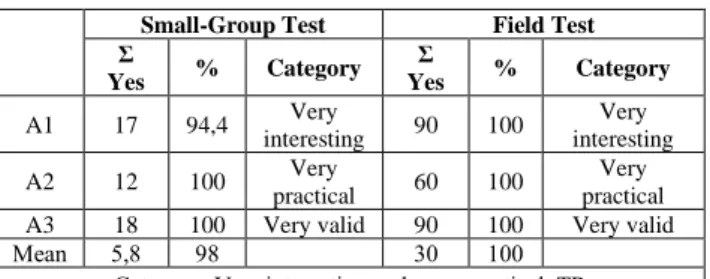
The field trial was conducted on February 27, 2020, with class IV B subjects consisting of 30 students. Field trials are used to determine the practicality and attractiveness of this product. Student Response Data on small group trials & product field trials in Table 4 with the aspect of victory (A1), practically (A2), and curiosity (A3).
Table 4 Student Response Data on Small Group & Field Trials
Small-Group Test Field Test
Σ
Yes % Category
Σ
Yes % Category
A1 17 94,4 interesting Very 90 100 interesting Very
A2 12 100 Very
practical 60 100
Very practical A3 18 100 Very valid 90 100 Very valid
Mean 5,8 98 30 100
Category: Very interesting and very practical, TR
Based on table 4, the results of practicality and attractiveness calculations in the small group trial scored 98%, in the field trial the score was 100%. Both are in the same category, which is very practical and very
interesting, with product test decisions that can be used without revision. This quantitative data can be interpreted that according to students’ interactive e-books are very practical and very interesting. Thus, the product can be used without revision. In addition to quantitative data students’ responses are also in the form of comments, namely: (1) e-books are very helpful in understanding the material, and (2) e-books are very good, exciting, and interesting. In the field trials, pretest and posttest were also conducted to determine the ability of the students before and after using an interactive e-book based on Lectora Inspire. Data on the pretest and posttest values are presented in Table 5.
Table 5 Results of Ability Before and After Using E-books
Score Pretest Posttest To Increase
Minimum 42,5 60 17,5
Maximum 92,5 100 7,5
Average 68,8 89,2 20,4
Table 5, shows the learning outcomes aspects of students’ knowledge in terms of minimum, maximum, and average values all increase. This shows that interactive e-books are effective for improving student learning outcomes in aspects of knowledge. While the results of learning aspects of skills and attitudes are unknown because research is not focused there.
The fifth stage is the evaluation carried out at all stages, namely analysis, design, development, and implementation. The evaluation aims to improve interactive e-book products at each stage. Also, an evaluation is conducted to determine the validity, practicality, and attractiveness of the product, so that an interactive e-book is suitable for use in the learning process. Evaluations at each stage are usually called formative evaluations, whereas evaluations at the end of the stages, which are overall evaluations related to product development goals are called summative evaluations.
4.
DISCUSSION
The validity of the product is based on the results of the validation of 3 validators, namely material experts by teaching material experts, and users. Validation of interactive e-book (electronic book) based on Lectora Inspire by strengthening the character of curiosity in the sub-theme of the wealth of energy resources in Indonesia in grade IV elementary school includes four aspects namely content worthiness, language, presentation, and curiosity. Content eligibility has three aspects of assessment, namely: (a) indicators adjusted to BC, namely, interactive e-book material containing various energy sources, containing renewable and non-renewable energy sources, containing obligations and rights, containing environmental benefits for humans, and containing interview questions. This is in line with the Ministry of National Education (2004) in analyzing the
curriculum must include, KI, KD, indicators, and subject matter. So that the preparation of material based on the analysis of basic competencies and objectives that have been developed; (b) material compiled coherently. Material indicators adjusted to the coherent material are systematically arranged, concise and concise material, and material clarity; and (c) examples of problems under daily life. Indicators of problems under daily life that includes examples of problems of energy sources include examples of rights and obligations includes examples of the benefits of solar energy (Rosita, Fadiawati, & Jalmo, 2017).
The results of the content feasibility assessment by material experts and users alike are 100%. This means that interactive e-books have reached a very valid category and products can be used without revision. However interactive e-book revisions are made according to the suggestions and comments of experts and users. The advice given by experts and users is that the covers and pictures are adjusted to the contents of the material contained in the interactive e-book. This is in line with Arsanti (2018) Presentation of images must be relevant and can support students’ understanding. This means that images must be adjusted to the contents of the material presented in an interactive e-book. So, students can understand the material through pictures
Language has three aspects of assessment, namely: (a) reading text in e-books. The reading text indicator in an e-book is the reading text in an e-book that is using straightforward sentences, using effective sentences, not using sentences containing 2 meanings; (b) sentence structure in e-books. The sentence structure indicators in e-books are sentences according to Indonesian rules, spelling under PUEBI, and the simplicity of sentence structure; and (c) vocabulary used according to the development of grade IV students. The vocabulary indicators are adjusted for the development of grade IV students, that is, vocabulary is easily understood by students, vocabulary does not complicate students, vocabulary is by the characteristics of students.
The results of language assessment by material experts reached 83.33%, while users gave a value of 100%. So, the interactive e-book has reached a very valid category and the product can be used without revision. Despite this, the material and the user-provided suggestions for small improvements to the interactive book. The advice is given sentences in an interactive e-book to be short, concise, and clear. This is in agreement with Arsanti (2018) The material is presented using effective sentences and adjusted to the rules of good and correct Indonesian Language (EBI). This means that effective and straightforward sentences will be easily understood by students (Ambarita, 2020).
The presentation has four aspects of assessment, namely: (a) e-book display design. The e-book display design indicators are overall e-book design, design by the
material, design by grade IV elementary school children; (b) study instructions. Indicators of learning instructions that are in the e-book include accuracy, ruffle, and clarity of coherent learning instructions, clear learning instructions; (c) information that motivates students. Indicators of information that motivate students, namely > 3 information that motivates students, there is > 2 information that motivates students, there is 1 information that motivates students; and (d) there is feedback on the book. Indicator of feedback in the e-book there are > 3 appropriate feedbacks, there are 2 right feedbacks, there is 1 right feedback.
The results of the assessment by the material experts and teaching materials experts are the same, which is 93.75%, while the user gives a value of 100%. This means that three validators provide assessments with the same category, which is very valid with a product testing feasibility test decision that can be used without revision. There are some suggestions from experts, teaching materials experts, and users. Suggestions were given by material experts, instructional materials experts, and users, namely the form of the font is not too big but easy to read and interesting for students. This is consistent with the opinion of Smaldino, et al, (Hartanti, 2017) The size of the text is very important for the ease of readability. This means that the font size in e-books is very influential to facilitate students reading.
The character of curiosity has three aspects of assessment namely: (a) encouraging students to learn further using e-books. Indicators encourage students to learn more about using e-books, encouraging students to learn more using e-books, encouraging students to learn more using e-books, namely encouraging students to actively use e-books, encourage students to enthusiastically use e-books, and stimulate participants to be asked. This is in line with the opinion of Sholehuzain (2017) the character of curiosity that is active in asking, trying to find other sources, trying to find more challenging problems, and have the desire to know more deeply. This means that the character of curiosity encourages students to ask questions about the things they learn and have the desire to learn more and more deeply; (b) Motivate students to learn new things. Indicators motivate students to learn new things, namely encouraging willingness to learn, motivate learning by reading, and stimulate students to learn new things; and (c) Allow students to ask further questions. The indicator allows students to ask further questions, namely giving 3 opportunities to ask questions, giving 2 opportunities to ask questions, and giving 1 opportunity to ask questions. The results of the curiosity assessment by material experts, users, and students are the same, which is 100%, while the teaching material experts get a value of 91.66%. This means that interactive e-books reach very valid categories and products can be used without revision.
Practicality and attractiveness of interactive e-books based on students’ responses at the implementation stage of small group trials and field trials. In the small group test and the field, the test assesses three aspects namely practicality, attractiveness, and the character of curiosity. In practical aspects, there are two aspects of assessment, namely: (a) easy to operate interactive e-books, which scores 100% in small group trials and field trials. Indicator of easy to operate interactive e-book that is the application can be used on a PC / laptop, easy to operate, and simple use; (b) the button in an interactive e-book that is easy to understand gets 100% in small group trials and field trials. The key indicators in the interactive e-book are easy to understand, namely the back-button compatibility, the next button compatibility, and the home button compatibility. This is in line with the opinion of Ginanjar (2010) multimedia should use simple instructions to facilitate its users. Therefore, each display in an interactive e-book is given an advanced, back, home, and exit button. The buttons aim to make it easier to operate interactive e-books so that in their use interactive e-books are easy and practical to use by students. Results of average practicality of interactive e-books based on Lectora inspire by strengthening the character of curiosity in trials small groups and large group trials get 100%. So, it can be concluded that interactive e-books are very practical and can be used without revision.
Victory has three aspects of assessment, namely: (a) the display of pictures, videos, and audio scores 100% in small group trials and field trials. Indicators display images, videos, and audio that is the display of images attracting students, displaying videos attracting students, audio that attracts students. This is in line with the opinions of Putra (2019) through interactive multimedia learners can increase the attractiveness and interest in learning, because interactive multimedia integrates text, graphics, images, photos, audio, video, and animation. Students who learn through interactive multimedia will be more active and more motivated in learning. Then it can be concluded that, an interactive e-book that combines images, audio, video, and animation. So that it can enable students to become more active in learning, motivated to learn more, and make it easier for students to understand the material presented; (b) the quality used in the e-book scores 100% in both small group tests and field trials. The quality indicators used in the e-book are PNG image quality used, the quality of the mp4 video used is clear, and the audio quality of the mp3 used is clear; (c) the e-book layout scores 83.3% in the small group test, while the field trial test gets 100%. The layout indicators in the e-book are the layout of the text arranged with unified, the layout of the images arranged with unified, the layout of the video is arranged with unified, the audio layout is arranged with unified. The average attractiveness results in small group trials get a value of 94.4% and field trials to get 100%, it can be concluded
that interactive e-books are very practical, interesting and can be used without revision Zhang-(Kennedy & Chiasson, 2016).
The character of curiosity has three aspects, namely: (a) encouraging students to learn further using e-books to score 100% in small group trials and field trials. Indicators encourage students to learn more about using books, namely encouraging students to actively use books, encourage students to enthusiastically use e-books, and stimulate students to ask questions; (b) motivate students to learn things that have just scored 100% in small group trials or field trials. Indicators motivate students to learn new things, namely encouraging willingness to learn, motivate learning by reading, and stimulate students to learn new things; and (c) allow students to ask further questions to get a score of 100% in small group trials and field trials. The indicator allows students to ask further questions, namely giving 3 opportunities to ask questions, giving 2 opportunities to ask questions, and giving 1 opportunity to ask questions. Based on these averages, the aspect of strengthening the character of curiosity in interactive e-books can be used without revision.
In the small group trial get suggestions and comments from students, namely interactive e-books are good and interesting, but the appearance of interactive e-books is too large so it needs to be shifted. Whereas the practicality and attractiveness questionnaire field scores 100% with a very practical and interesting category so that interactive e-books can be used without revision. After conducting field trials, conducted interpretation of posttest to find out the impact of interactive e-books on student learning outcomes. The results of the ability test of students showed an increase in learning outcomes aspects of knowledge of students in terms of minimum, maximum, and average values all increased. This shows that interactive e-books are effective for improving student learning outcomes in aspects of knowledge. While the results of learning aspects of skills and attitudes are unknown because research is not focused there.
In the field trials, the students’ responses to interactive e-books were very positive, they were enthusiastic and eager to follow interactive e-book learning. In the learning process takes place found the curiosity of students who are engaged through the enthusiasm of students by reading the material in the interactive e-book, in addition to that there are interesting pictures and videos to help students understand. After learning is finished students work on the exercises contained in the interactive e-book.
An interactive e-book has several advantages and disadvantages. The advantages of interactive e-books are: (1) interactive e-books are easy to copy-paste on a PC or laptop, (2) e-books are interactive so students are directly involved in learning and make lessons more meaningful,
(3) e interactive book containing images, audio, video and various images so that it is interesting and facilitates students’ learning in understanding the material learned, (4) students feel happy and interested in learning further, and (5) interactive e-books encouraging students to learn more. In addition to the advantages of interactive e-books have disadvantages, namely: (1) interactive e-books require technological and information facilities and infrastructure such as the availability of computer labs to support the implementation of learning using interactive e-books, (2) e-books require computers or laptops, have constraints on electricity, if the power goes out then interactive e-books cannot be used. The following display of interactive e-book based on Lectora Inspire can be seen in Figure 1.
Figure 1 The Display of Interactive E-Book
As shown in the cover image above, there is a picture of a hydroelectric power plant that is one of the energy sources that humans use in everyday life. This interactive e-book is a titled wealth of energy sources in Indonesia for 4th-grade elementary school. This interactive e-book is also equipped with voices. There is a start button to enter the main menu of interactive e-books. The main menu on the interactive e-book can be seen in Figure 2 below.
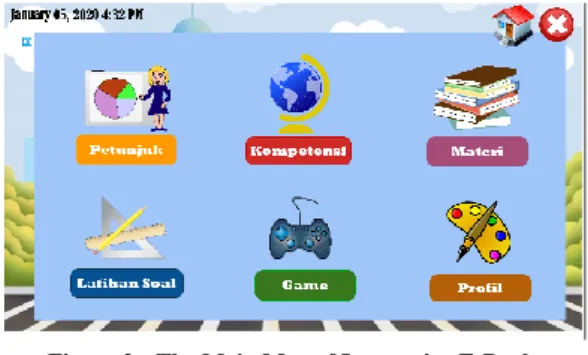
Figure 2 The Main Men of Interactive E-Book
As shown in the main menu image above, there are six buttons, namely instructions, basic competencies, material, practice questions, games, and profile maker. In this main menu, there is a home icon that functions to return to the cover page and an exit icon to exit the Lectora inspire application. The home and exit icons are used to facilitate the user in operating the Lectora inspire. An interactive e-book has several advantages and
disadvantages. The advantages of interactive e-books are: (1) interactive e-books are easy to copy-paste on a PC or laptop, (2) e-books are interactive so students are directly involved in learning and make lessons more meaningful, (3) e interactive book containing images, audio, video and various images so that it attracts and makes it easy for students to understand the material being studied, (4) students feel happy and interested in learning further, and (5) interactive e-books encourage students to learn more (Rini & Cholifah, 2020).
In addition to the advantages of interactive e-books has disadvantages, namely: (1) interactive e-books require technological and information facilities and infrastructure such as the availability of computer labs to support the implementation of learning using interactive e-books, and (2) e-books need computers or laptops, have electricity constraints, if the power goes out then interactive e-books cannot be used.
5.
CONCLUSION
Based on the discussion it can be concluded that this research and development resulted in an interactive e-book (electronic e-book) based on Lectora inspire by strengthening the character of curiosity in the sub-rich wealth of energy sources in class IV SDN Karangtengah 1 Blitar city that is valid, practical and interesting. From the results of the validity assessment by material experts, teaching material experts, users get an average value of 93.29% with a very valid category and can be used without revision. While the results of small group trials and the field obtained values of 98% and 100% respectively with the category of very practical and interesting can be used without revision. So that interactive e-books can be used in the learning process.
REFERENCES
[1] Arsanti, M. (2018). Development of Teaching Material for Creative Writing Subjects with Religious Character Education Values for PBSI Study Program Students, FKIP, UNISSULA. KREDO: Scientific Journal of Language and Literature, 1 (2), 69-88. Accessed on May 4, 2020.
[2] Ministry of Health. 2004. Guidelines for Preparing Curriculum Unit Levels for Elementary and Secondary Education. Jakarta: Ministry of Education. (Online). (Https://bsnp-indonesia.org). Accessed on March 19, 2020.
[3] Ginanjar, Anton. 2010. Development of Interactive Learning Media for Subjects for Mechanical Soil Removal. Surakarta: FKIP Sebelas Maret University. (Online), (https://ejournal.undiksha.ac.id/id/eprint/2451). Accessed on March 19, 2020.
[4] Hartanti, E., Djatmika, E. T., & Setyosari, P. (2017). Development of MediaVideo Clips as Supplements for Learning Material for Cultural Diversity of My Nations.
Journal of Education: Theory, Research and Development. Accessed on March 19, 2020.
[5] Majid, Abdul. 2014. Integrated Thematic Learning. Bandung: PT Youth Rosdakarya
[6] Rini, T. A., & Cholifah, P. S. (2020). Electronic Module With Project Based Learning (PjBL): Innovation Of Digital Learning Product On 4.0 Era. Edcomtech Jurnal Kajian Teknologi Pendidikan, 5(2), 155-161.
[7] , June). Teaching with an interactive e-book to improve children’s online privacy knowledge. In Proceedings of the 15th International Conference on Interaction Design and Children (pp. 506-511). Zhang-Kennedy, L., & Chiasson, S. (2016
[8] Rosida, R., Fadiawati, N., & Jalmo, T. (2017). Efektivitas penggunaan bahan ajar e-book interaktif dalam menumbuhkan keterampilan berpikir kritis siswa. Jurnal Pembelajaran Fisika, 5(1).
[9] Putra A. P. et al., “Interactive Multimedia Analysis in Thematic Learning: A Study of Practical Aspects,” 2019 5th International Conference on Education and Technology (ICET), Malang, Indonesia, 2019, pp. 61-65. Accessed on April 3, 2020.
[10] Rusdi, M. 2018. Educational Design and Development Research. Depok: PT Raja Grafindo Persada.
[11] Solehuzain, S., & Dwidayati, N. K. (2017). Creative Thinking Ability and Curiosity in Problem-Based Learning Models with Open-Ended Problems. Unnes Journal of Mathematics Education Research. Accessed on March 19, 2020.
[12] Sugiyono 2015. Qualitative, quantitative, and R & D. Bandung Research Methods: Alfabeta
[13] Zainudin & Suwarti. 2017. Character-Based Social Studies Learning. Malang: Malang State University [14] Huang, Y. M., Liang, T. H., Su, Y. N., & Chen, N. S.
(2012). Empowering personalized learning with an interactive e-book learning system for elementary school students. Educational Technology Research and Development, 60(4), 703-722.
[15] Ambarita, J. (2020). Workshop Pembuatan E-book Sebagai Bahan Ajar Elektronik Interaktif Untuk Guru Indonesia Secara Online di Tengah Covid 19. Community Engagement and Emergence Journal (CEEJ), 2(1), 44-57. [16] Rosita, R., Fadiawati, N., & Jalmo, T. (2017). Efektivitas E-Book Interaktif Sistem Pencernaan Manusia Untuk Menumbuhkembangkan Keterampilan Berpikir Kritis Siswa. Jurnal Bioterdidik: Wahana Ekspresi Ilmiah, 5(2). [17] Gunawan, I. (2013). Metode Penelitian: Teori dan