(will be inserted by the editor)
Accurate Keyframe Selection and Keypoint Tracking for
Robust Visual Odometry
Marco Fanfani · Fabio Bellavia · Carlo Colombo
Received: date / Accepted: date
Abstract This paper presents a novel stereo Visual Odometry (VO) framework based on Structure from Motion (SfM), where a robust keypoint tracking and matching is combined with an effective keyframe selec-tion strategy. In order to track andfind correct feature correspondences a robust loop chain matching scheme on two consecutive stereo pairs is introduced. Keyframe selection is based on the proportion of features with high temporal disparity. This criterion relies on the ob-servation that the error in the pose estimation prop-agates from the uncertainty of 3D points—higher for distant points, that have low 2D motion. Comparative results based on three VO datasets show that the pro-posed solution is remarkably effective and robust even for very long path lengths.
Keywords Visual Odometry·Structure from Motion· RANSAC· feature matching·keyframe selection
1 Introduction
The real-time estimation of the camera trajectory and the construction of a 3D map of the scene, based on im-ages acquired in an unknown environment, has received an increasing interest in the computer vision commu-nity during the last few years. This task is usually re-ferred to asvisual Simultaneous Localization And Map-ping (vSLAM) [7]. vSLAM systems typically include a Visual Odometry (VO) module [26, 30], aimed at the incremental estimation of the camera path using local information. Optimization algorithms over the whole M. Fanfani·F. Bellavia·C. Colombo
Computational Vision Group (CVG)
University of Florence, Via S. Marta, 3, Florence, Italy E-mail:{name}.{surname}@unifi.it
Tel: +39 055 275 8509 - Fax: +39 055 275 8570
estimated path and map can also be present, so as to enforce global consistency when revisiting part of the scene [15].
Related work on camera path estimation—which is the main topic addressed in this paper—is discussed hereafter.
1.1 Related Work
Methods for real-time camera tracking are mainly based either on probabilistic frameworks [23, 7] or on the SfM paradigm [26, 24]. In the former case they employ Bayesian filtering techniques, such as the Extendend Kalman Filter (EKF), to couple together in the same process camera positions and 3D points, incrementally updated. On the other side, the latter approaches ex-ploit the epipolar geometry constraints [14] to com-pute the camera positions and the 3D map through robust estimators, such as the RANdom SAmple Con-sensus (RANSAC) [9]. Successive refinement steps are usually applied by iterative non-linear optimization techniques—such as bundle adjustment [35]—over a se-lected sub-set of frames (keyframes).
Both kinds of approaches have their drawbacks. In the Bayesian frameworks, points have to be added and discarded as the estimation proceeds, since the 3D map cannot grow excessively for computational limits, thus resulting in a loss of estimation accuracy. On the other hand, in order to achieve real-time operation, keyframe-based approaches can perform local optimizations only occasionally. Nevertheless, according to [33], keyframe based solutions outperform Bayesian approaches, due to their ability to maintain more 3D points in the esti-mation procedure.
Stereo configurations have been widely used [26, 27, 20, 22, 11]. In general, stereo systems provide better so-lutions than single camera setups, since the rigid cali-bration of the cameras increases the accuracy of the 3D map and provides more robust matches. This avoids is-sues such as the delayed 3D feature initialization [23] (i.e. when a point is seen for the first time) and the scale factor uncertainty [34].
Camera tracking systems can also be characterized by the feature matching strategy adopted to detect and track keypoints across the image frames [6, 17, 25, 29, 18, 11]. In addition to the classical keypoint match-ing and trackmatch-ing methods [17], solutions robust to high degrees of blur [29], relying on edges [18], with hier-archical pose refinement [32], or exploiting the high computational power offered by modern GPUs through a dense approach [25] have been proposed. Effective stereo matching strategies [11] and sequentially over-lapping 3D maps [8] have also been employed.
1.2 Our Contribution
The main idea of the proposed system, named SSLAM, is to use only highly reliable data in the estimation pro-cess, as reflected mainly in the feature matching scheme and the choice of good frames.
The feature matching process is the main source of noise in a camera tracking system. Wrong matches can lead to erroneous estimates, which can be only par-tially corrected using robust outlier rejection strategies. To limit as much as possible the introduction of er-rors in early processing stages, we choose to employ an accurate and relatively slow matching strategy in-stead of less accurate solutions. In particular, a ro-bust loop chain matching scheme is adopted, improving upon VISO2-S [11], for using a more robust detector-descriptor pair. The adopted robust matching strategy avoids upfront the introduction of strong noise and thus the need of further global optimization steps. In ad-dition, this strategy can find correspondences also in images with high spatial and/or temporal disparity—a critical issue for any approach based on tracking [20].
The other aspect characterizing our system is the se-lection of the keyframes used as base references for the measurement of the 3D landmark positions for the cam-era trajectory computations. Keyframes are selected only if a strong feature temporal disparity is detected. This idea arises from the observation that errors may propagate also from the uncertainty of the 3D points, which is higher for distant points corresponding to low temporal flow matches in the images. The proposed strategy can be more stable and effective with respect to using a threshold on the average temporal disparity [19]
or a constant keyframe interleaving [26]. Moreover, eval-uating 2D measures such as the feature temporal flow leads to a more robust keyframe selection compared to approaches that evaluate the distance among frames in 3D space [11].
This paper significantly extends our previous work [2], by providing a detailed description of the pro-posed method in Sect. 2, followed by a comprehensive evaluation and comparison on the KITTI [10], New Col-lege [31] and New Tsukuba [21] datasets in Sect. 3. Conclusions andfinal remarks are given in Sect. 4.
2 Method overview
Given a calibrated and rectified stereo sequence S = {ft}, where the frame ft = (Itl, Itr) is composed by
the left Il
t and right Itr input images taken at time
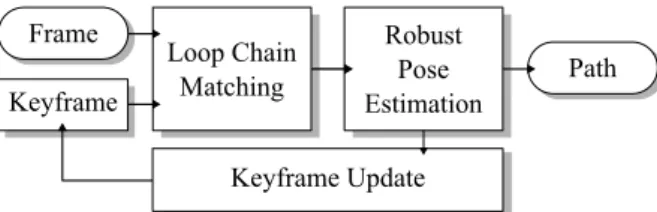
t∈N, SSLAM alternates between two main steps (see Fig. 1). Thefirst step matches keypoints between the last keyframefiand the current framefj, while the
sec-ond estimates the relative camera pose Pi,j= [Ri,j|ti,j] ∈R3×4, where R
i,j ∈R3×3 is the rotation matrix and
ti,j ∈ R3 is the translation vector. If the new pose is
successfully estimated and sufficient temporal disparity is detected betweenfj andfi, the framefj is updated
as the new keyframe.
Assuming that Ri,i = I and ti,i = 0 (where I
and 0 are respectively the identity matrix and the null vector) the absolute pose at time n is defined as Pn = P0,n. Pn can be computed by
concatenat-ing the poses P0,0,P0,k. . . ,Pi,jPj,n, where time steps
0< k < . . . < i < j belong to accepted keyframes and
n > j is the current frame.
Fig. 1: Pipeline of the proposed method
2.1 Loop Chain Matching
The proposed loop chain matching draws inspiration from the circle match of VISO2-S [11], as the candi-date correspondences should be consistent among the four image pairs (Iil, Iir), (Iil, Ijr), (Iir, Ijr), (Ijl, Ijr).
How-ever differently from [11], instead of a less accurate key-point detector and descriptor based on simple image
filters, a robust detector and descriptor pair is used. This also avoids using the two step matching strat-egy employed by VISO2-S to further refine correspon-dences, and permits achieving longer and more stable keypoint tracks, crucial for the pose estimation, with-out re-initialization issues and keypoint losses occurring with tracking strategies such as KLT [20].
In particular, the HarrisZ detector [3], which pro-vides results comparable to other state-of-the-art de-tectors, is used to extract robust and stable corner fea-tures in the affine scale-space on the imagesIl
i, Iir, Ijl, Ijr.
The sGLOH descriptor with the sCOr Nearest Neigh-bour matching [4] on the L1 distance is used instead
to obtain the candidate correspondences between im-age pairs (Il
i, Iir), (Iil, Ijr), (Iir, Ijr), (Ijl, Ijr) after spatial
and temporal constraints have been imposed to refine the candidates matches (see hereafter).
Letxd
s = [xds, yds]T ∈R2, d∈{l, r}, s∈{i, j} be a
point in the imageId
s. Aspatialmatch (xls,xrs) between
the images on the same frame is computed by the stereo epipolar constraints imposed by the calibration
|xls−xrs|<δx (1)
|yls−yrs|<δy (2)
where δy is the error band allowed by epipolar
rec-tification and δx is the maximum allowed disparity
(i.e. the corresponding stereo point must lie inside a 2δx×2δy rectangular window). In the case of a
tem-poral match (xd
i,xdj) between corresponding images at
different frames, theflow restriction
∥xd
i −xdj ∥<δr (3)
is taken into account, where δr is the maximum flow
displacement (i.e. the corresponding point in the next frame must lie inside a circular window of radius δr).
Only matches that form aloop chain C=((xli,xir),(xli,xlj),(xlj,xrj),(xri,xrj)
)
(4) are retained (see Fig. 2); however, some outliers can still be present. For this reason, each matching pair of the loop chain C is further filtered by RANSAC to refine the matches. These four RANSAC runs have an almost immediate convergence due to the high presence of in-liers. Only loop chains whose all pair matches survive to the four RANSACs arefinally collected into the set
Ci,j⊆{C}.
2.2 Robust Pose Estimation
The relative pose Pi,j between fi and fj is estimated
in the second step of the SSLAM approach (see again Fig. 2). The 3D pointXi,j corresponding to the match
pair (xl
i,xri) in keyframefican be estimated by
triangu-lation [14], since the intrinsic and extrinsic calibration parameters of the system are known—in particular, we use the iterative linear triangulation method described in [13].
Letxel
jandexrj be the projections ofXi,j onto frame
fj, according to the estimated relative pose Pi,j =
[Ri,j|ti,j]. The distance
D(Pi,j) =
∑ Ci,j⊆C,d∈{l,r}
∥exdj−xdj ∥ (5)
among the matches of the chain setCi,j must be
mini-mized, in order for the estimate pose Pi,j to be
consis-tent with the data. Due to the presence of outliers in
Ci,j, a RANSAC test is run, where the numberDR(Pi,j)
of outliers chain matches overCi,j exceeding a
thresh-old valueδtis minimized so that pose Pi,jbe consistent
with data: DR(Pi,j) = ∑ Ci,j Td ( ∥exdj−xdj ∥>δt ) . (6)
In Eq. 6,d∈{l, r}, and the indicator functionTd(P(d))
is 1 if the predicateP(d) is true for all the admissible values ofd, and 0 otherwise. The final pose estimation Pi,j between framesfi andfj is chosen as
Pi,j= argmin
Pi,j
DR(Pi,j) . (7)
At each iteration RANSAC estimates a candidate pose Pi,j using a minimal set of matches, i.e., 3 matches,
in order to be robust to outliers [9]. The candidate matches used to build the pose model Pi,j are sampled
from the set of candidate matches Ci,j. The pose Pi,j
is validated against the whole set of candidate matches
Ci,j according to (6) and the best model found so far
is retained. The process stops when the probability to get a better model is below some user-defined threshold value, and thefinal pose Pi,j is refined [16] on the set
GPi,j of inlier matches where
GPi,j= { C∈Ci,j|Td ( ∥exdj−xdj ∥<δt )} (8)
for a generic pose Pi,j.
With respect to the pose estimation method de-scribed above, SSLAM filters the frame sequence ac-cording to the observation that the image resolution provides a lower bound to the uncertainty of the po-sition of the keypoints used in the matching process, although subpixel precision is used. Matches are trian-gulated to get the corresponding 3D point, and even-tually estimate the relative pose between two tempo-ral frames. Close frame matches have a low tempotempo-ral disparity and the associated 3D point position has a
Left
Right
Time
Fig. 2: (Best viewed in color) Keypoint matches between the keyframe fi and the new frame fj must satisfy
the spatial constraint imposed by the epipolar rectification (yellow band) as well as the temporalflow restriction (orange cone). Furthermore, the four matching points must form a loop chainC (dotted line). In the ideal case, pointsxl
j,xrj in frame fj must coincide with the projectionsexlj,xerj ofXi,j obtained by triangulation ofxli,xri in
fi in order for the chainC to be consistent with the pose Pi,j. However, due to data noise, in the real case it is
required that the distances∥exl
j−xlj ∥and∥xerj−xrj ∥are minimal
Fig. 3: (Best viewed in color) The uncertainty of matches in the image planes is lower bounded by the image resolution (red) and it is propagated to the 3D points. In order to estimate the 3D point Xi,j, by
us-ing close frames fi andfj, a low temporal disparity is
present in the image planes, and the 3D point location Xi,j can assume a higher range Xi,j of values (dark
gray quadrilateral). In the case of distant framesfiand
fw, the possible locationsXi,w are more circumscribed
(blue quadrilateral), for the same resolution limits
high uncertainty with respect to distant frames, due to the error propagation from the matches on the im-age planes. Only points with sufficient displacement can give information about both the translational and rota-tional motion, as shown in Fig. 3. This idea is a straight generalization of the well-known baseline length issues
related to the trade-offbetween reliable correspondence matching and accurate point triangulation [14].
Exploiting this idea, SSLAM defines two subsetsFi,j
and ¯Fi,j of the set of chain matchesCi,j for fi andfj
which respectively include fixed and non-fixed points with respect to the temporalflow, i.e.
Fi,j ={C ∈Ci,j|Td(∥xdi −xdj ∥≤δf)} and, (9)
¯
Fi,j =Ci,j\Fi,j , (10)
for a given threshold δf. In order for frame fj to be
accepted as new keyframe, the number of non-fixed matches between frames fi and fj must be sufficient
according to a thresholdδm:
1−|Fi,j|
|Ci,j|
>δm . (11)
Indeed, if the estimation fails due to wrong matches or high noisy data, which practically leads to a final small RANSAC consensus set GPi,j, the frame fj is
discarded and the next frame fj+1 is tested. We also
tried to verify if the use of only non-fixed matches as input to RANSAC pose estimation can lead to better results, but no improvements were found, so the pro-portion of fixed and non-fixed points is only used for keyframe selection. This means that, while all matches are used to estimate the camera position, in presence of enough non-fixed matches, a higher accuracy can be achieved by limiting bad solutions. Note that for de-terminingfixed and non-fixed matchesflow vectors are considered, so that in the case of strong rotations and weak translations, even if points are far, their higher
flow would lead to better measurements and accuracy with respect to the minimal measuring unit, i.e. a pixel.
Fig. 4: (Best viewed in color) Examples of successive keyframes retained according to the temporal flow for two different sequences of the KITTI dataset. The two temporal keyframes involved are superimposed as for anaglyphs, only images for the left cameras are shown. Goodfixed and unfixed matches are shown in blue and light blue, respectively, while wrong correspondences are reported in cyan
Examples of fixed point estimations are shown in Fig. 4. With respect to the averageflow threshold com-monly employed by other systems such as [19], our strategy is more stable and can handle better keyframe drops. As an example, referring to Fig. 4, the average flow in the top configuration is considerably higher than that of the bottom one. Lowering the threshold, to ac-cept the bottom frame, would also include very low disparity frames (just consider to replace in the bot-tom frame the unfixed light blue matches by twice the matches with half disparity). In this sense, our measure is more robust, so that both the frames shown in the figure are retained as keyframes. In analogy, our frame selection resembles RANSAC while the averageflow is close to the least-square approach.
Finally, we add a pose smoothing constraint be-tween frames, so that the current relative pose estima-tion Pi,j cannot abruptly vary from the previous Pz,i,
z < i < j. This is achieved by imposing that the relative rotation around the origin between the two incremental rotations Rz,i and Ri,j is bounded
arccos(uTRTi,jRz,iu )
<δθ1 (12)
whereu= √1
3[1 1 1]
T. Optionally, in the case of strong
constrained movement, like that of a car, a further con-straint on the corresponding translation directionstz,i
andti,j can be added
arccos ( ti,jTtz,i ∥ti,j ∥∥tz,i∥ ) <δθ2 (13)
This last constraint can also resolve issues in the case of no camera movement or when moving objects crossing the camera path cover the scene.
3 Experimental Evaluation
The KITTI vision benchmark suite [10], the New College sequence [31] and the New Tsukuba stereo dataset [21] were used to evaluate our SSLAM system. Recently, the KITTI dataset has become a refer-ence evaluation framework for VO systems. The dataset provides sequences recorded from car driving sessions on highways, rural areas and inside cities with vehicle speed up to 80 km/h. The benchmark consists of 22 rectified stereo sequences from 500 m to 5 km, taken at 10 fps with a resolution of 1241×376 pixels. Recorded scenes are not static, as moving vehicles in opposite di-rection or crossing the road are present. In order to train the parameters of the methods, ground truth trajecto-ries are available only for thefirst 11 sequences. Results for the remaining sequences should be submitted online to get a final ranking. Translation and rotation errors normalized with respect to path length and speed are computed in order to rank the methods.
The New College dataset is made up of a very long sequence of 2.2 km for more than 50000 stereo rectified frames taken inside the Oxford New College campus us-ing a Segway. Data were recorded at 20 fps with a reso-lution of 512×384 pixels. Although no reliable ground truth is available, the sequence consists of several diff er-ent loops which can be used to qualitatively compare VO methods by visual inspection of estimated paths. Unlike the KITTI dataset, data are recorded at a lower speed and the camera movements are less constrained, i.e., strong camera shakes are present.
The New Tsukuba dataset is a virtual sequence that navigates into a laboratory reconstructed manu-ally by computer graphics. Images with a resolution of 640×480 pixels are recorded at 30 fps for one minute while accurate ground truth positions are registered and provided to the users. The sequence is rendered with four different illuminations from the most classicalfl u-orescentto the more challengingflashlightandlamps— see Fig. 5.
Unless otherwise specified, for SSLAM we setδf =
55 px,δm = 5%, δθ1 = 15◦ (see Sect. 2.2). About the spatial and temporal constraints, the triplet (δr,δx,δy)
(a) (b)
(c) (d)
Fig. 5: Example frames of the New Tsukuba stereo dataset: (a) fluorescent, (b) daylight, (c) flashlight, (d) lamps
dataset and to (100,100,12) px for the New College and New Tsukuba dataset, since these videos are taken at lower resolutions and baselines. In the rest of the eval-uation we will mainly compare SSLAM against VISO2-S as it is the only method whose authors have kindly replied to our request to provide us their full code. Note that, for the sake of comparison, VISO2-S (δr,δx,δy)
values are chosen as (200,200,3) px (default values) for KITTI and (100,100,3) in the New College dataset, where the latter values perform better than the default values. The translation constraint is δθ2 = 10◦ for the KITTI dataset while it is not used for New College— due to high camera shakes—and for the New Tsukuba sequences.
Furthermore, we tested SSLAM using keypoints de-tected at full and half resolution videos; in the lat-ter case, the notation SSLAM† is used. In the case of SSLAM† less accurate keypoints are found, with big-ger (normalized) feature patches, more sensitive to fast camera movements. Note also that more keypoints are found in full resolution SSLAM implementation than with SSLAM†. Nevertheless, different image resolutions do not affect the other parameters of the methods since keypoint positions are rescaled at the full resolution be-fore the constrained matching in both cases.
3.1 SSLAM Parameter Analysis
We compared different versions of our SSLAM system, corresponding to the successive improvements of the
pipeline proposed in Sect. 2, in particular we analysed different versions of the more challenging SSLAM†. We indicated by SSLAM†⋆ thefirst version which only in-cludes the loop chain matching described in Sect. 2.1, while the adaptive keyframe selection is incorporated in the default SSLAM†.
In order to analyse the robustness and the eff ec-tiveness of the proposed method, the SSLAM† sys-tem was tested with a different number of RANSAC iterations for the pose estimation. In particular, re-sults of SSLAM† with 500, 15 (set as default) and 3 RANSAC iterations, and SSLAM†⋆ with 500 iterations are presented, indicated respectively by SSLAM†/500, SSLAM†/15, SSLAM†/3 and SSLAM†⋆/500.
Figure 6 shows the average translation and rotation errors of the different SSLAM† variants for increasing path length and speed, according to the first 11 se-quences of the KITTI dataset [10]; we verified that sim-ilar results hold in the case of full resolution SSLAM.
The chain loop matching scheme together with the chosen keypoint detector and descriptor is robust even for long paths, without bundle adjustment or loop closure detection. SSLAM improves on the standard pose estimation without keyframes selection, allowing to track longer paths and confirming that the proposed keyframe selection strategy is effective.
Moreover, results for SSLAM†/15 and SSLAM†/500 are equivalent, while SSLAM†/3 obtains inferior results but similar to those obtained by SSLAM†⋆/500, giving an evidence of the robustness of the proposed matching selection strategy and pose estimation.
A further test aiming at investigating thefixed point threshold δf used to accept a frame as keyframe was
also done. This is the parameter that mainly affects the results, since selected keyframes decrease asδf
in-creases, while we verified that the computation is stable with respect to the choice of the other parameters. Note that increasingδmcan be considered similar to require
a higher δf for a lowerδm value. In particular, we run
SSLAM for different values of δf = 30, 50 (default),
80 px on KITTI and New College datasets. In the case of δf = 30 slightly inaccurate paths are present with
respect toδf = 50 on both datasets, while forδf = 80
higher pose errors are found.
Figure 7 shows the behaviour of SSLAM for the different values of δf on the New College sequence.
Clearly the default set δf = 50 px provides better
re-sults since even after a long path loops are correctly closed. This results confirm the observation that avoid-ing close keyframes improves the results, but this choice must be balanced with the tracking capability of the system. Moreover, if the system is unable to estimate the pose due to a low number of matches and tracking
Path Length [m] Translation Error [% ] 0 200 400 600 800 1 1.5 2 2.5 (a) Path Length [m] Rotation Error [ deg/m] 0 200 400 600 800 0 0.01 0.02 0.03 0.04 (b) Speed [km/h] Translation Error [% ] 0 50 100 0 2 4 6 8 10 (c) Speed [km/h] Rotation Error [ deg/m] 0 50 100 0 0.01 0.02 0.03 0.04 0.05 0.06 0.07 (d)
Fig. 6:(Best viewed in color) Average error on thefirst 11 sequences of the KITTI dataset. Plots (a-b) refer to the average translation and rotation error for increasing path length respectively, while plots (c-d) refer to increasing speed 0 50 100 150 200 −80 −60 −40 −20 0 20 40 60 80 100 [m] [m] (a) 0 50 100 150 200 −80 −60 −40 −20 0 20 40 60 80 100 [m] [m] (b) 0 50 100 150 200 80 60 40 20 0 20 40 60 80 100 [m] [m] (c)
Fig. 7: SSLAM estimated paths for the New College video sequence with δf = 30 px (a), δf = 50 px (b) and
δf = 80 px (c)
loss, a recovery method must be implemented as for any other VO methods.
Table 1: Average number of frames between two con-secutive keyframes and the corresponding standard de-viations for different values of the thresholdδf
δf 35 55 85 35 55 85
Average Std
KITTI 1 2 3 1 1 2
New College 5 10 32 8 13 39
Table 1 shows the average number of frames between two consecutive keyframes and the corresponding stan-dard deviations. Average keyframe rate depends upon
δf andδm but also on the camera speed and the video
frame rate. Slower camera speed and/or higher frame rate imply a lower keyframe rate, but on the other hand
δf and δm depend also on the scene. According to
Ta-ble 1, the average keyframe rate is lower for the New College dataset than for the KITTI dataset, due to their different camera speeds. Furthermore, as it can be noted in Fig. 8, the keyframe distribution is not uniform but it is denser near camera turns and accelerations.
3.2 Evaluation on the KITTI dataset
We report hereafter the results on the KITTI odom-etry benchmark for stereo methods only (more details are available online [10]) excluding methods that rely on laser data. Figure 9 shows the average translation and rotation errors of the different methods for increasing path length and speed. SSLAM and SSLAM†—ranked
-400 -300 -200 -100 0 100 200 0 50 100 150 200 250 300 350 400 450 Near Keyfr ame [win siz e=10] 0 9
Fig. 8:(Best viewed in color) An example of keyframe distribution along the Sequence 00 of the KITTI dataset for SSLAM (default δf=50 px). At each
esti-mated camera position the number of keyframes that fall inside a window of 10 frames centred at the camera location is shown according to the colorbar gradation
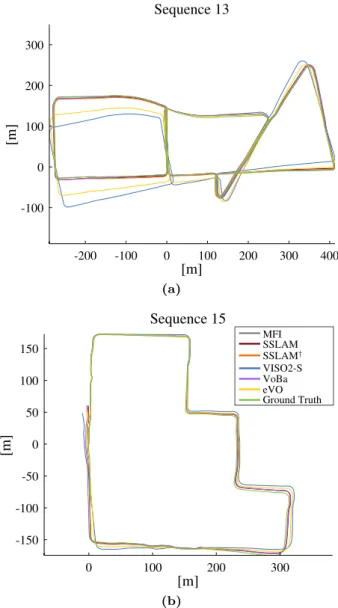
among the first positions of the KITTI benchmark— obtain respectively a mean translation error of 1.57% and 2.14% w.r.t. the sequence length and a rotation error of 0.0044 and 0.0059 deg/m. These rank place-ments show the robustness of the proposed methodol-ogy. Note however that the benchmark provides par-tial results, since these error metrics cannot take into account all the properties of a VO system. In partic-ular, referring to Fig. 10 where two sample tracks of the KITTI dataset are shown, it can be seen that while both MFI and VoBa (respectively ranked in 1st and
4th positions) provide slightly better results than
SS-LAM in term of KITTI metrics, on long paths SSSS-LAM† (12th ranked) clearly improves on the 7th ranked eVO
method. This can also be observed in the relative trans-lation error for an increasing path length in Fig. 9(a), where SSLAM† plot remains stable when compared to the increasing error of eVO. Additionally, evaluation on the KITTI sequence shows that our approach is robust in the case of non static scenes for common situations with other objects traveling in other directions. In par-ticular, the δθ2 constraint (see equation 13), allows to “remember” the recent past camera tracking data, thus avoiding to fall into wrong configurations in the case of Sequence 07 around frame 700, where a huge truck oc-cupying nearly the whole scene crosses the road while the camera stands still.
Table 2 shows the input matches and the found inliers in the RANSAC pose estimation by SSLAM, SSLAM† and VISO2-S. As it can be noted, while SSLAM† outputs a comparable number of initial matches with VISO2-S, only 50% of these are inliers for VISO2-S: This implies that our matching strategy
Path Length [m] Translation Error[\% ] 0 200 400 600 800 3.5 3 1.5 1 2 2.5 MFI SSLAM VISO2-S VoBa eVO SSLAM (a) Path Length [m] Rotation Error [ deg/m] 0 200 400 600 800 0 0.002 0.004 0.006 0.008 0.01 0.012 0.014 (b) Speed [km/h] Translation Error[\% ] 0 20 40 60 80 100 5 4.5 4 3 3.5 2.5 2 1.5 1 (c) Speed [km/h] Rotation Error [ deg/m] 0 20 40 60 80 100 0 0.005 0.01 0.015 (d)
Fig. 9: (Best viewed in color) Average error on the KITTI benchmark. Plots (a-b) refer to the average translation and rotation error for increasing path length respectively, while plots (c-d) refer to increasing speed
is more robust. Note also that the spatial and temporal flow constraints of VISO2-S are stricter, which would lead theoretically to a higher number of matches since the probability to make an accidental wrong match is higher for SSLAM and SSLAM† (except for the epipo-lar constraintδy, the other thresholds are about equal
to the minimal image size). Yet, as it can be seen from Table 2, the opposite holds, in favour of the robustness and stability of the proposed methodology.
3.3 Evaluation on the New College dataset
We tested SSLAM and SSLAM† versus VISO2-S not only on the whole sequence but also on the two sub-sequences corresponding to the small and large loops
Sequence 13 [m] [m] -200 -100 0 100 200 300 400 -100 0 100 200 300 (a) Sequence 15 [m] [m] 0 100 200 300 -150 -100 -50 0 50 100 150 MFI SSLAM VISO2-S VoBa eVO Ground Truth SSLAM (b)
Fig. 10: (Best viewed in color) Trajectories on the se-quences 13 (a) and 15 (b) of the KITTI dataset
Table 2: Average number of input matches before the RANSAC pose estimation andfinal inlier ratios
KITTI New College
pts inl(%) pts inl(%)
SSLAM 766 98 780 99
SSLAM† 222 96 201 97
VISO2-S 245 50 156 84
present in the sequence. This is done to analyse the behaviour of the methods at different starting points. Figure 11 shows the obtained tracks. While VISO2-S diverges as the sequence grows, both VISO2-SVISO2-SLAM and SSLAM† maintain the correct paths, closing the loops, without the need of bundle adjustment and loop closure techniques. In particular, full resolution SSLAM works
slightly better than SSLAM†. This becomes noticeable only at the end of the last part of the video sequence.
The New College video sequence seems more reliable than the KITTI sequences, since as it can be seen from Table 2, all methods achieve a higher number of tracked keypoints but also inliers, maybe due to slower cam-era movements. Anyway, VISO2-S still obtains a lower number of matches and inliers with respect to SSLAM and SSLAM†. Note also that the absence of the option-ally translation constraintδθ2 in this sequence does not affect the quality of the results.
3.4 Evaluation on the New Tsukuba dataset
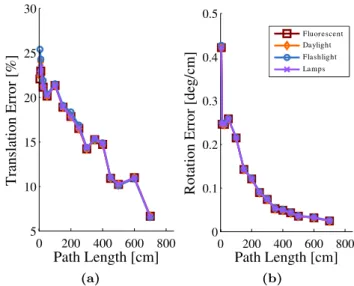
In order to investigate further into the robustness of our method, we tested SSLAM on the New Tsukuba sequence for all the available illuminations. In Fig. 12 estimated trajectories are reported together with the ground truth: Even if slight misalignments are present—especially in thefirst part of theflashlight sequence—SSLAM tracks well the camera movements for all illuminations. This is also clear by observing the translation and rotation errors in Fig. 13—computed using the KITTI metrics. For all illuminations, similar performance is obtained.
As already done for the KITTI and New College se-quences, also for the New Tsukuba dataset we tested SSLAM on half-resolution images obtaining approxi-mately the same errors reported for the full-resolution tests. In Fig. 14 are shown trajectories of both the full and half resolution input for thefluorescent sequence; Similar results are obtained for all the other illumina-tions.
It’s worth noting that the fluorescent sequence of the New Tsukuba dataset was also used in [1] to eval-uate the MFI method. Apart from a visual compari-son between the trajectories estimated by MFI and SS-LAM, from which no particular differences emerge, it is not possible to make a quantitative evaluation, since in [1] only relative accuracy improvements w.r.t. a base method are reported.
3.5 Running Times
The SSLAM approach is implemented in C/C++ non-optimized multithreaded code, for which the download is available1. As it can be seen in Table 3, where the
average running times for a single frame are reported, SSLAM scales with the resolution. By taking into ac-count that only keyframes are required by SSLAM,
0 20 40 60 80 100 -50 -40 -30 -20 -10 0 10 20 30 [m] [m] VISO2-S SSLAM† SSLAM (a) −50 0 50 100 150 200 −150 −100 −50 0 50 [m] [m] (b) −50 0 50 100 150 200 250 −50 0 50 100 150 [m] [m] (c)
Fig. 11: (Best viewed in color) Estimated paths for the New College video sequence. The plots (a), (b) and (c) refer respectively to first subsequence (from frame 0 to frame 18400), to the last subsequence (from frame 18400 to frame 52479) and to the whole sequence. Note that to achieve the best top view, each sequence was rotated so that the displayed axes correspond to the major directions of the autocorrelation matrix of the point positions, i.e., to the two greatest eigenvectors
Sequence NewTsukuba x [cm] z [cm] -800 -600 -400 -200 0 200 400 -800 -600 -400 -200 0 200 Ground truth Fluorescent Daylight Flashlight Lamps
Fig. 12:(Best viewed in color) Trajectories estimated by SSLAM on the New Tsukuba sequence for all avail-able illuminations Path Length [cm] Translation Error [% ] 0 200 400 600 800 5 10 15 20 25 30 (a) Path Length [cm] Rotation Error [ deg/cm] 0 200 400 600 800 0 0.1 0.2 0.3 0.4 0.5 Fluor escent Daylight Flashlight Lamps (b)
Fig. 13:(Best viewed in color) Average translation (a) and rotation (b) error for increasing path length for all New Tsukuba sequence illuminations
real-time performance is achieved when the keyframe computational time is less thanfk/fv, wherefk is the
keyframe rate andfv is the frame rate of the video
se-quences ([fk, fv] are respectively for the KITTI, New
College and New Tsukuba datasets equal to [2,10], [10,20] and [5,30]). This implies that the time to es-timate a single keyframe must not exceed 0.20 s, 0.50 s and 0.17 s respectively for the KITTI, New College and New Tsukuba sequences. Although only SSLAM† can run almost in real-time, code optimization using GPU acceleration is planned to improve the running times. Furthermore, we found that the main bottleneck of the
Sequence NewTsukuba x [cm] z [cm] -800 -600 -400 -200 0 200 400 -800 -600 -400 -200 0 200
Fig. 14: (Best viewed in color) Trajectories esti-mated using full (Fluorescent, red track) and half (Fluorescent†, blue track) resolution images of the New Tsukubafluorescent sequence
method is represented by the large size kernel convolu-tions employed by the accurate feature detector. Under this observation, further speed improvements should be achieved from fast and approximate convolution algo-rithms [12].
Table 3:Average computational time for a single frame on a Intel-i7 3.50GHz CPU, 8 cores are used
SSLAM SSLAM†
KITTI 3.85 s 0.55 s
New College 0.95 s 0.20 s
New Tsukuba 0.87 s 0.24 s
4 Conclusion
In this paper a new stereo VO system was presented. The approach achieves a low drift error even for long paths, is local and it does not rely on loop closure or bundle adjustment. A robust loop chain matching scheme for tracking keypoints is provided, sided by a frame discarding system to improve pose estimation. According to the experimental results, dropping low temporal disparity frames for discarding highly uncer-tain models is an effective strategy to reduce error prop-agation from matches, but it must be balanced to avoid the loss of keypoint tracks across the video sequence. Results validated on the KITTI, New College and New Tsukuba datasets show the effectiveness of the system, which is robust even with an extremely small number
of RANSAC iterations and able to work in various sce-narios under different illuminations.
Future work will include an efficient optimized code to improve real-time performance and possible integra-tions with information from other sensors to improve the accuracy of the localization. Our work mainly fo-cuses on strengthening the data retrieving and fi lter-ing phases, and relies on a well-know and simple pose estimation method [11]. Further future work will be addressed to extend and improve our VO pipeline by including novel numerical optimization techniques ex-ploiting long tracks based on Local Bundle Adjust-ment [5, 28] and tracking recovery mechanism to in-crease the SSLAM reliability.
5 Acknowledgments
This work was supported by the SUONO project (Safe Underwater Operations iN Oceans), SCN 00306, ranked first in the challenge on ”Sea Technologies” of the competitive call named ”Smart Cities and Commu-nities” issued by the Italian Ministry of Education and Research.
References
1. Badino, H., Yamamoto, A., Kanade, T.: Visual odometry by multi-frame feature integration. In: Proc. of the Inter-national Workshop on Computer Vision for Autonomous Driving at ICCV (2013)
2. Bellavia, F., Fanfani, M., Pazzaglia, F., Colombo, C.: Ro-bust selective stereo SLAM without loop closure and bun-dle adjustment. In: Proc. of 17th International Confer-ence on Image Analysis and Processing, ICIAP 2013, pp. 462–471 (2013)
3. Bellavia, F., Tegolo, D., Valenti, C.: Improving Harris corner selection strategy. IET Computer Vision 5(2) (2011)
4. Bellavia, F., Tegolo, D., Valenti, C.: Keypoint descrip-tor matching with context-based orientation estimation. Image and Vision Computing (2014)
5. Cvisic, I., Petrovic, I.: Stereo odometry based on careful feature selection and tracking. In: Proc. of the European Conference on Mobile Robots ECMR, pp. 1–6 (2015) 6. Davison, A.: Real-time simultaneous localization and
mapping with a single camera. In: Proc. of the 9th IEEE International Conference on Computer Vision, pp. 1403– 1410 (2003)
7. Davison, A., Reid, I., Molton, N., Stasse, O.: MonoSLAM: Real-time single camera SLAM. IEEE Trans. on Pattern Analysis and Machine Intelligence
29(6), 1052–1067 (2007)
8. Fanfani, M., Bellavia, F., Pazzaglia, F., Colombo, C.: SAMSLAM: Simulated annealing monocular SLAM. In: Proc. of 15th International Conference on Computer Analysis of Images and Patterns, CAIP 2013, pp. 515– 522 (2013)
9. Fischler, M.A., Bolles, R.C.: Random sample consensus: a paradigm for modelfitting with applications to image analysis and automated cartography. Commun. ACM
24(6), 381–395 (1981)
10. Geiger, A., Lenz, P., Urtasun, R.: Are we ready for au-tonomous driving? The KITTI vision benchmark suite. In: Proc. of Computer Vision and Pattern Recognition (2012). URLhttp://www.cvlibs.net/datasets/kitti/ eval_odometry.php
11. Geiger, A., Ziegler, J., Stiller, C.: StereoScan: Dense 3D reconstruction in real-time. In: IEEE Intelligent Vehicles Symposium (2011)
12. Getreuer, P.: A survey of gaussian convolution algo-rithms. Image Processing On Line3, 286–310 (2013) 13. Hartley, R., Sturm, P.: Triangulation. Computer Vision
and Image Understanding68(2), 146–157 (1997) 14. Hartley, R.I., Zisserman, A.: Multiple View Geometry in
Computer Vision, 2nd edn. Cambridge University Press (2004)
15. Ho, K., Newman, P.: Detecting loop closure with scene sequences. International Journal Computer Vision74(3), 261–286 (2007)
16. Horn, B.K.P.: Closed-form solution of absolute orienta-tion using unit quaternions. Journal of the Optical Soci-ety of America A4(4), 629–642 (1987)
17. Klein, G., Murray, D.: Parallel tracking and mapping for small AR workspaces. In: Proc. of the IEEE/ACM Inter-national Symposium on Mixed and Augmented Reality, pp. 225–234 (2007)
18. Klein, G., Murray, D.: Improving the agility of keyframe-based SLAM. In: Proc. of the 10th European Conference on Computer Vision, pp. 802–815 (2008)
19. Lee, G.H., Fraundorfer, F., Pollefeys, M.: RS-SLAM: RANSAC sampling for visual FastSLAM. In: Proc. of IEEE/RSJ International Conference on Intelligent Robots and Systems, pp. 1655–1660 (2011)
20. Lim, J., Pollefeys, M., Frahm, J.M.: Online environment mapping. In: Proc. of the IEEE Conference on Computer Vision and Pattern Recognition (2011)
21. Martull, S., Martorell, M.P., Fukui, K.: Realistic CG Stereo Image Dataset with Ground Truth Disparity Maps. In: Proc. of the ICPR2012 workshop Trak-Mark2012, pp. 40–42 (2012). URL http://www.cvlab. cs.tsukuba.ac.jp/dataset/tsukubastereo.php 22. Mei, C., Sibley, G., Cummins, M., Newman, P., Reid, I.:
RSLAM: A system for large-scale mapping in constant-time using stereo. International Journal of Computer Vision94, 198–214 (2011)
23. Montiel, J., Civera, J., Davison, A.: Unified inverse depth parametrization for monocular SLAM. In: Proc. of Robotics: Science and Systems. IEEE Press (2006) 24. Mouragnon, E., Lhuillier, M., Dhome, M., Dekeyser, F.,
Sayd, P.: Real time localization and 3D reconstruction. In: Proc. of the IEEE Conference on Computer Vision and Pattern Recognition, pp. 363–370 (2006)
25. Newcombe, R., Lovegrove, S., Davison, A.: DTAM: Dense tracking and mapping in real-time. In: Proc. of the 13th International Conference on Computer Vision (2011) 26. Nist´er, D., Naroditsky, O., Bergen, J.R.: Visual
odom-etry. In: Proc. of the IEEE Conference on Computer Vision and Pattern Recognition, pp. 652–659 (2004) 27. Paz, L., Pini´es, P., Tard´os, J., Neira, J.: Large-scale
6-DoF SLAM with stereo-in-hand. IEEE Trans. Robotics
24(5), 946–957 (2008)
28. Persson, M., Piccini, T., Felsberg, M., Mester, R.: Robust stereo visual odometry from monocular techniques. In: Proc of the IEEE Intelligent Vehicles Symposium IV2015, pp. 686–691 (2015)
29. Pretto, A., Menegatti, E., Bennewitz, M., Burgard, W.: A visual odometry framework robust to motion blur. In: Proc. of the IEEE International Conference on Robotics and Automation (2009)
30. Scaramuzza, D., Fraundorfer, F.: Visual Odometry: Part I - The First 30 Years and Fundamentals. IEEE Robotics and Automation Magazine18(4) (2011)
31. Smith, M., Baldwin, I., Churchill, W., Paul, R., New-man, P.: The new college vision and laser data set. The International Journal of Robotics Research28(5), 595–599 (2009). URL http://www.robots.ox.ac.uk/ NewCollegeData/
32. Strasdat, H., Davison, A.J., Montiel, J.M.M., Konolige, K.: Double window optimisation for constant time vi-sual SLAM. In: Proc. of the International Conference on Computer Vision, pp. 2352–2359 (2011)
33. Strasdat, H., Montiel, J., Davison, A.: Visual SLAM: Why filter? Image and Vision Computing 30, 65–77 (2012)
34. Strasdat, H., Montiel, J.M.M., Davison, A.J.: Scale drift-aware large scale monocular SLAM. In: Proc. of Robotics: Science and Systems (2010)
35. Triggs, B., McLauchlan, P., Hartley, R., Fitzgibbon, A.: Bundle adjustment - a modern synthesis. In: Proc. of the International Workshop on Vision Algorithms: Theory and Practice, pp. 298–372 (2000)