International Journal of Emerging Technology and Advanced Engineering
Website: www.ijetae.com (ISSN 2250-2459, ISO 9001:2008 Certified Journal, Volume 6, Issue 1, January 2016)
136
ICI Reduction Technique for OFDM Systems Using Combining
Weight Technique
Md. Jafir Alam
1, Garima Saini
21ME Scholar, 2Assistant Professor, Department of Electronics & Communication Engineering, National Institute of Technical
Teachers’ Training and Research, Chandigarh, India
Abstract--In this paper ICI reduction technique has been applied for OFDM system using combining weight technique. The ICI cancelation performance of proposed method has been simulated using MATLAB. The BER performance is improved and provides better improvement than the Hamming window and No window method. The BER performance is improved when the value of α is increased from 0.25 to 0.5.
Keywords--Bit-error rate (BER), Inter-carrier-interference (ICI), Optimum combining weight, Orthogonal frequency division multiplexing (OFDM), Near optimum combining weights, Signal to noise ratios (SNRs)
I. INTRODUCTION
Orthogonal Frequency Division Multiplexing
(OFDM).OFDM is a special form of the multicarrier modulation scheme[1]. In OFDM the individual carriers are mutually orthogonal to each other. OFDM provides high spectral efficiency; low implementation complexity. It has less vulnerability to echoes and non-linear distortion. Due to increase in symbol duration, there is a reduction in delay spread. Addition of guard band, almost removes the ISI in the system. OFDM can be efficiently implemented by using IFFT.
[image:1.612.328.568.241.422.2]With the increasing demand for wireless multimedia applications, it is desirable to design the wireless system with higher data rates. Furthermore, the frequency spectrum has limited and valuable source, making it necessary to utilize the available spectrum efficiently and co-exist with other wireless systems. Thus future wireless technology is required to operate at high data rates, at high carrier frequencies under the environment of high mobility and large spectrum interference, while the data transmission still remains reliable and supports multiple users. Orthogonal frequency division multiplexing (OFDM) technology is at the core of multicarrier systems that play a crucial role in fulfilling the above requirements [2].
Fig 1: Block Diagram of OFDM Systems
In a communication system based on OFDM technique, a receiver needs to synchronize with a transmitter in frequency, phase and time to faithfully reproduce the transmitted signal. Frequency offset in OFDM system is introduced by the mismatch between transmitter and receiver sampling clock and misalignment between the reference frequency of the transmitter and receiver stations. The sampling clock error appears in two ways.
(1) A slow variation in sampling time instant causes rotation of sub-carriers and subsequent loss of signal-to-noise ratio (SNR) due to ICI.
(2) It causes the loss of orthogonally among sub-carriers due to energy spread and adjacent sub-carriers
Let us defined the normalized sampling error as
t
Δ=
(1)International Journal of Emerging Technology and Advanced Engineering
Website: www.ijetae.com (ISSN 2250-2459, ISO 9001:2008 Certified Journal, Volume 6, Issue 1, January 2016)
137
And the power is approximated by
PtΔ ≈ (KtΔ)2 , where K = sub-carrier index (2)
Hence, the degradation grows as the square of offset tΔ
and the sub-carrier index K. This means that the outermost sub-carriers are most severely affected. The OFDM system with a large number of sub-carriers are very sensitive to the sampling offset
II. WIRELESS COMMUNICATION CHANNEL
The wireless channel is the defined as a link between a Transmitter and a receiver and classified considering the coherence bandwidth and coherence time. The multipath channel generally has a bandwidth where channel variations are highly correlated [3]. This bandwidth is called the coherence bandwidth (∆f)c.
When a signal is transmitted through a channel, if (∆f) c of the channel is small compared with the bandwidth of the transmitted signal, the channel is called to be frequency selective. In this case, the signal is severely distorted by the channel. And, if (∆f) c is much larger compared with the bandwidth of the transmitted signal, the channel is called to be frequency nonselective or flat. For the measure of frequency selectivity of the channel, there are two important parameters:
(1) The average excess delay
(2) The root mean square (RMS) delay spread
The Rayleigh distribution is commonly used to describe the statistical time varying nature of the envelope of a frequency non selective (flat) fading signal, or the envelope of an individual multipath component. In this case, the channel is called a Rayleigh fading channel. On the other hand, when a direct path is available or the channel signal reflectors, in this case the envelope as a Rice distribution and the channel is called, a Ricean fading channel.
The time variation of a channel is determined by a lot of factors, such as the height of the transmitter / receiver antenna, the speed of transmitter/receiver in motion, the shape of the antenna, the height of surrounding structures The three factors to describe the fading characteristics that a transmitted signal experiences in a channel, the p.d.f. of the envelope, frequency selectivity, and time selectivity. They are independent, so there are many combinations to consider. For instance, when no line-of-sight component is available in a channel, the data transmission rate is very high.
The receiver is installed in a high-speed cruising vehicle, the channel will be a frequency selective fast Rayleigh fading channel, and the data transmission rate is very low. Then the receiver is installed in a stationary terminal, the channel will be a frequency nonselective slow Ricean fading channel
.
[image:2.612.324.564.326.528.2]When the symbol transmission rate, channel frequency selectivity, and channel time selectivity are given, the transmission performance becomes more selective to the time selectivity as the number of sub-carriers increases. It is because the wider symbol duration is less robust to the random noise, whereas it becomes poor as the number of sub-carriers decreases because the wider poor spectrum of each sub-carriers is less robust to the frequency selectivity [4]. Fig. 2 shows the relation among the number of sub-carriers, frequency selectivity, and the time selectivity
Fig. 2: Relations among number of Subcarriers Frequency Selectivity and Time Selectivity [2].
III. INTER-CARRIER –INTERFERENCE
International Journal of Emerging Technology and Advanced Engineering
Website: www.ijetae.com (ISSN 2250-2459, ISO 9001:2008 Certified Journal, Volume 6, Issue 1, January 2016)
138
Fig.3: Loss of Orthogonality due to Sampling Offset [5]
Frequency offsets are typically introduced by a (small) frequency mismatch in the local oscillators of the transmitter and the receiver. The impact of a frequency error can be seen as an error in the frequency instants where, the received signal is sampled during demodulation by the FFT. Fig.3 depicts this twofold effect. The amplitude of the desired sub-carrier (SC) is reduced (“+”), and ICI arises from the adjacent SCs (“0”).Mathematically, a carrier offset can be accounted for by frequency shift δf and a phase offset θ in the low-pass equivalent received signal.
r
(t)‟= r
(t)e
j(2πδft+θ)(3)
It is required to reduce this inter-carrier-interference to a minimum for proper performance. Two ICI reduce techniques has been porposed.
A. Optimum Combining weights B. Near-Optimum combining weights
Optimum combining weights and near- optimum combining weights- Cyclic prefix (CP) combining weight is such technique which did not required any training symbols of pilote type or combo type. This technique has low complexity due to use of minimum number of operations of multiplication and devision. In this technique, the core idea is to utilize the ISI- Free part of cyclic prefix (CP), which is simlply ignore in trandititional methods in this technique, we linearly combined the ISI-free samples in CP with the corresponding samples in the OFDM symbol to suppress ICI, and this scheme is called „CP combinning’.
In addition, the optimum combining cofficients in the sence of ICI power minimization, and a set of ner – optimum cofficients are proposed to reduce the complexity.
Fig.4: Implementation of the CP combining [7]
Optimum combining weights and near-optimum combining weights are based on the cyclic prefix (CP) recycling scheme. The CP recycling scheme is motivated by the fact that in some situations the specified CP length is much longer than the delay spread and there is considerable number of ISI-free sample in CP. Conventionally, these ISI-free samples are simply discarded, and apparently it is a waste of resources. Therefore, the core idea of this scheme is to design a method to recycle the ISI –free samples in CP to improve the system performance. Originally, the CP recycling scheme was used to maximize signal-to-noise ratio (SNR) in the presence of frequency offset, and it was also applied to suppress the ICI caused by time-varying channels and directly applied the combining weights to suppress the phase noise effect.
The CP recycling scheme is applied to suppress the ICI power incurred by phase noise, although this idea has already been used in [8, 9], nevertheless, the heuristic combining weights adopted in are apparently not optimum in the sense of ICI minimization.
International Journal of Emerging Technology and Advanced Engineering
Website: www.ijetae.com (ISSN 2250-2459, ISO 9001:2008 Certified Journal, Volume 6, Issue 1, January 2016)
[image:4.612.332.574.141.406.2]139
TABLE 1. POWER DELAY PROFILE
Tap 1
Tap 2
Tap 3
Tap 4
Tap 5
Tap 6
Tap 7
Tap 8
Uni t
Dela
y 0 0.05 .12 .2 .23 .5 1.6 2.3 µs
Pow
er -1 -1 -1 0 0 0 -3 -5 dB
IV. SIMULATION RESULTS AND PLOTS
The ICI cancelation performance of proposed method in regards to the BER is examined in this section:An OFDM system with 1024 sub carriers over the time –varying multiple path Rayleigh channel is considered here for simulation. The symbol duration is set as T=Tu+Te+Tg ,
where the duration of information part is assumed as Tu=224 µs, the extension interval duration is Te=α.Tu, and
the guard interval duration is Tg=Tu/4,The carrier frequency
is assumed Fc=600 MHz and the channel band width is
5.71 MHz. The Uncoded 16 QAM is used for data modulation.
The cost 207 typical urban six-path (TU6) channel model is applied for channel delay spread simulation which the power delay profile is given in table1.
Each channel delay type is generated by Jack‟s model given with a normalize Doppler frequency, fd,norm = fd.Tu ×
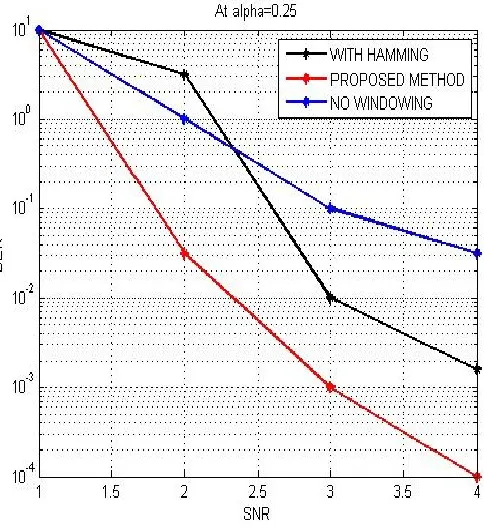
100%. The channel impulse response is assumed ideal known and a one-tap equalizer is used to compensate multipath fading. The figure 5 shows that BER performance is improved while applying proposed method and provides better improvement in performance than hamming window method and No windowing method. Comparing to Hamming method and No windowing method, more substantial improvement can be gained for a higher α value as an example of α=0.25 shown in fig. 5. For the case of α=0.5 shown in fig.6 there is a great BER performance improvement comparing to No windowing and just has the same performance with Hamming method window due to equal window shape for the case of α=0.5.
Fig.5: BER versus the SNR over AWGN Channel α=0.25
International Journal of Emerging Technology and Advanced Engineering
Website: www.ijetae.com (ISSN 2250-2459, ISO 9001:2008 Certified Journal, Volume 6, Issue 1, January 2016)
140
V. CONCLUSIONS
This paper described the BER performance while applying a proposed method and compares the performance of BER of proposed and hamming windows techniques. These methods conclude robust performance and improve BER performance from negligible amount of additional computational complexity. These methods can be incorporated with other phase noise mitigation methods since the output of the optimum combining method can be treated as a cleaner (less ICI polluted) input to the traditional phase noise mitigation methods.
Acknowledgement
Authors would like to thank the Director, National Institute of Technical Teacher‟s Training & Research, Chandigarh. Authors would also like to thank the Hon‟ble Chairman, Dr. Md. Shahabuddin, Secretary, members of the management and Director, Siwan Engineering & Technical Institute, Siwan, India for their constant inspiration.
REFERENCES
[1] S. Hara and R. Prasad, Multicarrier techniques for 4G Mobile
Communication, Artech House, 2000
[2] U. S. Jha and R. Prasad, OFDM towards Fixed and Mobile
Broadband Wireless Access, Artech House, 2000
[3] R. Prasad, “OFDM for Wireless Communication Systems”, Artech
House 2004
[4] Van Nee, R, and R.Prasad, OFDM for Wireless Multimedia
Communications, Norwod, MA: Artech House, 2000
[5] L. Wei and C. Schlegel, Synchronization requirement for multiuser
OFDM on Satellite mobile and two-path Rayleigh-fading channels, IEEE trans. Communi; 43(2/3/4): 887-895, 1995
[6] Ch-Ying Ma, Chun-Yen Wu, and Chia-Chi un Huang, “A Simple
ICI Suppression Method Utilizing Cyclic Prefix for OFDM Systems in the Presence of Phase Noise”, EEE Transactions on Communications, vol.61, no. 11,pp. 4539-4550, 2013
[7] Chun-Ying Ma, Sheng-Wen Liu, and Chia-Chi Huang, “Low
Complexity ICI Suppression Methods Utilizing Cyclic Prefix for OFDM Systems in High-Mobility Fading Channels”, IEEE Transaction Vehicular Technology, vol.63, no.2, pp.718-730, 2014
[8] N. N Tchamov, V. Syrjala, J. RINNE, M. Valkama, Y. Zou, and M.
Renfors, “System-and circuit-level optimization of PLL designs for DVB-T/H receivers,” Springer J. Analog Integrated Circuits and Signal process., vol.73,no. 1, pp. 185-200, 2012
[9] N. N. Tchamov, A. Hazmi, J. Rinne, M. Valkama, and M. Renfors,
“Performance comparison of DVB-T and DVB-T2 in the presence of phase noise,” in proc.2010 International OFDM-Workshop, pp. 1-4, 2010
[10] M.-X. Chang, “A novel algorithm of inter-subchannel interference
self-cancellation in OFDM systems,” IEEE Transactions. Wireless communications, vol. 6,no. 8 pp.2881-2893, 2007
[11] C.-Y. Ma, S.-W. Liu, and C.-C. Huang, “On optimum segment
combining weight for ICI self-cancellation in OFDM systems under doubly selective fading channels,” in proc. IEEE Veh. Technol. Conf., pp. 1-5. 2012.
BIOGRAPHIES
Md. Jafir Alam received the Bachelors of Technology degree in Electronics &
Communication Engineering from
Maulana Azad College of Engineering & Technology Patna, India in 2007. He is pursuing M.E in Electronics and
Communication Engineering from
National Institute of Technical Teachers‟ Training & Research, Ministry of Human Resource Development, Panjab Univsrsity, Chandigarh, India.
He is an Assistant Professor in the Department of Electronics & Communication Engineering, Siwan Engineering & Technical Institute Siwan, Bihar, India. His current research and teaching interests are in Signal and Systems, Digital Communication and Digital Electronics.
Mrs. Garima Saini received B.Tech
degree in Electronics &
Communication Engineering from Kurukshtera University, Kurukshtera and M.Tech degree in Electronics & Communication Engineering from Panjab Technical University, Jalandhar. Presently she is serving as Assistant Professor in the Department of Electronics & Communication Engineering, National Institute of Technical Teachers‟ Training & Research, Ministry of Human Resource Development, Panjab University, Chandigarh, India. Her area of interest Mobile Communication, Wireless Communications & Networks, Advanced Digital Communication, Soft Computing and Antenna.

![Fig. 2: Relations among number of Subcarriers Frequency Selectivity and Time Selectivity [2]](https://thumb-us.123doks.com/thumbv2/123dok_us/8694406.877907/2.612.324.564.326.528/fig-relations-number-subcarriers-frequency-selectivity-time-selectivity.webp)