International Journal of Emerging Technology and Advanced Engineering
Website: www.ijetae.com (ISSN 2250-2459, ISO 9001:2008 Certified Journal, Volume 5, Issue 3, March 2015)
68
Dimensional Analysis and Development of Similitude Rules for
Dynamic Structural Models
Gaurav Rastogi
1, Khalid Moin
2, S. M. Abbas
31
Research Scholar, 2,3Professor, Department of Civil Engineering, Jamia Millia Islamia, Jamia Nagar, New Delhi, India.
Abstract— Reduced scale models are widely used for
experimental investigations of large civil engineering structures due to limitations of the facilities available in testing laboratories as well as less costing of the experimental set up and fabrication of reduced scale models. Scale modeling reduces the size of a structural model without losing important characteristics in the behavior of the prototype. Scale models should satisfy similitude requirements so that they can be used to study the response of full scale (prototype) structures scale structures. However, very few studies have been carried out on the similitude rules for scaling down of the prototype structures with the models. In this study, an attempt has been made to develop the similitude relations dynamic structural models based on dimensional analysis which is a mathematical technique to deduce the theoretical relation of variables describing a physical phenomenon.
Keywords— Dimensional Analysis, Dynamic Structural
Models, Experimental Testing, Reduced Scale Model, Scaling, Similitude, Similitude Rules.
I. INTRODUCTION
The use of dimensions dates from early history when human beings first attempted to define and measure physical quantities. It was essential for these descriptions to have two general characteristics: qualitative and quantitative.
The qualitative characteristic enables physical phenomena to be expressed in certain fundamental measures of nature. The three general classes of physical problems, namely, mechanical (static and dynamic), thermodynamic and electrical are conveniently described qualitatively terms of the following fundamental measures:
Length
Force (or mass)
Time
Temperature
Electric Charge
These fundamental measures are commonly referred to as dimensions.
The scaling concept has been utilized in many engineering applications and helps engineers and scientists to replicate the behavior of the prototype. The scaling can be either scaling up or scaling down depending upon the application. The experimental results of the scaled model can be utilized to predict the behavior of the prototype. The similitude theory has been applied to different fields like structural engineering, vibration and dynamic problems. Simitses [1] applied similitude concept for laminated plates subjected to transverse, buckling and free vibration. Rezaeepazhand et.al [2, 3] have carried out analytical investigations of similitude theory applied to free vibrations of laminated plates. The investigations focused on the use of scaling laws for multilayered composite rectangular plates. The similarity conditions between the prototype and the scale model were derived from the equation of motion and dimensional analysis theory. Satish Kumar et al. [4] developed two test procedures for pseudo dynamic test of scaled concrete structures. The difference in the test results due to difference in testing procedure is also addressed. Oshiro R.E. et al. [5, 6] derived the scaling law for structures subjected to impact load with the use of an alternative dimensionless parameter accounting for strain rate effects. This paper describes the development of scaling rules considering the similitude criteria of dimensional analysis and Buckingham Theorem.
II. DIMENSIONAL ANALYSIS
The theory of dimensions can be summarized in two essential facts:
Firstly, any mathematical description (i.e. equation) that describes someaspect of nature must be in a dimensionally homogeneous form. That is, the governing equation must be valid regardless of the choice of dimensional units in which the physical variables are measured.
International Journal of Emerging Technology and Advanced Engineering
Website: www.ijetae.com (ISSN 2250-2459, ISO 9001:2008 Certified Journal, Volume 5, Issue 3, March 2015)
69
Secondly, as a consequence of the fact that all governing equations must be dimensionally homogeneous, it can be shown that any equation of the form
F (X1, X2, ….., Xn) = 0 (1)
Can be expressed in the form
G ( 1 2,……. m) = 0 (2)
Where the (pi) terms are dimensionless products of the n physical variables (X1, X2, Xn), and m = nr, where r is the
number of fundamental dimensions that are involved in the physical variables.
This second fact, that any equation of the form F (X1,
X2, Xn) = 0 is expressible as
G ( 1 2, ……. m) = 0, has two very important
implications:
The form of a physical occurrence may be partially deduced by proper consideration of the dimensions of the n physical quantities X, involved. The deductions are made by dimensional analysis, Physical systems that differ only in the magnitudes of the units used to measure the n quantities Xi, such as the quantities for a prototype
structure and its reduced –scale model, will have identical functional G. Similitude requirements for modeling result from forcing the pi terms ( 1 2, ……. m) to be equal in
model and prototype, which is a necessary condition for the full functional relationships to be equal.
III. STRUCTURAL MODELS
The main objective of conducting experiments on structures at reduced scales is to reduce the cost of experimentation. Cost is reduced due to the reduction in the loading equipment and a reduction in the cost of test structure fabrication and successful testing of the models within the limitations of the test facility available in the test laboratory. The researchers must be careful and clear on how far the model behaves similar to the prototype. The modeling accuracy depends upon material properties, fabrication accuracy, loading techniques, measurement methods and interpretation of results.
The following section explains the use of Buckingham Theorem in developing the geometrical relation, loading relation and material property relation between the model and the prototype. The relation between the model and prototype is termed as similitude relation. Any structural model must be designed, loaded and interpreted according to a set of similitude requirements that relate he model to the prototype.
In general, for any field problem, three independent scale factor, which represent three fundamental dimensions, namely mass, length and time, need to be selected for designing the scaled model. This selection of the scale factors and the three dimensions can be derived from the principal of dimensional analysis [7].
IV. BUCKINGHAM PITHEOREM
The basis of dimensional analysis is Buckingham’s Π – theorem [7]. This theorem states that by reason of the principle of dimensional homogeneity, every complete physical equation of the form of Eq. (3), which includes n
physical quantities (Q - quantities) measured according to a certain absolute units system, can be reduced to a functional relationship between a complete set of i
independent dimensionless products (Π - products) of the form of Eq. (4), the number of Π-products, i, is equal to the number of physical quantities involved, n, minus the number of arbitrary fundamental units needed as a basis for the absolute system, k, by which the Q -quantities are measured (Eq. 5)
f (Q1,Q2,...,Qn)= 0 (3)
F(Π1, Π2,…, Πi) = 0 (4)
i = n - k (5)
Since, the i, Π-products of the n considered physical quantities are dimensionless, they must be the same in the prototype and in the model structures. Then, a set of ratios can be defined to describe the relationship between the measurements in the prototype and model domains, defined in Eq. (6). In Eq. (6), Qr,j = ratio of the physical quantity j;
Qm,j = physical quantity j measured in the model structure;
and Qp,j = physical quantity j measured in the prototype
structure; j = 1 to n.
(6)
The associated dimensionless products Πr,s (s = 1 to i)
must then be equal to 1, since the Q ratios are already dimensionless. Therefore, Buckingham’s theorem can be written in the form of Eq. (7) to (9), where i is equal to n -
k. The Πr fundamental ratios constitute then a series of
products equal to unity that relates the measurements in the model and prototype domains.
f (Qr,1,Qr,2,...,Qr,n)= 0 (7)
F(Πr,1, Πr,2,…, Πr,i) = 0 (8)
International Journal of Emerging Technology and Advanced Engineering
Website: www.ijetae.com (ISSN 2250-2459, ISO 9001:2008 Certified Journal, Volume 5, Issue 3, March 2015)
70
V. SIMILITUDE OF DYNAMIC STRUCTURAL MODEL
The basic scaling relations are given in Table 1. The problem of dynamic loading in a building can be described with the greatest degree of simplification as the functional of Eq. (10)
(10)
Where σ = stress; r = position vector; t = time; ρ = density; E = modulus of elasticity; a = acceleration; g = acceleration of gravity; l = length; σ0 = initial stress; r0 =
initial position vector. The physical phenomenon is being measured using 10 physical quantities. In this case, it can be shown that the number of fundamental units needed as a basis for these quantities is 3, thus i = 7. Since the selection of the basic units is arbitrary, then some certain units of E,
ρ and l can be used. Assuming that Eq. (10) is complete, it can be reduced to the functional of 7 dimensionless products shown in Eq. (10). It is worth to note that g can be written in terms of these three units and is required as a necessary condition for completeness of Eq. (11).
(11)
Using Eq.(9) and (11), the similitude requirements for the problem are those given by Eq.(12).
(12)
The first ratio relates the stresses to the mechanical property of the material E. If prototype materials are to be used, then Er = 1, and then σr = 1 (equal stresses). The
second ratio implies that if a factor of the length equal to lr
is to be used, then all the position in space will be reproduced with a ratio of lr in the model structure. The
third ratio introduces the time relationship in the model and prototype domains. Noting that (E/ρ)r, can still be a ratio,
the time ratio, tr , is defined by Eq. (13).
(13)
The Forth ratio (Fraude’s number), relates the acceleration due to gravity and the absolute acceleration.
In this case, if the gravitational forces are not neglected,
and with the exception of centrifuge tests, gr = 1, and thus
ar = 1. The Fifth ratio (Cauchy’s number) relates the basic
fundamental properties assumed in the problem by means of g
.
Since in most of the cases gr =1, then Eq.(14) mustbe respected.
(14)
This relationship represents the major restriction for the true experimental reproduction, since ether Er and/or ρr
must be different than 1 to satisfy the non-trivial case where lr< 1. If prototype materials are to be used, then
Er = 1, and thus ρr must be different to 1, which is in
contradiction with the prototype materials assumption. Therefore, when using prototype materials, a true reproduction is impossible. In this regard, [7] states dead load effects in a model made of same prototype material. Dead load stresses and distortions are developed by the weight of the members in the structures. If they are to have the same relative effect in the model and prototype, the operating condition that the relative factor of safety in tension and shear in the model are to be equal to the ratio of the corresponding factor of safety in the prototype and Eq. (15) must be satisfied.
(15)
It is evident from Eq. (17) that the same material can be used in model and prototype only if the length ratio is unity. If the length scale is to be less than one, the material in the model must be proportionally heavier or less stiff or both. Therefore, when using prototype material, the true reproduction of the prototype by the model is impossible. If dead load stresses and displacements are to be ignored, this requirement may obviously be relaxed. To solve this problem, an artificial increase in the density of the material by method of artificial mass simulation, while keeping the modulus of elasticity constant, has been suggested.
VI. ARTIFICIAL MASS SIMULATION
Let’s assume that the mass of a building can be lumped at each floor level, as is normally done. Then, the inertial mass in the model structure (Mm) can be artificially
increased by ΔM to match the mass required by Eq. (16), in terms of the ratio related to the prototype building (Mr) [7].
International Journal of Emerging Technology and Advanced Engineering
Website: www.ijetae.com (ISSN 2250-2459, ISO 9001:2008 Certified Journal, Volume 5, Issue 3, March 2015)
71
If ‘true’ prototype materials are to be used (Er= 1 and ρr
= 1), then the additional mass (ΔMr) required to achieve Mr
in the model - prototype relationship is given by Eq. (17), if and only if the same dimensions of the prototype structure are being used as a basis for the experimental model.
(17)
Recognizing the fact that gravity loads cannot be neglected to reproduce axial compression failure, the gravitational mass must be also considered in the model. It seems reasonable to simulate that additional mass as distributed mass in horizontal planes at each floor level, as is normally assumed in design. The ratio of mass per unit of area, mr, is given by Eq. (18) and is equal to unity.
(18)
This additional mass (inertial and gravitational) can be simulated using steel or lead plates distributed on top of the slabs at each story level. However, additional concrete blocks on the storey slab of the model will be placed. For example, for lr = 0.25, ΔMr= 0.047, so for every ton of
mass located at a storey level of the prototype structure, 0.047 tons must be artificially added to the model. When different in-plane dimensions are being used in the experimental model, this is not using all the tributary slab on one side of the interior frame, for example, an artificial mass named mo must be added to the model. As a
consequence, the mass per unit of area in the model will be bigger than in the prototype, and in order to satisfy Eq. (20), Eq. (19) must be respected.
(19)
Where mm = distributed mass in the model, mo =
artificially simulated distributed mass, mp = distributed
mass in the prototype.
VII. SIMILITUDE RELATIONS
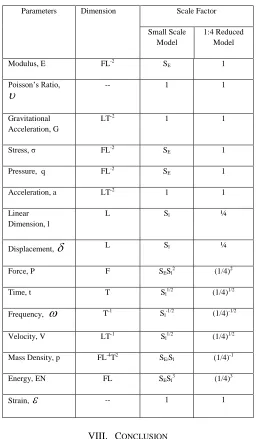
Similitude Relations and scale factors of different parameters for dynamic structural models are derived and shown in Table I. Scale factor Sl for 1:4 scale reduced
models is 1/4 and the material of 1:4 scale reduced models and their prototype is assumed to be same i.e. SE = 1. After
implementation of values of Sl and SE, the correspondent
scale factors for 1:4 scale reduced models are also shown in Table I.
TABLEI SIMILITUDE RELATIONS
Parameters Dimension Scale Factor
Small Scale Model
1:4 Reduced Model
Modulus, E FL-2 S
E 1
Poisson’s Ratio,
-- 1 1Gravitational Acceleration, G
LT-2 1 1
Stress, σ FL-2 SE 1
Pressure, q FL-2 S
E 1
Acceleration, a LT-2 1 1
Linear Dimension, l
L Sl ¼
Displacement,
L Sl ¼Force, P F SESl2 (1/4)2
Time, t T Sl1/2 (1/4)1/2
Frequency,
T-1 Sl-1/2 (1/4)-1/2
Velocity, V LT-1 S
l1/2 (1/4)1/2
Mass Density, p FL-4T2 S
E/Sl (1/4)-1
Energy, EN FL SESl3 (1/4)3
Strain,
-- 1 1VIII. CONCLUSION
[image:4.612.316.572.154.593.2]International Journal of Emerging Technology and Advanced Engineering
Website: www.ijetae.com (ISSN 2250-2459, ISO 9001:2008 Certified Journal, Volume 5, Issue 3, March 2015)
72
The establishment of similarity conditions, based on Buckingham π Theorem, is discussed and their use in the scaled model is also presented. The design and construction of models requires extreme care. Small variations can be critical for the interpretation of results. Non-linear structures can be validated using analytical models validated by scale models.
REFERENCES
[1] Simitses, G.J, structural similitude for flat laminated surfaces,Composite Structures 51 (2001) 191-194.
[2] Rezaeepazhand , J., simitses, G.J., Starnes jr. J.H., use of scaled-down models for predicting vibration respon-se of laminated plates, Composite structure 30 (1995) 419-426.
[3] Rezaeepazhand,J., simitses, G.J., Starnes jr. J.H., design of scaled down models for predicting shell vibration response, Journal of Sound and vibration, 195(2), 1996, 301-311.
[4] Satish Kumar, Itoh , Y., Saizuka, K., and Usami, T, Pseudo dynamic testing if scaled models, Journal of Structural engineering, April 1997, 524-526.
[5] Oshiro.R.E and Alves .M, scaling impacted structures, archive or applied mechanics, 74 (2004), 130-145.
[6] Oshiro.R.E and Alves .M, scaling impacted structures when the prototype and the model are made of different materials, International of Journal of solids and structures 43 (2006) 2744-2760.