Android-based Home Door Locks Application via
Bluetooth for Disabled People
N.H. Ismail, Zarina Tukiran,N.N. Shamsuddin,
Faculty of Electrical and Electronic EngineeringUniversiti Tun Hussein Onn Malaysia Johor, Malaysia
{nhuda, zarin}@uthm.edu.my, [email protected]
E.I.S Saadon
Pusat Pengajian Diploma, Universiti Tun Hussein Onn MalaysiaJohor, Malaysia [email protected]
Abstract— This paper discusses about an ongoing project that serves the needs of people with physical disabilities at home. It uses the Bluetooth technology to establish communication between user’s Smartphone and controller board. The prototype support manual controlling and microcontroller controlling to lock and unlock home door. By connecting the circuit with a relay board and connection to the Arduino controller board it can be controlled by a Bluetooth available to provide remote access from tablet or smartphone. This paper addresses the development and the functionality of the Android-based application (Android app) to assist disabled people gain control of their living area.
Index Terms— Bluetooth, Arduino controller
I. INTRODUCTION
In Malaysia, the number of disabled people keeps increasing year by year probably because of two common factors. Some are born this way while others have unfortunate accidents. According to the statistics from the Department of Social Welfare, the total number of disabled people in Malaysia in December 2012 is 305640. Among them, 27,363 are visual, 39,303 hearing, 180 speech, 106,252 physical, 117,699 learning, 2,130 mental and 12,713 multiple disabled people [1]. According to [2], disabled people have a limited ability to control electrical and electronics devices (On and OFF) at their home because normally the switches are placed at a height of 15m while the comfortable height for a wheelchair user is up to 13m only. It is also mentioned that the number of disabled-friendly facilities in Malaysia are still minimum. Therefore, providing a very practical facility that can ease accessing home appliances is really required which can greatly improve the lives of the disabled.
Recently, lot of researches have been devoted to a technology-based home security and automation. Smart Key Door with Wireless Security System using RF Signal [3] and Door Locking System using RFID Technology [4] using different mechanism to lock and unlock the door namely RF identification card (RFID). Both using PIC16F87XA as a microcontroller. Besides that, the Main Door Security System using SMS [5] propose the uses of Short Message Service Text Messaging (SMS) as a mechanism to control the system via mobile phone to lock and unlock the door. Rabbit Microprocessor is use as a microcontroller to perform this operation. Face Recognition Based on Auto-Switching
Magnetic Door Lock System using Microcontroller [6] use face recognition as a mechanism to lock and unlock the door.
With the rapid development in the fields of communication/networks and other related wireless technologies such as RFID (Radio Frequency Identification), UWB (Ultra Wide Band), Zigbee, NFC (Near Field Communication) and Bluetooth enable us to develop various kinds of wireless systems via handsets or smartphones. Research by [7] use handset and actuator for remote operation of various electrical devices at home. By pressing a single button on the handset, the signal is sent through the Zigbee technology to the actuator and subsequently switches ON/OFF the intended device. Research [8] on the other hand, demonstrated a handwriting recognition technology as a security tool to manage a security of the door. Once the disabled user enter the handwriting on the Smartphone, the door will immediately opened after going through the process of identification by the system. Researcher [9] develops a home automation through Bluetooth on Android mobile device. This system allows the user to lock and unlock a door in a short range.
Since Bluetooth has become so prevalent in mobile devices, it was seen as a simple, low cost and secure solution for wirelessly connecting a mobile device to a home automation system. Therefore, this paper developed a security system by exploiting Bluetooth as a wireless connection protocol on Android Mobile Device to control only one electrical appliance which is magnetic door lock. This project, however, focuses on those who are paralyzed from the legs up to waist level, in particularly those who use wheelchairs. The disabled user can easily use the Graphic User Interface (GUI) application that has been created in the Android Smartphone to lock or unlock the magnetic door through Bluetooth Protocol. A pop-up block will automatically appear on the screen to show the status of the door. At the same time, a small bulb that is attached to the door will switch “ON” once the door is opened.
II. SYSTEM DEVELOPMENT
[image:2.595.318.542.55.285.2]The architecture of the proposed home door locks application via Bluetooth technology is depicted in Fig. 1.
Fig. 1. System architecture
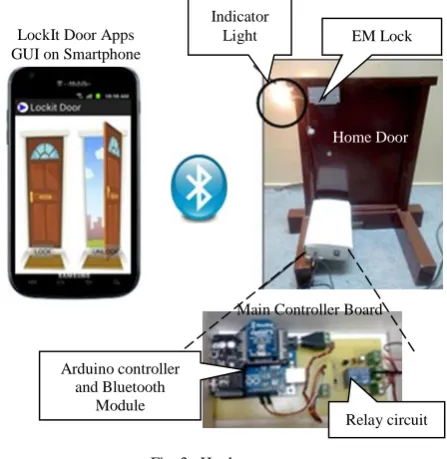
[image:2.595.47.286.108.255.2]An Android Apps called LockIt Door is designed to allow user choose their selection whether lock or unlock the door. The LockIt Door Apps is developed using Eclipse software and programmed using Java language. Fig. 2 shows its graphical user interface (GUI) and algorithm.
Fig. 2. Android apps (a) GUI and (b) algorithm
Once wireless communication between Smartphone Bluetooth and Bluetooth module is established through a pairing process, user’s key selections are sent as radio frequency (RF) signal to the main controller board installed at home.
Then, Arduino Uno controller is used to interpret key selections and determines whether to release or not the electromagnetic (EM) lock home door. The Arduino is programmed with C language. It sensed the RF signal at the input port of the controller. The relay circuit that is connected to Arduino released the EM lock to open the door if the relay circuit is triggered at 12V.
III. RESULTS AND ANALYSIS
Fig. 3 shows the hardware set-up for the entire project which compose with three main parts; LockIt Door Apps on the Smartphone, main controller board and EM lock.
Fig. 3. Hardware set-up
[image:2.595.45.284.358.478.2]Fig. 4 shows the experimental setup using smartphone as transmitter, Bluetooth module as receiver and LED as output. Basically, signal strength is depends on Bluetooth RF transmitted power, receiver sensitivity, and the absorption rate of the medium. When the medium absorbs transmitted energy higher than the signal at the receiver, it seems like the receiver sensitivity is low, then, the connection is lost.
Fig. 4. Experimental set-up
The Bluetooth Module of BlueBee type can receive the RF signal from 20 to 30 meter in non-obstacle environment. Due to these, two experiments are conducted to compare with the theoretical part.
A. Measurement set-up for different location
There are three (3) different types of measurements have been done; (i) indoor and, (ii) outdoor with non-obstacle area and (iii) indoor with obstacle area. As shown in Table 1, it is found that, for indoor (obstacle and non-obstacle area), the maximum distance that the receiver can detect the RF signal from the Smartphone is around 15 meters in house while for outdoor area, the maximum distance is 20 meters. In this case, it Main Controller Board
B lu et o o th M o d u le A rd u in o U n o C o n tr o ll er R el ay C ir cu it B lu et o o th c o mm u n ic at io
n EM Lock
at Home Door 12 Volt 5 Volt LockIt Door Apps on Mobile Device 3.3 Volt Start
1. Scan Bluetooth module 2. Create communication link
between Bluetooth devices 3. While connection is
established, sent user’s selection to main control board.
End
(a) (b)
Arduino controller and Bluetooth Module Relay circuit EM Lock Indicator Light LockIt Door Apps
GUI on Smartphone
Home Door
Main Controller Board
Bluetooth Module (Blue Bee)
[image:2.595.319.546.402.553.2]can be said that for non-obstacle area, the system can communicate between input and output at a distance of at least 20 m. However, the effectiveness of the system is reduced up to 20% for an obstacle area.
TABLE I. SIGNAL STRENGTH FOR DIFFERENT LOCATIONS
Reading Area Distance
(m)
Connected/ Intermittent/ Disconnected
First Indoor (non-obstacle) 5 Connected
10 Connected
15 Intermittent
20 Disconnected
25 Disconnected
30 Disconnected
Second Outdoor (non-obstacle) 5 Connected
10 Connected
15 Connected
20 Intermittent
25 Intermittent
30 Disconnected
Third Indoor (obstacle) 5 Connected
10 Connected
15 Intermittent
20 Intermittent
25 Disconnected
30 Disconnected
B. Bluetooth power strength measurement
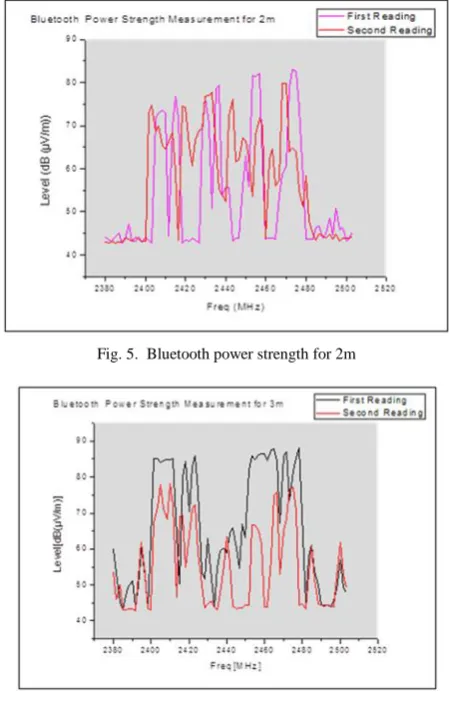
Bluetooh power strength measurement has been done in Electromagnetic Compatibality Center (EMC), UTHM. Based on the data, three (3) different types of analysis can be analyzed in terms of (i) frequency range, (ii) power strength for two different distances and (iii) Frequency Hoping Spread Spectrum (FHSS).
[image:3.595.44.282.125.451.2]i) Frequency range. Theoretically, Bluetooth is a wireless technology standard for exchanging data over short distances (using short-wavelength UHF radio waves in the ISM band from 2.4 to 2.485 GHz) from fixed and mobile devices, and building personal area networks (PANs) [10].Thus, from the measurement set-up as shown in Fig. 5 and 6, it is proved that the frequency range is still in the range of Bluetooth frequency even in a different distance and condition.
[image:3.595.49.280.127.450.2]Fig. 5. Bluetooth power strength for 2m
Fig. 6. Bluetooth power strength for 3m
ii)Power strength. The reading of the graph in Fig. 5 and 6 are converted from dB(µV/m) to the dBm to calculate the value of transmitted power of Bluetooth using Eq. 1.
𝑃𝑟 = 𝐸 [𝑑𝐵 (µ𝑚𝑉)] − 104.7 + (20 log 𝑑)
where;
Pr is power strength in dB E is level in dB(µV/m)
d is distance between Bluetooth module and antenna
Basically, the received power from Bluetooth module (Blue Bee) is ≥4dBm which is Class 2 radio [10]. Thus, the measurement has proved the data which is mentioned in [10] whereby the power strength is greater than 4dBm for both distances as illustrated in Fig 5 and 6.
there is a band width trade-off in order to gain signal-to-noise performance. This contradicts the normal approach to conserve frequency bandwidth, but the spreading process makes the data signal much less susceptible to electrical noise and other interference than conventional radio modulation technique. Other transmission and electrical noise, typically narrow in bandwidth, will only interference with a small portion of the spread spectrum signal, resulting in a much less interference and less errors when the receiver demodulates the signal. From these theory, we can know that why the graph at fig. 5 and 6 have too many peak in the range from 2.4GHz to 2.48 GHz when the Bluetooth start communicate between the Smartphone and the Bluetooth module.
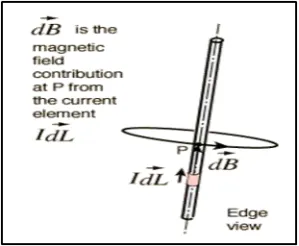
EM lock for door consists of a magnet bar, a steel plate and mounting accessories. When current flow, they will be bonded together strongly until the current is cut off. The relationship between the magnetic field contribution and its source current element is called the Biot-Savart law as written in Eq. 2.
3
4
r
r
dl
I
dB
where:
dB is perpendicular both to ds (which is the direction of the current) and to the unit vector r directed from the element to the point P
μ0is the magnetic constant
I is steady current
dl is a vector whose magnitude is the length of the differential element of the wire
r is the distance from the element to the point P
[image:4.595.88.238.520.643.2]When electrical current flow through a conductor, a very weak magnetic field is generated due to the positively and negatively charge atoms. Fig. 7 shows the direction of the magnetic field contribution follows the right hand rule illustrated for a straight line wire.
Fig. 7. Direction of magnetic field contribution
From Eq. 2, we can see that, the current flow can produce the electromagnetic. According to Biot-Savart’s Law when the signal “Lock” from the Smartphone is transmitted to the Bluetooth module, the current will flow to trigger the relay
circuit and the relay is normally close condition. In this condition, Magnetic Door Lock will bind together. When the signal “Unlock” is transmitted from the Smartphone, it will trigger back the relay and the relay was in a normally open condition, so the Magnetic Door Lock will release because no more the current flow.
IV. CONCLUSION AND FUTURE WORKS
The goal of this study is to propose a system that can help disabled people to open a magnetic door wirelessly using Android smartphone. The range and security aspects were considered through the use of Bluetooth technology that is embedded in the mobile device. The system was able to actuate a pin to Lock or Unlock the door from a short distance away by just pressing a button on a smartphone. The status of the door also has been created to make the system more complete.
In future, the LockIt Door Apps should offer assistance in controlling more doors, windows and basic home electronic appliances. Battery backup system should also be considered to ensure the completeness of the system.
ACKNOWLEDGMENT
The authors would like to thank Universiti Tun Hussein Onn Malaysia (UTHM) and Malaysia Government for the support and sponsor of this study.
REFERENCES
[1] Islam, M.R., “Right of the People with Disabilities and Social Exclusion in Malaysia”, International Journal of Social Science and Humanity, Vo. 5, No. 2, pp. 171-177, 2015.
[2] R.A. Ramlee, D. H. Z. Tang, M.M.Ismail, “Smart Home System for Disabled People Via Wireless Bluetooth”, in Proc. of IEEE International Conference on System Engineering and Technology, pp. 1-4, 2012.
[3] Julius Bin Pelipos (2010), “Smart Key Door with Wireless Security System using RF Signal,” Faculty of Electrical and Electronic Engineering, Universiti Tun Hussein Onn Malaysia: Final Year Project Report.
[4] Junaina Mohd Shah (2009), “Door Locking System using RFID Technology,” Faculty of Electrical and Electronic Engineering, Universiti Tun Hussein Onn Malaysia: Final Year Project Report. [5] Julisah Binti Mohamad Isah (2009), “Main Door Security System
using SMS.” Faculty of Electrical and Electronic Engineering, Universiti Tun Hussein Onn Malaysia: Final Year Project Report. [6] Harnani Hassan, Raudah Abu Bakar, Ahmad Thaqib and
Fawwaz Mokhtar (2012), “Face Recognition Based on Auto-Switching Magnetic Door Lock System using Microcontroller” in International Conference on System Engineering and Technology, Indonesia.
[7] Stapathy, A. and Das, D.P., “A system for remote operation of devices: Helpful for elderly and disabled people” in Proc. of IEEE International Conf. on Advanced Electronic Systems, pp. 350-353, 2013.
[8] Kuang-Yow Lian, Sung-Jung Hsiao and Wen-Tsai Sung, “Home Safety Handwriting Pattern Recognition System” in Proc. of IEEE 11th International Conf. on Cognitive Informatics and
[9] Potts, J. and Sukittanon, S., “Exploiting Bluetooth on Android Mobile Devices for Home Security Application”, in Proc. of IEEE Southeastcon, pp. 1-4, 2012.
[10]"Fast Facts". Bluetooth.com. Retrieved 10 December 2013