Open Access
Research article
Is complementary and alternative medicine (CAM) cost-effective? a
systematic review
Patricia M Herman*
1, Benjamin M Craig
2and Opher Caspi
3Address: 1Program in Integrative Medicine, University of Arizona, Tucson, Arizona, USA, 2Department of Pharmacy, University of Arizona, Tucson, Arizona, USA and 3Recanati Center for Internal Medicine and Research, Rabin Medical Center (Beilinson Campus), Petah Tikva, Israel
Email: Patricia M Herman* - [email protected]; Benjamin M Craig - [email protected]; Opher Caspi - [email protected]
* Corresponding author
Abstract
Background: Out-of-pocket expenditures of over $34 billion per year in the US are an apparent testament to a widely held belief that complementary and alternative medicine (CAM) therapies have benefits that outweigh their costs. However, regardless of public opinion, there is often little more than anecdotal evidence on the health and economic implications of CAM therapies. The objectives of this study are to present an overview of economic evaluation and to expand upon a previous review to examine the current scope and quality of CAM economic evaluations.
Methods: The data sources used were Medline, AMED, Alt-HealthWatch, and the Complementary and Alternative Medicine Citation Index; January 1999 to October 2004. Papers that reported original data on specific CAM therapies from any form of standard economic analysis were included. Full economic evaluations were subjected to two types of quality review. The first was a 35-item checklist for reporting quality, and the second was a set of four criteria for study quality (randomization, prospective collection of economic data, comparison to usual care, and no blinding).
Results: A total of 56 economic evaluations (39 full evaluations) of CAM were found covering a range of therapies applied to a variety of conditions. The reporting quality of the full evaluations was poor for certain items, but was comparable to the quality found by systematic reviews of economic evaluations in conventional medicine. Regarding study quality, 14 (36%) studies were found to meet all four criteria. These exemplary studies indicate CAM therapies that may be considered cost-effective compared to usual care for various conditions: acupuncture for migraine, manual therapy for neck pain, spa therapy for Parkinson's, self-administered stress management for cancer patients undergoing chemotherapy, pre- and post-operative oral nutritional supplementation for lower gastrointestinal tract surgery, biofeedback for patients with "functional" disorders (eg, irritable bowel syndrome), and guided imagery, relaxation therapy, and potassium-rich diet for cardiac patients.
Conclusion: Whereas the number and quality of economic evaluations of CAM have increased in recent years and more CAM therapies have been shown to be of good value, the majority of CAM therapies still remain to be evaluated.
Published: 02 June 2005
BMC Complementary and Alternative Medicine 2005, 5:11 doi:10.1186/1472-6882-5-11
Received: 23 December 2004 Accepted: 02 June 2005
This article is available from: http://www.biomedcentral.com/1472-6882/5/11 © 2005 Herman et al; licensee BioMed Central Ltd.
Background
Complementary and alternative medicine (CAM) has a reputation for good value among health conscious con-sumers [1]. In the United States concon-sumers spend over $34 billion per year on CAM therapies [2], dollars spent outside the conventional health care financing system. Such evidence on out-of-pocket expenditures is a testa-ment to the widely held belief that CAM therapies have benefits that outweigh their costs. Regardless of public opinion, there is often little more than anecdotal evidence on the health and economic implications of CAM therapies.
The paucity of outcomes research in CAM has likely depressed access to CAM therapies by impeding their inte-gration into financial mechanisms commonly found in conventional health care. Most US consumers who have health insurance coverage, either through public or pri-vate institutions, bear the entire cost of CAM therapies out-of-pocket [3]. Theoretically, CAM therapies seem effective and a good candidate for cost savings because they avoid high technology, offer inexpensive remedies, and harness the power of vis medicatrix naturae (the body's natural ability to heal itself). As such, a thorough and external review of economic and health outcomes of CAM is necessary for evidence-based consideration of CAM therapies as a covered expense. That being said, it is also known that affirmative evidence on economic and health outcomes is a necessary, but not sufficient step toward CAM coverage, and not the decision itself. Other factors such as historical demand, political expediency, consumer demand, and practitioner enthusiasm may also be consid-ered in the decision to incorporate CAM into a health insurance policy [1,4,5].
The need for economic evaluations is also growing in con-ventional healthcare. An increasing number of health plans and hospitals have moved from a simple budgetary focus in formulary decisions to requiring detailed evi-dence on the economic value of considered therapies rel-ative to alternrel-atives [6,7]. Beyond their use in decisions concerning health insurance coverage, economic out-comes of both CAM and conventional therapies also influence health policy, justify licensure of practitioners, inform industry investment decisions, provide general evidence to consumers about potential economic bene-fits, and can guide future research efforts through identify-ing decision-critical parameters for additional research [8,9].
In their systematic review of CAM economic evaluations, White and Ernst [4] identified 34 economic evaluations of CAM conducted between 1987 and 1999; only eleven of which were full economic evaluations (ie, compared both economic and health outcomes between two or more
alternatives) [10]. Quality was evaluated by noting whether cost data were collected prospectively and whether comparison groups were comparable – ie, assigned randomly. Unfortunately, their search strategy included the term "alternative medicine" but not "com-plementary medicine." Therefore, all single therapy stud-ies in their review are of CAM therapstud-ies that are usually used as substitutes (alternatives) to conventional care (eg, acupuncture, homeopathy, and spinal manipulation). No studies of complementary therapies (those used in con-junction with conventional care) were included, despite the use of the term "complementary" in their conclusion that spinal manipulative therapy may have benefits for back pain, but "there was a paucity of rigorous studies that could provide conclusive evidence of differences in costs and outcomes between other complementary therapies and orthodox medicine [4]."
The objectives of this paper are: 1) to introduce concepts commonly applied in economic evaluations of health technologies (often called technology assessment) so that practitioners and CAM users can translate and benefit from published evidence; and 2) present a systematic review of the current scope and quality of economic eval-uations of CAM. We begin with an overview of economic evaluation, including didactic examples from the CAM economic literature to help clarify the concepts presented. Readers familiar with this type of analysis can skip this section and proceed directly to the methods section.
In our systematic review we expand upon and update the initial review by White and Ernst. We evaluate study qual-ity in more detail, using both additional study design cri-teria and quality of reporting cricri-teria, and present a summary of the results from exemplary studies. While their review was the first of its kind, economic evaluations in the CAM literature have improved greatly in the last five years. We end the paper with a description of the attributes of CAM that make economic evaluation chal-lenging and how these issues may be addressed. We hope that practitioners' interest in economic evaluation will continue to grow, leading to greater incorporation of this research into CAM trials.
What is an economic evaluation?
medical events that are professionally meaningful. Humanistic outcomes are a broad category of intangible personal attributes, typically collected through self-report. Humanistic outcomes include quality of life characteris-tics such as sense of safety, physical comfort, enjoyment, meaningful activity, relationships, functional compe-tence, dignity, privacy, individuality, autonomy, and spir-itual well-being. Conventionally, clinical and humanistic outcomes are considered health outcomes, and we follow this convention for the remainder of the article.
There are several forms of economic evaluations that can be performed (cost-effectiveness analysis being only one of these) and each differs based on the selection and measurement of health outcomes. The perspective (or point of view) taken for the analysis also influences the selection and measurement of consequences, because not all outcomes are important to all decision makers. Gener-ally, there are three perspectives for economic analysis: individual (eg, patient), institutional (eg, health mainte-nance organization), or societal. The societal perspective accumulates all outcomes, while individual and institu-tional analyses are more selective. Regardless of perspec-tive, the objective of an economic evaluation is to provide information on consequences relating to alternatives faced by a decision maker.
The most basic form of economic evaluation is a table that lists the individual economic and health outcomes of alternative interventions. This table is known as a consequence study. Cost-identification studies and cost-minimization analyses only address economic outcomes and are discussed below in that section. The remaining forms of economic evaluations summarize economic and health outcomes into a single result (Table 1).
The advantages of performing cost-benefit and cost-utility analyses are that multiple outcomes are summarized into a single unit, either monetary units such as dollars (CBA)
or QALYs (CUA) and that therapies with different sets of health outcomes can be compared based on the differ-ences in the summary measures. Cost-benefit analysis has the additional benefit of directly indicating whether the therapy pays for itself.
The disadvantages of CBA and CUA come from the tech-niques required to produce a summary measure. Cost-benefit analysis requires putting a monetary value on all health outcomes (and ultimately on life), and cost-utility analysis assigns value to health outcomes based on their contribution to quality of life under the presumption of population-based preferences. An extensive literature addresses the methodological and theoretical issues involved in the construction of these summary measures. The process usually occurs in two steps. In the first step, health outcomes of the intervention are measured, and in the second the outcomes are valued in summary units and aggregated. Cost-benefit analyses often assess the mone-tary value of health outcomes based on willingness-to-pay using a technique called conjoint analysis [12-14]. Will-ingness-to-pay inherently places a lower values of life on individuals with low income, because they can not pay what they do not have. Cost-utility analyses have multiple methods to place quality of life values on health out-comes, also known as social tariffs. Summary measures of quality of life may not be sensitive enough to pick up short-term changes such as for acute conditions and will not pick up specific clinical outcomes like blood pressure control [15]. Examples of instruments used to capture these general health states include the EuroQoL (EQ-5D) [16] and the Health Utilities Index [17].
[image:3.612.54.554.101.188.2]Cost-effectiveness analysis (CEA) is the current standard in the literature, and has the most straight forward inter-pretation. Under CEA, therapies useful for a specific dis-ease or condition can be directly compared using a metric of effectiveness relevant to that condition, such as blood pressure control. Although these types of analyses do not
Table 1: Three forms of full economic evaluations
Cost-benefit Analysis (CBA) Cost-effectiveness Analysis (CEA) Cost-utility Analysis (CUA)
Number of Health Outcomes Multiple outcomes One outcome Multiple outcomes Unit of Health Outcomes Summary measure in monetary
units (eg, US dollars)
Natural units (eg, reduction in number of hot flashes)
Summary measure in quality of life units (eg, quality-adjusted
life-years, QALY) Results Net benefits
(B1 + B2 - C1 - C2)
Cost-effectiveness ratio* (C1 - C2) /(E1 - E2)
Cost-utility ratio* (C1 - C2) /(QALY1 - QALY2)
allow a summary of multiple outcomes they tend to respond well to the most urgent questions, such as how much would it cost to reduce the number of gestational diabetes cases by 10%? Clearly, a reduction in gestational diabetes cases has measurable implications in quality of life and economic units, but the creation of a summary measure is not necessary to address the decision maker's question.
No matter the approach taken, it is recommended that the estimated outcomes (economic, clinical and humanistic) of health care alternatives used in economic evaluation are best estimated in pragmatic clinical trials that directly and realistically compare the therapies of interest [10]. Rarely are the results of placebo-controlled trials appro-priate [1,4,18-20]. Also, since many CAM therapies target chronic disease, it is important that the study period be long enough to capture the full benefits and costs of each therapy, and that future costs and benefits be discounted to the present for comparison. Finally, all economic eval-uations should include some type of sensitivity analysis to test the robustness of results to the various assumptions made [1,20,21].
What are economic outcomes?
Economic outcomes are the net bundle of resources for-gone due to an intervention valued at the opportunity cost of those resources (the value of their next best use or "opportunity"). Since the cost of a therapy differs depend-ing on whether you are a patient, a health plan, or a health care provider, the economic outcomes (ie, costs) of each therapy depend on the perspective of the study. Studies that only measure the economic outcomes of
interven-tions are known as cost-identification studies. A study that describes the economic and health outcomes of a single therapy can also be called a cost-identification study. These studies inform full economic evaluations. That is, they provide the data needed to better design future stud-ies that consider both the economic and health outcomes of two or more alternative therapies. A cost-minimization analysis (CMA) explicitly assumes equivalence in health outcome among alternative therapies, and examines only economic outcomes. In practice, it appears the same as a cost-identification study, but under the assumption of equivalence, a CMA is a full economic evaluation.
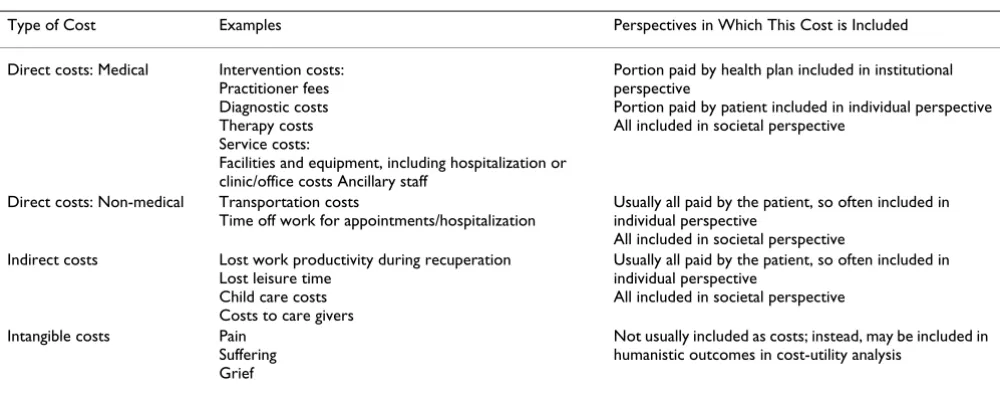
Table 2 has been summarized from other references [1,20,22] and gives a list of the types of economic out-comes and the perspective of analysis where each is con-sidered. Note that these types of economic outcomes should be inclusive of both the full costs of the therapy and of any treatment for adverse effects, which can be expensive. In economic evaluations, the safety of a ther-apy is addressed through accounting for the cost of treat-ing these adverse events as well as through their impact on clinical and quality of life outcomes.
[image:4.612.55.555.96.293.2]It is recommended that economic outcome data are best collected prospectively as part of a pragmatic clinical trial [1,4,19,20]. Inclusion and exclusion criteria for cost data should be established in the protocol, as for clinical outcome measurements, but provision must be made to add extra categories of costs which only become apparent after the trial has commenced [1,20]. Many studies try to collect cost data retrospectively, often after a therapy has shown clinical effectiveness. However, retrospective data
Table 2: Economic outcomes to include in economic evaluation
Type of Cost Examples Perspectives in Which This Cost is Included
Direct costs: Medical Intervention costs: Practitioner fees Diagnostic costs Therapy costs Service costs:
Facilities and equipment, including hospitalization or clinic/office costs Ancillary staff
Portion paid by health plan included in institutional perspective
Portion paid by patient included in individual perspective All included in societal perspective
Direct costs: Non-medical Transportation costs
Time off work for appointments/hospitalization
Usually all paid by the patient, so often included in individual perspective
All included in societal perspective Indirect costs Lost work productivity during recuperation
Lost leisure time Child care costs Costs to care givers
Usually all paid by the patient, so often included in individual perspective
All included in societal perspective
Intangible costs Pain Suffering Grief
Not usually included as costs; instead, may be included in humanistic outcomes in cost-utility analysis
collection is seldom fertile, adapted, or exhaustive, and it is subject to bias [18,20].
Examples of the different forms of economic evaluations of CAM
Our systematic review of the CAM economic evaluation literature (presented below) revealed no cost-conse-quence studies and no cost-benefit analyses. However, we did find examples of a cost-identification study, min-imization analysis, effectiveness analysis, and cost-utility analysis. These examples are presented below.
Cost-identification study
Frenkel and Hermoni, 2002 [23], performed a retrospec-tive comparison of medication consumption costs from computerized medication charts three months before and three months after a homeopathic intervention for atopic and allergic disorders. The review was performed on 48 consecutive self-referred patients in one clinic over one year with a diagnosis of an atopic condition who agreed to a classical homeopathic treatment in addition to usual conventional care. Of the 31 medication users (prescrip-tion and non-prescrip(prescrip-tion allergy-related medica(prescrip-tions) before the intervention, 27 reduced their use, two increased their use, and two had their medication level unchanged after the intervention. Of the 17 who had not used medication before the intervention, 4 began medica-tion after the intervenmedica-tion. There was an average drop in 3-month medication costs after homeopathy of $14 (1998 US$) or 54% per person.
Cost-minimization analysis
Herron and Hillis, 2000 [24], retrospectively compared government payments to physicians for 1418 Quebec health insurance enrollees who practiced the Transcen-dental Meditation (TM) to payments for 1418 randomly selected and matched enrollees who did not. Long term health outcomes were assumed to be equal for both groups. Before starting meditation, the groups were simi-lar in the yearly rate of increase in payments. After starting TM, annual physician payments for the meditation group declined 1 to 2% per year, while those for the non-TM group increased annually over the six year period. The dif-ference in the annual change in payments was statistically significant at a rate between 5 and 13% per year.
Cost-effectiveness analysis
Franzosi et al, 2001 [25], prospectively gathered health and economic outcomes during the 3.5 year follow-up period of a large randomized open-label study (n = 5664) of omega-3 polyunsaturated fatty acids (n-3 PUFA) as sec-ondary prevention for patients with recent myocardial inf-arction. The perspective was that of a third-party payer; accordingly only direct health care costs (hospital admis-sions, laboratory and diagnostic tests, and medications)
were considered. The incremental number of life-years saved by n-3 PUFA treatment over the 3.5 years (dis-counted at 5%) was 0.0332 per patient. The incremental cost discounted over the same period was 817€ per patient. Therefore, the incremental cost-effectiveness ratio is 24,603€ (approximately $25, 415 in 1999 US$ [26]) per life-year saved.
Cost-utility analysis
Korthals-de Bos et al, 2003 [27], performed an economic evaluation alongside a randomized controlled trial to compare manual therapy, physiotherapy, and care by a general practitioner for neck pain. The study used the soci-etal perspective and collected direct and indirect costs (including hours of help from family and friends, and hours of absenteeism from work or other activities) through the use of cost diaries kept by patients over one year. Data on each patient's overall health state were gath-ered at baseline and at one year using a survey instrument called the EuroQoL [16]. The utility of these health states were then calculated by using "society's" preferences for each of those health states. Society's preferences were esti-mated from a sample of the general population by the developers of the EuroQoL instrument. Using the com-parison of manual therapy to general practitioner care, manual therapy had a lower one-year cost ($402, US$) than general practitioner care ($1241). The QALYs were 0.82 for manual therapy and 0.77 for general practitioner care. Since the costs were lower and the QALYs higher for manual therapy as compared to usual care, manual ther-apy is said to dominate general practitioner care and no cost-utility ratio is calculated.
Methods
Search strategy
We searched the following electronic databases from Jan-uary 1999 to October 2004: Medline, AMED, Alt-Health-Watch, and the Complementary and Alternative Medicine Citation Index via NCCAM and the National Library of Medicine (NLM). Searching was restricted to English lan-guage journals and human studies with the keywords: complementary medicine or alternative medicine, and costs or cost analysis or cost-benefit or cost-effective or economic analysis or economic evaluation.
We removed duplicates from the search results and selected papers that reported original data on specific CAM therapies from any form of standard economic anal-ysis, analysis of costs, or economic modeling. Studies were then excluded if they were cited in the White and Ernst review [4], or if they were case studies or case series of five or fewer subjects.
Data analysis
The following data were extracted from each of the included studies: full citation information (author(s), date, title, journal, etc), form of economic evaluation (stated or inferred), the therapies being compared and whether the CAM therapies were being used in addition to usual care (complementary) or instead of usual care (alternative), the perspective of analysis (stated or inferred), the study design, the sample size, and summary results.
The studies were categorized as either full economic eval-uations (defined as a comparison between two or more alternatives and considering both costs and consequences [10]) or partial economic evaluations (those studies that did not contain a comparison, or only addressed costs). Studies that estimated resource utilization were included as full economic evaluations even if resources were not valued.
We captured data on quality of the full economic evalua-tions using two approaches. The first approach was to gather from each study the data needed to assess quality according to a 35-item checklist developed by the BMJ
Economic Evaluation Working Party [30]. This checklist was developed to improve the quality of published eco-nomic evaluations, and was chosen because it is thor-ough, and entails an objective assessment of whether essential components of an economic evaluation are reported in the article. Therefore, the checklist is mainly a measure of reporting quality and not necessarily of study quality. We also report available results from several other general reviews of economic evaluations of conventional therapies that use this checklist for comparison.
As the purpose of economic evaluations is to inform clin-ical practice and health policy decisions, the best evalua-tions are timely and use the best data available at the time [10]. On the other hand, an evaluation is only as good as the data upon which it is based. It has been suggested that the ideal situation for data collection is to collect eco-nomic data along side health outcomes in a randomized pragmatic trial [10]. Pragmatic trials offer a compromise between the goals of internal and external validity. To assess study quality, we went beyond White and Ernst's [4] criteria of randomization (to reduce bias by creating com-parable groups) and prospective collection of economic outcome data (to ensure all costs are captured) to include two additional indicators of whether a pragmatic (effec-tiveness or "real world") rather than efficacy trial was con-ducted. The first is that the comparison group was usual care, and the second was that the study was not blinded and not mandatory – ie, that physicians and patients could react realistically to the therapy [10]. These criteria relate to the external validity or generalizability of the study. Other indicators of a study's generalizability, such as the determination of whether study participants could be assumed to represent a normal case load, were not used as they required detailed knowledge as to the appropriate-ness of the inclusion and exclusion criteria for each condi-tion studied – a level of expertise not held by the study's authors.
Based on the study quality criteria, we report summarized results of the exemplary studies – ie, those meeting all four study quality criteria. If the health outcomes for one ther-apy are better than that of its alternative and the economic outcomes are better or equal (lower or equal costs), that therapy is said to dominate (be clearly better than) its alternative. This is also the case if both therapies have equal health outcomes and one has lower costs. In all other cases, the decision maker must elect whether the increase (loss) in health benefits is worth the increase (savings) in cost.
Results
com-plementary therapies (ie, used in addition to conven-tional care).
Reporting quality checklist
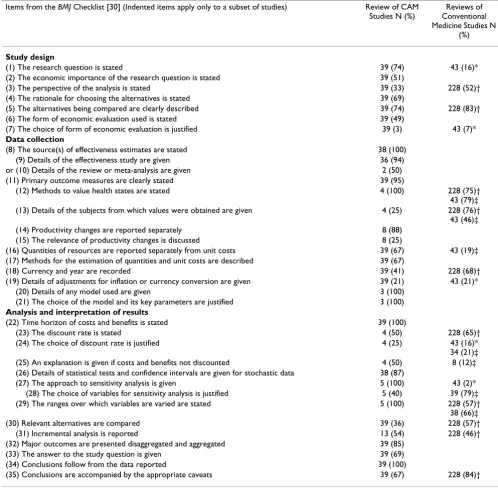
Table 4 shows the results of the application of the BMJ 35-item quality checklist [30] to the 39 full economic evaluations. For comparison, Table 4 also contains comparable results from systematic reviews in conven-tional medicine [6,83,84].
Study design
These checklist items indicate whether essential compo-nents of the study design were reported. About half the studies stated the form of the economic evaluation, how-ever, several were stated incorrectly and only one justified the form chosen. The bulk of the studies presented effectiveness analyses (36 or 92%), five presented cost-utility analyses, and one was a cost-minimization study [24]. Only one-third of studies stated the perspective of the analysis, however, it could be determined from the costs included for all studies. Ten used a societal perspec-tive, and the majority (33 or 85%) used some sort of insti-tutional perspective (eg, health insurance company or hospital). Note that the totals by form and perspective add to more than 39. This is because individual studies can include analyses using more than one form of
eco-nomic evaluation and can report costs from more than one perspective.
Data collection
[image:7.612.54.554.110.321.2]These checklist items relate to the presence of information essential to the generalizability of study results. All studies that included health outcomes (ie, all except the one cost minimization study [24]) reported the source of their effectiveness estimates. In 36 of the 38 cases the source was a single study, often the economic evaluation itself. The two other studies were modeling studies [49,78] where reviews were used as the source of effectiveness esti-mates. Items 12 and 13 are appropriate for cost-utility analyses (where health states are valued in terms of util-ity) and there were four such studies [27,35,51,78], only one of which gave details on the subjects from whom the valuations were obtained [35]. Productivity changes (items 14 and 15) are appropriate for studies using the societal perspective. Eight studies included the costs of changes in productivity from improvement in back or leg pain [47,82], neck pain [27], migraine [32], anxiety [44], ankylosing spondilitis [51], psoriasis [49], and children's rhinopharyngitis [41]. All but one [49] reported these amounts separate from total costs. However, few dis-cussed the relevance to the study of productivity changes.
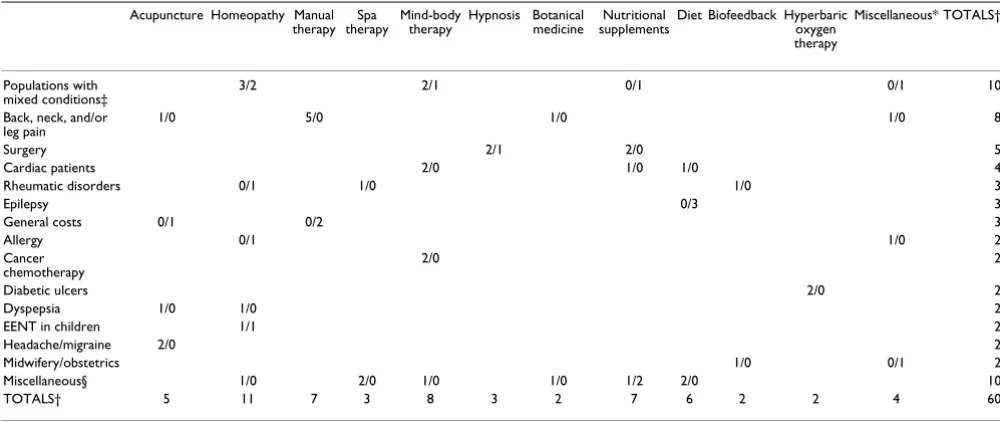
Table 3: Types of complementary and alternative medicine (CAM) therapies studied for various conditions (full/partial economic evaluations)
Acupuncture Homeopathy Manual
therapy therapySpa Mind-body therapy Hypnosis Botanical medicine supplementsNutritional Diet Biofeedback Hyperbaric oxygen therapy
Miscellaneous* TOTALS†
Populations with mixed conditions‡
3/2 2/1 0/1 0/1 10
Back, neck, and/or leg pain
1/0 5/0 1/0 1/0 8
Surgery 2/1 2/0 5
Cardiac patients 2/0 1/0 1/0 4
Rheumatic disorders 0/1 1/0 1/0 3
Epilepsy 0/3 3
General costs 0/1 0/2 3
Allergy 0/1 1/0 2
Cancer chemotherapy
2/0 2
Diabetic ulcers 2/0 2
Dyspepsia 1/0 1/0 2
EENT in children 1/1 2
Headache/migraine 2/0 2
Midwifery/obstetrics 1/0 0/1 2
Miscellaneous§ 1/0 2/0 1/0 1/0 1/2 2/0 10
TOTALS† 5 11 7 3 8 3 2 7 6 2 2 4 60
EENT = Eye, ear, nose, and throat conditions
* Miscellaneous CAM therapies include: multivitamins, shoe orthoses, electrodermal screening, and aromatherapy. † Some studies compared more than one CAM therapy. Therefore, totals exceed the number of studies found.
‡ Populations with mixed conditions include: patients with chronic disease, patients at one general practice (4 studies), long-term care workers, persons in Quebec health system, inner city children, and older adults (2 studies).
About two-thirds of studies reported resource use quanti-ties separate from unit costs, or described the methods used to estimate both quantities and unit costs. Whereas, almost all reported the currency used, only a minority (16 or 41%) reported the currency year. A smaller number reported the details of adjustments for inflation or
[image:8.612.53.551.111.603.2]cur-rency conversion, but this was not often required in stud-ies collecting and reporting data in the same year and currency. Models (one decision tree model [78] and two multiplicative-type or impact [49,57] models) were used in three studies and in all cases the details of the model were given and justified.
Table 4: Reporting quality of complementary and alternative medicine (CAM) economic evaluations and comparable results of similar reviews in conventional medicine
Items from the BMJ Checklist [30] (Indented items apply only to a subset of studies) Review of CAM Studies N (%)
Reviews of Conventional Medicine Studies N
(%)
Study design
(1) The research question is stated 39 (74) 43 (16)* (2) The economic importance of the research question is stated 39 (51)
(3) The perspective of the analysis is stated 39 (33) 228 (52)† (4) The rationale for choosing the alternatives is stated 39 (69)
(5) The alternatives being compared are clearly described 39 (74) 228 (83)† (6) The form of economic evaluation used is stated 39 (49)
(7) The choice of form of economic evaluation is justified 39 (3) 43 (7)*
Data collection
(8) The source(s) of effectiveness estimates are stated 38 (100) (9) Details of the effectiveness study are given 36 (94) or (10) Details of the review or meta-analysis are given 2 (50) (11) Primary outcome measures are clearly stated 39 (95)
(12) Methods to value health states are stated 4 (100) 228 (75)† 43 (79)‡ (13) Details of the subjects from which values were obtained are given 4 (25) 228 (76)†
43 (46)‡ (14) Productivity changes are reported separately 8 (88)
(15) The relevance of productivity changes is discussed 8 (25)
(16) Quantities of resources are reported separately from unit costs 39 (67) 43 (19)‡ (17) Methods for the estimation of quantities and unit costs are described 39 (67)
(18) Currency and year are recorded 39 (41) 228 (68)† (19) Details of adjustments for inflation or currency conversion are given 39 (21) 43 (21)*
(20) Details of any model used are given 3 (100) (21) The choice of the model and its key parameters are justified 3 (100)
Analysis and interpretation of results
(22) Time horizon of costs and benefits is stated 39 (100)
(23) The discount rate is stated 4 (50) 228 (65)† (24) The choice of discount rate is justified 4 (25) 43 (16)*
34 (21)‡ (25) An explanation is given if costs and benefits not discounted 4 (50) 8 (12)‡ (26) Details of statistical tests and confidence intervals are given for stochastic data 38 (87)
(27) The approach to sensitivity analysis is given 5 (100) 43 (2)* (28) The choice of variables for sensitivity analysis is justified 5 (40) 39 (79)‡ (29) The ranges over which variables are varied are stated 5 (100) 228 (57)†
38 (66)‡ (30) Relevant alternatives are compared 39 (36) 228 (57)†
(31) Incremental analysis is reported 13 (54) 228 (46)† (32) Major outcomes are presented disaggregated and aggregated 39 (85)
(33) The answer to the study question is given 39 (69) (34) Conclusions follow from the data reported 39 (100)
(35) Conclusions are accompanied by the appropriate caveats 39 (67) 228 (84)†
* Comparable estimates available from Jefferson et al, 1998 [83].
Analysis and interpretation of results
All studies stated the time horizon for costs and benefits and most (35 or 90%) reported a time horizon of one year or less. Items 23 through 25 apply only to the four remaining studies with time horizons longer than one year. The discount rate is reported in two of these studies (one with a time horizon of 42 months [25] and the other that included a 12-year projection [78]), but only one jus-tified the choice of discount rate [78]. Two studies gave an explanation for why they did not discount costs and ben-efits, however, neither needed to – one had a one-year time horizon [35] and the other stated its time horizon as one course of chemotherapy [55]. Five studies performed sensitivity analyses [25,27,35,51,78]. In all cases the approach and the range of variables tested were stated, but the choice of variables to test was only justified in two cases [35,51].
In about one-third of studies there was some comparison of study results to that of other studies. In most cases this was done as a simple statement noting that the results were either similar, or that they were dissimilar and that this might be because of differences in study design. Incre-mental cost-effectiveness or cost-utility ratios are usually only required when one therapy offers clearly better health outcomes than the other, but at a higher cost. In the 13 studies where this was the case over one-half reported incremental analyses. In most cases the major outcomes of the studies were shown disaggregated, and the study question was answered. We did require that a proper research question be stated (see the answers to item 1) for it to be answered. In all cases, we felt that the conclusions followed the data, but in about one-third of cases the conclusions were not presented with the appro-priate caveats. For example, if a study did not explicitly discuss its limitations, it was not included as meeting the last item.
Measures of study quality
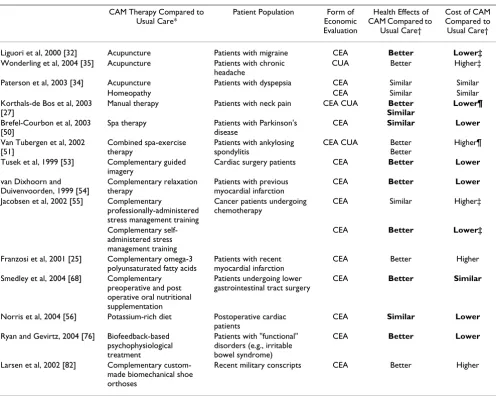
Twenty-seven studies (69%) gathered cost data prospec-tively and 21 (54%) used randomly assigned comparison groups. In 32 studies (82%) the physicians and patients were not blinded to the treatment received and participa-tion was not mandatory (a worksite intervenparticipa-tion [57]), and therapies were compared to usual care in 34 (87%) of studies. Fourteen studies [25,27,32,34,35,50,51,53-55,68,74,76,82] met all study quality criteria, and a sum-mary of their results is shown in Table 5.
Discussion
The number of economic evaluations of CAM has increased in recent years, even if we only count full evalu-ations of alternative therapies. Study quality has also increased, and although reporting quality can use improvement, it is on the whole similar to that seen in
economic evaluations of conventional medicine. Never-theless, there are still too few good quality evaluations to draw many conclusions about the cost-effectiveness of specific CAM therapies for particular conditions.
Potential reasons for paucity
A possible explanation for the paucity of studies is that there may be less of an incentive to perform economic evaluations of CAM. Consumers are already spending a large amount of their disposable income on CAM without formal proof of effectiveness or cost effectiveness. Eco-nomic evaluations are typically required for the incorpo-ration of therapies under traditional financing mechanisms and for adjustment of coverage under these mechanisms. Therefore, the market for economic evalua-tion in CAM may be small due to reduced involvement of third-party payers in CAM financing.
Some CAM practitioners do not see the need for economic evaluations. An interesting study by Kelner et al [85] asked chiropractors, homeopaths, and Reiki practitioners about the need to demonstrate the effectiveness, safety and cost effectiveness of their therapies. The chiropractors agreed that high quality economic evaluations are essential to their practice, but Reiki practitioners could see no reason for this research, and the homeopaths were divided on these issues. There may be good reason why some practi-tioners resist economic evaluation. If studies are per-formed that show economic benefit of CAM therapies, third party reimbursement may follow which could reduce practitioner autonomy. Coverage may also be restricted to the standardized forms of botanical medicines, nutritional supplements, or protocols used in the studies [86]. This could dramatically change how CAM is practiced by decreasing the use of multidimen-sional multicomponent interventions, by institutionaliz-ing care into conventional health care systems, and by limiting the individualization of care.
Relative quality of evaluations
that Jefferson et al took a more restrictive interpretation of this quality criterion.
Several studies have shown that at least some aspects of quality in economic evaluations improve over time [6,87]. Our findings suggest a trend of quality improve-ment in these studies in CAM. We found that 69% (27 of 39) of the cohort of full economic evaluations collected cost data prospectively as compared to 45% (5 of 11) in White and Ernst's review. Similarly, we found that 54% (21 of 39) of our studies used randomization to create the
comparison groups as compared to 45% (5 of 11) in White and Ernst's review.
[image:10.612.58.554.106.502.2]We found that 14 (36%) of full economic evaluations met all four study quality criteria and were identified as exem-plars. However, the evidence from these criteria must be interpreted cautiously; meeting all study quality criteria does not guarantee an adequate study design. Some aspects of what makes a good pragmatic trial could not be judged by what was reported. For example, pragmatic tri-als enroll patients typical of normal caseload in typical
Table 5: Summary of the results of complementary and alternative medicine (CAM) economic evaluations with exemplary study quality
CAM Therapy Compared to Usual Care*
Patient Population Form of Economic Evaluation
Health Effects of CAM Compared to
Usual Care†
Cost of CAM Compared to Usual Care†
Liguori et al, 2000 [32] Acupuncture Patients with migraine CEA Better Lower‡
Wonderling et al, 2004 [35] Acupuncture Patients with chronic headache
CUA Better Higher‡
Paterson et al, 2003 [34] Acupuncture Patients with dyspepsia CEA Similar Similar
Homeopathy CEA Similar Similar
Korthals-de Bos et al, 2003 [27]
Manual therapy Patients with neck pain CEA CUA Better Similar
Lower¶
Brefel-Courbon et al, 2003 [50]
Spa therapy Patients with Parkinson's disease
CEA Similar Lower
Van Tubergen et al, 2002 [51]
Combined spa-exercise therapy
Patients with ankylosing spondylitis
CEA CUA Better Better
Higher¶
Tusek et al, 1999 [53] Complementary guided imagery
Cardiac surgery patients CEA Better Lower
van Dixhoorn and Duivenvoorden, 1999 [54]
Complementary relaxation therapy
Patients with previous myocardial infarction
CEA Better Lower
Jacobsen et al, 2002 [55] Complementary
professionally-administered stress management training
Cancer patients undergoing chemotherapy
CEA Similar Higher‡
Complementary self-administered stress management training
CEA Better Lower‡
Franzosi et al, 2001 [25] Complementary omega-3 polyunsaturated fatty acids
Patients with recent myocardial infarction
CEA Better Higher
Smedley et al, 2004 [68] Complementary preoperative and post operative oral nutritional supplementation
Patients undergoing lower gastrointestinal tract surgery
CEA Better Similar
Norris et al, 2004 [56] Potassium-rich diet Postoperative cardiac patients
CEA Similar Lower
Ryan and Gevirtz, 2004 [76] Biofeedback-based psychophysiological treatment
Patients with "functional" disorders (e.g., irritable bowel syndrome)
CEA Better Lower
Larsen et al, 2002 [82] Complementary custom-made biomechanical shoe orthoses
Recent military conscripts CEA Better Higher
Bold entries indicate that the CAM therapy was shown to be clearly superior to (dominate) usual care. CEA = cost-effectiveness analysis; CUA = cost-utility analysis
* The use of the term "complementary" in this column indicates CAM therapies used in addition to usual care.
† If tests of statistical significance were performed, costs must be significantly higher or lower (and health effects significantly better or worse), or they were considered "similar."
settings with average physicians following them under routine conditions [10]. Judgments as to whether these criteria were met were not possible because of vague reporting. It is also not generally agreed across all health economists that a pragmatic trial, even a well-designed one, can fully represent the real world of health care. These economists advocate for the collection of cost data using an observational study design.
A study may also be of "poor" quality because it applied the CAM therapy inappropriately. This can happen when a study is designed by researchers not familiar with a ther-apy. In response to this problem researchers and practi-tioners of several CAM therapies have begun development of standards for research and reporting. Reporting stand-ards do not guarantee that the therapy was used appropri-ately, but they at least allow determination of what was done. One such set of reporting standards are the STRICTA recommendations for acupuncture [88]. Of the four full evaluations of acupuncture, two (one of which was included in Table 5[32]) met STRICTA reporting standards. As these types of guidelines are not yet availa-ble for all CAM therapies, we did not assess whether CAM therapies were applied appropriately in the studies reviewed.
Cost-effectiveness of CAM
The exemplary studies summarized in Table 5 indicate that a number of CAM therapies may be considered cost-effective compared to usual care for a number of condi-tions: acupuncture for migraine, manual therapy for neck pain, spa therapy for Parkinson's, complementary guided imagery for cardiac surgery patients, complementary relaxation therapy for patients with previous myocardial infarction, complementary self-administered stress man-agement for cancer patients undergoing chemotherapy, complementary pre- and post-operative oral nutritional supplementation for lower gastrointestinal tract surgery, potassium-rich diet (rather than potassium supplements) for postoperative cardiac patients, and biofeedback for patients with "functional" disorders such as irritable bowel syndrome. Acupuncture and homeopathy were both found to be equivalent in terms of effects and costs to usual care for dyspepsia. The attractiveness of the other CAM therapies shown in Table 5 depends on whether the increased health benefits are worth the additional cost, or whether other aspects of the therapy make them attractive, such as patient preference. Only one of the studies sum-marized in Table 5 reported results of a CAM therapy being dominated by (clearly inferior to) usual care. The use of professionally-administered stress management for cancer patients undergoing chemotherapy was shown to have higher costs, but no additional health benefits over usual care. It is important for CAM that this contradictory
evidence is also known for best clinical practice and the efficient use of CAM resources.
On the surface one might expect that therapies that substi-tute for usual care (alternative medicine) would be much more likely to be cost effective. In this sample of exemplar studies, of the nine study comparisons where CAM thera-pies were shown to be superior to usual care (better effects and lower costs, similar effects and lower costs, or better effects and similar costs), four were studies of complementary therapies. Therefore, there is evidence that even though complementary therapies are given in addition to usual care, they can improve clinical outcomes without increasing costs.
Issues specific to the economic evaluation of CAM
In many ways the economic evaluation of CAM therapies is similar to that of conventional medicine. However, there are a number of issues specific to CAM that must be considered. These issues can roughly be divided into three groups: those involved with the impact of economic eval-uation on CAM in general, those involving the estimation of health outcomes (ie, issues involved with estimating the efficacy or effectiveness of CAM), and those specific to CAM's economic and humanistic outcomes. The first group of issues has already been addressed above under the potential reasons for paucity.
The methodological challenges involved in determining the clinical effectiveness of CAM have been discussed at length in a number of papers. These include the appropri-ateness of population-based studies when individualized treatments are used and individualized outcomes are expected [89-91], reductionist focus on one therapy for one outcome when that therapy comes from a holistic healing system [92-94], the difficulties with blinding when no appropriate placebo is available [94,95], and the requirement for randomization when most CAM users have strong preferences for their therapy of choice and will often either refuse to be randomized, or will bypass the randomization if it is not to their liking [94]. These challenges are relevant to economic evaluations since they are dependent on effectiveness studies for health out-comes. Also since humanistic and economic outcomes are ideally measured alongside health outcomes in the same trials [1,4,19,20], the challenges above are also relevant to their measurement.
term studies be performed [96]. However, there are a number of challenges inherent in long term studies in addition to the increase in cost (eg, increased loss to fol-low-up through patient attrition) [97]. In our systematic review we found only two clinical trials that followed patients prospectively longer than one year: a five-year study of relaxation therapy for patients with a previous myocardial infarction [54], and a 3.5-year study of n-3 PUFA as secondary prevention for patients with previous myocardial infarction [25].
Economic evaluations in CAM must recognize that the process of healthcare itself can be effective for patients. Attributes of the process of using CAM that may have value include patient empowerment, the operationaliza-tion of patient preference for a particular type of interven-tion, the length and process of the consultainterven-tion, and still having treatment options open when other medical approaches have failed [4,98]. Therefore, economic evalu-ation of CAM needs to measure and include this value where appropriate.
Optimizing health, maximizing wellness, and enhancing well-being are patient-centered outcomes – ones that by definition require subjective measurement [99]. Eco-nomic evaluation of CAM must include appropriate meas-urement of these humanistic outcomes to account for the full value of CAM therapies. Our systematic review found five studies where humanistic outcomes were captured. The more well-known instruments used to measure health status in these studies included the SF-6D [35] and the EuroQoL (EQ-5D), and health status was translated into quality of life units using population-based prefer-ences [27,51]. Sensitivity of these instruments to the changes in quality of life is an important concern for the evaluation of CAM therapies. Although the use of the EuroQoL for manual therapy for neck pain [27] resulted in a statistically insignificant change in quality of life, two other studies demonstrated small, but statistically signifi-cant differences in quality of life using the SF-6D for acu-puncture for chronic headache [35], and using the EuroQoL for spa therapy for ankylosing spondylitis [51]. Therefore, it is possible to measure a change in humanistic outcomes for CAM therapies with these instruments.
The collection of economic outcome data is complicated by that fact that in the United States and other countries many CAM therapies are available over the counter and/ or are often paid for out-of-pocket. The lack of administra-tive claims data on CAM therapies in countries where these costs are not covered or reimbursed means that cost studies require primary data collection (eg, patient self-report instruments) [100]. In their study on manual ther-apy for neck pain, Korthals-de Bos and colleagues used weekly cost diaries to obtain economic outcomes [27].
The second, related challenge is that many over-the-coun-ter products, such as certain botanical medicines and nutritional supplements, are not standardized and of inconsistent quality. Standardization and quality will affect both the costs of the therapy and its outcomes. Finally, since there is often no provider "gatekeeper" con-trolling access to CAM therapies, monitoring of patient use can be complicated and labor intensive.
Recommendations for future research
Despite the challenges described for economic evalua-tions of CAM therapies, these studies ought to be done. Every planned trial of CAM therapies should at least con-sider the feasibility of including an evaluation of eco-nomic impacts. Observational studies should also include these data, and as information accumulates regarding eco-nomic impacts, these costs and cost savings can be esti-mated more accurately. Although in the ideal every cost category shown in Table 2 should be measured and out-comes should include a measure of quality-adjusted life-years, the estimation of direct medical costs and savings associated with the therapy (eg, practitioner fees, lab fees, and the cost of herbs or other supplements prescribed) will be fairly straightforward for most studies, and the planned primary outcome of the study can serve as the measure of effects to determine cost effectiveness. Even if the clinical outcomes of a CAM therapy are similar or slightly less beneficial than those of usual care, a lower cost of care can still make these therapies attractive to deci-sion makers. However, if no cost data are available, even highly effective therapies can be easily overlooked.
Limitations
The limitations of this study are similar to those of the other reviews. First, the reader was not blinded to journals and article authors, which may have influenced results. Second, our measures of study quality depend on the information reported in an article, and no attempt was made to judge the merits of clinical or modeling assump-tions made in the analyses. Third, only one reader read all the papers and extracted all the data. This may have lead to inaccurate reporting of results, and/or a biased interpre-tation of study quality. To maximize accuracy, data extrac-tion was performed at least twice for each paper with several months break between extractions. Also, the approach and assumptions used to determine study qual-ity were discussed at length with the other authors. These discussions led to a homogeneous approach being taken to both the application of the reporting quality criteria and the definition as to what constitutes an economic evaluation.
Conclusion
thera-pies which offer the most benefit per unit of cost. Eco-nomic evaluations inform evidence-based clinical practice and health policy. To be considered by these decision makers, CAM therapies and their outcomes must be known and compared to conventional approaches. How-ever, CAM practitioners must themselves decide whether the cost of performing these studies is worth the potential impacts to their profession of being considered in man-aged care. Nevertheless, these evaluations will be done and they will be better done with practitioner involve-ment. Whereas the number and quality of these studies has increased in recent years and more CAM therapies have been shown to be good value, there are still not enough studies to measure the cost effectiveness of the majority of CAM. If CAM providers wish to increase the provision of therapies to improve population health, they must report the potential outcomes of CAM therapies widely and well.
Competing interests
The author(s) declare that they have no competing interests.
Authors' contributions
PH had the main responsibility for the manuscript and for bringing together the concepts of CAM and economics. PH also read and evaluated the quality of all papers included in the review. BC ensured that the health eco-nomic concepts were presented appropriately. PH and OC conceived the idea for the paper. OC contributed clinical and methodological insights. All authors read and approved the final manuscript.
Additional material
Acknowledgements
This project was supported by grant #T32 AT01287-03 from the National Center for Complementary and Alternative Medicine.
References
1. White AR, Resch KL, Ernst E: Methods of economic evaluation in complementary medicine. Forsch Komplementarmed 1996,
3:196-203.
2. MacLennan AH, Wilson DH, Taylor AW: The escalating cost and prevalence of alternative medicine. Preventive Medicine 2002,
35:166-173.
3. Eisenberg DM, Davis RB, Ettner SL, Appel S, Wilkey S, Van Rompay M, Kessler RC: Trends in alternative medicine use in the United States, 1990-1997. JAMA 1998, 280:1569-1515. 4. White AR, Ernst E: Economic analysis of complementary
med-icine: a systematic review. Complementary Therapies in Medicine
2000, 8:111-118.
5. Pelletier KR, Astin JA: Integration and reimbursement of com-plementary and alternative medicine by managed care and insurance providers: 2000 update and cohort analysis. Alter-native Therapies 2002, 8:38-48.
6. Neumann PJ: Evidence-based and value-based formulary guidelines. Health Affairs 2004, 23:124-134.
7. Sullivan SD, Lyles A, Luce B, Grigar J: AMCP guidance for submis-sion of clinical and economic evaluation data to support for-mulary listing in US health plans and pharmacy benefits management organizations. Journal of Managed Care Pharmacy
2001, 7:272-282.
8. Claxton K, Neumann PJ, Araki S, Weinstein MC: Bayesian value-of-information analysis: an application to a policy model of Alzheimer's disease. International Journal of Technology Assessment in Health Care 2001, 17:38-55.
9. Claxton K, Posnett J: An economic approach to clinical trial design and research priority-setting. Medical Economics 1996,
5:513-524.
10. Drummond MF, O'Brien B, Stoddart GL, Torrance GW: Methods for the economic evaluation of health care programmes.
Second edition. Oxford, Oxford University Press; 1997:305. 11. Gunter MJ: The role of the ECHO model in outcomes
research and clinical practice improvement. American Journal of Managed Care 1999, 5:S217-S224.
12. Ratcliffe J, van Haselen RA, Buxton M, Hardy K, Colehan J, Partridge M: Assessing patients' preferences for characteristics associ-ated with homeopathic and conventional treatment of asthma. Thorax 2002, 57:503-508.
13. Johannesson MJB: Economic evaluation in health care: is there a role for cost-benefit analysis? Health Policy 1991, 17:1-23. 14. O'Brien BGA: When do the "dollars" make sense? Toward a
conceptual framework for contingent valuation studies in health care. Medical Decision Making 1996, 16:288-299.
15. Chapman RH, Berger M, Weinstein MC, Weeks JC, Goldie S, Neu-mann PJ: When does quality-adjusting life-years matter in cost-effectiveness analysis? Health Economics 2004, 13:429-436. 16. Dolan P: Modelling valuations for EuroQoL health states.
Medical Care 1997, 35:1095-1108.
17. Coons SJ, Rao S, Keininger DL, Hays RD: A comparative review of generic quality-of-life instruments. Pharmacoeconomics 2000,
17:13-35.
18. Chaufferin G: Improving the evaluation of homeopathy: eco-nomic considerations and impact on health. British Homeo-pathic Journal 2000, 89:S27-S30.
19. Drummond MFDL: Economic analysis alongside clinical trials: revisiting methodological issues. International Journal of Technol-ogy Assessment in Health Care 1991, 7:561-573.
20. White A: Economic evaluation in acupuncture. Acupuncture in Medicine 1996, 14:109-113.
21. Ashcroft DM, Po ALW: Herbal remedies: issues in licensing and economic evaluation. Pharmacoeconomics 1999, 16:321-328. 22. Naglak M, Mitchell DC, Kris-Etherton P, Harkness W, Pearson T:
What to consider when conducting a cost-effectiveness anal-ysis in a clinical setting. Journal of the American Dietetic Association
1998, 98:1149-1154.
23. Frenkel M, Hermoni D: Effects of homeopathic intervention on medication consumption in atopic and allergic disorders.
Alternative Therapies 2002, 8:76-79.
24. Herron RE, Hillis SL: The impact of the transcendental medita-tion program on government payments to physicians in Quebec: an update. American Journal of Health Promotion 2000,
14:284-291.
25. Franzosi MG, Brunetti M, Marchioli R, Marfisi RM, Tognoni G, Vala-gussa F, GISSI-Prevenzione Investigators: Cost-effectiveness anal-ysis of n-3 polyunsaturated fatty acides (PUFA) after myocardial infarction: results from Gruppo Italiano per lo
Additional File 1
Descriptions of included studies ordered by complementary and alterna-tive medicine (CAM) modality, form of economic evaluation, and publi-cation date. The appendix contains a table summarizing each of the 56 economic evaluations found in the systematic review. For each evaluation the following are reported: therapies compared, study population, study design and sample size, whether it was a full or partial economic evalua-tion, form of the evaluaevalua-tion, perspective, and summary results. Click here for file
Studio della Sopravvivenza nell'Infarto (GISSI) - Prevenzi-one Trial. Pharmacoeconomics 2001, 19:411-420.
26. OANDA Corporation: FXConverter - 164 Currency Converter. [http://www.oanda.com/convert/fxhistory].
27. Korthals-de Bos IBC, Hoving JL, van Tulder MW, Rutten-van Molken MPMH, Ader HJ, de Vet HCW, Koes BW, Vondeling H, Bouter LM:
Cost effectiveness of physiotherapy, manual therapy, and general practitioner care for neck pain: economic evaluation alongside a randomised controlled trial. BMJ 2003,
326:911-917.
28. National Center for Complementary and Alternative Medicine:
What is complementary and alternative medicine (CAM)?
[http://nccam.nih.gov/health/whatiscam].
29. Kovacs FM, Llobera J, Abraira V, Lazaro P, Pozo F, Kleinbaum D, KAP Group: Effectiveness and cost-effectiveness analysis of neu-roreflexotherapy for subacute and chronic low back pain in routine general practice: a cluster randomized, controlled trial. Spine 2002, 27:1149-1159.
30. Drummond MF, Jefferson TO, BMJ Economic Evaluation Working Party: Guidelines for authors and peer reviewers of economic submissions to the BMJ. BMJ 1996, 313:275-283.
31. Yeh GY, Phillips RS, Davis RB, Eisenberg DM, Cherkin DC: Visit time as a framework for reimbursement: time spent with chiropractors and acupuncturists. Alternative Therapies in Health & Medicine 2003, 9:88-94.
32. Liguori A, Petti F, Bangrazi A, Camaioni D, Guccione G, Pitari GM, Bianchi A, Nicoletti WE: Comparison of pharmacological treat-ment versus acupuncture treattreat-ment for migraine without aura--analysis of socio-medical parameters. Journal of Tradi-tional Chinese Medicine 2000, 20:231-240.
33. Cherkin DC, Eisenberg D, Sherman KJ, Barlow W, Kaptchuk TJ, Street J, Deyo RA: Randomized trial comparing traditional Chinese medical acupuncture, therapeutic massage, and self-care education for chronic low back pain. Archives of Inter-nal Medicine 2001, 161:1081-1088.
34. Paterson C, Ewings P, Brazier JE, Britten N: Treating dyspepsia with acupuncture and homeopathy: reflections on a pilot study by researchers, practitioners and participants. Comple-mentary Therapies in Medicine 2003, 11:78-84.
35. Wonderling D, Vickers AJ, Grieve R, McCarney R: Cost effective-ness analysis of a randomised trial of acupuncture for chronic headache in primary care. BMJ 2004:1-5.
36. van Haselen RA, Graves N, Dahiha S: The costs of treating rheu-matoid arthritis patients with complementary medicine: exploring the issue. Complementary Therapies in Medicine 1999,
7:217-221.
37. Frei H, Thurneysen A: Homeopathy in acute otitis media in children: treatment effect or spontaneous resolution? British Homeopathic Journal 2001, 90:180-182.
38. Jain A: Does homeopathy reduce the cost of conventional drug prescribing? A study of comparative prescribing costs in general practice. Homeopathy: the Journal of the Faculty of Homeopathy 2003, 92:71-76.
39. Trichard M, Lamure E, Chaufferin G: Study of the practice of homeopathic general practitioners in France. Homeopathy: the Journal of the Faculty of Homeopathy 2003, 92:135-139.
40. Becker-Witt C, Keil T, Roll S, Menke D, Vance W, Wegscheider K, Willich SN: Effectiveness and costs of homeopathy compared to conventional medicine - a prospective multicenter cohort study: April 3-4; London. Volume 1. The Royal London Homoeo-pathic Hospital; 2003:57-60.
41. Trichard M, Chaufferin G: Cost-effectiveness study of treatment of recurrent acute rhinopharyngitis in 18 month-old to 4-year-old children by homeopathic general practitioners: April 3-4; London. Volume 1. The Royal London Homoeopathic Hospital; 2003:43-49.
42. Slade K, Chohon BP, Barker PJ: Evaluation of a GP practice based homeopathy service. Homeopathy 2004, 93:67-70.
43. Van Wassenhoven M, Ives G: An observational study of patients seeking homeopathic treatment. Homeopathy 2004, 93:3-11. 44. Trichard M, Chaufferin G: Cost-effectiveness study of the
treat-ment of anxiety disorders by homeopathic general practi-tioners: April 3-4; London. Volume 1. The Royal London Homoeopathic Hospital; 2003:62-63.
45. Hess JA, Mootz RD: Comparison of work and time estimates by chiropractic physicians with those of medical and
osteo-pathic providers. Journal of Manipulative and Physiological Therapeutics 1999, 22:280-291.
46. Burton AK, Tillotson KM, Cleary J: Single-blind randomised con-trolled trial of chemonucleolysis and manipulation in the treatment of symptomatic lumbar disc herniation. European Spine Journal 2000, 9:202-207.
47. Hemmila HM: Quality of life and cost of care of back pain patients in Finnish general practice. Spine 2002, 27:647-653. 48. Stano M, Haas M, Goldberg B, Traub PM, Nyiendo J: Chiropractic
and medical care costs of low back care: results from a prac-tice-based observational study. American Journal of Managed Care
2002, 8:802-809.
49. Shani J, Harari M, Hristakieva E, Seidl V, Bar-Giyora J: Dead-Sea cli-matotherapy versus other modalities of treatment for pso-riasis: comparative cost-effectiveness. International Journal of Dermatology 1999, 38:252-262.
50. Brefel-Courbon C, Desboeuf K, Thalamas C, Galitzky M, Senard JM, Rascol O, Montastruc JL: Clinical and economic analysis of spa therapy in Parkinson's disease. Movement Disorders 2003,
18:578-584.
51. Van Tubergen A, Boonen A, Landewe R, Rutten-van Molken M, Van Der Heijde D, Hidding A, Van der Linden S: Cost effectiveness of a combined spa-exercise therapy in ankylosing spondylitis: a randomized controlled trial. Arthritis & Rheumatism 2002,
47:459-467.
52. Roth B, Stanley TW: Mindfulness-based stress reduction and healthcare utilization in the inner city: preliminary findings.
Alternative Therapies in Health & Medicine 2002, 8:60-62, 64-66. 53. Tusek DL, Cwynar R, Cosgrove DM: Effect of guided imagery on
length of stay, pain and anxiety in cardiac surgery. Journal of Cardiovascular Management 1999, 10:22-28.
54. van Dixhoorn JJ, Duivenvoorden HJ: Effect of relaxation therapy on cardiac events after myocardial infarction: a 5-year fol-low-up study. Journal of Cardiopulmonary Rehabilitation 1999,
19:178-185.
55. Jacobsen PB, Meade CD, Stein KD, Chirikos TN, Small BJ, Ruckde-schel JC: Efficacy and costs of two forms of stress manage-ment training for cancer patients undergoing chemotherapy. Journal of Clinical Oncology 2002, 20:2851-2862. 56. Mehl-Madrona L: Complementary medicine treatment of
uterine fibroids: a pilot study. Alternative Therapies in Health & Medicine 2002, 8:34-36, 38-40, 42, 44-46.
57. Bittman B, Bruhn KT, Stevens C, Westengard J, Umbach PO: Recre-ational music-making: a cost-effective group interdiscipli-nary strategy for reducing burnout and improving mood states in long-term care workers. Advances in Mind-Body Medicine
2003, 19:4-15.
58. Lang EV, Rosen MP: Cost analysis of adjunct hypnosis with seda-tion during outpatient intervenseda-tional radiologic procedures.
Radiology 2002, 222:375-382.
59. Meurisse M, Defechereux T, Hamoir E, Maweja S, Marchettini P, Gol-logly L, Degauque C, Joris J, Faymonville ME: Hypnosis with con-scious sedation instead of general anaesthesia? Applications in cervical endocrine surgery. Acta Chirurgica Belgica 1999,
99:151-158.
60. Defechereux T, Meurisse M, Hamoir E, Gollogly L, Joris J, Faymonville ME: Hypnoanesthesia for endocrine cervical surgery: a state-ment of practice. The Journal of Alternative & Complementary Medicine 1999, 5:509-520.
61. Chrubasik S, Kunzel O, Black A, Conradt C, Kerschbaumer F: Poten-tial economic impact of using a proprietary willow bark extract in outpatient treatment of low back pain: an open non-randomized study. Phytomedicine 2001, 8:241-251. 62. Stothers L: A randomized trial to evaluate effectiveness and
cost-effectiveness of naturopathic cranberry products as prophylaxis against urinary tract infection in women. Cana-dian Journal of Urology 2002, 9:1558-1562.
63. Shabert JK, Winslow C, Lacey JM, Wilmore DW: Glutamine-anti-oxidant supplementation increases body cell mass in AIDS patients with weight loss: a randomized, double-blind con-trolled trial. Nutrition 2000, 16:71-73.
64. Blakeley JA, Ribeiro V: A survey of self-medication practices and perceived effectiveness of glucosamine products among older adults. Complementary Therapies in Medicine 2002,