A Methodology for Modelling
Mobile Agent-Based Systems
(Mobile agent Mobility Methodology - MaMM)
DIVINA A. MELOMEY
A thesis submitted in partial fulfillment
of the requirements of the
University of East London
for the degree of
Master of Philosophy
Research undertaken in the
School of Architecture, Computing and Engineering
‘I know the thoughts that I have toward you, says the Lord, thoughts of peace and not of evil, to give you a future and a hope’. (Jeremiah 29:11)
I would like to thank my supervisory team for their support in my research.
I would also like to acknowledge the funding I received from The Allan and Nesta
Charitable Trust(ANFCT), Grant reference LPG/sw/Ferguson for sponsoring part of my
final year Ph.D tuition for 2007/8. I am also grateful to Letty Glaister for facilitating the
grant process.
I would like to express my appreciation to Dr. Godfried Williams (University of
Gloucestershire) for his interest, expertise, motivation and support in shaping and
developing my understanding of research. My gratitude goes to my parents Andrew and
Elizabeth Melomey, for their constant presence, love and support during this research
process. I also like express my appreciation to the Melomey and Atchoe family in the
UK, for their love, support and friendship during this period of research. Furthermore, I
would also like to thank Madam Elizabeth Odumang and Reverend Ebenezer Odai
Tettey for their encouragement, prayers and friendship.
List of Tables ... vii
List of Figures ... viii
Acknowledgements ... viii
Chapter 1: Introduction ... 1
1.1 Existing Approaches in Mobile Agent-based Systems ... 4
1.2 Research Aim and Objectives ... 5
1.3 Research Process ... 6
1.4 Thesis Structure ... 7
Chapter 2: Literature Review ... 9
2.1 Introduction ... 9
2.2 Background Theory ... 9
2.3 Definition of Software Agents ... 10
2.4 Existing Agent Modelling Languages ... 13
2.4.1 Agent Unified Modelling Language ... 16
2.4.2 Agent Modelling Language ... 17
2.4.3 Specification Language for Agent Systems ... 18
2.4.4 Caste-Centric Agent Modelling Language and Environment ... 18
2.4.5 Autonomy Specification Language ... 19
2.4.6 Other Extensions to UML ... 20
2.4.7 AUML Deployment Diagram ... 21
2.5.1 Multi-agent Systems Engineering Methodology ... 25
2.5.2 GAIA Methodology ... 28
2.5.3 TROPOS Approach ... 29
2.5.4 Prometheus Methodology ... 30
2.6 Mobile Agent ... 32
2.7 Traditional Software Development Models ... 35
2.7.1 Waterfall Model ... 36
2.7.2 Rapid Prototyping Model ... 37
2.7.3 Evolutionary and Iterative Model ... 37
2.7.4 Incremental Model ... 37
2.7.5 Spiral Model ... 38
2.8 Discussion ... 38
2.9 Summary ... 39
Chapter 3: Research Methodology ... 40
3.1 Introduction ... 40
3.2 Delphi Technique/Study ... 41
3.2.1 The Delphi Process ... 41
3.2.2 Selection of Experts ... 41
3.2.3 Data Collection Process ... 42
3.2.3.1 Round 1 ... 42
3.2.3.2 Round 2 ... 43
3.2.4 Analysis of Delphi Study Data ... 46
3.2.5 Confidentiality of Delphi Study ... 48
3.3 Case Studies ... 48
3.3.1 Data Collection and Analysis Process ... 48
3.4 Simulation ... 49
3.5 Summary ... 50
Chapter 4: Mobile Agent Modelling Modelling ... 51
4.1 Introduction ... 51
4.2 The Mobile agent Mobility Methodology (MaMM) ... 51
4.2 .1 Reasons for Developing the Mobile Agent Mobility Methodology .. 52
4.2.2 Mobility Concepts and Design Requirement Considerations ... 53
4.3 Concepts of Multi-agent Systems ... 54
4.3.1 Existing Concepts of Multi-agent Systems ... 54
4.3.2 Proposed Concepts for Describing Mobile Agents ... 57
4.4 Composition of Agent System ... 58
4.5 Phases of MaMM ... 60
4.5.1 Mobility Requirement Elicitation ... 60
4.5.2 Fitness Classification ... 64
4.5.2.1 Mathematical Modelling of Mobility Requirements ... 66
4.5.2.2 Binomial Coefficient Application to Requirements ... 74
4.5.2.3 Concepts underlying GA Problem Formulation ... 78
4.5.3 Code Transformation ... 89
4.5.4 Mobility Implementation ... 91
4.6 Simulation ... 91
4.7 Simulation of Fitness function Using GA Concepts ... 92
4.7.1 Objectives of Simulation ... 92
4.7.2 Overview of Simulation ... 92
4.8 Summary ... 94
Chapter 5: Simulation and Evaluation ... 96
5.1 Introduction ... 96
5.2 Mobility Fitness Functions Testing ... 96
5.2.1 Step 1: Problem Setup. ... 97
5.2.2 Step 2: Function Option for Problem Setup ... 98
5.2.3 Step 3: Monitoring and Observation. ... 99
5.3 Fitness Function Translation ... 100
5.3.1 Test 1: Remote Method Invocation ... 100
5.3.2 Test 2: Mobility Synchronisation ... 101
5.3.3 Test 3: Rastrigin’s Function ... 103
5.4 Simulation Results ... 104
5.4.1 Results for Mobility Method Invocation Function ... 104
5.4.2 Results for Mobility Synchronisation Function ... 105
5.4.3 Results for Rastrigin’s Function ... 107
5.7 Real Life Usefulness of Results ... 113
5.8 Summary ... 116
Chapter 6: Conclusions and Future Work ... 117
6.1 Summary ... 117
6.2 Delphi Study ... 118
6.3 Case Studies ... 118
6.4 Mobile agent-based Mobility Methodology ... 119
6.4.1 Simulation Testing and Evaluation of Results ... 121
6.5 Research Contributions ... 125
6.6 Future Work ... 127
References ... 129
Appendix A - Auto generated Codes ... 144
Appendix B - Delphi Study Data ... 148
Appendix C - Case Studies Interviews ... 155
List of Tables
Table 2.1 Analysis of Existing Modelling Languages for MAS ... 16
Table 2.2 Existing Multi-agent Systems Methodologies ... 25
Table 4.1 Generic and Mobility Requirements ... 75
Table 5.1 Final Point Co-ordinates ... 109
Table 6.1 Existing Multi-agent Systems Methodologies and MaMM... 121
List of Figures
Figure 1.1 Research process... 6
Figure 4.1 Agent-to-Mobile Agent Diagram
.
... 59
Figure 4.2 Phases of MaMM
.
... 60
Figure 4.3
Mobility Fitness Classification Model ... 65
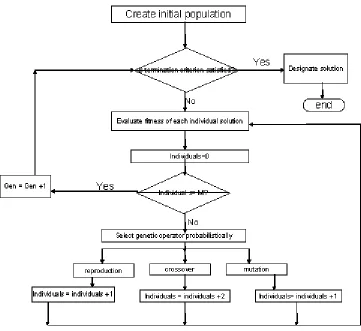
Figure 4.4 Genetic Algorithm Flowchart ... 86
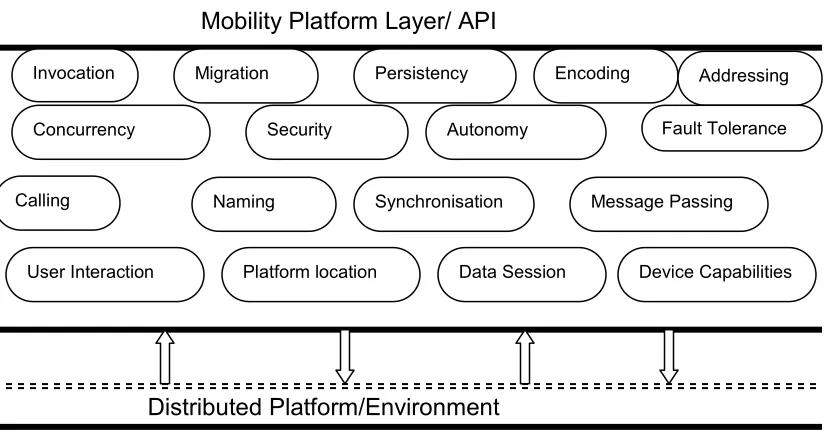
Figure 4.5 Mobility Design Layer Diagram ... 90
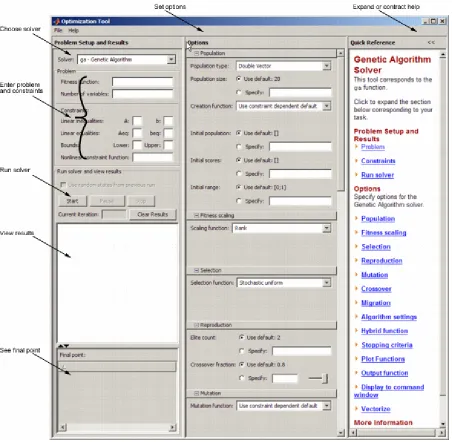
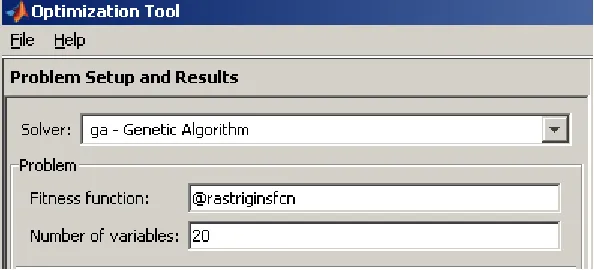
Figure 4.6 GA Optimization Tool ... 94
Figure 5.1 ‘@mobilityRMI’ function simulation Setup ... 97
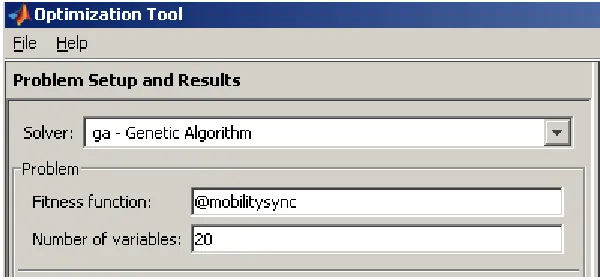
Figure 5.2 ‘@mobilitysync’ Problem Setup ... 97
Figure 5.3
‘@rastriginfcn’ Problem Setup ... 98
Figure 5.4 Population Options ... 98
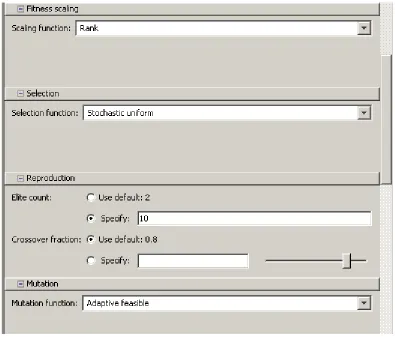
Figure 5.5 GA Tool GUI for Genetic Operator Options ... 99
Figure 5.8 ‘@mobilitysync’ function option ... 105
Figure 5.9 ’@mobilitysync’ function plot ... 106
Figure 5.10 ‘@mobilitysync’ function results ... 106
Figure 5.11 ‘@rastriginsfcn’ simulation results ... 107
Figure 5.12
‘@rastriginsfcn’ simulation function plot... 108
Figure 5.13
‘@mobilitysync’ plot function ... 110
Figure 5.14
‘@mobilityRMI’ plot function ... 110
CHAPTER 1
Introduction
With the emergence of mobile and wireless information communication technology, the
focus of research in distributed computing has turned to addressing challenges relevant
to mobile entities and their environments. One area of such research is mobile
distributed computing to support and address mobility issues in the wired and non-wired
remote environment. This shift in software paradigm has resulted in the birth of the
mobile agent which is a new paradigm for distributed application development. The
mobile agent paradigm has broken down one of the major barriers in distributed
computing which is based on the client/server model. In the client/server model a client
needs to establish and maintain a reliable connection with a server(s) in order to
communicate although this is less efficient for a highly distributed environment.
Different researchers have defined the mobile agent in different ways. Milojicic (1999)
defined the mobile agent as an autonomous software program that can migrate from one
platform to another on a heterogeneous network, performing tasks on behalf of the user.
Jansen (2002) defined the mobile agent as ‘travelling agents’, these programs will
shuttle their being, code and state, across different resources. Cubaleska and Schneider
(2002) defined the mobile agent as a computational process that implements the
autonomous communicating functionality of an application. The platform is therefore
made up of the computational environment and the agent is also made up of the code
and state information that is needed to perform some form of computation (Jansen and
In the context of this research, a mobile agent can be defined a as an autonomous agent
that exhibits mobility characteristics such as persistency, robustness, security
assessment for its codes and environment, mobility transparency and fault tolerance.
Autonomous agents and multi-agents have become very important in both industrial and
academic research. These paradigms draw on concepts from distributed computing,
object oriented systems, software engineering, artificial intelligence, economics, game
theory, sociology and organisational science. The concept of autonomous agents offers
solutions to complex software systems through analysing, designing and implementation
(Jennings et al., 1998).
Jennings (2000) identified Agent Oriented Systems Engineering (AOSE) as having the
potential to considerably improve the practices of software engineering. It is suggested
that concepts of AOSE offer alternative ways of providing software solutions to complex
systems. AOSE adopts a multi-agent approach to systems development in an attempt to
solve complex problems. A general definition of an agent can be defined based on its
general characteristics. Agents are characterised by autonomy, social-ability,
interactivity, proactive/goal oriented, reactive, persistent and a desirable property such
as mobility, adaptation and rationality (Brustoloni, 1991; Smith et al., 1994; Wooldridge
and Jennings, 1995; Franklin and Graesser, 1996; Williams, 2007a). Existing literature
about multi-agent systems indicates that autonomous agents are intelligent. In this thesis
both autonomous and intelligent agents will be termed agent. Many applications can be
created using mobile agents, which means that agents can be integrated to support
mobility in several applications. Common applications which utilises mobile agents
which usually carry active and real time content enroute to several remote locations.
Since the emergence of the agent paradigm, there has been an influx of different
approaches and methodologies to modelling agent systems. This indicates the level of
interest that agents have generated in both the commercial and academic research
environment. Several researchers have devoted considerable time and effort into
developing suitable frameworks and architectures for agents. However, there has been
little in the way of providing a systematic practical approach or methodology for
developing and addressing mobility issues in mobile agent based systems. There are
inherent complexities in using traditional approaches and/or methodologies for
engineering agent and mobile agent based systems. These complexities have led to
ad-hoc solutions being adopted whereby practical systems have been built from scratch.
The overall purpose of this research goal is therefore to develop a methodology using
the underlying principles of Genetic Algorithm (GA) approach to modelling mobility in
mobile agent based systems to support and overcome some of these shortcomings in
current engineering practice and also to improve upon previous attempts.
The rest of this chapter sets the background for the research work undertaken and
outlines the aims, objectives and contributions of this thesis. It introduces the
methodologies and approaches for developing mobile agent based systems and
identifies challenges and shortcomings that need to be overcome to develop the
1.1 Existing Approaches in Mobile Agent-based Systems
With the ever increasing proliferation of new technology owing to the widespread growth
in applications, the need to provide a strategy for the analysis, design and deployment of
these application systems has increasingly gained a sustained level of interest among
agent researchers(Omicini, 2001;Santandiyo et al., 2004;Self and DeLoach, 2004).
Attempts which have so far been made by the agent research community have focused
on the conceptual modelling of mobile agent-based applications. Methodologies that
attempt to address mobility issues are met with notational constraints and
implementation considerations. This is as a result of implementing the methodologies as
concepts thereby limiting the methodologies (Loukil et al., 2006). There is also lack of
consistency in definition for mobile agent in the current approaches that have been
developed to model the mobility for mobile agent (Chhetri et al., 2006). Many different
approaches to modelling mobility of mobile agent have focused attention on different
concepts relating their context specific definition (Belloni and Marcos, 2004). For
instance, most existing literature on methodologies and approaches associate the
mobility to the agent’s role or task which is assigned at any given time during the agent’s
lifecycle. The role assigned to the agent determines whether it will be stationary or
mobile in a multi-agent environment. In a multi-agent system or environment, mobility is
viewed as an attribute assigned to an agent or a role performed by the agent and is
usually specified in the itinerary of the agent. Meanwhile, the mobile agent as a
computational process has been shown to improve the latency and bandwidth usage in
distributed applications (Wooldridge et al., 2000). Given this background, it is necessary
1.2 Research Aim and Objectives
Aim
The aim of this research is to identify and develop a methodology to model the mobility
of mobile agent-based systems. Having this in mind, the objectives of this work are:
Objectives
To review methodologies and approaches and to identify deficiencies in current
practice.
To develop a methodology to model mobility in mobile agent-based systems.
The methodology will be divided into phases to facilitate the ease in the
development process of mobile agent-based systems. The principle of dividing
the methodology into phases is to facilitate the development of the software and
to make it more manageable.
To develop criteria for classifying mobility fitness based on mobility specific
requirements.
To develop mathematical models based on mobility requirements identified and
derived from the Delphi study and case studies.
To translate core mobility requirements modelled mathematically into mobility
fitness functions solvers for selecting mobility requirements for applications
development. The Rastrigin’s function will be used for benchmarking
performance of the mobility fitness functions.
To design a layered diagram indicating where and how mobility requirements fit
1.3 Research Process
As in indicated in Figure 1.1, the research stages covered are as follows; comprehensive
and ongoing literature review of multi-agent approaches, methodologies and mobility
modelling. Delphi study was employed to solicit the views of experts in software
development in the area of online banking and Virtual Learning Environments (VLE) and
online games which indicated emerging views and patterns in systems development.
Results from this study gave strong pointers to which case studies were appropriate for
the methodology development. Case studies were also used for the evaluation and
refinement of the methodology which is known as MaMM. The mobility requirements
which were derived from both the Delphi study and case studies were simulated and
evaluated.
Figure 1.1: Research Process Delphi Study
Mathematically Modelling of Mobility
Simulation, Testing and Evaluation
Mobile agent-based Mobility Methodology
Case Studies
1.4 Thesis Structure
In the rest of the thesis, a thorough and an ongoing literature review is presented. A high
level conceptual methodology is presented along with mobility design layer diagram and
mobility fitness as captured in the phases of the methodology.
Chapter 2 reviews the background theory of software agents and agent
mobility, the traditional approach to software development processes, the
various approaches and methodologies that are available are all described in
detail. The limitations of agents are identified against generic requirements
for modelling mobility in mobile agent-based systems, which provide the
motivation for undertaking this research.
Chapter 3 describes the research methodology employed in this research.
Delphi study and the case studies are discussed and the reasons why these
approaches are used. The GA tool used for simulating the results is
discussed.
Chapter 4 presents the key mobility requirements, concepts and mobile
agent-based methodology. Concepts and theories that underpin the
methodology are discussed. Genetic Algorithms, genetic operators and
fitness functions are introduced to the methodology at the analysis phase of
the development process.
Chapter 5 presents results from the modelling and simulation of the Mobile
agent-based Mobility Methodology (MAMM). In this chapter, Rastrigins’
function is used as a benchmark to measure the effectiveness and
computational complexity of this approach, an indication is provided that this
mobility methodology outperforms other state-of-the-art approaches and
methodologies and also explains the reasons why this methodology is better
in terms of the mobility and communication requirements for mobile
agent-based systems.
Chapter 6 brings together the conclusions of this research and focuses on the
contributions and limitations that the mobility methodology is able to provide.
This chapter also outlines future work that can be undertaken to extend the
CHAPTER 2
Literature Review
2.1 Introduction
In this chapter, a literature review of work in the area of multi-agents and mobile agents
is presented. In the definition of an agent, mobility is an attribute/characteristic of the
agent, this means that to provide a definition for a mobile agent, it has all the properties
of an agent including mobility/migration. Researches into multi-agent systems were
therefore investigated in order to gain an insight into and extent to which agent mobility
has been exploited. Limitations of the existing approaches, methodologies, agent
modelling languages, common software development methodologies are highlighted
thus serving as a motivation for establishing research objectives for this thesis.
2.2 Background Theory
Software agents and Multi-Agents have become very important in research and software
development in recent years. Characteristics of software agents include autonomy,
pro-activeness, social-ability, re-activeness and mobility. To understand the mobile agent in
the context of this research, a historical background of how this has evolved is explained
and explored. Software agent concepts have been drawn from distributed computing,
object-oriented systems, software engineering, artificial intelligence, economics,
sociology, programming and organisational science(Brustoloni, 1991;Smith et
2.3 Definitions of Software Agent
There are several definitions for software agents all of which share similar characteristics
(Brustoloni, 1991;Smith et al.,1994;Wooldridge and Jennings, 1995; Franklin and
Graesser, 1996;Williams, 2007a). In this thesis, software agent is used interchangeably
with autonomous agent. The following identifies various definitions provided by different
researchers who have been working in this field:
Brustoloni (1991) definition is ‘Autonomous agents are systems capable of autonomous,
purposeful action in the real world’. He compared his autonomous agents to other agent
definitions, and stressed that his agent must of necessity live and act ‘in the real world’.
He also insists that his agents must be reactive; that is, agents must be able to respond
to external, asynchronous stimuli in a timely fashion.
Wooldridge and Jennings (1995) not only provided a definition, but also add an
explanation for autonomy, sensing and acting, allowing for a broad, yet clear and
concise, range of environments or platforms. Wooldridge and Jennings (1995) defined
an agent as ‘... a hardware or (more usually) software-based computer system that
enjoys the following properties:
Autonomy: agents operate without the direct intervention of humans or
others, and have some kind of control over their actions and internal state;
Social-ability: agents interact with other agents (and possibly humans) via
Reactivity: agents perceive their environment, (which may be the physical
world, a user via a graphical user interface, a collection of other agents, the
INTERNET, or perhaps all of these combined), and respond in a timely
fashion to changes that occur in it;
Pro-activeness: agents do not simply act in response to their environment,
they are able to exhibit goal-directed behavior by taking the initiative’.
An agent can have several characteristics such as the ability to be autonomous, learn,
react, be mobile, flexible, and communicative regarding its state, have a continuous
running process and be goal oriented. All agents must have at least these characteristics
as defined by these requirement; autonomy, reactive, continuous running process and
lastly be goal oriented (Franklin and Graesser, 1996).
White (1996) also defined an agent as an entity that occupies a specific place. This
entity can move and occupy different places at different times. This independent entity is
made up of procedures and the state of an agent. A place is referred to as a network of
computers that offer services to any mobile agent that enters it.
These concepts put together offer solutions to complex software systems by analysing,
designing and implementing them (Jennings et al., 1998). Whenever an agent is
characterised by its ability to move or migrate autonomously in a network, then it is said
to be a mobile agent.
Numerous approaches have been developed to model a multi-agent system which is
stationary and mobile agents (Wooldridge et al., 2000). The design of an agent using
different development approaches has been a popular activity in recent years although
one of the issues that have been under-developed is mobility in mobile agent-based
systems. Most designers assume mobility is part of a role assigned to the agent and
concepts to model this mobility have not matured sufficiently enough to support the
entire lifecycle of a mobile agent-based system (Wooldridge et al., 2000).
An interesting question which is worth considering before the background theory is
examined is why the need for a systematic approach for modelling the mobility in mobile
agent-based systems. Mobility issues which surface when modelling mobile agents for
migration on a heterogeneous network include the integrity of data, access control,
privacy of data and authentication, trust where an agent agrees to meet on a mutually
agreed secure host, persistency where a mechanism that permits vital information about
the migration activities of the agents to be kept so that a system can resume activities
after it has crashed or failed. Since mobile agents are able to migrate from one node to
another on a heterogeneous network, performing tasks on behalf of its user without the
user’s intervention, there is a need to model these mobile agents in order to address the
mobility issues as identified. Agent paradigm provides a solution for modelling and
implementing complex software system by associating their actions and behaviours to
2.4 Existing Agent Modelling Languages
Modelling languages enable software developers to specify requirements of software
systems during development processes and also to see the world as made up of
software agents. The need to develop/extend existing modelling languages has become
important because of the evolving dynamic requirements of agents (Melomey,2007;
Melomey et al., 2007a). Most of these modelling languages have been used to express
knowledge with respect to goals, tasks and concepts of agents (Melomey et al., 2007a).
The modelling language is a form of communication for modelling purposes. A modelling
language guides a developer to clearly represent the internal and external structures and
elements that influence agent representation either textually or visually. A visual
language allows domain knowledge developers to assemble programs quickly from
existing components with its related operations. Visual language offers an added
advantage which is to match between the systems to be modelled to the visual abstract.
Alternatively, human skills present a higher level of knowledge using textual languages
and the associated tool support (Levesque, 1984: Kremer, 1998; Blackwell, 2001).
Unlike the object oriented systems development methodology, AOSE (Kang et al., 2004)
has not reached the maturity stage where issues such as modelling languages for
system application from the requirement phase through to the implementation of the
entire software processes can be established. There is the need for modelling
language(s) to model the interaction of agents and their behaviors from the requirement
phase through to implementation. Modelling languages are important in order to give a
when modelling agent systems are the representation of agents, validating and verifying
the agent systems and appropriate model representation.
Formal models with respect to mathematical and linguistic models are essential for
describing and reasoning about mobility of agents (Levesque, 1984: Kremer, 1998;
Blackwell, 2001). These issues have not, so far, been addressed and appear to have
been ignored. However, it is not only the agent’s behaviour that need to be modelled but
also stakeholders and users, and their interaction with the proposed system modelling
languages which should have the ability to capture both internal and external structures
of the agent. Even though it is portrayed that the agent has, or of necessity must have,
control over its internal structures, there is a need to show the transition from one phase
to the other. Control is left entirely to the agent at this point. Modelling for agent systems
requires a combination of visual and formal languages. A formal specification tends to
provide a solution for some weaknesses of the visual modelling language that may be
identified. A formal specification enables models to be defined using precise semantics.
Furthermore, to facilitate the transformation from one phase to other, for example from
the analysis phase to systems design phase, this requires specialist skill on the part of
the program developers and effective communication amongst developers. It is,
however, ineffective and inappropriate for communication and discussion with
stakeholders (Mauco et al., 2001; Dignum, 2003). Formalising visual languages for
conceptual modelling comes with its own set of challenges such as ambiguities of
meaning and expression of the graphical notations.
There are quite a number of modelling languages applied to mobile agents and agent
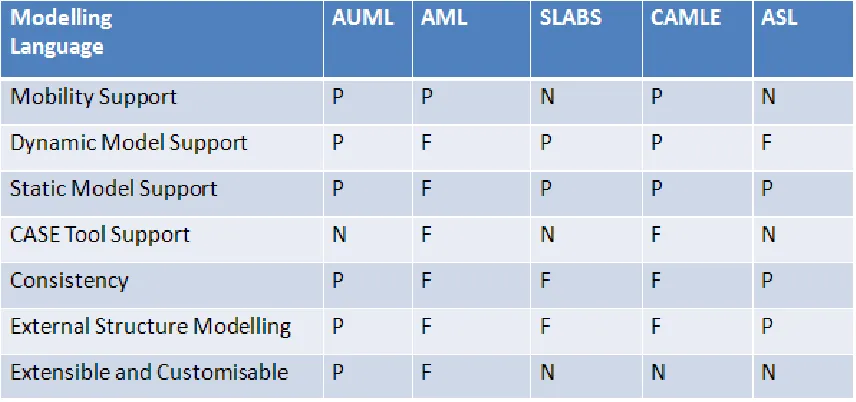
al., 2000). Table 2.1 provides a summary of existing modelling languages for Multi-agent
Systems (MAS) and attempts made in addressing mobility in agent systems Melomey
2007, Melomey et al., 2007). Criteria used for the comparative analysis in Table 2.1
were derived from distributed system mobility goals (Melomey et al., 2007a). Table 2.1
compares how well the existing modelling languages for MAS;
1. support and model mobility of agent systems
2. model static agent present in an environment and how the agents interact as
well as allocate resources upon request
3. provide dynamic modelling support for mobility. That is modeling the sequences
of interactions between agents and mobile agents from high level abstraction to
low level abstraction
4. preserve the consistency of mobile agents characteristic as it transforms itself
through the software process
5. support developers through CASE tool to analyse and design phases of the
software process in the systems lifecycle
6. model roles of agents and mobile agents, interfaces and interactions of agents
within and outside their environment (external structure moelling).
7. accommodate new and additional words, stereotypes and phrases for mobility
Table 2.1: Analysis of Existing Modelling Languages for MAS
Results from Table 2.1 indicate the strength and weakness of each modelling language
for Multi-agent Systems (MAS). The following sub section will present each language in
detail with their strengths and weaknesses.
2.4.1
Agent Unified Modelling Language
Agent Unified Modelling Language (AUML) is an extension to the unified modelling
language. There are no restrictions to the extensions one can make to UML. For
example, Mouratidis et al. (2003) provided extensions on deployment and activity
diagrams to model agent mobility in Tropos. Similarly, another approach in modelling
2.4.2
Agent Modelling Language
Agent Modelling Language (AML) has features for capturing multi-agent systems. AML
combines both visual and formal language for modelling and agent specification, and it
draws its concepts from multi-agent systems theory (Cervenka et al., 2004). AML also
specifies models and document systems by extending UML 2.0. AML according to
Cervenka et al. (2004) is a semi visual modelling language based on the concepts of
multi-agent systems and also specifies the models and documents a system. It reuses
concepts from UML and also makes use of mechanisms for specifying and extending
UML-based languages. It is also easy to incorporate into UML based CASE tools. The
language syntax, semantics and notations are defined at AML meta-model and notation
level (Trencansky and Cervenka, 2005). AML therefore provides constructs for modelling
applications which represent and exhibit characteristics in multi-agent system.
Strengths of Agent Modelling Language
The strength of AML is in capturing multi-agent systems using UML 2.0 to model agent
specification. AML has the ability to easily incorporate UML 2.0 to existing UML case
tools and to model static mobility and the agent execution environment.
Limitations of Agent Modelling Language
.AML does not model dynamic mobility. AML only models mobility through the design
phase. There were no construct or mobility supports to model mobility of the mobile
agent.
AML focus is on the development of multi-agent systems and not on mobile agent
systems (Cervenka and Trencansky, 2004; Cervenka and Trencansky, 2007). According
for modeling applications that embody and/or exhibits characteristics of multi-agent
systems’ and also ‘…. how entities can get to a particular node of the physical
infrastructure’. AML therefore provided constructs to model multi-agent systems only.
2.4.3
Specification Language for Agent-Based Systems
Specification Language for Agent-Based Systems (SLABS) provides the developer with
language facilities together with features for formal specification as well as the
verification of agent based systems (Zhu, 2001). Its focus is geared towards the
development of large scale complex systems. According to Zhu (2001) SLABS is based
on a generalised model of agents rather than a specific agent theory, is decomposable
and integrates new concepts such as caste and provides language facilities for AOSE.
2.4.4 Caste-Centric Agent Modelling Language and Environment
A Caste-Centric Agent Modelling Language and Environment (CAMLE) is a language
based on the notion of caste and draws on the concepts of SLABS (Shan and Zhu,
2004). Caste by definition is a set of agents with the same behaviour and structure.
SLABS combine both graphical modelling with formal specification language by
automation. CAMLE introduced visual models at the design stage of the development
process which are caste, collaboration and behavioural. Diagrams in the caste model
specify relationships including their movement from one caste to the other (Shan and
Zhu, 2004; Zhu and Shan, 2005). Collaboration models include diagrams organised in a
hierarchical order depicting the interaction of agents and their relationship in the system.
take and how it changes states depending on a given scenario. All these models come
with well defined associated notations.
2.4.5 Autonomy Specification Language
Autonomy Specification Language (ASL) is a language that allows for an exact
specification of activities which will be carried out by group of agents, deontic constraints
which place an imposition on these agents and the implications brought about by
executing activities on a specific constraint (Weib et al., 2006). ASL has its strength in
the operational modelling for specifying the autonomy of the agent. An ASL concept
defines roles through a set of activities as well as specifying the behaviours that it
conforms to or deviates from accepted norms of agent systems. In specifying the
behaviours, it enables behavioural prediction of agents through the roles they assume.
Furthermore, ASL enables software designers to specify the autonomy of agent as well
as allowing the detection and resolution of induced conflicts that occur during runtime.
Weib et al. (2005) argues that to be able to implement autonomy in a commercial,
scientific and industrial application, it can only be achieved through a systematic process
of rigorous modelling and verification. This will offer a high level of dependability on
systems that can be granted permission to act autonomously. Without this kind of
dependability, it will be difficult for agents to be used in the ecommerce, industrial and
scientific applications. ASL has an operational character which is expressive and also
Limitations of Autonomy Specification Language
ASL constructs for modelling and assigning individual agents for a role has not yet been
explicitly defined or expressed and no mention were made of how mobility issues will be
handled (Weib et al., 2006). Weib et al. (2006, p.1) introduced ASL as a formal language
‘…that allows for a precise specification of the activities to be carried out by a set of
agents, the deontic constraints imposed on these activities, and the implications of
activity execution on particular constraints (i.e. constraint dynamics)’.
2.4.6 Other Extensions to UML
There have been attempts to model mobility of the mobile agent by extending UML 2.0
which is known as Agent UML (AUML). The AUML extensions are activity and
deployment diagrams.
AUML was proposed as an extension to UML to be used as a tool to model
communication protocols and interactions in multi agent system (Bauer, 1999; Odell
2000, Bauer et al., 2001). AUML has been used by some agent researchers to model
the extension of activity and deployment diagrams. These extensions model the static
views of the mobile agents rather than the dynamic view. Other languages that have
been used to model mobility are Agent Specification Language (ASL) (Weib et al., 2005)
and Agent-based Modeling language (AML). AML provides the definition for
meta-classes that are used to model the structure and behaviour of mobility of entities
Baumeister et al. (2003) extended UML 2.0 to the AUML activity diagram in an
attempt to model mobility. The authors introduced new stereotypes such as
mobile, mobile location, clone and move to model mobility. Baumeister et al.
(2003) also introduced new concepts such as mobile objects, locations, nested
locations, actions and two notional variants. With the introduction of new
stereotypes and concepts, the authors attempted to answer the question; who is
performing an action and where the action is being performed. The authors used
swimlanes to represent objects to indicate who is performing an action and the
object’s mobility with respect to the object’s location.
Limitations of Other Extensions to UML
The AUML extensions made by Baumeister et al. (2003) provided a concept of nested
locations but this was not properly defined and illustrated. The mobile location
stereotype also lacked clarity. The AUML activity diagrams made by Baumeister et al.
(2003) were meant to model mobility, however, the sterotypes and concepts do not have
a direct bearing on agents nor mobile agents but rather objects and their mobility
relationships.
2.4.7 AUML Deployment Diagram
The deployment diagram in UML provides the physical resources in the system which
The proposal by Mouratidis et al. (2002) was to provide definition for origin, destination
and mobility path as an extension to deployment and activity diagram in order to model
mobility based on UML 2.0 meta-structures. The origin is the platform where the mobile
agent begins its execution and the destination is the platform where the mobile agent
finishes its execution. Mobility path is the path between the origin and destination.
Mouratidis et al. (2002) also provided notations for capturing mobility of agents in the
network.
2.4.8
AUML Activity Diagram Extensions
An activity diagram in UML demonstrates the dynamism of a system. This was achieved
by modelling the flow of activity. An activity is a representation of an operation in a class
of a system that results in changes in the system state.
The extension by Mouratidis et al. (2002) was based on UML 2.0 meta-structures for the
activity diagram which captures the sequence, concurrency and iteration of the mobile
agent. It provides answers to how it is able to get to its intended destination. The
extended activity diagram provides concepts that capture the sequence of movement,
mobility path details and decisions an agent makes regarding which path it should take
(Mouratidis et al., 2002). Diamond notations of UML were also used to capture situations
where a mobile agent has to decide which node to visit from the available options. These
knowledge statements are then converted to codes and added to the knowledge
Poggi et al. (2004) also extended the deployment and activity diagrams in an attempt to
model mobility. The authors introduced concepts and notations such as home, mobility
path, and visitor. They also introduced dotted lines to represent messages and dashed
lines towards platforms where a mobile agent may visit. The activity diagram of UML
was also extended by introducing concepts such as bounce failure and return path which
indicate two statements with two arguments (Poggi et al., 2004). AUML is also able to
model the sequence of activities, concurrency and iteration of the movement of the
mobile agent.
Limitations of AUML Activity Diagram Extensions
The AUML deployment and activity diagram introduces additional concepts and
notations which model static mobility and dynamic mobility for agent-oriented software
development (Mouratidis et al., 2002; Poggi et al., 2004). However, AUML activity and
deployment diagrams were not able to model the dynamic mobility of the agent from one
node to the other (Mouratidis et al., 2002; Poggi et al., 2004). The extensions were able
to model only the static mobility (Mouratidis et al., 2002; Poggi et al., 2004). The AUML
activity diagram did not demonstrate the continuous established link whereby a mobile
agent can make an independent decision (Mouratidis et al., 2002; Poggi et al., 2004).
Also there was no mention of any form of itinerary for the mobile agent which is central
to the development of an internal structure for the mobile agent. For example,
Kosiuczenko (2003, p.1) used sequence diagram to model mobility of an object and
noted that ‘There are several kinds of UML diagrams for convenient modelling of
behaviour, but these diagrams can hardly be used for modelling mobility’ and then
introduced extension to model interaction of mobile objects by proposing ‘… a new
concluded by pointing out ‘…that our interpretation of UML 2.0 Activity diagrams is
based on mobile calculus…’ Poggi et al.,(2004, p.14) also proposed ‘…an AUML
deployment diagram, that is an UML deployment diagram enhanced with agent based
concepts….’.
2.5 Existing Multi-Agent Approaches
The approaches available for modelling the mobility of mobile agents are predominantly
an extension to the Unified Modelling Language (UML) diagram. UML provides
unification and formalisation for methods of the numerous approaches to the object
oriented (OO) software systems lifecycle (Jacobson et al., 1998). UML is a specification
language for object modelling and a general purpose modelling language which includes
a standardised graphical notation used to create an abstract model of a system
(Jacobson et al., 1998). UML is made up of the following diagrams: use case, class,
sequence, collaboration, package and components diagrams.
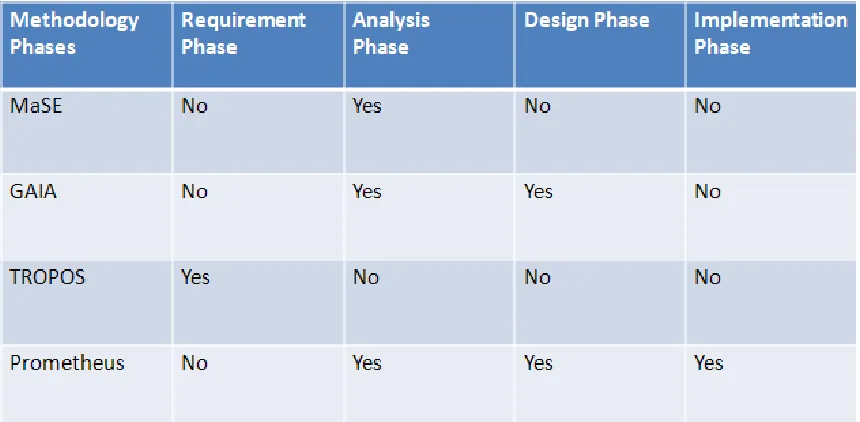
The following section provides an overview of MaSE, GAIA, TROPOS and Prometheus
methodologies. Table 2.2 also provides a summary of existing Multi-agent Systems
YES – Strength of the Methodology NO – Limitation of the Methodology
Table 2.2: Existing Multi-agent Systems Methodologies
2.5.1
Multi-agent Systems Engineering (MaSE) Methodology
DeLoach et al.(2001) developed a Multi-agent Systems Engineering (MaSE)
Methodology. The approach used was to add the move command in the MaSE analysis
models with its associated transformation requirements and was incorporated in the
design functionality (Self and DeLoach ,2004). Design models were further translated
into java based agents that operate within a mobile agent environment. DeLoach (2004)
also introduced dynamic agents with one of the following properties:
Cloning: this is the ability of an agent to create a replica or an instance of itself either at
the same location or at different locations DeLoach et al (2001).
Instantiation: an agent having the ability to create instances of another class other than
Mobility: the ability of an agent to migrate from one node to another.
In MaSE, only the analysis and design phases of mobile multi-agent systems were
considered based on the following assumptions:
1. The agent determines when to move even though another agent or the agent
platform may advise the agent’s when to move.
2. The actual movement of an agent is handled by the appropriate mobile agent’s
platform protocol which is similar to FIPA’s Simple Migration Protocol (SMP). The
protocol with a request is sent to its mobile agent platform which terminates the
agent. It is then sent to the destination platform where it is restarted. The platform
is responsible for the movement and the agent is responsible for restarting itself
in an appropriate state.
MaSE methodology has two phases and seven steps (DeLoach, 2004). The author’s
focus was on the output models of the analysis phase i.e. role models and concurrent
tasks. In other words, the analysis phase defines a set of roles to be played by the agent
as well as a set of tasks that also define the behaviour of specific roles and lastly a set of
coordination protocols between those roles.
According to DeLoach (2004) a move activity within the state of the concurrent task
diagram returns two values which are Boolean value and a reason value. The Boolean
variable always returns either a success or failure. The reason value provides a reason
why there is a failure or a success. For example if the reason value is failure, it provides
the reason why a move failed and also provide the agent with knowledge to recover
Basically all the tasks from the analysis phase are translated into various components in
the design phase. This phase is where the internal agent architecture is defined. . Apart
from requesting <move>, each component of the mobile agent is designed to respond to
a <move> that is by being able to save its internal state and to restart from its new
location(Self and DeLoach,2003). Every agent has a component that is created to
oversee the operations and provide interaction between the components. The
component for the mobile agents should have the capacity to transform itself in order to
handle shutdown and re-initialisation of all the agent components.
Agent class in MaSE methodology is a model for the different types of agents in a
system (DeLoach et al., 2001). It is similar to the object class as in the object oriented
paradigm. In this particular case an agent class is defined by the role it plays in the
systems and not by attributes and methods as in the object oriented paradigm. Tasks
that are associated with a role automatically become a component of the agent class
depending on its role in the system (Self and DeLoach, 2003). The agent component is
responsible for completing most of the agent mobility function and actually determines
whether the agent should move or not after a move request is made.
Limitations of MaSE
The MASE methodology focused on the output models of the analysis phase of systems
development and failed to identify why mobility is needed and its association with the
requirements of the systems. Wood and DeLoach (2000, p.208) stated that ‘…the
methodology does not consider dynamic systems where agents can be created,
2.5.2 GAIA Methodology
Generic Architecture for Information Availability (GAIA) is a methodology for agent
oriented analysis and design (Wooldridge et al., 2000; Zambonelli et al., 2003). It is a
general methodology that can be applied in many phases of multi-agent systems.
According to Wooldridge et al. (2000) it handles both micro and macro level aspects of
the entire system.
GAIA methodology has been identified as suitable in large scale commercial
applications by the authors Wooldridge et al. (2000) and Juan et al., (2002), Zambonelli
et al.(2003). According to Wooldridge et al. (2000) agents in a GAIA system should have
at least 100 agents in typical applications. In this methodology, the requirements of the
system are independent which allows the analyst to adopt a systematic approach from
the requirement phase to the analysis phase.
GAIA borrows its terminology and notations from object oriented analysis and design.
GAIA is intended to help software engineers in understanding and modelling of complex
systems. The formal notation for the expression of permission in GAIA methodology is
based on FUSION notation for operation of schemata.
Strengths of GAIA Methodology
GAIA provides an approach for developing collaborative multi-agent systems providing
the analysis and design phases of systems development (Wooldridge et al. 2000; Juan
et al., 2002; Zambonelli et al.2003).
Limitations of GAIA Methodology
GAIA lacks the concepts and graphical notations to support the modelling and reasoning
of the agents’ mobility and the social interaction in an environment or platform. Huang et
al. (2007) identified these limitations in the GAIA design phase for which attempts were
made to provide extensions to designing and developing agent-based software.
Wooldridge et al. (2000, p.24) also cited that ‘ There are several issues remaining for
future work……the representation of inter-agent cooperation protocols within Gaia is
currently somewhat impoverished….we will need to provide a much richer protocol
specification framework’.
2.5.3 TROPOS Approach
TROPOS is a requirements-driven methodology (Perini et al., 2002;Castro et al., 2002).
It was developed to provide support for all the analysis and design activities during the
entire software development process. TROPOS covers the early and late requirement
phases, as well as the architectural design and implementation phases. It makes use of
actors, goals and actor dependencies. Bresciani et al. (2004) defined TROPOS as a
software methodology which allows the exploitation of the flexibility that is provided by
agent oriented programming. Agent oriented programming encourages the need to
accommodate open architectures that changes continuously and dynamically i.e.
Strengths of TROPOS Approach
The greatest strength of Tropos approach lies in its identification of early and late
requirements for the system in the requirement phase of the systems development
process (Perini et al., 2002; Castro et al., 2002; Bresciani et al., 2004).
Limitations of TROPOS Approach
TROPOS was developed for multi-agent system applications and not for mobile agent
system application development according to Garzetti et al.(2002) and Bresciani et al.
(2004), hence it failed to provide the necessary processes and concepts to model
dynamic mobility for systems development. For instance , Castro et al., (2002, p.365)
explained that Tropos include the following ‘…methodology includes techniques for
generating an implementation from Tropos detailed design. Using agent-oriented
programming platform for implementation seems natural, given that the detailed design
is defined in terms of (system) actors, goals and inter-dependencies among them’. The
explanation did not include mobility of an agent.
2.5.4 Prometheus Methodology
Prometheus methodology is a more detailed process for specifying, designing, and the
implementation of intelligent agent systems (Padgham and Winikoff, 2002; Padgham et
al., 2005). The goal of this methodology is to have well defined deliverables which are
practical enough to be used by those who do not have an exclusive knowledge of agents
Padgham and Winikoff (2004) stated that Prometheus methodology is a software
methodology that is able to aid in the transition of agents from research laboratories to
industrial practice. It distinguishes itself from other methodologies by the following
features;
• provides detailed guidance on how each process should be carried out in
Prometheus.
• provides supports on the design of goal oriented agents and agents that have
plans
• gives coverage on activities from requirements specification of agents through to detailed designs
• facilitates support tools in the form of Prometheus Design Tools (PDT) which are
available on the internet.
• aimed at these two markets (education and industrial developers), this
methodology was successfully implemented and was given positive feedback
and comments which was used to improve the methodology.
Padgham and Winikoff (2004) stressed that the Prometheus methodology is a general
purpose approach and that for the detailed stages it is allowed to make certain
assumptions.
The Prometheus methodology is defined as concepts, notations for capturing design and
also a technique that provides guidance on how to carry out steps in the processes. The
method has three main phases which are: the systems specification; the architectural
Limitations of Prometheus Methodology
Padgham and Winikoff (2005) stressed that the Prometheus methodology is a general
purpose approach for developing and implementing intelligent systems and therefore
does not provide notations and concepts for modeling mobility. Fletcher (2007, p.342)
concluded that ‘the key conclusion is that this methodology is very suitable for
developing static interactions between agents…’
2.6 Mobile Agent
A mobile agent is an autonomous software program that can migrate from one platform
to another on a heterogeneous network performing task on behalf of the user (Milojicic,
1999). It is a computational process that implements the autonomous, communicating
functionality of an application and is able to migrate from one computer to another over a
network. The platform is made up of the computational environment and the agent is
also made up of the code and state information that is required to perform some form of
computation (Cubaleska and Schneider, 2002). In other words, the platform provides a
physical environment for the deployment of agents and agent can be said to have a set
of attributes called state which describe its characteristics. Agents communicate using
an Agent Communication Language (ACL).
Jansen (2002) defined a mobile agent as ‘traveling agents’, and these programs will
A mobile agent has been defined in several ways by a number of authors, some of which
are presented as follows:
• Mobile agents are software abstractions that can migrate across the network
representing users in the various tasks as defined by Milojicic et al (1999).
• Jansen and Karygiannis (1999) defined a mobile agent as a computational process that implements the autonomous, communicating functionality of an
application and is able to migrate from one computer to the other over a network.
This means that mobile agents are software agents that possess the ability to
move from one host to the other. A host platform may consist of more than one
agent. The platform is made up of the computational environment and the agent
is made up of the code and state information that is required to perform some
form of computation. The platform provides the physical environment for
deployment by the agent. The number of mobile agents required depends upon
the size and type of application.
A mobile agent is therefore characterised by its ability to migrate from one host to
another during execution. It is important to note, that its migration is not always from one
host to another host but from any place or location that will allow it to resume its
execution.
Mobile agents’ architectures have contributed to the solution of problems caused by
unreliable network connections, reduction of network loads and latency that is sending
consumption to a minimum. The ability of Mobile agents’ to sense their environment and
react dynamically to changes in the environment makes them very useful in the area of
intrusion detection. Mobile agents have been used in industrial and commercial
applications for example ecommerce, manufacturing, air traffic control, and real time
system and information management.
In this research the mobile agent is defined as autonomous agent that exhibits mobility
characteristics such as persistency, robustness, security assessment for its codes and
environment, mobility transparency and fault tolerance. Furthermore a mobile agent is
defined as a program that exhibits persistency, fault tolerance, synchronisation, remote
addressing and referencing, calling, invocation, execution, and remote code execution
and migration capabilities.
The mobile agent can be implemented using one of the following two technologies;
remote objects (Vinoski, 1997) or mobile code (Baldi et al. 1997). An example of remote
objects implementation is Aglets (Lange, 1997). An example of a mobile code
implementation is Telescript (White, 1996) and AgentTCL (Gray, 1995). There are other
Java-based mobile systems such as JADE (Java Agent Development Framework),
Aglets, Concordia and Voyager. JADE was developed by Telecom Italia and is
controlled via a remote graphical user interface and is available on the JADE website.
There are many benefits to be derived from the nature of distributed computing of agent
for which mobile agent plays a central role in performing task related to it. The benefits
Distributed knowledge expertise. There are times that knowledge required to
solve some type of problems may not reside in a central or single resource,
mobile agents are required to migrate to other environment or platforms in
search of solution where stationary agents are limited by resources.
The nature of mobile agents in a distributed system allows for system
modularity as opposed to a monolithic program. Large complex systems are
broken down to smaller adaptive and proactive modules.
Improve speed. Due to the parallelism which is a natural outcome of
modularity, agents and mobile agents have their own local memories and
processor.
Modularity in mobile agent-based systems allows for efficiency in that only a
part of resource are used for providing solution for a problem.
There is currently no methodology for modelling the mobility of mobile agent other than
using existing multi-agent approaches to capture mobility as a role in multi-agent
development depending on the ad-hoc tasks assigned to an agent when needed
(DeLoach et al., 2001; Wooldridge et al., 2000; Zambonelli et al., 2003; Perini et al.,
2002; Castro et al., 2002; Padgham and Winikoff, 2002; Padgham et al., 2005).
2.7 Traditional Software Development Process Models
A popular and acceptable definition for a software development methodology is the
collection of processes, procedures, standards and policies used by a software
requirement. Somerville (2001) describes many of such software process models in his
book on software engineering. There are several steps procedures and activities
involved in systems development which include the waterfall model, rapid prototyping
model, spiral model, the evolutionary model and incremental model. There are also agile
and rapid applications development models.
There are several benefits why iterative and incremental techniques were chosen as part
of MaMM. They are:
It helps to alleviate against earlier risk that might stem from architecture or
integration issues
Allows for the delivery of an independent module to be implemented and
executed incrementally
Allows progress to be monitored with the detection of problems being identified
and isolated.
2.7.1 Waterfall Model
This is a classic model introduced in the 1970’s by Winston W. Royce. The waterfall
model is usually modelled in cascade which begins with the establishment of a
specific requirement, followed by the design, implementation, system testing and
finally the release to customer (Royce, 1970). There is no iterative feature in the
waterfall model and it works well when the requirements are known and can be
2.7.2 Rapid Prototyping Model
This is commonly known as a ‘throwaway’ or ‘operational’ model. The development
process for the Rapid Prototyping Model (RPM) produces a program that performs
an important set of functions in the final software product (Isensee and Rudd, 1966).
The approach is mainly used to test the implementation method, a specific language
or user acceptance of a product. If successful, it serves as the basis for actual
product development after which the prototype is then thrown away or discarded
(Andrews, 1991). The difference between the waterfall model and the rapid
prototyping model is the speed in which the system is developed.
2.7.3 Evolutionary and Iterative Model
The evolutionary model offers a continuous feedback loop between each phase of
the software life cycle or systems development (Greer and Ruhe, 2004). The iterative
method is used incrementally thereby producing an executable release of the
software product. Developers and designers usually apply both the incremental and
iterative model effectively in procedural and object oriented programming.
2.7.4 Incremental Model
The purpose of this model is to develop a fully operational and quality system at
each development phase. The model is build and implemented in an incremental
fashion with various components of the system developed at different times and
Riesbeck, 2008). The advantage this method offers to the developer/designer is the
ability to break down complex tasks into smaller manageable components.
2.7.5 Spiral Model
The spiral model was developed by Boehm (1988) and was developed as an
enhancement to the waterfall model. The spiral model adds a preceding risk analysis
to each cascade of the waterfall model and spiral model is mainly used in large scale
software development. This model has proved to be successful where the goal of the
system is software reuse and specific software objectives can be incorporated.
2.8 Discussion
In developing applications where it is advantageous to apply agent and mobile agent
concepts as part of the solution, it is imperative to ensure a high level of cohesion of
agents, mobility concepts and models through the development process which means
that the coupling among these elements in the systems is kept to a minimum. Complex
mappings of agent concepts from the analysis phase to the design phase needs to be
kept at minimum. When this is achieved it enhances agent understandability, traceability
and maintainability. To represent real world agents, they may be assigned with roles of
which some may need to be mobile. Collectively, all these function represented influence
the behaviour of the agent making decisions about mobile agents in a specific system
regarding the migration to and from a platform, the following requirements must be taken
into consideration for a robust solution; reliability; security; performance; fault tolerance;
and transparency. To address some of these issues, concepts for mapping agent,
describing agent’s behaviour, dealing with communications, specifying and constraining
achieve transparency and other features must be considered. These issues are
fundamental in an open distributed system environment.
2.9 Summary
In this chapter, current literature about agent, modelling languages, agents approaches
and methodologies, common software development methodologies, mobile agent and
mobility concepts have been discussed. This has indicated some weaknesses and
limitations in the lack of a methodology to model mobility in mobile agent based systems.
These limitations make the existing approaches and methodologies inadequate for
modelling mobility in mobile agent based systems. In the light of such inadequacies,
chapter 3 will present the research methodology which justifies the choices and methods
CHAPTER 3
Research Methodology
3.1 Introduction
This study was conducted to gather information for the development of a methodology to
model and build mobile agent-based systems. The Delphi study was used to collect
expert views on emerging views and software practices in mobile agent software
development. The outcome of the Delphi study and the review of existing literature gave
a focus on the selection of the three case studies which exhibit the characteristic
requirements of mobile agents and the commonalities that exist among the requirements
for developing applications with a high level of migration in their specific environment.
Case studies have been used in research as a technique which is made up of thorough
investigation in an effort to provide in depth analysis of the processes being studied (Yin,
1994). Case studies can be used together with other data collection methods (Yin,
1994). The case studies were used to collect further details from experts and senior
analysts who contributed their individual perspective of how and what processes were
involved in the different types of online projects they were involved in when they were
interviewed. These provided greater insights into the dynamics of online systems
development. Mobility requirements identified were modelled and fitness functions were
formulated. The modelled mobility requirements were assigned fitness function for
evaluation and accuracy and simulated using a GA tool in the Matlab environment.
Simulation was suitable for this research because of the benefits it offers in solving
3.2 Delphi Technique/Study
The Delphi study was used in this thesis to solicit converging opinions (Dalkey and
Helmer, 1963; Linstone and Turoff, 1975; Hsu and Sanford 2007) such as emerging
trends, view from experts and software practices in mobile agent development as in
generating a consensus from an expert.
3.2.1 The Delphi Process (Number of Rounds)
Three rounds of questionnaires were used in this thesis. A number of early Delphi study
researchers accepted and agree that three rounds is enough to reach consensus from
experts in most cases (Cyphert and Grant, 1971; Brooks, 1979; Ludwig, 1997; Custer et
al.,1999).
3.2.2 Selection of Experts
According to existing literature, choosing appropriate experts for the study has a direct
correlation to the quality of outcome of the results and therefore the selection should be
dependent on expertise in the area of discipline (Judd, 1972; Taylor and Judd, 1989).
According to Delbecq et al., (1975), participants qualified to take part in a Delphi study
falls into three categories the decision makers in the top management who are likely to
make use of the results of the study; professional members and support team; and
finally, the respondents whose expertise are being sought after. The experts who
participated in this Delphi study were selected based on their expertise in projects they
have led and been involved in and their software practices for the types of project they
have led. The experts who participated were drawn from the National Health Trust
developers with over 15 years experience in leading diverse software projects in the
United States of America. Delphi studies have been used in a number of research areas
to identify and forecast on research issues. The number of respondent varies from 4 to
171 according to existing literature which is modifiable to suit research issues for which
expert views are being sought (Gustafson et al., 1973; Robertson et al., 2005). The size
of experts used for this study was s