287
PARALLEL MRI RECONSTRUCTION USING
SVD-AND-LAPLACIAN TRANSFORM BASED SPARSITY
REGULARIZATION
JING BIAN, YAMING WANG, HUAXIONG ZHANG, LITAO ZHU, MINGFENG JIANG School of Information Science and Technology, Zhejiang Sci-Tech University, Hangzhou 310018, China
ABSTRACT
The SENSE model with sparsity regularization acts as an unconstrained minimization problem to reconstruct the MRI, which obtain better reconstruction results than the traditional SENSE. To implement the sparsity constraints, discrete wavelet transform (DWT) and total variation (TV) are common exploited together to sparsify the MR image. In this paper, a novel sparsifying transform based on the combination of singular value decomposition (SVD) and Laplacian (LP) transform is proposed for parallel MR image reconstruction. The proposed algorithm adopts the SVD of the MR image as sparsifying transform instead of exploiting the wavelet domain sparsity of the image, and uses the LP-norm as an alternative to TV-norm in the sparsity regularization term. The performances of the proposed method are evaluated on two typical types of MR image (complex brain MR image and sparse angiogram MR image). Compared with the DWT-TV sparsifying transform, the proposed SVD-LP method can significantly achieve better reconstruction quality and considerably improve the computation efficiency.
Keywords: SENSE Reconstruction, Singular Value Decomposition, Laplacian Transforms, Sparsity Regularization
1. INTRODUCTION
MRI speed is usually limited by the large number of samples needed along the phase-encoding direction [1]. Parallel MR imaging (pMRI) exploits spatial sensitivity of an array of receiver coils to reduce the number of required Fourier encoding steps, thereby accelerating MR scanning. SENSitivity Encoding (SENSE) [2, 3] is one of the most optimal parallel image reconstruction techniques when the sensitivity maps of the coil array are known, one of the most widely used parallel MRI technique. All commercial scanners use modified versions of the basic SENSE method [4, 5], such as Philips (SENSE), Siemens (mSENSE), GE (ASSET) and Toshiba (SPEEDER).
One disadvantage of parallel MRI is that the image signal-to-noise ratio (SNR) is degraded because of the reduced data samples and the spatially correlated nature of multiple RF receivers [6]. Regularization is an attractive means of restoring stability in the reconstruction mechanism where prior information can also be incorporated effectively. Furthermore, the regularization is also presented for SENSE-based reconstruction in the complex wavelet domain [7]. The standard Tikhonov regularization was first introduced in pMRI literature by Liang in 2002 [8]. A common
issue with Tikhonov regularization is the smoothing effect on edges [9-10]. To overcome this issue, Total Variation (TV) based regularization has been incorporated into SENSE to improve reconstructed image quality [11-14]. A drawback of TV-based regularization methods is that nothing else except the local information is used, which may cause blocky effects with a loss of fine structures while preserving edges in reconstruction. Liang et al [15] investigate Nonlocal Total Variation (NLTV) for SENSE regularization to address the issue of blocky effect with TV-regularized SENSE. The NLTV-based regularization method not only inherits the edge-preserving advantage of TV-based regularization but also overcomes the blocky effect, which can preserve fine details and reduce noise and artifacts. Recently, a sparsifying transform based on the Laplacian (LP) transform has been introduced as an alternative to the TV-based sparsifying transform, which can compress MR image signals better than in the conventional TV framework [16].
With the advent of compressed sensing (CS) theory [17-18], sparsity-promoting regularization
criteria (e.g., ℓ1-based regularization) have gained
288 than conventional methods require, thus significantly reducing the scan time. Due to different ancillary information (channel sensitivities for pMRI and image sparseness for CS), the pMRI and CS can be combined together for further improvement of the reconstruction quality [22-23]. The SENSE model with sparsity regularization is reformulated as an unconstrained minimization problem to reconstruct the MRI, proving to be very successful in pMRI processing [24-25]. In the sparsity regularized reconstruction methods, the augmented Lagrangian (AL) framework is developed for solving regularized SENSE-reconstruction optimization problems [24], and a fast MR image reconstruction algorithm is
proposed for SENSE with arbitrary k-space
trajectories by Ye et al [25]. In the sparsity regularization term, how to sparsify the MR images plays a key role. The most commonly used sparsity bases are predefined transforms, such as the discrete cosine transform (DCT), and the discrete wavelet transform (DWT). In the recent works [24-25], the ℓ1 norm of wavelet coefficients by using DWT is introduced as the sparsity regularization term in the SENSE reconstruction. Recently, Hong et al[26] presents singular value decomposition(SVD) as the data-adaptive sparsity basis in Compressed sensing MRI (CS-MRI), which can significantly accelerate the reconstruction process and achieve better image quality than other commonly used sparsifying transforms(DCT and DWT). And Majumdar et al propose to exploit the nuclear norm regularization to implement the Sparse-MRI[27] and SENSE[28] reconstruction, where the nuclear norm is defined as the sum of singular values of the MR image, and the results show that the proposed reconstruction method is considerably faster than the Sparse-SENSE. It can be found that the SVD-based sparsifying transform method has better reconstruction quality and faster reconstruction speed than the DWT-based method. The main purpose of this paper is to develop a combined saprsifying transform for SENSE reconstruction, which integrates the features of SVD and Laplacian transform.
The rest of the article is organized as follows. Section 2 formulates the sparsity-based regularization algorithm for SENSE reconstruction. And then the focus is shifted to the construction of the saprsifying transform by using SVD and Laplacian transform. Section 3 describes the experimental setup and the reconstruction algorithm. Section 4 shows the experiment results. In section 5, the features about the proposed method are
discussed. Finally, in section 6, the conclusions of the work are presented.
2. THEORY
2.1 Formulation of Standard SENSE
SENSE is one of the standard reconstruction methods for parallel imaging, and the acquisition process of SENSE can be formulated as a linear operation in the following equation:
Au= f (1)
where f is the vector formed from k-space data
acquired in all channels and u is the unknown vector describing the desired full field-of-view (FOV) image to be reconstructed. The system
matrix A consists of the product of the Fourier
encoding and coil sensitivity. The sensitivity
encoding matrix A is formulated as follows:
2 ( )
{ , },
( , )
x y
j k x k y
l m n l
A
=
e
− π +s x y
(2)where kx and ky indicate the k-space sampling
position for the mth element, (x, y) denotes the pixel
for the nth element in u, and sl is the sensitivity
profile of the l-th receiver channel.
2.2 Laplacian Transform based Sparse-SENSE In Sparse-MRI reconstruction[17], the sparsifying transform is often implemented by using the combination of Total-Variation(TV) with other transforms(such as DWT), which can be considered as requiring the image to be sparse by both the specific transform and finite- differences at the same time. The reconstruction of Sparse-MRI can be formulated by solving the following constrained optimization problem.
1 2
min
( )
( )
. .
u
u u
u
TV u
s t
F u
f
ψ
α
ε
+
−
≤
(3)Here, ψ denotes the transforming from pixel
representation into a sparse representation, Fu is
the undersampled Fourier transform, u is the
reconstructed image, and fu is the measured k
-space data from the scanner. Here
α
trades ψsparsity with TV sparsity, and
ε
controls thefidelity of the reconstruction to the measured data. The Sparse-SENSE reconstructs image from the multi-channel data using the same nonlinear convex program as that of Sparse-MRI, except that the
Fourier encoding matrix Fu is replaced by the
sensitivity encoding matrix A. Therefore, the
289
1
2
min ( ) ( )
. .
u u TV u
s t Au f
ψ
α
ε
+
− ≤ (4)
where
2 2
; ;
1, , ;
, 1 , ; ( ) ( ) ( ) , , 0 0
h ij v ij
ij
i j i j h ij
i j i j v ij
TV u D u D u
u u i n
D u
i n
u u j n
D u j n + + = + − < = = − < = =
∑
(5)In this paper, the Laplicain transform, based on the second-order difference, is introduced as an alternative to the TV sparsity. Then the reconstruction process of the Sparse-SENSE can be reformulated as:
1
2
min ( ) ( )
. .
u u LP u
s t Au f
ψ
α
ε
+
− ≤ (6)
where
2 2
; ;
1, 1, ,
;
, 1 , 1 ,
;
( )
(
)
(
)
2
1<
0
1,
2
1<
0
1,
h ij v ij
ij
i j i j i j
h ij
i j i j i j
v ij
LP u
L u
L u
u
u
u
i
n
L u
i
n
u
u
u
j
n
L u
j
n
+ −
+ −
=
+
+
−
<
=
=
+
−
<
=
=
∑
(7)
The constrained minimization in Eq. (6) is usually achieved by solving the equivalent unconstrained regularization problem
2 1
min ( )
( )
u
Au
−
f
+
β ψ
u
+
γ
LP u
(8)where β >0 and γ >0 are weights for the 1
norm and LP norm respectively.
2.3 Constructing the sparsifying transform ψ In the Sparse-SENSE reconstruction, the sparsifying transform plays an important role in improving the MR imaging quality. The commonly used sparsity base in the sparse-SENSE is the DWT [24-25]. And Hong et al proposes that the SVD-based sparsifying transform can sparsify a broad range of MR images and perform effective image reconstruction. In this work, we aim to construct the SVD-based sparsifying transform for Sparse-SENSE reconstruction.
The image ISENSE reconstructed by standard
SENSE method is used as the initial MR imaging.
The SVD is performed on theISENSE, then we can
get the transforming matrices U andV :
'
SENSE SENSE
I
= Σ
U
V
(9)where U and V are two unitary matrices,
andΣSENSE, is a diagonal matrix with nonnegative diagonal elements in decreasing order, a very
sparse representation ofISENSE. With UandV , the
SVD-based sparsifying transform and its inverse can be derived as follows:
1
( )
'
( )
'
u
U uV
x
UxV
ψ
ψ
−=
=
(10)Based on the Esq. (8) and (10), a SVD-based sparsity regularization can reconstruct MR image
better than theISENSE. To obtain a more sparse and
robust representation of the reconstructed image,
the unitary matrices U and V can be updated
iteratively by decomposing the reconstructed image of Eq. (8). After several iterations, the reconstructed MR image can obtain the stable case.
3. MATERIALS AND METHODS
One brain dataset is acquired on a 3 Tesla whole-body GE scanner (GE Healthcare, Waukesha, WI) from a healthy male volunteer using an eight-channel head array with fast spoiled gradient-echo sequence. The acquisition parameters are TR 300
ms , TE 10 ms, FOV 22×22 cm2, and matrix
256×256×8[29]. The channel sensitivity maps are
estimated from 32 central k-space phase-encoding
lines and processed using an electromagnetic reverse method [30]. Multichannel images are then created by multiplying the object images with the simulated sensitivity maps. To investigate the effect of noise on the proposed method, 30dB complex Gaussian noise are added to generate the
multichannel k-space data. To simulate
undersampled datasets, k-space datas are decimated
using reduction factors of R=2 and R=4 respectively. Here, two different object images are used to test the reconstruction performance, one is a brain MR image as in the Figure 1(a), the other is an angiogram MR image shown in Figure 1(b).
290 (b)
Figure1. Two Objective MR Images. (A) A Brain MR Image, Left: Reference Image, Right: Zoomed-In Of The
Box In The Reference Image; (B) An Angiogram MR Image, Left: Reference Image, Right: Zoomed-In Of The
Box In The Reference Image.
The proposed algorithm is implemented by modifying the non-linear conjugate gradient (NLCG) used in the Sparse-MRI [19, 26], where the total variation (TV) regularization is replaced by the Laplician filters. In this paper, the Symmlet 4 was used as the wavelet basis in the DWT-based reconstruction methods. All reconstruction methods were implemented in the Matlab programming environment (Version2008a, Math Works, Natick, MA), and the experiments are performed on a ThinkPad laptop with 2.67GHz Intel Core 2Duo processor, 4G of memory and Windows7 operating system.
To quantitatively evaluate the efficiency and accuracy of the proposed sparsifying transform method, three different indexes are introduced: (i) the peak SNR (PSNR) for quality of the reconstructed image; (ii) Relative Error (RE) to the
reference image u0; (iii) the image reconstruction
time. Furthermore, the reconstructed images and their zoomed-in regions are also compared visually for R=4 and SNR=30dB. The PSNR and RE are calculated as follows:
10
1 10 log PSNR
MSE
= (11)
where MSE is the mean square error between the reconstructed and the reference images.
0 2 0 2
u
u
RE
u
−
=
(12)where u is the reconstructed image and u0 is the
reference one.
4. RESULTS
All images are labeled by the method used on the top-left corner, where “SENSE” denotes the conventional SENSE method, “SVD-TV” indicates the combination of SVD sparsifying transform and TV norm, “SVD-LP” the combination of SVD and LP norm, “DWT-TV” the combination of DWT and TV norm, “DWT-LP” the combination of
DWT and LP norm, “IDT-TV” the combination of identity transform (IDT) and TV norm, and “IDT-LP” the combination of IDT and LP norm.
4.1 The Brain Imaging Experiment
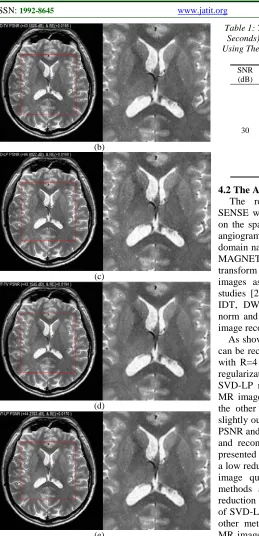
The brain image is obtained by scanning a healthy male volunteer’s brain with a Bruker 2T whole-body MRI system, and the MR brain image is a complex form with more contrast in pixel domain. Figure 2 shows the reconstructed MR images of SENSE, SVD-TV, SVD-LP, DWT-TV and DWT-LP for R=4 and SNR=30. For each sub-figure, the left column is the reconstructed MR image with PSNR, and the right column is the zoomed-in regions with RE. Visually one can find that the reconstructed MR images by Sparse-SENSE methods (SVD-TV, SVD-LP, DWT-TV and DWT-LP) outperform that by conventional SENSE method. And among the four Sparsifying methods, the SVD-LP method can reconstruct the MR image with the highest PSNR and the lowest RE. Table 1 shows the PSNRs, REs and reconstruction time (in seconds) by these methods with different reduction factors (R=2, 4) and adding 30dB measurement noise. As is expected, the reconstructed MR image has higher PSNR and smaller RE as the SNR increases and or the reduction factor decreases. In these sparsifying transform, the SVD-based sparsity methods considerably outperforms the DWT-based methods on computing efficiency, and the computing time of the SVD-based methods is about one forth of the DWT-based methods. Moreover, SVD-based method can improve the reconstructed image quality with slightly higher PSNR and smaller RE than DWT-based method. Compared with TV-norm based method, the LP-norm based methods can improve the MR image reconstruction with higher PSNR and lower RE. However, the LP-norm based methods take slight longer time than the TV-norm based methods.
291 (b)
(c)
(d)
(e)
Figure 2. The Reconstructed Brain MR Images (The Left Column) And Zoomed-In Regions (The Right Column) By Using Different Methods With Reduction Factor R=4
And SNR=30db. (A) Conventional SENSE Method (B)SVD-TV Method (C) SVD-LP Method (D) DWT-TV
Method (E) DWT-LP Method. The PSNR And RE Of Each Method Are Shown Of The Top-Left Corner Of
[image:5.612.95.354.71.607.2]Each Sub-Image.
Table 1: The Psnrs, Res And Reconstruction TIME (In Seconds) Of The Reconstructed Brain MR Images By Using These Methods With Different Reduction Factors
(R=2, 4) And SNR=30.
SNR (dB) R
Sparsity
Method PSNR REs (%)
Time (s)
30 2
SENSE 58.75 0.32 6.14 SVD-TV 60.46 0.26 11.30 SVD-LP 61.23 0.21 11.48 DWT-TV 59.97 0.28 45.05 DWT-LP 60.56 0.24 45.53
4
SNESE 40.12 2.75 5.74 SVD-TV 43.50 1.86 9.98 SVD-LP 44.80 1.60 10.60 DWT-TV 43.15 1.94 44.71 DWT-LP 44.28 1.70 44.99 4.2 The Angiogram Imaging Experiment
The reconstruction performance of Sparse-SENSE with SVD-LP sparsity bases is also tested on the sparse MR image, such as angiogram. The angiogram MR image itself is sparse in the pixel domain naturally, and it is obtained using a Simens MAGNETOM Avanto 1.5T system. The identity transform (IDT) is commonly used for the sparse images as the sparsity basis in many previous studies [22, 26]. For comparing the performance, IDT, DWT and SVD bases combined with TV norm and LP norm are applied in the sparse MR image reconstruction.
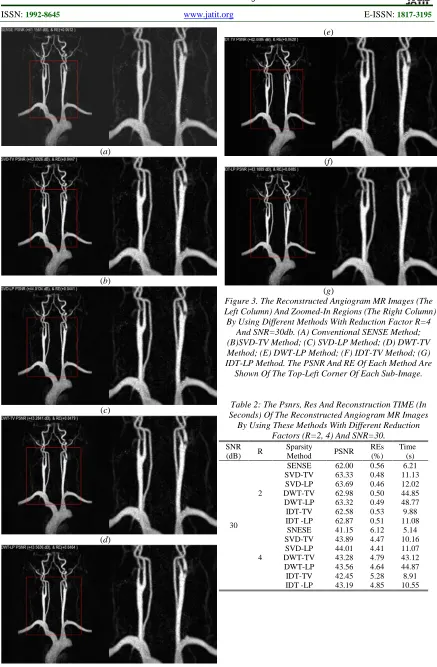
As shown in Figure 3, the angiogram MR image
can be reconstructed from the reduced k-space data
292 (a)
(b)
(c)
(d)
(e)
(f)
(g)
Figure 3. The Reconstructed Angiogram MR Images (The Left Column) And Zoomed-In Regions (The Right Column)
[image:6.612.89.526.67.734.2]By Using Different Methods With Reduction Factor R=4 And SNR=30db. (A) Conventional SENSE Method; (B)SVD-TV Method; (C) SVD-LP Method; (D) DWT-TV Method; (E) DWT-LP Method; (F) IDT-TV Method; (G) IDT-LP Method. The PSNR And RE Of Each Method Are Shown Of The Top-Left Corner Of Each Sub-Image.
Table 2: The Psnrs, Res And Reconstruction TIME (In Seconds) Of The Reconstructed Angiogram MR Images
By Using These Methods With Different Reduction Factors (R=2, 4) And SNR=30.
SNR (dB) R
Sparsity
Method PSNR REs (%)
Time (s)
30 2
SENSE 62.00 0.56 6.21 SVD-TV 63.33 0.48 11.13 SVD-LP 63.69 0.46 12.02 DWT-TV 62.98 0.50 44.85 DWT-LP 63.32 0.49 48.77 IDT-TV 62.58 0.53 9.88 IDT -LP 62.87 0.51 11.08
4
293
5. DISCUSSION
In this paper, the combination of SVD and Laplacian transform sparsity regularization is proposed to implement the parallel MRI. And different sparsifying strategies are provided to compare with the proposed SVD-LP method in reconstructing two different MR images on reconstruction properties and computational efficiency.
Sparse-SENSE is a sparsity regularized SENSE reconstruction, which can act as the SENSE model with sparsity constraints. The sparser the MR image is in the sparsifying transform results, the more accurate the sparsity constraint is, and thus the better the reconstructed MR image is. For sparsity, the SVD-based transform generates more sparse coefficients and exhibits better sparsity than the DWT-based transform. In addition, the Laplacian transform, a sparisfying transform based on the second-order difference, transforms the MR image to a sparser representation than TV do. That is, the second-order difference of the MR image is much closer to zero than the first-order difference, i.e. TV. The proposed SVD-LP method combines the SVD with Laplacian transform to implement the sparsity, which can generate a sparser representation of MR image than the DWT-TV method, the sparsifying method used in the Sparse-SENSE. Table 1, 2 and Figure 2, 3 demonstrate that the SVD-based method outperforms other transfer domain methods (DWT-based, IDT-based) in reconstructing the MR images (including the complex brain MR image and the sparse angiogram MR image), and LP-norm based methods can reconstruct the MR images better than the conventional TV-norm based method. Among all those sparsity methods, the reconstruction of the proposed SVD-LP is the best one with the highest PSNR and the lowest RE.
The computational efficiency of the parallel MR image reconstruction with different sparsity constraints were demonstrated with two typical types of MR image. The reconstruction based on the SVD sparsity strategy is significantly faster than that based on the DWT-based sparse method. And the computation time of the LP-norm based reconstruction methods is slight longer than that of the TV-norm based methods, because it takes some more time to calculate the LP-norm than the TV-norm of the MR image.
In this work, the proposed SVD-LP sparsity constraints is only used in the Cartesian trajectory,
but it can apply to wide use in the arbitrary k-space
trajectories. In addition, the non-linear conjugate
gradient (NLCG) is exploited to implement the reconstruction of parallel MR image. A fast reconstruction method has recently been proposed for parallel MR image [25], which is a combination of variable splitting, the quadratic penalty technique and an optimal gradient method. In the further work, the idea can be integrated with our proposed method for parallel MR imaging reconstruction
with arbitrary k-space trajectories. What’s more, the
SVD-LP based sparsifying transform method is also available in the compress sensing based MR image reconstruction, which generates sparser representation of the MR image than the conventional sparsity method.
6. CONCLUSION
In this paper, a novel sparsifying transform based on the combination of SVD and Laplacian transform is proposed for parallel MR image reconstruction. The proposed algorithm adopts the SVD instead of the wavelet domain sparsity of the MR image as sparsifying transform in the SENSE reconstruction, and uses the LP-norm as an alternative to TV-norm in the Sparse-SENSE method. The computational efficiency and reconstruction quality of the proposed method are evaluated on two typical types of MR image. The experimental results indicate that, compared with the conventional DWT-TV sparisfying transform strategy, the proposed method is capable of improving the computation efficiency and achieving more accurate reconstruction.
ACKNOWLEDGEMENTS
This work is supported in part by the National Natural Science Foundation of China (30900322, 61070063 and 61272311).
REFERENCES:
[1] Deshmane A, Gulani V, Griswold MA, and
Seiberlich N, “Parallel MR Imaging”, J. Magn.
Reson. Imaging, Vol. 36, 2012, pp. 55-72.
[2] K. P. Pruessmann, M. Weiger, M. B.
Scheidegger, and P. Boesiger, “SENSE:
Sensitivity Encoding for Fast MRI”, Magn
Reson Med, Vol. 42, 1999, pp. 952–962.
[3] K. P Pruessmann, M. Weiger, P. B¨ornert, and
P. Boesiger, “Advances in Sensitivity
Encoding with Arbitrary k-space Trajectories”,
294
[4] M. Blaimer, F. Breuer, M. Mueller, R. M.
Heidemann, M. A. Griswold, P. M. Jakob, “SMASH, SENSE, PILS, GRAPPA: how to
choose the optimal method”, Rev Top Magn
Reson Imaging, Vol.15, No. 4, 2004, pp. 223– 36.
[5] D. J. Larkman and R. G. Nunes, “Parallel
magnetic resonance imaging”, Phys. Med. Biol.,
Vol. 52, 2007, pp. R15–R55.
[6] F. H. Lin, T. Y. Huang, N. K. Chen, F. N.
Wang, S. M. Stufflebeam, J. W. Belliveau, L. L. Wald, and K. K. Kwong, “Functional MRI using regularized parallel imaging acquisition”, Magn Reson Med, Vol. 54, No. 2, 2005, pp. 343–353.
[7] L. Chaari, J. C. Pesquet, A. Benazza-Benyahia,
P. Ciuciu, “A wavelet-based regularized reconstruction algorithm for SENSE parallel
MRI with applications to neuroimaging”, Med
Image Anal, Vol. 15, 2011, pp. 185–201.
[8] Z. Liang, R. Bamme, J. Ji, N. J. Pelc, and G. H.
Glover, “Making better SENSE: wavelet denoising, Tikhonov regularization, and total
least squares”, In Proc. of the International
Society of Magnetic Resonance in Medicine, 2002, PP. 2388.
[9] F. H. Lin, K. K. Kwong, J. W. Belliveau, and L.
L. Wald, “Parallel imaging reconstruction
using automatic regularization”, Magn Reson
Med, Vol. 51, No. 3, 2004, pp. 559–567.
[10] H. Omer, R. Dickinson, “A graphical
generalized implementation of SENSE
reconstruction using Matlab”, Concepts in
Magn Reson Part A, Vol. 36A, No. 3, 2010, pp.178-186.
[11] K. Block, M. Uecker, and J. Frahm,
“Undersampled radial MRI with multiple coils: Iterative image reconstruction using a total
variation constraint”, Magn Reson Med, Vol.
57, 2007, pp.1086–1098.
[12] L. Ying, B. Liu, M. Steckner, G. Wu, M. Wu,
and S. J. Li, “A statistical approach to sense
regularization with arbitrary k-space
trajectories”, Magn Reson Med, Vol. 60, 2008,
pp. 414–421.
[13] B. Liu, K. King, M. Steckner, J. Xie, J. Sheng,
and L. Ying, “Regularized sensitivity encoding (SENSE) reconstruction using Bregman
iterations”, Magn Reson Med, Vol.61, No. 1,
2009, pp.145–152.
[14] S. L. Keeling, C. Clason, M. Hintermüller, F.
Knoll, A. Laurain, G. Winckel, “An image space approach to Cartesian based parallel MR imaging with total variation regularization”,
Med Image Anal, Vol.16, No. 1, 2012, pp.189-200.
[15] D. Liang, H. Wang, Y. Chang, and L. Ying,
“Sensitivity encoding reconstruction with
nonlocal total variation regularization”, Magn
Reson Med, Vol.65, No.5, 2011, pp. 1384– 1392.
[16] Y. Dong, J. Ji, “Compressive sensing MRI
with laplacian sparsifying transform”, Biomedical Imaging: From Nano to Macro, 2011, pp. 81-84.
[17] E. J. Candès, J. Romberg, T. Tao, “Robust
uncertainty principles: Exact signal reconstruction from highly incomplete
frequency information”, IEEE Trans. on Info.
Theory, Vol.52, No.2, 2006, pp. 489-509.
[18] D. L. Donoho, “Compressed sensing”, IEEE
Trans. on Info. Theory, Vol.5, No.4, 2006, pp.1289-1306.
[19] M. Lustig, D. L. Donoho, and J. M. Pauly,
“Sparse MRI: The Application of Compressed
Sensing for Rapid MR Imaging”, Magn Reson
Med, vo.58, 2007, pp.1182–1195.
[20] L. B. Montefusco, D. Lazzaro, S. Papi, and C.
Guerrini, “A Fast Compressed Sensing Approach to 3D MR Image Reconstruction”, IEEE Trans. Med. Imaging, Vol.30, No. 5, 2011, pp. 1064-1075.
[21] J. Huang, S. Zhang, D. Metaxas, “Efficient MR
image reconstruction for compressed MR
imaging”, Med Image Anal, Vol.15, No.5,
2011, pp.670–679.
[22] D. Liang, B. Liu, J. Wang, and L. Ying,
“Accelerating SENSE Using Compressed
Sensing”, Magn Reson Med, Vol. 62, 2009, pp.
1574–1584.
[23] R. Otazo, D. Kim, L. Axel, and D. K.
Sodickson, “Combination of compressed
sensing and parallel imaging for highly accelerated first-pass cardiac perfusion MRI”, Magn Reson Med, Vol. 64, 2010, pp. 767-776.
[24] S. Ramani, J. A. Fessler, “Parallel MR Image
Reconstruction Using Augmented Lagrangian
Methods”, IEEE Trans Med Imaging, Vol. 30,
No. 3, 2011, pp. 694-706.
[25] X. Ye, Y. Chen, W. Lin, and F. Huang, “Fast
MR Image Reconstruction for Partially Parallel
Imaging With Arbitrary k-space Trajectories”,
IEEE Trans Med Imaging, Vol.30, No. 3, 201, pp.575-5841.
[26] M. Hong, Y. Yu, H. Wang, F. Liu and S.
Crozier, “Compressed sensing MRI with singular value decomposition-based sparsity
basis”, Phys Med Biol, Vol.56, 2011,
295
[27] A. Majumdar, R. K. Ward, “Exploiting rank
deficiency and transform domain sparsity for
MR image reconstruction”, Magn Reson
Imaging, Vol.30, No. 1, 2012, pp. 9-18.
[28] A. Majumdar, R. K. Ward, “Nuclear
norm-regularized SENSE reconstruction”, Magn
Reson Imaging, Vol.30, No. 2, 2012, pp.213-221.
[29] J. Ji, J. B. Son, S. D. Rane, “PULSAR: A
MATLAB Toolbox for Parallel Magnetic Resonance Imaging Using Array Coils and
Multiple Channel Receivers”, Concepts in
Magn Reson Part B, Vol.31B, No. 1, 2007, pp.24-36.
[30] J. Jin, F. Liu, E. Weber, Y. Li, S. Crozier, “An
electromagnetic reverse method of coil sensitivity mapping for parallel
MRI-Theoretical framework”, Journal of Magnetic