1537
HYBRID ALGORITHM IN IMAGE COMPRESSION
BETWEEN SPATIAL DOMAIN AND FREQUENCY DOMAIN
BASED ON DISCRETE COSINE TRANSFORM
ZYAD THALJI
Department of Management Information Systems, College of Applied Studies and Community Service, Imam Abdurrahman Bin Faisal University, Al-Dammam, Saudi Arabia.
Email: [email protected]
ABSTRACT
Image compression comprises a method for decreasing image size. In the image compression process, the redundancy in a matrix code is removed. Compression allows data to be efficiently transmitted or stored. This paper demonstrates the integration of the spatial domain and frequency domain in resizing image dimensions according to the pixel location. For image coding, the Discrete Cosine Transform (DCT) was employed in the frequency domain. Then, for coding and compressing the image, Huffman coding was used. During the first level, quantization was employed. Before using the Huffman decoding, Dequantization was used for image decoding. This prepares the matrix for the use of the Inverse Discrete Cosine Transform (IDCT), in the frequency domain for image decoding. The new algorithm is efficient, producing a high rate in image compression.
Keyword: Image Compression, Discrete Cosine Transform, quantization, Spatial Domain, Frequency Domain
1. .INTRODUCTION
Files are compressed in order to produce image data with a new code, in a compact form. This minimizes the number of bits in representation. However, the use of lossy compression may result in a distorted image. A large amount of data in raster images is why using refutable image compression is important. For instance, a one-second video clip comprises 25 images in a Pal system, while a one-second color film consumes roughly 19 megabytes of memory. As such, a typical hard disk of a PC-machine with the capacity of 540 MB can only store one film of approximately 30 seconds in duration. Compression is therefore important [1, 2]. Image compression is important as it decreases data redundancy, which in turn reduces the memory consumed and the broadcast bandwidth. Accordingly, owing to its Lossless assets, a method of compression that integrates DCT and Huffman coding technique was presented and has proven its efficiency. From the obtained results, the method generated high-performance compression value, with visually minor difference between compressed images and original images. Notably, many methods of compression are available today, but there is still a need for a compression method that is faster, storage efficient, simple to implement, and user appropriate. To study the strictures of image
compression, reduce the noise ratio and great the compression ratio is an important constraint it gives an artificial performance of the compression of images [3-5].
An image encompasses a two-dimensional assortment that is characterized by Digital arrangement, but for transmission and storage purposes, the images are transformed into digital form. While Digital Image entails two-dimensional matrix of pixels. Meanwhile, the typical procedure of data compression for Image compression usually yields unsatisfactory outcome. In the domain of remote sensing, biomedical and video processing techniques, images of different types are used, and for transmission and storage, compression is needed. During the process of compression, redundancy or extra bits from the image are removed. In this regard, several methods of data compression which can be deemed as common universal compression procedures with the ability to compress data of all types. These encompass the lossless algorithms and they keep all information concerning the compressed data. Notably, images carry positive statistical properties that certain encoders can oppress [6].
1538
1.1 The Lossless Compression
The techniques of lossless compression allow the image to be flawlessly recovered from the compressed. Another term used for this is entropy coding since, owing to the fact that it employs the statistics method in redundancy minimization. In general, lossless compression is employed in a rare application with strict prerequisites, for instance, medical images. Among the techniques that are present in lossless compression include Area coding, Huffman encoding, Run length encoding, and LZW coding Huffman Algorithm. The coding algorithm is grounded upon the existence of a data item, and this item requires less number of bits in encoding the more frequently occurring data. Using a code-word, a Huffman code contacts each symbol, and in its property, there is no code-word within the lexicon that is a prefix of any other code-word within the lexicon. This is a universal method to code symbols that are based upon their arithmetic occurrence probabilities [7]. Further, the more frequently emerging symbols are allotted with a smaller number of bits, whereas the less frequently emerging symbols are allotted with a larger number of bits.
The Huffman code encompasses a prefix code, and it entails a range of sequences that form a two-dimensional object. Meanwhile, the Huffman coding algorithm is initiated through a formation of a list of all the character symbols in downward probabilities order. Then, from the lowest, a binary tree containing a symbol at each leaf is conceptualized. Here, two symbols of probabilities with the lowest probabilities are picked out at each step. These are then placed at the top of the unfinished tree and substituted with a secondary symbol that denotes two original symbols. Then, the tree is navigated in order todetermine the character digits. Accordingly, prior to the initiation of the data file compression, the codes must be extracted by the encoder. Also, the probabilities or occurrences need to be printed, on the output, which is simple to do, considering that the frequencies encompass integers while the possibilities can be inscribed as scaled integers.
At the onset of the compressed file, the decoder read the code-word prefix. Then, the Huffman tree for the alphabet is constructed. The decoding algorithm is straightforward as it begins at the root, and it reads the first bit off the input code-word. In this regard, the lowest edge of the tree is followed if it is 0, while the highest edge is followed if it is 1. The next bit is then read, and another edge is transferred toward the tree leaves. Nearing a leaf, the decoder finds the original, uncompressed symbol. At the root with the subsequent bit, this process reinitiates. Conceptually, the decoding of a
Huffman-compressed file by sliding down the code tree for all symbols is straightforward. However, it is a slow process. It is necessary that the compressed file is read bit by bit, and for each bit,the decoder is required to advance a node within the code tree [1].
The Huffman code outcome is representable as a variable-length table of code in the encoding of a source symbol, and the Huffman code algorithm obtains this code from the projected probability for each conceivable value of the source symbol. As such, in general, as opposed to other entropy methods, more common symbols are denoted with fewer bits as opposed to less common symbols. The Hoffmann algorithm can be effectively executed, and it could discover a code in time linear to the input weight numbers, providing that these weights are sorted [2]. Contrariwise, the best method of encoding is one that separately encodes symbols. However, across all methods of compression, Huffman encoding is not ideal in all cases. Accordingly, Table 1 presents the symbol letters, the coding words, the frequency of each symbol and the needed total bits as representatives of each letter [ 8-11].
Table.1: Example of Huffman variable-length coding
Total Bits Frequency Code Letter 39 13 001 (r) 12 3 0000 (t) 32 8 0001 (h) 42 14 010 (m) 45 15 011 (v) 86 86 1 (x) 256 Total
1.2. The Lossy Compression Method Presses
Lossy compression is commonly employed in the compression of multimedia data such as streaming data and Messenger, and it is employed in reducing the sound files or image files providing that accuracy or color accuracy is inconsequential and some loss of data is indiscernible. This type of Compression does not consider the unneeded data, and it involves image resizing, which encompasses moving the image scope by decreasing the image’s dimension in terms of Length and width [12]. For base 2, the application of the foundation is the most fitting in reducing the image size. As illustration: a 1024 x 1024 image is shrinkable to sizes of 512 x 512, 256 x 256 and 128 x 128.
1539 grayscale image which can be decreased by half. The reduction will decrease the needed number of bits in representing each light point, that is, from 8 to 7 bits. However, it should be noted that considerable reduction of color will impact the clarity and quality of the image. Accordingly, Figure (1) highlights the clarity and quality impacting the image, which was used in the reduction of the number of colors [13].
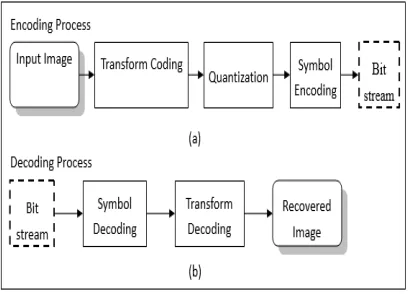
A number of different algorithms have demonstrated their appropriateness for lossy compression. Accordingly, the usage steps of these algorithms can be viewed in Figure (2). Other comparable converts namely the Discrete Cosine Transform (DCT) are used in the image data decorrelation, after which, each conversion coefficient can be independently fixed while the density effectiveness is retained. In this regard, the most widespread DCT definition of a 1-D sequence of length N is expressed by the following equation (1).
(1)
Where: u= 0,1,2, N-1
For the Two-Dimensional DCT, its purpose is to examine the efficacy of DCT on images, which requires the expansion of ideas highlighted in the most recent section on two-dimensional space. The 2-D DCT encompasses a direct extension of the 1-D case and is expressed by an equation (2) below:
(2)
For u, v= 0, 1, 2, N-1, and the inverse transform is expressed as follows:
(3)
The basic algorithm for N = 8 is highlighted, and notably, it shows a flexible increase in frequency together, both horizontally and vertically. The highest left source algorithm of consequences from the propagation of the DC constituent as shown in Figure (1) with it is moves. As such, the algorithm undertakes a constant value, signified as the DC coefficient.
[image:3.612.314.518.161.288.2]The conversion of the image from spatial to Fourier format has no linkage to image compression, but the ensuing quantization phase is linked to image compression. Figure 2 shows the steps of the DCT and quantization.
Figure 1: The Image Following the Use of DCT with Two Dimensions
Figure 2: The steps of using bandwidth
2. LITERATURE REVIEW
In illustrating the importance of image compression: suppose there is a 100-minute video utilizing the standard view (PAL System) with the 720 x 576 dots screen size. In this regard, if the PAL system captures 25 frames per second and the colored dots-point requires 3 bytes for representing them, then, the clip size can be regarded as equal.
size 720 ∗ 576 ∗ 3 ∗ 100 ∗ 60 ∗ 25
186624000000 byte
[image:3.612.314.518.329.476.2]1540
2.1 General Concepts in Image Compression.
2.1.1 Compression ratio: This ratio is obtained through the division of the data signifying the original image over the compressed image data. This is expressed in Equation (4) below:
𝐶 (4)
Where: (N1) denotes the number of bits within the original image (H), N2 signifies the number of bits within the compressed image (H'). Here, Cr that is greater than 1 denotes that the resultant image is smaller than the original image, while Cr that is smaller than 1 denotes that the resultant image is bigger than the original image [15].
2.1.2 Error: This notion denotes the difference between the pixel value within the image following decompression with the equivalent pixel prior to the process of compression [16].
𝑒 𝑥, 𝑦 𝐻 𝑙, ℎ 𝐻 𝑙, ℎ (5)
2.1.3 Total error: This notion denotes the summation of the discrepancies within an equation (2) for each pixel that is present within the image. The computation of total errors is based on the expression below:
(6)
3. PREVIOUS STUDIES
For image compression, DWT and DCT were employed in Harjeetpal Singh and Sakshi Rana. In this study, the authors proposed the application of Nobel as a hybrid system. Additionally, the authors employed several techniques of image compression techniques such as Hoffman – the Hoffman technique is not lossless. As found by the authors, the application of more than one algorithm assists in enhancing the proposed algorithm particularly in terms of efficiency. The authors further stated that in encoding an image as a group of transform, the is self-similarity in a lot of real-life images [17].
In S. Roy, a method of compressing vector images known as Vector Quantity (VQ), was proposed. In particular, this method is grounded upon two compression methods. VQ encompasses an image coding method with the use of available quantities, and it transforms separate codes into
DCT. In generating the final code file, DCT is used. All types of images can be used for the algorithm. Further, the algorithm
The code is appended for the image and the image is reconstructed using the mechanism itself. The model images were employed in testing the proposed method. Then, the proposed method’s performance is compared with that of the customary VQ method, and good results were achieved [18].
A novel hybrid system encompassing the integration of DWT and DCT algorithms under compression ratio settings was proposed in Boela. The algorithm executes DCT at the lowest DWT coefficient. Through the pixel's assemblage at comparable frequencies, DCT gains from repeating data. In this study, the focal point was on the development of an algorithm for compressing the static images. Also, as opposed to the JPEG-based DCT system, the proposed method demonstrated good performance. Also, it appears that the new system functions better within in a symmetrical environment and it also dramatically decreases the impacts of image edge destruction. From the results of an analysis, it is clear that a continual level of deformation is maintainable. For this reason, as opposed to other systems, the amount of required bits to transfer hybrid coefficients appears to be lower [19].
In Manik Groach and Amit Garg, the authors proposed an image compression method that integrates two algorithms namely DCT and SPIHT. Utilizing low-frequency compression, the process is carried out with the DCT image compression algorithm. This is followed by the analysis of the compressed image with orthogonal wavelet conversion. Through the analysis of the output of the search field algorithm, the resultant matrix employs a new coding within the high-frequency field. This domain is known as the high-frequency SPIHT. Contrasted with its corresponding operations as in the image encoding, the original image can be reconstructed after encoding, and the quality appears to be acceptable. From the experimental outcomes, Despite appears to impart superior quality or quality that is almost comparable to SPIHT [20].
1541 matrix and when storing images. Rather than the original image storage, the algorithm computes the difference between the arithmetic average of the entire group of images and the standard matrix and storage. DWT with the encrypted Huffman algorithm was also employed in this study for evaluating the correlation coefficient, error in the square root box and the compression time for each of the identical and distinctive image sets. As demonstrated by the obtained outcomes, when combined, the grouping of images is accelerated.
Senapatil and Kisan examined a fractal image compression that is inherently identical, while its principal structure is repeated in image reduction at all levels. The purpose of image compression is to decrease image size while image quality remains the same. Further, to accurately identify the small information eliminated from the original JPEG image, the authors proposed using a JPEG image. Accordingly, the image was broken down into two parts namely the domain partition and the domain partition. The DCT algorithm was applied to the image to convert it. The image was compressed, and the invisible signals were removed. The Huffman encoding was used to reduce the image size. Through the creation of a new code, the encoding will decrease the number of symbols. The result appears that the data is counted by Entropy. As the last step, the compression ratio, the middle of the error box and the peak signal noise ratio were computed. This will impart result that is superior to the standard JPEG image, as these parameters values were improved [22].
In Fryza, three-dimensional Cusin conversion was employed on the image and video compression program. The author mentioned that the proposed method is an optimal way to construct a three-dimensional DCT frequency input in the stream of signals and symbols. The amount of non-zero frequency coefficients is dictated by the video sequence character. In this regard, a slow-motion sequence increases the low number of symbols and vice versa. Further, the tracking algorithm generates a lot of frequency coefficients. For this reason, the ratio of compression of the encoded output will be low. The author proved that the 3D DCT encoder compression characteristics rely on the scene difference, and are improvable via the intranet programmer [23].
A precise biometric system established upon a human ear was proposed in Saleh. Accordingly, a lot of structures were extracted in the spatial domain including the area of the ear, ear edge points, as well as ear sizes within diverse seats. In the registration stages, these structures were extracted and kept as
patterns. The author employed Euclidean distance for each feature or for the entire features, and obtained different accurate rates of appreciation, reaching 88.2%. Meanwhile, the use of spatial domain structures and features of frequency domain including FFT and DCT coefficients increases the rate of recognition to 92%. According to the author, the use of the average values of 5 samples rather than 3 samples for each person can yield 100% of accurate recognition [24].
A distinctive algorithm with a discrete cosine for transforms and fractional image compression was proposed in Sandhya. In order to obtain the best compression for an image, quadratic tree decomposition with Huffman encoding was applied. The application of the quadratic tree with Hoffman encoding imparts greater ratio of compression ratio and superior quality for the images that work its compression. The use of the proposed algorithm generated greater compression to images but the image decoding time became longer [25].
In Bernatin and Sundari, the authors demonstrated the application of a method for processing enormous data amounts within a video surveillance system. According to the authors, it is important to have high-efficiency video recovery technology and advanced video compression techniques. DWT and DWT were employed in this study, and following the usage of DCT, DWT code was produced. For the purpose, the statistical repetition code of the Hoffman algorithm was applied. After the encryption and decryption to restore images and video to what was the process of checking the efficiency of the algorithm. The results prove the high efficiency of this algorithm, and the authors reported that it claimed nearly 98% of its storage space [26].
The technological revolution influenced everything [16, 27-45], even the approaches for encoding time and reducing the search space for the real issues. These days, Artificial Intelligence (AI) algorithms are used widely, mainly in solving challenging problems such as medical image analysis [46-50], patterns recognition and Content-based image retrieval [51-67], object segmentation [16, 27, 37, 68-73], Healthcare Monitoring system [40, 74], prediction [75-77], nurse rostering problem [78], as well as Learning Management System [79-104]. Therefore, AI algorithms were used for solving various Image Compression issues [105-107].
4. MATERIALS AND METHODS
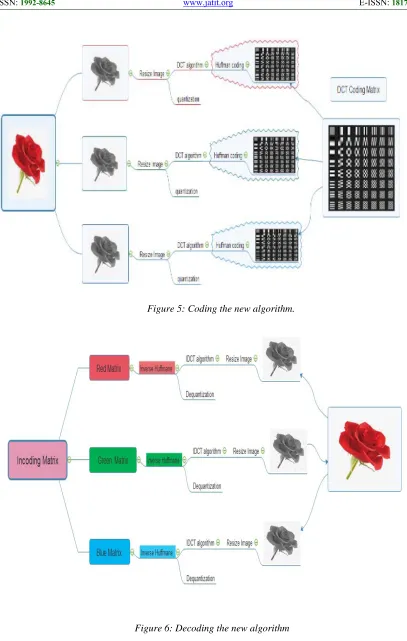
1542 execution of the algorithm, first, the color image is read from the file, and then, the colored image is broken down into three images. Determined by the operation mode (RGB): the first grayscale image contains the red color intensity, the second one contains the green color intensity, and the third one carries the blue color intensity. Resizing of the three grayscale images is the following step. Here, an algorithm (DCT) is applied to the three thumbnails on their own with the application of the quantization method and mask with the DCT algorithm.
The Huffman algorithm is then used on the 3 resultant matrices. The three matrices are next merged to become a single matrix to become the encoded matrix. The matrix is then decoded, and the colored image is returned to its initial form. The previous steps were reversed, and vice versa. Based on the value of the color density of each stratum (red, green and blue), the Huffman matrix is broken down into three matrices. Then, the Hoffman inverse algorithm is employed on them, followed by the application of the reverse algorithm (DCT). The three images are then resized to their beginning size, and to establish the original color image, the three grayscale images are merged to become one image. The ensuing phase will detail these steps.
Processing color images at programming languages are difficult. As such, it is much simpler to programmatically convert a color image into a grayscale image. The image from grayscale is then converted into a color image, based on its original position. Unquestionably, verification is needed to the original color of the image. Hence, the use of any color as coloring is prohibited. It is possible to convert a color image into a grayscale image. Somehow, the real color of the image may not be blue. Hence, when returning the grayscale image to its original color, the color intensity must be specified. It should be noted that the obtained value may not be as accurate. Hence, the use of the proposed algorithm provides a novel way to resolve this issue.
4.1 Steps of The Algorithm
4.1.1 The Coding Steps
All types of color images can be used including TIFF, JPG, PNG, and GIF, and the selected images are split into 3 major frames namely red, blue, and green.
The Dugad method [108] is used in minimizing the three images, as shown in Figure 3. In order to reduce the mathematical overhead, a number of images resizing methods were formed
within the convert domain. Within the convert area, Dugad demonstrated a very efficient image-resizing algorithm in terms of mathematical density and in image value as well. Within the spatial domain, its antialiasing mesh retort appears to be superior to that of bilinear exclamation. Dugad’s algorithm is grounded upon the multiplication-convolution property of the DCT with superior characteristics of a resizing filter.
[image:6.612.312.524.378.685.2]Meanwhile, in order to prevent distortion in the image, the mode of 4 adjacent pixels is employed. As an illustration of the idea proposed; for an image with a dimension comprising of 16×16 pixels, its dimension result must be of 8×8 pixels, and the four-pixel numbers (1, 2, 21, and 22) (refer Figure (4)). Then, computation is made to the arithmetic mode. The outcome value is kept within the first pixel, in the second matrix. As an example, the green color was employed for the four pixels within the first matrix. In the second matrix, the green color is also employed. The process repeated until the end of the image. This process is also done to all three images. Hence, a special domain is employed within the compression image.
1543
Figure.4: The resize of the image from(16x16) to (8x8).
The Discrete Cosine Transform (DCT) can now be employed on the 3 matrices. In order to benefit from the efficiency of the algorithm in compression, the Huffman algorithm was applied to the 3 grayscale images (red, green and blue).
At the final stage of the hybrid method, 3 matrices are combined to form one matrix, and the matrix outcome encompasses the compressed color image as can be viewed in Figure (5) and Figure (6), the three grayscale images and the combined compression color image.
4.1.2 The Decoding steps
The procedural steps of the decoding method are as laid down below:
The moment the cypher matrix arrived at other band, the algorithm split the cypher matrix into 3 parts namely a red, a blue and a green part.
In order to prepare for the succeeding step, the reverse Huffman algorithm was applied to the three grayscale images of red, green and blue.
The three-grayscale matrix was decoded by the algorithm. The Inverse Discrete Cosine Transform (IDCT) was applied to the three grayscale images.
The inverse of Dugad method was employed in returning the matrix into the normal size (the initial image prior to the encoding).
The aforementioned steps will be successively employed on the three frames of grayscale images namely, red, blue and green.
1544
[image:8.612.92.497.101.369.2]Figure 5: Coding the new algorithm.
1545
5. EXPERIMENTAL RESULTS AND
DISCUSSION
This study employed a database comprising 10 color images with varying sizes for measuring the efficiency of the proposed algorithm. All these images were obtained from the Internet. The sizes of these images can be viewed in Table 2.
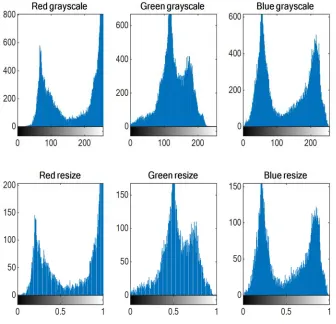
At the start of the process, the algorithm separated the color image into three matrices, after that the resizing image method is applied to three matrices, figure 7 shows that the histogram of the three original matrices and it's resizing are similar. The DCT algorithm is singly applied to the dataset. Accordingly, the new size of the 10 images prior to compression and following decompression can be viewed in Table 3. As can be observed from the table, the difference in values of image sizes is linked to the required DCT. On the dataset, the efficiency of the DCT algorithm is 1.02. In this study, the Compression Ratio coefficient (Cr) was used as a factor for measuring the algorithm’s efficiency.
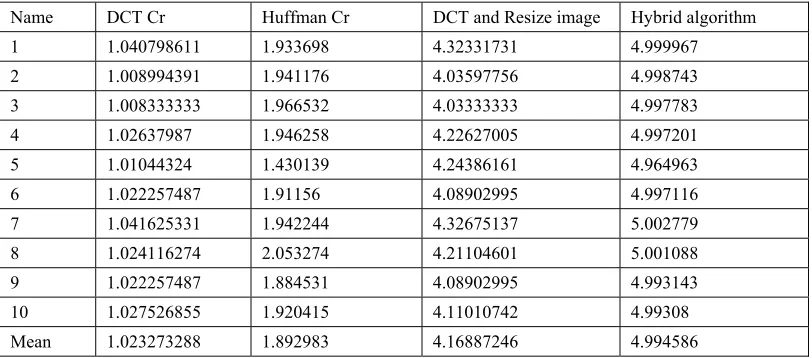
Table 6 presents the Compression Ratio coefficient (Cr) results.
On the exact dataset, the Huffman coding was applied on its own. Table 4 shows the dataset prior to and following the application of the new algorithm, and after the image is decompressed to return to normal (decompression images). Meanwhile, as can be observed in Table 6, the mean of Huffman is 1.9.
The proposed algorithm was employed on the same dataset. Accordingly, Table 5 presents the dataset prior to and following the application of the new algorithm, and after the image is decompressed to return to normal (decompression images).
Table (6) shows the efficiency computation results of the new algorithm. As can be observed
from the results, for the hybrid algorithm, the arithmetic mean of the compression ratio is roughly
[image:9.612.140.476.359.683.2]5.
1546
Table 2: Dimensions and Size of 10 Color images.
.
Table 3: Using only (DCT) on the Template Images
Name
Image before compression Matrix compression After decompression
Dimensions Size (Kbytes) Dimensions Size (Kbytes) Dimensions Size (Kbytes)
1 231x218x3 151.074 224x216x3 145.152 224x216x3 145.152
2 241x209x3 151.107 240x208x3 149.760 240x208x3 149.760
3 208x242x3 151.008 208x240x3 149.760 208x240x3 149.760
4 281x180x3 151.740 280x176x3 147.840 280x176x3 147.840
5 169x225x3 114.075 168x224x3 112.896 168x224x3 112.896
6 194x259x3 150.738 192x256x3 147.456 192x256x3 147.456
7 226x223x3 151.194 224x216x3 145.152 224x216x3 145.152
8 591x591x3 1047.843 584x584x3 102.3168 584x584x3 1023.168
9 259x194x3 150.738 256x192x3 147.456 256x192x3 147.456
10 195x259x3 151.515 192x256x3 147.456 192x256x3 147.456
Image before compression
Name Dimensions Size (bytes)
1 231x218x3 151074
2 241x209x3 151107
3 208x242x3 151008
4 281x180x3 151740
5 169x225x3 114075
6 194x259x3 150738
7 226x223x3 151194
8 591x591x3 1047843
9 259x194x3 150738
[image:10.612.93.522.433.722.2]1547
Table 4: Using only (Huffman) on the Template Images
Name Image before compression Matrix compression After decompression Dimensions Size (Kbytes) Dimensions Size (Kbytes) Dimensions Size (Kbytes)
1 231x218x3 151.074 224x216x3 78.127 224x216x3 151.074
2 241x209x3 151.107 240x208x3 77.843 240x208x3 151.107
3 208x242x3 151.008 208x240x3 76.789 208x240x3 151.008
4 281x180x3 151.740 280x176x3 77.965 280x176x3 151.740
5 169x225x3 114.075 168x224x3 79.765 168x224x3 114.075
6 194x259x3 150.738 192x256x3 78.856 192x256x3 150.738
7 226x223x3 151.194 224x216x3 77.845 224x216x3 151.194
8 591x591x3 1047.843 584x584x3 510.328 584x584x3 1047.843
9 259x194x3 150.738 256x192x3 79.987 256x192x3 150.738
[image:11.612.101.514.314.494.2]10 195x259x3 151.515 192x256x3 78.897 192x256x3 151.515
Table 5: Using a Resize image with the DCT and Huffman coding on the Data Template
Image before compression Matrix compression Matrix after decompression Name Dimensions Size (Kbytes) Dimensions Size (Kbytes) Dimensions Size (Kbytes)
1 231x218x3 151.074 112x104x3 30.215 231x218x3 145.152
2 241x209x3 151.107 120x104x3 30.229 241x209x3 149.760
3 208x242x3 151.008 104x120x3 30.215 208x242x3 149.760
4 281x180x3 151.740 136x88x3 30.365 281x180x3 147.840
5 169x225x3 114.075 80x112x3 22.976 169x225x3 112.896
6 194x259x3 150.738 96x128x3 30.165 194x259x3 147.456
7 226x223x3 151.194 112x104x3 30.222 226x223x3 145.152
8 591x591x3 1047.843 288x288x3 209.523 591x591x3 1023.168
9 259x194x3 150.738 128x96x3 30.189 259x194x3 147.456
10 195x259x3 151.515 96x128x3 30.345 195x259x3 147.456
Table 6: The Compression ratio of the four schemas
Name DCT Cr Huffman Cr DCT and Resize image Hybrid algorithm
1 1.040798611 1.933698 4.32331731 4.999967
2 1.008994391 1.941176 4.03597756 4.998743
3 1.008333333 1.966532 4.03333333 4.997783
4 1.02637987 1.946258 4.22627005 4.997201
5 1.01044324 1.430139 4.24386161 4.964963
6 1.022257487 1.91156 4.08902995 4.997116
7 1.041625331 1.942244 4.32675137 5.002779
8 1.024116274 2.053274 4.21104601 5.001088
9 1.022257487 1.884531 4.08902995 4.993143
10 1.027526855 1.920415 4.11010742 4.99308
[image:11.612.104.510.525.704.2]1548 In Amrutbhai and others [109], the authors demonstrated the use of Haar wavelet and VQ techniques. In this study, LZW coding was used on the test images of the cameraman (256 X 256) and Lena (256 X 256), and the obtained observation mean results of compression ratio is 2.54.
For image compression, a novel algorithm was proposed in Amanpreet Kaur [110]. In compressing a grey scale image in the spatial domain, the algorithm employs the technique of decision tree. In this study, the obtained ratio of average compression is 1.304. The authors reported that their proposed algorithm was very efficient in image compression.
For the algorithm, the obtained average compression ratio is 4.99. Clearly, the performance of the proposed algorithm supersedes that of other hybrid algorithms that employ the exact approach.
6. CONCLUSION
This study demonstrated the application of spatial treatment and frequency treatment in digital image compression. For color image compression, this study proposed a novel algorithm with the capacity of converting the color image into three intensity images. With the use of the method proposed, the digital image is resized according to its location. The first step involved the use of frequency treatment with the application of the Discrete Cosine Transform (DCT) algorithm, followed by the next step which involves the use of spatial treatment with the application of the Huffman coding. In the first step of decompression, the matrix is restructured to produce the grayscale image. Decompression was also performed to the digital image with the use of Inverse Discrete Cosine Transform (IDCT). From the results obtained, it was evident that the proposed algorithm is efficient and robust, based on the values provided by a compression ratio for the resultant compressed images. Owing to the different image sizes, this paper does not take into account the issue of distortion. The original and the resulting images differ due to the rules of use of the DCT algorithm
ACKNOWLEDGEMENT
I would like to thank the Department of Management Information Systems at the Faculty of Applied Studies and Community Service, and to the Imam Abdulrahman Bin Faisal University represented by the Deanship of Scientific Research for their support of scientific research at the university and for their provision of all the means needed for research and innovation.
DATABASE
The performance of the proposed algorithm was evaluated using 10 self-gathered images of diverse flower object.
Image 1 Image 2
Image 3 Image 4
Image 5 Image 6
Image 7 Image 8
1549
REFERENCES
[1] Bandyopadhyay S K, Paul T U and Raychoudhury A. Image compression using approximate matching and run length.
International Journal of Advanced Computer
Science and Applications, 2011, 2(6).
[2] Huffman D A. A method for the construction of minimum-redundancy codes. Proceedings of
the IRE, 1952, 40(9): 1098-1101.
[3] Van Leeuwen J. On the Construction of Huffman Trees. In ICALP, pp. 382-410.
[4] Stix G. PROFILE. Scientific American, 1991,
265(3): 54-61.
[5] Gallager R and Van Voorhis D. Optimal source codes for geometrically distributed integer alphabets (corresp.). IEEE Transactions on
Information theory, 1975, 21(2): 228-230.
[6] Abrahams J. Code and parse trees for lossless source encoding. In Compression and Complexity of Sequences 1997. Proceedings, pp. 145-171.
[7] Hu T C and Tucker A C. Optimal computer search trees and variable-length alphabetical codes. SIAM Journal on Applied
Mathematics, 1971, 21(4): 514-532.
[8] Cleary J and Witten I. Data compression using adaptive coding and partial string matching.
IEEE transactions on Communications, 1984,
32(4): 396-402.
[9] Moffat A. Implementing the PPM data compression scheme. IEEE transactions on
Communications, 1990, 38(11): 1917-1921.
[10] Cleary J G and Teahan W J. Unbounded length contexts for PPM. The Computer Journal,
1997, 40(2_and_3): 67-75.
[11] Schürmann T and Grassberger P. Entropy estimation of symbol sequences. Chaos: An Interdisciplinary Journal of Nonlinear
Science, 1996, 6(3): 414-427.
[12] Ziv J and Lempel A. Compression of individual sequences via variable-rate coding. IEEE
Transactions on Information theory, 1978,
24(5): 530-536.
[13] Singh V and Elamvazuthi I. Fingerprint matching algorithm for poor quality images.
The Journal of Engineering, 2015, 1(1).
[14] Lin Y, Amit A, Marcellin M and Bilgin A. Task-Based JPEG 2000 Image Compression: An Information-Theoretic Approach. In 2018 Data Compression Conference, pp. 423-423. [15] Patel P A, Patel V K and Patel Y B. Vector
Quantization And Lzw Based Lossy Image Compression. International Journal of
Advanced Research in Computer Science,
2018, 9(1).
[16] Thalji Z and Alsmadi M. Iris Recognition using robust algorithm for eyelid, eyelash and shadow avoiding. World Applied Sciences
Journal, 2013, 25(6): 858-865.
[17] Singh H and Rana S. Image Compression Hybrid using DCT, DWT, Huffman.
International Journal of Scientific &
Engineering Research, 2012.
[18] Roy S, Sen A and Sinha N. VQ-DCT based image compression: a new hybrid approach.
Assam University Journal of Science and
Technology, 2010, 5(2): 73-80.
[19] DIVYA G B and Rani M K S. Implementation of Image Compression Using Hybrid DWT-DCT Algorithms. International Journal of Modern Trends in Engineering and Research
(IJMTER) Volume, 2015, 2.
[20] Groach M and Garg A. DCSPIHT: Image compression algorithm. International Journal
of Engineering Research and Applications,
2012, 2(2): 560-567.
[21] Latha P M and Fathima A A. Collective compression of images using averaging and transform coding. Measurement, 2019, 135:
795-805.
[22] Leni P-E, Fougerolle Y and Truchetet F. Kolmogorov superposition theorem for image compression. IET Image Processing, 2012,
6(8): 1114-1123.
[23] Setyaningsih E and Wardoyo R. Review of image compression and encryption techniques. International Journal of Advanced Computer Science and
Applications, 2017, 8(2).
[24] Saleh F, Hamdy A and Zaki F. Hybrid features of spatial domain and frequency domain for person identification through ear biometrics.
Pattern Recognition and Image Analysis,
2009, 19(1): 35-38.
[25] Rabie T. Lossless quality steganographic color image compression. Int J Adv Comput Sci Appl, 2015, 6(4): 114-123.
[26] Rehna V and Jeya Kumar M. Hybrid approach to image coding: A review. International Journal of Advanced Computer Science and
Applications, 2011, 2(7).
1550 Advance Computing Conference, 6-7 March 2009, pp. 296-299.
[28] Alsmadi M, Badawi U A and Reffat H E. A High Performance Protocol for Fault Tolerant Distributed Shared Memory (FaTP). Journal
of Applied Sciences, 2013, 13: 790-799.
[29] Haddad F, Alfaro J And Alsmadi M K. Hotelling's T² Charts Using Winsorized Modified One Step M-Estimator For Individual Non Normal Data. Journal of Theoretical & Applied Information
Technology, 2015, 72(2): 215-226.
[30] Haddad F and Alsmadi M K. Improvement of The Hotelling’s T2 Charts Using Robust Location Winsorized One Step M-Estimator (WMOM). Journal of Mathematics (ISSN
1016-2526), 2018, 50(1): 97-112.
[31] Alsmadi M K, Badawi U A and Moharram H M. Server Failures Enabled Javaspaces Service. Journal of Computer Science, 2014,
10(4): 671-679.
[32] Alsmadi M K. Apparatus and method for lesions segmentation. 2018.
[33] Alsmadi M K. Facial expression recognition. 2018.
[34] Aldaej R, Alfowzan L, Alhashem R, Alsmadi M K, Al-Marashdeh I, Badawi U A, Alshabanah M, Alrajhi D and Tayfour M. Analyzing, Designing and Implementing a Web-Based Auction online System.
International Journal of Applied Engineering
Research, 2018, 13(10): 8005-8013.
[35] Almaimoni H, Altuwaijri N, Asiry F, Aldossary S, Alsmadi M, Al-Marashdeh I, Badawi U A, Alshabanah M and Alrajhi D. Developing and Implementing WEB-based Online Destination Information Management System for Tourism. International Journal of Applied
Engineering Research, 2018, 13(10):
7541-7550.
[36] Almrashdeh I A, Sahari N, Zin N A M and Alsmadi M. Requirement analysis for distance learning management system students in Malaysian universities. Journal of Theoretical and Applied Information
Technology, 2011, 24(1): 17-27.
[37] Alsmadi M k, Omar K B and Noah S A. Proposed method to decide the appropriate feature set for fish classification tasks using Artificial Neural Network and Decision Tree.
IJCSNS 2009, 9(3): 297-301.
[38] Alsubaie N, Althaqafi N, Alradwan E, Al-Hazza F, Alsmadi M, Al-Marashdeh I, Badawi U A, Alshabanah M, Alrajhi D, Alsmadi S and Tayfour M. Analyzing and
Implementing an Online Metro Reservation System. International Journal of Applied
Engineering Research, 2018, 13(11):
9198-9206.
[39] Daniyah Alkhaldi D A, Hajer Aldossary, Mutasem k. Alsmadi, Ibrahim Al-Marashdeh, Usama A Badawi, Muneerah Alshabanah, Daniah Alrajhi. Developing and Implementing Web-based Online University Facilities Reservation System. International
Journal of Applied Engineering Research,
2018, 13(9): 6700-6708.
[40] Almarashdeh i, Alsmadi M K, Farag T, Albahussain A S, Badawi U A, Altuwaijri N, Almaimoni H, Asiry F, Alowaid S, Alshabanah M, Alrajhi D, Fraihet A A and Jaradat G. Real-Time Elderly Healthcare Monitoring Expert System Using Wireless Sensor Network International Journal of
Applied Engineering Research, 2018, 13(6):
3517-3523.
[41] Al Smadi M K S. Fish Classification Using Perceptron Neural Network. Centre for Graduate Studies, Universiti Utara Malaysia, 2007.
[42] Alsmadi M K and Badawi U A. Pattern matching in Rotated Images Using Genetic Algorithm. Journal of King Abdulaziz
University Computing and Information 2017,
5: 53 - 59.
[43] Aldossary S, Althawadi A, Almotairy M, Alsmadi M k, Alrajhi D, Alshabanah M, AlMarashdeh I, Tayfour M and Aljamaeen R. Analyzing, Designing And Implementing A Web-Based Command Center System.
International Research Journal of
Engineering and Technology, 2019, 6(1):
1008-1019.
[44] Sheikh R A, Al-Assami R, Albahr M, Suhaibani M A, Alsmadi M k, Alshabanah M, Alrajhi D, Al-Marashdeh I, Abouelmagd H and Alsmadi S. Developing and Implementing a Barcode Based Student Attendance System.
International Research Journal of
Engineering and Technology, 2019, 6(1):
497-506.
[45] Abbas A A, Alzayer K, Alkhaldi A, Alsmadi M k, Alshabanah M, Alrajhi D, Almarashdeh I and Tayfour M. Analyzing and Implementinga System For Reporting, Follow Up and Resolving of Complaints.
International Research Journal of
Engineering and Technology, 2019, 6(1):
1551 [46] Alsmadi M K. A hybrid firefly algorithm with
fuzzy-C mean algorithm for MRI brain segmentation. American Journal of Applied
Sciences, 2014, 11(9): 1676-1691.
[47] Alsmadi M K. MRI brain segmentation using a hybrid artificial bee colony algorithm with fuzzy-c mean algorithm. Journal of Applied
Sciences, 2015, 15(1): 100.
[48] Alsmadi M K. A hybrid Fuzzy C-Means and Neutrosophic for jaw lesions segmentation.
Ain Shams Engineering Journal, 2017.
[49] Park S H and Han K. Methodologic Guide for Evaluating Clinical Performance and Effect of Artificial Intelligence Technology for Medical Diagnosis and Prediction.
Radiology, 2018: 171920.
[50] Kermany D S, Goldbaum M, Cai W, Valentim C C, Liang H, Baxter S L, McKeown A, Yang G, Wu X and Yan F. Identifying Medical Diagnoses and Treatable Diseases by Image-Based Deep Learning. Cell, 2018, 172(5):
1122-1131. e1129.
[51] Al Smadi A M, Alsmadi M K, Al Bazar H, Alrashed S and Al Smadi B S. Accessing Social Network Sites Using Work Smartphone for Face Recognition and Authentication. Research Journal of Applied
Sciences, Engineering and Technology, 2015,
11(1): 56-62.
[52] Alsmadi M. Facial recognition under expression variations. Int. Arab J. Inf. Technol., 2016,
13(1A): 133-141.
[53] Alsmadi M, Omar K and Almarashdeh I. Fish Classification: Fish Classification Using Memetic Algorithms with Back Propagation Classifier. 2012.
[54] Alsmadi M, Omar K, Noah S and Almarashdeh I. A hybrid memetic algorithm with back-propagation classifier for fish classification based on robust features extraction from PLGF and shape measurements. Information
Technology Journal, 2011, 10(5): 944-954.
[55] Alsmadi M, Omar K B, Noah S A and Almarashdeh I. Fish Recognition Based on Robust Features Extraction from Size and Shape Measurements Using Neural Network
Journal of Computer Science, 2010, 6(10):
1088-1094.
[56] Alsmadi M K. An efficient similarity measure for content based image retrieval using memetic algorithm. Egyptian Journal of
Basic and Applied Sciences.
[57] Alsmadi M K. Query-sensitive similarity measure for content-based image retrieval using meta-heuristic algorithm. Journal of
King Saud University - Computer and
Information Sciences.
[58] Alsmadi M K, Hamed A Y, Badawi U A, Almarashdeh I, Salah A, Farag T H, Hassan W, Jaradat G, Alomari Y M and Alsmadi H M. Face Image Recognition Based On Partial Face Matching Using Genetic Algorithm.
SUST Journal of Engineering and Computer
Sciences (JECS), 2017, 18(1): 51-61.
[59] Alsmadi M K, Omar K B, Noah S A and Almarashdeh I. Fish recognition based on robust features extraction from color texture measurements using back-propagation classifier. Journal of Theoritical and Applied
Information Technology, 2010, 18(1).
[60] Badawi U A and Alsmadi M K. A General Fish Classification Methodology Using Meta-Heuristic Algorithm With Back Propagation Classifier. Journal of Theoretical & Applied
Information Technology, 2014, 66(3):
803-812.
[61] Yousuf M, Mehmood Z, Habib H A, Mahmood T, Saba T, Rehman A and Rashid M. A Novel Technique Based on Visual Words Fusion Analysis of Sparse Features for Effective Content-Based Image Retrieval.
Mathematical Problems in Engineering,
2018, 2018.
[62] Saritha R R, Paul V and Kumar P G. Content based image retrieval using deep learning process. Cluster Computing, 2018: 1-14.
[63] Alsmadi M K, Omar K B and Noah S A. Fish recognition based on robust features extraction from size and shape measurements using back-propagation classifier.
International Review on Computers and
Software, 2010, 5(4): 489-494.
[64] Alsmadi M K, Omar K B, Noah S A and Almarashdeh I. Fish recognition based on robust features extraction from size and shape measurements using neural network. Journal
of Computer Science, 2010, 6(10): 1088.
[65] Alsmadi M K S, Omar K B, Noah S A and Almarashdah I. Fish recognition based on the combination between robust feature selection, image segmentation and geometrical parameter techniques using Artificial Neural Network and Decision Tree. arXiv preprint
arXiv:0912.0986, 2009.
[66] Alsmadi M, Omar K B and Noah S A. Back propagation algorithm: the best algorithm among the multi-layer perceptron algorithm.
International Journal of Computer Science
1552 [67] Alsmadi M, Omar K, Noah S, Almarashdeh I,
Al-Omari S, Sumari P, Al-Taweel S, Husain A, Al-Milli N and Alsmadi M. Fish recognition based on robust features extraction from size and shape measurements using neural network. Information
Technology Journal, 2009, 10(5): 427-434.
[68] Farag T H, Hassan W A, Ayad H A, AlBahussain A S, Badawi U A and Alsmadi M K. Extended Absolute Fuzzy Connectedness Segmentation Algorithm Utilizing Region and Boundary-Based Information. Arabian Journal for Science and
Engineering, 2017: 1-11.
[69] Alsmadi M K. A hybrid Fuzzy C-Means and Neutrosophic for jaw lesions segmentation.
Ain Shams Engineering Journal.
[70] Badawi U A and Alsmadi M K S. A Hybrid Memetic Algorithm (Genetic Algorithm and Great Deluge Local Search) With Back-Propagation Classifier for Fish Recognition
International Journal of Computer Science
Issues, 2013, 10(2): 348-356.
[71] M A, K O and S N. Back Propagation Algorithm : The Best Algorithm Among the Multi-layer Perceptron Algorithm. International Journal
of Computer Science and Network Security,
2009, 9(9): 378-383.
[72] Sharma M, Purohit G and Mukherjee S. Information Retrieves from Brain MRI Images for Tumor Detection Using Hybrid Technique K-means and Artificial Neural Network (KMANN). Networking Communication and Data Knowledge Engineering. Springer, 2018, pp. 145-157. [73] Gao Y, Li X, Dong M and Li H-p. An enhanced
artificial bee colony optimizer and its application to multi-level threshold image segmentation. Journal of Central South
University, 2018, 25(1): 107-120.
[74] Rasmi M, Alazzam M B, Alsmadi M K, Almarashdeh I A, Alkhasawneh R A and Alsmadi S. Healthcare professionals’ acceptance Electronic Health Records system: Critical literature review (Jordan case study). International Journal of Healthcare
Management, 2018: 1-13.
[75] Alsmadi M K. Forecasting River Flow in the USA Using a Hybrid Metaheuristic Algorithm with Back-Propagation Algorithm.
Scientific Journal of King Faisal University
(Basic and Applied Sciences), 2017, 18(1):
13-24.
[76] Adeyemo J, Oyebode O and Stretch D. River Flow Forecasting Using an Improved
Artificial Neural Network. EVOLVE-A Bridge between Probability, Set Oriented Numerics, and Evolutionary Computation VI. Springer, 2018, pp. 179-193.
[77] Ahani A, Shourian M and Rad P R. Performance Assessment of the Linear, Nonlinear and Nonparametric Data Driven Models in River Flow Forecasting. Water
Resources Management, 2018: 1-17.
[78] Jaradat G M, Badareen A, Ayob M, Al-Smadi M, Al-Marashdeh I, Ash-Shuqran M and Al-Odat E. Hybrid Elitist-Ant System for Nurse-Rostering Problem. Journal of King Saud University-Computer and Information
Sciences, 2018.
[79] Almarashdeh I. Sharing instructors experience of learning management system: A technology perspective of user satisfaction in distance learning course. Computers in
Human Behavior, 2016, 63: 249-255.
[80] Almarashdeh I, Bouzkraoui H, Azouaoui A, Youssef H, Niharmine L, Rahman A A, Yahaya S S S, Atta A M A, Egbe D A And Murimo B M. An Overview Of Technology Evolution: Investigating The Factors Influencing Non-Bitcoins Users To Adopt Bitcoins As Online Payment Transaction Method. Journal of Theoretical and Applied
Information Technology, 2018, 96(13).
[81] Almarashdeh I. The important of service quality and the trust in technology on users perspectives to continues use of mobile services. Journal of Theoretical & Applied
Information Technology, 2018, 96(10).
[82] Almarashdeh I and Alsmadi M. Investigating the acceptance of technology in distance learning program. In Information Science and Communications Technologies (ICISCT), International Conference on, Tashkent Uzbekistan pp. 1-5.
[83] Almarashdeh I and Alsmadi M. Heuristic evaluation of mobile government portal services: An experts' review. In 11th International Conference for Internet Technology and Secured Transactions (ICITST), 5-7 Dec. 2016, pp. 427-431. [84] Almarashdeh I and Alsmadi M K. How to make
them use it? Citizens acceptance of M-government. Applied Computing and
Informatics, 2017, 13(2): 194-199.
[85] Almarashdeh I and Alsmadi M K. Applied Computing and Informatics. 2017.
E-1553 government Services. Journal of Applied
Sciences, 2014, 14(8): 791-797.
[87] Almarashdeh I, Althunibat A, Fazidah Elias N, Adewumi A, Al Thunibat A, Zin N, Ashaari N, Al Thunibat A, Zin N and Sahari N. E-Government for mobile societies-stocktaking of current trends and initiatives. Journal of
Applied Sciences, 2013, 14(8): 104-111.
[88] Almarashdeh I, Elias N F, Sahari N and Zain N. Development of an interactive learning management system for malaysian distance learning institutions. Middle East Journal of
Scientific Research, 2013, 14(11):
1471-1479.
[89] AlMarashdeh I, Jaradat G M, Ayob M, Abu-Al-Aish A and Alsmadi M. An Elite Pool-Based Big Bang-Big Crunch Metaheuristic for Data Clustering. Journal of Computer Science,
2018.
[90] Almarashdeh I, Sahari N and Mat Zin N. Heuristic evaluation of distance learning management system interface. In International Conference on Electrical Engineering and Informatics Bandung, Indonesia 17-19 July pp. 1-6.
[91] Almarashdeh I, Sahari N, Zin N M and Alsmadi M. Instructors acceptance of Distance Learning Management System. In International Symposium on Information Technology 2010 (ITSim 2010), Kuala Lumpur, pp. 1-6.
[92] Almarashdeh I A, Sahari N, Zin N A H M and Alsmadi M. Distance learners acceptance of learning management system. In 2nd International Conference on Data Mining and Intelligent Information Technology Applications (ICMIA2010), Seoul, Korea, pp. 304-309.
[93] Almarashdeh I A, Sahari N, Zin N A H M and Alsmadi M. Distance Learning Management System requirements From Student’s Perspective. The international Journal of Theoretical and Applied Information
Technology, 2011, 24(1).
[94] Almarashdeh I A, Sahari N and Zin N A M. Heuristic evaluation of distance learning management system interface. In Electrical Engineering and Informatics (ICEEI), 2011 International Conference on, pp. 1-6.
[95] Almarashdeh I A, Sahari N, Zin N a M and Alsmad M. The Success of Learning Management System Among Distance Learners in Malaysian Universitie. Journal of Theoretical and Applied Information
Technology, 2010, 21 (2): 80-91.
[96] Almarashdeh I A, Sahari N, Zin N A M and Alsmadi M. The Success Of Learning Management System Among Distance Learners In Malaysian Universities. Journal of Theoretical & Applied Information
Technology, 2010, 21(2).
[97] Almarashdeh I A, Sahari N, Zin N A M and Alsmadi M. Acceptance of learning management system: A comparison between distance learners and instructors. Advances in
Information Sciences and Service Sciences,
2011, 3(5): 1-9.
[98] Almarashdeh I A E. Study of the Usability of Learning Management System Tool (Learning Care) of Postgraduate Students in University Utara Malaysia (UUM). Graduate School, Universiti Utara Malaysia, 2007. [99] Almrashdah I A, Sahari N, Zin N A H M and
Alsmadi M. Distance learners acceptance of learning management system. In Advanced Information Management and Service (IMS), 2010 6th International Conference on, pp. 304-309.
[100] Almrashdah I A, Sahari N, Zin N A H M and Alsmadi M. Instructors acceptance of distance learning management system. In Information Technology (ITSim), 2010 International Symposium in, pp. 1-6.
[101] Almrashdeh I A, Sahari N, Zin N A M And Alsmadi M. Distance Learning Management System Reqiurements From Student's Perspective. Journal of Theoretical &
Applied Information Technology, 2011,
24(1).
[102] Almrashdeh I A, Sahari N, Zin N A M and Alsmadi M. Instructor's success measures of Learning Management System. In Electrical Engineering and Informatics (ICEEI), 2011 International Conference on, pp. 1-7.
[103] Ibrahim Almarashdeh M K A, Ghaith Jaradat, Ahmad Althunibat, Sami Abdullah Albahussain, Yousef Qawqzeh, Usama A Badawi, Tamer Farag. Looking Inside and Outside the System: Examining the Factors Influencing Distance Learners Satisfaction in Learning Management System. Journal of
Computer Science, 2018, 14(4): 453-465.
[104] Jaradat G, Ayob M and Almarashdeh I. The effect of elite pool in hybrid population-based meta-heuristics for solving combinatorial optimization problems. Applied Soft
Computing, 2016, 44: 45-56.
1554 neural networks. In Proceedings of the IEEE Conference on Computer Vision and Pattern Recognition, pp. 5306-5314.
[106] Toderici G, O'Malley S M, Hwang S J, Vincent D, Minnen D, Baluja S, Covell M and Sukthankar R. Variable rate image compression with recurrent neural networks.
arXiv preprint arXiv:1511.06085, 2015.
[107] Khatun S and Iqbal A. A Review of Image Compression Using Fractal Image Compression with Neural Network. 2018. [108] Dugad R and Ahuja N. A fast scheme for
image size change in the compressed domain.
IEEE Transactions on Circuits and Systems
for Video Technology, 2001, 11(4): 461-474.
[109] Patel A N, Patel V K and Patel Y B. Vector Quantization And Lzw Based Lossy Image Compression. International Journal of
Advanced Research in Computer Science,
2018, 9(1).
[110] Kaur A and Jindal B. Image Compression Using Decision Tree Technique.
International Journal of Advanced Research
![Figure 3: Figure (a)The minimization of Dugad method, Figure (b) the process of his method [105]](https://thumb-us.123doks.com/thumbv2/123dok_us/8900181.954575/6.612.312.524.378.685/figure-figure-minimization-dugad-method-figure-process-method.webp)