Study on Bird Flu Infection Process within a Poultry
Farm with Effects of Spatial Diffusion
Arrival Rince Putri
1,∗,
Masaji Watanabe
1,
Tertia Delia Nova
21GraduateSchoolofEnvironmentalandLifeScience,OkayamaUniversity,700-8530,Okayama,Japan
2DepartmentofAnimalScience,AndalasUniversity,71389,Padang,Indonesia
Copyright c2017 by authors, all rights reserved. Authors agree that this article remains permanently
open access under the terms of the Creative Commons Attribution License 4.0 International License
Abstract
We describe an ODE model and a PDE model. A nonlinear diffusion system of partial differential equations is analyzed for investigation of bird flu transmission process within a poultry farm. Effect of threshold number that gives measure of infectious intensity is investigated. It depends on three factors: removal of infected birds, vaccination, and capacity of the farm. Our analysis shows that the transmission of bird flu within a poultry farm is expressible in terms of traveling wave solutions. It also shows a spatial significance of diffusivity.Keywords
Nonlinear Diffusion System, Transmission Process, Infectious Intensity, Traveling Wave Solutions, Numerical Results1
Introduction
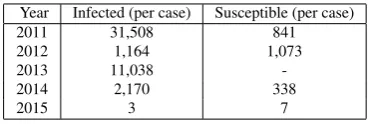
Bird flu is a highly infectious and fatal disease for domestic birds. The disease is caused by virus types H5N1 carried by wild birds such as wild ducks. Most highly pathogenic strain (H5N1) has been spreading throughout Asia since 2003, be-fore it reached Europe in 2005 and Middle East, as well as Africa in 2006. Cases of infected poultry farms were re-ported from several provinces of Indonesia including Bali, East Java, West Java and West Kalimantan in January 2004. Several cases of bird flu-to-human infection have also been reported. Those include cases found in 12 provinces in In-donesia. Any human-to-human infection of bird flu has not yet been reported so far. However, bird flu is now endemic to some region (Table 1) and it is inevitable for the virus to ac-quire the ability unless the contact between hosts and human is reduced in frequency.
[image:1.595.325.510.323.385.2]Poultry farms are contact points between carriers of bird flu virus and human. The infection with highly pathogenic form transmits rapidly over a poultry farm and causes do-mestic birds serious symptoms that eventually lead to death. In current practice, even if infection is detected from only
Table 1.Bird Flu Cases in West Sumatra 2011-2015
Year Infected (per case) Susceptible (per case)
2011 31,508 841
2012 1,164 1,073
2013 11,038
-2014 2,170 338
2015 3 7
Source:Department of Animal Husbandry, West Sumatra, Indonesia
one bird, the entire population in the farm are culled, which have been causing immense damage to the poultry industry. Vaccination is an effective measure against bird flu because vaccinated chickens produce up to 100 thousands times less viruses when infected. While vaccinating chickens is effec-tive, it affects export trade. Some countries even set a non-vaccination policy [1]. Now techniques to control outbreaks in a poultry farm must be developed.
In this study, infection processes of bird flu within a poul-try farm is analyzed with mathematical techniques. Various mathematical models have been applied to problems that re-late to bird flu infection. A mathematical model to interpret the spread Avian Influenza from the bird world to the hu-man world with autonomous ordinary differential equations was analyzed [3,7] and the stability analysis is carried out. The transmission dynamics and spatial spread rate by the size of the susceptible poultry birds were studied [4]. A disease transmission model with diffusive terms to investigate spa-tial spread of Avian Influenza among flock and human were studied [9]. A diffusive epidemic that describes the transmis-sion of Avian Influenza among birds and humans is investi-gated [2]. Mathematical models for bird flu infection process within a poultry farm were also proposed in previous study [5,6,8,10].
flu intrudes into a poultry farm, some infected birds die at an early stage of infection, and some others live longer. Re-gardless of being alive or dead, infected birds are the hosts of virus, unless they are completely removed from the pop-ulation. In a typical poultry farm in Indonesia, there are ten houses each of which contains 1250 chickens. Each chicken in a house is placed in 25x50 [cm] wire net cages. Groups of each of which consists of four cages placed on each side are line up in one direction which amount total length approxi-mate 40 [m] (Figure 1).
Figure 1.Typical of Poultry Farm in Indonesia (Gunung Nago Group Farm, Padang City, West Sumatra).
Mathematical model based on those factors and situation in a poultry farm that illustrated in Figure 1 were proposed in previous studies on bird flu infection processes within a poultry farm. A mathematical model was formulated in a study of the population of susceptible birds and the popula-tion of infected birds [5], and it was reformulated by taking the virus concentration into consideration [6] and spatial ef-fects were incorporated into formulation of infection process. In recent studies, mathematical model was proposed based on the assumption that vacancies due to infection are replaced instantly, so that the total population always balances with the capacity of the farm [8]. The model was reformulated with consideration of spatial effect, and existence of traveling wave solutions in a singular limit was established [10]. Those traveling wave solutions correspond to progressive infection in a poultry farm. In this paper, analysis in the previous stud-ies is continued. In the following sections, a mathematical model is described, and numerical techniques are illustrated. Numerical results are introduced and their significance is in-terpreted.
2
Mathematical Model of Bird Flu
In-fection Process And Stability
Analy-sis
LetX,Y, andZ be the population of susceptible birds, the population of infected birds, and the virus concentration in the medium, respectively. The number of transformation
from susceptible birds to infected birds due to infection per unit time is proportional to the virus concentration in the mediumZ and the number of susceptible birdsX. The de-creasing rate of susceptible birds due to infection isσXZ, whereσis a positive constant. The decreasing rate in the pop-ulation of susceptible birds due to infection is the increasing rate in the population of infected birds. The number of in-fected birds removed from the population is proportional to the number of infected birds itself. Infected birds are hosts of virus. The increasing rate of the virus concentration is pro-portional to the number of infected birds because virus grow inside the hosts. The decreasing rate of virus concentration is proportional to the virus concentration itself. The foregoing disquisition leads to the following system of equations [5,6]
dX
dt = a{c−(X+Y)} −ωrXZ, dY
dt = ωrXZ−mY, dZ
dt = p(Y −rZ),
(1)
whereais the rate of supply of new healthy birds for vacan-cies,cis the capacity of the farm,mis the removal rate,p, r, andωare positive constants. Note thatσ=ωr. When va-cancies due to infection are replaced instantly, the total pop-ulation always balances with the capacity of the farm. Under the situation,X+Y =cand
dX dt =−
dY
dt =ωrXZ+m(c−X) (2) holds. Now, the system (1) becomes the following system of equations for the population of the susceptible birds X and the virus concentration Z [8]
dX
dt = m(c−X)−ωrXZ, dZ
dt = p(c−X−rZ).
(3)
Denote by X = X(t, X0, Z0), Z = Z(t, X0, Z0)
the solution of system (3) that satisfies initial conditions X(0, X0, Z0) = X0, Z(0, X0, Z0) = Z0. Let Γ =
{(X, Z)|0 ≤ X ≤ c, Z ≥ 0}. The Γ is invariant un-der the flow generated by the system (3) in the sense that
(X(t, X0, Z0), Z(t, X0, Z0))belongs toΓfor t ≥ 0
−0.5 0 0.5 1 1.5 −0.5
0 0.5 1 1.5
X
Z
(A) m = 1.5
−0.5 0 0.5 1 1.5
−0.5 0 0.5 1 1.5
X
Z
[image:3.595.357.483.93.410.2](B) m = 0.5
Figure 2. Invariant regionΓ: c= 1,ω = 1,p = 1, andr = 1. The
invariant regionΓis shown for initial conditions(X0, Z0) = (1,0)and
different values ofm.
3
Mathematical Model with Spatial
Virus Diffusion
Viruses transmit from one bird to another through media such as feed, dirt and air, so that spatial effects of virus trans-mission should be incorporated into formulation. It is appro-priate to assume that a medium is one dimensional because bird cages are lined up in one direction. Let xbe the one dimensional coordinate variable. When a diffusive term is added to the right hand side of the second equation, the sys-tem (3) becomes
∂X
∂t = m(c−X)−ωrXZ, ∂Z
∂t = p(c−X−rZ) +d ∂2Z
∂x2,
(4)
wheredis the diffusion constant [10]. Traveling wave solu-tions of (4) are solusolu-tions expressed in terms of funcsolu-tionsU andV as
X(x, t) =U(s), Z(x, t) =V(s), s=x−kt, (5) wherekis the propagation speed of wave. Substituting (5) into (4) leads to the system of the ordinary differential
equa-0 20 40 60 80 100
0 0.1 0.2 0.3 0.4 0.5 0.6 0.7 0.8 0.9 1
Time (t)
X and Z
X: susceptible birds Z: virus concentration
(A) m = 1.5
0 20 40 60 80 100
0 0.1 0.2 0.3 0.4 0.5 0.6 0.7 0.8 0.9 1
Time (t)
X and Z
X: susceptible birds Z: virus concentration
(B) m = 0.5
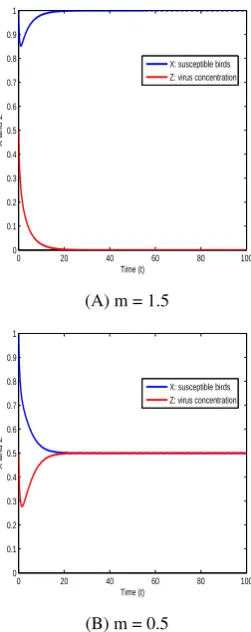
Figure 3.Solution of the ODE system (3):c= 1,ω= 1,p= 1, andr= 1.
(A) any solution converges to the infection free state forωc−m <0, (B)
any solution converges to the endemic state forωc−m >0.
tions
U0 = −1
k{m(c−U)−ωrU V}, V0 = W,
W0 = −δW −ρ(c−U−rV),
(6)
There are two stationary points for the system (6) in the
(U, V, W) phase space. One stationary point isC(c,0,0), and the other stationary point isD(m/ω, ωc−m/ωr,0). A heteroclinic connection from the stationary point D to the stationary pointC gives rise to a traveling wave solution of (4). Existence of such a heteroclinic orbit in a singular limit was established under the conditionωc−m >0in a previous study [10].
In the following, system (4) is focused on. The unknown variableXandZof the system (3) are now functions ofxand t, and they represent the population of susceptible birds and the virus concentration at locationxand timet, respectively. Solutions X(x, t)and Z(x, t)are defined in the region in the xt plane {(x, t)|0 ≤ x ≤ l, t ≥ 0}. The system is associated with the initial conditions
X(x,0) =X0(x), Z(x,0) =Z0(x), (0≤x≤l). (7)
[image:3.595.99.229.94.412.2]Constant solutions of the system (4) includes the infection free equilibriumE0(c,0)which represents that there are no
infected birds, and endemic equilibriumE+(X∗, Z∗)where X∗= m
ω, Z
∗= ωc−m
ωr . (8) Letr0=
ωc
m. The parameterr0gives measure of infectious intensity. If the condition
r0>1 (9)
is satisfied, then the endemic equilibriumE+ is realistic in
the sense that it lies in the first quadrant. In that case, E+
corresponds to an endemic state in which a part of the popu-lation remains infected. Those facts suggest that the parame-terr0depends on the capacity of farmc, the constantω, and
the removal ratem.
Stability of constant solutions of nonlinear system such as system (4) has been studied by other authors [2]. Letµbe the eigenvalue of the operator−∆with homogeneous boundary conditions on the interval[0, l], that is,
Z00+µZ = 0, Z0(0) =Z0(l) = 0.
Those eigenvalues are µ=
kπ l
2
, k= 0,1,2, .... Fur-thermore, let
J=
0 0 0 d∆
+
−m−ωrZ∗ −ωrX∗
−p −pr
, (10)
where∆ = ∂
2
∂x2. The linearization of the system (4) isut=
J u.λis the eigenvalue ofJif and only if it is an eigenvalue of the matrix
φ=
−m−ωrZ∗ −ωrX∗
−p −dµ−pr
, (11) that has characteristic equation
(λ+ (m+ωrZ∗))(λ+ (dµ+pr))−ωprX∗. (12) For the infection free equilibrium E0, the characteristic
equation is
λ2+ (dµ+pr+m)λ+ (mdµ+pr(m−ωc)) = 0. (13) Ifr0 < 1, thenpr(m−ωc)> 0, eigenvalues are all
nega-tive for any non-neganega-tive value ofµandE0is asymptotically
stable. It means that the number of virus concentration de-creases as time elapses, so that the endemic state is insignif-icant. On the other hand, ifr0 > 1, thenpr(m−ωc)< 0,
there is a possibility that eigenvalue is positive for some non-negative value ofµandE0is unstable. For the endemic
equi-libriumE+, the characteristic equation is
λ2+ (dµ+pr+ωc)λ+ (ωcdµ+pr(ωc−m)) = 0. (14) Ifr0>1, thenpr(ωc−m)>0, eigenvalues are all negative
for any non-negative value of µ andE+ is asymptotically
stable. It means that endemic state is significant, and that there are some infected birds in the population. Otherwise, ifr0 < 1, then pr(ωc−m) < 0, there is a possibility that
eigenvalue is positive for some non-negative value ofµand E+is unstable.
4
Numerical Results
In order to investigate the transmission process of bird flu within a poultry farm from x = 0 to l = 100, nonlinear diffusion system (4) subject to boundary conditions
∂X
∂x(0, t) = 0, Z(0, t) = 0.5,
Z(l, t) = 0,
∂X
∂x(l, t) = 0,
(15)
and initial conditions
X0=
(
1/2(1−x) 0≤x <1 1 1≤x≤100
Z0=
(
1/2(1−x) 0≤x <1
0 1≤x≤100
(16)
was solved numerically. The values of the parameters are fixed atc = 1,ω = 1,r = 1, andp = 1. We will show numerical simulation for the susceptible birds (X) and the virus concentration (Z) for different values of the parameter mandd.
0 50 100 0 50 100 150 0 0.2 0.4 0.6 0.8 1
Spatial coordinate (x) Time (t)
X
(A)XComponent
0 50 100 0 50 100 150 0 0.1 0.2 0.3 0.4 0.5
Spatial coordinate (x) Time (t)
Z
[image:4.595.356.508.427.752.2](B)ZComponent
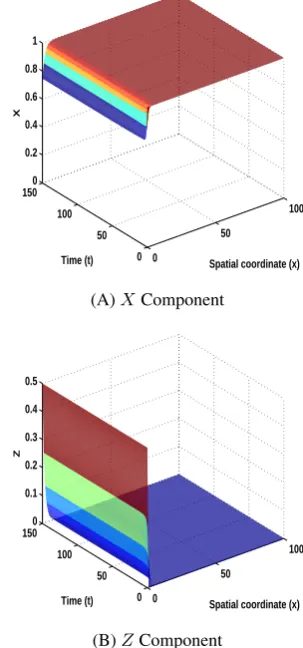
Figure 4.Solution of the system (4):m= 1.5andd= 1. The state is free
Letm= 1.5, thenr0 = 0.667<1, so that, the infection
free equilibriumE0of the system (4) is asymptotically stable,
as shown in Figure 4. The figure depicts the persistence of the infection free state, in which the number of the virus concen-tration decrease as time elapses and population of the sus-ceptible bird remains equal to capacity of farm. In this case, the endemic state is not significant. On the other hand, let m= 0.5, thenr0= 2>1, so that, the endemic equilibrium
E+ of the system (4) is asymptotically stable, as shown in
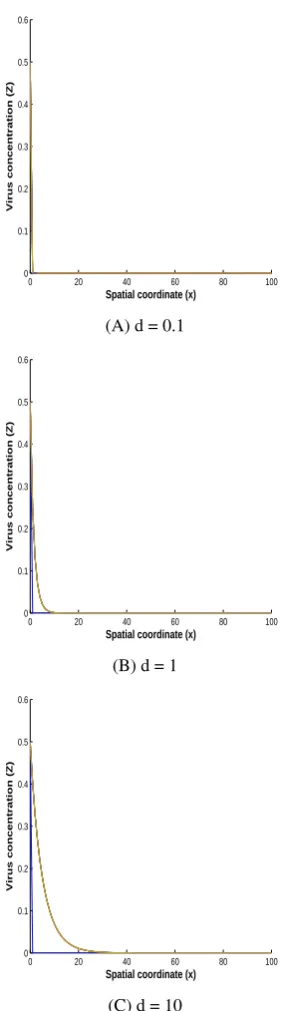
Figure 5. It shows the stability of the endemic state in which a part of the population is always infected. The figure shows the decreasing value ofXand the increasing value ofZwith respect timetand distancex. Traveling wave solutions ap-pear whenE+is asymptotically stable. The wave profile for
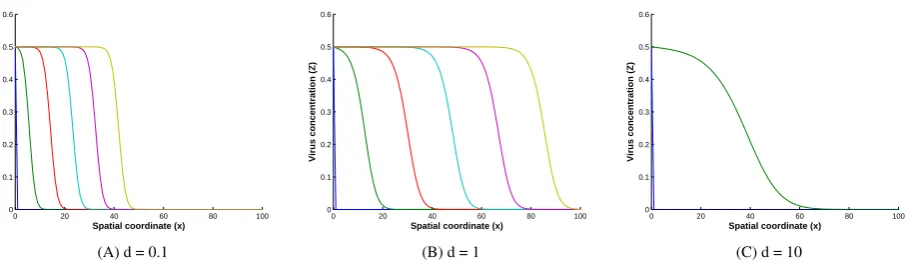
the system (4) were illustrated in Figure 6 form= 1.5and Figure 7 form= 0.5. Progressive waves of bird flu infection were profiled for different oftandd. Note that the blue line in Figure 6 and 7 are solutions of the system (4) whent= 0.
0
50
100
0 50 100 150
0 0.2 0.4 0.6 0.8 1
Spatial coordinate (x) Time (t)
X
(A)XComponent
0
50
100
0 50 100 150
0 0.1 0.2 0.3 0.4 0.5
Spatial coordinate (x) Time (t)
Z
[image:5.595.348.490.89.596.2](B)ZComponent
Figure 5. Solution of the system (4): m= 0.5andd= 1. The state is
endemic. A solution approaches the endemic equilibriumE+.
0 20 40 60 80 100
0 0.1 0.2 0.3 0.4 0.5 0.6
Spatial coordinate (x)
Virus concentration (Z)
(A) d = 0.1
0 20 40 60 80 100
0 0.1 0.2 0.3 0.4 0.5 0.6
Spatial coordinate (x)
Virus concentration (Z)
(B) d = 1
0 20 40 60 80 100
0 0.1 0.2 0.3 0.4 0.5 0.6
Spatial coordinate (x)
Virus concentration (Z)
(C) d = 10
[image:5.595.95.241.330.653.2]0 20 40 60 80 100 0
0.1 0.2 0.3 0.4 0.5 0.6
Spatial coordinate (x)
Virus concentration (Z)
(A) d = 0.1
0 20 40 60 80 100 0
0.1 0.2 0.3 0.4 0.5 0.6
Spatial coordinate (x)
Virus concentration (Z)
(B) d = 1
0 20 40 60 80 100 0
0.1 0.2 0.3 0.4 0.5 0.6
Spatial coordinate (x)
Virus concentration (Z)
[image:6.595.79.539.99.231.2](C) d = 10
Figure 7.Profile of the virus concentration form= 0.5.
5
Discussions
In this paper, we have considered analysis based on model (4) for bird flu infection process within a poultry farm. The parameterr0(r0=ωc/m)gives measure of infectious
inten-sity. Our analysis has shown that the infection is controllable forr0 < 1, and that it is uncontrollable forr0 > 1.
Stabil-ities of infection free equilibrium and endemic equilibrium were analyzed. In absence of spatial diffusion, the infection free equilibriumE0is asymptotically stable and the endemic
equilibrium is unstable providedr0 <1. The infection free
equilibrium is unstable and the endemic equilibrium E+ is
asymptotically stable providedr0>1.
Our numerical results have shown that transmission of bird flu within a poultry farm is expressible in terms of a progres-sive wave with a constant speed. Those waves appear when r0 > 1, which implies that the bird flu prevails provided
r0>1, that is,ωcis large ormis small. On the contrary, the
traveling wave solutions do not seem to exist forr0 < 1. It
means that the bird flu is made controllable ifωcis small or mis large. Existence of traveling wave solution in a singular limit was established in a previous study [10]. Our numerical results have also shown that the wave speed is proportional to the diffusivity, that is, the smaller the diffusivity is, the slower the propagation of virus infection.
Culling is the current practice even if only one bird is detected positive for infection of bird flu, which has given poultry farmers immense damages. Measures to control out-breaks of bird flu in poultry farms must be developed not only for economical effects but also for prevention of human-human infection. Outbreaks of bird flu in poultry farms must also be controlled for reduction of human contacts of infected birds. Our study has shown that bird flu infection within a poultry farm can be controlled with appropriate vaccination and proper removal of infected individuals.
Acknowledgements
This work was supported in part by Directorate General of Resources for Research, Technology and Higher Education, Ministry of Research, Technology, and Higher Education, the Republic of Indonesia.
REFERENCES
[1] J. Breytenbach. Vaccination and Biosecurity is the Key, Poul-try Worlds: Proquest Agriculture Journal, Vol.159, No.4, 33, 2015.
[2] K. Ik Kim, Z. Lin, and L. Zhang. Avian-Human Influenza Epi-demic Model with Diffusion, Nonlinear Analysis: Real World Applications, Vol.1, 313-332, 2010.
[3] S. Iwami, Y. Takeuchi, and X. Liu. Avian-Human Influenza Epidemic Model, Mathematical Biosciences, Vol.207, 1-25, 2007.
[4] R. Liu, V.R.S.K. Duvvuri, and J. Wu. Spread Pattern Forma-tion of H5N1-Avian Influenza and its ImplicaForma-tion for Control Strategies, Math. Model. Nat. Phenom, Vol.3, No.7 161-179, 2008.
[5] T.D. Nova, M. Mawengkang, and M. Watanabe. Modeling and Analysis of Bird Flu Outbreak within a Poultry Farm, Proceedings of the First International Conference on Bioin-formatics, Editors: Ana Fred and Joaquim Filipe and Hugo Gamboa 2010 STICC ? Institute for Systems and Technolo-gies of Information, Control and Communication, ISBN: 978-989-674-019-1, 96-101, 2010.
[6] T.D. Nova, M. Mawengkang, and M. Watanabe. Study on Control of Bird Flu Outbreak within a Poultry Farm, Anziam. J, Vol.51 (EMAC2009), C668-C681, 2010.
[7] M. Derouich, and A. Boutayeb. An Avian Influenza Mathe-matical Model, Applied MatheMathe-matical Science, Vol.2, No.36, 1749-1760, 2008.
[8] T.D. Nova, A.R. Putri, and M. Watanabe. Analytical Study on Bird Flu Transmission Process within a Poultry Farm, Pro-ceedings of the International Conference on Engineering and Applied Science (ICEAS), ISBN: 978-986-87417-1-3, 212-22, 2015.
[10] A.R. Putri, T.D. Nova, and M. Watanabe. Mathematical Formulation and Numerical Simulation of Bird Flu Infec-tion Processwithin a Poultry Farm. AIP Conf. Proc., ISBN: