The Effect of Microstructure Evolution on the Elevated Temperature
Mechanical Properties in Mg-Sn-Ca System
Do Hyung Kim
1;*1, Ju Youn Lee
1;*1, Hyun Kyu Lim
1;*1, Joon Seok Kyeong
1;*1,
Won Tae Kim
2and Do Hyang Kim
1;*21Center for Noncrystalline Materials, Dept. of Metallurgical Eng., Yonsei University,
134 Shinchon-dong, Seodaemun-gu, Seoul 120-749, Korea
2Applied Science Division, Cheongju University, 36 Naedok-dong, Sangdang-gu, Cheongju, Chongbuk 360-764, Korea
The effect of microstructural evolution on the creep properties in Sn-Ca system has been investigated. As-cast microstructure of Mg-Sn-Ca alloy consists of two or three phases depending on the Ca/Sn ratio,i.e.Mg2Sn, CaMgSn and Mg2Ca phases. Ternary CaMgSn phase has
two types of morphology by its pseudo hyper-eutectic reaction with-Mg; coarse rod-like primary or feather-like eutectic phase. Primary solidified CaMgSn phase exhibit negative effect on the tensile properties in spite of its high thermal stability up to 500C. According to the creep
test results, apparent stress exponent value (n¼7) indicates climb controlled creep mechanism by core diffusion above 150C. Activation
energy of Mg-5Sn-2Ca alloy (74 kJ/mol) is close to grain boundary diffusion for pure magnesium, 92 kJ/mol. Creep resistance is remarkably improved with the presence of Mg2Ca phase. [doi:10.2320/matertrans.MER2008140]
(Received April 25, 2008; Accepted August 4, 2008; Published September 25, 2008) Keywords: magnesium-tin-calcium, creep, CaMgSn, Mg2Ca
1. Introduction
Mg alloys have the great potential for high performance structural applications due to their inherent properties such as low density, high specific strength, superior damping capac-ity and good castabilcapac-ity etc. Commercial high temperature Mg alloys are often classified by their processing methods. There are Mg-Ag-RE, Mg-Zn-Zr and Mg-Y-RE series alloys which have been mainly fabricated by sand casting process. Though these alloys show high performance above 200C,1,2)
their high cost by using rare earth elements restricts wider applications. Die cast processing is well known for high productivity. To improve die castability, most alloys contain Al. Although Al significantly increases castability, discon-tinuous precipitation of -phase (Mg17Al12) significantly
decreases high temperature strength.3) Therefore, usage of
Mg alloys containing Al is limited below 200C.
Final goal for development of creep resistance Mg alloy is to design alloys with low cost, but maintaining its high performance. One of candidate for achieving this goal is Mg-Sn-Ca system. Basically, Sn and Ca have better cost effectiveness than rare earth elements. Moreover, according to the binary phase diagrams,4) their inter-metallic
com-pounds formed with Mg exhibit high thermal stability. Especially, there are a lot of successful developments on the enhancement of creep resistance in Mg-Al series alloy with Ca addition.5–7)
In Mg-Sn binary system, Mg2Sn phase has a high melting
point (770C). In addition, this phase can be easily
precipitated because it has a relatively high solubility limit (14.48 mass%) at 560C and little solubility at ambient
temperature. Lately, the alloys based on the binary Mg-Sn system have been received much attention for creep resistance alloy due to the high thermal stability of Mg2Sn
phase. Kang et al. reported that Mg2Sn phase plays an
important role in resisting matrix deformation during creep in Mg-8Sn-3Al-1Si alloy.8,9)Kaineret al.have reported that ternary CaMgSn phase not only shows highly thermal stability up to 500C, but also the alloys containing CaMgSn
phase show favorable creep resistance in compressive mode.10,11)More recently, A. Kozlov et al.have studied on the phase equilibria of Mg-Sn-Ca system using CALPHAD method.12,13) However, close examination on the role of
respective 2nd phases on high temperature mechanical properties has not been performed in detail. Therefore, in this study, the effect of microstructural evolution on the high temperature properties in Mg-Sn-Ca system has been investigated.
2. Experimental Procedure
All materials investigated in the present study are listed in Table 1. High purity metals with nominal compositions were prepared in an electrical resistance furnace under a SF6 +
CO2 protective gas atmosphere. Molten metal was poured
into a preheated (100C) rectangular steel mold with a dimension of 1.5 cm in thickness, 6 cm in width, and 10 cm in height.
The phases in as-cast microstructure of the alloys listed in Table 1 were analyzed preliminary via X-ray diffraction (Rigaku, CN2301) using monochromatic CuKradiation to construct the phase selection map in as-cast state. For microstructural observations, the specimens were etched with a solution of 2% nital solution (2 ml nitric acid and 98 ml ethanol). The microstructures were observed by optical microscopy (OM; Leica DMRM) and scanning electron microscopy (SEM; JEOL 5310). A detailed analysis for phase identification was performed by transmission electron microscopy (TEM; JEM 2000 EX). Specimens for TEM were prepared by an ion milling method (Gatan, model 600) after mechanical grinding.
*1Graduate Student, Yonsei University
*2Corresponding author, E-mail: [email protected]
constitutive phases were indentified as Mg2Sn, CaMgSn and
Mg2Ca phases. The results of the phase identification are
also listed Table 1. Two-phase regions of-Mg + CaMgSn,
-Mg + Mg2Sn, -Mg + Mg2Ca and three-phase regions
of -Mg + CaMgSn + Mg2Sn and -Mg + CaMgSn +
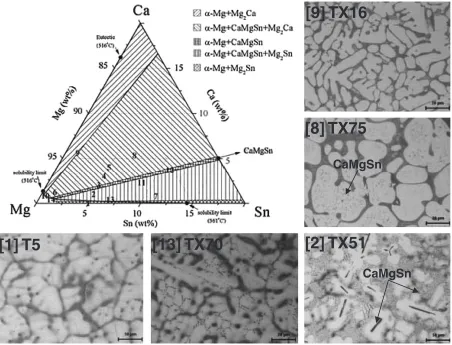
Mg2Ca are schematically outlined in Fig. 1 based on the
result shown in Table 1. The Optical microscopic images shown in Fig. 1 stand for typical microstructures observed for the alloys listed in Table 1. As expected, T5 (Mg-5 mass%Sn) alloy consisted of two phase microstructure,
-Mg primary dendrite and interdendritic Mg2Sn phases.
With small addition of Ca, CaMgSn phase newly formed together with Mg2Sn phase in TX51 (Mg-5
mass%Sn-1 mass%Ca) alloy. Noticeably, the ternary CaMgSn phase was present in two types of morphology; coarse rod-like phase in the grain interior and fine feather-like phase near inter-dendritic region. To identify these two types of the
No. Composition (mass%) Constitutive Abbrev. Remarks Mg Sn Ca Phases
1 95 5 — -Mg, Mg2Sn T5
2 94 5 1 -Mg, CaMgSn, Mg2Sn TX51
Mechanical 3 93 5 2 -Mg, CaMgSn, Mg2Ca TX52
properties 4 92 5 3 -Mg, CaMgSn, Mg2Ca TX53
5 91 5 4 -Mg, CaMgSn, Mg2Ca TX54
6 97.58 1.20 1.22 -Mg, CaMgSn, Mg2Ca TX11
7 88.15 11.10 0.75 -Mg, CaMgSn, Mg2Sn TX111
8 87.88 6.78 5.34 -Mg, CaMgSn, Mg2Ca TX75
9 93.23 1.18 5.59 -Mg, Mg2Ca TX16 Phase
10 98.70 0.48 0.82 -Mg, CaMgSn, Mg2Ca TX01 construction
11 88.75 8.98 2.72 -Mg, CaMgSn, Mg2Sn TX93 map
12 85.33 10.97 3.70 -Mg, CaMgSn TX114 13 92.70 6.91 0.39 -Mg, CaMgSn, Mg2Sn TX70
14 93.38 1.21 0.41 -Mg, CaMgSn TX10
[9] TX16
[8] TX75
[13] TX70
[1] T5
[2] TX51
CaMgSn
CaMgSn
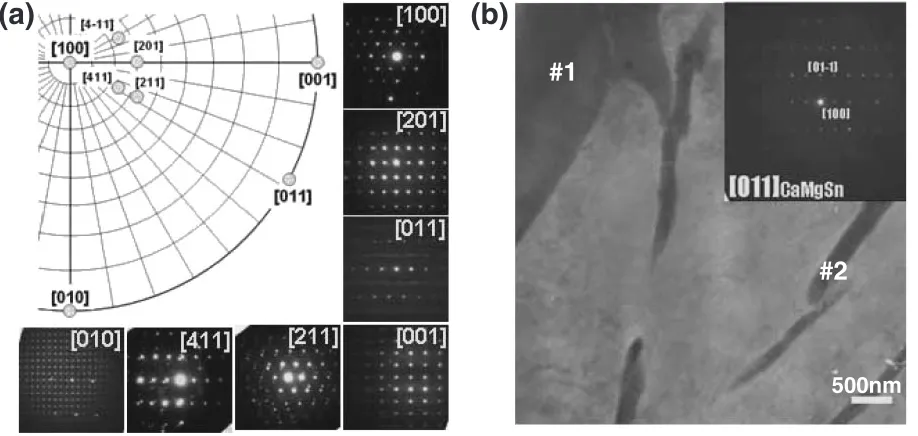
[image:2.595.46.291.192.390.2] [image:2.595.74.526.423.768.2]phase carefully, TEM analysis was performed. Figure 2(a) is the stereogram centered at [100] zone axis constructed by several diffraction patterns obtained from feather-like phase, clearly confirming the primitive orthorhombic structure of CaMgSn phase. Besides, selected area diffraction pattern obtained from coarse rod-like phase corresponded to [011] zone axis of CaMgSn phase, as shown in Fig. 2(b). Energy dispersive spectrum (EDS) results obtained from coarse rod-like (#1 position in Fig. 2(b)) and fine feather-like (#2 position in Fig. 2(b)) phases are listed in Table 2, confirming that the composition of two-types of phase is nearly similar. TEM and EDS analysis support that two types of phase have same crystal structure in spite of the different morphologies. When the amount of Ca increased further or exceeds the amount of Sn, eutectic Mg2Ca phase forms in inter-dendritic
region as shown in TX16 (Mg-1 mass%Sn-6 mass%Ca) alloy. In the regions between three two-phase regions of
-Mg + CaMgSn, -Mg + Mg2Sn and -Mg + Mg2Ca,
there are two three-phase regions of -Mg + CaMgSn + Mg2Sn and-Mg + CaMgSn + Mg2Ca as shown in TX70
(Mg-7 0.5 mass%Ca) and TX75 (Mg-7 mass%Sn-5 mass%Ca) alloy, respectively.
Among the microstructures in Fig. 1, it is, in particular, noticeable that the ternary CaMgSn phase is present in two types of morphology when the alloy compositions are located in the two phase region of-Mg and CaMgSn phases, coarse rod-like phase in the grain interior and fine feather-like phase near inter-dendritic region as shown in TX51 alloy. For detailed analysis on the solidification behavior, thermody-namic calculation was performed by using PandatÔ
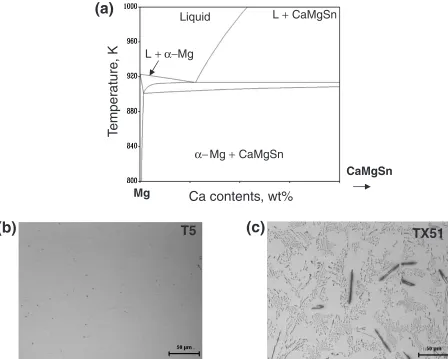
pro-gram. Figure 3(a) shows vertical-section between Mg and CaMgSn phase in ternary Mg-Sn-Ca system. There is a peudo-binary eutectic reaction between-Mg and CaMgSn phase near the composition of 1 mass% Ca. Considering the optical microscope image of TX51 alloy in Fig. 1, the coarse rod-like CaMgSn phase forms as a primary solidification phase when passing through L + CaMgSn region in hyper-eutectic composition range during solidification. Primary CaMgSn phase grows with rod-like shape in the liquid melt at initial solidification stage. The optical microscope image of TX51 alloy in Fig. 1 also clearly shows that -Mg halo forms around the primary CaMgSn phase. In general, when the composition difference between primary and the other eutectic phase is high enough, solute depleted zone easily forms around the primary solidification phase.14)At the later
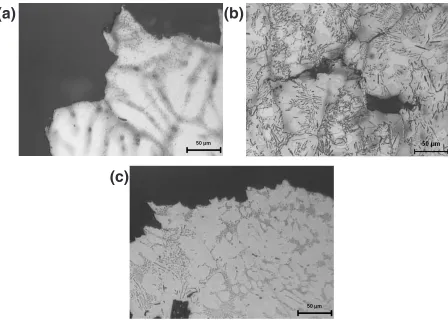
stage of solidification, eutectic reaction occurs resulting in the formation of fine feather-like CaMgSn phase embedded in the -Mg matrix since the pseudo-eutectic reaction composition is quite close to Mg. Figure 3(a) also shows that the pseudo-binary eutectic temperature is about 635C. To confirm the thermal stability of the CaMgSn phase, TX51 alloy was annealed at 500C for 24 h. For comparison, T5 alloy was annealed at the same condition. After heat treatment at 500C, CaMgSn phase remained stable, but
Mg2Sn phase dissolved into the matrix in TX51 alloy
(Fig. 3(c)), as can be seen clearly from the comparison with the as-cast microstructure of TX51 alloy in Fig. 1 (eutectic temperature of -Mg and Mg2Sn: 561C). The
result is further supported from the case of T5 alloy (Fig. 3(b)) where Mg2Sn phase perfectly dissolves into
the matrix. According to the thermodynamic data,12) two
invariant ternary eutectic reaction in Mg-rich region exist as follows; L! -Mg + CaMgSn + Mg2Sn at 561.81C
(Mg88:92Sn11:07Ca0:01), L! -Mg + CaMgSn + Mg2Ca
at 514.39C (Mg88:93Sn0:20Ca10:87). After pseudo-binary
eutectic reaction, solidification is terminated by selecting one of two ternary eutectic reactions, depending on the alloy
1
2
(b)
(a)
500nm
[image:3.595.71.530.76.294.2]Fig. 2 Phase identification using transmission electron microscopy: (a) Stereogram at [100] zone axis of the CaMgSn phase constructed by several diffraction patterns obtained from feather-like phase; and (b) Selected area diffraction pattern obtained from coarse rod-like phase.
Table 2 EDS results obtained from CaMgSn phase as shown in Fig. 2(b).
EDS (at%) Mg Ca Sn
[image:3.595.46.290.361.402.2]composition. To predict the microstructure evolution more clearly, the solidification behavior was calculated by Scheil’s model15,16)(complete mixing in liquid, no diffusion in solid).
The results about TX51 and TX52 alloy are described in Fig. 4(a) and (b). In both alloys, primary CaMgSn phase solidifies as a primary phase, and then pseudo binary eutectic reaction occurs at 638C. However, final stage of
solid-ification of remaining liquid in TX51 and TX52 is quiet different each other. In TX51 alloy, remained liquid solidifies by the ternary eutectic reaction; L !-Mg + CaMgSn + Mg2Sn at 561C. On the other hand, in TX52 alloy, remained
liquid solidifies by the ternary eutectic reaction; L! -Mg + Ca-MgSn + -Mg2Ca at 514C. Therefore, the phases
which form at the final stage of solidification are Mg2Sn and
Mg2Ca phases in TX51 and TX52 alloys, respectively. The
solidification behavior of TX51 and TX52 alloys can be clearly evidenced from the as-cast microstructures shown in Fig. 4(a) and (b). The final solidified phases in ternary eutectic region were identified as Mg2Sn and Mg2Ca phase
in TX51 and TX52 alloy, respectively, as marked by arrows in Fig. 4.
3.2 Mechanical properties at elevated temperature
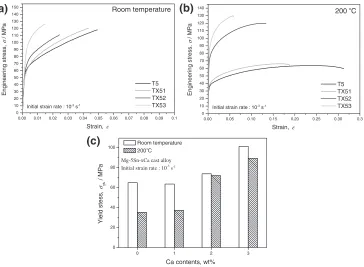
Figure 5 describes the tensile test results of these alloys at room temperature and 200C, respectively. T5 and TX51
alloys exhibited significant yield strength decrease at 200C.
Form the results of stress variations as shown in Fig. 5(c), it can be noticed that the high temperature yield strength remarkably improved above 2 mass% Ca. Compared with T5 alloy, the yield strength of TX51 alloy was also deteriorated significantly in spite of the existence of CaMgSn phase, indicating that primary and eutectic CaMgSn phase does not play a favorable role in enhancing the tensile properties. However, with increasing volume fraction of Mg2Ca phase,
high temperature strength was significantly improved, but ductility decreased (Fig. 5(b)).
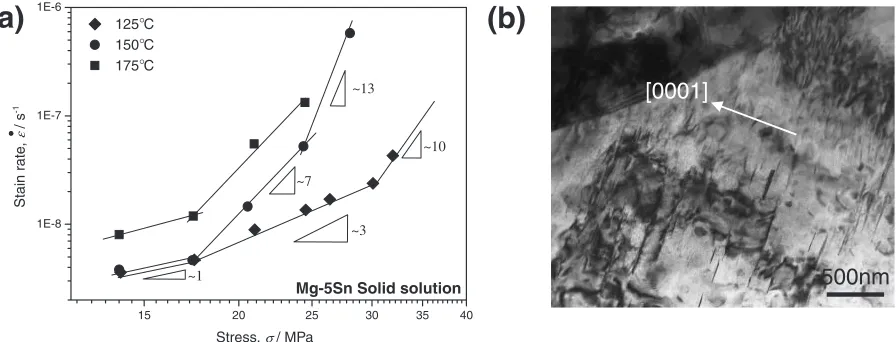
Figure 6(a) shows the creep properties of T5 binary alloy. From the double logarithmic plot of stress as a function of minimum creep rate, stress exponent, n, is determined by following power law creep equation:17)
_
"
"¼Anexp Q RT
;
where""_is minimum creep rate (or secondary strain rate) and
is applied stress, respectively. It can be observed that there is a significant variation in the stress exponent with stress and temperature. At the low stress regime, from the stress exponents (n¼1), it can be deduced that diffusional creep dominates the deformation behavior. At the medium stress regime, stress exponent of T5 alloy is increased from 3 to 7
α−
Mg
+
CaMgSn
Mg
CaMgSn
T5
TX51
(b)
(c)
T
emper
Ca contents, wt%
[image:4.595.74.522.75.434.2]above 150C. From these apparent stress exponents, creep
mechanism changes from glide to climb controlled creep above 150C. Detailed TEM analysis after creep deformation showed that dynamic precipitation of Mg2Sn occurrs above
150C as shown in Fig. 6(b). This precipitation may induce
the increment of stress exponent. However, the effect of precipitation on the deformation behavior is not dealt with in detail in the present study.
500 0.0 0.1 0.2 0.3 0.4 0.5 0.6 0.7 0.8 0.9 1.0
Mg2Sn CaMgSn
Liquid
V
olume fr
action, %
Temperature, °C
α-Mg TX51 500 0.0 0.1 0.2 0.3 0.4 0.5 0.6 0.7 0.8 0.9 1.0
Mg2Ca CaMgSn
Liquid
V
olume fr
action, %
Temperature, °C
α-Mg
TX52
(a)
(b)
Ternary Eutectic
with Mg
2Sn
Ternary Eutectic
with Mg
2Ca
725 700 675 650 625 600 575 550
525 525 550 575 600 625 650 675 700 725
Fig. 4 Solidification behavior calculated using Scheil’s model and comparison with optical microstructures in (a) TX51; and (b) TX52 alloy, respectively. 0 0 20 40 60 80 100 Y ield stess , σys / MP a
Ca contents, wt%
Room temperature 200°C
Mg-5Sn-xCa cast alloy Initial strain rate : 10-3s-1
0.00 0 10 20 30 40 50 60 70 80 90 100 110 120 130 140 T5 TX51 TX52 TX53 Engineer ing stress , σ / MP a
Strain, ε
200°C
Initial strain rate : 10-3 s-1
(a)
(b)
(c)
0.00 0 10 20 30 40 50 60 70 80 90 100 110 120 130 140 150 T5 TX51 TX52 TX53 Engineer ing stress , σ / MP aStrain, ε
Room temperature
Initial strain rate : 10-3 s-1
0.1 0.09 0.08 0.07 0.06 0.05 0.04 0.03 0.02
0.01 0.05 0.10 0.15 0.20 0.25 0.30 0.3
3 2
1
Fig. 5 Tensile test results of TX series alloys: (a) Stress-strain curves at room temperature; (b) Stress-strain curves at 200C; and
[image:5.595.75.525.74.385.2] [image:5.595.119.483.429.696.2]Figure 7(a) shows creep properties of T5, TX51 and TX52 alloys at 150C. Generally, when the Ca content increased,
minimum creep rate decreased. Especially, creep resistance is remarkably improved above 2 mass% Ca content. This behavior shows similar tendency with the tensile test results at high temperature regime. Stress exponents of all the alloys show dislocation creep climb controlled behavior similar to T5 alloy. Figure 7(b) shows temperature dependence of creep behavior for TX52 alloy under 50 MPa. The activation energy of TX52 alloy was found to be 74 kJ/mol under loading condition of 50 MPa. This value is close to that of grain boundary diffusion for pure magnesium, 92 kJ/mol.18)
From the above results, high temperature mechanical proper-ties are remarkably improved when the Ca contents increases above 2 mass%. According to the pre-described microstruc-ture/phase analysis, this improvement attributed to the presence of Mg2Ca phase.
4. Discussion
4.1 The effect of morphology of CaMgSn phase on the mechanical properties
As mentioned above, CaMgSn phase has two types of morphology due to its pseudo eutectic solidification behav-ior. Though the CaMgSn phase shows high thermal stability,
it does not provide beneficial effects on the tensile mechan-ical properties. This fact can be attributed to its solidification morphology of the CaMgSn primary phase. Figure 8 shows the fractured surface scanning electron microscopy (SEM) image after tensile test of TX51 alloy. It can be observed that primary CaMgSn phase acts as crack initiation sites during
15
Mg-5Sn Solid solution
Stress, σ / MPa
500nm
40 35 30 25 20
1
Fig. 6 Creep properties of T5 alloy: (a) Double logarithmic plot of stress as a function of minimum creep rate by power-law equation; and (b) Dynamic precipitation behavior in matrix after creep deformation at 150C under 40 MPa.
20 1E-8
1E-7
T5 TX51 TX52
Str
ain r
a
te
,
ε
/ s
-1
Stress, σ / MPa
150°C
7
2.46x10⁻⁴ 2.49x10⁻⁴ 2.52x10-42.55x10-42.58x10⁻⁴ 2.60x10⁻⁴ 2.63x10-42.66x10-4 -19.0
-18.5 -18.0 -17.5 -17.0 -16.5 -16.0 -15.5
144.55kJ/mol
ln (Str
ain r
ate), ln(
ε
) / s
-1
1/RT, 1/kJ/mol x K
73.91kJ/mol
TX52 under 50MPa
)
b
(
)
a
(
100 90 80 70 60 50 40 30
Fig. 7 Creep properties of TX series alloys: (a) Stress dependence behavior at 150C; and (b) Temperature dependence behavior under
50 MPa in TX52 alloy.
CaMgSn
[image:6.595.77.525.74.245.2] [image:6.595.116.482.301.442.2] [image:6.595.316.537.491.668.2]deformation. Namely, ductile fracture is originated from the primary CaMgSn phase in grain interior. This means that primary CaMgSn phase can affect negatively on the tensile properties. In order to examine the effect of cooling rate on morphology of CaMgSn phase, rapidly solidified specimen by injection casting was prepared for mechanical test. In injection casting method, inductively re-melted sample in a fused silica tube is injected through a nozzle into water-cooled copper mold, having cylindrical cavity having 5 mm diameter and 50 mm height. Rapid cooling rate can effec-tively suppress growth of primary CaMgSn phase in TX51 alloy as shown in Fig. 9(a). According to the stress-strain
curves obtained from tensile test, injection cast alloy shows higher mechanical properties than mold cast alloy (Fig. 9(b)). This result shows that formation of coarse primary CaMgSn phase can be avoided by high cooling rate processing. Further works about rapid cooling rate effect on the mechanical properties are in progress.
4.2 The effect of constituent phases on the elevated temperature properties
Figure 10 shows creep rupture behavior after deformation at 200C. In the alloys containing Mg2Sn phase, creep
rupture occurs along the inter-granular boundary as shown in
0.00 0 25 50 75 100 125 150 175 200
TX51 alloy
Mold cast Injection cast Tensile test
Initial strain rate : 10-3 Room temperature
Engineer
ing Stress
σ
/ MP
a
Strain, ε
)
b
(
)
a
(
0.15 0.10
0.05
Fig. 9 Effect of cooling rate on tensile properties: (a) Optical microstructure of rapid solidified TX51 alloy; and (b) Comparison of tensile properties depending on the processing conditions.
(a)
(b)
[image:7.595.89.514.75.230.2](c)
[image:7.595.74.522.284.605.2]Fig. 10(a) and (b). On the other hand, TX52 alloy containing Mg2Ca phase shows trans-granular fracture as shown in
Fig. 10(c). This means that eutectic Mg2Ca phase shows
better boundary strengthening than Mg2Sn phase. Therefore,
it is considered that Mg2Ca phase effectively inhibits grain
boundary sliding during creep deformation.
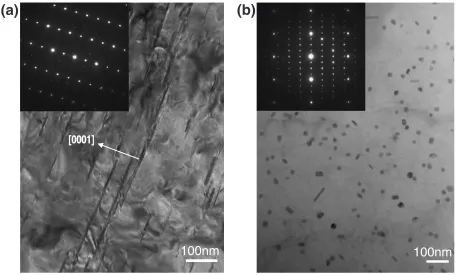
Figure 11 shows precipitation behavior of T5 and TX53 alloy after creep deformation at 200C under 40 MPa and
50 MPa loading, respectively. As mentioned above, T5 alloy shows dynamic precipitation behavior. Mostly, rod-like Mg2Sn precipitates lie along basal plane of-Mg. Compared
to the dynamic precipitation at 150C as shown in Fig. 6(b),
theses precipitates appears to be coarser. (Fig. 11(a)). On the other hand, in TX53 alloy, there is precipitation behavior, too. However, it can be observed that these fine precipitates remain stable without coarsening after creep deformation at 200C. According to the selected area diffraction pattern, theses precipitates were identified as Mg2Ca phase as shown
in Fig. 11(b). Mg2Ca precipitates exhibit various types of
morphology; rod, spherical and short rod type. Rod-like precipitates have an orientation relationship with matrix;
ð0001ÞMg2Ca==ð0001ÞMg and h211110iMg2Ca==h10110iMg. This
relationship corresponds to that reported in the previous report.19)From these results, it can be deduced that Mg
2Ca
precipitates are more effective on creep resistance than Mg2Sn due to high thermal stability against coarsening.
5. Conclusions
In the present study, we have investigated the relationship between microstructural evolution and mechanical properties in Mg-Sn-Ca alloys. Major conclusions can be summarized as follows.
(1) As-cast microstructures of Mg-Sn-Ca alloy consist of two or three phase depending on the Ca/Sn ratio, i.e. Mg2Sn,
CaMgSn and Mg2Ca phases.
(2) CaMgSn phase has two types of morphology due to its pseudo hyper-eutectic reaction with -Mg, i.e. coarse rod-like primary phase and feather-rod-like eutectic phase.
(3) Primary solidified CaMgSn phase exhibits negative effect on the tensile properties due to its solidification morphology. (4) According to the creep test results of TX series alloys, apparent stress exponent value shows dislocation climb controlled mechanism by core diffusion (n¼7) above 150C. Activation energy of TX52 alloy (74 kJ/mol) is close
to grain boundary diffusion for pure magnesium, 92 kJ/mol. (5) Creep resistance remarkably improves with the presence of Mg2Ca phase. The Mg2Ca phase changed the fracture
behavior from inter-granular to trans-granular fracture mode. Mg2Ca precipitates show higher thermal stability against
coarsening that Mg2Sn precipitates.
Acknowledgements
This study was supported by a grant from the Fundamental R&D Program for Core Technology of Materials funded by the Ministry of Commerce, Industry and Energy, Republic of Korea, and the Global Research Laboratory Program of Korea Ministry of Science and Technology. Ju Youn Lee, Joon Seok Kyeong and Hyun Kyu Lim are grateful for the support by Second Stage of Brain Korea 21 Program.
REFERENCES
1) B. L. Mordike: Mater. Sci. Eng. A324(2002) 103–112.
2) K. U. Kainer and F. von Buch:Magnesium alloys and technology, ed.
100nm
[0001]
[0001]
[image:8.595.70.527.73.348.2]100nm
Fig. 11 Bight field images obtained from as-crept at 200C: (a) T5 under 40 MPa loading. (b) TX53 alloy under 50 MPa loading,
by K. U. Kainer, (Wiley-VCH, 2003).
3) C. J. Bettles and M. A. Gibson: Magnesium Alloys and Their Applications, ed. by K. U. Kainer, (Weinheim, 2004).
4) A. A. Nayeb-Hashemi and J. B. Clark: Phase diagrams of binary magnesium alloy, (ASM International, 1988).
5) Y. Terada, Y. Mori and T. Sato: Mater. Trans.48(2007) 97–100. 6) Y. Nakaura, A. Watanabe and K. Ohori: Mater. Trans. 47 (2006)
1031–1039.
7) Y. Terada, N. Ishimatsu, Y. Mori and T. Sato: Mater. Trans.46(2005) 145–147.
8) D. H. Kang, S. S. Park and Nack J. Kim: Mater. Sci. Eng. A413–414
(2005) 555–560.
9) D. H. Kang, S. S. Park, Yoon S. Oh and Nack J. Kim: Mater. Sci. Eng. A449–451(2007) 318–321.
10) N. Hort, Y. Huang, T. A. Leil, P. Maier and K. U. Kainer: Adv. Eng. Mater.8(2006) 359–364.
11) T. A. Leil, Y. Huang, H. Dieringa, N. Hort, K. U. Kainer, J. Bursik, Y. Jiraskova and K. P. Rao: Mater. Sci. Forum546–549(2007) 69–72. 12) A. Kozlov, M. Ohno, R. Arroyave, Z. K. Liu and R. Schmid-Fetzer:
Intermetallics16(2008) 299–315.
13) A. Kozlov, M. Ohno, R. Arroyave, Z. K. Liu and R. Schmid-Fetzer: Intermetallics16(2008) 316–321.
14) P. Gordon: Principles of phase diagrams in materials systems, (McGraw-Hill, 1968).
15) E. Scheil: Z. Metallkde34(1942) 70.
16) D. Stefanescu: Science and Engineering of Casting Solidification, (Kluwer Academic/Plenum Publishers, 2002).
17) T. H. Courtney:Mechanical behavior of Materials, (McGraw Hill Int. Ed. 2000).
18) H. J. Frost and M. F. Ashby:Deformation-mechanism maps, (Perga-mon press, 1982).