Effect of Nb addition on mechanical properties and shape memory behavior of Ti–Mo–Ga alloys was investigated by cyclic loading-unloading tensile tests, tensile tests at various temperatures and Vickers hardness tests. The martensitic transformation start temperature (Ms) decreased by 20 K with 1 at% increase of Nb content in the Ti–6Mo–3Ga(at%) alloy. The shape memory effect was observed in the Ti–6Mo– 3Ga(at%) alloy. The superelastic strain increased with increasing Nb content. The increase of the yield stress during the cyclic deformation decreased the strain recovery rate in the Ti–6Mo–3Ga(at%) alloy. Aging at intermediate temperatures resulted in increase in hardness of the Ti– 6Mo–3Ga–(0–4)Nb(at%) alloys. The increase in hardness decreased significantly with increasing Nb content because the addition of Nb was effective to suppress the!phase hardening. The yield stress decreased and the strain recovery rate increased with increasing number of cycle in the Ti–6Mo–3Ga–4Nb(at%) alloy.
(Received October 11, 2005; Accepted December 16, 2005; Published March 15, 2006)
Keywords: shape memory alloy, superelasticity, biomaterial, smart material, titanium based alloy
1. Introduction
Ni-free Ti-based shape memory alloys have attracted much interest in recent years because of their potential applications for biomedical devices. Ti-based alloys have been developed for biomedical applications such as artificial bones, joints and dental materials due to their high biocompatibility and good
mechanical properties.1,2) It has been well known that a
martensitic transformation form (disordered BCC) to
orthorhombic martensite (00) and its reverse transformation
are related to the shape memory behavior of the -type Ti
alloys.3,4)The shape memory effect and superelastic behavior
have been reported in Ti-based alloys.5–15)We have reported
that Ti–Mo–Ga alloys exhibited excellent superelastic
behavior with a recovery strain of 4%.9) But, the Ti–Mo
based alloys are susceptible to! phase embrittlement. It is
generally acknowledged that the formation of!phase leads
to severe loss of ductility. A premature failure occurred in the Ti–Mo–Ga alloys subjected to annealing at intermediate
temperatures.16)In this study, the effect of Nb addition on
mechanical properties and shape memory behavior of Ti– Mo–Ga alloys was investigated. The effect of Nb addition on
!phase embrittlement is also reported.
2. Experimental Procedures
Ti–6Mo–3Ga–(0–4)Nb(at%) alloy ingots were prepared
by the Ar arc melting method. Hereafter, Ti–xMo–yGa–
zNb(at%) is abbreviated to Ti–xMo–yGa–zNb. The ingots
were sealed in vacuum into a quartz tube and homogenized at 1373 K for 86.4 ks, and then cold-rolled with the reduction of 95% in thickness. Specimens for the tensile tests and Vickers hardness measurements were cut from the cold-rolled sheet by an electro-discharge machine. The specimens were cleaned with ethanol, wrapped in Ti foils and encapsulated in quartz tubes under a 3.3 kPa partial pressure of high-purity Ar, and then annealed at 1073 K for 120 s. Some specimens
were aged at temperatures between 573 and 1073 K for 60 s after the annealing. The specimens were quenched into water by breaking the quartz tubes. The oxidized surface was removed by mechanical polishing followed by electro-polishing. The final thickness of specimens was about 0.4 mm. Bending tests were carried out at room temperature where the specimens were deformed into a round shape with a diameter of 10 mm and heated up to approximately 500 K.
Tensile tests were carried out at a strain rate of 1:67
104s1 at various temperatures between 223 and 383 K
using a Shimadzu AG-A universal testing machine. The gage length of the specimens was 20 mm. The shape memory behavior was investigated by strain increment cyclic tensile tests at room temperature. Vickers hardness was measured more than ten points where applied load and time were 200 g and 10 s, respectively, using an Akashi HM-102 Vickers hardness tester.
3. Results and Discussion
Figure 1 shows a result of bending test for a Ti–6Mo–3Ga alloy subjected to heat treatment at 1073 K for 120 s. It is clearly seen that the specimen bent at room temperature recovered to the original straight shape by heating up to 500 K. The alloy exhibits a perfect shape memory effect within a strain of 3.5% by the bending test. The shape memory behavior was also investigated by cyclic loading-unloading tensile tests. Figure 2 shows stress–strain curves of the Ti–6Mo–3Ga alloy subjected to heat treatment at 1073 K for 120 s. Each stress–strain curve and strain recovery were obtained at room temperature by a loading and unloading cycle followed by heating: broken lines with an arrow indicate the shape recovery by heating. The similar measure-ment was repeated by increasing the maximum strain upon loading in a same sample. The starting points of the stress– strain curves are shifted in order that they are separated each other. Almost perfect shape memory effect was observed at the first and the second cycle. The plastic strain remained after heating increased with increasing tensile strain. It is
noted that the apparent yield stress indicated by an arrow increased with increasing number of cycle until the 3rd cycle. The apparent yield stress was defined by the 0.2% offset yield stress in this study. It was reported that the shape memory effect in the Ti–6Mo–3Ga alloy was mainly due to the stress induced martensitic transformation during tensile
deforma-tion followed by the reverse transformadeforma-tion during heating.9)
Thus, the increase in the apparent yield stress means that the critical stress to induce the martensitic transformation increases during the cyclic deformation in the Ti–6Mo–3Ga alloy. This is opposite tendency observed in Ti–Ni alloys during cyclic deformation. It has been reported that the critical stress to induce the martensitic transformation decreases with increasing cyclic deformation in the Ti–Ni alloys, since the internal stress formed by a slip deformation
assists the formation of the stress induced martensites.17,18)It
is supposed that the increase in yield stress during cyclic
deformation in the Ti–6Mo–3Ga alloy is due to the!phase
formed during heating for each cycle.
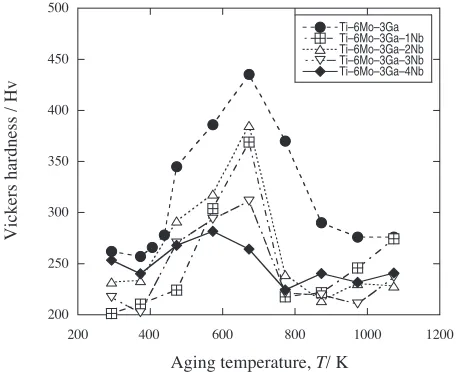
The Vickers hardness was measured in Ti–6Mo–3Ga–(0– 4)Nb alloys which were subjected to aging treatment at temperatures between 373 and 1073 K for 60 s. Figure 3 shows the change in hardness as a function of heat treatment temperature. Aging the specimens at intermediate temper-atures resulted in increase in hardness of the Ti–6Mo–3Ga– (0–4)Nb alloys. The rate of increase in hardness is distinctly more rapid in the Ti–6Mo–3Ga alloy. For the Ti–6Mo–3Ga alloy, the hardness increased rapidly with increasing aging temperature up to 673 K. This result is consistent with
previous works that!phase forms on aging at temperatures
up to about 723 K in Ti–Mo based alloys.19,20) The rate of
increase in hardness decreased significantly with increasing Nb content. This result obviously indicates that the addition
of Nb suppressed the formation of thermal!phase in the Ti–
6Mo–3Ga alloy.
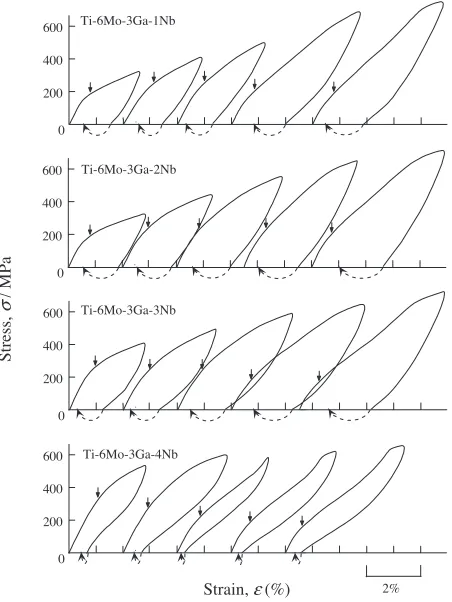
Figure 4 shows stress–strain curves of the Ti–6Mo–3Ga– (1–4)Nb alloys subjected to heat treatment at 1073 K for 120 s. The Ti–6Mo–3Ga–(1–3)Nb alloys exhibit the shape memory effect at the first cycle. A small amount of strain recovered superelastically during unloading in the Ti–6Mo– 3Ga–3Nb alloy. The strain mainly recovered superelastically in the Ti–6Mo–3Ga–4Nb alloy. This indicates that the addition of Nb decreased the martensitic transformation temperature. The yield stress increased slightly at the second cycle in the Ti–6Mo–3Ga–1Nb and Ti–6Mo–3Ga–2Nb alloys. But, no increase of yield stress was observed in the Ti–6Mo–3Ga–3Nb and Ti–6Mo–3Ga–4Nb alloys during the cyclic deformation. The yield stresses were evaluated using the stress–strain curves of the Ti–6Mo–3Ga–(0–4)Nb alloys and they are plotted as a function of number of cycle in Fig. 5. The yield stress increased during cyclic deformation reaching a maximum yield stress at the 3rd cycle, and then the yield stress decreased gradually with increasing number of cycle for the Ti–6Mo–3Ga alloy. The maximum yield stress was obtained at the 2nd or 3rd cycles for the Ti–6Mo– 3Ga–1Nb and Ti–6Mo–3Ga–2Nb alloys, respectively. On the other hand, the yield stress decreased monotonously with increasing number of cycle for the Ti–6Mo–3Ga–4Nb alloy. This result also confirms that the Nb is effective to suppress
the!phase hardening.
In order to clarify the effect of Nb addition on shape
Fig. 1 A result of bending test for the Ti–6Mo–3Ga alloy: (a) after deformation and (b) after heating up to 500 K.
0 200 400 600 800
Strain,ε(%)
Stress,
σ
/
MPa
2%
Fig. 2 Stress–strain curves obtained by cyclic loading-unloading tensile tests for the Ti–6Mo–3Ga alloy.
200 250 300 350 400 450 500
200 400 600 800 1000 1200
Ti–6Mo–3Ga Ti–6Mo–3Ga–1Nb Ti–6Mo–3Ga–2Nb Ti–6Mo–3Ga–3Nb Ti–6Mo–3Ga–4Nb
Vickers hardness / Hv
Aging temperature, T/ K
[image:2.595.116.483.73.189.2] [image:2.595.313.541.229.415.2] [image:2.595.56.283.229.319.2]memory properties, the strain recovery rates of Ti–6Mo–3Ga and Ti–6Mo–3Ga–4Nb alloys are compared in Fig. 6 as a function of number of cycle. The strain recovery rate of Ti– 6Mo–3Ga alloy decreased between the first and the third cycles. This is caused by the increase of the critical stress to induce the martensitic transformation in the Ti–6Mo–3Ga alloy during the cyclic deformation. Slip occurs if the stress level for slip deformation becomes lower than the critical stress to induce the martensite. Thus, it is suggested that the
increase of the critical stress by the formation of ! phase
increased the permanent strain by slip deformation, and resulted in the decrease of the strain recovery rate during the cyclic deformation. On the other hand, the strain recovery rate increased during the cyclic deformation in the Ti–6Mo– 3Ga–4Nb alloy. This is consistent with the decrease of the critical stress to induce the martensitic transformation in the Ti–6Mo–3Ga–4Nb alloy during the cyclic deformation as shown in Fig. 5.
Figure 7 shows a series of stress–strain curves obtained at various temperatures for the Ti–6Mo–3Ga–2Nb alloy. Ten-sile stress was applied until strain reached about 3% and then the stress removed followed by heating to measure the strain recovery. The shape memory effect was observed in the Ti– 0
200
2% Ti-6Mo-3Ga-3Nb
0 600
400
200
Strain,ε(%)
Stress,
σ
/
MPa
Ti-6Mo-3Ga-4Nb
0 600
400
200
Fig. 4 Stress–strain curves obtained by cyclic loading-unloading tensile tests for of the Ti–6Mo–3Ga–(1–4)Nb alloys.
100 200 300 400 500 600
1 2 3 4 5 6 7 8
Ti–6Mo–3Ga Ti–6Mo–3Ga–1Nb Ti–6Mo–3Ga–2Nb Ti–6Mo–3Ga–3Nb Ti–6Mo–3Ga–4Nb
Yield stress,
σ
/ MPa
Number of cycle
Fig. 5 Change of yield stress of the Ti–6Mo–3Ga–(0–4)Nb alloys during the cyclic deformation.
70 75
0 1 2 3 4 5 6
Ti-6Mo-3Ga Ti-6Mo-3Ga-4Nb
Strain recovery rate (%)
Number of cycle
Fig. 6 Comparison of recovery rates between the Ti–6Mo–3Ga and Ti– 6Mo–3Ga–4Nb alloys during the cyclic deformation.
223K
0 600
400
200
243K 263K
283K
0 600
400
200
297K 323K
343K
2 3 0
600
400
200
363K
2 3
383K
2 1 1
1 3
Stress,
σ
/
MPa
Strain,ε(%)
[image:3.595.313.543.70.266.2] [image:3.595.58.284.73.374.2] [image:3.595.313.542.323.565.2] [image:3.595.58.284.433.626.2]6Mo–3Ga–2Nb alloy in the temperature region between 223 and 383 K. The residual strain after unloading was almost completely recovered by heating to about 500 K for the specimens deformed at temperatures between 263 and 297 K. On the other hand, the superelastic behavior was observed in the Ti–6Mo–3Ga–4Nb alloy as shown in Fig. 8. This result is reasonable since the Nb decreases the martensitic trans-formation temperature in Ti-based alloys. The temperature dependence of yield stress for the Ti–6Mo–3Ga–2Nb and Ti– 6Mo–3Ga–4Nb alloys is plotted in Fig. 9. The minimum critical stress is observed at 298 and 263 K in the Ti–6Mo– 3Ga–2Nb and Ti–6Mo–3Ga–4Nb alloys, respectively. The temperature exhibiting the minimum yield stress is taken as
the martensitic transformation start temperature (Ms).11–13)
The critical stress increased with decreasing temperature
from the minimum stress point. This is because the stress for the rearrangement of martensite variants increases with decreasing temperature. On the other hand, the critical stress increases with increasing temperature from the minimum stress point since the stress for inducing martensites increases with increasing temperature, which is in accordance with the Clausius–Clapeyron relationship.
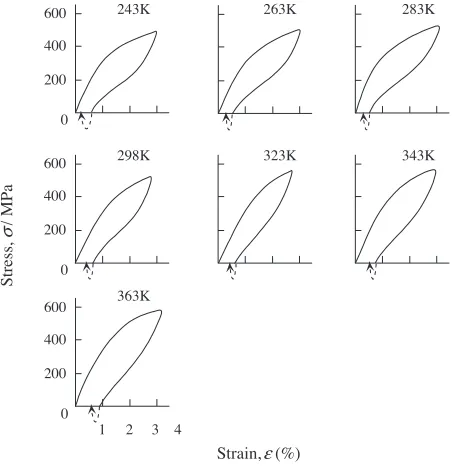
It is noted that the superelastic behavior was observed in the temperature range between 243 and 283 K in which the minimum critical stress was obtained for the Ti–6Mo–3Ga– 4Nb alloy as shown in Fig. 8. For the Ti–Ni shape memory
alloy, the superelastic behavior does not appear at the Ms
temperature because the start temperature for the reverse
transformation (As) is higher than theMs. It is supposed that
the As temperature is lower thanMs in the Ti–6Mo–3Ga–
4Nb alloy due to the large temperature difference between
Ms and Mf. The large temperature difference between Ms
and Mf has been also reported in the Ti–Nb based
alloys.11,13,15)
[image:4.595.311.541.73.263.2]The superelastic strain decreased with increasing temper-ature for the Ti–6Mo–3Ga–4Nb alloy. This result can be explained by the difference in the temperature dependence of the critical stress for inducing martensites and the stress for slip deformation. The critical stress to induce the martensites increases with increasing temperature, while the stress for slip deformation decreases with increasing temperature. Thus, the permanent strain by slip deformation increases with increasing temperature, causing the recoverable strain to decrease.
Figure 10 shows the Nb content dependence of the Ms
temperature in the Ti–6Mo–3Ga alloy. The temperature
exhibiting the minimum critical stress was taken asMs. The
Ms linearly decreases with increasing Nb content: the Ms
decreased by 20 K with 1 at% increase of Nb content. The Mo
and Ga also decreaseMs in Ti-based alloys.9)This means that
the shape memory effect or superelastic behavior is achiev-able at body temperature by controlling Mo and Ga contents, suggesting that the Ti–Mo–Ga–Nb alloy can be a candidate material for the biomedical shape memory alloys.
243K
0 600
400
200
263K 283K
298K
0 600
400
200
323K 343K
363K
2 1 3 4 0
600
400
200
Stress,
σ
/
MPa
Strain,ε(%)
Fig. 8 Stress–strain curves obtained at various temperatures for the Ti– 6Mo–3Ga–4Nb alloy.
100 200 300 400 500
200 250 300 350 400
Ti-6Mo-3Ga-2Nb Ti-6Mo-3Ga-4Nb
Stress,
σ
/
MPa
Temperature, T/K
Fig. 9 Temperature dependence of yield stress for the Ti–6Mo–3Ga–2Nb and Ti–6Mo–3Ga–4Nb alloys.
200 250 300 350 400
0 1 2 3 4
Ms
temperature,
T
/K
Nb content(at%)
[image:4.595.57.288.74.307.2] [image:4.595.56.283.363.552.2]increase in hardness of the Ti–6Mo–3Ga–(0–4)Nb alloys. The increase in hardness decreased significantly with increasing Nb content.
(3) The addition of Nb was effective to suppress the !
phase hardening during the cyclic deformation followed by heating. The critical stress to induce martensites decreased and the strain recovery rate increased with increasing number of cycle in the Ti–6Mo–3Ga–4Nb alloy.
(4) The martensitic transformation start temperature (Ms)
decreased by 20 K with 1 at% addition of Nb content in the Ti–6Mo–3Ga alloy.
Acknowledgments
This work was partially supported by the ILC Project from University of Tsukuba the 21 Century Center of Excellence Program and the Grants-in-Aid for Fundamental Scientific Research (Kiban A (1999–2001), Kiban A (2002–2004)) from the Ministry of Education, Culture, Sports, Science and Technology, Japan.
Mater. Trans.43(2002) 2978–2983.
7) T. Maeshima and M. Nishida: Mater. Trans.45(2004) 1096–1100. 8) T. Maeshima and M. Nishida: Mater. Trans.45(2004) 1101–1105. 9) H. Y. Kim, Y. Ohmatsu, J. I. Kim, H. Hosoda and S. Miyazaki: Mater.
Trans.45(2004) 1090–1095.
10) Y. Fukui, T. Inamura, H. Hosoda, K. Wakashima and S. Miyazaki: Mater. Trans.45(2004) 1077–1082.
11) H. Y. Kim, H. Satoru, J. I. Kim, H. Hosoda and S. Miyazaki: Mater. Trans.45(2004) 2443–2448.
12) J. I. Kim, H. Y. Kim, H. Hosoda and S. Miyazaki: Mater. Trans.46
(2005) 852–857.
13) J. I. Kim, H. Y. Kim, T. Inamura, H. Hosoda and S. Miyazaki: Mater. Sci. Eng. A403(2005) 334–339.
14) H. Y. Kim, T. Sasaki, K. Okutsu, J. I. Kim, T. Inamura, H. Hosoda and S. Miyazaki: Acta Mater.54(2006) 423–433.
15) H. Y. Kim, S. Hashimoto, J. I. Kim, T. Inamura, H. Hosoda and S. Miyazaki: Mater. Sci. Eng. A417(2006) 120–128.
16) Y. Ohmatsu, H. Hosoda and S. Miyazaki: 4th Pacific Rim Inter. Conf. Adv. Mater. Proc., (The Japan Inst. Metals, 2001) pp. 1627–1629. 17) S. Miyazaki, T. Imai, Y. Igo and K. Otsuka: Metall. Trans. A17A
(1986) 115–120.
18) S. Miyazaki: Engineering Aspects of Shape Memory Alloys (Ed. by T. W. Dueriget al.), Butterworth-Heineman (1990) 452–469. 19) F. Langmayr, P. Fratzl, G. Vogl and W. Miekeley: Phys. Rev. B49
(1994) 11759–11766.