Journal of Documentation
A Context-based Study of Serendipity in Information Research among Chinese ScholarsJournal: Journal of Documentation
Manuscript ID JD-05-2017-0079.R1
Manuscript Type: Article
Keywords: Serendipity, Context, Model, information encountering, Information Science, Information retrieval
Journal of Documentation
A Context-based Study of Serendipity in Information
Research among Chinese Scholars
Purpose: The current understanding of serendipity is based primarily on studies employing Westerners as participants, and it remains uncertain whether or not this understanding would be pervasive under different cultures, such as in China. In addition, there is not a sufficient systematic investigation of context during the occurrence of serendipity in current studies. This paper examines the above issues by conducting a follow-up empirical study with a group of Chinese scholars.
Design/methodology/approach: The social media application “Wechat” was employed as a research tool. A diary-based study was conducted and 16 participants were required to send to the researchers any cases of serendipity they encountered during a period of two weeks, and this was followed by a post-interview.
Findings: Chinese scholars experienced serendipity in line with the three main processes of: encountering unexpectedness, connection-making and recognising the value. An updated context-based serendipity model was constructed, where the role of context during each episode of experiencing serendipity was identified, including the external context (e.g. time, location and status), the social context, and the internal context (e.g. precipitating conditions, sagacity/perceptiveness and emotion).
Originality/value: The updated context model provides a further understanding of the role played by context during the different processes of serendipity. The framework for experiencing serendipity has been expanded, and this may be used to classify the categories of serendipity.
Keywords: serendipity, context, model, information encountering
Paper type: Research paper
1. Introduction
Research into serendipity has been ongoing since the term “serendipity” was first coined by Horace Walpole in 1754, in reference to the Three Princes of Serendip, who were always making discoveries by accident. Studies relating to serendipity can be found in various disciplines, including information studies (Foster and Ford, 2003), 6
Journal of Documentation
human computer interaction (Sun et al., 2011), social science (Merton, 2004), careerresearch (Bright et al., 2005), arts and humanities (Delgadillo and Lynch, 1999), psychology (Heinström, 2006), organisation (Cunha et al., 2010), and medicine (Allegaert, 2013).
However, regardless of the increasing interest in the understanding of serendipity, an interesting discovery revealed from our review of current studies is that the proposed frameworks or theoretical models for serendipity were formed primarily on the basis of taking Westerners as the research subjects (e.g. Makri and Blandford, 2012a; McCay-Peet and Toms, 2015). This led to our thinking about whether or not these research findings would be pervasive under different cultures, such as in China.
In addition, although a number of theoretical models for serendipity have been put forward by various researchers (Erdelez, 2004; Makri and Blandford, 2012a; McCay-Peet and Toms, 2015; Rubin et al., 2011), very few of these studies have examined the occurrence of serendipity from a systematic perspective of context. The empirical studies by Points et al. (2015) showed contextual factors such as location, activity and focus can influence a user’s experience of serendipity. Kefalidou and Sharples’s (2016) study also found that time, location, and the content of a text message can also impact a user’s experience of serendipity. Serendipity, as part of a wider behaviour model, is considered as “the product of context” (Foster and Ellis, 2014, p.18),and the role of context in fostering serendipity deserves to be understood in its own right.
We previously undertook a mobile-diary study to understand serendipity among a group of British researchers (Sun et al., 2011). Eleven British scholars participated in that study, and we received 23 serendipity cases within one week. The outcome of the study was that we identified the perception of serendipity among these British researchers and made an initial probe into the role of context in serendipitous experiences (See Figure 1). We identified two different levels of abstraction that can lead to a positive outcome during a serendipitous experience, including level of abstraction 1 “the unexpected finding of information” and level of abstraction 2 “making unexpected connections between pieces of information”, and in some cases level of abstraction 1 can lead to level of abstraction 2. Context played a role in affecting the experiencing of serendipity, and it has been examined from the three perspectives of: people (active or less active), temporal factors, and environment (i.e. working environments, places, and changing environments). We then adopted Schmidt’s (2000) context model to denote the relationship between the role of the 6
Journal of Documentation
individual and their context in serendipity by considering different elements, such asan individual’s level of attention, pressure, and focus under the effects of the physical environment, the social environment and the time. However, limited by the perception of serendipity at that time, we only discussed these elements as different factors having an influence on participants’ readiness to experience serendipity, and thereby failed to make a further examination of how these elements would act during the separated processes of serendipitous encountering.
Based on our previous study and the inspiring achievements made in the field of serendipity study in recent years, we carried out a follow-up empirical study among a group of Chinese scholars with the following research aims:
• To identify whether the current understanding of serendipity can also be adapted to Chinese scholars;
• To further investigate the role played by context during the different processes of experiencing serendipity.
{Insert Figure 1 here}
2. Background
2.1 Context in serendipity research
In recent decades, a number of researchers have performed different studies with respect to serendipity, although these researchers have not reached a consensus on the definition of serendipity. For example, van Andel (1994) defines serendipity as “the art of making an unsought finding”, while Fine and Deegan (1996) give the definition of serendipity as “the unique and contingent mix of insight coupled with chance”. More recently, McCay-Peet and Toms (2015) contend that serendipity is “an unexpected experience prompted by an individual’s valuable interaction with ideas, information, objects, or phenomena”, while the term serendipity is defined in Björneborn’s (2017) paper as “what happens when we, in unplanned ways, encounter resources (information, things, people, etc.) that we find interesting”. Rather than giving a definition, Makri and Blanford (2012) identified three key elements for serendipitous encountering: unexpectedness, insight and value.
However, regardless of the various definitions, it is well accepted by information researchers that serendipity is an integral part of information behaviour, and “context” is a significant concept when studying information behaviour, as argued by Case and Given (2016):
Comment [t1]: This is a new section followed by reviewer’s suggestion
Journal of Documentation
The seeker—whether actively looking for information or receiving informationthrough serendipity—exists in an environment that partially determines, constrains, and supports the types of needs and inquiries that arise. The seeker also has his or her own memories, predispositions, and motivations—an internal environment of influence. (Chapter 3, p. 48) and Context determines much of a person’s perceptions throughout the [information seeking] process, and it affects one’s choice of sources and meanings. (Chapter 11, p. 351)
Björneborn’s (2017), who adopted the theory of affordances from Gibson (1977), also argues that serendipity can be viewed as an affordance, which should never reside inside the environment alone nor inside people alone, but should be viewed as the relational phenomenon between people and a given environment. In a similar vein, after a review of serendipity studies in information research, Foster and Ellis (2014) concluded that serendipity does not exist within a vacuum, but is “the product of context” (p.18). Some empirical studies also demonstrate contextual factors affecting an individual’s experiencing of serendipity. For example, through a “Wizard of Oz” approach, where users received text messages/suggestions from a group of “wizards” based on users’ notes in an app “SerenA”, Points et al. (2015) found that those contextual factors such as location, activity and focus can influence a user’s
experience of serendipity. Similar findings can be found in another paper (Kefalidou and Sharples, 2016), where the contextual factors such as time, location, and the content of the text message can impact a user’s experience of serendipity. McCay-Peet and Toms (2015) have found that those environmental factors which are trigger-rich, enabling connections and leading to the unexpected can help users facilitate serendipity in a digital environment. Such ongoing research findings provide substantial evidence that context does play a vital role in people’s experience of serendipity.
2.2 A Further Discussion of Context
From a review of the existing studies on the issues of context and serendipity, it is evident that none of them have systematically discussed the term “context”, nor how it may influence the different processes during a serendipitous encounter. Björneborn (2017) used the term “affordance”, McCay-Peet and Toms considered “environmental 6
Journal of Documentation
factors”, while Kefalidou and Sharples’ (2016) description of context also refers to auser’s different activities. Foster and Ellis (2014) argued that “even context is debatable and has been the subject of exploration in its own right” (p. 18). Case and Given (2016) considered context to be “ill defined”, but also highlighted its important role when integrated in human information behaviours. Taken together, we believe there is a need to probe this special term “context”.
Based on a review by Courtright (2007), the study of “context” in information science has shifted from a “system-centred” to a “user-centred” stance. A previous “system-centred” view regards context as an “objective reality” (Talja, 1997), which has served as a backdrop for those environmental factors or variables that exist objectively around the information actor, and can therefore be enumerated by the researcher. Such a view of context is also labelled as “objectivist” (Talja et al., 1999), which presents context as a set of entities that can be conceptualised independently to influence a participant’s information practices (e.g. temporal or spatial conditions, problem situations, etc.). However, taking only those environmental variables into the consideration of context fails to shed light on the variability among actors in the same or similar settings. The information actors can carry out actions independently and differently in response to the variability of the environmental factors in their information practices. Therefore, an increasing number of researchers have now attempted to examine the role of context from the viewpoint of the information actor. This “user-centred” view emphasises the role of information actors during their information practices, and considers the information activities in relation to the contextual variables and influences. Various models have been constructed to support this kind of view, such as Wilson’s (1981) information seeking model where an individual’s physiological, affective and cognitive needs are located in the concentric layers at the root of motivation towards the information seeking behaviour. Foster’s (2004) nonlinear model for interdisciplinary information-seeking also highlights information seekers’ feelings and thoughts, coherence, knowledge and understanding as the internal context to influence information seeking behaviour. Although such a person-in-context stance is being accepted by more and more researchers, there are also critics who argue that these models do not account adequately for the mutual interactions of contextual factors, especially the social interactions. Each individual is conceptualised as a social actor (Lamb et al., 2003) and knowledge as inherently social (Talja, 1997). Therefore, information actors should construct information not 6
Journal of Documentation
only through their physiological or affective needs but also through socialinteractions. Rather than simply observing the information actors’ behaviours or recording their views, the relevant discourse should also be taken into consideration when trying to gain an understanding of the role of context in information research (Given, 2002; Sundin, 2002; Talja et al., 2005). Taken together, Courtright (2007) suggests the combination of multiple methods to paint a comprehensive portrait of context, which should not only try to capture any environmental variables around the information actor, but should also try to understand their mind-sets and follow the links across their multiple social settings.
Following the above discussion, in this paper we discuss the environmental variables as the “external context”, the mind-sets relating to the role played by the information actor as the “internal context”, and the social settings around the actor as the “social context”.
2.3 Existing Serendipity Models
Although the study of serendipity is still an emerging research discipline, several studies in information research have explored how serendipity happens, and
theoretical models have been designed by the researchers. We reviewed the six existing models for serendipity, five of which are process-oriented while the sixth is based on the essence of serendipity.
Process-orientated models
The first model designed to help with an understanding of serendipity was proposed by Erdelez (2004), who also labelled serendipity as “information
encountering”, a specific type of opportunistic acquisition of information. The study was undertaken in a controlled environment where users were asked to actively look for information relating to a particular foreground problem, but where they actually encountered information relating to a background problem. According to this model, the information encountering process is divided into five stages: noticing, stopping,
examining, capturing and returning. A user’s current searching behaviour with regard
to the foreground problem is interrupted when he notices the information related to the background problem. The user then stops to examine this information, captures any useful details and finally returns to the search relating to the foreground problem. 6
Journal of Documentation
This model later won support from Makri and Warwick (2010) in a study ofarchitects’ web behaviour.
McCay-Peet and Toms (2010) adapted Cunha’s (2005) conceptual model of the serendipity process in organisational management, and identified the process of serendipity as follows: while searching for a solution to task A, with certain
precipitating conditions a person perceives a trigger and then sparks a bisociation
between disparate, previously unconnected pieces of information and finally this leads
to an unexpected solution to task A, or even to a new task B. The most salient point of
this model is the precipitating condition (Cunha, 2005)which shows that, to some extent, serendipity can be guided with appropriate strategies. This model has been updated recently by combining several other models with respect to serendipity (McCay-Peet and Toms, 2015). The process of a serendipitous experience is redefined as a combination of seven elements, namely, trigger, delay,connection, follow-up,
valuable outcome, unexpected thread and the final perception of serendipity. In
addition, they argued that, unlike other elements, the elements of delay and follow up
“do not have to happen for perception of serendipity to occur”.
The remaining two models are more focused on the mental processes of individuals who have had serendipitous experiences. Lawley and Tompkins (2008) considered serendipity as “the whole shebang” with six components including the
prepared mind, an unexpected event, recognised potential, seizing the moment,
amplifying the effects and evaluating the effects. They argued that following the
removal of any of the six components and the iterative circularity from recognising potential to amplify the effects, the process would no longer be regarded as
serendipity. Makri and Blandford (2012) developed their serendipity model based on semi-structured interviews with 28 interdisciplinary researchers. Their findings suggested that unexpected circumstances and insight could stimulate a person to make
new connections with an iterative process by projecting the potential value of an
outcome and further exploring the value to gain a valuable, unanticipated outcome.
Apart from the five process-oriented models, there is another important model which depicts the essence of serendipity. Rubin et al. (2011) employed a selective blog minding method by analysing 56 blog entry accounts of chance encounters, from which they identified four key facets which can be used to facilitate serendipity: a
prepared mind (including a prior concern and previous experience), an act of noticing
(the ability to notice the provided clue), chance (an accidental or unplanned encounter 6
Journal of Documentation
with the find) and a fortuitous outcome (unexpected benefits linked to the find). Anindividual may conclude whether or not an event should be regarded as serendipity by a reframing of these four facets.
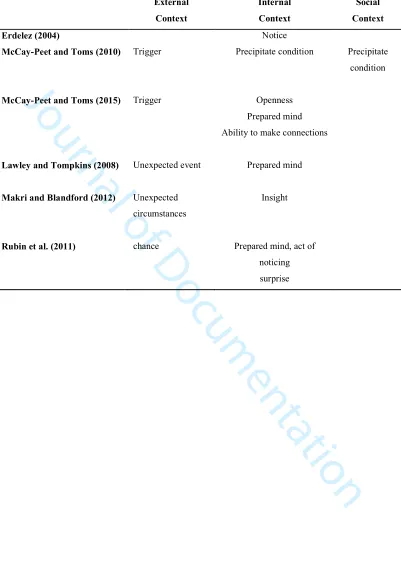
On further reflection of these models, we have found that from a “user-centred” point of view, these models all partly refer to the contextual factors, especially those relating to the information actor, as is listed in Table 1. Erdelez’s model requires users to notice the background problem, and such an “ability to notice” can be considered as part of the internal contextual factors that affect an individual’s experiencing of serendipity. In addition, her model is useful for understanding part of the process post-encounter, but it fails to cover what happens beforehand (e.g. whether or not external factors played a role to trigger the encounter). McCay-Peet and Toms’s (2010) model identified “precipitating conditions” as “active learning” (internal context) and “social networks” (social context), and as a requirement for a “trigger” (e.g. text, images, audio) to facilitate serendipity. However, as an early model in knowledge work, this model fails to look into how the “precipitating conditions” would impact the process of serendipity. In their updated model (McCay-Peet and Toms, 2015), they further highlighted how the “trigger” confirms the “noticing” element of the process of serendipity, and identified the three forms of triggers as “verbal” “textual” and “visual”. They further proposed different external factors (trigger-richness, highlight triggers, enabling connections and enabling capturing) and internal factors (openness, a prepared mind, the ability to make connections) that may influence the perception of serendipity, but these factors, especially the external factors, are not discussed from the perspective of context. The other two mental-process models focus mainly on the perceptual process required for a serendipitous episode, and also discussed some contextual factors. For example, Lawley and Tompkins (2008) considered a “prepared mind” (internal context) and an “unexpected event” (external context) as necessary components in a serendipitous episode, while similarly, Makri and Blandford (2012a) considered how “unexpected circumstances” (external context) and “insight” (internal context) can lead to making new connections, and they also found that, although not directly reflected in their model, their participants’ moods or feelings (internal context) can impact the openness to making connections. Similarly, chance (external context), a prepared mind, an act of noticing and surprise (internal context) can all be considered as contextual factors that are referred in Rubin et al.’s (2011) model. 6
Journal of Documentation
However, a systematic discussion from the perspective of these contextual factorscannot be drawn from these existing studies.
{Insert Table 1 here}
3. Research Method
We developed a mobile-diary method for our study in the UK to help participants capture their serendipitous experiences in a comparatively natural setting. Satisfactory feedback was received via the mobile diary application, with 23 serendipitous cases reported by 11 British participants within a one-week period. One major concern raised by some of the participants in that study was that they were unwilling to carry around an additional mobile device, and this undoubtedly affected their serendipitous experiences. To overcome this particular drawback, in this study we used the social media platform “Wechat” to replace the diary application. The main reasons for choosing “Wechat” were: 1) it covers similar functions to our diary application, and different types of data can be recorded and transferred (i.e. text, video, audio, and image); 2) participants had no concerns about portability problems, and no additional package needed to be installed on participants’ own mobile phones, as they were all frequent users of “Wechat”, and were quite familiar with its functions; 3) “Wechat” is a social media platform, so it also has the function of allowing direct communication between participants and the researchers, and if participants had any problems during the experiment period, they were able to send messages to the researchers and receive immediate responses; 4) it had the advantage of allowing the researchers to send a “reminder” to participants each day, to help to make them aware they were in an experiment situation.
3.1 Participants
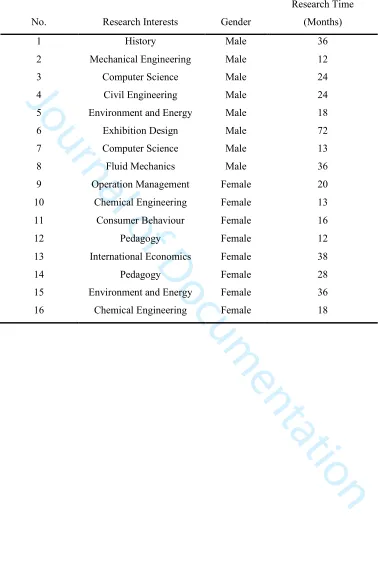
16 Chinese PhD students (eight males and eight females) were recruited to take part in this follow-up study, with each participant having had at least 12 months’ research experience. We chose PhD students mainly because: 1) following the research findings of Foster and Ford (2003) which showed that serendipity is experienced widely among researchers, and PhD students are a group of scholars dedicated to research projects who are easy to access; 2) our previous study recruited 11 PhD students and received 23 serendipity cases within a week. This successful experience demonstrated that it was a feasible solution to recruit PhD students with 6
Journal of Documentation
which to conduct such a diary-study. Detailed information about all participants islisted in Table 2. All the participants’ names reported in this study are aliases. {Insert Table 2 here}
3.2 Procedure
1) Pilot Study. A pilot study was performed with two participants (one male and
one female) at the University of Nottingham Ningbo China for a period of four days. The detailed experiment issues (e.g. time arrangement, interview preparation) were all determined according to the pilot study. Four serendipitous cases were collected from the pilot study.
2) Pre-interview. Each participant was invited to a short interview (around 30
minutes) before the empirical study. The research purpose was introduced, and participants were invited to collect any cases they considered as serendipity during a period of two weeks, either on the Web or as part of their daily activities (e.g. reading, research, and socialisation). In addition to introducing the research purpose to each participant, we also conducted two additional operations during the pre-interview, as follows:
(a) Each participant’s initial understandings of serendipity were collected. During the interview process we found that each participant reported that this was the first time s/he had heard about the concept of serendipity. To better support the study, we then carefully introduced participants to this concept. First, we presented the definition of serendipity from the Oxford Concise English Dictionary: “the
occurrence and development of events by chance in a happy or beneficial way”. We
then provided participants with the following example from the pilot study:
I was trying hard to download a journal paper which could be very relevant to my research. However, when I checked in our university databases, it was not available to download and payment was required to get access to the paper. Then, one day when I was searching for other research papers, a web link of the paper turned up on the screen. Being curious, I clicked the link and it asked me to register in a platform called Research Gate. I followed the registration and was then amazed to find that the author of the paper was also a member of Research Gate, so I followed him on Research Gate and sent him a
Journal of Documentation
request for a copy of the paper, and he sent me a copy of his working paper free of charge! It was really exciting for me to get the paper by such a chance! (Pilot study Case 4)
We took care to highlight to participants that this example was simply provided to help them to understand the concept of serendipity, and by no means to restrict them to a particular type, stressing that there are various examples. They were instructed that if they experienced any encounters which they considered as serendipity, they should send the researchers a relevant message.
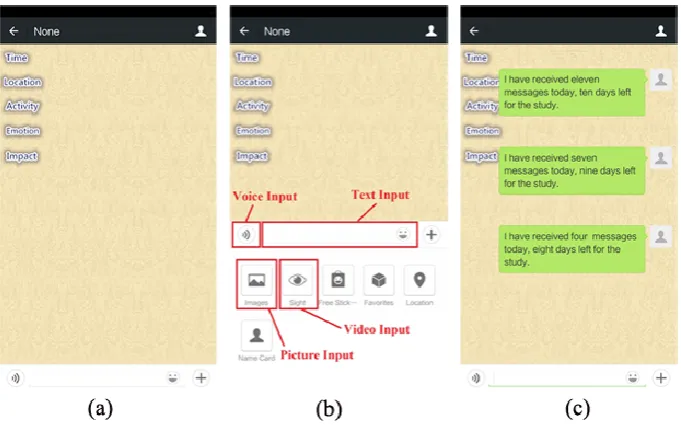
(b) Participants were introduced to the group created using the social media tool “Wechat” and its functions. To achieve better research results, we designed a specific interface and instructed our participants on how to use its functions (Figure 2). A detailed description of the interface is provided in Appendix A.
{Insert Figure 2 here}
3) Two-week study. A lesson we learnt from our previous study is the necessity to
extend the experimental time window to give our participants sufficient time for potential encounters with serendipitous experiences (one participant failed to send us any information and argued that the time available was insufficient for him to encounter serendipity). Thus, we set the experiment time period at two weeks for this study. Participants were required to use the tool provided to record their serendipitous experiences, and return them to the researchers within two weeks. All the sent data was only visible to the researchers. In addition, at approximately 10:30pm each day, a reminder message was sent to each participant by the researchers to better provide them with a research context (Figure 2-c). The time chosen for sending the reminder was based on the pilot study and observation of the routines of most participants.
4) Post-interview. Each participant was invited to a post-interview at the end of
the study. The interview was conducted within one week and lasted for approximately one hour with each participant. It was semi-structured and qualitative in nature and centred on participants’ recorded serendipitous encounters, as well as participants’ experiences of the research method.
3.3 Data Collection
Two types of data were collected: the recorded diary data of the participants’ serendipitous experiences and the post-interview data. We received a total of 62 6
Journal of Documentation
serendipitous records, each describing a case which the participant regarded asserendipity. The records for each participant were printed out to help them reflect on their experiences during the post-interview. All interviews were recorded and transcribed by the interviewer.
3.4 Data Analysis
The data we collected are qualitative in nature. A Thematic Analysis (Braun and Clarke, 2006) was conducted to code the interview data. We first followed a top-bottom theoretical thematic analysis to investigate how the participants experienced serendipity. We began this part of the coding by identifying the themes drawn from our previous study, where we identified the nature of serendipity according to two different levels of abstraction, and the value of serendipity. The first level identified the “unexpected finding of information” by considering different combinations of three components: whether the information was directly related to the activity being undertaken by the individual (non-activity-based vs. activity-based); whether or not the information encountered was unexpectedly valuable to the encounterers
(unexpectedly valuable or not); and whether the information was from an unexpected or likely source. The second level identified the making of unexpected connections between different pieces of information, people and ideas.
We then used a bottom-top inductive thematic analysis to identify any contextual factors which existed in the serendipity cases. Initially, we identified a number of categories, including the time for experiencing serendipity (i.e. a.m., p.m., and across time periods), the different locations in which serendipity occurred (e.g. office, dormitory, classroom, , library, etc.), the different activities during which serendipity was experienced (e.g. travelling, surfing the Internet, attending seminars, talking to classmates, talking to friends, etc.), and a category more related to an individual’s cognitive or psychological characteristics, such as memories, an amount of thinking, expertise, previous needs, instantly raised needs, and emotions (see Figure 3, for examples of the coding for the pilot study case). We then compared the categories and grouped those categorised with overlapping meanings into possible themes. As a result, we concluded this layer of analysis with the three major themes of: external context (i.e. time, location, and personal status), social context (e.g. different social counterparts) and internal context (i.e. precipitating conditions,
sagacity/perceptiveness and emotions). It should be noted that the precipitating
Comment [t2]: This part is largely
complemented by a more detailed introduction of our coding schemes.
Journal of Documentation
conditions include visceral needs, conscious needs and previousexperience/knowledge.
After we finished coding the themes of the contexts, especially the internal context themes of the precipitating conditions, we carried out a full review and found that our original coding of the first level “unexpected finding of information” could also be considered as a process of making connections between the encountering and the precipitating conditions. As a result, we re-coded this part of the framework into the three different themes of unexpectedness, connection-making and value, which were further expanded into the sub-themes of “unforeseen means of encountering information”, “unexpected content of the encountered information” and “both”. The theme of “connection-making” was further expanded into “connection-making between unexpectedness and visceral needs”, “connection-making between unexpectedness and conscious needs” and “connection-making between
unexpectedness and previous experience/knowledge”, while the theme of “value” was expanded into the sub-themes of “substantial value” and “emotional value”. This will be discussed in detail in the following sections.
{Insert Figure 3 here}
4. Participants’ Perceptions of Serendipity
By analysing the 62 reported serendipitous cases, we found that the Chinese scholars conformed to the framework of experiencing serendipity according to the three main processes of: encountering unexpectedness, connection-making and finally leading to a valuable outcome.
4.1 Unexpectedness
Three different channels were identified from our empirical study to facilitate the likelihood of encountering unexpectedness during the new study:
(i) Any unforeseen means by which a participant encounters a piece of
information. An example, which can better explain our identification of this element,
is provided in the following case:
[In a training session] a student delivered a talk on fire extinguishers several days ago, which made me recognise that I had never noticed there is a fire extinguisher in my lab before, and I raised some concerns, such as what were 6
Journal of Documentation
they used for? How did they work? I had all these concerns resolved today byaccidently attending a ‘fire alarm introduction’ presentation. (Case 7)
The participant (P3) reported she had learnt about the principles of fire
extinguishers from a talk during a training session. She then raised the need to collect relevant information about fire extinguishers around her lab setting (e.g. where they are located in the lab, and how to use them). However, this need was not addressed at that time and the participant forgot to address the need after the talk had finished. As explained by the participant during the interview, “I just thought about it in my mind and didn’t write it down during the talk. Actually, when the talk finished, I just forgot about it”. It was not until she accidently attended a related “fire alarm introduction” that she realized the need again, and found the answer to this need during the
presentation. We argue that the answer to the participant’s need was not unexpected to her, but the way that she received the answer made her feel it was “unexpected”, as attending such a presentation was not her original schedule, “I even didn’t know about such a presentation, but one of my friends just asked me to accompany her”.
(ii) The content of the encountered information brings unexpectedness.In some
other cases, it is the content of the information that leads to a sense of unexpectedness:
My instructor from an academic training session asked his students to present an article during the session which he had just handed out to us. The article was about a wind-up radio which greatly aroused my interest in radio technology. I had never thought I would learn about wind-up radios in this training. (Case 6)
In this case, the participant was situated in a certain context (a training session), and it was the sudden appearance of information (about the radio) which was interesting to him and resulted in his feeling of “unexpectedness”.
(iii) Both the unforeseen means and content of the encountered information bring
a sense of unexpectedness.:
There was a seminar, but I didn’t pay attention as it seemed not so relevant to my research. However, I was required by my supervisor to attend. It was difficult for 6
Journal of Documentation
me to concentrate at the beginning of that seminar. My interest was aroused whenI noticed from the PPT that the lecturer had used the same simulation software as me and he used a graphical way to present the results in his research, which I had never considered before. I found it was really useful! (Case 1)
This is an interesting case, not only because of the unexpected information gained from the seminar by the participant (i.e. presenting results with graphics), but also the unexpectedness of attending the seminar, as explained by the participant:
In the beginning, it was not my intention to attend the seminar as I thought it was not so relevant to my research. I just attended by accident and it was not
something I had planned to do. Furthermore, I didn’t expect there would be such useful information which I could take away from the seminar. Therefore, I would consider it as serendipity. (P 1)
From this response, it is evident that both the useful information she received from the seminar, and the way she received the information (by attending the seminar accidentally) functioned in her coming across this serendipitous experience.
4.2 Connection-making
We have previously found that connections can be made between different pieces of information, people and ideas (Sun et al., 2011), and it is a level of abstraction that can lead to a positive impact. In this paper, we have further expanded this process of connection-making by identifying the different internal contextual factors of precipitating conditions:
• Connections made between unexpectedness and visceral needs. • Connections made between unexpectedness and conscious needs. • Connections made between unexpectedness and previous
experience/knowledge.
The term “visceral need” and “conscious need” originates from Taylor’s (2015) work, which characterized four different levels of information needs during the interaction between an information seeker and a librarian. An information seeker may begin with an unexpressed need in mind (what Taylor calls a “visceral need”), and then such a need becomes “conscious” with accumulated information (e.g. by talking
Comment [t3]: This section is revised by referring to Taylor’s work.
Journal of Documentation
to the librarian), and turns to a “formalised need” with a qualified and rationalstatement, which finally leads to a “comprised need” that can be presented to information systems. Although Taylor’s framework is usually used to describe the negotiation process between an information enquirer and an information specialist, which is not exactly the process of encountering a serendipitous episode, we do find that the characteristics of such “visceral needs” and “conscious needs” conform to the situations reflected in the participants of our empirical study. For example, Taylor argues that a “visceral need [not] existing in the remembered experience of the enquirer, [probably] is inexpressible in linguistic terms, [and can] change in form, quality, concreteness, and criteria as information is added.” In our study, we also found some participants did not raise a need, which was not previously in their memory or experience, until they encountered unexpected information. While a “conscious need”, as described by Taylor, is a “within-brain description”, it is quite similar to a previously unaddressed concern/question by a participant. This part will be discussed further in Section 5.3.1.
4.3 Value
Our participants pointed out that they would only consider any unexpected experiences as serendipity if they offered them some form of benefit. Two types of value arose from our study: substantial value and emotional value. Substantial value refers to a value that brings beneficial results or outcomes to the participant (e.g. finding the answer to a previous concern), while emotional value refers to a value caused by an emotion which is aroused when a participant encounters unexpected information (e.g. the emotional satisfaction of recalling previous memories). This part will be discussed further in Section 5.3.3.
5 The Role of Context
Context plays a significant role in nurturing serendipitous experiences, although it has often been neglected in previous studies. As a complement to our previous work (Sun et al., 2011), in this paper we have identified the conception of context more comprehensively, based on the discussion in the background section, including external context, social context and internal context, and different contextual factors were identified from the empirical study.
Journal of Documentation
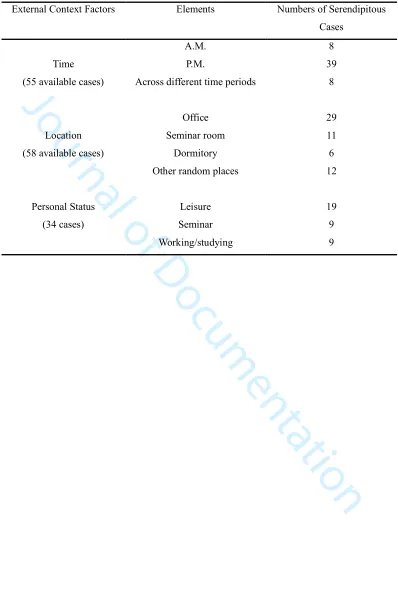
5.1 External context“External context” refers to the ambient conditions surrounding the participant, and the three different external contextual factors which have been identified from our empirical study are time, location and personal status (Table 3).
{Insert Table 3 here}
(1) Time. There were seven out of 62 collected cases for which our participants
were unable to recall the time of the encounter. Among the remaining 55 available cases, only eight happened before noon (a.m.), while the remaining 47 cases happened after noon (p.m.). It is evident that different time periods during the day contributed distinctly to the development of serendipitous experiences. The final eight cases were reported across different time periods, where the participant was engaging with an ongoing activity until s/he recognised the occurrence of serendipity after some time. Existing research has demonstrated that different times of day can impact human performance (Fröberg, 1977), and even the cognitive and evaluative efficiency of individuals (Natale et al., 2003). Our participants also reported that they were more engaged in different activities in the afternoon, as a result of which it was also more likely that they would encounter serendipity, as explained by one of the participants:
Personally speaking, I find myself more conscious about the concept of serendipity in the afternoon or evening than in the morning, and normally I’m more engaged in the afternoon. So I think that’s the reason why I always send you messages in the afternoon. (P 4)
(2) Location. Some locations (e.g. libraries) are richer in resources (e.g. books)
than other locations (e.g. canteens). Therefore, it is intuitively sound to assume that locations may influence the occurrence of serendipity. 58 of the cases reported by our participants indicated where their serendipitous experiences had taken place (the location of the remaining four cases could not be recalled). Our data showed that 29 cases happened in an office environment, followed by 11 cases in a seminar room, six cases in a dormitory and other random places (laboratory, café, library, etc.).
Following a further look into the office environment, which produced most serendipity cases during our study, we found that there were three possible reasons that contributed to the encounter of serendipity:
Journal of Documentation
• The office environment is resource-rich, including posters, notifications,different online libraries, etc. Where more information is presented to a participant, s/he will have an increased possibility of experiencing serendipity; • It provides an interdisciplinary social setting. The work settings for the
participants was interdisciplinary, so a participant from mechanical engineering would be sitting in the same office as colleagues from other backgrounds, such as chemical engineering, architecture, or computer science, etc. Foster and Ford (2003) provided several examples of experiencing serendipity among
interdisciplinary researchers, and similar cases were also collected in our study. For example, one participant (P 2) from mechanical engineering accidently learnt about a new image-searching engine “TinEye” during a break, when talking with a colleague from computer science, which helped him locate the resource literature for an image he had used in his writing. Another participant (P 6, design background) also encountered useful information about using Nvivo to help his data analysis, of which he was not previously aware, from a casual conversation with a colleague with an HCI background;
• It makes it easy to get access to different resources. Consider the following example. One participant (P 7) sent us a case in which he happened to encounter a method of “histogram equalization” from a blog when he was browsing the Internet in the office. He then conducted a further search into this method (by referring to Wikipedia and other relevant literature), which enabled him to understand this method and recognise its value (i.e. it could be used in his own research). Compared to other environments, such as a laboratory or a café, it is obvious that the accessibility of resources (e.g. licenses to libraries) impact a participant’s judgement of the value of the encountered information.
(3) Status. Status here refers primarily to a participant’s commitment to certain
ongoing activities. We have identified three different types of personal status, as follows:
• Leisure: the participant was in a relatively relaxed and open state, such as travelling, playing games, flicking through interesting books or browsing online information, etc. This was a state in which the participant was in his/her own private time fulfilling his/her own interests.
Journal of Documentation
• Seminar: the participant was attending a seminar, a lecture or a presentationwhere the participant was a student or a listener.
• Working/Studying: the participant was in an intense and focused state carrying out research-related tasks.
According to Table 3, among the three different types of personal status, participants tended to experience serendipity more often during their “leisure” time. Studies show that openness and a relaxed setting can facilitate encountering
serendipity (McCay-Peet and Toms, 2015; Sun, et al., 2011). Compared to the status of attending a seminar or working/studying, we consider that the participants in the leisure status were more open and relaxed.
5.2 Social context
Socialisation has always been considered as a significant factor when it comes to discussions on the role of context (Foster, 2004). In our collected cases, aside from the 37 of 62 cases where the participants had a different personal status, the remaining 25 all took place when they were socialising with others (see Table 4).
{Insert Table 4 here}
Table 4 illustrates that participants experienced serendipity frequently when they were socialising with different people, ranging from the familiar (e.g. classmates, colleagues) to the unfamiliar. However, an obvious trend which can be identified from the table is that our participants tended to experience serendipity more often during periods of socialisation with their peers (classmates, colleagues and friends), while only one case occurred during contact with a superior. This differs from our previous study in the UK, where four of the collected serendipity cases under a social context came from communicating with superiors. A possible reason for such a phenomenon is “power-distance”, which is a widely-understood cultural difference between the West and the East (Hofstede, 1980), while China has been confirmed as one country with a high power-distance, where students are known to keep a larger interaction distance from their professors (Richardson and Smith, 2007). Therefore, compared to communicating with their superiors, the Chinese participants were more likely to communicate with their peers, leading to more serendipitous encounters. 6
Journal of Documentation
5.3 Internal context
Based on our collected data, we have divided the internal contexts into the following three aspects: precipitating conditions, sagacity/perceptiveness and emotions.
5.3.1 Precipitating conditions
Precipitating conditions refers to the prior conditions for experiencing serendipity. We have defined such precipitating conditions from a more subjective perspective, which is in relation to an individual’s mind-set, covering visceral needs, conscious
needs and previous experience/ knowledge.
-Visceral needs. As explained in Section 4.2, a visceral need refers to a need that
does not exist in a participant’s remembered experience, and it is not raised until the moment the unexpected information is encountered, as illustrated in the following example:
During a casual conversation with a friend of mine, I was really surprised to know that she was in collaboration with one of my classmates in graduate school whom I had not contacted since our graduation. It was an unexpected piece of
information to me and I think there would be a high possibility that I could collaborate with him in the future. (Case 44)
In this case, the participant was initially unconscious of her need to contact an old classmate. It was not until encountering the unexpected information (i.e. her friend was working with him) that she became aware of such a need (to make contact and perhaps collaborate in the future).
- Conscious needs. This indicates that a participant had encountered a
need/concern at a previous time (e.g. the need to download a useful paper), but for some reason the need/concern failed to be addressed immediately (e.g. unable to access the data resource). Such a need/concern was resolved when the participant encountered the information unexpectedly, as in the following example:
I was doing my own experiments recently and gathered loads of experimental data. However, I was not clear how to deal with the errors of the experimental 6
Journal of Documentation
data. During a fluid lab session, I was demonstrating the experiment proceduresto the UG (undergraduate) students when I accidently found a handbook near the lab facilities which explains how to read data and deal with errors. I just felt like I had found a big treasure. I started reading immediately; it is easy to understand and is really helpful. (Case 16)
Clearly, the participant was conscious of his needs/concerns related to dealing with the errors in his experimental data, to keep his research moving forward. However, unexpectedly, this need/concern was addressed as a result of serendipity.
- Previous experience/knowledge. Several participants also reported that
serendipitous experiences were triggered by their previous experience or knowledge:
Today I was cleaning up my summer clothes. Then suddenly I found my old computer which I hadn’t used for a long time. When I turned it on, I saw a picture folder which contained all the pictures I took during my UG and this file was the only copy I had! They were really precious memories to me and I had never thought they would come to me in such an unexpected way! (Case 20)
I taught my students an old Chinese poem yesterday in my class. And today I just saw the same poem on one of my friends’ Wechat shared pages. What a surprise! Even though we were far away from each other, we still shared the same feelings from the old poem! (Case 60)
In Case 20, the accidental discovery of the old pictures helped the participant to recall precious memories of her university life, so the sense of serendipity felt by the participant was mainly based on her previous experience. The situation is similar to the information encountered coincidentally (i.e. recalling the same poem) in Case 60. These cases demonstrate that the prior knowledge, interests and personal experiences can be recalled in unexpected ways, thereby contributing to serendipitous experiences.
5.3.2 Sagacity/Perceptiveness
Unexpectedness and precipitating conditions are two necessary components for making connections. However, sagacity or perceptiveness is also required when 6
Journal of Documentation
making such connections. Heinström (2006) and Rubin et al. (2011) have bothconsidered the act of noticing as an ability to “shift the attention from a primary activity to a clue in the environment”, and it is “one of the central elements in incidental information acquisition”. Sagacity/perceptiveness is also reflected in our study, as in the following example:
It was annoying to search for academic articles in China. I used Go-Agent before, but it no longer works in China. Later on, I encountered serendipityon three different occasions and finally selected the best option for searching academic articles: the first was through the Wechat chatting group, where many members in the group proposed different solutions; the second searching method I learnt was in the laundry room where I met a post graduate student and he talked about some software which he told me that even foreign students use to search for academic articles; and the third method was learnt in the canteen where I met my senior and discussed the issue with him and he proposed a solution to me. (Case 30)
The participant experienced different information on three different occasions, and during the interview he emphasised how it was the concatenation of the three
experiences that made him consider the whole matter as one piece of serendipity. The sagacity/perceptiveness in this case helped the participant to make connections between a conscious need (strategies to search for academic papers) and the
unexpected encountering of information on three different occasions. Apart from this example, during the two-week study, the number of serendipitous cases we collected from each participant ranged from one to thirteen. Such differences in
sagacity/perceptiveness are consistent with the discovery by Erdelez (1997) that serendipitous encounterers can range from super-encounterers to occasional encounterers.
5.3.3 Emotions
When a connection is made between unexpectedness and the precipitating conditions, participants switched their attention from the current task to an evaluation of the serendipity they had encountered. Once the value of an encountered experience is acknowledged, serendipity occurs. The term “valuable outcome”, which has been highlighted in previous studies (Makri and Blandford, 2012; McCay-Peet and Toms, 6
Journal of Documentation
2015; Rubin et al., 2011), is also manifested in our study as follows:(1) Finding answers to a prior problem or concern. This is most relevant to those serendipities with conscious needs, where the participants are aware of their needs but the answers to prior problems were obtained in an unexpected way.
(2) Providing a potential solution to a need or simply discovering other needs. This is most relevant to visceral needs, as in the example reported in Case 44, where the unexpected information from the participant’s classmate may be useful in the future, but whether or not a desirable outcome can be reached in the future is still unknown.
We identified such a value as “substantial value”, as it is most relevant to those need-oriented serendipity cases (either for conscious needs or visceral needs), and it is of substantial benefit for helping participants to address their needs or concerns.
However, apart from “substantial value”, we also identified from the study “emotional value” – which highlights the role of emotion–, especially in those cases categorised as previous experience/knowledge-oriented. In both Case 20 and Case 60, the unexpected information triggered a huge emotional response from our
participants, and it was because such “emotional value” was so compelling that they came to conclude that the encountered experience was an episode of serendipity.
It should be noted that “emotional value” usually accompanies “substantial value” in need-oriented serendipity cases, such that finding solutions to previous conscious needs, or finding potential benefit from visceral needs often accompanies a positive emotion. However, “emotional value” also functions independently in the experience of serendipity, such as in the previous experience/knowledge-oriented cases (e.g. Case 20 and Case 60) in our collected data. Previous studies have pointed out that positive emotions can result from serendipity (McCay-Peet and Toms, 2015; Sun et al., 2011). Nevertheless, few studies have investigated how the role of emotional value is embedded in the process of encountering and perceiving something as serendipity.
6. Discussion
6.1 A Context-based Model of Serendipity
Comment [t4]: The whole discussion part is rewritten and complemented. We have removed the culture part throughout the paper, and focused on the finding of context.
Journal of Documentation
Based on this empirical study and our previous study, we have identified contextual factors during the processes of serendipity, and further developed a context-based model, as illustrated in Figure 4. This model consists of two parts: 1) In the centre of the model are the three main processes in experiencing serendipity, including encountering unexpectedness, connection-making and value; 2) the impact of external context, social context and internal context on each process during a serendipitous encounter.The participants’ experiencing of serendipity began with encountering
unexpectedness, either in an unforeseen way and/or in the unexpected content of the encountered information. Connections are then made between the encountered information and the precipitating conditions (i.e. visceral needs, conscious needs or previous experience/knowledge) of the participant. Once the value of the encountered information (i.e. substantial value and/or emotional value) is recognised by the participants, serendipity occurs.
Each process for encountering serendipity is impacted by context. The main impact of external context and social context is that they are the stimuli for encountering unexpectedness. Such unexpectedness would then lead to connection-making by combing the precipitating conditions, including visceral needs, conscious needs or previous experience/knowledge, which are the internal contextual factors of an individual.
The connection-making process depends mainly on the information encounterer’s sagacity/perceptiveness. However, there is also the situation in which connections are provided by external variables, such as from an interaction partner during a period of social contact. One of the participants (P 14) sent us a case concerned with “how to prevent falling asleep while driving” when she was discussing something with her friend, when she unexpectedly received information from her friend that passengers may read books aloud during the journey, which may interest the driver and prevent boredom. The participant considered the received information to be serendipitous because it was both an unexpected idea and she also applied the idea to her own driving, which turned out to be quite useful. In this case, the participant’s process of making connections was simplified thanks to her friend’s suggestion. Thus, we argue that the external or social context can sometimes facilitate the process of making connections. Furthermore, the interaction time and activity may also prohibit making connections or evaluating the encountered value. One participant (P 6) reported that 6
Journal of Documentation
he had unexpectedly encountered some information relating to his own research while teaching undergraduates in the laboratory. However, he was too busy answering the problems from the students to think further about the encountered information. It was not until he received the daily reminder that he was able to recall the encountered information from earlier in the day, at which point he became aware of the value of the same. In this case, we argue that the participant’s status of being busy (e.g. answering questions from students) may have prohibited his immediate recognition of, or attention to, serendipity at the time at which it occurred.Emotion played an important role in recognising the value of any encounters. Makri and Blandord’s (2012a) study found that a good mood may help participants to exploit the value of an encounter, while a bad mood may impede such exploitation (p. 694, case UD1 and AD4). In our study, we have identified the value of an encounter as a substantial value and an emotional value, and particularly in any previous experience/knowledge-oriented cases (e.g. recalling good memories, as in Case 20), the emotional value would directly lead participants to consider the encounter as an episode of serendipity. Another point which should be noted is the relationship between emotions and sagacity/perceptiveness (the broken arrow line in Figure 4). Research from the fields of psychology and neuro-science has revealed that emotions can also impact an individual’s cognitive processes, such as their memory, decision-making, attention or learning (Schupp et al., 2006; Lerner et al., 2015), which may thus further influence how connections are made between any unexpected information and the precipitating conditions.
{Insert Figure 4 here}
6.2 A comparison with our previous model
There are two main differences between this updated model and our previous model. The first is that we have found that the process of connection-making is actually pervasive in all cases of serendipity. In our previous model, we identified two different levels of abstraction that can lead to serendipity, and connection-making is the second level of abstraction that can sometimes result from the first level, although we also identified some cases of serendipity which directly resulted from the first level of abstraction. However, by identifying the internal context of the precipitating conditions in this new empirical study, we have found that the original first level of abstraction also involves a connection-making process. For example, we previously 6
Journal of Documentation
identified a case as the first level of abstraction where the participant accidentlynoticed some interesting module codes when he was looking at the whiteboard during a workshop. The participant was looking for module information from different sources (leaflets, the Internet) at that time, and this new module turned out to be useful. We previously considered there to be no connection-making during this case and we identified it as non-activity-based, unexpectedly valuable information from unexpected sources (a category of the first level of abstraction). However, according to our new identification of internal context, this participant had a conscious need in mind (always looking for interesting module information), and the unforeseen means by which he obtained the new module source from the whiteboard during the workshop (unexpectedness) led to a connection between this unexpectedness and the conscious need, and when he finally recognised the value of the encounter (a useful module), serendipity occurred. We believe this new identification of internal context helps us to better understand the connection-making process during serendipity.
The second difference between this updated model and the previous model is that it demonstrates the impact of different contexts during each process of serendipity. Our previous model mainly discussed the role of context in encountering serendipity from three aspects: the role of people (active or less active), the role of temporal factors, and the role of the environment (i.e. the working environment, places, and the changing environment). We directly adopted Schmidt’s context model (2000) to denote the relationship between the role of the individual and their context in serendipity, but failed to explain how these contextual factors affected the different processes of a serendipitous episode. This element is complemented in this empirical study through a new identification of contextual factors:
1) The role of people was further identified by explaining the internal context of the precipitating conditions (i.e. visceral needs, conscious needs and previous experience/knowledge), sagacity/perceptiveness, and emotions. The precipitating conditions form a premise for each individual to make connections when
unexpected encountering happens, sagacity/perceptiveness impacts mainly on the process of making connections, while emotion can affect a participant’s
recognition of the encountered value, and may also impact an individual’s sagacity/perceptiveness when it comes to making connections.
Journal of Documentation
2) The role of temporal factors and the role of the environment were furtheridentified by defining the external context (i.e. time, location, personal status) and social context. The external context and social context are the stimuli for
unexpected encountering, and they also affect a participant’s connection-making (e.g. facilitation) and recognition of the encountered value (e.g. being busy).
The proposed new context model verified serendipity as “the product of context” (Foster, 2014, p. 18), and these external, social and internal contexts play different roles and are interwoven throughout the encountering process of serendipity.
6.3 Implications of the updated model 6.3.1 An extension of the existing framework
We identified three processes for experiencing serendipity: “unexpectedness”, “connection-making” and “value”. This identification is similar to the framework proposed by Makri and Blandford (2012b), in which they considered
“unexpectedness”, “insight” and “value” as the three key elements with which to evaluate serendipity, and where the “making of the connection itself involves an amount of insight” (p. 714). Our new contribution to this framework is that, based on our empirical study, we have further expanded the three processes. We have identified three different channels that lead to “unexpectedness”, the different situations of connection-making between the encountered unexpectedness and the precipitating conditions of visceral needs, conscious needs and previous knowledge/experience, and we have also identified value as substantial value and emotional value.
The identification of “unexpectedness” in our work is similar to the work by Foster and Ford (2003), in which they classified four different categories of
serendipity. Our identification of “unforeseen means of encountering information” is similar to Foster and Ford’s third category, “the unexpected finding of information the
existence and and/or location of which was unexpected, rather than the value” (p.332),
and the identification of the “unexpected content of the encountered information” is similar to Foster and Ford’s fourth category, “the unexpected finding of information that also proved to be of unexpected value: (a) by looking in “likely” sources”; (b) by chance” (p.332). However, our work also goes beyond their framework by identifying the processes of “connection-making” and “value”, which is not discussed in their paper. By expanding the different processes of serendipity, we have found it is 6
Journal of Documentation
possible to give a new classification of the different categories of serendipity. Table 5categorises the cases listed in the previous sections of this paper, and we argue:
• For a conscious need/concern, it is more the unforeseen means of encountering the information that results in the participants’ sense of unexpectedness, and brings both substantial value (e.g. an answer to the concern) and emotional value (the positive emotion when the need is addressed), as identified in Case 7, Case 44 and Case 30.
• For a visceral need/concern, it is usually the unexpected content of the encountered information that leads to participants’ feelings of unexpectedness, while it also brings both substantial value (e.g. finding a possible solution for a visceral need) and emotional value (a positive emotion), as identified in Case 6 and Case 44. However, sometimes the unforeseen means of encountering information may also play a role in leading to unexpectedness, as identified in Case 1.
• For previous experience/knowledge, it often results in emotional value, and both the unforeseen means of encountering the information and the unexpected content of the encountered information have the potential to bring a feeling of unexpectedness to participants, as identified in Case 20 and Case 60.
{Insert Table 5 here}
6.3.2. Design strategies based on the identified contextual factors Björneborn (2017) argues that:
We cannot design environments always leading to serendipity – as serendipity is a highly subjective and situational phenomenon. But affordances for serendipity can be engineered……Serendipity may thus be intended by designers, but must always be unplanned by users (p. 1068).
From this empirical study, the identified contextual factors of external context, social context and internal context helped us to look into the role played by context during the different processes of serendipity, and thus provide possible implications 6
Journal of Documentation
for designers to design affordances that can “engineer serendipity”. These include: (1) consider participants’ status. Our participants tended to experience serendipity more often in the afternoon than in the morning, especially when they are in their leisure time. When organising activities that aim to facilitate serendipity (e.g. free discussion seminars, using information systems to make recommendations), it is better to take participants’ status into consideration and arrange such activities during their leisure time; (2) consider locations. Our study has found that places with rich resources, such as a physical resource (e.g. licensed online libraries) or a socialisation resource (e.g. interdisciplinary offices), and with easy accessibility provide greater potential for participants to encounter serendipity; (3) try to create social networks. Social context is a significant stimulus, where participants can encounter unexpectedness which may result in serendipity, so attention should be given to such context to help to “engineer serendipity”; (4) design environments that are both diverse and conspicuous. Motivated by an understanding of the internal context of pre-conditions and sagacity/noticeability, we also suggest the design of more diverse and noticeable environments to encourage the occurrence of serendipity. Current information technologies, such as recommendations, personalisation and visualisation may consider this aspect to facilitate the occurrence of serendipity; (5) combine emotional design. As identified in the study, emotion plays an important role during the process of encountering serendipity, so an element of curious and/or interesting information may help to encourage the occurrence of serendipity. We consider that designs for joy, surprise and/or other emotional design strategies can also be applied to serendipitous design strategies.6.5 Two limitations of the research method
There are two methodology-based issues raised from the empirical study that we think are worthy of further discussion. The first issue concerns the participants’ initial understanding of serendipity. According to our empirical studies, we have found there are disparities in the basic understanding of the term “serendipity” between the Chinese participants and the previous participants in the UK. People from non-English speaking countries, such as China, may lack an initial understanding of the concept of serendipity because the concept originated in the West. Even the Chinese translation of the term was seen as exotic by the Chinese participants. Hence, at the very beginning of the study, when we introduced the research purpose to our 6