Improving Continuous Sign Language Recognition:
Speech Recognition Techniques and System Design
Jens Forster, Oscar Koller, Christian Oberd¨orfer, Yannick Gweth, Hermann Ney
Human Language Technology and Pattern Recognition Group
Computer Science Department
RWTH Aachen University
Aachen, Germany
{surname}@cs.rwth-aachen.deAbstract
Automatic sign language recognition (ASLR) is a special case of automatic speech recognition (ASR) and computer vision (CV) and is currently evolving from using artificial lab-generated data to using ’real-life’ data. Although ASLR still struggles with feature extraction, it can benefit from techniques developed for ASR. We present a large-vocabulary ASLR system that is able to recognize sentences in continuous sign language and uses features extracted from standard single-view video cameras without using additional equipment. ASR techniques such as the multi-layer-perceptron (MLP) tandem approach, speaker adaptation, pronunciation modelling, and parallel hidden Markov models are investigated. We evaluate the influence of each system component on the recognition performance. On two publicly available large vocabulary databases representing lab-data (25 signer, 455 sign vocabulary, 19k sentence) and unconstrained ’real-life’ sign language (1 signer, 266 sign vocabulary, 351 sentences) we can achieve 22.1%respectively38.6%WER.
Index Terms: Continuous Sign Language Recognition, Large Vocabulary, ASR, Computer Vision, Recognition System
1. Introduction
Sign languages are natural languages that develop in commu-nities of deaf people around the world and vary from region to region. A sign consists of manual and non-manual com-ponents that partly occur in parallel but are not perfectly syn-chronous [1]. Manual components comprise hand configura-tion, place of articulaconfigura-tion, hand movement and hand orientation while non-manual components include body pose and facial ex-pression. ASLR is a subfield of CV and ASR allowing methods of both worlds to be deployed but it also inherits their respec-tive challenges. Large inter-/intra-personal signing variability, strong coarticulation effects, context dependent classifier ges-tures, no agreed written form or phoneme-like definition in con-junction with partly parallel information streams, high signing speed inducing motion blur, missing features and the need for automatic hand and face tracking make video-based ASLR a notoriously challenging research field.
Although ASLR is starting to tackle ’real-life’ data, the ma-jority of work in the community still focusses on the recognition of isolated signs, particularly in the context of gesture recogni-tion. Deng and Tsui [2] and Wang et al. [3] use parallel HMMs to recognize isolated signs in American Sign Language or Chi-nese Sign Language, respectively, achieving recognition
accu-racies over 90%. Ong et al. [4] use boosted sequential pattern trees to recognize isolated signs in British sign language (BSL) allowing to combine partly parallel, not perfectly synchronous, automatically mined phoneme-like units in the recognition pro-cess. Pitsikalis et al. [5] extract subunit definitions from lin-guistic annotation in HamNoSys [6], whereas Koller et al. [7] employ an open SignWriting [8] dictionary to produce and align linguistically meaningful subunits to signs in German sign lan-guage (GSL).
However, in real tasks ASLR is more likely to face contin-uous signing, that is what this work focusses on. In this con-text, Cooper et al. [9] compare boosted sequential pattern trees to HMMs using linguistically inspired subunits and 3D track-ing information findtrack-ing that the trees outperform HMMs for BSL. Forster et al. [10] investigate techniques to combine not perfectly synchronous information streams within an HMM-based ASLR system finding that synchronization just at word boundaries improves the recognition performance. Recogniz-ing a sign language sentence by spottRecogniz-ing individual signs has been investigated by several authors [11, 12, 13, 14] reporting promising results. Finally Yang et al. [15] use a nested dynamic programming approach to handle coarticulation movements be-tween signs.
Video Input
Feature Analysis
Global Search: argmax
wN
1
�Pr(wN
1)·Pr(x
T
1|w
N
1)
�
Recognized Word Sequence
Word Model Inventory
Language Model
XT
1
xT
1
ˆ
wN
1
Pr(xT
1|w
N
1)
Pr(wN
[image:2.595.60.296.74.206.2]1)
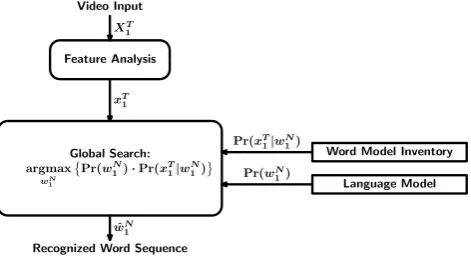
Figure 1: Bayes’ decision rule used in ASLR.
partly parallel information streams/modalities are presented and evaluated. The system and its components are tested in the context of continuous ASLR for two publicly available, large-vocabulary databases. One database represents lab-data created for pattern recognition purposes and one database represents ’real-life’ data recorded from German public TV. Comparing findings on lab-data and ’real-life’ data we investigate which findings on lab-data generalize to ’real-life’ scenarios.
2. System overview and features
The ASLR system described here follows the system design proposed in [18] and is based on Bayes’s decision rule but differs in several aspects. Specifically, features adapted from action recognition, learned features, a number of techniques to combine different modalities within the system, class-based language models, gap/noise models and signer adaptation tech-niques for multi-signer data are employed.
The recognition result of the system is the sequence of words that best fits the trained word models and the language model (see Figure 1). One has to note that linguistically this represents a major simplification but the use of gloss an-notations (see Section 2.1 for a short definition) is a com-mon practice within the recognition community to deal with the non-availability of a common writing system for sign lan-guages. While linguistically motivated writing notations such as HamNoSys[6] or SignWriting [8] cover information about different modalities used within sign languages, they are still a weak labeling scheme for signs because they do not give an annotation of the movement, facial expression, etc. per time frame. Furthermore, using glosses as target classes and annota-tion scheme allows for faster annotaannota-tion of large amounts sign language data which is needed for a automatic statistical recog-nition approach.
Finally, the proposed recognition system has been tested on the two publicly available databases SIGNUM [19] and RWTH-PHOENIX-Weather (PHOENIX) [20] for GSL which are among the biggest datasets available for continuous ASLR.
2.1. Visual modeling
Albeit the cited work on automatic subunit extraction from sign language videos, it is still unclear how signs can be split into subunits. Furthermore, the majority of sign language corpora including those used in this work (see Section 3) is annotated usingglosseseffectively labeling the meaning of a sign rather than its appearance. Therefore, the proposed system is based on
whole-word models. The visual model (VM) of a sign consists of a left-to-right HMM in Bakis topology [21] where each seg-ment of the model (each pair of consecutive states) is modelled by a separate Gaussian mixture model (GMM) with globally pooled covariance matrix. The number of segments per model is estimated from manually annotated sign boundaries on the training data. Due to strong visual pronunciation variances (3 different signs for Sunday exist in GSL), the effect of explicit visual pronunciation modelling is investigated in Section 3.
2.2. Language models
Language models (LMs) play a crucial role in state-of-the-art ASR and ASLR systems. Dreuw et al. [18] showed that the impact of the well-known LM scale on the recognition perfor-mance of an ASLR system is in the same order of magnitude as in an ASR system. Therefore, the LM scale is optimized for all experiments presented in this work.
In contrast to ASR where it is possible to obtain language-specific almost arbitrarily large text collections for every lan-guage and domain, here the LM can only be trained on the tran-scribed training data of any given database for ASLR inherit-ing the problem of sinherit-ingletons and infrequent signs which often make up more than 40% of the available vocabulary of typically 200 to 500 signs. Inspired by the idea of class and topic LMs in ASR [22, 23, 24] and statistical sign language translation [25], we propose to use classes of visually and contextual similar signs within the LM. Class selection is based on the analysis of errors of a baseline system without LM classes. In this work, all LMs are trained using the SRILM toolkit [26] with modified Kneser-Ney discounting with interpolation [27].
2.3. Manual and non-manual features
GSL conveys information through manual and non-manual pa-rameters. Manual parameters comprise both hands’ shape, their orientation and position. There are two-handed, as well as single-handed signs. Single-handed signs are usually signed us-ing the dominant hand which in the databases used in this work corresponds to the right hand for all subjects in PHOENIX and all but two in the SIGNUM database.
Non-manual features: Face patches are extracted using the same tracking approach as described above. Furthermore, a position and orientation invariant active appearance model (POIAAM) [31] is fitted to each frame obtaining a 109 di-mensional shape descriptor, including shape model parameters, head rotation in space, mouth and eye openings and degrees of eyebrow raise. Finally, every frame of a video sequence is scaled down to32×32and53×65respectively to get a simple upper body feature as originally proposed in [18].
For all features, temporal context is included by stacking ±4video frames for SIGNUM and±2frames for PHOENIX. Since the resulting feature dimension is too high to robustly es-timate HMM parameters, PCA is applied. All features but the movement trajectory are reduced to 200 dimensions. In case of the colored hand and face patches PCA is applied to each color channel (red, green, blue) separately, yielding a final feature di-mension of 210. The movement trajectory feature itself has only limited discriminative power and is therefore combined with the HoG3D features of the right hand.
2.4. Signer adaptation and modality combination
Sign languages use partly parallel, but not perfectly syn-chronous information streams/modalities to convey meaning. These modalities must be handled in the recognition process but it is an open question how to incorporate different modali-ties within such a system. A similar situation exists in audio-visual speech recognition (AVSR) where acoustic features and visual features of the mouth are combined. Following the work in AVSR, we investigated feature combination (concatenation), system combination using (i)ROVER [32] as well as combina-tion between HMMs on state level (synchronous combinacombina-tion) and at word boundaries (asynchronous combination). Experi-mental results show that the first two types of combination are not effective for current ASLR because either the resulting fea-ture space dimension is too high or the systems make too similar recognition errors [10]. Here, only results for synchronous and asynchronous combination are presented.
Signer adaptation: ASR systems trained on different speak-ers have to address the speakspeak-ers’ voice and speech patterns to achieve good recognition performance. A common approach is to use speaker adaptive training (SAT) and learn speaker depen-dent feature transformation matrices using constraint maximum likelihood linear regression (CMLLR). Analogous to ASR, ASLR has to tackle signing styles. Therefore, SAT/CMLLR is evaluated in the context of ASLR for 25 signers.
3. Experimental results
The SIGNUM database [19] contains lab recordings of 25 sign-ers wearing black long-sleeve clothes in front of a dark blue background signing predefined sentences. Videos are recorded at780×580Pixel and 30 frames per second (fps). Each signer signs the603unique training and177testing sentences once, whereas they are signed thrice in the single signer setup. 3.6% of the glosses are out of vocabulary (OOV). Table 1 shows statistics of the single signer setup only. The multi signer setup has the same vocabulary and OOV rate but 15k sentences (92k running glosses) for training and 4.4k sentences (23k running glosses) for testing. If not stated explicitly otherwise, all pre-sented SIGNUM results refer to the single signer setup.
[image:3.595.317.534.88.180.2]The PHOENIX [20] database contains ’real-life’ sign lan-guage footage recorded from weather-forecasts aired by the
Table 1: Statistics for SIGNUM single signer and PHOENIX
SIGNUM PHOENIX
Train Test Train Test
# sentences 1809 531 304 47
# running glosses 11,109 2805 3309 487
vocabulary size 455 - 266
-# singletons 0 - 90
-# OOV [%] - 3.6 - 1.6
perplexity (3-gram) 17.8 72.2 15.9 34.9
public German TV-station PHOENIX. ’Real-life’ is meant from a computer vision point of view, where the signers were not ar-tificially restricted in any sense in their signing (sentence struc-ture, choice of vocabulary, size and intensity of signs, . . . ) and where the recording conditions have a much larger variance than on other signing corpora (lighting, camera-signer position, . . . ). The video footage has not been created for pattern recognition purposes or linguistic research. From a linguistic point of view the employed language has to be classified as non-native, as the signer is a hearing interpreter, whose parents are deaf. The videos (210×260Pixel, 25 fps interlaced) show the interpreter wearing dark clothes in front of an artificial gray gradient back-ground and pose a strong challenge to CV and ASLR due to high signing speed (majority of signs spans less than 10 frames), strong coarticulation effects and more than 30% of the vocabu-lary being singletons. Statistics of both databases are shown in Table 1.
The system is trained using maximum likelihood and the EM-algorithm. The number of Gaussian densities and the LM-scale are optimized. For PHOENIX, the system uses 1433 emission distributions with a total of 4k Gaussians and a globally pooled covariance matrix. The same applies to SIGNUM, but the numbers are 1366 emission distributions with 24k Gaussians for single signer and 198k for multi-signer. Recognition uses word-conditioned tree search and Viterbi approximation.
Basic Features: In order to build a well performing ASLR system, the feature selection plays a crucial role. The full video images can be seen as a global descriptor of manual and non-manual parameters and are, thus, a good starting point. As the hands are known to carry the most information in signing, tracked and cut out hand patches have often been preferred [18] over full frames. Comparing both features, hand patches outperform full images on both databases (see Table 2, Row 1).
Model length estimation:In ASR, the HMM model of a word is formed by the linked models of the word’s subunit HMMs. Thereby, the typical temporal length of a word is modelled. This approach is not yet possible in ASLR because the defini-tion and extracdefini-tion of subunits is still an open research quesdefini-tion. PHOENIX includes word boundary annotations from which the number of segments for each gloss HMM can been estimated by choosing the median of the lengths minus 20% and adjusting the length in case the adapted median is shorter than the short-est utterance of the gloss. The hand patch baseline presented above uses this approach. Using uniform length for all glosses, the recognition result is60.8%instead of55.0%WER. ’Boot-strapping’ the initial system alignment using the word boundary ground truth, we achieve57.5%WER.
Table 2: WERs for competing features (Rows 1.-6.), WERs without and with specific techniques (Rows 7.-11.). ’+’ denotes a synchronous, asynchronous or feature combination. Please see corresponding text parts for explanations. HoG3D uses tracked hand locations. For PHOENIX, in rows 3.-5., manual ground truth annotation has been used instead.
Competing Features PHOENIX SIGNUM
1. Full image Hand patch 80.1 55.0 31.6 16.0
2. Hand patch HoG3D 55.0 49.7 16.0 12.5
3. HoG3D +Traj 45.2 42.1 12.5 14.2
4. HoG3D+Traj +Face 42.1 41.9 14.2 14.2
5. HoG3D +Full 45.2 45.2 12.5 10.7
Impact of Techniques WER [%] WER [%]
6. Model Length Estimation 60.8 55.0 16.0 17.5
7. Temporal Context 51.3 49.7 12.7 12.4
8. MLP 39.8 43.3 16.0 13.0
9. Manual Tracking Annotation 55.0 48.3 – –
10. Gap Models 42.1 39.8 – –
11. Class LM 39.8 38.6 – –
frame alignment of an HMM system with uniform length. No improvement over uniform length is observed due to the estimation on the frame alignment having limited accuracy and the signs in the video already sharing a similar length.
Visual pronunciation variants:Sign languages exhibit strong pronunciation variation which manifest in visual sign vari-ants. Visual variants are not explicitly labeled in PHOENIX or SIGNUM. While in SIGNUM no variants exist because of the artificial nature of the database, PHOENIX shows high variabil-ity within signs annotated by the same gloss. This arises mainly from the interpreter mixing different dialects.
We have manually annotated the variants with regard to the visual appearance and the motion of the hand yielding on average2.7variants per gloss and a total of 711 different variants. Using these annotations, each variant is modelled by a distinct HMM with model length estimation achieving 56.5%WER in contrast to the baseline of55.0%. Further, both systems outperform the 62.2% WER of a ’nearest-neighbor’ style system where each gloss occurrence is modelled indepen-dently. Apparently, increasing the number of dedicated HMMs per gloss worsens recognition. Coherent manual definition of variants is likely to be a problematic factor, as well as the HMMs not generalizing well over unseen data because of the reduction in training data per HMM and strong coarticulation effects.
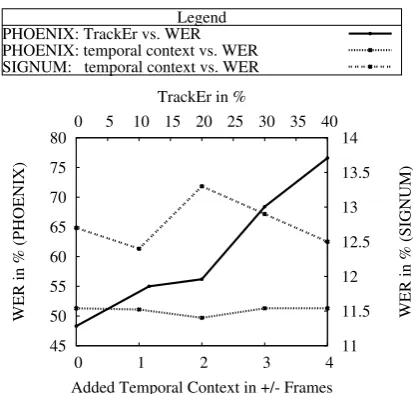
Tracking Influence: The presented hand patch baselines rely on tracking to localize the hands of the signer. Tracking is not perfect and errors propagate through the recognition system. Figure 2 shows the impact of tracking quality measured in tracking error rate (TrackEr) [28] counting a tracked position as wrong if it differs by more than 20 Pixel from ground truth on ASLR for PHOENIX. The TrackEr of 0 at48.3%WER refers to using ground truth tracking annotation (see Table 2, Row 9).
HoG3D:HoG3D features encode the shape and its change over time of a tracked hand. The latter aspect is not covered by hand patch features. Further, HoG3D features are more compact than hand patches, and robust against local illumination changes. Comparing to the hand patch baselines, recognition results are improved from55.0%to49.7%WER for PHOENIX and from 16.0%to12.5%WER for SIGNUM. The result on PHOENIX
45 50 55 60 65 70 75 80
0 1 2 3 4
11 11.5 12 12.5 13 13.5 14 0 5 10 15 20 25 30 35 40
WER in % (PHOENIX) WER in % (SIGNUM)
Added Temporal Context in +/- Frames TrackEr in %
[image:4.595.57.282.145.266.2]Legend PHOENIX: TrackEr vs. WER PHOENIX: temporal context vs. WER SIGNUM: temporal context vs. WER
Figure 2: Solid Black: Influence of tracking performance in TrackEr on WER for PHOENIX using right hand patches fea-tures (read top x-axis vs. left y-axis). Dotted: Impact of tempo-ral context using HoG3D (right hand) on WER for PHOENIX (read bottom x-axis vs. left y-axis). Dashed: Impact of tem-poral context using HoG3D (right hand) on WER for SIGNUM (read bottom x-axis vs. right y-axis)
is almost as good as using ground truth tracking information for the hand patches.
Temporal Context:The temporal context of a feature includes information that cannot easily be learned by an HMM system but has been shown to improve results in ASR [33].
Although HoG3D features already incorporate temporal context, we find that including additional context benefits the recognition, as can be seen in Figure 2. More context than±2 frames degrades recognition accuracy on PHOENIX, capturing too much information of the following glosses. On SIGNUM, we observe only marginal recognition improvement indicating that the context included in HoG3D is sufficient. The chosen system defaults are at±2frames for PHOENIX and±4frames for SIGNUM and are, thus, well chosen for both cases.
Modalities: In addition to the body pose (full image) and the right hand (HoG3D), we evaluate the performance using fa-cial expressions (POIAAM), the left hand (HoG3D) and the movement of the right hand (Traj). For both databases, the left hand tracking quality is worse than the right hand. Hence-forth ground truth tracking annotations are used for PHOENIX to avoid tracking bias. Thus, the HoG3D baseline improves to 45.2% WER. Using left hand features63.9% respectively 51.0%WER are achieved for PHOENIX and SIGNUM. The stronger recognition degradation for PHOENIX reflects the dif-ficulty of the database. With facial features, the recognition result is62.6%respectively 89.3% WER for PHOENIX and SIGNUM. The high WER for SIGNUM is due to the fact that hardly any facial expressions are present here. Concatenating movement trajectory and right hand HoG3D, results are im-proved for PHOENIX but not for SIGNUM (Table 2, Row 3).
results for both databases are improved if the respectively best single modalities are combined. For a full overview of modality combination techniques and results refer to [10].
Gap Models: The SIGNUM database is designed to con-tain only one-handed signs and no switching of the hand. Contrarily, in PHOENIX signers partly switch hands and use the left hand for signing while holding the right. This effect introduces missing features in the information stream of the right and left hand. One way to remedy this problem is to borrow the idea of noise models from ASR and to augment the system’s vocabulary by two such models. One model subsuming signs performed by the left hand only and one for long gaps between signs of more than five frames that are part of the sentence but do not belong to either neighboring sign. The training data annotation is automatically augmented by labels for both aspects using ground truth annotation. Using these gap models, the WER is improved from42.1%to39.8% on PHOENIX, due to the models only being populated with clean and complete data. Further, we observe an improved feature to HMM state alignment (measured as distance to the ground truth annotation).
MLP-tandem: The MLP-tandem approach was evaluated for SIGNUM and PHOENIX. For SIGNUM the MLP is trained on hand patch features resulting in13.0%WER that outperforms the baseline by 3%. This result is comparable to the12.5% obtained using HoG3D features. For PHOENIX, the MLP is trained on concatenated HoG3D with Trajectory features. The recognition result is with43.3%WER (at±1 frame temporal context)3.5%worse than the baseline of39.8% obtained by the HoG3D+Traj features alone. Including more temporal context does not help because it is already included in the MLP posterior estimates. Two aspects feature into the performance of the MLP features on PHOENIX. On the one hand, it is not clear if the MLP can reliably extract the relevant information from the HoG3D+Traj features although following the ASR praxis of using the best feature available. On the other hand, the MLPs for PHOENIX and SIGNUM have about the same number of parameters but the MLP on SIGNUM is trained using ten times the data of PHOENIX. Anyhow, the results show that MLP features as used in ASR achieve comparable results to specialized features from CV although requiring training themselves.
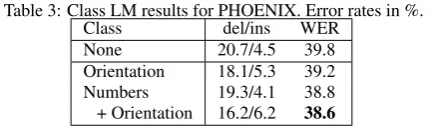
Class LM:With regard to PHOENIX the analysis of the recog-nition errors showed that 3.8% absolute of all errors are due to misclassified numbers and 2.2% absolute are due to orientations such asnorth. Further, both classes appear in a specific context such as a number before the gloss TEMPERATURE which is not adequately captured by sign-level LMs. Additionally, num-bers have a low frequency in the LM training data appearing on average less than ten times. Augmenting the LM for PHOENIX with a class for numbers, the perplexity (PPL) on the test data is reduced from34.9to29.3. Orientations reduce PPL to31.2 and using both classes PPL is reduced to25.7.
[image:5.595.319.534.82.146.2]Table 3 shows that using the orientation category the recog-nition performance is only marginally improved but using the number category alone improves the overall recognition result by 1.2% WER. Other categories as used in sign language trans-lation [25] did not improve results. For SIGNUM, class LMs have not been used because of the special and artificial struc-ture of the sentences.
Table 3: Class LM results for PHOENIX. Error rates in %.
Class del/ins WER
None 20.7/4.5 39.8
Orientation 18.1/5.3 39.2
Numbers 19.3/4.1 38.8
+ Orientation 16.2/6.2 38.6
Signer adaptation:Applying the findings on SIGNUM single signer to the case of 25 signers and using tracked hand patches of the right hand as features, the system achieves23.6%WER. In ASR SAT is used to adapt the features to better fit the learned models. In the same fashion, we use SAT to adapt the baseline system to the signers sign patterns. In a second train-ing pass, signer specific feature transformation matrices are esti-mated using CMLLR. In SIGNUM the signer ids are annotated and hence no signer clustering is performed.
Using the signer ids of the test data, it is possible to evaluate what is the maximal achievable improvement in terms of WER using SAT/CMLLR on the given test data. In the typical recog-nition setup the ids of the signers in the test data are not known and the resulting improvement is lower due to errors in the clus-tering process. Adapting the proposed recognition system build for the SIGNUM multi-signer database using SAT/CMLLR, the WER of23.6% is improved to22.1% showing that the standard approach from ASR is applicable to ASLR without any modifi-cations.
4. Summary and conclusion
In this work, a large-vocabulary ASLR system for continuous sign language using single-view videos as well as the process of feature selection, technology transfer from ASR and CV and system design have been presented. Techniques from ASR and CV have been evaluated in the context for ASLR for challeng-ing ’real-life’ data and data designed for pattern recognition.
Some aspects were found to generalize over both data sets: HoG3D alone outperforms all other tested features with MLPs being a close second. The combination of the two best single performing modalities achieves the best combination result and the system benefits from including temporal context in features. Other findings are related to particularities of the given cor-pora: On PHOENIX, gap models improve results but use spe-cific annotations not necessarily available in other corpora. The improvement by class LMs exploits domain-specific knowledge and model length estimation relies on accurate sign boundaries. To sum up, the WER on ’real life’ data has been reduced from over80%to 38.6%and on lab data from over30% to 10.7%for single signer and to22.1%for multi signer. Although this might sound very high compared to the state-of-the-art in ASR, this is one of the first times that recognition results have been published on ’real-life’ data. We believe that our work helps pushing ASLR towards more realistic application scenar-ios, which come along with challenges most of the current sign language data sets ignore. This goes especially for the use of single-view video material in contrast to using special hardware such as bulky cyber gloves, or stereo cameras.
5. Acknowledgements
This work has been partly funded by the European Commu-nity’s Seventh Framework Programme FP7-ICT-2007-3, grant agreement 231424 - SignSpeak project and the Janggen-P¨ohn-Stiftung. Special thanks to Thomas Hoyoux (Technical Univer-sity Innsbruck) and Yvan Richard (Centre de Recerca i Inno-vacio de Catalunya (CRIC)) for providing AAM and HoG3D features.
6. References
[1] C. Vogler and D. Metaxas, “A framework for recognizing the
si-multaneous aspects of american sign language,”Computer Vision
and Image Understanding, vol. 81, no. 3, pp. 358–384, 2001.
[2] J. Deng and H. T. Tsui, “A Two-step Approach based on PaHMM
for the Recognition of ASL,” inACCV, Jan 2002.
[3] C. Wang, X. Chen, and W. Gao, “Expanding Training Set for
Chi-nese Sign Language Recognition,” inFG, 2006.
[4] E.-J. Ong, H. Cooper, N. Pugeault, and R. Bowden, “Sign
lan-guage recognition using sequential pattern trees,” inCVPR, Jun.
16 – 21 2012, pp. 2200 – 2207.
[5] V. Pitsikalis, S. Theodorakis, C. Vogler, and P. Maragos, “Ad-vances in phonetics-based sub-unit modeling for transcription
alignment and sign language recognition,” inCVPR, 2011, pp.
1 – 6.
[6] T. Hanke, “HamNoSys - representing sign language data in
lan-guage resources and lanlan-guage processing contexts,” inLREC
2004, Workshop proceedings : Representation and processing of
sign languages, 2004, pp. 1 – 6.
[7] O. Koller, H. Ney, and R. Bowden, “May the force be with you: Force-aligned signwriting for automatic subunit annotation of
cor-pora,” inFG, Apr. 2013.
[8] V. Sutton and Writing, Deaf Action Committee for Sign,Sign
writing. Deaf Action Committee (DAC), 2000.
[9] H. Cooper, E.-J. Ong, N. Pugeault, and R. Bowden, “Sign
lan-guage recognition using sub-units,”JMLR, vol. 13, pp. 2205–
2231, Jul 2012.
[10] J. Forster, C. Oberd¨orfer, O. Koller, and H. Ney, “Modality com-bination techniques for continuous sign language recognition,” in
IbPRIA, Jun. 2013.
[11] P. Buehler, M. Everingham, and A. Zisserman, “Learning sign language by watching TV (using weakly aligned subtitles),” in
CVPR, 2009.
[12] H. Cooper and R. Bowden, “Learning signs from subtitles: A weakly supervised approach to signlanguage recognition,” in
CVPR, Jun 2009, pp. 2568 – 2574.
[13] H.-D. Yang, S. Sclaroff, and S.-W. Lee, “Sign language spot-ting with a threshold model based on conditional random fields,”
PAMI, vol. 31, no. 7, pp. 1264–1277, July 2009.
[14] S. Najak, K. Duncan, S. Sarkar, and B. Loeding, “Finding recur-rent patterns from continuous sign language sentences for
auto-mated extraction of signs,”JMLR, vol. 13, pp. 2589 – 2615, Dec
2012.
[15] R. Yang, S. Sarkar, and B. Loeding, “Handling movement epenthesis and hand segmentation ambiguities in continuous sign
language recognition using nested dynamic programming,”PAMI,
vol. 32, no. 3, pp. 462–477, Mar 2010.
[16] S. Ong and S. Ranganath, “Automatic sign language analysis: a
survey and the future beyond lexical meaning,”IEEE
Transac-tions on Pattern Analysis and Machine Intelligence, vol. 27, no. 6, pp. 873–891, 2005.
[17] A. Kl¨aser, M. Marszałek, and C. Schmid, “A spatio-temporal
de-scriptor based on 3d-gradients,” inBMVC, Sep 2008, pp. 995–
1004.
[18] P. Dreuw, D. Rybach, T. Deselaers, M. Zahedi, and H. Ney, “Speech recognition techniques for a sign language recognition
system,” inInterspeech, Aug. 2007, pp. 2513–2516, iSCA best
student paper award.
[19] U. von Agris, M. Knorr, and K.-F. Kraiss, “The significance of
facial features for automatic sign language recognition,” inFG,
Sep 2008, pp. 1–6.
[20] J. Forster, C. Schmidt, T. Hoyoux, O. Koller, U. Zelle, J. Piater, and H. Ney, “Rwth-phoenix-weather: A large vocabulary sign
lan-guage recognition and translation corpus,” inLREC, May 2012.
[21] R. Bakis, “Continuous speech word recognition via centisecond acoustic states,” in91st Meeting of the Acoustical Society of
Amer-ica (ASA), Washington, DC, USA, April 1976.
[22] A. Emami and S. Chen, “Multi-class model m,” inICASSP, May
2011, pp. 5516–5519.
[23] S. F. Chen and S. M. Chu, “Enhanced word classing for model
m,” inInterspeech, 2010, pp. 1037–1040.
[24] W. Naptali, M. Tsuchiya, and S. Nakagawa,
“Topic-dependent-class-based n-gram language model,” ASL, vol. 20, no. 5, pp.
1513–1525, 2012.
[25] D. Stein, C. Schmidt, and H. Ney, “Analysis, preparation, and
op-timization of statistical sign language machine translation,”
Ma-chine Translation, vol. 26, no. 4, pp. 325–357, Dec. 2012.
[26] A. Stolcke, J. Zheng, W. Wang, and V. Abrash, “SRILM at
Six-teen: Update and outlook,” inASRU, Waikoloa, Hawaii,
Decem-ber 2011.
[27] S. F. Chen and J. Goodman, “An empirical study of smoothing
techniques for language modeling,” Computer Speech &
Lan-guage, vol. 13, no. 4, pp. 359–393, 1999.
[28] P. Dreuw, T. Deselaers, D. Rybach, D. Keysers, and H. Ney, “Tracking using dynamic programming for appearance-based sign
language recognition,” inFG, 2006, pp. 293–298.
[29] Z. T¨uske, M. Sundermeyer, R. Schl¨uter, and H. Ney,
“Context-dependent mlps for lvcsr: Tandem, hybrid or both?” in
Inter-speech, Portland, OR, USA, Sep. 2012.
[30] G. R. J. Schenk, “Novel hybrid nn/hmm modelling techniques for
on-line handwriting recognition,” inIWFHR, Oct 2006, pp. 619 –
623.
[31] J. Piater, T. Hoyoux, and W. Du, “Video Analysis for
Continu-ous Sign Language Recognition,” in4th Workshop on the
Repre-sentation and Processing of Sign Languages: Corpora and Sign
Language Technologies, May 2010, lREC.
[32] B. Hoffmeister, R. Schl¨uter, and H. Ney, “icnc and irover: The limits of improving system combination with classification?” in
Interspeech, Sep. 2008, pp. 232–235.
[33] A. Zolnay, R. Schl¨uter, and H. Ney, “Acoustic feature