The sustainability of the datateam method
A qualitative study of the implications for practice and policy and
differences between schools
Niek van der Veen
(s1494201)
Supervisors:
Kim Schildkamp
Cindy Poortman
Table of contents
Foreword ... i
Summary ... ii
1. Introduction ...1
2. Theoretical overview ...3
2.1 The implications for practice and policy ...3
2.2 Sustainability of methods ...3
2.3 Factors facilitating sustainability ...3
2.3.1 The role of the school leader ...4
2.3.2 Professional development and team collaboration ...6
3. Method ...7
3.1 Sample and instruments ...7
3.2 Analysis...8
3.3 Procedure ...8
4. Results ...9
4.1 Within case analyses ...9
4.1.1 Results school A ...9
4.1.2 Results school B ... 12
4.1.3 Results school C ... 14
4.1.4 Results school D ... 17
4.1.5 Results school E ... 19
4.1.6 Results school F ... 21
4.2 Cross-case analyses ... 24
5. Conclusion and discussion ... 32
5.1 Answering the research questions ... 32
5.2 Limitations of the study ... 34
5.3 Directions for future research ... 35
6. References... 36
Appendix A ... 39
Appendix B ... 42
i
Foreword
In 2008, I graduated from high school. Afterwards, the long journey of college began. After five years, with a bachelor’s degree from the University of Groningen in possession, I ended up in Enschede, where I started with the master’s programme Educational Science and Technology. This thesis symbolises the endpoint of all these wonderful years as a ‘student’.
In the beginning of this master’s programme, there were three classes about the datateam method, lectured by Kim Schildkamp. For me, this was one of the more interesting classes up until that point. Later on, I found out that Kim Schildkamp was looking for students to do their master’s thesis in this research topic. For me there were no doubts and I did not hesitate to contact her. This way, I ended up writing a thesis about the sustainability of the datateam method. From February, when I started with the thesis, up until August, I was guided by Kim Schildkamp as well as the second supervisor, Cindy Poortman. I want to thank you both for always being ready to answer my questions and to read my draft versions of the thesis and providing me with feedback.
The greatest deal of gratitude however, I owe my parents. For this thesis, I had to travel to differing places, in order to be able to interview the respondents in the thesis. My parents were always willing to lend me a car, as long as I filled up the tank afterwards. Moreover, during the last six years, my parents have always supported me, and not in the least financially. I really want to thank you both for this. With the completion of the thesis, this era ends.
Niek van der Veen Enschede,
ii
Summary
1
1. Introduction
In the Netherlands, schools are responsible for the quality of their education and have considerable autonomy in making choices related to this quality (Schildkamp, Lai & Earl, 2013). There are, however, certain legal requirements for schools to monitor their own quality, as well as regular school
inspections. These legal requirements and inspections result in multiple sources of data, such as evaluations of quality aspects, e.g. the quality of teaching. In combination with other data, such as students’ scores on assessments, the quality of the school can be evaluated. Also, schools can use data to evaluate the effectiveness of programs and practices and identify areas of improvement (Mason, 2002). Data could also be used for instructional purposes, to reflect on teaching or management practices, to identify areas of need and target resources, and for decisions related to personnel. When data are used to inform decisions in these areas, this is called data-based decision making (Schildkamp et al., 2013).
In data-based decision making, decisions are based upon a broad range of data, for example students’ scores on assessments and observations in the classroom. In the context of schools, ‘data’ are defined as information that is collected and organized to represent some aspect of schools. There are multiple sources of data, including context data such as survey results about school culture, input data such as demographics of the student population, process data such as data on the quality of instruction and class observations and outcome data such as student test scores (Schildkamp et al., 2013).
Decisions in areas ranging from professional development to student learning should be informed by data, since this can lead to increased student achievement and school improvement (Datnow, Park & Wohlstetter, 2007). However, it is not uncommon for teachers to base their decisions on intuition and instinct (Slavin, 2002). Research has shown that schools often do not use data for school improvement (Ledoux, Blok, Boogert & Krüger, 2009). Schildkamp and Kuiper (2010) also found that too few data are used within schools. A possible reason for this is that the necessary data are not readily available to make an informed decision. Also, it is possible that teachers or school leaders are of the opinion that data are not needed to make decisions. Moreover, teachers or school leaders may experience a lack of skills for using data effectively (Schildkamp et al., 2013).
The use of data has become more and more important within secondary education, although it is a relatively new concept in the Netherlands (Schildkamp et al., 2013). Data-based decision making however, implies that teachers and school leaders know how to analyze, interpret and use data in an effective way. Thus, schools need support in the use of data. Therefore, the datateam method was developed (Schildkamp et al., 2013).
The aim of the datateam method is to support schools in the use of data. By using data effectively, schools are able to evaluate the quality, and individual teachers are able to reflect on their own practices. The data should be used in making decisions, for example regarding student learning.
In the datateam method, small teams are formed consisting of (4-6) teachers and (1-2) school leaders. In these teams, data are used to solve educational problems, using a structured approach. An important element of the method is that the teams work collaboratively. School leaders are part of the data team, because school leaders often have a different perspective on a particular problem. Therefore, new hypotheses can be brought to the table. Also, the school leader does not have to be convinced of implementing the outcomes of the data team afterwards, because of involvement in the process from the start. Examples of problems that can be discussed in teams are above average retention rates, disappointing results for a specific subject, and declining exam results (Schildkamp et al., 2013).
The teams are supported by a coach from the university over a period of two years. Under the guidance of this coach, teachers in the data teams learn to systematically use data within the school. An iterative and cyclic procedure is used in these teams, consisting of eight steps. These eight steps are formulating a clear problem definition, formulating a hypothesis (about what may be causing the problem), collecting and analyzing data, as well as checking if the data are valid and reliable, drawing conclusions based on the data, implementing improvement measures and evaluating the effectiveness of these measures. After external support ends, teachers and school leaders are expected to lead their own data teams (Schildkamp et al., 2013). Thus, teachers and school leaders should be able to continue the method after two years of training.
2
relatively little is known about the sustainability of the datateam method. The first two years, schools are guided and supported by a coach from the university. The question is however, how data teams influence practice and policy, and whether and how teams proceed after external support has ended. These are topics that have yet to be explored.
Implications of the method for practice and policy as well as the sustainability of the method are topics that need to be examined. The topic of implications for practice includes questions about the implementation and continuation of the outcomes of the data teams. Implications for policy could for example include the datateam method being present in the school plan and policy documents. The main question concerning the sustainability is whether schools have continued the datateam method without the support of the university. Also, the possible formation of extra data teams is relevant to the sustainability of the datateam method. Finally, the aim was to explain differences between schools. The following research questions were formulated:
1) What are the implications for practice and policy of working with the datateam method? 2) To what extent is the datateam method sustainable?
3) How can differences in sustainability of the datateam method between schools be explained? By answering these research questions, the aim was to contribute to the datateam method, as it could offer insights in what contributes to the fact that the method is or is not continued within schools. Next to these practical contributions, this study aims at making a scientific contribution, by offering insights in factors that contribute to the sustainability of the method. This way, the study could help in
3
2. Theoretical overview
2.1 The implications for practice and policy
In the datateam method, school leaders and teachers are provided with opportunities to develop their knowledge and skills needed to collect, analyze, interpret and use data (Schildkamp & Kuiper, 2010; Schildkamp, Poortman & Handelzalts, forthcoming). Therefore, the datateam method is expected to lead to more ‘skilled’ teachers. Also, the data team wants to solve an educational problem
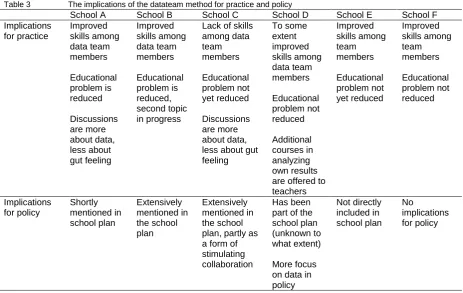
(Schildkamp et al., forthcoming). For that reason, an implication of the method could be solving, or reducing, this problem (Schildkamp, Handelzalts, Poortman, Leusink, Meerdink, Smit, Ebbeler & Hubers, 2014). Another implication might be that conversations about educational problems become based upon data, instead of gut feeling. When the data team did not finish the eight steps of the data team procedure yet, but somehow did contribute to changes in practice, e.g. the way of examination, this could also be seen as an implication for practice.
Implications for the policy could include the school taking up the activities and the goals of the datateam method in the school plan and the school prospectus. Also, when the data team contributes to the fact that the policy of the school is more focused on the use of data in the school, this could be seen as an implication for policy.
2.2 Sustainability of methods
Several educational reform attempts have proven to be lacking sustainability. Sustainability can be seen as the capacity of an educational reform to continue. However, according to Hargreaves and Fink (2000), sustainability also implies that educational change is developed without compromising the development of other initiatives in the surrounding environment. According to Fullan (2007),
sustainability is the capacity of a system to engage in the complexities of continuous improvement consistent with deep values of moral purpose. In this context, moral purpose should be seen as a commitment to raise the bar and closing the gap of student achievement, improving the environment, treating people with respect and engaging in the big picture of national policy and societal goals. For this study, the definition as formulated by Fullan (2007) was used. The Inspectorate in the Netherlands wants schools in secondary education to use more data. Next to this, data teams aim at improving student achievement and teacher practices. Therefore, the datateam method appears to serve the moral purpose of which Fullan (2007) speaks.
For Fullan (2007), relationships are at the heart of any educational reform. The sustainability of an educational change is always the result of the interrelations between and across groups at various levels, such as the school level and the classroom level, in differing contexts and at various points in time.
Thus, for an educational change to be sustainable, it has to endure over time. Therefore, the continuation of the data teams is an important topic in this study, as well as the formation of new data teams. There are three scenarios in which the datateam method is considered as sustained. The first scenario is when the original data team is still active within the school. In the second scenario, one or more new data teams have been formed. Such a team would consist of teachers and school leader(s) that were not involved in the original data team, possibly guided, however, by some members of the original data team. Finally, it is possible that the data team is no longer active. However, when the datateam method contributed to the fact that teachers and school leaders use data in the school, e.g. to inform decisions, this could be seen as a form of sustainability, as the datateam method aims at supporting schools in their use of data. Thus, a school could have ‘sustained’ the datateam method, without the continuation of the data team itself.
2.3 Factors facilitating sustainability
4
Figure 1
2.3.1 The role of the school leader
The role of the school leader is considered essential in the literature (Fullan, 2007; Hargreaves & Fink, 2000). The school leader plays a crucial role in motivating, encouraging and supporting teachers (Fullan, 2007). In the datateam method, the principal of the school often does not participate in the team. Therefore, school leaders in this study are all members of the school management team. The goal of leadership is to build engagement, partnership and skills necessary for sustainable educational change (Levin, 2012).
One of the core tasks of the school leader in realizing data-based decision making within the school is creating a culture of data use (Levin & Datnow, 2012; Wayman, 2005; Lange, Range & Welsh, 2012), as the sustainability of an educational reform is affected by the school culture (Sindelar, Shearer, Yendol-Hoppey & Liebert, 2006). For the culture of the school to start embracing the use of data, explicit norms and expectations for the use of data should be created (Lange et al., 2012). A culture which values regular and consistent use of data, or a culture of inquiry, is essential (Datnow, Park, & Wohlstetter, 2007). In such a culture, school staff look critically at data, reflect on their own functioning, and are open to changing their practice when the data reveal the need for this
(Schildkamp et al., 2013).
5
data (Schildkamp & Kuiper, 2010).Furthermore, an educational change is more likely to endure when the school has a culture of
collaboration (Sindelar et al., 2006). Creating collaborative cultures and structures is seen as a main
task of a school leader. This implies a climate of trust (Leithwood et al., 2004; Levin & Datnow, 2012). Such a climate of trust and collaboration is needed as this offers teachers opportunities to discuss data with each other, also outside of the data team. Based upon these discussions, teachers are able to improve practice (Levin & Datnow, 2012). Little (2006) refers to this as a collegial professional culture, in which there is little distance between teachers. Teachers share values and have a collective focus on and responsibility for student learning.
Next to this, a school leader should base strategies on leaders developing other leaders, so-called ‘teacher leaders’, in order to create a critical mass of teachers who are skilled in and committed to the change. This ‘critical mass’ should be able to continue the educational change. Especially when external support eventually ends, as is the case in the datateam method, this is crucial to the
sustainability (Fullan, 2007; Hargreaves, 2002). These teacher-leaders can support the school leader in some of the tasks, for example by providing other teachers with resources and encouragement for the innovation and its new practice (Sindelar et al., 2006). With regard to the datateam method, the functioning of the data team should be independent of the school leader that is involved. Thus, teacher-leaders are able, for example, to initiate team meetings or guide and support a new member in the team.
In addition, giving teachers the opportunity to participate in decision-making, e.g. shared
decision making, is helpful for the sustainability of an educational change (Sindelar et al., 2006). Thus,
for the data teams it is important that teachers and school leaders share responsibilities, such as in decision-making. This applies to all members of the data team, not only ‘teacher-leaders’. Team members should have the feeling that the outcomes of the data team procedure are achieved in collaboration. This means that opinions of all participants are valued in the team. Shared decision making will increase the motivation of teachers (Fullan, 2007). In addition, teachers will feel less isolated and more committed (Wahlstrom & Louis, 2008).
Furthermore, the school leader should be actively involved in the particular reform to support its continuation. One indicator of active involvement by the school leader is whether meetings related to the method are attended (Fullan, 2007). By being directly involved in the process, teachers will feel taken seriously and the school leader can pass on the enthusiasm about the use of data. This increases the motivation of teachers (Fullan, 2007). Teachers are also more likely to become committed to the reform, when the school leader devotes time to it (Sindelar et al., 2006). A lack of interest of school leaders however, is a reason for educational change to be discontinued (Fullan, 2007).
Another factor is the influence on the self-efficacy of teachers (Thoonen, 2012). The self-efficacy of teachers is significant as it plays an important role in teachers being motivated. Moreover, a high sense of self-efficacy is believed to lead to a more open attitude to new ideas and more
willingness to experiment with new methods. There are three ways for a school leader to enhance a teacher’s self-efficacy. The first one is offering feedback on the use of data. The second one is offering explicit experience by functioning as a role model. Modelling is a physical demonstration of an activity along with an explanation of the thinking process (Marsh & Farrell, forthcoming). Bringing data to meetings to support conclusions is also a form of modelling (Wayman, Spring, Lemke & Lehr, 2012). The last one is verbal persuasion, which could be helpful in convincing a teacher to participate, or to keep participating, in the educational reform. Teachers then, need to be convinced of the ‘perceived value’. When a school leader makes sure that teachers believe in the value of the educational reform, this will lead to higher levels of motivation and determination to continue the reform (Owston, 2007). By emphasizing that the educational reform supports student learning, teachers are more likely to participate (Sindelar et al., 2006), and this will lead to more effective use of data by teachers (Wayman, Cho, Jimerson & Spikes, 2012).
6
school concerning budget and timetable (Fullan, 2007). In fact, a lack of time, space or money for staff support has negative effects for the sustainability (Fullan, 2007; Sindelar et al., 2006; Sanches & Dias, 2013). By ‘institutionalizing’ prerequisites such as space and time, new teachers are also able to ‘step into’ the reform without experiencing insurmountable problems (Hargreaves, 2002). With regard to the datateam method, it may be important whether teachers received a compensation, financial or in time, for their participation in the data team, whether meetings were scheduled for a longer period or one at a time, and whether teachers’ schedules were cleared in order to be able to have data team meetings.
It is important though, to keep in mind that the aforementioned factors influencing the sustainability of an educational change, are not independent of each other. For example, when a culture of data use is created, staff and leaders turn to data, ask questions about it, reflect on the meaning of data and make decisions based on data. Not only shared norms and expertise are developed this way, but this often leads to participants becoming so-called ‘teacher-leaders’ (Knapp, Swinnerton, Copland & Monpas-Huber, 2006). Thus, to some extent the abovementioned factors influence each other.
2.3.2 Professional development and team collaboration
When a new project starts or when a teacher joins an ongoing project, the individual teacher will have to change. Therefore, professional development is crucial to the sustainability of data initiatives involving teachers (Wayman, 2005; Owston, 2007). Hargreaves (2002) states that for a project to endure over time, long term capacity building is needed. This can be done by developing teachers’ skills, i.e. professional development. This capacity building should lead to an institutional culture of continuous learning (Webster et al., 2011). The datateam method could be seen as a form of professional development, with the ultimate goal of school improvement (Schildkamp & Poortman, forthcoming). This form of professional development ends after two years, when the external coach leaves. However, for deep learning to occur, constant support for teachers is needed (Sleegers & Ledoux, 2006). Therefore, opportunities for professional development, such as a course in how to analyze data or additional external support for the team, should be available when necessary.
Professional development can be offered in formal courses, but also through informal learning on the job. In the latter, teachers can learn from their colleagues. Also, when a new member joins the data team, this member should be guided and supported by other team members, and informal learning on the job should occur. Thus, teachers should be able to learn from each other, offer support to each other and be able to solve individual and school-wide problems collaboratively (Owston, 2007). Interactions between teachers are very important, as these provide them with knowledge, feedback and social support. This creates opportunities for teachers to deepen the understanding about the educational change. A deeper understanding about the educational change increases the chances of an educational change to be continued. A lack of social support however, threatens the sustainability (Coburn, Russell, Kaufman & Stein, 2012). Thus, teachers should frequently discuss their use of data, how to improve it, and teachers should be able to give feedback to each other (Little, 2006). The datateam method involves working in a group. As mentioned above, a goal of the method is to solve school-wide problems collaboratively. Therefore, informal learning may be a logical
7
3. Method
3.1 Sample and instruments
There are currently twelve schools in the Netherlands which have been making use of the datateam method and where the external coach already left. In this study, data was collected from six of these schools. A data team trainer from the University contacted the twelve schools and got information about the data teams. Based on this information, six schools were selected. Three schools were selected that appeared to have continued the datateam method. Also, three schools were selected where the datateam method appeared to be discontinued. Thus, a purposeful sampling technique was used, since this research process is one of ‘discovery’ rather than testing of hypotheses (Denscombe, 2003). A school leader of each school, which participated in the data team, was part of the research, as well as one or two data team members. This differed per school as in some schools a second teacher who participated in the data team was not available. Furthermore, the data expert, whenever present within a school, was interviewed. The purpose was to portray whether the datateam method was sustained and to define and explain possible differences between schools. Also, it was studied if and how outcomes of the data teams were implemented. The units of analysis were actors involved in the data teams, i.e. teachers, school leaders and data experts.
In this research, data were collected through interviews. In total, 20 interviews were conducted (see table 1). Respondent 10 was the data expert at two schools. As a consequence, this respondent was interviewed about both the schools. Therefore, there were 19 respondents.
Thus, a qualitative method was used. Interviewing was chosen above a survey, since the opportunity to ask for more information and opinions of participants was considered most relevant to answer the research questions. This way, more information is gathered about why the method is continued or discontinued. There were separate interview schemes for school leaders, teachers and data experts. All interviews were conducted in the months May, June and July 2014. All interviews lasted approximately 45 minutes. In the interview schemes, questions were related to the themes in the theoretical framework (see figure 1). Thus, questions were asked related to the role of the school leader, to professional development and to team collaboration. Examples of the questions asked are: What was the role of the school leader in continuing the data team? Did you or one of your colleagues ever think that you needed more professional development? In what way do teachers learn from each other within the data team? In addition, the school plan and the school prospectus of all schools were included in the study. Indications of the datateam method and the use of data were collected from these sources.
[image:11.595.65.528.513.736.2]
Table 1
Respondent Function Data team
1 School leader A
2 Teacher A
3 Teacher A
4 School leader B
5 Teacher B
6 Data expert B
7 School leader C
8 Teacher C
9 Teacher C
10 Data expert C/F
11 School leader D
12 Teacher D
13 Teacher D
14 Data expert D
15 School leader E
16 Teacher E
17 School leader F
18 Teacher F
8
3.2 Analysis
All interviews were audio-recorded and transcribed. Themes were induced and clustered into
categories corresponding to the research questions and literature themes. Examples of these themes were the way the school leader motivated teachers and in what way the use of data had become a part of the school’s policy. After all the interviews had been conducted and transcribed, these
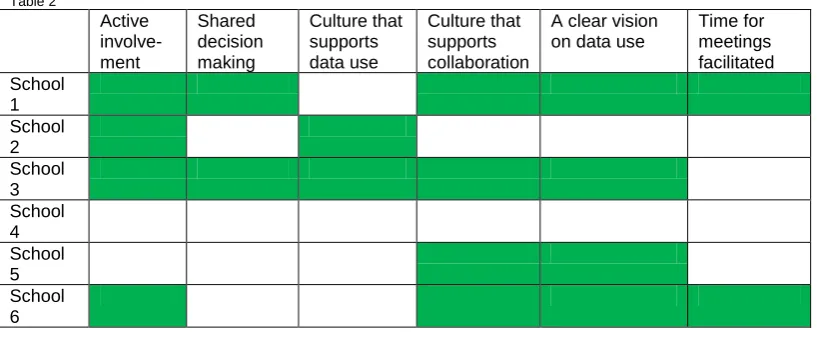
[image:12.595.66.476.263.439.2]transcripts were analyzed. The themes from the literature, as discussed in the theoretical framework, were used in a cross-case and within-case analysis of the transcripts. Patterns of differences and similarities between respondents were highlighted and summarized into tables. An example is shown in table 2. In this table, the presence in the school of a factor influencing sustainability, was indicated with a green space. The absence of factors was indicated with a white space. This way, influencing factors may be identified. Next to the analyses of the transcripts, the school plan and the school prospectus were analyzed. These were screened for terms such as ‘data team’, ‘data use’ etc. Any information about the use of data was noted and described in the results.
Table 2
Active involve- ment
Shared decision making
Culture that supports data use
Culture that supports collaboration
A clear vision on data use
Time for meetings facilitated School
1 School 2 School 3 School 4 School 5 School 6
3.3 Procedure
The interviews and documents were analyzed in order to be able to answer the research questions. Reliability and validity were addressed based on the procedures described by Poortman and
Schildkamp (2011). Data were collected systematically. All respondents were approached in the same way, i.e. with the same interview scheme. The interviews were audio-recorded and transcribed in order to avoid errors and subjectivity and therefore to enhance the reliability. Also, short summaries of the interviews were checked with the respondents, again to prevent errors and subjectivity.
Furthermore, a part of the analyses were conducted by a second researcher. This was done to enhance the inter-coder reliability for the coding process. The inter-coder reliability analysis, using the Kappa statistic, was performed to determine consistency among coders. The inter-coder reliability for the coders was found to be Kappa = 0,61 (p <0.001). There was also a supervisor who was engaged in reviewing parts of the data analysis and final reporting, to enhance reliability.
Internal validity was enhanced by highlighting patterns of differences and similarities between respondents. The external validity was addressed by describing the congruence with the theoretical framework. Also, detailed descriptions of the schools were provided. This way, analytical
9
4. Results
4.1 Within case analyses
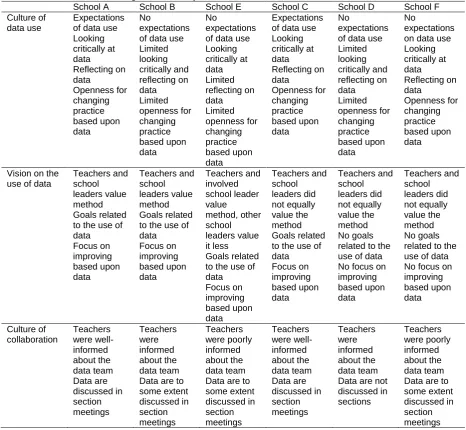
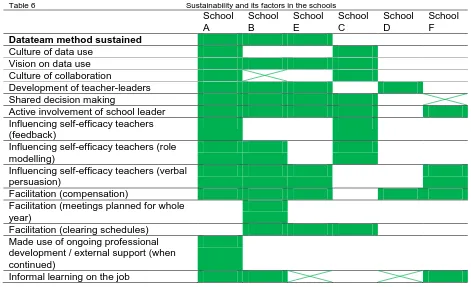
The implications of the datateam method for the school’s practice and policy will be discussed here. Also, the sustainability of the method will be discussed. In the literature review, factors influencing the sustainability were portrayed. In line with figure 1, these factors will be described in relation to the individual schools.
4.1.1 Resultsschool A
Context school A
School A focused on a large number of grade repeaters in the third year of havo (senior general secondary education). Also, a number of these students seemed to continue at vmbo-level (pre-vocational secondary education) instead of continuing havo. The ultimate goal of the team was to realize that students were at the right level of education in the third year.
Implications for practice in school A
The datateam method has led to teachers being more skilled in data use, although the biggest impact seemed to be on the way teachers think. The school leader stated: ‘Teachers start examining what the real problem is, instead of avoiding any risks. This is a way of thinking which is really starting to grow in the school’. One of the teachers indicated: ‘You have a different view of your lessons, of what you do. How effective will this be?’ Another respondent stated that the datateam method contributed to the fact that things in the classroom, that are not going well, are identified in an earlier stadium. For example, this respondent constantly evaluated assessment tools and results, and made adjustments in the assessments based upon these evaluations. In addition, teachers were more open for things that were not going well and kept thinking about possible causes of these things. In general, the data team members acquired the skills for collecting, analyzing, interpreting and using data, with the possible exception of the skill of analyzing data. This analysis was conducted by a mathematics teacher, as this was less hard to do for this particular teacher.
The datateam method allowed the school to take some measures, which has led to a
reduction of the educational problem. One of these measures was the introduction of a particular way of testing. First of all, there were much more discussions about the prediction of results for the learning path of students. Also, teachers were expected to use assessments that were able to differentiate between students. Such assessments used differing categories of questions, such as ‘reproduction’ questions and ‘insight’ questions. Furthermore, the school focused on a more intensive relationship between the student and the tutor.
The method also allowed the data team to reject gut feelings of teachers and school leaders, for example: ‘Students are just lazy and unmotivated’. The school leader stated that the datateam method enhanced the quality of conversations with teachers about their practice. It is a way to have ‘objective discussions’. Thus, these discussions are more based upon data instead of gut feeling.
An additional implication was that teachers have become more open. Sections were involved by the data team, which allowed them to start thinking in the same way. Everyone in the school knew the data team and what they did. There was a shared opinion in the school that the data team was doing a worthy job. Teachers, in the meantime, feel it is rather ‘normal’ that data team members interview students and teachers. Also, there were plans to split up the expertise in the data team, to be able to form two data teams. To conclude, both the teachers and the school leaders, in and outside of the datateam, were enthusiastic about the method.
Implications for policy in school A
In the school plan, the data team was mentioned as a goal within the school: ‘to work with a data team’. It also stated that a data team should research how to maximize results. This seems somewhat general and abstract and these were the only references towards the data team. The topic of the data team though, was mentioned several times too. However, these were not linked to the datateam method. The topic of the data team and the data team itself were mentioned as separate goals in the school.
10
the school’s policy. The school leader did indeed state that the datateam method had become
increasingly important within the school. An example of this was the continuation of facilitating the data team, while no money was available for other components within the school. In the school plan, collaboration between teachers in general was strongly emphasized and stimulated, and as a component of this, for example, reflecting on one’s own practice and each other’s practice within sections.
Thus, while the school prospectus did not include the data team or the use of data in the school, the school plan only shortly described the data team. There were implications for policy though. The last two years, the budget for projects was frozen. An exception was made for projects that were really important to the school. The datateam method was such an exception.
Sustainability of the datateam method in school A
The original data team was still active within the school. When the existing data team finished their current research item, about grade repetition, the school leader wanted to start another data team. Current data team members would be spread out over the two teams, as both teams would need the guidance and support of experienced data team members.
Factors influencing the sustainability in school A
A culture of data use in school A
Being reflective and critical about their own practice was seen as important by the respondents, as well as looking back and determining whether one has done the right things. Also, it was stated that one should be open towards things that are not going well, and that one has to keep thinking about what one is doing and why. The school leader also stated that teachers had become more open towards changing their practice and shared data. School leaders attended meetings of sections, and provided sections with goals and expectations. In individual meetings with teachers, data were used by school leaders to formulate points of improvement.
A vision on the use of data in school A
One respondent stated that the datateam method was mentioned in the vision of the school and that it was an important component of the policy. The school provided the data team with additional hours of external support. A respondent stated: ‘this indicates how important it is for the school board. That is why there were hours and money available for it.’ Also, there was a growing consensus amongst teachers that the datateam procedure is of importance. In the school plan, the focus was on collaboration at all levels. Goals were formulated to improve education. These goals were to be addressed under guidance of school leaders and teacher-leaders. There was a focus on constant learning and improving. The way to achieve this was described as collaboration. The use of data was not explicitly mentioned in this respect.
A culture of collaboration in school A
The data team members informed other teachers about their progress through study days and the teacher bulletin. At such a study day, the school leader involved in the data team informed the school staff about the content and the process of the team. One respondent thought this was rather
important, as teachers would feel that the school leaders thought of the datateam method as
important, and therefore teachers would take it more seriously. Also, teachers were asked to formulate their ideas about the subject on a whiteboard in the teachers’ lounge. Furthermore, team members discussed the progress and the concept of the data team in meetings with their sections. This process of informing colleagues was indicated as rather important, since the input of teachers might be needed sooner or later. One respondent stated; ‘we notice that it is starting to live among colleagues as well, and that colleagues notice that they can have input in the process’. The school leader also
emphasized that they were trying to ‘keep it alive’, and that they were succeeding in this.
The last couple of years, teachers have been discussing the use of data in their sections. A respondent stated: ‘The collaboration in the section has never been as good as the last couple of years. Meetings are much more intensive.’ The sections worked collaboratively on improving their effectiveness. Also, collaboration between teachers was a key element in the school plan.
The development of teacher-leaders in school A
11
current data team and was considered as very experienced by other team members. Both were able to guide new team members. All team members used verbal persuasion in order to convince other teachers to collaborate and provide the data team with input. For example, when a teacher refused to collaborate at first, the emphasis on student achievement was decisive in this process of ‘persuasion’. The school leader stated: ‘They are visible in the school as members of the data team’.
Shared decision making in school A
Conclusions about data were drawn individually by all team members. During meetings, these separate conclusions were discussed and converted to one overall conclusion. The school leader wanted to do things, for example approaching other teachers for input, together. It should not be dependent of the school leader: ‘Because then, if I leave the data team, the whole thing collapses’.
One teacher joined the data team at one point. The process of selecting and approaching this new team member was conducted collaboratively, as this was extensively discussed within the team. One of the teachers stated: ‘After discussing it with us, the school leader approaches the new team member [...] but first, we discuss if someone fits in the team’.
Active involvement by school leaders in the datateam method in school A
There was one school leader involved in this data team. This school leader participated in a similar way as the teachers did. One respondent said: ‘It is not noticeable that she is a school leader’. The school leader was virtually always present at the meetings. The only involvement by the principal was through discussing the compensation for teachers with the school leader involved in the data team. The principal was never present during data team meetings.
Influencing the self-efficacy of teachers in school A
Teachers received feedback on the use of data by the school leader. In discussions with individual teachers, or sections, the school leader used data to support conclusions about their practice. This could be seen as a form of role modelling. The school leader made use of verbal persuasion when teachers were needed for input. When teachers did not respond to questions of the data team, the school leader was able to persuade these teachers by simply talking about the importance of it. The school leader stated: ‘We use data to enhance student achievement. That needs to be emphasized’.
Facilitation in school A
One respondent considered the compensation for participation crucial: ‘When there is no
compensation, the method will not survive. Therefore, the school board should say: ‘’We appreciate it and we compensate you for it’’. Teachers in the data team were compensated in time for their participation, although this differed per person. This depended on how much time a person spent on data team tasks. The mathematics teacher for example, was more compensated, as this teacher spent a lot of time on the data analyses.
Meetings of the data team were planned in advance for the whole school year. After external support ended however, this did not happen any longer. The meetings were then planned one at a time. The schedules of teachers were not cleared for the data team meetings.
Professional development in school A
After external support ended, the data team was still able to ask questions by e-mailing the external trainer. Also, the school provided the data team with five additional hours of external training. Thus, the data team could ask the external trainer for help in person, with a total of five hours over one school year. The teachers in the data team thought of this as really important. One of the respondents thought that the support of the external trainer would no longer be necessary in the upcoming school year. The school leader had a similar point of view, although it might be needed to ensure the sequence of the eight-step procedure. Another respondent however, was not sure about this: ‘I think that it is important to have someone you can contact when you are facing some difficulties’.
One teacher was responsible for the data analysis, as this was a mathematics teacher. The other team members did not possess the necessary skills to analyze data. Both this mathematics teacher as another team member thought that the school should offer some sort of training in data analysis. The school leader in the data team however, did not share this opinion: ‘Data analysis is one of the things that you do. I think it is good, when you want to work in an efficient way, that you have one expert who can do the analysis’.
12
Team collaboration in school A
Teachers in the team were able to learn from each other. There was one teacher in the team who was more experienced in working with the datateam method, as she also participated in the pilot of the datateam method. Other teachers in the team were able to learn a lot from this ‘experienced’ teacher. Furthermore, teachers provided each other with feedback on the use of data. The school leader was convinced that, for example, data analysis qualities will grow through informal learning on the job: ‘You do not learn that in two years’.
At one point, a new teacher joined the data team. This teacher was informed and guided in the first weeks by one team member. One respondent emphasized however: ‘Anyone of us could have guided her, that is not the point’. Thus, this teacher was supposed to learn through informal learning on the job.
4.1.2 Results school B
Context school B
School B focused on problems with central examination results for geography. The differences between central examination results and school examination results were too big. The eight step procedure for this topic was finished. The next topic focused on the large number of grade repeaters in the third year of vwo (pre-university education). Also, a number of these students seemed to continue on havo-level (senior general secondary education) instead of continuing vwo. The ultimate goal of the team was to realize that students were on the right level of education in the third year.
Implications for practice in school B
Regarding the skills that were to be acquired by teachers, the data expert stated: ‘Actually, everything has been learned in the two years of external training, in which a lot of practicing with the method occurred’. The datateam method also contributed to the fact that its members individually started using more data in their classroom. One of the respondents stated: ‘I seriously think I can do more for students’. Twice a year, on study days, one of the team members made suggestions based upon the results of the data team. These suggestions were meant for teachers in the school and could be, for example, about changing some part of their practice or about looking critically at themselves or at certain data about themselves.
The first educational problem that was researched by the data team, was reduced. This was done by paying more attention to which subtopics caused students to fail. Also, in lower secondary education there appeared to be a lot of multiple choice tests, while this was absent in upper secondary education. These were more aligned, by discussing tests in sections and the reduction of multiple choice tests. In the most recent school year, the team started with a new topic. There were no results regarding this new topic yet, and the problem had not yet been reduced.
The school leader already used data at the section-level, but also started looking at the individual level. When a teacher’s performance differed from its colleagues, the school leader had a discussion with this teacher about making changes. However, there were no indications of discussions being more based on data rather than on gut feeling in the school, except for the data team members.
Implications for policy in school B
The datateam method was a component of the school plan, as the data team and its topic were mentioned. The school plan also stated that the data team would research more topics in future years. Moreover, the team was described with regard to the formation, the goals and the frequency of meetings. It was also stated that the group of participants of the data team could differ, which depended on the topic of research. The school’s prospectus did not mention the data team.
Since the datateam method started, the use of data in the school had received more attention as well. For example, the school plan had set expectations for teachers to use data. However, it is not sure whether the datateam method itself had a contribution in this.
Sustainability of the datateam method in school B
13
was announced. After this, a similar group would be formed, which researches educational problems by doing data-research, but without the name ‘data team’. The school leader stated: ‘After a year we are going to decide whether we keep calling it like this, or that it becomes an educational team [...] eventually, if often leads to educational things, didactics, or things about the teacher, but often educational things’.
Factors influencing the sustainability in school B
A culture of data use in school B
One of the school leaders had been using data for years, by looking critically at them and using data to reflect on practice. This was independent of the datateam method. One of the teachers stated: ‘He has been working with data for years. Also without the data team he would have done this’. In the team, every member looked critically at data, and members were open to data. Outside of the data team, this openness to data and to other teachers’ opinions was mostly not present. One of the respondents stated: ‘We are not really a school where people easily criticize each other [...] there are too many at this school that do not want to be spoken to, that are more on their own island’. The use of data by individual teachers was neither stimulated in recent years, nor practiced. Slowly, this was starting to change. Data just recently became part of job evaluations.
A vision on the datateam method in school B
One respondent felt that one of the school leaders in the data team had a really clear point of view of where to go with the data team. The teachers in the team and the school leaders had a shared vision on the datateam method, as both groups saw the value it had for the school. In the school plan, it was included that analyses of results were expected to be discussed in sections and with the school leader. Based on these analyses, sections were expected to create points of improvement. Also, goals with regard to the results were to be formulated.
A culture of collaboration in school B
One of the team members informed other teachers in the school about the data team on study days, twice a year. One respondent stated that everyone in the school knew the data team: ‘Everybody knows the data team, everybody knows who is in the data team and who to address when you have something’. The school leader, however, believed that the communication with the rest of the school should have been better.
Most of the teachers outside of the data team did not discuss their practice with other
teachers, let alone the use of data. One respondent also thought that a part of the teachers would not be willing to participate when input of teachers were to be needed for the data team. This respondent stated: ‘I expect that there is a connection with age. `The older the teacher, the less willing to
participate’. It was rather new in the school that school leaders discussed results with sections. Discussions within sections were supposed to be the next step, but this did not happen yet in every section. The school plan did not include any components about the collaboration between teachers.
The development of teacher-leaders in school B
One of the teachers had some additional tasks, for example creating the agenda, and informing other teachers about the data team. Also, when a scheduled meeting was cancelled, this teacher tried to plan the meeting at another moment. The school leader also stated that this teacher had to take the initiative for data team meetings: ‘I think it is good that a teacher does this, and that it is not dependent of a school leader’.
Shared decision making in school B
Everyone in the team was equal. One could openly say what was on one’s mind. One of the
respondents said: ‘Although I have not been working here for too long, I do dare to say; this is not right or that is not right. To be honest, I really value that’. Every opinion was valued in the team and
decisions were made together. Every team member thought of recommendations based upon the results individually. Then, these individual recommendations were combined. The new members of the team were selected and approached after a discussion between the remaining original team members. Thus, these decisions were made collaboratively.
Active involvement by school leaders in the datateam method in school B
14
process of the data team, as indicated by one of the teachers: ‘He contributed to the team’s discussions [...] and had an added value’. The other school leader however, contributes less to the team than most of the teachers and had a ‘low added value’.
The principal was not present at the data team meetings. The data team members did not want this, as the presence of the principal would have hindered their contribution to the team. One of the respondents stated: When he is present, others are much more cautious about what they do and do not say in the team’. The principal was kept up to date though, by the two involved school leaders.
Influencing self-efficacy of teachers in school B
There were no indications of feedback on the use of data by the school leader. The school leader did use data in discussions with teachers to support conclusions about the functioning of teachers. This could be seen as role modelling. The school leader used verbal persuasion to convince teachers to keep participating in the data team when these teachers had doubts. The school leader said: ‘Sometimes I chose to have a talk with someone to discuss what was going on [...] when someone was uncomfortable with the discussions about the data analysis, as that person did not understand it [...] and after that it worked again’.
Facilitation in school B
Teachers in the data team were financially compensated for their participation. Meetings of the data team were planned for the whole school year. The school leader was also able to make sure that all the team members’ schedules were cleared in order to be able to meet.
Professional development in school B
The external trainer was no longer needed. However, the school leader emphasized: ‘It might be helpful if the trainer came by at some point to prevent that a certain structure of the method becomes lost [...] as we let the eight-step procedure for what it was. We do it, but it is not explicitly mentioned every time’. When the team would have decided that it is necessary to work more strictly according the eight-step procedure though, the role of an external trainer might be needed.
The respondents felt that they possessed the necessary skills to collect, interpret, analyze and use data to improve practice. Therefore, additional supportive courses were not needed.
Team collaboration in school B
Team members did learn from each other. One for example, was better at analyzing data, while another was better at formulating questions for a survey. New members were not guided in the
method. They read the eight step procedure for themselves and were supposed to think along with the rest of the team members. There was no special guidance, new members had to learn from the other team members.
4.1.3 Results school C
Context school C
This school addressed the transfer between the fourth, fifth and sixth year of vwo (pre-university education), as well as the possible continuation of students at the lower level of havo (senior general secondary education). This school only offered upper secondary education in havo and vwo. The goal was to prevent student transfers to a lower educational level, i.e. to have students at the right ‘place’ when they start in the fourth year of either havo or vwo.
Implications for practice in school C
With regard to the skills in collecting, analyzing, interpreting and using data, the datateam method was not effective in this school. Although the datateam method did contribute to the fact that its members developed a more critical view of what was going on in the school, the team members indicated to be lacking the aforementioned skills. One of the respondents indicated to be ‘less enthusiastic’ about working with data as a consequence of working in a data team, possibly because: ‘I feel the need to translate it to my own daily practice, but this was not possible for me’. This respondent also indicated to have enjoyed excluding gut feelings of teachers. However, after a while the data team started focusing on motivation as the possible cause of the problem, and this was ‘too vague’ for her.
15
respondents indicated however: ‘The results of that afternoon were somewhat poorly drawn up. I think that it is a shared feeling in the team. [...] Personally I think it is neither fish nor fowl’. The data team did tackle some gut feelings regarding the topic of research. The school leader indicated that the use of data had led to a lot of worthy discussions.
Implications for policy in school C
In the school plan, the data team was mentioned. The procedure of working, as well as the value and the topic of the data team were mentioned. Furthermore, the data team was mentioned as a
component of stimulating collaboration between teachers and, as a result of collaboration, the improvement of teaching.
The school leader revealed that the school used more data than ever, but did not attribute this to the datateam method: ‘I rather think that the arrival of a data expert was important in this’. The school leader valued the collaborative discussions about education rather than the use of data in the team to solve an educational problem.
Sustainability of the datateam method in school C
The original data team was still active within the school. However, the eight step procedure was not used anymore. The school leader stated that data were no longer to be used in the data team. In the forthcoming years the data team will not start researching a new topic, instead the team will discuss educational topics within the school rather than researching them. Thus, the school leader really valued the collaborative discussions about the school’s practice and wanted to continue with this rather than using data collaboratively to solve an educational problem. The school leader stated: ‘When I need data, I ask the data expert for it. Why would I put a data team on that? [...] We research things in sections or in the school board. Everybody is aware that there is much more data than before and we eagerly use them. It is not a specific data team thing’. Thus, data were being used in the school. Therefore, the school leader did not think it was necessary to have a data team in the school. One of the teachers indicated that the use of data was rather normal, independent of the datateam method: ‘Although the method maybe to some extent sharpened our awareness of it’. As the datateam method is no longer being used in this school, and the method did not seem to have contributed to more or better use of data in the school, this school did not ‘sustain’ the datateam method.
Factors influencing the sustainability in school C
A culture of data use in school C
The data expert stated: ‘That school is pretty used to working with data’. The school leaders in the data team critically looked at data. Teachers were open to data and had a critical view. One
respondent stated that teachers already used data in their daily practice, and that it was not a result of the data team. Individual teachers used data in their classrooms to reflect on their practice. One of the respondents stated: ‘It is a requirement to get your lessons on a certain level, to evaluate what you did’. The use of data was always part of the conversations between teachers and school leaders.
A vision on the use of data in school C
All data team members really wanted to improve the school. The datateam method was not part of the school’s policy though. The school leader saw the team as an opportunity to discuss education collaboratively. Researching an educational problem with the help of data was not considered
necessary. The school leader used data in evaluations with sections and individual teachers. Teachers thought of this process as positive. The vision included the use of data to learn from each other and to improve the quality of the school. The school plan stated: ‘Made errors and evaluations are always aimed at improvement’.
A culture of collaboration in school C
At one point, the data team and other teachers and school leaders in the school discussed
16
decide for sections what they should do, this always happened in discussions. Collaboration between teachers was stimulated, as one of the respondents indicated: ‘There are a lot of initiatives to
collaborate [...] for example, opportunities to observe each other’. Learning from each other, for example, was an important component of the school plan. The school plan, among other things, stated: ‘We stimulate teachers to have discussions about what leads to greater student achievement. It is important that one can learn to and from another [...] through peer review, visiting and discussing each other’s lessons based upon clear criteria, and participation in lesson study and data teams’.
The development of teacher-leaders in school C
There were no teacher-leaders developed for the method. The school leader that initiated the meetings, was absent during three months. In this period, no one took the initiative of arranging a meeting and the team virtually was not active during that period.
Shared decision making in school C
All members of the team were seen as equal. The data expert stated: ‘If you had attended one of our meetings, I do not think you would have distinguished school leader and teacher’. Points from every team member were valued. Teachers in the data team felt they had influence on the process and that they were important. The respondents emphasized the ‘flat’ organization of the school, in which the school board is very open to initiatives of teachers.
Active involvement by school leaders in the datateam method in school C
There were two school leaders involved in the data team. One of these school leaders initiated meetings and controlled the process of the team. This school leader was also responsible for the communication with other school leaders and teachers in the school about the data team proceedings. The other school leader only participated in the team.
The principal in the school was not present at meetings, but was informed about the data team proceedings. One of the teachers stated: ‘He was present at that afternoon with all the colleagues to hear about our progress. He is just an interested person’.
Influencing self-efficacy of teachers in school C
Feedback on the use of data was mainly given by the data expert, although to some extent also by school leaders. One of the respondents stated: ‘Especially with the analysis we struggled sometimes [...] and they were of course strong in that, they had an important share in that’. Another respondent mentioned that the school leaders, besides giving feedback, also received feedback from the data expert. Data were used by the school leader in supporting conclusions in discussions with teachers. This is a way of role modelling. Verbal persuasion was used to convince teachers in the school of the importance of data. The school leader stated: ‘You just keep talking. Eventually, they just cannot deny it’. However, there were no indications of verbal persuasion with regard to the datateam method.
Facilitation in school C
Data team members did not get compensated, financially or in time, for their participation. Meetings were planned for the whole school year. After external support ended however, meetings were planned one or two at a time. Initially, schedules of teachers were cleared in order to be able to meet with the whole team. Later on, this became impossible due to a lack of time. However, if the team indicated that a free afternoon was needed to catch up on the work, schedules were indeed cleared. This happened two times. The school leader tried to pick a moment were everyone was available, as this school leader had access to everyone’s schedules.
Professional development in school C
There was no need for an external trainer after the two years of training. When the team would have worked with the eight-step procedure though, this external trainer would have been essential. One of the respondents indicated: ‘If we, or the school, think it is important to research something based upon this method, I fear that we are not good enough to do that by ourselves’.
17
Team collaboration in school C
When a team member did not agree with something, this would be discussed. The data expert stated: ‘Sometimes they were more like a critical talking group’. The datateam method aims at training skills in collecting, analyzing, interpreting and using data. In this team, the data expert had a big part in
collecting and analyzing data, while at the same time the data expert stated: ‘if one does not apply the learned skill frequently, it has no chance of surviving’. Team members were to some extent able to learn from the data expert, but apparently this was insufficient.
During the years, no new team members joined. If a new member was to be joining the team however, no guidance would have been needed. The school leader stated: ‘We no longer use the eight-step procedure, so I do not think that guidance is necessary’. As data were no longer used in the team, skills in collecting, analyzing, interpreting and using data could not be gathered through informal learning.
4.1.4 Results school D
Context school D
School D focused on central examination results in havo. The percentage of graduating students had dropped in the last couple of years. The data team wanted to uncover why this was happening, with the ultimate goal of improving the percentage of graduating students.
Implications for practice in school D
With regard to the skills in collecting, analyzing, interpreting and using data, the team members were to some extent able to acquire these. Especially when it came to analyzing data, teachers lacked skills. In this, the data expert was important. One of the respondents did not take the course in analyzing data, as it was too far away: ‘I had planned to learn that from other team members at some time, but this did not happen yet’.
The data team was discontinued after two years of external support. In these two years, a solution or reduction of the educational problem was not achieved. The data team contributed in rejecting some gut feelings, for example the feeling that students coming from the pre-vocational education track performed worse than ‘regular’ students. However, there were no indications of conversations about educational problems being more based upon data instead of gut feelings.
Although the data team was discontinued after two years, it did contribute to the fact that all teachers in the school received professional development courses in teaching and differentiating. In the upcoming school year, teachers are offered a course in analyzing their own results. The school leader stated: ‘We have started developing all teachers, because apparently the way they teach is not as good as some teachers think [...] those are changes that were applied, to some extent, as a consequence of the datateam method’. The datateam method also contributed to the fact that school leaders systematically use data in their work. The school leader stated: ‘I started to look more careful. I think that this is the cause, but I want to be sure that it is. [...] teachers are shown an analysis of their own results and we discuss these with them’. Also, structural meetings with sections were
reintroduced. These were planned three or four times a year, with the goal of evaluating the results and improving them: ‘We want to know, and see on paper, what they are going to do in order to improve’.
Implications for policy in school D
One of the teachers stated that the datateam method did not have implications for policy: ‘It stayed on an island’. According to the school leader, the data team was included in the school plan during the years it was active.
The school leader stated that the datateam method contributed to a change in the school plan, as the use of data was included after the data team stopped. The Inspectorate evaluated this school and confirmed that data were ‘insufficiently’ used. This happened after the data team was
18
Sustainability of the datateam method in school D
The data team was no longer active in this school. The school had to cut expenses and the data team was not important enough to keep facilitating it.
Factors influencing the sustainability in school D
A culture of data use in school D
A lot of the teachers in the school, including data team members, appeared to have an external locus of control. The school leader stated: ‘Colleagues did not want to look in the mirror. Could I be the reason of the problem? And that is an important component of such a method’. Also, teachers were not used to working with data. Thus, looking critically at data and reflecting on one’s practice based upon data did not occur. One of the respondents stated: ‘It is now mandatory, in central examinations, to request a group report from the CITO and send it to the school board. [...] that is a way to compare yourself with teachers at other locations. That is possible, but people do not really use those
possibilities. If one has structural lower results than one’s colleagues, I guess it will attract attention at some point’. This indicates that the use of data to improve one’s practice, was not yet a very lively topic in this school.
A vision on the use of data in school D
There was no vision on the use of data. It is only since recently, that school leaders started discussing an analysis of one’s results with the concerning teacher. When these results were insufficient, this resulted in certain points of improvement. The school leader stated about the use of data in these conversations: ‘Teachers are somewhat surprised. They are totally not used to looking like that’. However, this was after the data team was discontinued. One of the respondents indicated: ‘I actually do not know why the team was discontinued [...] it just did not happen. [...] I think it is a real pity’. This may indicate that school leaders and teachers did not have a shared vision of the datateam method, as the school leader stated: ‘The data team was not unimportant, but not the most important’.
A culture of collaboration in school D
Three times a year, at meetings with all teachers, one of the teachers told about the data team and what was being researched. The school leader stated: ‘I was responsible for creating time at such meetings for one of the team members to inform everyone about the data team’. Also, information about the school which all teachers received through e-mail, contained some information about the data team as well. However, this happened two times a year. The respondents thought this could have been better. One of the teachers stated: ‘There was virtually no response to what we were doing’. Teachers were used to being on their own ‘island’. There were no structural meetings with sections and data were neither used nor discussed in the time of the data team.
The development of teacher-leaders in school D
There was one teacher who encouraged team members and took initiatives. This teacher also communicated with the teachers in the school about the data team. The school leader stated: ‘There was one colleague who got that job, and around him, a data team was formed’.
Shared decision making in school D
The school leader stated that data team members did not have any more influence on possible implications of the method than other teachers in the school. At best, these members knew earlier what was going to happen. In the team, the school leader inspired people and divided the tasks. Concrete tasks were executed by the teachers in the team. The school leader stated: ‘The teacher-leader was responsible for the research process and the other two colleagues were the research staff at that moment’.
Active involvement by school leaders in the datateam method in school D