2061
Syntax for Semantic Role Labeling, To Be, Or Not To Be
Shexia He1,2,∗, Zuchao Li1,2,∗, Hai Zhao1,2,†, Hongxiao Bai1,2, Gongshen Liu3 1Department of Computer Science and Engineering, Shanghai Jiao Tong University
2Key Laboratory of Shanghai Education Commission for Intelligent Interaction
and Cognitive Engineering, Shanghai Jiao Tong University, Shanghai, China
3School of Cyber Security, Shanghai Jiao Tong University, China
{heshexia, charlee}@sjtu.edu.cn, [email protected], {baippa, lgshen}@sjtu.edu.cn
Abstract
Semantic role labeling (SRL) is dedicated to recognizing the predicate-argument structure of a sentence. Previous stud-ies have shown syntactic information has a remarkable contribution to SRL per-formance. However, such perception was challenged by a few recent neural SRL models which give impressive perfor-mance without a syntactic backbone. This paper intends to quantify the importance of syntactic information to dependency SRL in deep learning framework. We propose an enhanced argument labeling model companying with an extended k -order argument pruning algorithm for ef-fectively exploiting syntactic information. Our model achieves state-of-the-art results on the CoNLL-2008, 2009 benchmarks for both English and Chinese, showing the quantitative significance of syntax to neu-ral SRL together with a thorough empiri-cal survey over existing models.
1 Introduction
Semantic role labeling (SRL), namely semantic parsing, is a shallow semantic parsing task, which aims to recognize the predicate-argument structure of each predicate in a sentence, such as whodid
whattowhom,whereandwhen, etc. Specifically, we seek to identify arguments and label their se-mantic roles given a predicate. SRL is an
impor-∗
These authors made equal contribution.† Correspond-ing author. This paper was partially supported by National Key Research and Development Program of China (No. 2017YFB0304100), National Natural Science Foundation of China (No. 61672343 and No. 61733011), Key Project of National Society Science Foundation of China (No. 15-ZDA041), The Art and Science Interdisciplinary Funds of Shanghai Jiao Tong University (No. 14JCRZ04).
tant method to obtain semantic information ben-eficial to a wide range of natural language pro-cessing (NLP) tasks, including machine transla-tion (Shi et al.,2016), question answering (Berant et al.,2013;Yih et al.,2016) and discourse relation sense classification (Mihaylov and Frank,2016).
There are two formulizations for semantic predicate-argument structures, one is based on constituents (i.e., phrase or span), the other is based on dependencies. The latter proposed by the CoNLL-2008 shared task (Surdeanu et al.,
2008) is also called semantic dependency pars-ing, which annotates the heads of arguments rather than phrasal arguments. Generally, SRL is de-composed into multi-step classification subtasks in pipeline systems, consisting of predicate identi-fication and disambiguation, argument identifica-tion and classificaidentifica-tion.
In prior work of SRL, considerable attention has been paid to feature engineering that struggles to capture sufficient discriminative information, while neural network models are capable of ex-tracting features automatically. In particular, syn-tactic information, including synsyn-tactic tree feature, has been show extremely beneficial to SRL since a larger scale of empirical verification of Pun-yakanok et al.(2008). However, all the work had to take the risk of erroneous syntactic input, lead-ing to an unsatisfactory performance.
To alleviate the above issues, Marcheggiani et al.(2017) propose a simple but effective model for dependency SRL without syntactic input. It seems that neural SRL does not have to rely on syntactic features, contradicting with the belief that syntax is a necessary prerequisite for SRL as early asGildea and Palmer(2002). This dramatic contradiction motivates us to make a thorough ex-ploration on syntactic contribution to SRL.
se-quence tagging tasks with predicate-specific en-coding. With the help of the proposed k-order argument pruning algorithm over syntactic tree, our model obtains state-of-the-art scores on the CoNLL benchmarks for both English and Chinese. In order to quantitatively evaluate the contri-bution of syntax to SRL, we adopt the ratio be-tween labeled F1score for semantic dependencies (Sem-F1) and the labeled attachment score (LAS) for syntactic dependencies introduced by CoNLL-2008 Shared Task1 as evaluation metric. Consid-ering that various syntactic parsers contribute dif-ferent syntactic inputs with various range of qual-ity levels, the ratio provides a fairer comparison between syntactically-driven SRL systems, which will be surveyed by our empirical study.
2 Model
To fully disclose the predicate-argument structure, typical SRL systems have to step by step perform four subtasks. Since the predicates in CoNLL-2009 (Hajiˇc et al., 2009) corpus have been pre-identified, we need to tackle three other subtasks, which are formulized into two-step pipeline in this work, predicate disambiguation and argument la-beling. Namely, we do the work of argument iden-tification and classification in one model.
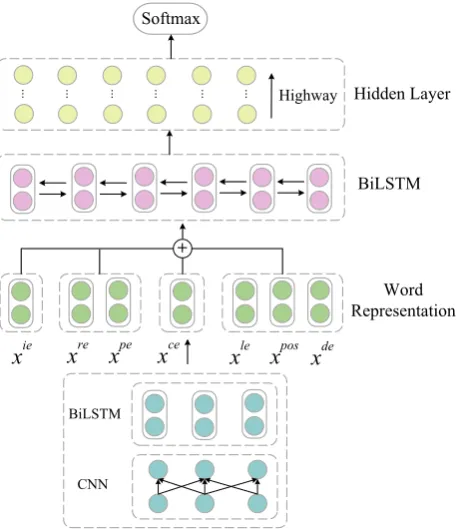
Argument structure for each known predicate will be disclosed by our argument labeler over a sequence including possible arguments (candi-dates). There are two ways to determine the se-quence, one is to simply input the entire sentence as a syntax-agnostic SRL system does, the other is to select words according to syntactic parse tree around the predicate as most previous SRL systems did. The latter strategy usually works through a syntactic tree based argument pruning algorithm. We will use the proposed k-order ar-gument pruning algorithm (Section 2.1) to get a sequence w = (w1, . . . , wn) for each predicate. Then, we represent each wordwi ∈wasxi (Sec-tion 2.2). Eventually, we obtain contextual fea-tures with sequence encoder (Section 2.3). The overall role labeling model is depicted in Figure1.
2.1 Argument Pruning
As pointed out byPunyakanok et al.(2008), syn-tactic information is most relevant in identifying
12008 is an English-only task, while
CoNLL-2009 extends to a multilingual one. Their main difference is that predicates have been beforehand indicated for the latter.
BiLSTM
CNN
+
BiLSTM
Word Representation
Hidden Layer Softmax
xie xre xpe xce xle xpos xde
[image:2.595.310.539.63.328.2]Highway ... ... ... ... ... ...
Figure 1: The Argument Labeling Model
the arguments, and the most crucial contribution of full parsing is in the pruning stage. In this pa-per, we propose a k-order argument pruning al-gorithm inspired by Zhao et al.(2009b). First of all, for node n and its descendant nd in a syn-tactic dependency tree, we define theorderto be the distance between the two nodes, denoted as
D(n, nd). Then we definek-order descendants of given node satisfyingD(n, nd) = k, andk-order traversal that visits each node from the given node to its descendant nodes within k-th order. Note that the definition ofk-order traversal is somewhat different from tree traversal in terminology.
A brief description of the proposed k-order pruning algorithm is given as follow. Initially, we set a given predicate as the current node in a syn-tactic dependency tree. Then, collect all its argu-ment candidates by the strategy ofk-order traver-sal. Afterwards, reset the current node to its syn-tactic head and repeat the previous step till the root of the tree. Finally, collect the root and stop. The
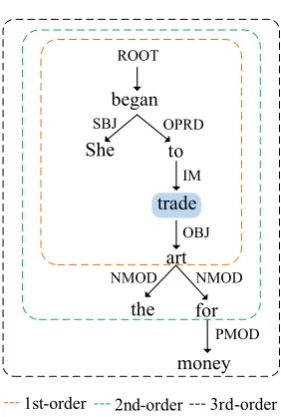
k-order argument algorithm is presented in Algo-rithm 1 in detail. An example of a syntactic de-pendency tree for sentenceShe began to trade the art for moneyis shown in Figure2.
Algorithm 1k-order argument pruning algorithm Input: A predicatep, the root nodergiven a
syn-tactic dependency treeT, the orderk Output: The set of argument candidatesS
1: initializationsetpas current nodec,c=p
2: foreach descendantniofcinT do 3: ifD(c, ni)≤kandni∈/ Sthen 4: S=S+ni
5: end if
6: end for
7: find the syntactic headchofc, and letc=ch 8: ifc=rthen
9: S =S+r
10: else
11: gotostep 2 12: end if
13: return argument candidates setS
First, previous standard pruning algorithm may hurt the argument coverage too much, even though indeed arguments usually tend to surround their predicate in a close distance. As a sequence tag-ging model has been applied, it can effectively handle the imbalanced distribution between argu-ments and non-arguargu-ments, which is hardly tack-led by early argument classification models that commonly adopt the standard pruning algorithm. Second, the extended pruning algorithm provides a better trade-off between computational cost and performance by carefully tuningk.
2.2 Word Representation
We produce a predicate-specific word represen-tation xi for each word wi, where i stands for the word position in an input sequence, follow-ingMarcheggiani et al.(2017). However, we dif-fer by (1) leveraging a predicate-specific indicator embedding, (2) using deeper refined representa-tion, including character and dependency relation embeddings, and (3) applying recent advances in RNNs, such as highway connections (Srivastava et al.,2015).
In this work, word representationxi is the con-catenation of four types of features: predicate-specific feature, character-level, word-level and linguistic features. Unlike previous work, we leverage a predicate-specific indicator embedding
xiei rather than directly using a binary flag either 0 or 1. At character level, we exploit convolu-tional neural network (CNN) with bidirecconvolu-tional LSTM (BiLSTM) to learn character embedding
ROOT
the She
began
to
trade
art
for
money
SBJ OPRD
IM
OBJ
NMOD NMOD
PMOD
[image:3.595.344.485.55.264.2]1st-order 2nd-order 3rd-order
Figure 2: An example offirst-order,second-order and third-order argument pruning. Shadow part indicates the given predicate.
xcei . As shown in Figure 1, the representation calculated by the CNN is fed as input to BiL-STM. At word level, we use a randomly initial-ized word embeddingxrei and a pre-trained word embedding xpei . For linguistic features, we em-ploy a randomly initialized lemma embeddingxlei
and a randomly initialized POS tag embedding
xposi . In order to incorporate more syntactic in-formation, we adopt an additional feature, the de-pendency relation to syntactic head. Likewise, it is a randomly initialized embedding xdei . The resulting word representation is concatenated as
xi = [xiei , xcei , xrei , x pe i , xlei , x
pos i , xdei ].
2.3 Sequence Encoder
As Long short-term memory (LSTM) net-works (Hochreiter and Schmidhuber, 1997) have shown significant representational effectiveness to NLP tasks, we thus use BiLSTM as the sen-tence encorder. Given an input sequence x = (x1, . . . , xn), BiLSTM processes the sequence in both forward and backward direction to obtain two separated hidden states, −→hi which handles data fromx1toxiand
←−
hiwhich tackles data fromxn toxifor each word representation. Finally, we get a contextual representationhi = [
− →
hi,
←−
hi]by con-catenating the states of BiLSTM networks.
Hyperparameter values
die(indicator embedding) 16
dpe(pre-trained embedding) 100
dce(character embedding) 300
dre(word embedding) 100
dle(lemma embedding) 100
dpos(POS tag embedding) 32
dde(dependency label embedding) 64 LSTM hidden sizes 512
BiLSTM layers 4
Hidden layers 10
Learning rate 0.001
[image:4.595.316.512.58.205.2]Word dropout 0.1
Table 1: Hyperparameter values.
of all time steps. The MLP network consists of10 layers with highway connections and we employ
ReLU activations for the hidden layers. Finally, we use a softmax layer over the outputs to maxi-mize the likelihood of labels.
2.4 Predicate Disambiguation
Although predicates have been identified given a sentence, predicate disambiguation is an in-dispensable task, which aims to determine the predicate-argument structure for an identified predicate in a particular context. Here, we also use the identical model (BiLSTM composed with MLP) for predicate disambiguation, in which the only difference is that we remove the syntactic de-pendency relation feature in corresponding word representation (Section 2.2). Exactly, given a predicate p, the resulting word representation is
pi = [piei , pcei , prei , p pe i , plei , p
pos i ].
3 Experiments
Our model2 is evaluated on the CoNLL-2009 shared task both for English and Chinese datasets, following the standard training, development and test splits. The hyperparameters in our model were selected based on the development set, and are summarized in Table 1. Note that the parame-ters of predicate model are the same as these in argument model. All real vectors are randomly initialized, and the pre-trained word embeddings for English are GloVe vectors (Pennington et al.,
2014). For Chinese, we exploit Wikipedia doc-uments to train Word2Vec embeddings (Mikolov
2The code is available at https://github.com/ bcmi220/srl_syn_pruning.
0 5 10 15 20
k
0 20 40 60 80 100
Percentage (%)
Coverage Reduction
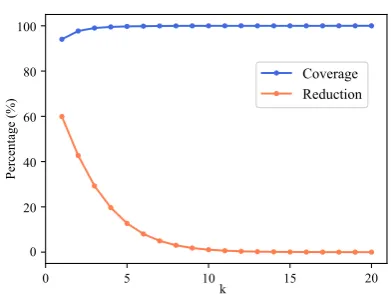
Figure 3: Changing curves of coverage and reduc-tion with differentkvalue on English training set. The coverage rate is the proportion of true argu-ments in pruning output, while the reduction is the one of pruned argument candidates in total tokens.
et al.,2013). During training procedures, we use the categorical cross-entropy as objective, with Adam optimizer (Kingma and Ba,2015). We train models for a maximum of 20 epochs and obtain the nearly best model based on development re-sults. For argument labeling, we preprocess cor-pus withk-order argument pruning algorithm. In addition, we use four CNN layers with single-layer BiLSTM to induce character representations derived from sentences. For English3, to fur-ther enhance the representation, we adopt CNN-BiLSTM character embedding structure from Al-lenNLP toolkit (Peters et al.,2018).
3.1 Preprocessing
During the pruning of argument candidates, we use the officially predicted syntactic parses pro-vided by CoNLL-2009 shared-task organizers on both English and Chinese. Figure3shows chang-ing curves of coverage and reduction followchang-ingk
on the English train set. According to our statis-tics, the number of non-arguments is ten times more than that of arguments, where the data dis-tribution is fairly unbalanced. However, a proper pruning strategy could alleviate this problem. Ac-cordingly, the first-order pruning reduces more than 50% candidates at the cost of missing 5.5% true ones on average, and the second-order prunes about 40% candidates with nearly 2.0% loss. The coverage of third-order has achieved 99% and it reduces approximately 1/3 corpus size.
It is worth noting that as k is larger than 19,
[image:4.595.79.285.62.241.2]System (syntax-aware) P R F1
Single model
Zhao et al.(2009a) − − 86.2
Zhao et al.(2009c) − − 85.4
Bj¨orkelund et al.(2010) 87.1 84.5 85.8
Lei et al.(2015) − − 86.6
FitzGerald et al.(2015) − − 86.7
Roth and Lapata(2016) 88.1 85.3 86.7
Marcheggiani and Titov(2017) 89.1 86.8 88.0
Ours 89.7 89.3 89.5
Ensemble model
FitzGerald et al.(2015) − − 87.7
Roth and Lapata(2016) 90.3 85.7 87.9
Marcheggiani and Titov(2017) 90.5 87.7 89.1
System (syntax-agnostic) P R F1
Marcheggiani et al.(2017) 88.7 86.8 87.7
[image:5.595.75.289.61.300.2]Ours 89.5 87.9 88.7
Table 2: Results on the English test set (WSJ).
there will come full coverage on all argument can-didates for English training set, which let our high order pruning algorithm degrade into a syntax-agnostic setting. In this work, we use the tenth-order pruning for pursuing the best performance.
3.2 Results
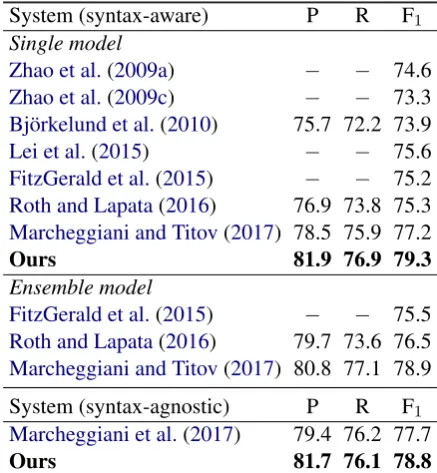
Our system performance is measured with the of-ficial script from CoNLL-2009 benchmarks, com-bining the output of our predicate disambigua-tion with our semantic role labeling. Our predi-cate disambiguation model achieves the accuracy of 95.01% and 95.58%4on development and test sets, respectively. We compare our model per-formance with the state-of-the-art models for de-pendency SRL.5 Noteworthily, our model is lo-cal and single without reranking, which neither includes global inference nor combines multiple models. The experimental results on the English in-domain (WSJ) and out-of-domain (Brown) test sets are shown in Tables2and3, respectively.
For English, our syntax-aware model outper-forms previously published best single model, scoring 89.5% F1 with 1.5% absolute improve-ment on the in-domain (WSJ) test data. Compared
4Note that we give a slightly better predicate model than Roth and Lapata(2016), with 94.77% and 95.47% accuracy on development and test sets, respectively.
5Here, we do not compare against span-based SRL
mod-els, which annotate roles for entire argument spans instead of semantic dependencies.
System (syntax-aware) P R F1
Single model
Zhao et al.(2009a) − − 74.6
Zhao et al.(2009c) − − 73.3
Bj¨orkelund et al.(2010) 75.7 72.2 73.9
Lei et al.(2015) − − 75.6
FitzGerald et al.(2015) − − 75.2
Roth and Lapata(2016) 76.9 73.8 75.3
Marcheggiani and Titov(2017) 78.5 75.9 77.2
Ours 81.9 76.9 79.3
Ensemble model
FitzGerald et al.(2015) − − 75.5
Roth and Lapata(2016) 79.7 73.6 76.5
Marcheggiani and Titov(2017) 80.8 77.1 78.9
System (syntax-agnostic) P R F1
Marcheggiani et al.(2017) 79.4 76.2 77.7
[image:5.595.306.525.62.299.2]Ours 81.7 76.1 78.8
Table 3: Results on English out-of-domain test set (Brown).
System (syntax-aware) P R F1
Zhao et al.(2009a) 80.4 75.2 77.7
Bj¨orkelund et al.(2009) 82.4 75.1 78.6
Roth and Lapata(2016) 83.2 75.9 79.4
Marcheggiani and Titov(2017) 84.6 80.4 82.5
Ours 84.2 81.5 82.8
System (syntax-agnostic) P R F1
Marcheggiani et al.(2017) 83.4 79.1 81.2
Ours 84.5 79.3 81.8
Table 4: Results on the Chinese test set.
with ensemble models, our single model even pro-vides better performance (+0.4%F1) than the sys-tem (Marcheggiani and Titov,2017), and signifi-cantly surpasses all the rest models. In the syntax-agnostic setting (without pruning and dependency relation embedding), we also reach the new state-of-the-art, achieving a performance gain of 1% F1. On the out-of-domain (Brown) test set, we achieve the new best results of 79.3% (syntax-aware) and 78.8% (syntax-agnostic) in F1 scores. Moreover, our syntax-aware model performs bet-ter than the syntax-agnostic one.
[image:5.595.310.524.355.486.2]System(without predicate sense) P R F1 1st-order 84.4 82.6 83.5 2nd-order 84.8 83.0 83.9 3rd-order 85.1 83.3 84.2
[image:6.595.311.518.60.219.2]Marcheggiani and Titov(2017) 85.2 81.6 83.3
Table 5: SRL results without predicate sense.
Our system P R F1 BiLSTM 86.5 85.1 85.8 basic model 86.3 85.7 86.0 + indicator embedding 86.8 85.8 86.3 + character embedding 87.2 86.6 86.9 + both 87.7 87.0 87.3 BiLSTM + both 87.3 86.7 87.0
Table 6: Ablation on development set. The “+” denotes a specific version over the basic model.
3.3 Analysis
To evaluate the contributions of key factors in our method, a series of ablation studies are performed on the English development set.
In order to demonstrate the effectiveness of our
k-order pruning algorithm, we report the SRL per-formance excluding predicate senses in evalua-tion, eliminating the performance gain from pred-icate disambiguation. Table 5 shows the results from our syntax-aware model with lower order ar-gument pruning. Compared to the best previous model, our system still yields an increment in re-call by more than 1%, leading to improvements in F1 score. It demonstrates that refining syntactic parser tree based candidate pruning does help in argument recognition.
Table6presents the performance of our syntax-agnostic SRL system with a basic configuration, which removes components, including indicator and character embeddings. Note that the first row is the results of BiLSTM (removing MLP from basic model), whose encoding is the same asMarcheggiani et al.(2017). Experiments show that both enhanced representations improve over our basic model, and our adopted labeling model is superior to the simple BiLSTM.
Figure 4 shows F1 scores in different k-order pruning together with our syntax-agnostic model. It also indicates that the least first-order pruning fails to give satisfactory performance, the best per-forming setting coming from a moderate setting of
k = 10, and the largest k shows that our
argu-0 5 10 k 15 20
85 86 87 88 89
F1
(%)
syntax-aware syntax-agnostic
Figure 4: F1 scores by k-order pruning and the syntax-agnostic result on English development set.
ment pruning falls back to syntax-agnostic type. Meanwhile, from the best k setting to the lower order pruning, we receive a much faster perfor-mance drop, compared to the higher order prun-ing until the complete syntax-agnostic case. The proposedk-order pruning algorithm always works even it reaches the syntax-agnostic setting, which empirically explains why the current syntax-aware and syntax-agnostic SRL models hold little per-formance difference, as maximum k-order prun-ing actually removes few words just like syntax-agnostic model.
3.4 End-to-end SRL
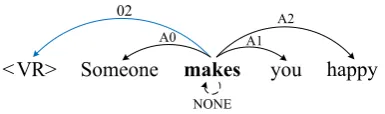
In this work, we consider additional model that integrates predicate disambiguation and argument labeling into one sequence labeling model. In or-der to implement an end-to-end model, we intro-duce a virtual root (VR) for predicate disambigua-tion similar toZhao et al.(2013) who handled the entire SRL task as word pair classification. Con-cretely, we add a predicate sense feature to the in-put sequence by concatenating a VR. The word representation of VR is randomly initialized dur-ing traindur-ing. In Figure5, we give an example se-quence with the labels for the given sentence.
[image:6.595.77.284.171.272.2]A2 A0
02
<VR> Someone makes you happy
[image:7.595.84.277.61.118.2]NONE A1
Figure 5: An example sequence with labels of end-to-end model (makesis the given predicate).
Our system P R F1
[image:7.595.306.536.61.188.2]syntax-aware (end-to-end) 89.3 88.7 89.0 syntax-aware (pipeline) 89.7 89.3 89.5 syntax-agnostic (end-to-end) 88.9 87.9 88.4 syntax-agnostic (pipeline) 89.5 87.9 88.7
Table 7: Comparison of results on CoNLL-2009 data between our end-to-end and pipeline models.
3.5 CoNLL-2008 SRL Setting
For a full SRL task, the predicate identification subtask is also indispensable, which has been in-cluded in CoNLL-2008 shared task. We thus eval-uate our model in terms of data and setting of the CoNLL-2008 benchmark (WSJ).
To identify predicates, we train the BiLSTM-MLP sequence labeling model with same param-eters in Section2.4to tackle the predicate identi-fication and disambiguation subtasks in one shot, and the only difference is that we remove the predicate-specific indicator feature. The F1 score of our predicate labeling model is 90.53% on in-domain (WSJ) data. Compared with the best re-ported results, we observe absolute improvements in semantic F1 of 0.8% (in Table 8). Note that as predicate identification is introduced, our same model shows about 6% performance loss for either syntax-agnostic or syntax-aware case, which indi-cates that predicate identification should be care-fully handled, as it is very needed in a complete practical SRL system.
4 Syntactic Contribution
Syntactic information plays an informative role in semantic role labeling. However, few studies were done to quantitatively evaluate the syntac-tic contribution to SRL. Furthermore, we observe that most of the above compared neural SRL sys-tems took the syntactic parser of (Bj¨orkelund et al.,
2010) as syntactic inputs instead of the one from CoNLL-2009 shared task, which adopted a much weaker syntactic parser. Especially (Marcheggiani and Titov, 2017), adopted an external syntactic
System LAS Sem-F1
Johansson and Nugues(2008) 90.13 81.75
Zhao and Kit(2008) 87.52 77.67
Zhao et al.(2009b) 88.39 82.1 (80.53) 89.28 82.5 (80.94)
Zhao et al.(2013) 88.39 82.5 (80.91) 89.28 82.4 (80.88) Ours (syntax-agnostic) − 82.9
Ours (syntax-aware) 86.0 83.3
Table 8: Results on the CoNLL-2008 in-domain (WSJ) test set. The results in parenthesis are on WSJ + Brown test set.
parser with even higher parsing accuracy. Con-trarily, our SRL model is based on the automati-cally predicted parse with moderate performance provided by CoNLL-2009 shared task, but outper-forms their models.
This section thus attempts to explore how much syntax contributes to dependency-based SRL in deep learning framework and how to effectively evaluate relative performance of syntax-based SRL. To this end, we conduct experiments for em-pirical analysis with different syntactic inputs.
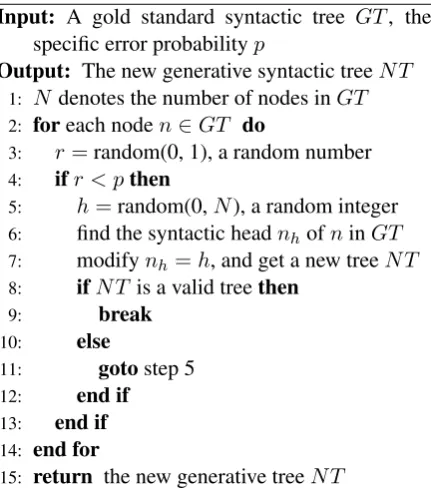
Syntactic Input In order to obtain different syn-tactic inputs, we design a faulty synsyn-tactic tree gen-erator (refer to STG hereafter), which is able to produce random errors in the output parse tree like a true parser does. To simplify implementation, we construct a new syntactic tree based on the gold standard parse tree. Given an input error probabil-ity distribution estimated from a true parser output, our algorithm presented in Algorithm2 stochasti-cally modifies the syntactic heads of nodes on the premise of a valid tree.
[image:7.595.73.285.167.239.2]System LAS (%) P (%) R (%) Sem-F1 (%) Sem-F1/LAS (%)
Zhao et al.(2009c) [SRL-only] 86.0 − − 85.4 99.3
Zhao et al.(2009a) [Joint] 89.2 − − 86.2 96.6
Bj¨orkelund et al.(2010) 89.8 87.1 84.5 85.8 95.6
Lei et al.(2015) 90.4 − − 86.6 95.8
Roth and Lapata(2016) 89.8 88.1 85.3 86.7 96.5
[image:8.595.313.516.267.424.2]Marcheggiani and Titov(2017) 90.3∗ 89.1 86.8 88.0 97.5 Ours + CoNLL-2009 predicted 86.0 89.7 89.3 89.5 104.0 Ours + Auto syntax 90.0 90.5 89.3 89.9 99.9 Ours + Gold syntax 100 91.0 89.7 90.3 90.3
Table 9: Results on English test set, in terms of labeled attachment score for syntactic dependencies (LAS), semantic precision (P), semantic recall (R), semantic labeled F1 score (F1), the ratio Sem-F1/LAS. A superscript * indicates LAS results from our personal communication with the authors.
Algorithm 2Faulty Syntactic Tree Generator Input: A gold standard syntactic tree GT, the
specific error probabilityp
Output: The new generative syntactic treeN T
1: N denotes the number of nodes inGT
2: foreach noden∈GT do
3: r =random(0, 1), a random number 4: ifr < pthen
5: h=random(0,N), a random integer 6: find the syntactic headnhofninGT 7: modifynh=h, and get a new treeN T 8: ifN T is a valid treethen
9: break
10: else
11: gotostep 5
12: end if
13: end if
14: end for
15: return the new generative treeN T
proposed bySurdeanu et al.(2008) as evaluation metric.6 The benefits of this measure are twofold: quantitatively evaluating syntactic contribution to SRL and impartially estimating the true perfor-mance of SRL, independent of the perforperfor-mance of the input syntactic parser.
Table 9 reports the performance of existing models7in term of Sem-F1/LAS ratio on CoNLL-2009 English test set. Interestingly, even though our system has significantly lower scores than oth-ers by 3.8% LAS in syntactic components, we
6The idea of ratio score inSurdeanu et al.(2008) actually
was from author of this paper, Hai Zhao, which has been indi-cated in the acknowledgement part ofSurdeanu et al.(2008).
7Note that several SRL systems without providing
syntac-tic information are not listed in the table.
85 90 LAS (%) 95 100
84 86 88 90 92
Sem-F
1 (%)
[image:8.595.74.290.282.527.2]1st-order SRL 10th-order SRL GCNs
Figure 6: The Sem-F1 scores of our mod-els with different quality of syntactic inputs vs. GCNs (Marcheggiani and Titov,2017) on test set.
obtain the highest results both on Sem-F1 and the Sem-F1/LAS ratio, respectively. These results show that our SRL component is relatively much stronger. Moreover, the ratio comparison in Table
9 also shows that since the CoNLL-2009 shared task, most SRL works actually benefit from the enhanced syntactic component rather than the im-proved SRL component itself. All post-CoNLL SRL systems, either traditional or neural types, did not exceed the top systems of CoNLL-2009 shared task, (Zhao et al., 2009c) (SRL-only track using the provided predicated syntax) and (Zhao et al.,
2009a) (Joint track using self-developed parser). We believe that this work for the first time reports both higher Sem-F1and higher Sem-F1/LAS ratio since CoNLL-2009 shared task.
per-formance using the Sem-F1/LAS ratio. Figure 6
shows Sem-F1 scores at different quality of syn-tactic parse inputs on the English test set whose LAS varies from 85% to 100%. Compared to pre-vious state-of-the-arts (Marcheggiani and Titov,
2017). Our tenth-order pruning model gives quite stable SRL performance no matter the syntactic in-put quality varies in a broad range, while our first-order pruning model yields overall lower results (1-5% F1 drop), owing to missing too many true arguments. These results show that high-quality syntactic parses may indeed enhance dependency SRL. Furthermore, it indicates that our model with an accurate enough syntactic input as Marcheg-giani and Titov (2017), namely, 90% LAS, will give a Sem-F1 exceeding 90% for the first time in the research timeline of semantic role labeling.
5 Related Work
Semantic role labeling was pioneered by Gildea and Jurafsky(2002). Most traditional SRL models rely heavily on feature templates (Pradhan et al.,
2005;Zhao et al.,2009b;Bj¨orkelund et al.,2009). Among them,Pradhan et al.(2005) combined fea-tures derived from different syntactic parses based on SVM classifier, whileZhao et al.(2009b) pre-sented an integrative approach for dependency SRL by greedy feature selection algorithm. Later,
Collobert et al. (2011) proposed a convolutional neural network model of inducing word embed-dings substituting for hand-crafted features, which was a breakthrough for SRL task.
With the impressive success of deep neural net-works in various NLP tasks (Zhang et al., 2016;
Qin et al.,2017;Cai et al.,2017), a series of neu-ral SRL systems have been proposed. Foland and Martin (2015) presented a dependency semantic role labeler using convolutional and time-domain neural networks, whileFitzGerald et al.(2015) ex-ploited neural network to jointly embed arguments and semantic roles, akin to the work (Lei et al.,
2015), which induced a compact feature represen-tation applying tensor-based approach. Recently, researchers consider multiple ways to effectively integrate syntax into SRL learning. Roth and La-pata (2016) introduced dependency path embed-ding to model syntactic information and exhib-ited a notable success. Marcheggiani and Titov
(2017) leveraged the graph convolutional network to incorporate syntax into neural models. Dif-ferently, Marcheggiani et al. (2017) proposed a
syntax-agnostic model using effective word repre-sentation for dependency SRL, which for the first time achieves comparable performance as state-of-the-art syntax-aware SRL models.
However, most neural SRL works seldom pay much attention to the impact of input syntactic parse over the resulting SRL performance. This work is thus more than proposing a high perfor-mance SRL model through reviewing the high-lights of previous models, and presenting an ef-fective syntactic tree based argument pruning. Our work is also closely related to (Punyakanok et al.,
2008;He et al.,2017). Under the traditional meth-ods, Punyakanok et al. (2008) investigated the significance of syntax to SRL system and shown syntactic information most crucial in the pruning stage. He et al. (2017) presented extensive error analysis with deep learning model for span SRL, including discussion of how constituent syntactic parser could be used to improve SRL performance.
6 Conclusion and Future Work
This paper presents a simple and effective neural model for dependency-based SRL, incorporating syntactic information with the proposed extended
k-order pruning algorithm. With a large enough setting ofk, our pruning algorithm will result in a syntax-agnostic setting for the argument labeling model, which smoothly unifies syntax-aware and syntax-agnostic SRL in a consistent way. Experi-mental results show that with the help of deep en-hanced representation, our model outperforms the previous state-of-the-art models in both syntax-aware and syntax-agnostic situations.
References
Jonathan Berant, Andrew Chou, Roy Frostig, and Percy Liang. 2013. Semantic parsing on Freebase from
question-answer pairs. In Proceedings of the 2013
Conference on Empirical Methods in Natural Lan-guage Processing (EMNLP). Seattle, Washington, USA, pages 1533–1544.
Anders Bj¨orkelund, Bohnet Bernd, Love Hafdell, and Pierre Nugues. 2010. A high-performance
syntac-tic and semansyntac-tic dependency parser. InProceedings
of the 23rd International Conference on Computa-tional Linguistics (CoLING 2010). Beijing, China, pages 33–36.
Anders Bj¨orkelund, Love Hafdell, and Pierre Nugues.
2009. Multilingual semantic role labeling. In
Pro-ceedings of the Thirteenth Conference on Computa-tional Natural Language Learning (CoNLL 2009): Shared Task. Boulder, Colorado, pages 43–48.
Deng Cai, Hai Zhao, Zhisong Zhang, Yuan Xin, Yongjian Wu, and Feiyue Huang. 2017. Fast and accurate neural word segmentation for Chinese. In Proceedings of the 55th Annual Meeting of the As-sociation for Computational Linguistics (ACL). Van-couver, Canada, pages 608–615.
Ronan Collobert, Jason Weston, Michael Karlen, Ko-ray Kavukcuoglu, and Pavel Kuksa. 2011. Natural
language processing (almost) from scratch. Journal
of Machine Learning Research12(1):2493–2537.
Nicholas FitzGerald, Oscar Tckstrm, Kuzman
Ganchev, and Dipanjan Das. 2015. Semantic role
labeling with neural network factors. In
Proceed-ings of the 2015 Conference on Empirical Methods in Natural Language Processing (EMNLP). pages 960–970.
William Foland and James Martin. 2015. Dependency-based semantic role labeling using convolutional
neural networks. InJoint Conference on Lexical and
Computational Semantics. pages 279–288.
Daniel Gildea and Daniel Jurafsky. 2002. Automatic
labeling of semantic roles. Computational
linguis-tics28(3):245–288.
Daniel Gildea and Martha Palmer. 2002. The necessity of parsing for predicate argument recognition. In Proceedings of 40th Annual Meeting of the Associa-tion for ComputaAssocia-tional Linguistics (ACL). Philadel-phia, Pennsylvania, USA, pages 239–246.
Jan Hajiˇc, Massimiliano Ciaramita, Richard Johans-son, Daisuke Kawahara, Maria Ant`onia Mart´ı, Llu´ıs M`arquez, Adam Meyers, Joakim Nivre, Sebastian Pad´o, Jan ˇStˇep´anek, Pavel Straˇn´ak, Mihai Surdeanu, Nianwen Xue, and Yi Zhang. 2009. The CoNLL-2009 shared task: Syntactic and semantic
dependen-cies in multiple languages. In Proceedings of the
Thirteenth Conference on Computational Natural Language Learning (CoNLL 2009): Shared Task. Boulder, Colorado, pages 1–18.
Luheng He, Kenton Lee, Mike Lewis, and Luke Zettle-moyer. 2017. Deep semantic role labeling: What
works and what’s next. InProceedings of the 55th
Annual Meeting of the Association for Computa-tional Linguistics (ACL). Vancouver, Canada, pages 473–483.
Sepp Hochreiter and Jrgen Schmidhuber. 1997.
Long short-term memory. Neural Computation
9(8):1735–1780.
Richard Johansson and Pierre Nugues. 2008.
Dependency-based syntactic-semantic analysis
with propbank and nombank. In Proceedings of
the Twelfth Conference on Computational Natural Language Learning (CoNLL). pages 183–187.
Diederik Kingma and Jimmy Ba. 2015. Adam: A
method for stochastic optimization. In
Proceed-ings of the 3rd International Conference on Learn-ing Representations (ICLR).
Tao Lei, Yuan Zhang, Llu´ıs M`arquez, Alessandro Mos-chitti, and Regina Barzilay. 2015. High-order
low-rank tensors for semantic role labeling. In
Proceed-ings of the 2015 Conference of the North American Chapter of the Association for Computational Lin-guistics: Human Language Technologies (NAACL: HLT). pages 1150–1160.
Diego Marcheggiani, Anton Frolov, and Ivan Titov. 2017. A simple and accurate syntax-agnostic neural model for dependency-based semantic role labeling. InProceedings of the 21st Conference on Computa-tional Natural Language Learning (CoNLL 2017). Vancouver, Canada, pages 411–420.
Diego Marcheggiani and Ivan Titov. 2017.
Encod-ing sentences with graph convolutional networks
for semantic role labeling. In Proceedings of the
2017 Conference on Empirical Methods in Natural Language Processing (EMNLP). Copenhagen, Den-mark, pages 1506–1515.
Todor Mihaylov and Anette Frank. 2016. Discourse re-lation sense classification using cross-argument
se-mantic similarity based on word embeddings. In
Proceedings of the Twentieth Conference on Compu-tational Natural Language Learning - Shared Task (CoNLL). Berlin, Germany, pages 100–107.
Tomas Mikolov, Ilya Sutskever, Kai Chen, Greg S Cor-rado, and Jeff Dean. 2013. Distributed representa-tions of words and phrases and their
compositional-ity. InAdvances in Neural Information Processing
Systems (NIPS). pages 3111–3119.
Jeffrey Pennington, Richard Socher, and Christopher Manning. 2014. Glove: Global vectors for word
representation. In Proceedings of the 2014
Matthew E. Peters, Mark Neumann, Mohit Iyyer, Matt Gardner, Christopher Clark, Kenton Lee, and Luke Zettlemoyer. 2018. Deep contextualized word
rep-resentations. In Proceedings of the 2018
Confer-ence of the North American Chapter of the Associ-ation for ComputAssoci-ational Linguistics: Human Lan-guage Technologies (NAACL: HLT). New Orleans, Louisiana.
Sameer Pradhan, Wayne Ward, Kadri Hacioglu, James Martin, and Daniel Jurafsky. 2005. Semantic role
labeling using different syntactic views. In
Proceed-ings of the 43rd Annual Meeting of the Association for Computational Linguistics (ACL). Ann Arbor, Michigan, pages 581–588.
Vasin Punyakanok, Dan Roth, and Wen-tau Yih. 2008. The importance of syntactic parsing and inference in
semantic role labeling. Computational Linguistics
34(2):257–287.
Lianhui Qin, Zhisong Zhang, Hai Zhao, Zhiting Hu,
and Eric Xing. 2017. Adversarial
connective-exploiting networks for implicit discourse relation
classification. In Proceedings of the 55th Annual
Meeting of the Association for Computational Lin-guistics (ACL). Vancouver, Canada, pages 1006– 1017.
Michael Roth and Mirella Lapata. 2016. Neural se-mantic role labeling with dependency path
embed-dings. In Proceedings of the 54th Annual
Meet-ing of the Association for Computational LMeet-inguistics (ACL). Berlin, Germany, pages 1192–1202.
Chen Shi, Shujie Liu, Shuo Ren, Shi Feng, Mu Li, Ming Zhou, Xu Sun, and Houfeng Wang. 2016. Knowledge-based semantic embedding for machine
translation. InProceedings of the 54th Annual
Meet-ing of the Association for Computational LMeet-inguistics (ACL). Berlin, Germany, pages 2245–2254.
Rupesh K Srivastava, Klaus Greff, and J¨urgen
Schmid-huber. 2015. Training very deep networks. In
Ad-vances in neural information processing systems. pages 2377–2385.
Mihai Surdeanu, Richard Johansson, Adam Meyers, Llu´ıs M`arquez, and Joakim Nivre. 2008. The conll 2008 shared task on joint parsing of syntactic and
se-mantic dependencies. InProceedings of the Twelfth
Conference on Computational Natural Language Learning - Shared Task (CoNLL). Manchester, Eng-land, pages 159–177.
Wen-tau Yih, Matthew Richardson, Chris Meek, Ming-Wei Chang, and Jina Suh. 2016. The value of se-mantic parse labeling for knowledge base question
answering. InProceedings of the 54th Annual
Meet-ing of the Association for Computational LMeet-inguistics (ACL). Berlin, Germany, pages 201–206.
Zhisong Zhang, Hai Zhao, and Lianhui Qin. 2016. Probabilistic graph-based dependency parsing with
convolutional neural network. InProceedings of the
54th Annual Meeting of the Association for Compu-tational Linguistics (ACL). Berlin, Germany, pages 1382–1392.
Hai Zhao, Wenliang Chen, Jun’ichi Kazama, Kiyotaka
Uchimoto, and Kentaro Torisawa. 2009a.
Multi-lingual dependency learning: Exploiting rich fea-tures for tagging syntactic and semantic
dependen-cies. In Proceedings of the Thirteenth
Confer-ence on Computational Natural Language Learning - Shared Task (CoNLL). Boulder, Colorado, pages 61–66.
Hai Zhao, Wenliang Chen, and Chunyu Kit. 2009b. Se-mantic dependency parsing of NomBank and Prop-Bank: An efficient integrated approach via a
large-scale feature selection. InProceedings of the 2009
Conference on Empirical Methods in Natural Lan-guage Processing (EMNLP). Singapore, pages 30– 39.
Hai Zhao, Wenliang Chen, and Guodong Zhou. 2009c. Multilingual dependency learning: A huge feature engineering method to semantic dependency
pars-ing. In Proceedings of the Thirteenth Conference
on Computational Natural Language Learning -Shared Task (CoNLL). Boulder, Colorado, pages 55– 60.
Hai Zhao and Chunyu Kit. 2008. Parsing syntactic
and semantic dependencies with two single-stage
maximum entropy models. In Proceedings of the
Twelfth Conference on Computational Natural Lan-guage Learning (CoNLL). pages 203–207.
Hai Zhao, Xiaotian Zhang, and Chunyu Kit. 2013. In-tegrative semantic dependency parsing via efficient
large-scale feature selection. Journal of Artificial