667
Polyglot Semantic Role Labeling
Phoebe Mulcaire♥ Swabha Swayamdipta♦ Noah A. Smith♥
♥Paul G. Allen School of Computer Science & Engineering, University of Washington
♦School of Computer Science, Carnegie Mellon University
{pmulc,nasmith}@cs.washington.edu, [email protected]
Abstract
Previous approaches to multilingual se-mantic dependency parsing treat lan-guages independently, without exploiting the similarities between semantic struc-tures across languages. We experiment with a new approach where we combine resources from a pair of languages in the CoNLL 2009 shared task (Hajiˇc et al., 2009) to build apolyglotsemantic role la-beler. Notwithstanding the absence of par-allel data, and the dissimilarity in anno-tations between languages, our approach results in an improvement in SRL perfor-mance on multiple languages over a mono-lingual baseline. Analysis of the poly-glot model shows it to be advantageous in lower-resource settings.
1 Introduction
The standard approach to multilingual NLP is to design a single architecture, but tune and train a separate model for each language. While this method allows for customizing the model to the particulars of each language and the available data, it also presents a problem when little data is avail-able: extensive language-specific annotation is re-quired. The reality is that most languages have very little annotated data for most NLP tasks.
Ammar et al. (2016a) found that using train-ing data from multiple languages annotated with Universal Dependencies (Nivre et al., 2016), and represented using multilingual word vectors, out-performed monolingual training. Inspired by this, we apply the idea of training one model on multi-ple languages—which we call polyglot training— to PropBank-style semantic role labeling (SRL). We train several parsers for each language in the CoNLL 2009 dataset (Hajiˇc et al., 2009): a
tra-I think Peter even made some deals with the gorillas .
O O A0 AM-ADV O O A1 AM-ADV O O
Pero el suizo difícilmente atacará a Rominger en la montaña .
O O arg0-agt argM-adv O O arg1-pat argM-loc O O
Četrans oslovil sedm velkých evropskýchvýrobců nákladních automobilů.
[image:1.595.308.538.221.326.2]O O RSTR RSTR RSTR O O PAT
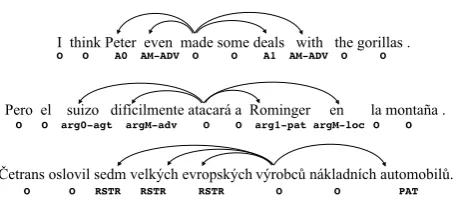
Figure 1: Example predicate-argument structures from English, Spanish, and Czech. Note that the argument labels are different in each language.
ditional monolingual version, and variants which additionally incorporate supervision from English portion of the dataset. To our knowledge, this is the first multilingual SRL approach to combine su-pervision from several languages.
# sentences
# sentences w/
1+ predicates # predicates
CAT 13200 12876 37444
CES 38727 38579 414133
DEU 36020 14282 17400
ENG 39279 37847 179014
JPN 4393 4344 25712
SPA 14329 13836 43828
[image:2.595.71.294.67.197.2]ZHO 22277 21073 102827
Table 1: Train data statistics. Languages are indi-cated with ISO 639-3 codes.
2 Data
We evaluate our system on the semantic role label-ing portion of the CoNLL-2009 shared task (Hajiˇc et al.,2009), on all seven languages, namely Cata-lan, Chinese, Czech, English, German, Japanese and Spanish. For each language, certain tokens in each sentence in the dataset are marked as pred-icates. Each predicate takes as arguments other words in the same sentence, their relationship marked by labeled dependency arcs. Sentences may contain no predicates.
Despite the consistency of this format, there are significant differences between the training sets across languages.1 English uses PropBank role la-bels (Palmer et al., 2005). Catalan, Chinese, En-glish, German, and Spanish include (but are not limited to) labels such as “arg0-agt” (for “agent”) or “A0” that may correspond to some degree to each other and to the English roles. Catalan and Spanish share most labels (being drawn from the same source corpus, AnCora; Taul´e et al.,2008), and English and German share some labels. Czech and Japanese each have their own distinct sets of argument labels, most of which do not have clear correspondences to English or to each other.
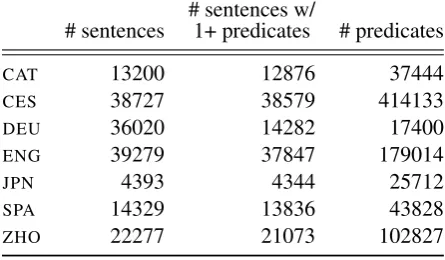
We also note that, due to semi-automatic pro-jection of annotations to construct the German dataset, more than half of German sentences do
notinclude labeled predicate and arguments. Thus while German has almost as many sentences as Czech, it has by far the fewest training examples (predicate-argument structures); see Table1.
1This is expected, as the datasets were annotated
indepen-dently under diverse formalisms and only later converted into CoNLL format (Hajiˇc et al.,2009).
3 Model
Given a sentence with a marked predicate, the CoNLL 2009 shared task requires disambiguation of the sense of the predicate, and labeling all its dependent arguments. The shared task assumed predicates have already been identified, hence we do not handle the predicate identification task.
Our basic model adapts the span-based depen-dency SRL model ofHe et al.(2017). This adap-tation treats the dependent arguments as argument spans of length 1. Additionally, BIO consistency constraints are removed from the original model— each token is tagged simply with the argument la-bel or an empty tag. A similar approach has also been proposed byMarcheggiani et al.(2017).
The input to the model consists of a sequence of pretrained embeddings for the surface forms of the sentence tokens. Each token embedding is also concatenated with a vector indicating whether the word is a predicate or not. Since the part-of-speech tags in the CoNLL 2009 dataset are based on a different tagset for each language, we do not use these. Each training instance consists of the annotations for a single predicate. These repre-sentations are then passed through a deep, multi-layer bidirectional LSTM (Graves,2013; Hochre-iter and Schmidhuber, 1997) with highway con-nections (Srivastava et al.,2015).
Japanese, the predicate sense annotation is sim-ply the lemmatized token of the predicate, giving a one-to-one predicate-“sense” mapping.
For argument labeling, every token in the sen-tence is assigned one of the argument labels, or NULL if the model predicts it is not an argument to the indicated predicate.
3.1 Monolingual Baseline
We use pretrained word embeddings as input to the model. For each of the shared task languages, we produced GloVe vectors (Pennington et al., 2014) from the news, web, and Wikipedia text of the Leipzig Corpora Collection (Goldhahn et al., 2012).2 We trained 300-dimensional vectors, then reduced them to 100 dimensions with principal component analysis for efficiency.
3.2 Simple Polyglot Sharing
In the first polyglot variant, we consider multi-lingual sharing between each language and En-glish by using pretrained multilingual embed-dings. This polyglot model is trained on the union of annotations in the two languages. We use strati-fied sampling to give the two datasets equal effec-tive weight in training, and we ensure that every training instance is seen at least once per epoch.
Pretrained multilingual embeddings. The ba-sis of our polyglot training is the use of pretrained multilingual word vectors, which allow represent-ing entirely distinct vocabularies (such as the to-kens of different languages) in a shared represen-tation space, allowing crosslingual learning (Kle-mentiev et al.,2012). We produced multilingual embeddings from the monolingual embeddings using the method of Ammar et al. (2016b): for each non-English language, a small crosslingual dictionary and canonical correlation analysis was used to find a transformation of the non-English vectors into the English vector space (Faruqui and Dyer,2014).
Unlike multilingual word representations, ar-gument label sets are disjoint between language pairs, and correspondences are not clearly de-fined. Hence, we use separate label representa-tions for each language’s labels. Similarly, while (for example)ENG:look andSPA:mira may be se-mantically connected, the senses look.01 and
2For English we used the vectors provided on the GloVe
websitenlp.stanford.edu/projects/glove/.
mira.01may not correspond. Hence, predicate sense representations are also language-specific.
3.3 Language Identification
In the second variant, we concatenate a language ID vector to each multilingual word embedding and predicate indicator feature in the input repre-sentation. This vector is randomly initialized and updated in training. These additional parameters provide a small degree of language-specificity in the model, while still sharing most parameters.
3.4 Language-Specific LSTMs
This third variant takes inspiration from the “frus-tratingly easy” architecture of Daume III (2007) for domain adaptation. In addition to process-ing every example with a shared biLSTM as in previous models, we add language-specific biL-STMs that are trained only on the examples be-longing to one language. Each of these language-specific biLSTMs is two layers deep, and is com-bined with the shared biSLTM in the input to the third layer. This adds a greater degree of language-specific processing while still sharing representa-tions across languages. It also uses the language identification vector and multilingual word vectors in the input.
4 Experiments
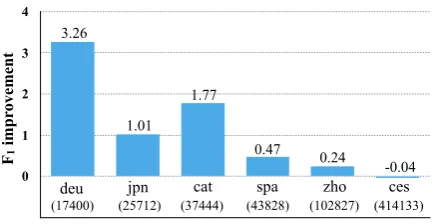
We present our results in Table2. We observe that simple polyglot training improves over monolin-gual training, with the exception of Czech, where we observe no change in performance. The lan-guages with the fewest training examples (Ger-man, Japanese, Catalan) show the most improve-ment, while large-dataset languages such as Czech or Chinese see little or no improvement (Figure2). The language ID model performs inconsis-tently; it is better than the simple polyglot model in some cases, including Czech, but not in all. The language-specific LSTMs model performs best on a few languages, such as Catalan and Chinese, but worst on others. While these results may re-flect differences between languages in the opti-mal amount of crosslingual sharing, we focus on the simple polyglot results in our analysis, which sufficiently demonstrate that polyglot training can improve performance over monolingual training.
Marcheg--1 0 1 2 3 4
3.26
1.01 1.77
0.47 0.24
-0.04 deu jpn cat spa zho ces
Languages (by # of predicates)
(25712) (37444) (43828) (102827) (414133) (17400)
F1
imp
rove
me
n
[image:4.595.72.290.63.175.2]t
Figure 2: Improvement in absoluteF1 with poly-glot training with addition of English. Languages are sorted in order of increasing number of predi-cates in the training set.
giani et al.(2017) excepted. While this results in better performance on many languages, our model has the advantage of not relying on a syntactic parser, and is hence more applicable to languages with lower resources. However, the results suggest that syntactic information is critical for strong per-formance on German, which has the fewest pred-icates and thus the least semantic annotation for a semantics-only model to learn from. Neverthe-less, our baseline is on par with the best published scores for Chinese, and it shows strong perfor-mance on most languages.
Label-wise results. Table3gives theF1 scores for individual label categories in the Catalan and Spanish datasets, as an illustration of the larger trend. In both languages, we find a small but consistent improvement in the most common label categories (e.g., arg1and argM). Less common
la-bel categories are sensitive to small changes in per-formance; they have the largest changes in F1 in absolute value, but without a consistent direction. This could be attributed to the addition of English data, which improves learning of representations that are useful for the most common labels, but is essentially a random perturbation for the rarer ones. This pattern is seen across languages, and consistently results in overall gains from polyglot training.
One exception is in Czech, where polyglot training reduces accuracy on several common ar-gument labels, e.g., PAT and LOC. While the ef-fect sizes are small (consistent with other lan-guages), the overallF1 score on Czech decreases slightly in the polyglot condition. It may be that the Czech dataset is too large to make use of the comparatively small amount of English data, or that differences in the annotation schemes prevent
effective crosslingual transfer.
Future work on language pairs that do not in-clude English could provide further insights. Cata-lan and Spanish, for example, are closely related and use the same argument label set (both being drawn from the AnCora corpus) which would al-low for sharing output representations as well as input tokens and parameters.
Polyglot English results. For each language pair, we also evaluated the simple polyglot model on the English test set from the CoNLL 2009 shared task (Table4). English SRL consistently benefits from polyglot training, with an increase of 0.25–0.7 absoluteF1 points, depending on the language. Surprisingly, Czech provides the small-est improvement, despite the large amount of data added; the absence of crosslingual transfer in both directions for the English-Czech case, breaking the pattern seen in other languages, could there-fore be due to differences in annotation rather than questions of dataset size.
Labeled vs. unlabeledF1. Table5provides un-labeledF1 scores for each language pair. As can be seen here, the unlabeledF1 improvements are generally positive but small, indicating that poly-glot training can help both in structure prediction and labeling of arguments. The pattern of seeing the largest improvements on the languages with the smallest datasets generally holds here: the largest F1 gains are in German and Catalan, fol-lowed by Japanese, with minimal or no improve-ment elsewhere.
5 Related Work
Model CAT CES DEU ENG JPN SPA ZHO
Marcheggiani et al.(2017) - 86.00 - 87.60 - 80.30 81.20
Best previously reported 80.32 86.00 80.10 89.10 78.15 80.50 81.20
Monolingual 77.31 84.87 66.71 86.54 74.99 75.98 81.26
+ENG(simple polyglot) 79.08 84.82 69.97 – 76.00 76.45 81.50
+ENG(language ID) 79.05 85.14 69.49 – 75.77 77.32 81.42
+ENG(language-specific LSTMs) 79.45 84.78 68.30 – 75.88 76.86 81.89
Table 2: SemanticF1 scores (including predicate sense disambiguation) on the CoNLL 2009 dataset. State of the art for Catalan and Japanese is fromZhao et al.(2009), for German and Spanish fromRoth and Lapata(2016), for English and Chinese fromMarcheggiani and Titov(2017). Italics indicate use of syntax.
arg0 arg1 arg2 arg3 arg4 argL argM
Gold label count (CAT) 2117 4296 1713 61 71 49 2968
MonolingualCATF1 82.06 79.06 68.95 28.89 42.42 39.51 60.85
+ENGimprovement +2.75 +2.58 +4.53 +18.17 +9.81 +1.35 +1.10
Gold label count (SPA) 2438 4295 1677 49 82 46 3237
MonolingualSPAF1 82.44 77.93 70.24 28.89 41.15 22.50 58.89
+ENGimprovement +0.37 +0.43 +1.35 -3.40 -3.48 +4.01 +1.26
Table 3: Per-label breakdown ofF1 scores for Catalan and Spanish. These numbers reflect labels for each argument; the combination is different from the overall semanticF1, which includes predicate sense disambiguation.
ENG-only +CAT +CES +DEU +JPN +SPA +ZHO
[image:5.595.134.460.476.529.2]86.54 86.79 87.07 87.07 87.11 87.24 87.10
Table 4: SemanticF1 scores on the English test set for each language pair.
Model CAT CES DEU ENG JPN SPA ZHO
Monolingual 93.92 91.92 87.95 92.87 85.55 93.61 87.93
+ENG 94.09 91.97 89.01 – 86.17 93.65 87.90
Table 5: Unlabeled semanticF1scores on the CoNLL 2009 dataset.
convolutional networks to SRL, obtaining state of the art results on English and Chinese. All of these approaches are orthogonal to ours, and might ben-efit from polyglot training.
Other polyglot models have been proposed for semantics. Richardson et al.(2018) train on mul-tiple (natural language)-(programming language) pairs to improve a model that translates API text into code signature representations. Duong et al. (2017) treat English and German semantic pars-ing as a multi-task learnpars-ing problem and saw im-provement over monolingual baselines, especially for small datasets. Most relevant to our work is Johannsen et al. (2015), which trains a polyglot
model forframe-semantic parsing. In addition to sharing features with multilingual word vectors, they use them to find word translations of target language words for additional lexical features.
6 Conclusion
Acknowledgments
We thank Luke Zettlemoyer, Luheng He, and the anonymous reviewers for helpful comments and feedback. This research was supported in part by the Defense Advanced Research Projects Agency (DARPA) Information Innovation Office (I2O) under the Low Resource Languages for Emergent Incidents (LORELEI) program issued by DARPA/I2O under contract HR001115C0113 to BBN. Views expressed are those of the authors alone.
References
Waleed Ammar, George Mulcaire, Miguel Ballesteros,
Chris Dyer, and Noah Smith. 2016a. Many
lan-guages, one parser. Transactions of the Association
for Computational Linguistics, 4:431–444.
Waleed Ammar, George Mulcaire, Yulia Tsvetkov, Guillaume Lample, Chris Dyer, and Noah A Smith. 2016b. Massively multilingual word embeddings. arXiv:1602.01925.
Hal Daume III. 2007. Frustratingly easy domain
adap-tation. InProceedings of ACL.
Long Duong, Hadi Afshar, Dominique Estival, Glen Pink, Philip Cohen, and Mark Johnson. 2017. Mul-tilingual semantic parsing and code-switching. In
Proceedings of CoNLL.
Manaal Faruqui and Chris Dyer. 2014. Improving vec-tor space word representations using multilingual
correlation. InProceedings of EACL.
Dirk Goldhahn, Thomas Eckart, and Uwe Quasthoff. 2012. Building large monolingual dictionaries at the Leipzig corpora collection: From 100 to 200
lan-guages. InProceedings of LREC.
Alex Graves. 2013. Generating sequences with recur-rent neural networks. arXiv:1308.0850.
Jiang Guo, Wanxiang Che, Haifeng Wang, Ting Liu, and Jun Xu. 2016. A unified architecture for se-mantic role labeling and relation classification. In
Proceedings of COLING.
Jan Hajiˇc, Massimiliano Ciaramita, Richard Johans-son, Daisuke Kawahara, Maria Ant`onia Mart´ı, Llu´ıs M`arquez, Adam Meyers, Joakim Nivre, Sebastian
Pad´o, Jan ˇStˇep´anek, et al. 2009. The conll-2009
shared task: Syntactic and semantic dependencies in
multiple languages. InProceedings of CoNLL.
Luheng He, Kenton Lee, Mike Lewis, and Luke Zettle-moyer. 2017. Deep semantic role labeling: What
works and whats next. InProceedings of ACL.
Sepp Hochreiter and J¨urgen Schmidhuber. 1997.
Long short-term memory. Neural Computation,
9(8):1735–1780.
Anders Johannsen, H´ector Mart´ınez Alonso, and An-ders Søgaard. 2015. Any-language frame-semantic
parsing. InProceedings of EMNLP.
Alexandre Klementiev, Ivan Titov, and Binod Bhat-tarai. 2012. Inducing crosslingual distributed
rep-resentations of words. Proceedings of COLING.
Diego Marcheggiani, Anton Frolov, and Ivan Titov. 2017. A simple and accurate syntax-agnostic neural model for dependency-based semantic role labeling. arXiv:1701.02593.
Diego Marcheggiani and Ivan Titov. 2017. Encoding sentences with graph convolutional networks for
se-mantic role labeling. In Proceedings of EMNLP,
Copenhagen, Denmark.
Joakim Nivre, Marie-Catherine de Marneffe, Filip Ginter, Yoav Goldberg, Jan Hajic, Christopher D. Manning, Ryan T. McDonald, Slav Petrov, Sampo Pyysalo, Natalia Silveira, Reut Tsarfaty, and Daniel Zeman. 2016. Universal dependencies v1: A
mul-tilingual treebank collection. In Proceedings of
LREC.
Martha Palmer, Daniel Gildea, and Paul Kingsbury.
2005. The Proposition Bank: An annotated
cor-pus of semantic roles. Computational Linguistics,
31(1):71–106.
Jeffrey Pennington, Richard Socher, and Christo-pher D. Manning. 2014. GloVe: Global vectors for
word representation. InProceedings of EMNLP.
Kyle Richardson, Jonathan Berant, and Jonas Kuhn.
2018. Polyglot semantic parsing in APIs. In
Pro-ceedings of NAACL.
Michael Roth and Mirella Lapata. 2016. Neural se-mantic role labeling with dependency path embed-dings. arXiv:1605.07515.
Rupesh Kumar Srivastava, Klaus Greff, and J¨urgen Schmidhuber. 2015. Training very deep networks.
InNIPS.
Swabha Swayamdipta, Miguel Ballesteros, Chris Dyer, and Noah A. Smith. 2016. Greedy, joint
syntactic-semantic parsing with stack LSTMs. InProceedings
of CoNLL.
Mariona Taul´e, M. Ant`onia Mart´ı, and Marta Recasens.
2008. AnCora: Multilevel annotated corpora for
Catalan and Spanish. InProceedings of LREC.
Hai Zhao, Wenliang Chen, Jun’ichi Kazama, Kiyotaka Uchimoto, and Kentaro Torisawa. 2009. Multilin-gual dependency learning: Exploiting rich features for tagging syntactic and semantic dependencies. In