Parsing as Reduction
Daniel Fern´andez-Gonz´alez†∗ Andr´e F. T. Martins‡#
†Departamento de Inform´atica, Universidade de Vigo, Campus As Lagoas, 32004 Ourense, Spain ‡Instituto de Telecomunicac¸˜oes, Instituto Superior T´ecnico, 1049-001 Lisboa, Portugal
#Priberam Labs, Alameda D. Afonso Henriques, 41, 2o, 1000-123 Lisboa, Portugal
[email protected], [email protected]
Abstract
We reduce phrase-based parsing to depen-dency parsing. Our reduction is grounded on a new intermediate representation, “head-ordered dependency trees,” shown to be isomorphic to constituent trees. By encoding order information in the depen-dency labels, we show that any off-the-shelf, trainable dependency parser can be used to produce constituents. When this parser is non-projective, we can perform discontinuous parsing in a very natural manner. Despite the simplicity of our ap-proach, experiments show that the result-ing parsers are on par with strong base-lines, such as the Berkeley parser for En-glish and the best non-reranking system in the SPMRL-2014 shared task. Results are particularly striking for discontinuous parsing of German, where we surpass the current state of the art by a wide margin.
1 Introduction
Constituent parsing is a central problem in NLP—one at which statistical models trained on treebanks have excelled (Charniak, 1996; Klein and Manning, 2003; Petrov and Klein, 2007). However, most existing parsers are slow, since they need to deal with a heavy grammar con-stant. Dependency parsers are generally faster, but less informative, since they do not produce con-stituents, which are often required by downstream applications (Johansson and Nugues, 2008; Wu et al., 2009; Berg-Kirkpatrick et al., 2011; Elming et al., 2013). How to get the best of both worlds?
Coarse-to-fine decoding (Charniak and John-son, 2005) and shift-reduce parsing (Sagae and Lavie, 2005; Zhu et al., 2013) were a step forward
∗This research was carried out during an internship at Priberam Labs.
to accelerate constituent parsing, but typical run-times still lag those of dependency parsers. This is only made worse ifdiscontinuousconstituents are allowed—such discontinuities are convenient to represent wh-movement, scrambling, extrapo-sition, and other linguistic phenomena common in free word order languages. While non-projective dependency parsers, which are able to model such phenomena, have been widely developed in the last decade (Nivre et al., 2007; McDonald et al., 2006; Martins et al., 2013), discontinuous con-stituent parsing is still taking its first steps (Maier and Søgaard, 2008; Kallmeyer and Maier, 2013).
In this paper, we show that an off-the-shelf, trainable, dependency parseris enough to build a highly-competitive constituent parser. This (sur-prising) result is based on a reduction1 of con-stituent to dependency parsing, followed by a sim-ple post-processing procedure to recover unaries. Unlike other constituent parsers, ours does not require estimating a grammar, nor binarizing the treebank. Moreover, when the dependency parser is non-projective, our method can perform discon-tinuous constituent parsing in a very natural way.
Key to our approach is the notion of head-ordered dependency trees (shown in Figure 1): by endowing dependency trees with this additional layer of structure, we show that they become iso-morphic to constituent trees. We encode this struc-ture as part of the dependency labels, enabling a dependency-to-constituent conversion. A re-lated conversion was attempted by Hall and Nivre (2008) to parse German, but their complex encod-ing scheme blows up the number of arc labels, af-fecting the final parser’s quality. By contrast, our light encoding achieves a 10-fold decrease in the label alphabet, leading to more accurate parsing.
While simple, our reduction-based parsers are on par with the Berkeley parser for English (Petrov
1The title of this paper is inspired by the seminal paper of
Pereira and Warren (1983) “Parsing as Deduction.”
and Klein, 2007), and with the best single system in the recent SPMRL shared task (Seddah et al., 2014), for eight morphologically rich languages. For discontinuous parsing, we surpass the current state of the art by a wide margin on two German datasets (TIGERandNEGRA), while achieving fast
parsing speeds. We provide a free distribution of our parsers along with this paper, as part of the TurboParser toolkit.2
2 Background
We start by reviewing constituent and dependency representations, and setting up the notation. Fol-lowing Kong and Smith (2014), we use c-/d- pre-fixes for convenience (e.g., we write c-parser for constituent parser and d-tree for dependency tree).
2.1 Constituent Trees
Constituent-based representations are commonly seen as derivations according to a context-free grammar (CFG). Here, we focus on properties of the c-trees, rather than of the grammars used to generate them. We consider a broad scenario that permits c-trees with discontinuities, such as the ones derived with linear context-free rewrit-ing systems (LCFRS; Vijay-Shanker et al. (1987)). We also assume that the c-trees are lexicalized.
Formally, letw1w2. . . wLbe a sentence, where wi denotes the word in the ith position. A c-tree is a rooted tree whose leaves are the words
{wi}L
i=1, and whose internal nodes (constituents) are represented as a tuple hZ, h,Ii, where Z
is a non-terminal symbol, h ∈ {1, . . . , L} in-dicates the lexical head, and I ⊆ {1, . . . , L}
is the node’s yield. Each word’s parent is a pre-terminal unary node of the form hpi, i,{i}i,
wherepidenotes the word’s part-of-speech (POS)
tag. The yields and lexical heads are defined so that for every constituent hZ, h,Ii with children
{hXk, mk,Jki}Kk=1, (i) we have I = SKk=1Jk;
and (ii) there is a uniqueksuch thath=mk. This kth node (called the head-child node) is commonly chosen applying a handwritten set of head rules (Collins, 1999; Yamada and Matsumoto, 2003).
A c-tree is continuous if all nodes hZ, h,Ii
have a contiguous yieldI, anddiscontinuous oth-erwise. Trees derived by a CFG are always con-tinuous; those derived by a LCFRS may have dis-continuities, the yield of a node being a union of spans, possibly with gaps in the middle. Figure 1
2http://www.ark.cs.cmu.edu/TurboParser
shows an example of a continuous and a discontin-uous c-tree. Discontindiscontin-uous c-trees have crossing branches, if the leaves are drawn in left-to-right surface order. An internal node which is not a pre-terminal is called aproper node. A node is called unary if it has exactly one child. A c-tree with-out unary proper nodes is calledunaryless. If all proper nodes have exactly two children then it is called a binary c-tree. Continuous binary trees may be regarded as having been generated by a CFG in Chomsky normal form.
Prior work. There has been a long string of work in statistical c-parsing, shifting from sim-ple models (Charniak, 1996) to more sophisticated ones using structural annotation (Johnson, 1998; Klein and Manning, 2003), latent grammars (Mat-suzaki et al., 2005; Petrov and Klein, 2007), and lexicalization (Eisner, 1996; Collins, 1999). An orthogonal line of work uses ensemble or rerank-ing strategies to further improve accuracy (Char-niak and Johnson, 2005; Huang, 2008; Bj¨orkelund et al., 2014). Discontinuous c-parsing is con-sidered a much harder problem, involving mildly context-sensitive formalisms such as LCFRS or range concatenation grammars, with treebank-derived c-parsers exhibiting near-exponential run-time (Kallmeyer and Maier, 2013, Figure 27). To speed up decoding, prior work has consid-ered restrictons, such as bounding the fan-out (Maier et al., 2012) and requiring well-nestedness (Kuhlmann and Nivre, 2006; G´omez-Rodr´ıguez et al., 2010). Other approaches eliminate the dis-continuities via tree transformations (Boyd, 2007; K¨ubler et al., 2008), sometimes as a pruning step in a coarse-to-fine parsing approach (van Cranen-burgh and Bod, 2013). However, reported run-times are still superior to 10 seconds per sentence, which is not practical. Recently, Versley (2014a) proposed an easy-first approach that leads to con-siderable speed-ups, but is less accurate. In this paper, we design fast discontinuous c-parsers that outperform all the ones above by a wide margin, with similar runtimes as Versley (2014a).
2.2 Dependency Trees
In this paper, we use d-parsers as a black box to parse constituents. Given a sentence w1. . . wL,
a d-treeis a directed tree spanning all the words in the sentence.3 Each arc in this tree is a tuple
3We assume throughout that dependency trees have a
S
.
. VP
ADJP
JJ
cautious ADVP
RB
still VBZ
is NP
NN
public DT
The
The public is still cautious .
DT NN VBZ RB JJ .
NP#1 S#2 VP#1 VP#1
S#2
Es kam nichts Interessantes .
PPER VVFIN PIAT NN $.
NP#2
NP#1 S#1
[image:3.595.92.505.65.264.2]VROOT#1
Figure 1: Top: a continuous (left) and a discontinuous (right) c-tree, taken from English PTB§22 and German NEGRA, respectively. Head-child nodes are in bold. Bottom: corresponding head-ordered d-trees. The indices #1, #2, etc. denote the order of attachment events for each head. Note that the English unary nodesADVPandADJPare dropped in the conversion.
really needs caution
RB VBZ NN
VP VP VP
NN caution VBZ
needs RB really VP
VP NN caution VBZ
needs RB
really
VP NN
caution VP
VBZ needs RB really
Figure 2: Three different c-structures for the VP “really needs caution.” All are consistent with the d-structure at the top left. hh, m, `i, expressing a typed dependency relation
`between the head wordwhand the modifierwm.
A d-tree is projectiveif for every archh, m, `i
there is a directed path fromhto all words that lie betweenhandmin the surface string (Kahane et al., 1998). Projective d-trees can be obtained from continuous c-trees by reading off the lexical heads and dropping the internal nodes (Gaifman, 1965). However, this relation is many-to-one: as shown in Figure 2, several c-trees may project onto the same d-tree, differing on their flatness and on left or right-branching decisions. In the next section, we introduce the concept of head-ordered d-trees and express one-to-one mappings between these two representations.
Prior work. There has been a considerable amount of work developing rich-feature d-parsers. While projective d-parsers can use dynamic pro-gramming (Eisner and Satta, 1999; Koo and
consider an extra root symbol, as often done in the literature.
Collins, 2010), non-projective d-parsers typically rely on approximate decoders, since the underly-ing problem is NP-hard beyond arc-factored mod-els (McDonald and Satta, 2007). An alternative are transition-based d-parsers (Nivre et al., 2006; Zhang and Nivre, 2011), which achieve observed linear time. Since d-parsing algorithms do not have a grammar constant, typical implementations are significantly faster than c-parsers (Rush and Petrov, 2012; Martins et al., 2013). The key con-tribution of this paper is to reduce c-parsing to d-parsing, allowing to bring these runtimes closer.
3 Head-Ordered Dependency Trees We next endow d-trees with another layer of struc-ture, namely order information. In this frame-work, not all modifiers of a head are “born equal.” Instead, their attachment to the head occurs as a sequence of “events,” which reflect the head’s preference for attaching some modifiers before others. As we will see, this additional structure will undo the ambiguity expressed in Figure 2.
3.1 Strictly Ordered Dependency Trees
Let us start with the simpler case where the attach-ment order is strict. For each head word h with modifiersMh = {m1, . . . , mK}, we endowMh
with a strict order relation ≺h, so we can or-ganize all the modifiers of h as a chain, mi1 ≺h
mi2 ≺h . . . ≺h miK. We regard this chain as
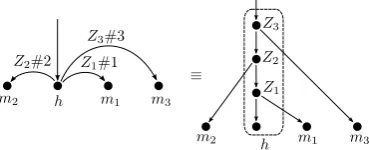
[image:3.595.86.279.331.441.2]Figure 3: Transformation of a strictly-ordered d-tree into a binary c-tree. Each node is split into a linked list forming a spine, to which modifiers are attached in order.
Figure 4: Two discontinuous constructions caused by a non-nested order (top) and a non-projective d-tree (bottom). In both cases nodeAhas a non-contiguous yield.
to h before mj”). We represent this graphically
by decorating d-arcs with indices (#1,#2, . . .) to denote the order of events, as we do in Figure 1.
A d-tree endowed with a strict order for each head is called a strictly ordered d-tree. We es-tablish below a correspondence between strictly ordered d-trees and binary c-trees. Before doing so, we need a few more definitions about c-trees. For each word positionh∈ {1, . . . , L}, we define
ψ(h)as the node higher in the c-tree whose lexi-cal head ish. We call the path fromψ(h)down to the pre-terminalphthespineofh. We may regard
a c-tree as a set ofLspines, one per word, which attach to each other to form a tree (Carreras et al., 2008). We then have the following
Proposition 1. Binary c-trees and strictly-ordered d-trees are isomorphic, i.e., there is a one-to-one correspondence between the two sets, where the number of symbols is preserved.
Proof. We use the construction in Figure 3. A for-mal proof is given as supplementary material.
3.2 Weakly Ordered Dependency Trees
Next, we relax the strict order assumption, restrict-ing the modifier setsMh = {m1, . . . , mK}to be
onlyweakly ordered. This means that we can par-tition theK modifiers intoJ equivalence classes,
Mh = SJj=1M¯hj, and define a strict order≺h on
the quotient set: M¯1
h ≺h . . .≺h M¯hJ. Intuitively,
there is still a sequence of events (1toJ), but now at each eventjit may happen that multiple mod-ifiers (the ones in the equivalence setM¯hj) are
si-Algorithm 1Conversion from c-tree to d-tree Input: c-treeC.
Output: head-ordered d-treeD.
1: Nodes :=GETPOSTORDERTRAVERSAL(C).
2: Setj(h) := 1for everyh= 1, . . . , L. 3: forv:=hZ, h,Ii ∈Nodesdo
4: foreveryu:=hX, m,J iwhich is a child ofvdo 5: ifm6=hthen
6: Add toDan archh, m, Zi, and put it inM¯j(h)
h .
7: end if 8: end for
9: Setj(h) :=j(h) + 1. 10: end for
multaneously attached to h. A weakly ordered d-tree is a d-tree endowed with a weak order for each head and such that any pairm, m0in the same
equivalence class (writtenm ≡h m0) receive the
same dependency label`.
We now show that Proposition 1 can be gener-alized to weakly ordered d-trees.
Proposition 2. Unaryless c-trees and weakly-ordered d-trees are isomorphic.
Proof. This is a simple extension of Proposition 1. The construction is the same as in Figure 3, but now we can collapse some of the nodes in the linked list, originating multiple modifiers attach-ing to the same position of the spine—this is only possible for sibling arcs with the same index and arc label. Note, however, that if we start with a c-tree with unary nodes and apply the inverse pro-cedure to obtain a d-tree, the unary nodes will be lost, since they do not involve attachment of mod-ifiers. In a chain of unary nodes, only the last node is recovered in the inverse transformation.
We emphasize that Propositions 1–2 hold with-out blowing up the number of symbols. That is, the dependency label alphabet is exactly the same as the set of phrasal symbols in the constituent representations. Algorithms 1–2 convert back and forth between the two formalisms, performing the construction of Figure 3. Both algorithms run in linear time with respect to the size of the sentence.
3.3 Continuous and Projective Trees
What about the more restricted class of projective d-trees? Can we find an equivalence relation with continuous c-trees? In this section, we give a pre-cise answer to this question. It turns out that we need an additional property, illustrated in Figure 4. We say that ≺h has the nesting property iff
Algorithm 2Conversion from d-tree to c-tree Input: head-ordered d-treeD.
Output: c-treeC.
1: Nodes :=GETPOSTORDERTRAVERSAL(D).
2: forh∈Nodesdo
3: Createv:=hph, h,{h}iand setψ(h) :=v.
4: SortMh(D), yieldingM¯h1≺hM¯h2≺h. . .≺hM¯hJ.
5: forj= 1, . . . , Jdo
6: LetZbe the label in{hh, m, Zi |m∈M¯j h}.
7: Obtain c-nodesψ(h) = hX, h,Iiandψ(m) =
hYm, m,Jmifor allm∈M¯hj.
8: Add c-nodev:=hZ, h,I ∪S
m∈M¯hjJmitoC.
9: Setψ(h)and{ψ(m)|m∈M¯j
h}as children ofv.
10: Setψ(h) :=v. 11: end for
12: end for
mj implies that eithermi ≡h mj ormi ≺h mj.
A weakly-ordered d-tree which is projective and whose orders≺hhave the nesting property for
ev-eryh is called anested-weakly ordered projec-tive d-tree. We then have the following result.
Proposition 3. Continuous unaryless c-trees and nested-weakly ordered projective d-trees are iso-morphic.
Proof. See the supplementary material.
Together, Propositions 1–3 have as corollary that nested-strictly ordered projective d-trees are in a one-to-one correspondence with binary con-tinuous c-trees. The intuition is simple: if≺h has
the nesting property, then, at each point in time, all one needs to decide about the next event is whether to attach the closest available modifier on theleft or on the right. This corresponds to choosing between left-branching or right-branching in a c-tree. While this is potentially interesting for most continuous c-parsers, which work with binarized trees when running the CKY algorithm, our c-parsers (to be described in§4) do not require any binarization since they work with weakly-ordered d-trees, using Proposition 2.
4 Reduction-Based Constituent Parsers We now invoke the equivalence results established in§3 to build c-parsers when only a trainable d-parser is available. Given a c-treebank provided as input, our procedure is outlined as follows: 1. Convert the c-treebank to dependencies
(Algo-rithm 1).
2. Train a labeled d-parser on this treebank. 3. For each test sentence, run the labeled d-parser
and convert the predicted d-tree into a c-tree without unary nodes (Algorithm 2).
4. Do post-processing to recover unaries.
The next subsections describe each of these steps in detail. Along the way, we illustrate with exper-iments using the English Penn Treebank (Marcus et al., 1993), which we lexicalized by applying the head rules of Collins (1999).4
4.1 Dependency Encoding
The first step is to convert the c-treebank to head-ordered dependencies, which we do using Algo-rithm 1. If the original treebank has discontinu-ous c-trees, we end up with non-projective d-trees or with violations of the nested property, as estab-lished in Proposition 3. We handle this gracefully by training a non-projective d-parser in the sub-sequent stage (see§4.2). Note also that this con-version drops the unary nodes (a consequence of Proposition 2). These nodes will be recovered in the last stage, as described in§4.4.
Since in this paper we are assuming that only an off-the-shelf d-parser is available, we need to convert head-ordered d-trees to plain d-trees. We do so by encoding the order information in the de-pendency labels. We tried two different strategies. The first one, direct encoding, just appends suf-fixes #1, #2, etc., as in Figure 1. A disadvantage is that the number of labels grows unbounded with the treebank size, as we may encounter complex substructures where the event sequences are long. The second strategy is a delta-encodingscheme where, rather than writing the absolute indices in the dependency label, we write thedifferences be-tween consecutive ones.5 We used this strategy for the continuous treebanks only, whose d-trees are guaranteed to satisfy the nested property.
For comparison, we also implemented a repli-cation of the encoding proposed by Hall and Nivre (2008), which we callH&N-encoding. This strat-egy concatenates all the c-nodes’ symbols in the modifier’s spine with the attachment position in the head’s spine (e.g., in Figure 3, if the modi-fier m2 has a spine with nodes X1, X2, X3, the generated d-label would beX1|X2|X3#2; our direct encoding scheme generatesZ2#2instead). Since their strategy encodes the entire spines into
com-4We train on§02–21, use§22 for validation, and test on
§23. We predict automatic POS tags withTurboTagger (Mar-tins et al., 2013), with 10-fold jackknifing on the training set.
5For example, if #1,#3,#4 and#2,#3,#3,#5 are
respectively the sequence of indices from the head to the left and to the right, we encode these sequences as#1,#2,#1
plex arc labels, many such labels will be ated, leading to slower runtimes and poorer gener-alization, as we will see.
For the training portion of the English PTB, which has 27 non-terminal symbols, the direct coding strategy yields 75 labels, while delta en-coding yields 69 labels (2.6 indices per symbol). By contrast, the H&N-encoding procedure yields 731 labels, more than 10 times as many. We later show (in Tables 1–2) that delta-encoding leads to a slightly higher c-parsing accuracy than direct en-coding, and that both strategies are considerably more accurate than H&N-encoding.
4.2 Training the Labeled Dependency Parser
The next step is to train a labeled d-parser on the converted treebank. If we are doing continuous c-parsing, we train a projective d-parser; otherwise we train a non-projective one.
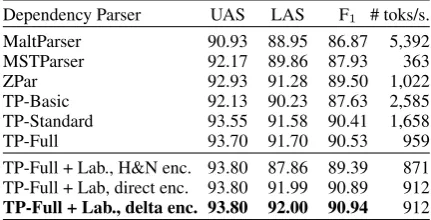
[image:6.595.308.524.66.176.2]In our experiments, we found it advantageous to perform labeled d-parsing in two stages, as done by McDonald et al. (2006): first, train an unla-beled d-parser; then, train a dependency labeler.6 Table 1 compares this approach against a one-shot strategy, experimenting with various off-the-shelf d-parsers: MaltParser (Nivre et al., 2007), MSTParser(McDonald et al., 2005),ZPar(Zhang and Nivre, 2011), and TurboParser (Martins et al., 2013), all with the default settings. For Tur-boParser, we used basic, standard and full models. Our separate d-labeler receives as input a back-bone d-structure and predicts a label for each arc. For each headh, we predict the modifiers’ labels using a simple sequence model, with features of the formφ(h, m, `)andφ(h, m, m0, `, `0), where m andm0 are two consecutive modifiers
(possi-bly on opposite sides of the head) and`and`0are
their labels. We use the same arc label features
φ(h, m, `)asTurboParser. Forφ(h, m, m0, `, `0),
we use the POS triplethph, pm, pm0i, plus
unilex-ical features where each of the three POS is re-placed by the word form. Both features are con-joined with the label pair`and`0. Decoding
un-der this model can be done by running the Viterbi algorithm independently for each head. The run-time is almost negligible compared with the run-time to parse: it took 2.1 seconds to process PTB§22,
6The reason why a two-stage approach is preferable is
that one-shot d-parsers, for efficiency reasons, use label fea-tures parsimoniously. However, for our reduction approach, d-labels are crucial and strongly interdependent, since they jointly encode the c-structure.
Dependency Parser UAS LAS F1 # toks/s.
MaltParser 90.93 88.95 86.87 5,392
MSTParser 92.17 89.86 87.93 363
ZPar 92.93 91.28 89.50 1,022
TP-Basic 92.13 90.23 87.63 2,585 TP-Standard 93.55 91.58 90.41 1,658
TP-Full 93.70 91.70 90.53 959
TP-Full + Lab., H&N enc. 93.80 87.86 89.39 871 TP-Full + Lab, direct enc. 93.80 91.99 90.89 912 TP-Full + Lab., delta enc. 93.80 92.00 90.94 912
Table 1: Results on English PTB§22 achieved by various d-parsers and encoding strategies. For dependencies, we report unlabeled/labeled attachment scores (UAS/LAS), excluding punctuation. For constituents, we show F1-scores (without
punctuation and root nodes), as provided byEVALB(Black et al., 1992). We report total parsing speeds in tokens per sec-ond (including time spent on pruning, decoding, and feature evaluation), measured on a Intel Xeon processor @2.30GHz.
direct enc. delta enc. # labels F1 # labels F1
Basque 26 85.04 17 85.17
French 61 79.93 56 80.05
German 66 83.44 59 83.39
Hebrew 62 83.26 43 83.29
Hungarian 24 86.54 15 86.67
Korean 44 79.79 16 79.97
Polish 47 92.39 34 92.64
Swedish 29 77.02 25 77.19
Table 2: Impact of direct and delta encodings on the dev sets of the SPMRL14 shared task. Reported are the number of labels and the F1-scores yielded by each encoding technique.
a fraction of about 5% of the total runtime.
4.3 Decoding into Unaryless Constituents
After training the labeled d-parser, we can run it on the test data. Then, we need to convert the pre-dicted d-tree into a c-tree without unaries.
To accomplish this step, we first need to recover, for each head h, the weak order of its modifiers
Mh. We do this by looking at the predicted
depen-dency labels, extracting the event indices j, and using them to build and sort the equivalent classes
{M¯hj}J
j=1. If two modifiers have the same index
[image:6.595.323.508.298.412.2]4.4 Recovery of Unary Nodes
The last stage is to recover the unary nodes. Given a unaryless c-tree as input, we predict unaries by running independent classifiers at each node in the tree (a simple unstructured task). Each class is either NULL (in which case no unary node is
ap-pended to the current node) or a concatenation of unary node labels (e.g.,S->ADJPfor a nodeJJ). We obtained 64 classes by processing the training sections of the PTB, the fraction of unary nodes being about 11% of the total number of nodes. To reduce complexity, for each node symbol we only consider classes that have been observed with that symbol in the training data. In PTB§22, this yields an average of 9.9 candidates per node occurrence. The classifiers are trained on the original c-treebank, stripping off unary nodes and trained to recover those nodes. We used the following fea-tures (conjoined with the class and with a flag in-dicating if the node is a pre-terminal):
• The production rules above and beneath the node (e.g.,S->NP VPandNP->DT NN);
• The node’s label, alone and conjoined with the parent’s label or the left/right sibling’s label;
• The leftmost and rightmost word/lemma/POS tag/morpho-syntactic tags in the node’s yield;
• If the left/right node is a pre-terminal, the word/lemma/morpho-syntactic tags beneath. This is a relatively easy task: when gold unaryless c-trees are provided as input, we obtain an EVALB F1-score of 99.43%. This large figure is due to the small amount of unary nodes, making this mod-ule have less impact on the final parser than the d-parser. Being a lightweight unstructured task, this step took only 0.7 seconds to run on PTB§22, a tiny fraction (less than 2%) of the total runtime.
Table 1 shows the accuracies obtained with the d-parser followed by the unary predictor. Since two-stage TP-Full with delta-encoding is the best strategy, we use this configuration in the sequel. To further explore the impact of delta encoding, we report in Table 2 the scores obtained by direct and delta encodings on eight other treebanks (see
§5.2 for details on these datasets). With the ex-ception of German, in all cases the delta encoding yielded betterEVALBF1-scores with fewer labels. 5 Experiments
To evaluate the performance of our reduction-based parsers, we conduct experiments in a variety
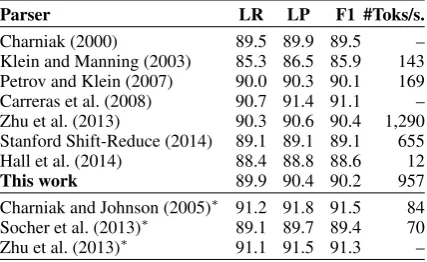
Parser LR LP F1 #Toks/s.
Charniak (2000) 89.5 89.9 89.5 – Klein and Manning (2003) 85.3 86.5 85.9 143 Petrov and Klein (2007) 90.0 90.3 90.1 169 Carreras et al. (2008) 90.7 91.4 91.1 – Zhu et al. (2013) 90.3 90.6 90.4 1,290 Stanford Shift-Reduce (2014) 89.1 89.1 89.1 655 Hall et al. (2014) 88.4 88.8 88.6 12
This work 89.9 90.4 90.2 957
[image:7.595.310.524.63.194.2]Charniak and Johnson (2005)∗ 91.2 91.8 91.5 84 Socher et al. (2013)∗ 89.1 89.7 89.4 70 Zhu et al. (2013)∗ 91.1 91.5 91.3 –
Table 3: Results on the English PTB§23. All systems report-ing runtimes were run on the same machine. Marked as∗are reranking and semi-supervised c-parsers.
of treebanks, both continuous and discontinuous.
5.1 Results on the English PTB
Table 3 shows the accuracies and speeds achieved by our system on the English PTB§23, in compar-ison to state-of-the-art c-parsers. We can see that our simple reduction-based c-parser surpasses the three Stanford parsers (Klein and Manning, 2003; Socher et al., 2013, and Stanford Shift-Reduce), and is on par with the Berkeley parser (Petrov and Klein, 2007), while being more than 5 times faster. The best supervised competitor is the recent shift-reduce parser of Zhu et al. (2013), which achieves similar, but slightly better, accuracy and speed. Our technique has the advantage of being flexible: since the time for d-parsing is the domi-nating factor (see§4.4), plugging a faster d-parser automatically yields a faster c-parser. While reranking and semi-supervised systems achieve higher accuracies, this aspect is orthogonal, since the same techniques can be applied to our parser.
5.2 Results on the SPMRL Datasets
We experimented with datasets for eight lan-guages, from the SPMRL14 shared task (Seddah et al., 2014). We used the official training, de-velopment and test sets with the provided pre-dicted POS tags. For French and German, we used the lexicalization rules detailed in Dybro-Johansen (2004) and Rehbein (2009), respectively. For Basque, Hungarian and Korean, we always took the rightmost modifier as head-child node. For Hebrew and Polish we used the leftmost mod-ifier instead. For Swedish we induced head rules from the provided dependency treebank, as de-scribed in Versley (2014b). These choices were based on dev-set experiments.
ex-cept French, our system outperforms the Berke-ley parser (Petrov and Klein, 2007), with or with-out prescribed POS tags. Our average F1-scores are superior to the best non-reranking system par-ticipating in the shared task (Crabb´e and Seddah, 2014) and to the c-parser of Hall et al. (2014), achieving the best results for 4 out of 8 languages.
5.3 Results on the Discontinuous Treebanks
Finally, we experimented on two widely-used dis-continuous German treebanks: TIGER (Brants et
al., 2002) and NEGRA (Skut et al., 1997). For
the former, we used two different splits: TIGER -SPMRL, provided in the SPMRL14 shared task;
andTIGER-H&N, used by Hall and Nivre (2008).
For NEGRA, we used the standard splits. In these
experiments, we skipped the unary recovery stage, since very few unary nodes exist in the data.7 We ran TurboTagger to predict POS tags for TIGER -H&NandNEGRA, while inTIGER-SPMRLwe used
the predicted POS tags provided in the shared task. All treebanks were lexicalized using the head-rule sets of Rehbein (2009). For comparison to related work, sentence length cut-offs of 30, 40 and 70 were applied during the evaluation.
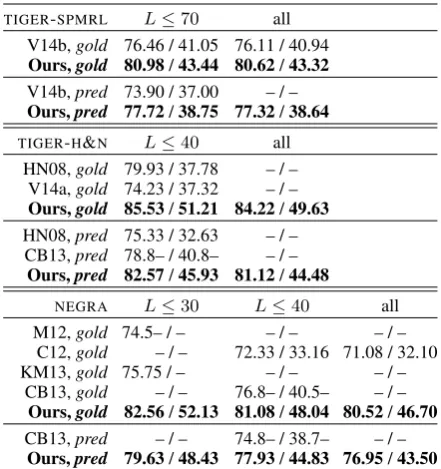
Table 5 shows the results. We observe that our approach outperforms all the competitors con-siderably, achieving state-of-the-art accuracies for both datasets. The best competitor, van Cranen-burgh and Bod (2013), is more than 3 points be-hind, both in TIGER-H&N and in NEGRA. Our
reduction-based parsers are also much faster: van Cranenburgh and Bod (2013) report 3 hours to parse NEGRA with L ≤ 40. Our system parses
allNEGRAsentences (regardless of length) in 27.1
seconds in a single core, which corresponds to a rate of 618 tokens per second. This approaches the speed of the easy-first system of Versley (2014a), who reports runtimes in the range 670–920 tokens per second, but is much less accurate.
6 Related Work
Conversions between constituents and dependen-cies have been considered by De Marneffe et al. (2006) in one direction, and by Collins et al. (1999) and Xia and Palmer (2001) in the other, to-ward multi-representational treebanks (Xia et al., 2008). This prior work aimed at linguistically sound conversions, involving grammar-specific
7NEGRAhas no unaries; for theTIGER-SPMRLandH&N
dev-sets, the fraction of unaries is 1.45% and 1.01%.
TIGER-SPMRL L≤70 all
V14b,gold 76.46 / 41.05 76.11 / 40.94 Ours,gold 80.98/43.44 80.62/43.32 V14b,pred 73.90 / 37.00 – / – Ours,pred 77.72/38.75 77.32/38.64
TIGER-H&N L≤40 all
HN08,gold 79.93 / 37.78 – / – V14a,gold 74.23 / 37.32 – / – Ours,gold 85.53/51.21 84.22/49.63 HN08,pred 75.33 / 32.63 – / –
CB13,pred 78.8– / 40.8– – / – Ours,pred 82.57/45.93 81.12/44.48
NEGRA L≤30 L≤40 all
M12,gold 74.5– / – – / – – / – C12,gold – / – 72.33 / 33.16 71.08 / 32.10 KM13,gold 75.75 / – – / – – / –
[image:8.595.306.527.61.296.2]CB13,gold – / – 76.8– / 40.5– – / – Ours,gold 82.56/52.13 81.08/48.04 80.52/46.70 CB13,pred – / – 74.8– / 38.7– – / – Ours,pred 79.63/48.43 77.93/44.83 76.95/43.50
Table 5: F1/ exact match scores onTIGERandNEGRAtest
sets, with gold and predicted POS tags. These scores are com-puted by the DISCO-DOP evaluator ignoring root nodes and, forTIGER-H&NandNEGRA, punctuation tokens. The base-lines are published results by Hall and Nivre 2008 (HN08), Maier et al. 2012 (M12), van Cranenburgh 2012 (C12), Kallmeyer and Maier 2013 (KM13), van Cranenburgh and Bod 2013 (CB13), and Versley 2014a, 2014b (V14a, V14b).
transformation rules to handle the kind of ambigu-ities expressed in Figure 2. Our work differs in that we are not concerned about the linguistic plausi-bility of our conversions, but only with the formal aspects that underlie the two representations.
The work most related to ours is Hall and Nivre (2008), who also convert dependencies to con-stituents to prototype a c-parser for German. Their encoding strategy is compared to ours in§4.1: they encode the entire spines into the dependency la-bels, which become rather complex and numer-ous. A similar strategy has been used by Vers-ley (2014a) for discontinuous c-parsing. Both are largely outperformed by our system, as shown in
§5.3. The crucial difference is that we encode only the top node’s label and its position in the spine— besides being a much lighter representation, ours has an interpretation as a weak ordering, leading to the isomorphisms expressed in Propositions 1–3.
con-Parser Basque French German Hebrew Hungar. Korean Polish Swedish Avg.
Berkeley 70.50 80.38 78.30 86.96 81.62 71.42 79.23 79.19 78.45
Berkeley Tagged 74.74 79.76 78.28 85.42 85.22 78.56 86.75 80.64 81.17 Hall et al. (2014) 83.39 79.70 78.43 87.18 88.25 80.18 90.66 82.00 83.72 Crabb´e and Seddah (2014) 85.35 79.68 77.15 86.19 87.51 79.35 91.60 82.72 83.69
This work 85.90 78.75 78.66 88.97 88.16 79.28 91.20 82.80 84.22
Bj¨orkelund et al. (2014) 88.24 82.53 81.66 89.80 91.72 83.81 90.50 85.50 86.72
Table 4: F1-scores on eight treebanks of the SPMRL14 shared task, computed with the providedEVALB SPMRLtool, which
takes into account all tokens except root nodes. Berkeley Tagged is a version of Petrov and Klein (2007) using the predicted POS tags provided by the organizers. Crabb´e and Seddah (2014) is the best non-reranking system in the shared task, and Bj¨orkelund et al. (2014) the ensemble and reranking-based system which won the official task. We report their published scores.
sistent with the predicted d-structure. Our work differs in which we do not need to run a c-parser in the second stage—instead, the d-parser already stores constituent information in the arc labels, and the only necessary post-processing is to re-cover unary nodes. Another advantage of our method is that it can be readily used for discon-tinuous parsing, while their constrained CKY al-gorithm can only produce continuous parses. 7 Conclusion
We proposed a reduction technique that allows to implement a c-parser when only a d-parser is given. The technique is applicable to any d-parser, regardless of its nature or kind. This reduction was accomplished by endowing d-trees with a weak or-der relation, and showing that the resulting class of head-ordered d-trees is isomorphic to constituent trees. We showed empirically that the our re-duction leads to highly-competitive c-parsers for English and for eight morphologically rich lan-guages; and that it outperforms the current state of the art in discontinuous parsing of German. Acknowledgments
We would like to thank the three reviewers for their insightful comments, and Slav Petrov, Djam´e Seddah, Yannick Versley, David Hall, Muhua Zhu, Lingpeng Kong, Carlos G´omez-Rodr´ıguez, and Andreas van Cranenburgh for valuable feedback and help in preparing data and running software code. This research has been partially funded by the Spanish Ministry of Economy and Competitiveness and FEDER (project TIN2010-18552-C03-01), Ministry of Education (FPU Grant Program) and Xunta de Galicia (projects R2014/029 and R2014/034). A. M. was supported by the EU/FEDER pro-gramme, QREN/POR Lisboa (Portugal), under the Intelligo project (contract 2012/24803), and
by the FCT grants UID/EEA/50008/2013 and PTDC/EEI-SII/2312/2012.
References
Taylor Berg-Kirkpatrick, Dan Gillick, and Dan Klein. 2011. Jointly learning to extract and compress. In
Proc. of Annual Meeting of the Association for Com-putational Linguistics.
Anders Bj¨orkelund, ¨Ozlem C¸etino˘glu, Agnieszka Fale´nska, Rich´ard Farkas, Thomas Mueller, Wolf-gang Seeker, and Zsolt Sz´ant´o. 2014. Introducing the ims-wrocław-szeged-cis entry at the spmrl 2014 shared task: Reranking and morpho-syntax meet un-labeled data. In Proc. of the First Joint Workshop on Statistical Parsing of Morphologically Rich Lan-guages and Syntactic Analysis of Non-Canonical Languages.
Ezra Black, John Lafferty, and Salim Roukos. 1992. Development and evaluation of a broad-coverage probabilistic grammar of english-language computer manuals. InProc. of Annual Meeting on Association for Computational Linguistics.
Adriane Boyd. 2007. Discontinuity revisited: An improved conversion to context-free representations. InProc. of Linguistic Annotation Workshop. Sabine Brants, Stefanie Dipper, Silvia Hansen,
Wolf-gang Lezius, and George Smith. 2002. The TIGER treebank. InProc. of the workshop on treebanks and linguistic theories.
Xavier Carreras, Michael Collins, and Terry Koo. 2008. TAG, Dynamic Programming, and the Per-ceptron for Efficient, Feature-rich Parsing. InProc. of the International Conference on Natural Lan-guage Learning.
Eugene Charniak and Mark Johnson. 2005. Coarse-to-fine n-best parsing and maxent discriminative reranking. In Proc. of Annual Meeting of the As-sociation for Computational Linguistics.
Eugene Charniak. 1996. Tree-bank grammars. In
Proc. of the National Conference on Artificial Intel-ligence.
Eugene Charniak. 2000. A
Michael Collins, Lance Ramshaw, Jan Hajiˇc, and Christoph Tillmann. 1999. A Statistical Parser for Czech. InProc. of the Annual Meeting of the Asso-ciation for Computational Linguistics on Computa-tional Linguistics.
Michael Collins. 1999.Head-driven statistical models for natural language parsing. Ph.D. thesis, Univer-sity of Pennsylvania.
Benoit Crabb´e and Djam´e Seddah. 2014. Multilingual discriminative shift reduce phrase structure parsing for the SPMRL 2014 shared task. In Proc. of the First Joint Workshop on Statistical Parsing of Mor-phologically Rich Languages and Syntactic Analysis of Non-Canonical Languages.
Marie-Catherine De Marneffe, Bill MacCartney, Christopher D Manning, et al. 2006. Generat-ing typed dependency parses from phrase structure parses. InProc. of the Meeting of the Language Re-sources and Evaluation Conference.
Ane Dybro-Johansen. 2004. Extraction automatique de Grammaires d’Arbres Adjoints `a partir d’un cor-pus arbor´e du franc¸ais. Master’s thesis, Univer-sit´e Paris 7.
Jason Eisner and Giorgio Satta. 1999. Efficient pars-ing for bilexical context-free grammars and head au-tomaton grammars. InProc. of Annual Meeting of the Association for Computational Linguistics. Jason Eisner. 1996. Three new probabilistic models
for dependency parsing: An exploration. InProc. of International Conference on Computational Lin-guistics.
Jakob Elming, Anders Johannsen, Sigrid Klerke, Emanuele Lapponi, Hector Martinez Alonso, and Anders Søgaard. 2013. Down-stream effects of tree-to-dependency conversions. InProc. of the An-nual Conference of the Human Language Technolo-gies - North American Chapter of the Association for Computational Linguistics.
Haim Gaifman. 1965. Dependency systems and phrase-structure systems. Information and control. Carlos G´omez-Rodr´ıguez, Marco Kuhlmann, and
Gior-gio Satta. 2010. Efficient parsing of well-nested lin-ear context-free rewriting systems. InProc. of the Annual Conference of the North American Chapter of the Association for Computational Linguistics. Johan Hall and Joakim Nivre. 2008. A
dependency-driven parser for german dependency and con-stituency representations. InProc. of the Workshop on Parsing German.
David Hall, Greg Durrett, and Dan Klein. 2014. Less grammar, more features. In Proc. of the Annual Meeting of the Association for Computational Lin-guistics.
Liang Huang. 2008. Forest reranking: Discriminative parsing with non-local features. InProc. of the An-nual Meeting of the Association for Computational Linguistics.
Richard Johansson and Pierre Nugues. 2008.
Dependency-based Semantic Role Labeling of Prop-Bank. InEmpirical Methods for Natural Language Processing.
Mark Johnson. 1998. PCFG models of linguistic tree representations. Computational Linguistics. Sylvain Kahane, Alexis Nasr, and Owen Rambow.
1998. Pseudo-projectivity: a polynomially parsable non-projective dependency grammar. In Proc. of the International Conference on Computational Lin-guistics.
Laura Kallmeyer and Wolfgang Maier. 2013. Data-driven parsing using probabilistic linear context-free rewriting systems. Computational Linguistics. Dan Klein and Christopher D. Manning. 2003.
Accu-rate unlexicalized parsing. InProc. of Annual Meet-ing on Association for Computational LMeet-inguistics. Lingpeng Kong and Noah A Smith. 2014. An
em-pirical comparison of parsing methods for stanford dependencies. arXiv preprint arXiv:1404.4314. Lingpeng Kong, Alexander M. Rush, and Noah A.
Smith. 2015. Transforming dependencies into phrase structures. In Proc. of the Conference of the North American Chapter of the Association for Computational Linguistics.
Terry Koo and Michael Collins. 2010. Efficient third-order dependency parsers. InProc. of Annual Meet-ing of the Association for Computational LMeet-inguis- Linguis-tics.
Sandra K¨ubler, Wolfgang Maier, Ines Rehbein, and Yannick Versley. 2008. How to compare treebanks. InProc. of the Meeting of the Language Resources and Evaluation Conference.
Marco Kuhlmann and Joakim Nivre. 2006. Mildly non-projective dependency structures. In Proc. of the joint conference of the International Committee on Computational Linguistics and the Association for Computational Linguistics.
Wolfgang Maier and Anders Søgaard. 2008. Tree-banks and mild context-sensitivity. InProc. of For-mal Grammar.
Wolfgang Maier, Miriam Kaeshammer, and Laura Kallmeyer. 2012. Data-driven plcfrs parsing revis-ited: Restricting the fan-out to two. InProc. of the Eleventh International Conference on Tree Adjoin-ing Grammars and Related Formalisms.
Mitchell P. Marcus, Beatrice Santorini, and Mary Ann Marcinkiewicz. 1993. Building a large annotated corpus of english: The penn treebank. Computa-tional Linguistics.
Andr´e F. T. Martins, Miguel B. Almeida, and Noah A. Smith. 2013. Turning on the turbo: Fast third-order non-projective turbo parsers. InProc. of the Annual Meeting of the Association for Computational Lin-guistics.
Takuya Matsuzaki, Yusuke Miyao, and Jun’ichi Tsujii. 2005. Probabilistic CFG with latent annotations. In
Proc. of the Annual Meeting of the Association for Computational Linguistics.
Ryan McDonald and Giorgio Satta. 2007. On the com-plexity of non-projective data-driven dependency parsing. In Proc. of International Conference on Parsing Technologies.
pars-ing uspars-ing spannpars-ing tree algorithms. InProc. of Em-pirical Methods for Natural Language Processing. Ryan McDonald, Kevin Lerman, and Fernando Pereira.
2006. Multilingual dependency analysis with a two-stage discriminative parser. InProc. of International Conference on Natural Language Learning. Joakim Nivre, Johan Hall, Jens Nilsson, G¨ulsen
Eryiˇgit, and Svetoslav Marinov. 2006. Labeled pseudo-projective dependency parsing with support vector machines. InProc. of International Confer-ence on Natural Language Learning.
Joakim Nivre, Johan Hall, Jens Nilsson, Atanas Chanev, G¨ulsen Eryiˇgit, Sandra K¨ubler, Svetoslav Marinov, and Erwin Marsi. 2007. Maltparser: A language-independent system for data-driven depen-dency parsing. Natural Language Engineering. Fernando C. N. Pereira and David H. D. Warren. 1983.
Parsing as Deduction. InProc. of the Annual Meet-ing of the Association for Computational LMeet-inguis- Linguis-tics.
Slav Petrov and Dan Klein. 2007. Improved infer-ence for unlexicalized parsing. InProc. of the North American Chapter of the Association for Computa-tional Linguistics.
Ines Rehbein. 2009.Treebank-Based Grammar Acqui-sition for German. Ph.D. thesis, School of Comput-ing, Dublin City University.
Alexander M Rush and Slav Petrov. 2012. Vine prun-ing for efficient multi-pass dependency parsprun-ing. In
Proc. of the North American Chapter of the Associ-ation for ComputAssoci-ational Linguistics.
Alexander Rush, David Sontag, Michael Collins, and Tommi Jaakkola. 2010. On dual decomposition and linear programming relaxations for natural language processing. InProc. of Empirical Methods for Nat-ural Language Processing.
Kenji Sagae and Alon Lavie. 2005. A classifier-based parser with linear run-time complexity. InProc. of the Ninth International Workshop on Parsing Tech-nology.
Djam´e Seddah, Sandra K¨ubler, and Reut Tsarfaty. 2014. Introducing the spmrl 2014 shared task on parsing morphologically-rich languages. In Proc. of the First Joint Workshop on Statistical Parsing of Morphologically Rich Languages and Syntactic Analysis of Non-Canonical Languages, August. Wojciech Skut, Brigitte Krenn, Thorsten Brants, and
Hans Uszkoreit. 1997. An annotation scheme for free word order languages. In Proc. of the Fifth Conference on Applied Natural Language Process-ing ANLP-97.
Richard Socher, John Bauer, Christopher D Manning, and Andrew Y Ng. 2013. Parsing with composi-tional vector grammars. InProc. of Annual Meeting of the Association for Computational Linguistics. Andreas van Cranenburgh and Rens Bod. 2013.
Dis-continuous parsing with an efficient and accurate dop model. Proc. of International Conference on Parsing Technologies.
Andreas van Cranenburgh. 2012. Efficient parsing with linear context-free rewriting systems. InProc.
of the Conference of the European Chapter of the Association for Computational Linguistics.
Yannick Versley. 2014a. Experiments with easy-first nonprojective constituent parsing. In Proc. of the First Joint Workshop on Statistical Parsing of Mor-phologically Rich Languages and Syntactic Analysis of Non-Canonical Languages.
Yannick Versley. 2014b. Incorporating semi-supervised features into discontinuous easy-first constituent parsing. CoRR, abs/1409.3813.
Krishnamurti Vijay-Shanker, David J Weir, and Ar-avind K Joshi. 1987. Characterizing structural descriptions produced by various grammatical for-malisms. InProc. of the Annual Meeting on Associ-ation for ComputAssoci-ational Linguistics.
Yuanbin Wu, Qi Zhang, Xuanjing Huang, and Lide Wu. 2009. Phrase dependency parsing for opinion min-ing. InProc. of Empirical Methods for Natural Lan-guage Processing.
Fei Xia and Martha Palmer. 2001. Converting depen-dency structures to phrase structures. InProc. of the First International Conference on Human Language Technology Research.
Fei Xia, Owen Rambow, Rajesh Bhatt, Martha Palmer, and Dipti Misra Sharma. 2008. Towards a multi-representational treebank. LOT Occasional Series. Hiroyasu Yamada and Yuji Matsumoto. 2003.
Statis-tical dependency analysis with support vector ma-chines. In Proc. of International Conference on Parsing Technologies.
Yue Zhang and Joakim Nivre. 2011. Transition-based dependency parsing with rich non-local features. In
Proc. of the Annual Meeting of the Association for Computational Linguistics.