Synthesis of pH-Sensitive Hydrogel Based on
Starch-Polyacrylate Superabsorbent
Fatemeh Soleimani1*, Mohammad Sadeghi2
1Young Researchers Club, Islamic Azad University, Khorramabad Branch, Khorramabad, Iran; 2Department of Chemistry, Science
Faculty, Islamic Azad University, Arak Branch, Arak, Iran. Email: *fatisoleymani @yahoo.com
Received January 9th, 2012; revised February 18th, 2012; accepted March 25th, 2012
ABSTRACT
In this article, we synthesize of a novel starch-based superabsorbent hydrogel via graft copolymerization of mixtures of acrylic acid (AA) and 2-Hydroxy ethyl methacrylate (HEMA) onto starch backbones. The polymerization reaction was carried out in an aqueous medium and in the presence of ammonium persulfate (APS) as an initiator and N,N’-methylene
bisacrylamide (MBA) as a crosslinker. The hydrogel structures were confirmed by FTIR spectroscopy. Furthermore, the swelling of superabsorbing hydrogels was examined in solutions with pH values ranging between 1 and 13. It showed a reversible pH-responsive behavior at pHs 2 and 8. This on-off switching behavior makes the synthesized hydrogels as an excellent candidate for controlled delivery of bioactive agents. A proposed mechanism for hydrogel formation was suggested and the structure of the product was established using FTIR and SEM spectroscopies.
Keywords: Starch; Hydrogel; pH-Sensitive; Vinylic Monomers
1. Introduction
Loosely crosslinked hydrophilic polymers (hydrogels) being able to absorb and retain hundreds of their own weight of water are known as superabsorbents [1]. The swelling properties of these hydrogels have attracted the attention of researchers and technologists, and have found wide-spread applications in drug delivery systems, agri- culture, separation processes and many other fields [2-7].
The modification of natural polymers is a promising method for the preparation of new materials. Graft co- polymerization of vinyl monomers onto natural polymers is an efficient approach to achieve these materials. Su- perabsorbing resins were first developed with a view to utilizing agricultural materials, and are typed by the hy- drolyzed corn starch-g-poly(acrylonitrile), H-SPAN [8].
Since then, starches from different resources as well as other polysaccharides, for example, cellulose, hydroxye- thyl cellulose [8-13], agar, sodium alginate [3] and guar gum were graft copolymerized to achieve water absorb- ing polymers. Polyacrylonitrile (PAN), polyacryamide, and poly (acrylic acid) have been frequently grafted, mostly onto starch, using different, initiators especially the ceric-saccharide redox system Radical polymerize- tion, however, has several disadvantages. The reproduce- bility of this method is poor, and there is little control over the grafting process, so the molecular weight distri-
bution is polydisperse. In addition, the necessity for inert gases (e.g., argon) to prepare an oxygen-free atmosphere and the need for initiators, toxic and/or expensive mono- mers, and crosslinkers are other disadvantages of free- radical polymerization reactions. These problems have been reviewed in detail. For the first time, Fanta et al.,
with a new method, tried to synthesize of HSPAN su- perabsorbent hydrogel. They indicated by a solubility test that crosslinks were formed during graft copolymerize- tion, by coupling of the two growing PAN radicals, and during saponification, by the attack of starch alkoxide ions on the nitrile groups as the initioation reaction of nitrile polymerization in the early stages of saponifica- tion. The nitrile groups of PAN were converted to a mix- ture of hydrophilic carboxamide and carboxylate groups during alkaline hydrolysis followed by in situ crosslink-
ing of the grafted PAN chains. The initially formed oxy- gen-carbon bonds between the starch hydroxyls and ni- trile groups of the PAN chains remained crosslinking sites. Then, Fanta and Doane [14] attempted to extend this idea to the preparation of superabsorbent hydrogels by the saponification of PAN in the presence of polyhy- droxy polymers. Finally, Yamaguchi et al. [15] reported
the preparation of superabsorbing polymers from mix- tures of PAN and various saccharides or alcohols.
In this investigation, we paid attention to the synthesis and investigation of a superabsorbent based on starch and
an initiator was added to starch solution and was allowed to stir for 10 min. After adding APS, variable amounts of AA and HEMA were added simultaneously to the starch solution. MBA solution (0.050 - 0.15 g in 5 ml H2O) was
added to the reaction mixture after the addition of monomers and the mixture was continuously stirred. Af- ter 60 min, the reaction product was allowed to cool to ambient temperature and neutralized to pH 8 by addition of 1 N sodium hydroxide solution. The hydrogel was poured to excess non solvent ethanol (200 mL) and re- mained for 3 h to dewater. Then ethanol was decanted and the product scissored to small pieces (diameter ~5 mm) [15-20]. Again, 100 mL fresh ethanol was added and the hydrogel was remained for 24 h. Finally, the fil- tered hydrogel is dried in oven at 60˚C for 10 h. After grinding, the powdered superabsorbent was stored away from moisture, heat and light. Infrared spectroscopy (Fig-
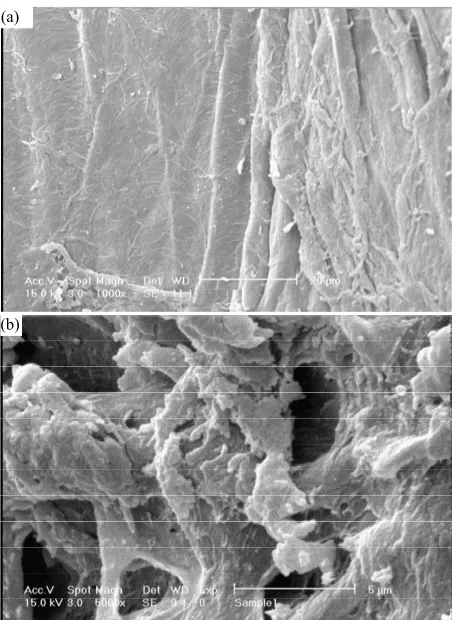
ure 1) and SEM (Figure 2) were carried out to confirm
the chemical structure of the materials obtained. Crosslink- ing graft copolymerization of vinyl monomers (AA and HEMA) ontostarchwas shown in Scheme 1.
3. Results and Discussion
3.1. Effect of pH on Equilibrium Swelling
In this series of experiments, swelling ratio for the syn- thesized hydrogels was measured in different pH solu-
[image:2.595.310.537.82.394.2]Transmittance/Wavenumber (cm–1)
Figure 1. FTIR spectra of (a) the pure Starch and (b) the crosslinked Starch-poly(NaAA-co-HEMA) hydrogel.
(b)
Figure 2. SEM photograph of the optimized superabsorbent hydrogel (a) Surface of pure carboxymethylcelloluse; (b) Surface of porous hydrogel.
[image:2.595.307.540.444.700.2]Figure 3. pH-dependent swelling of the superabsorbent hydrogel.
tions ranged from 1.0 to 13.0 (Figure 3). Since the swelling capacity of all “anionic” hydrogels is apprecia- bly decreased by the addition of counter ions (cations) to the swelling medium, no buffer solutions were used. Therefore, stock NaOH (pH 10.0) and HCl (pH 1.0) so- lutions were diluted with distilled water to reach desired basic and acidic pHs, respectively. Maximum swelling (95 g/g) was obtained at pH 8. In acidic media, most carboxylic acid groups are protonated, so decreased re- pulsion of anionic groups leads to a decreased swelling ratio. At higher pHs (5 - 8), some carboxylate groups are ionized and the electrostatic repulsion between carboxy- late groups causes an enhancement of the swelling ca- pacity. The reason of the swelling loss for the highly ba- sic solutions is the charge screening effect of excess Na+
in the swelling media, which shield the carboxylate ani- ons and prevent effective anion-anion repulsion. Similar swelling-pH dependencies have been reported in the case of other hydrogel systems [21-25].
3.2. pH-Responsiveness Behavior of the Hydrogel
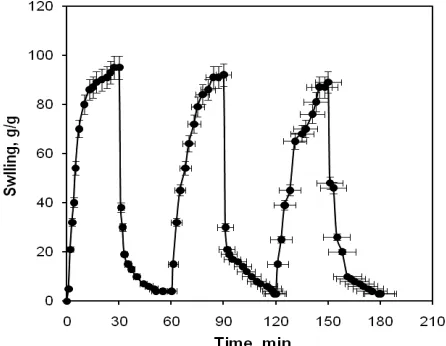
Since the semi-IPN hydrogels show different swelling behaviors at various pHs, so we investigated their pH-re- versibility in the solutions buffered at pHs 2 and 8 (Fig- ure 4). The figure shows a stepwise reproducible swell- ing change of the hydrogel at 25˚C with alternating pH between 2 and 8. At pH 8.0, the hydrogel swells up to 95 g/g due to anion-anion repulsive electrostatic forces, while, at pH 2.0, it shrinks within a few minutes due to protonation of solfunate groups. This sharp swelling-des- welling behavior of the hydrogels makes them suitable candidates for controlled releasing systems. Such on-off switching behavior as reversible swelling and deswelling
Figure 4. The pH-responsiveness behavior of starch-g-poly (AA-co-HEMA) superabsorbing hydrogel in solutions with pH 2.0 and 8.0.
has been reported for other ionic hydrogels [26-30].
4. Conclusion
The superabsorbent hydrogel, starch-g—poly(NaAA-co- HEMA), was synthesized through graft copolymerization mixture. The maximum water absorbency superabsorbent in solutions with pH = 8 was 95 g/g. Also the superab- sorbent hydrogels exhibited high sensitivity to pH, so that, several swelling changes of the hydrogel or drug release- ing percent were observed in lieu of pH variations in a wide range (1-13). Furthermore, the reversible swelling- deswelling behavior in solutions with acidic and basic pH, makes the hydrogels as a suitable candidate for con-trolled releasing systems.
5. Acknowledgements
The authors thank the Research center of Islamic Azad University of Arak.
REFERENCES
[1] D. C. Hwang, S. Damodaran, “Synthesis and Properties of Fish Protein-Based Hydrogel,” Journal of the
Ameri-can Oil Chemists’ Society, Vol. 74, No. 9, 1997, pp.
1165-1171.
[2] J. Kost, “Encyclopedia of Controlled Drug Delivery,” Vol. 1, Wiley, New York, 1999, p. 445.
[3] A. S. Hoffman, “Polymeric Materials Encyclopedia,” Vol. 5, CRC Press, Boca Raton, 1996, p. 3282.
[4] N. A. Peppas, A. G. Mikes, “Hydrogels in Medicine and Pharmacy,” Vol. 1, CRC Press, Boca Raton, 1986. [5] D. W. Jenkins, S. M. Hudson, “Review of Vinyl Graft
[image:3.595.311.534.86.259.2]Properties of Alginate Superabsorbent Filament Fibers Crosslinked with Glutaraldehyde,” Journal of Applied
Polymer Science, Vol. 78, No. 10, 2000, pp. 1797-1804.
doi:10.1002/1097-4628(20001205)78:10<1797::AID-AP P110>3.0.CO;2-M
[9] J. C. Salamone, E. L. Rodriguez, K. C. Lin, L. Quach, A. C. Watterson and I. Ahmad, “Aqueous Salt Absorption by Ampholytic Polysaccharides,” Polymer, Vol. 26, No. 8, 1985, pp. 1234-1238.
doi:10.1016/0032-3861(85)90259-9
[10] G. F. Fanta, “Polymeric Materials Encyclopedia,” Vol. 10, CRC Press, Boca Raton, 1996, p. 7901, 8051.
[11] Y. Zhu, B. Pu, J. Zhang and J. Shen, “Synthesis of Anti- Salt Absorbent Resins and Studies of Reaction Mecha-nism,” Journal of Applied Polymer Science, Vol. 79, No. 3, 2001, pp. 572-574.
doi:10.1002/1097-4628(20010118)79:3<572::AID-APP2 10>3.0.CO;2-T
[12] H. T. Lokhande, P. V. Varadarajan and V. Iyer, “Water- Superabsorbent Polymers through Gamma Radiation- Induced Graft-Copolymerization of Acrylonitrile on Guargum,” Journal of Applied Polymer Science, Vol. 45, No. 11, 1992, pp. 2031-2036.
doi:10.1002/app.1992.070451117
[13] V. D. Athawale and V. L. Lele, “Recent Trends in Hy-drogels Based on Starchgraft-Acrylic Acid: A Review,”
Starch/Starke,Vol. 53, No. 1, 2001, pp. 7-13.
doi:10.1002/1521-379X(200101)53:1<7::AID-STAR7>3. 0.CO;2-Q
[14] D. W. Lim, H. S. Whang and K. J. Yoon, “Synthesis and Absorbency of a Superabsorbent from Sodium Starch Sulfate-g-Polyacrylonitrile,” Journal of Applied Polymer
Science, Vol. 79, No. 8, 2001, pp. 1423-1430.
doi:10.1002/1097-4628(20010222)79:8<1423::AID-APP 90>3.0.CO;2-V
[15] R. M. Silverstein, F. X. Webster, “Spectrometric Identi-fication of Organic Compounds,” 6th edition, Wiley, New York, 1998.
[16] M. O. Weaver, L. A. Gugliemeli, W. M. Doane and C. R. Russel, “Hydrolyzed Starch-Polyacrylonitrile Graft Co-polymers: Effect of Structure on Properties,” Journal of
Applied Polymer Science, Vol. 15, No. 12, 1971, pp.
3015-3024. doi:10.1002/app.1971.070151211
[17] E. Sjostrom, “Fundamental of Carbohydrate Chemistry
doi:10.1002/pat.408
[21] J. J. Hermans, “Flow Properties of Disperse Systems,” Wiley Interscience, New York, 1953.
[22] W. F. Lee and W. Y. Yuan, “Thermoreversible Hydrogels X: Synthesis and Swelling Behavior of the (N-isopropy- lacrylamide-co-sodium 2-acrylamido-2-methylpropyl sul- fonate) Copolymeric Hydrogels,” Journal of Applied
Polymer Science, Vol. 77, No. 8, 2000, pp. 1760-1768.
doi:10.1002/1097-4628(20000822)77:8<1760::AID-APP 13>3.0.CO;2-J
[23] S. E. Park, Y. C. Nho, Y. M. Lim and H. Kim, “Prepara-tion of pH-Sensitive Poly(vinyl alcohol-g-methacrylic acid) and Poly(vinyl alcohol-g-acrylic acid) Hydrogels by Gamma Ray Irradiation and Their Insulin Release Be-havior,” Journal of Applied Polymer Science, Vol. 91, No. 1, 2004, pp. 636-643. doi:10.1002/app.13211
[24] K. Burugapalli, D. Bhatia, V. Koul and V. Choudhary, “Interpenetrating Polymer Networks Based on Poly (acrylic acid) and Gelatin. I: Swelling and Thermal Be-havior,” Journal of Applied Polymer Science, Vol. 82, No. 1, 2001, pp. 217-227. doi:10.1002/app.1841
[25] S. Lu, M. Duan and S. Lin, “Superabsorbent Polymeric Materials VIII: Swelling Behavior of Crosslinked Poly [sodium acrylate-co-trimethyl methacryloyloxyethyl ammonium iodide] in Aqueous Salt Solutions,” Journal
of Applied Polymer Science, Vol. 79, No. 9, 2001, pp.
1665-1674.
doi:10.1002/1097-4628(20010228)79:9<1665::AID-APP 160>3.0.CO;2-P
[26] A. Pourjavadi, M. Sadeghi and H. Hosseinzadeh, “Modi-fied Carrageenan. 5. Preparation, Swelling Behavior, Salt- and pH-Sensitivity of Partially Hydrolyzed Crosslinked Carrageenan-graft-polymethacrylamide Superabsorbent Hydrogel,” Polymers for Advanced Technologies, Vol. 15, No. 11, 2004, pp. 645-653. doi:10.1002/pat.524
[27] A. M. Lowman and N. A. Peppas, “Encyclopedia of Con-trolled Drug Delivery,” Wiley, New York, 1999, p. 139. [28] A. Richter, A. Bund, M. Keller and K. Arndt,
“Charac-terization of a Microgravimetric Sensor Based on pH Sen-sitive Hydrogels,” Sensors and Actuators B: Chemical, Vol. 99, No. 2-3, 2004, pp. 579-585.
doi:10.1016/j.snb.2004.01.011
methyl piperazine and Methyl Methacrylate Hydrogels,”
European Polymer Journal, Vol. 37, No. 7, 2001, pp.
1473-1478. doi:10.1016/S0014-3057(00)00250-0 [30] F. L. Buchholz, “Superabsorbent Polymers: Science and
Technology,” In: F. L. Buchholz and N. A. Peppas, Eds.,
ACS Symposium Series 573, American Chemical Society,