Automatic Extraction of Morphological Lexicons
from Morphologically Annotated Corpora
Ramy Eskander, Nizar Habash, Owen Rambow Center for Computational Learning Systems
Columbia University
{reskander,habash,rambow}@ccls.columbia.edu
Abstract
We present a method for automatically learn-ing inflectional classes and associated lem-mas from morphologically annotated corpora. The method consists of a core language-independent algorithm, which can be opti-mized for specific languages. The method is demonstrated on Egyptian Arabic and Ger-man, two morphologically rich languages. Our best method for Egyptian Arabic pro-vides an error reduction of 55.6% over a sim-ple baseline; our best method for German achieves a 66.7% error reduction.
1 Introduction
Morphological lexicons specify all inflected forms for each lexeme; in a language with rich morphol-ogy, such a resource can be important for natural lan-guage processing (NLP) tasks in order to limit data sparseness. For example, a morphological lexicon is an important component of a morphological tagger or of a part-of-speech (POS) tagger for languages with rich morphology.1 Traditionally, a morpholog-ical lexicon has been created through painstaking lexicographic and morphological analysis of the lan-guage, drawing on unannotated corpora. Recently, new approaches have emerged. Fully or largely un-supervised approaches cannot link surface forms to morphosyntactic features and are thus not suited for building morphological lexicons. This problem is overcome by approaches that use explicit linguistic knowledge. In this paper, we investigate using exist-ing morphologically annotated corpora. In a mor-phologically annotated corpus, the words in natu-rally occurring texts or transcribed speech are anno-tated for the correct morphological analysis
(includ-1
Note that a full-form morphological lexicon is functionally equivalent to a morphological analyzer-generator, since one can be used to create the other.
ing, of course, core POS) in context. While there has been much work on computational morphology, to our knowledge this is the first paper to study the question of how to extract morphological lexicons from morphologically annotated corpora, and how to determine how much annotation is needed. In this paper, we assume a corpus with each word an-notated with morphosyntactic features and with a lemma which tells us what lexeme the word form is part of. The task is to predict the correspondence between a word form and its lemma and morpholog-ical features.
This paper makes two contributions. First, we introduce an algorithm that learns unseen forms by analogy. This algorithm is language-independent. It incrementally merges complementary paradigm in-formation about different lexemes into more abstract and more informative inflectional classes. Second, we explore how to model stems, and we propose a generalization of the Semitic root-and-template modeling. We use Egyptian Arabic (EGY), and Ger-man (GER) as our test languages. We test on corpus data, in order to simulate a standard real-world ap-plication. The baseline just uses the word forms seen in training and does not predict any unseen forms. Our language-independent algorithm improves the performance for both EGY and GER, with error re-ductions over the baseline of 44.4% for EGY and of 66.7% for GER. By adding language-specific mod-eling of the stem using templates, we obtain further error reductions for EGY (up to 55.6%) but not for GER.
Next, we review related work (Section 2) and introduce the key linguistic concepts we use (Sec-tion 3). We present our basic language-independent method in Section 4, and our language-specific mod-eling of stem variation in Section 5.
2 Related Work
Approaches to Morphological Modeling Much work has been done in the area of computational morphology ranging from systems painstakingly de-signed by hand (Koskenniemi, 1983; Buckwalter, 2004; Habash and Rambow, 2006; D´etrez and Ranta, 2012) to unsupervised methods that learn morphology models from unannotated data (Creutz and Lagus, 2007; Monson et al., 2008; Ham-marstr¨om and Borin, 2011; Dreyer and Eisner, 2011). There is a large continuum between these two approaches. Closer to one end, we find work on min-imally supervised methods for morphology learning that make use of available resources such as paral-lel data, dictionaries or some additional morpholog-ical annotations (Yarowsky and Wicentowski, 2000; Cucerzan and Yarowsky, 2002; Neuvel and Fulop, 2002; Snyder and Barzilay, 2008). Closer to the other end, we find work that focuses on defining morphological models with limited lexicons that are then extended using raw text (Cl´ement et al., 2004; Forsberg et al., 2006). The work presented in this paper falls in the middle of this continuum: we are interested in learning complete morphological mod-els using rich morphological annotations and, op-tionally, limited linguistic knowledge. We compare the value of different amounts of annotation and how they relate to additional linguistic knowledge.
Morphological Paradigms Many traditional and modern theories of inflectional morphology orga-nize natural language morphology by paradigms (Stump, 2001; Walther, 2011; Camilleri, 2011). Within the continuum we discussed above, we find hierarchical representations of paradigm knowledge that have been used in manually constructed mor-phological models (Finkel and Stump, 2002; Habash et al., 2005). Furthermore, D´etrez and Ranta (2012) introduce an implementation of Smart Paradigms – heuristically organized paradigms minimizing the number of forms needed to predict the full paradigm of a particular lexeme.
Both Forsberg et al. (2006) and Cl´ement et al. (2004) describe methods for automatically populat-ing a lexicon from raw data given a set of morpho-logical inflectional classes in a language. Our work differs in that we use annotated data, but do not start with a complete set of inflectional classes; thus, our work is exactly complementary to this work.
The concept of a paradigm is also used in many published efforts on unsupervised learning of mor-phology, although not always in a way consistent with its use in linguistics. For instance, Snover et al. (2002) (and later on Can and Manandhar (2012)) define a paradigm as “a set of suffixes and the stems that attach to those suffixes and no others”. This definition is quite limited since it is not modeling the notion of lexeme. Chan (2006) defines a simpler concept of paradigms in hisprobabilistic paradigm model, which has many limitations, such as not han-dling syncretism or irregular morphology, nor dis-tinguishing inflection and derivation.
Dreyer and Eisner (2011) learn complete Ger-man verb paradigms from a small set of complete seed paradigms (50 or 100), which they choose ran-domly from all verbs in the language. They model stem changes using letter-based models, and use a large unannotated corpus in addition to the seed paradigms. Durrett and DeNero (2013) attack the same problem as Dreyer and Eisner (2011). Instead of using unannotated text, they model explicit rules for affixes and stem changes. The major difference between these two efforts and our work is that the problem is defined differently: we assume that the training and test data is defined by a corpus, not by complete paradigms. Our methods therefore are more sensitive to frequency effects of tokens. We believe that our way of stating the problem is more relevant to actual computational challenges for lan-guages with limited morphological resources. We empirically compare our approach to that of Durrett and DeNero (2013) in Section 5.
letter-based models (Yarowsky and Wicentowski, 2000; Neuvel and Fulop, 2002; Dreyer and Eisner, 2011), we explore the use of abstract stems.
In our previous work on the EGY morphological analyzer CALIMA, we similarly used a lexicon of annotated morphological forms and extended it au-tomatically using a simpler approach to paradigm completion (Habash et al., 2012).
3 Linguistic Terminology
In this section, we review key concepts from mor-phology, and introduce the terminology we will use in this paper.2 We then introduce our own formal-ization of stems using vocalic templates.
Morphology is the study of word forms and their decomposition into elementary morphemes, which are the smallest meaning-bearing units of a lan-guage. There are two types of morphological pro-cesses: inflectional and derivational morphology. In inflectional morphology, a core meaning is retained and different word forms reflect different types of morphosyntactic features such as person, number, or tense. In derivational morphology, the core meaning of a word is changed, and perhaps even its part-of-speech (POS). In this paper, we restrict our interest to inflectional morphology. Furthermore, we take the written form of the word to be primary, and base all morphological analyses on the written form.
We will refer to the set of all word forms that are related through inflectional morphology alone as
lexeme. We can refer to a lexeme with a lemma, which we take to be a language-specific and conven-tionalized choice of one of the inflected forms. For example, in English the verb is conventionally cited in the infinitive (often withto, which can be omit-ted), while in Arabic it is conventionally cited in per-fective third person masculine singular. The lemma is sometimes referred to as a “citation form”. A
paradigmof a lexeme is a list ofcells, where a cell is a combination of a complete set of morphosyn-tactic features (properties) and the corresponding in-flected form of the lexeme. A paradigm is com-pleteif there are cells for all possible morphosyn-tactic features (the list of possible morphosynmorphosyn-tactic features is of course language-dependent).
We can divide the word forms into affixes (i.e., prefixes and suffixes) and thestem. There is no
sin-2
We (roughly) base our terminology and our conceptualiza-tion on the inferential-realizaconceptualiza-tional theory of Stump (2001).
gle correct way to do this for the words of a lan-guage. Each lexeme has its own paradigm. We can abstract from paradigms by grouping together paradigms which share the same affixes in corre-sponding cells, and where stems in correcorre-sponding cells differ in some restricted manner. We can de-fine the inflectional class (IC) more formally as a set ofabstract cells, where an abstract cell is a com-bination of a complete set of morphosyntactic fea-tures (properties) and an abstract representation of a stem (an abstract stem) along with fully specified affixes. The abstract stems (and thus the abstract cells) must have the property that, given a single in-stantiated word form of a lexeme along with its as-sociated IC, we can derive the complete paradigm of the lexeme deterministically. In the first results we present, we simply assume that the stem is ei-ther shared entirely with oei-ther abstract cells, or it is entirely lexically instantiated. We explore language-specific approaches to defining an abstract stem in Section 5, where we also discuss relevant morpho-logical facts of EGY and GER.
Prefixes, suffixes, and stems can be the same for different cells of a single paradigm or IC. This is calledsyncretism. We will refer to the cells which share a stem as astem syncretism zone or “zone” for short.
4 Language-Independent Inflectional Class Construction Algorithm
In this section, we present our language-independent IC construction algorithm (LICA). LICA consists of a core algorithm for building ICs from seen data and models of soft-stem syncretism and affix prediction.
4.1 Problem Definition
Starting with a corpus of words annotated as triples of hprefix+stem+suffix, lemma, featuresi, we want to create a lexicon of complete ICs, with each IC having an associated set of lemmas. The following is an input example specifying the in-flected form of the 3rd person plural
imperfec-tive inflection for the EGY lemmakatab3 ‘write’:
hy+iktib+uwA,katab, I3UPi.
3
IC1
IC3
IC2
IC4 CS = 3
CS = 2
CS = 1 IC1,3
IC2
IC4 CS = 2
IC1,2,3
IC4 IC1
L1 – L2 – L3 IC2 L4 – L5
IC3 L6 – L7
IC4 L8
IC1,3 L1 – L2 – L3
L6 – l7 IC2 L4 – L5
IC4 L8
IC1,2,3 L1 – L2 – L3
L4 – L5 L6 – l7 IC4 L8
2 3
[image:4.612.93.519.61.161.2]1
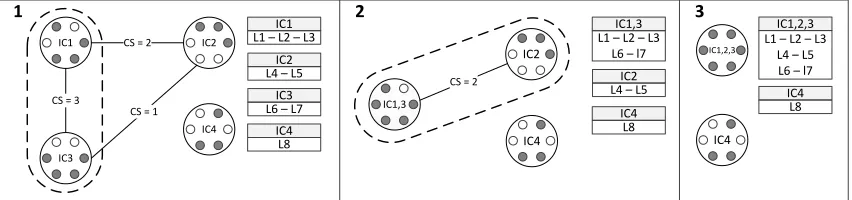
Figure 1: This graph illustrates two merges that result in combining three ICs in two steps. The IC cells are represented as solid (filled cells) or blank (empty cells) circles. CS is the compatibility score marking the number of matching filled cells in an IC. The boxes to the right of the graph represent the lexicon which associates lemmas (L*) with ICs. IC4 is not connected with any of the other ICs, because it has cell values that are incompatible with them.
4.2 Core Algorithm
Building the Initial Inflectional Classes An ini-tial IC is constructed for each lemma found in the input corpus using all the triplets involving said lemma. Since the lemma itself is an inflected form with ana priori fixed feature combination, we also use the lemma to construct the initial IC, even if it did not occur as a word form in the corpus. If all inflected forms of a lemma appear in the training data, the IC will be complete. However, typically there are many unseen forms. If all seen forms re-lated to one lexeme have the same stem, the abstract stem chosen for the IC is a single stem variable; the abstract cells of the new IC can of course dif-fer in terms of affixes (which are always fully spec-ified rather than represented as variables). In cases when the seen forms of one lemma have more than one stem, the IC created will simply be the same as the paradigm, i.e., we have fully instantiated stems as our abstract stems. We call such ICs suppletive ICs. At this point, we have a repository of numerous incomplete ICs and a lexicon consisting of a one-to-one mapping between lemmas and these new ICs. We then identify all ICs that are exactly the same (by definition, these are not suppletive ICs), and merge the associated sets of lemmas. We now have a new lexicon in which some ICs are associated with more than one lemma.
Constructing the Inflectional Class Graph We construct an IC graph that connects all mergeable ICs. Two ICs are mergeable if neither of the ICs is suppletive, if they share at least one abstract cell for some morphological feature, and if no morpho-logical features are associated with different abstract cells, i.e., there are no incompatibilities. Each point
in the graph represents a specific IC, while the edges carry the following four scores that we use to deter-mine mergeability order:
• Thecompatibility scoreis the number of non-empty intersections between the two ICs.
• The originality scoreis the larger number of previous merges of the two ICs. At the begin-ning, this number is 0 for all edges.
• Thecompleteness scoreis the size of the union of non-empty rows from the two ICs
• Thelexical size scoreis the sum of the number of lemmas associated with the two ICs.
The edges of the graph are ranked according to the compatibility score first (more is better). Any ties are broken using the originality score (lower is bet-ter), any remaining ties by the completeness score (more is better) and then by the lexical size score (more is better). We explored all possible orders of tie breaking using EGY data, and determined the or-der of the listing above to be best. We use it in all experiments reported in this paper.
IC and other ICs are recalculated. Graph edges that become incompatible after the merge are removed. The two original ICs are removed from the graph and lexicon. See Figure 1 for an illustration of the merge process.
4.3 Completing Stems and Affixes
Soft Stem Syncretism Zones We extend the con-cept of stem-syncretism zones into a statistical model that computes the probability that the abstract stems in two abstract cells are the same given their feature combinations, i.e., that they belong to the same syncretism zone. We refer to this approach as “soft” stem-syncretism zones or “soft zones” for short. The probabilities are computed for each feature-combination pair as the ratio of the times the abstract stem for the feature-combination pair are equal divided by the times the abstract stem for the feature-combination pair are not empty. The prob-abilities can be computed after the initial IC graph construction or after the merging process has con-cluded; they can also be based on IC type counts or weighted by the number of associated lemmas. Applying soft zones to fully complete the ICs can only be done after merging is completed. We try all the possible alternatives for learning the SZs on the EGY data, including experiments with small train-ing data sizes. The best accuracy is obtained ustrain-ing IC type weights learned after the merge. We use this setting for all experiments.
When applying the soft zones to determine the abstract stems of empty cells, we consider all filled cells in the same IC and select the abstract stem from the cell of the feature combination that has the high-est soft-zone probability with the feature combina-tion of the empty cell. Note that the copied abstract stem can be either a stem variable, or, for a supple-tive IC, a lexical form.
Predicting Affixes In building the ICs mentioned above, some feature combinations and their corre-sponding affixes (prefixes and suffixes) are missing since they were not in the training data. We fill the missing affixes in a particular ICiby copying them from other ICs that we rank by overall seen affix similarity to IC i. ICs with conflicting affixes for any feature combinations are excluded completely. For any remaining missing affix-feature combina-tion, we use the most common affix for that feature combination over all ICs.
4.4 Model Application
The complete ICs produced by the completion algo-rithm, associated with their lemmas in the lexicon, can now be used to predict the surface form of a given lemma and morphological features. We use the following procedure: If the given features are the same as those used to define the lemma, then the surface form is the same as the lemma form. If the lemma was seen in training, we select its IC from the model and generate the inflection associated with the features. This may require instantiating a stem vari-able (in case the IC is not suppletive), but this can be done deterministically from the lemma.
If the lemma has not been seen, then we build an IC on the fly using the lemma, i.e., an IC with a single cell. We then pick an IC from the model that does not conflict with that IC. The priority is given to the IC with the largest lexicon size, which is likely to be a result of several merges. If such an IC does not exist, a backup mode returns the stem of the lemma associated with the most frequent affixes of the queried features.
4.5 Results on Egyptian Arabic
Data and Metrics We use a morphologically an-notated EGY corpus based on the CALLHOME EGY (CHE) corpus (Gadalla et al., 1997).4 We di-vide the corpus into three parts: training, develop-ment and test, of about 75K, 36K and 41K words, respectively. We conduct our experiments on verbs only since they have a large number of possible mor-phosyntactic feature combinations. The verbs in these experiments are uncliticized. Clitics are eas-ily handled using a few orthographic rules (El Kholy and Habash, 2010). On average, uncliticized verbs are about 12% of all words in our corpus. The data is represented in triplets as described in Section 4.1. There is a total of 19 feature combinations of as-pect/mood (perfective,imperfective and imperative), person (first, second and third), gender (masculine, feminine and neutral) and number (singular and plu-ral). Some combinations are invalid such as the first and third persons with the imperative form. The lemma we use is the Arabic citation form for verbs, which is the perfective third person masculine
gular (P3MS) inflection. We use this fact to fill the P3MS cells when building the initial ICs.
We evaluate the accuracy of the automatically generated bidirectional lexicon by generating sur-face forms from lemmas and morphosyntactic fea-tures. We use the model application method de-scribed in Section 4.4.
Baseline Our baseline system consists of two steps. First, we check the features. All cases of cita-tion form features (in the case of EGY, P3MS) return the lemma as the inflected form. Otherwise, we look up the lemma and feature pair among all triplets in the training data and return the inflected form if such a triplet was found. If not, the baseline does not re-turn an answer.
Results The results on tokens are summarized in Table 2 under the column heading BL (baseline) and NOTMP (LICA with no stem template). Our sys-tem consistently improves over the baseline for all training data sizes explored.
Error Analysis We performed an error analysis using the best settings found on the development set. We found that in 46% of the error types the lemma is unseen. Additional 35% of the cases are due to stem templates that are unseen in the com-plete ICs although their corresponding lemmas are seen. About one tenth of the cases are because of the existence of multiple forms of the same lemma and feature combinations, where our system assigns a form that is different from the gold form. Finally, gold errors contribute to about 9% of all errors.
4.6 Results on German
Data and Metrics For our experiments, we use the TIGER corpus (Brants and Hansen, 2002). We divide the corpus into three parts: training, develop-ment and test, of about 709K, 143K and 37K words, respectively. However, we use the first 75K words in training and the first 36K words in development to have the results comparable to EGY. We conduct our experiments on verbs only. We disregard any verbs with separable prefixes (as is common in work in morphology learning). On average, verbs with-out separable prefixes are abwith-out 9% of all words in our corpus. The data is represented in triplets as de-scribed in Section 4.1. There are 28 feature com-binations of tense (present, past), person (first, sec-ond and third), number (singular, plural), and mood
(indicative, subjunctive, imperative, past participle, infinitive). Some combinations are invalid such as any tense with the non-tensed participle or infinitive. The infinitive is the lemma. We use the same metrics as for EGY (Section 4.5).
Results The results are summarized in Table 5, with the relevant results in the column NOTMP. We see that our algorithm performs substantially better than the baseline at all training set sizes, with greater relative error reductions at smaller training sizes.
Error Analysis We inspected all error types in the development set and found that nearly 8% of all er-ror types are erer-rors in the gold annotation of the de-velopment set, and in 4% of cases, our predicted form is correct because a lemma is shared by two verbal paradigms (for example,werdenhas different past participles depending on whether it is the pas-sive auxiliary or the verb for ‘become’).
5 Language-Specific Modeling of Stems
5.1 General Approach
We model the abstract stems using the notions of or-thographic template and orthographic root. To meet our definition of IC given above, we define these two notions so that the root and template can always be extracted deterministically. We define them simply in terms of sets of letters: the set of letters of the alphabet used to write the language we are modeling is partitioned into the root let-tersand thepattern letters. The orthographic tem-plate is a string that specifies the temtem-plate letters and that has placeholders for the root letters, which we write as ‘2’. The orthographic root is a sequence of strings that specifies the root letters that can fill a vocalic template’s placeholders, in the order spec-ified. Note that an IC along with a root is equiv-alent to a paradigm, since the root can be inserted deterministically into the abstract stem. This gives us another way to specify a lexeme: since a com-plete paradigm enumerates all inflected forms of a lexeme, and since a complete IC along with a root defines a complete paradigm, we can specify a lex-eme to be a pair consisting of an IC along with a root. This pair determines a complete mapping from morphosyntactic features to surface word forms for the lexeme.
EGY Inflectional Class (IC) Repository
IC-1 IC-2 IC-3
P1US 2a2a2+t 2a2∼+ayt 2u2+t P1UP 2a2a2+nA 2a2∼+aynA 2u2+nA
P2MS 2a2a2+t 2a2∼+ayt 2u2+t
P2FS 2a2a2+tiy 2a2∼+aytiy 2u2+tiy P2UP 2a2a2+tuwA 2a2∼+aytuwA 2u2+tuwA
P3MS 2a2a2 2a2∼ 2A2
P3FS 2a2a2+it 2a2∼+it 2A2+it
P3UP 2a2a2+uwA 2a2∼+uwA 2A2+uwA
I1US Aa+22i2 Aa+2i2∼ Aa+2uw2 I1UP ni+22i2 ni+2i2∼ ni+2uw2 I2MS ti+22i2 ti+2i2∼ ti+2uw2
I2FS ti+22i2+iy ti+2i2∼+iy ti+2uw2+iy I2UP ti+22i2+uwA ti+2i2∼+uwA ti+2uw2+uwA
I3MS yi+22i2 yi+2i2∼ yi+2uw2
I3FS ti+22i2 ti+2i2∼ ti+2uw2 I3UP yi+22i2+uwA yi+2i2∼+uwA yi+2uw2+uwA
C2MS A i22i2 2i2∼ 2uw2
C2FS A i22i2+iy 2i2∼+iy 2uw2+iy
C2UP A i22i2+uwA 2i2∼+uwA 2uw2+uwA EGY Lexicon
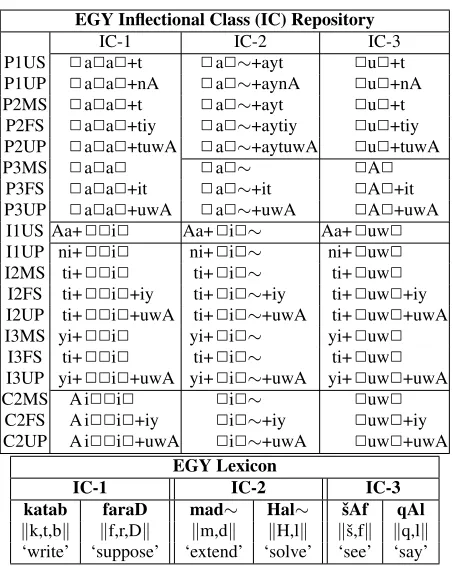
[image:7.612.73.299.53.336.2]IC-1 IC-2 IC-3 katab faraD mad∼ Hal∼ ˇsAf qAl kk,t,bk kf,r,Dk km,dk kH,lk kˇs,fk kq,lk ‘write’ ‘suppose’ ‘extend’ ‘solve’ ‘see’ ‘say’ Table 1: Example of three inflectional classes and associ-ated lemmas with their roots in EGY. The various blocks in the IC table specify different syncretism zones.
root of the lemma is used to decompose the stem of the inflected form into a root and a template.
5.2 Choosing Root and Pattern Letters
Determining which letters count as root letters and which count as pattern letters is language-specific. In this paper, we use three approaches to choosing root and pattern letters.
No Template (NOTMP) In this approach, we do not model the stem at all, i.e., there are no pattern letters. As a result, the ICs cannot express stem changes; any verb with a stem change will be an irregular verb and it will be modeled with a sup-pletive IC. Note that in EGY,every verb manifests a stem change between the perfective and imperfec-tive forms, while in GER many verbs in fact do have the same stem for all inflected forms. The results of the NOTMP approach are the same basic approach results already presented in Section 4.
Scholar (SCHLR) In this approach, we use lin-guistic scholarship and intuition to choose a set of letters to be the pattern letters. These are letters
which we know can change in stems within the same IC. We discuss this approach for EGY in Sec-tion 5.3.1 and for GER SecSec-tion 5.4.1.
Empirical (EMPR) In this approach, we obtain the set of pattern letters empirically. We align the letters of all the stems in the development corpus with the stem letters of their corresponding lemmas. This allows us to identify which letters change be-tween lemma stem and inflected stem. We order the letters by the probability that a letter changes given all occurrences of that letter, and by the probabil-ity that a letter changes given all changes that oc-cur. This gives us two rankings. For both rank-ings and for each letter that changes, we construct a set of letters by including all letters from the most highly ranked letter down to the letter under con-sideration. This gives us per ranking as many sets as there are letters that change. We then choose the best performing set among all sets generated by both rankings. We present the results of this approach for EGY in Section 5.3.1 and for GER in Section 5.4.1.
5.3 Egyptian Arabic
5.3.1 Choice of Pattern Letters
Scholar-based Pattern Letters For the EGY SCHLR approach, we selected the following pattern letters:
Z øøø
ðð
2a2∼+aytiy⇒Hal∼aytiy. Note that in this paper, we do not use any rules; all regular phonological and orthographic variation is “compiled” into the ICs. We also see examples of stem syncretism zones in Table 1; they are marked with horizontal lines. The stems associated with P3MS, P3FS and P3UP hap-pen to be the same within each IC (although differ-ent across ICs). Differdiffer-ent ICs have differdiffer-ent zones: e.g., IC-1 has one zone for the P*** features, while IC-2 and IC-3 have two identical zones for P3** and P[12]**.
Empirically Determined Pattern Letters For EGY, the EMPR approach, using the algorithm described in Section 5.2, yields the following optimal set of pattern letters:
HZ øøøð@
@@
A ˆA ˇAwy´yˆy’θaui. This set is very similar to the SCHLR set except in that it omits the lexically constant (per lexeme) Shadda diacrtic
∼ (ortho-graphic gemination marker), and some very infre-quent Hamzated forms; and it also adds one letterH
θas a result of orthographic inconsistency in the training data.Corpus Verb
BL NOTMP SCHLR EMPR EMPR
Size Count IIC+HZ
0K 0 19.3 20.0 20.0 20.0 58.8
1K 95 51.8 64.2 68.3 68.1 83.3
5K 630 64.2 77.0 83.9 83.9 91.1
[image:8.612.73.302.374.486.2]10K 1,201 70.4 84.3 89.4 89.1 92.4 25K 2,994 79.6 91.5 94.4 94.8 95.6 50K 5,966 84.5 94.2 96.9 96.7 97.2 75K 8,690 85.6 94.9 97.5 97.6 97.2
Table 2: Learning curve comparing system performance for EGY ontokens(development set).
Results The template approaches SCHLR and EMPR consistently beat NOTMP which does not make use of any templatic stem modeling (see Ta-ble 2). However, SCHLR and EMPR perform about equally. This is not surprising since the two sets of pattern letters are quite similar.
Error Analysis We conducted an error analysis of EMPR using the best settings found on the develop-ment set. About 86% of the error types in NOTMP where the lemma is unseen are solved after intro-ducing EMPR. Additionally, 71% of the cases in NOTMP where the stem template is unseen and the lemma is seen are solved. However, 7% of the error
types in EMPR are not present in NOTMP, and they are all cases where the stem template is unseen while the lemma is seen. Errors due to multiple stem forms and gold errors remain the same in both NOTMP and EMPR, contributing to 26% and 23%, respectively, of all the error types in EMPR.
5.3.2 Other Enhancements with Linguistic Knowledge
Other linguistic knowledge can also help enrich the process of IC learning, especially under limited annotation conditions. We use the following two types of linguistic knowledge, which seamlessly in-tegrate into the core merging algorithm described above.
Iconic Inflectional Classes (IICs) are ICs that are manually fully annotated, i.e., they have all the tem-plate cells for all morphosyntactic features specified. IICs are treated like any other ICs when constructing the initial IC graph. They are different from other ICs in that they initially have no lemmas associated with them in the lexicon.
Hard Stem-Syncretism Zones (HZ) are stem-syncretism zones determined manually by linguists to hold for all ICs. As such they can be more fine-grained than is needed to describe individual ICs. A hard zone is not applied in case of any partial dis-agreement within it. Unlike soft zones, they could be applied before or after the merge process, and they do not guarantee that the ICs will be completely filled.
because of all the cases with verbs appearing in the citation form. As expected, IICs always help improve accuracy, especially under limited (and no) data conditions. However the benefits diminish rapidly for larger training sets. When evaluating on types only (results not presented in this paper), we find that using IICs in our system with no data is better than using the baseline with 75K words.
5.3.3 Blind Test Set
Table 3 shows the accuracies the different sys-tems on our blind test set. The results for the test set are lower than those of the development set, but the trends are the same. We also compare our re-sults to those obtained using the system of Durrett and DeNero (2013) on the same test data. Note that we apply their system to our problem – predicting unseen forms from annotated corpora (i.e., incom-plete paradigms), not to the problem for which they created their system – predicting unseen forms from complete paradigms. Our best system outperforms theirs by 2.8% absolute in accuracy.
System Accuracy Error Reduction
Baseline 84.7
NOTMP 91.5 44.4
SCHLR 93.2 55.6
EMPR 93.2 55.6
[image:9.612.316.538.53.282.2]Durrett & DeNero 90.4 37.3
Table 3: Results for EGY ontokensusing a blind test set.
5.4 German
5.4.1 Choice of Pattern Letters
Scholar-based Pattern Letters We now discuss our scholarship-based choice of pattern letters for German. Like Arabic, German verb paradigms can show stem changes which are typically vowel changes. Furthermore, like Arabic, German has prefixes, suffixes, and circumfixes. However, un-like Arabic, German has many verbs (called “weak verbs”) which are regular in the sense that they show no stem change at all. The irregular verbs, or “strong verbs”, show many different patterns of stem changes. Another difference to Arabic is that the affixes are not the same for all verb paradigms. In particular, the weak verbs form several inflec-tional classes (which, of course, differ only in af-fixes). Finally, unlike Arabic, in the strong verbs the orthographic root does not necessarily consist
GER Inflectional Class (IC) Repository
IC-1 IC-2 IC-3
PI1S 2o2 +e 2e2 +e 2e2 +e PI2S 2o2 +st 2ie2 +st 2i2 +st
PI3S 2o2 +t 2ie2 +t 2i2 +t
PI1P 2o2 +en 2e2 +en 2e2 +en
PI2P 2o2 +t 2e2 +t 2e2 +t
PI3P 2o2 +en 2e2 +en 2e2 +en
PS1S 2o2 +e 2e2 +e 2e2 +e
PS2S 2o2 +est 2e2 +est 2e2 +est
XI1S 2o2 +te 2a2 + 2a2 +
XI2S 2o2 +est 2a2 +st 2a2 +st XS1S 2o2 +te 2¨a2 +e 2¨a2 +e XS2S 2o2 +test 2¨a2 +est 2¨a2 +est
PP ge+ 2o2 +t ge+ 2e2 +en 2e2 +en
INF 2o2 +en 2e2 +en 2e2 +en
GER Lexicon
IC-1 IC-2 IC-3 holen sohlen sehen lesen vergeben begeben
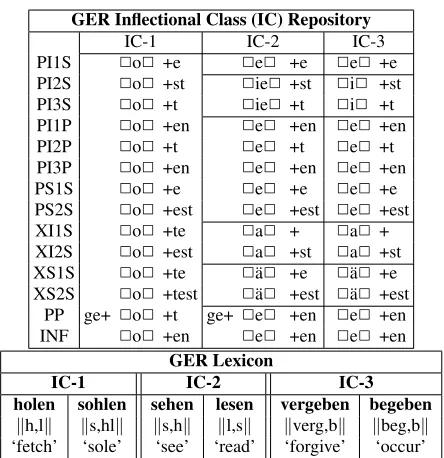
kh,lk ks,hlk ks,hk kl,sk kverg,bk kbeg,bk ‘fetch’ ‘sole’ ‘see’ ‘read’ ‘forgive’ ‘occur’ Table 4: Example of three inflectional classes (some cells omitted in the interest of space economy) and associated lemmas with their roots in German (“X” stands for past tense). The different blocks in the IC table specify differ-ent stem syncretism zones.
of sequences of single letters: the strong verbs have monosyllabic stems (plus perhaps derivational mor-phology), with the vowel in this stem potentially un-dergoing changes. However, the onset and coda of the stem syllable can be any consonant cluster al-lowed by German phonology. Thus, in German, we model roots as pairs of strings of any length (which represent the onset and coda of the stem syllable). Table 4 shows a weak IC and two strong ICs.
Since German strong verbs can have any stem vowel, we assume that all eight vowel letters of Ger-man (aeiou¨a¨o¨u) are pattern letters, and all other con-sonant letters are root letters. German weak verbs show no stem changes at all; if we tailored our tem-plates to them, we would define all letters to be root letters, and there would be no pattern letters at all. This is in fact the experiment we reported on in Sec-tion 4.6, and whose results are shown as NOTMP in Table 5. However, since we do not know dur-ing traindur-ing time whether a verb is weak or strong, all verbs will be modeled with an orthographic tem-plate, even though there is no stem change at all.
[image:9.612.79.295.350.425.2]set of pattern letters. The EMPR pattern letters dif-fer from the SCHLR pattern letters by omitting five vowels, but including theßvariant of thes.
Results In table 5 we see that using all eight vow-els as pattern letters (SCHLR column) in fact de-creases performance at every training size (and rel-atively more at smaller training sizes). However, if we use the empirically obtained pattern letter set oa¨aß, we see that we perform better than SCHLR at almost all training sizes, and slightly better than NOTMP at larger training sizes.
Error Analysis A manual inspection of all devel-opment error types again revealed 8% develdevel-opment set annotation errors and 4% acceptable variations. To investigate why NOTMP outperforms SCHLR for German on the development set, we performed an oracle experiment: we assumed we knew for each seen verb in training whether it is a weak or a strong verb. If it is weak, we model it using NOTMP, and if it is strong, using SCHLR. We observe as expected that the performance on weak verbs is very similar to that obtained using NOTMP on all verbs. However, for the strong verbs, it is only when we have more than 75,000 words of training data that the oracle outperforms NOTMP. We assume that the reason is that the highly frequent verbs are strong, but occur frequently enough so that their IC can be learned di-rectly from the training data. Using SCHLR simply adds noise for these very frequent verbs. It is only for the less frequent strong verbs that SCHLR can contribute, and then only when a large amount of training data is available.
5.4.2 Blind Test Set
Table 6 shows the accuracies the different sys-tems on our blind test set. The results for the test set are lower than those of the development set, and NOTMP, SCHLR,and EMPR produce very simi-lar accuracy results. We also compare our results to those obtained by running the system of Durrett and DeNero (2013) on the same training and test data. Our system outperforms Durrett and DeNero (2013)’s system reducing the error of by 5%.5
5
We also tested our system on Durrett and DeNero (2013)’s problem definition and data, training on 200 GER paradigms, and testing on 200 unseen paradigms. This is the case of testing for unseen lemmas in our system. Our system gives an accu-racy of 88.4% as opposed to 91.8% as reported by Durrett and DeNero (2013). Our system was not designed for this task.
Corpus Verb
BL NOTMP SCHLR EMPR Size Count
0K 0 13.7 25.2 25.2 25.2
1K 81 43.3 72.0 67.0 69.4
5K 461 64.8 83.5 83.0 83.1
10K 929 72.1 89.0 87.4 88.6
25K 2,362.0 79.5 93.6 93.0 92.4
50K 4,527 86.2 95.6 95.1 95.6
[image:10.612.317.537.56.165.2]75K 6,728 88.9 96.8 96.2 97.0
Table 5: Learning curve comparing system performance for GER ontokenson DEV corpus. BL=Baseline
System Accuracy Error Reduction Baseline 89.5
NOTMP 96.5 66.7
SCHLR 96.5 66.7
EMPR 96.5 66.7
[image:10.612.338.514.215.290.2]Durrett 96.3 64.8
Table 6: Results for GER ontokensusing a blind test set.
6 Conclusion and Future Work
We presented a method for automatically learn-ing inflectional classes and associated lemmas from morphologically annotated corpora. In the future, we plan to improve several aspects of our mod-els, in particular, using more powerful language-independent template transformations to automati-cally optimize for stem and affix modeling. We plan to take the insights from this paper and ap-ply them to new dialects and languages with lim-ited resources. We are interested in extending our approach to languages with different morphological systems, e.g., agglutinative or reduplicative. We will explore ideas from unsupervised morphology learn-ing to minimize the need for morphological annota-tions.
Acknowledgment
References
Sabine Brants and Silvia Hansen. 2002. Developments in the tiger annotation scheme and their realization in the corpus. InIn Proceedings of the Third Conference on Language Resources and Evaluation LREC-02. Las Palmas de Gran Canaria, pages 1643–1649.
Tim Buckwalter. 2004. Buckwalter Arabic Morpho-logical Analyzer Version 2.0. LDC catalog number LDC2004L02, ISBN 1-58563-324-0.
Maris Camilleri. 2011. Island morphology: Morphol-ogy’s interactions in the study of stem patterns. Lin-guistica, 51:65–84. Internal and External Boundaries of Morphology.
Burcu Can and Suresh Manandhar. 2012. Probabilistic hierarchical clustering of morphological paradigms.
EACL 2012, page 654.
Erwin Chan. 2006. Learning probabilistic paradigms for morphology in a latent class model. InProceedings of the Eighth Meeting of the ACL Special Interest Group on Computational Phonology at HLT-NAACL, pages 69–78.
Lionel Cl´ement, Benoˆıt Sagot, and Bernard Lang. 2004. Morphology based automatic acquisition of large-coverage lexica. InLREC 04, pages 1841–1844. Mathias Creutz and Krista Lagus. 2007. Unsupervised
models for morpheme segmentation and morphology learning.ACM Transactions on Speech and Language Processing (TSLP), 4(1).
Silviu Cucerzan and David Yarowsky. 2002. Boot-strapping a multilingual part-of-speech tagger in one person-day. InProceedings of the 6th conference on Natural language learning-Volume 20, pages 1–7. Gr´egoire D´etrez and Aarne Ranta. 2012. Smart
paradigms and the predictability and complexity of in-flectional morphology. EACL 2012, page 645. Markus Dreyer and Jason Eisner. 2011.
Discover-ing morphological paradigms from plain text usDiscover-ing a dirichlet process mixture model. In Proceedings of the Conference on Empirical Methods in Natural Lan-guage Processing, pages 616–627.
Greg Durrett and John DeNero. 2013. Supervised Learn-ing of Complete Morphological Paradigms. In Pro-ceedings of the 2013 Conference of the North Amer-ican Chapter of the Association for Computational Linguistics: Human Language Technologies (NAACL-HLT), Atlanta, GA.
Ahmed El Kholy and Nizar Habash. 2010. Techniques for Arabic morphological detokenization and ortho-graphic denormalization. In Proceedings of LREC-2010, May.
Ramy Eskander, Nizar Habash, Ann Bies, Seth Kulick, and Mohamed Maamouri. 2013. Automatic correc-tion and extension of morphological annotacorrec-tions. In
Proceedings of the 7th Linguistic Annotation Work-shop and Interoperability with Discourse, pages 1– 10, Sofia, Bulgaria, August. Association for Compu-tational Linguistics.
Raphael Finkel and Gregory Stump. 2002. Generating Hebrew Verb Morphology by Default Inheritance Hi-erarchies. InProceedings of the Workshop on Compu-tational Approaches to Semitic Languages, pages 9– 18.
Markus Forsberg, Harald Hammarstr¨om, and Aarne Ranta. 2006. Morphological lexicon extraction from raw text data. Advances in Natural Language Process-ing, pages 488–499.
Hassan Gadalla, Hanaa Kilany, Howaida Arram, Ashraf Yacoub, Alaa El-Habashi, Amr Shalaby, Krisjanis Karins, Everett Rowson, Robert MacIntyre, Paul Kingsbury, David Graff, and Cynthia McLemore. 1997. CALLHOME Egyptian Arabic Transcripts. In
Linguistic Data Consortium, Philadelphia.
Hassan Gadalla. 2000. Comparative Morphology of Standard and Egyptian Arabic. LINCOM EUROPA. Nizar Habash and Owen Rambow. 2006. MAGEAD: A
morphological analyzer and generator for the Arabic dialects. InProceedings of the 21st International Con-ference on Computational Linguistics and 44th Annual Meeting of the Association for Computational Linguis-tics, pages 681–688, Sydney, Australia.
Nizar Habash, Owen Rambow, and George Kiraz. 2005. Morphological Analysis and Generation for Arabic Dialects. In Proceedings of the ACL Workshop on Computational Approaches to Semitic Languages, pages 17–24, Ann Arbor, Michigan.
Nizar Habash, Abdelhadi Soudi, and Tim Buckwalter. 2007. On Arabic Transliteration. In A. van den Bosch and A. Soudi, editors, Arabic Computational Mor-phology: Knowledge-based and Empirical Methods. Springer.
Nizar Habash, Ramy Eskander, and Abdelati Hawwari. 2012. A Morphological Analyzer for Egyptian Ara-bic. InProceedings of the Twelfth Meeting of the Spe-cial Interest Group on Computational Morphology and Phonology, pages 1–9, Montr´eal, Canada.
Nizar Habash. 2010. Introduction to Arabic Natural Language Processing. Morgan & Claypool Publish-ers.
Harald Hammarstr¨om and Lars Borin. 2011. Unsuper-vised learning of morphology. Computational Lin-guistics, 37(2):309–350.
H. Kilany, H. Gadalla, H. Arram, A. Yacoub, A. El-Habashi, and C. McLemore. 2002. Egyptian Colloquial Arabic Lexicon. LDC catalog number LDC99L22.
In-ternational Joint Conference on Artificial Intelligence, pages 683–685.
Christian Monson, Jaime Carbonell, Alon Lavie, and Lori Levin. 2008. Paramor: Finding paradigms across morphology. Advances in Multilingual and Multi-modal Information Retrieval, pages 900–907.
Sylvain Neuvel and Sean A Fulop. 2002. Unsuper-vised learning of morphology without morphemes. In
Proceedings of the ACL-02 workshop on Morphologi-cal and phonologiMorphologi-cal learning-Volume 6, pages 31–40. Association for Computational Linguistics.
Matthew G Snover, Gaja E Jarosz, and Michael R Brent. 2002. Unsupervised learning of morphology using a novel directed search algorithm: Taking the first step. In Proceedings of the ACL-02 workshop on Morpho-logical and phonoMorpho-logical learning-Volume 6, pages 11–20.
Benjamin Snyder and Regina Barzilay. 2008. Unsuper-vised multilingual learning for morphological segmen-tation. InProceedings of ACL-08: HLT, pages 737– 745, Columbus, Ohio, June.
Gregory T. Stump. 2001. Inflectional Morphology. A Theory of Paradigm Structure. Cambridge Studies in Linguistics. Cambridge University Press.
G´eraldine Walther. 2011. Measuring morphological canonicity. Linguistica, 51:157–180. Internal and Ex-ternal Boundaries of Morphology.