Background: Self‑stigma may feature strongly and be detrimental for people with depression, but the understanding of its nature and prevalence is limited by the lack of psychometrically validated measures. This study is aimed to validate the Arabic version self‑stigma of depression scale (SSDS) among adolescents. Materials and Methods: A cross‑sectional study involved 100 adolescents randomly selected. The analyses include face validation, factor analysis, and reliability testing. A test–retest was conducted within a 2‑week interval. Results: The mean score for self‑stigma of depression among study participants was 68.9 (Standard deviation = 8.76) median equal to 71 and range was 47. Descriptive analysis showed that the percentage of those who scored below the mean score (41.7%) is shown less than those who scored above the mean score (58.3%). Preliminary construct validation analysis confirmed that factor analysis was appropriate for the Arabic‑translated version of the SSDS. Furthermore, the factor analysis showed similar factor loadings to the original English version. The total internal consistency of the translated version, which was measured by Cronbach’s alphas ranged from 0.70 to 0.77 for the four subscales and 0.84 for the total scale. Test–retest reliability was assessed in 65 respondents after 2 weeks. Cronbach’s alphas ranged from 0.70 to 0.77 for the four subscales and 0.84 for the total scale. Conclusions: Face validity, construct validity, and reliability analysis were found satisfactory for the Arabic‑translated version of the SSDS. The Arabic‑translated version of the SSDS was found valid and reliable to be used in future studies, with comparable properties to the original version and to previous studies.
Keywords: Cronbach’s alpha, depression, Jazan, mental health, self-stigma
The Self‑Stigma of Depression Scale: Translation and Validation of the
Arabic Version
Hussain Ahmed Darraj, Mohamed Salih Mahfouz1, Rashad Mohamed Al Sanosi2, Mohammed Badedi3, Abdullah Sabai3
Address for correspondence: Dr. Hussain Ahmed Darraj, Jazan Health Affairs, Ministry of Health, P. O. Box: 1075, Abu Arish 45911, Saudi Arabia. E‑mail: [email protected]
Self‑stigma involves the internalization of public negative beliefs and attitudes by an individual with depression. Self‑stigma can cause people with depression to lose hope for recovery, avoid seeking help, and delay or terminate early treatment.[11,12]
The aim of this paper is to translate the English‑language version of the self‑stigma of depression scale (SSDS) into Arabic and to validate the Arabic‑language version among adolescents so that it could be used in Arabic‑speaking populations. Face validity, internal consistency, test–retest reliability, and construct validity were assessed.
Materials and Methods
Self‑stigma of depression scale
Barney et al. developed the SSDS with input from focus group discussions including persons with and without a
Original Article
Introduction
S
tigma and burden related to depression are common all over the world.[1,2] Recent research has highlighted stigmatizing beliefs as an important barrier for seeking help of mental health services.[3‑5] Corrigan has proposed a framework in which stigma is categorized as either public stigma or self‑stigma. Within each of these two areas, stigma is further divided into three elements: stereotypes, prejudice, and discrimination.[6]Self‑stigma is defined as the reduction in a person’s self‑esteem or sense of self‑worth due to the perception held by the individual that he or she is socially unacceptable.[7] Self‑stigma is thought to occur when people experiencing a mental illness or seeking help self‑label as someone who is socially unacceptable and in doing so internalize stereotypes,apply negative public attitudes to themselves, and suffer diminished self‑esteem and self‑efficacy.[8] Common demonstrations of self‑stigma include feeling shame and limiting integration with others.[9] Researchers have also noted that individuals who self‑stigmatize may avoid seeking psychological services to avoid being labeled as having a mental illness.[10]
Jazan Health Affairs, Ministry of Health,
1Department of Family
and Community Medicine, Faculty of Medicine, Jazan University, 2Substance Abuse
Research Center, Jazan University,3Public Health
Administration, Jazan Health Affairs, Ministry of Health, Jazan, Saudi Arabia
ABSTRACT
This is an open access article distributed under the terms of the Creative Commons Attribution-NonCommercial-ShareAlike 3.0 License, which allows others to remix, tweak, and build upon the work non-commercially, as long as the author is credited and the new creations are licensed under the identical terms.
For reprints contact: [email protected] Access this article online
Quick Response Code:
Website:
www.ruralneuropractice.com
DOI:
10.4103/0976-3147.193552
history of depression, and a literature review conducted by the researchers. However, the SSDS is designed to assess the extent to which a person holds stigmatizing attitudes toward themselves in relation to having depression. It is a 16‑item scale with four subscales: shame, self‑blame, social inadequacy, and help‑seeking inhibition. Responses to the self‑stigma items are measured on a five‑point scale (ranging from one “strongly agree” to five “strongly disagree”). Items are coded so that a higher score indicates greater self‑stigma. Cronbach’s alphas ranged from 0.78 to 0.83 for the four subscales and 0.87 for the total scale. Test–retest reliability was assessed in 151 respondents after 2 months. Intraclass correlation coefficients are (ICCs) 0.63. In Chinese version of SSDS, internal consistency is α = 0.874 and test–retest reliability is r = 0.824.[13] Stigma scores were stratified for gender and depression experiences, but no minimally important change was defined.[14]
Study design and participants
This study employed a cross‑sectional study design. The source population was adolescent students in Jazan City. Two intermediate and two secondary schools for boys and girls were randomly selected. The number of study participants for each phase was determined according to the type of validation method. Thirty students were recruited in Phase 1 to assess face validity, whereas in Phase 2 for construct validity, the sample size was calculated depending on based on method presented by Gorsuch.[15] For reliability testing, the required sample size was calculated based on the Cronbach’s alpha formula. Taking into consideration 10% dropout. The final required sample size was 120 participants. In test–retest phase (Phase 3), the sample size was based on ICC (Walter et al., 1998). The minimally acceptable ICC value (r1 = 0.7) versus an alternative ICC value reflecting the expectations (r1 = 0.8) was chosen, with the power of 80% and a significance level of 5%; the required sample size was forty participants.[16]
Translation and cross‑cultural adaptation
The planned procedures for translating the SSDS were based on the guidelines of translation and cross‑cultural adaptation by Beaton et al.[17] Translation and back translation were conducted to confirm accuracy and appropriateness of SSDS wording. The instrument was translated by two independent persons from English into Arabic at the same time. One of them was aware of the study’s purpose and goals, and the other one was not. Both translators had discussed the differences between their translations to resolve any differences until they develop a consensus about the Arabic wording of each item. Two back translations into English were done by two independent persons. The back translation was conducted with no prior exposure to the English‑language version of the questionnaire. Then, Expert Committee Review was conducted. Principal investigator, translators, Arabic language expert, social expert, and psychiatrist discussed any discrepancies found between the original D‑Lit and items and the back‑translated versions of the questionnaire. The committee also assessed the suitability of the instrument to be used at the level of adolescents, and it was appropriate. To avoid any limitation on the applicability of this version of the
scale, the final translation was in classic Arabic, which can be used in other Arab countries with different dialects. Which was similar to the English version in content and structure. Then, face validity was conducted as shown in this study.
Data collection
The data collection was conducted at each respective school in Jazan City. There was no missing data. In Phase 1, face validation was conducted. The selected participants (n = 30) were asked to go through the Arabic version of the SSDS. After reading through the instrument, they were asked if they fully understood the instrument and its meaning. There are no difficulties met the participants with the translated instrument. In the second phase, construct validation and reliability testing were conducted. The Arabic version of the SSDS was distributed to the participants (n = 120). The researcher briefly explained the content and how to answer the instrument before asking the participants to complete the instrument. The participants were encouraged to ask if they had any problem with the instrument. The average time was taken to complete the instrument was 15 min. These completed instruments were returned to the researcher. At the end of Phase 2, no participants had indicated problems with the Arabic version of the SSDS. The Phase 3, which was the test– retest reliability, was conducted after a 2‑week interval. In this phase, we have been able to reach 65 participants who had involved in Phase 2 and the same Arabic version of the SSDS was given to them. It was to test if the participants would provide the same answer as in the previous phase. The same procedures were repeated similarly to the Phase 2.
Statistical analysis
Ethical considerations
The study proposal and instrument were approved by the faculty of Medicine Ethical Committee. Authorization was granted from the headmasters of the selected schools. During the distribution of the questionnaire, students were informed that the information collected would be kept anonymous and that participation was completely voluntary. Informed consent was sought from the eligible participants following full disclosure regarding the study before data collection is done. Proxy consent for children was obtained from parents or the responsible. The purpose of the study was explained. The participants were assured that they may withdraw from the study at any time during the study.
Results
Descriptive results
The participants’ ages ranged from 12 to 19 years (Mean = 15.3 years, standard deviation [SD] = 1.68 years). The summary of participant’s demographic information is shown in Table 1. In the current study, the mean score for depression self‑stigma among the participants is 68.9 (SD = 8) median is 71 and range is 33–80. The descriptive summary of the Arabic‑translated version of the SSDS among the participants is tabulated in Table 1. Based on the mean score, the participants were divided into two groups; participants who scored below the mean score and participants who scored above the mean score. The percentage of those who scored below the mean score was (41.7%) less than those who scored above the mean score (58.3%).
Reliability testing
The internal consistency of the Arabic‑translated version of the SSDS was found Cronbach’s alphas ranged from 0.70 to 0.77 for the four subscales and 0.84 for the total scale. This reliability estimate exceeded the recommended criterion for internal consistency of at least 0.70.[20] The item‑to‑total score correlations were between r = 0.30 and r = 0.60, with 16 items exceeded the 0.30 criterion.[21] Test–retest reliability was assessed in 65 respondents after 2 weeks. Pearson correlation ranged from 0.72 to 0.78 for the four subscales and 0.77 for the total scale.
Readability testing
Gunning Fog index is 5.88 for the Arabic version of SSDS which indicates the number of years of formal education that a person requires to easily understand the questions in the SSDS on the first reading.
Factor analysis
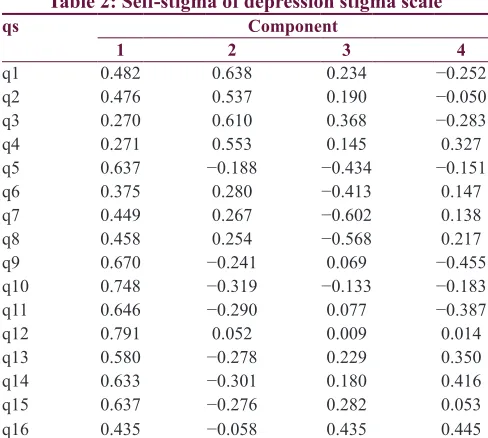
The preliminary analysis for factor analysis of the Arabic‑translated version of the SSDS showed a satisfactory result. The determinant is >0.00001. The value of the KMO MSA was 0.79. Nevertheless, since the value of KMO exceeded the recommended value of 0.60,[22] the analysis proceeded with all items regardless of the individual MSA. In addition, Bartlett’s test of sphericity was found highly significant (P < 0.001). The factor loading of the translated instrument is shown in Table 2. The table confirms that all items of the scale have been explained by a single factor (component 1). For the subscales: shame (Q1‑Q4),
self‑blame (Q5‑Q8), social inadequacy (Q9‑Q12), and help‑seeking inhibition (Q13‑Q16), the factor analysis was conducted for each subscale alone to confirm the items correlation to subscale as one factor component because we have found the determinants >0.00001, value of KMO exceeded the recommended value, and Bartlett’s test of sphericity was found highly significant (P < 0.001), and the correlation between items and subscale has been adequate as shown in Table 3.
Discussion
This study examined the psychometric properties of the Arabic version of the 16‑item SSDS. The results provide solid support for the scale’s reliability and validity among
Table 1: Some characteristics of study
participants (n=120)
Characteristic Frequency (n) Percentage
Nationality
Saudi 106 88.3
Non‑Saudi 14 11.7
Sex
Male 60 50
Female 60 50
Grade
Excellent 77 73.3
Very good 20 19
Good 7 6.7
Poor 1 1
Measurements
Below mean score 50 41.7
Above mean score 70 58.3
Mean score (SD) 68.9 (8)
SD: Standard deviation
Table 2: Self‑stigma of depression stigma scale
qs Component
1 2 3 4
q1 0.482 0.638 0.234 −0.252
q2 0.476 0.537 0.190 −0.050
q3 0.270 0.610 0.368 −0.283
q4 0.271 0.553 0.145 0.327
q5 0.637 −0.188 −0.434 −0.151
q6 0.375 0.280 −0.413 0.147
q7 0.449 0.267 −0.602 0.138
q8 0.458 0.254 −0.568 0.217
q9 0.670 −0.241 0.069 −0.455
q10 0.748 −0.319 −0.133 −0.183
q11 0.646 −0.290 0.077 −0.387
q12 0.791 0.052 0.009 0.014
q13 0.580 −0.278 0.229 0.350
q14 0.633 −0.301 0.180 0.416
q15 0.637 −0.276 0.282 0.053
q16 0.435 −0.058 0.435 0.445
adolescent school students. Reliability was demonstrated through adequate estimates of internal consistency; Cronbach’s alphas ranged from 0.70 to 0.77 for the four subscales and 0.84 for the total scale, which exceeds the minimum criterion of 0.70.[20] This internal consistency estimate is consistent with the findings from other studies of SSDS measures, which reported Cronbach’s alphas ranged from 0.78 to 0.83 for the four subscales and 0.87 for the total scale, and for the Chinese version of SSDS internal consistency is α = 0.87.[13] Test–retest reliability in our study for SSDS was assessed in 65 respondents after 2 weeks. Pearson correlation ranged from 0.72 to 0.78 for the four subscales and 0.77 for the total scale. In contrast with the original version of SSDS which found test–retest reliability in 151 respondents after 2 months ranged from 0.49 to 0.63 and 0.63 for total.[14] On another hand, the test–retest reliability of Chinese version of SSDS is r = 0.82.[13] The corrected item‑to‑total correlations for 16 items exceeded the 0.30 criterion[21] suggesting the homogeneity of the measure and that each item was measuring a unique construct. This finding was not reported in the original English version of the SSDS.
The findings of the factor analysis provide further support for the construct validity of the Arabic SSDS. All items have been explained by the whole scale, and items of subscale also have been correlated which indicate that the Arabic version of the SSDS is valid to measure depression Stigma.
Gunning Fog index was 5.88 for the Arabic version of SSDS which indicates the number of years of formal education that a person requires to easily understand the questions in the SSDS on the first reading. This confirms that SSDS is appropriate for the level of adolescent students.
Limitations
Around half (n = 65) of participants were dropped during the second time test to fill the same questionnaire, compared to participants in the first time test (n = 120), this dropout was due to midterm examinations, but still it was a statistically appropriate sample for test‑retest as the minimal sample size was calculated to be above of forty participants.
Conclusion
The findings from this analysis of the psychometric properties of the Arabic version of the SSDS in adolescent school students yield promising evidence that the 16‑item SSDS has acceptable reliability and validity. The findings also indicate that the SSDS is potentially useful for assessing depression self‑stigma that precedes the designing of depression destigmatization programs and monitors the effectiveness
of these interventions to produce the desired change among adolescent school students, which is important for compacting depression stigma and improve help‑seeking behavior. This study provides evidence that supports the face validity, content, construct validity, and reliability of the SSDS for adolescent school students.
Acknowledgments
We would like to thank Dr. Ahmed Abo El Yazid, for his valuable comments and suggestions in the early work. Furthermore, we thank the staff from Jazan University, for their efforts in supervising the data collection phase. We appreciate the efforts of the Education Directorate in Jazan Region, administrative staff and teachers for coordination and help with data collection. Furthermore, we would like to thank Professor Kathy Griffiths, for permission to use the Depression Literacy Questionnaire.
Financial support and sponsorship
Nil.
Conflicts of interest
There are no conflicts of interest.
References
1. Brohan E, Gauci D, Sartorius N, Thornicroft G; GAMIAN‑Europe Study Group. Self‑stigma, empowerment and perceived discrimination among people with bipolar disorder or depression in 13 European countries: The GAMIAN‑Europe study. J Affect Disord 2011;129:56‑63.
2. Calear AL, Griffiths KM, Christensen H. Personal and perceived
depression stigma in Australian adolescents: Magnitude and
predictors. J Affect Disord 2011;129:104‑8.
3. Eaton J, McCay L, Semrau M, Chatterjee S, Baingana F, Araya R, et al. Scale up of services for mental health in low‑income and
middle‑income countries. Lancet 2011;378:1592‑603.
4. Gearing RE, Schwalbe CS, MacKenzie MJ, Brewer KB,
Ibrahim RW, Olimat HS, et al. Adaptation and translation of mental health interventions in Middle Eastern Arab countries: A systematic review of barriers to and strategies for effective treatment implementation. Int J Soc Psychiatry
2013;59:671‑81.
5. Thapar A, Collishaw S, Pine DS, Thapar AK. Depression in adolescence. Lancet 2012;379:1056‑67.
6. Corrigan P. How stigma interferes with mental health care. Am Psychol 2004;59:614‑25.
7. Vogel DL, Wade NG, Hackler AH. Perceived public stigma
and the willingness to seek counseling: The mediating roles of self‑stigma and attitudes toward counseling. J Couns Psychol 2007;54:40.
8. Corrigan PW, Shapiro JR. Measuring the impact of programs
that challenge the public stigma of mental illness. Clin Psychol Rev 2010;30:907‑22.
Table 3: Component matrix‑different subscale
Shame subscale Self‑blame subscale Social inadequacy subscale Help‑seeking inhibition subscale
q1 0.853 q5 0.703 q9 0.811 q13 0.786
q2 0.755 q6 0.611 q10 0.843 q14 0.815
q3 0.752 q7 0.793 q11 0.821 q15 0.749
q4 0.614 q8 0.809 q12 0.743 q16 0.683
9. Kranke DA, Floersch J, Kranke BO, Munson MR. A qualitative
investigation of self‑stigma among adolescents taking psychiatric
medication. Psychiatr Serv 2011;62:893‑9.
10. Link BG, Phelan JC. Conceptualizing stigma. Annu Rev Sociol
2001;27:363‑85.
11. Corrigan PW, Wassel A. Understanding and influencing the
stigma of mental illness. J Psychosoc Nurs Ment Health Serv
2008;46:42‑8.
12. Fung KM, Tsang HW, Corrigan PW, Lam CS, Cheung WM.
Measuring self‑stigma of mental illness in China and its
implications for recovery. Int J Soc Psychiatry 2007;53:408‑18.
13. Chin PQ. Validation of Chinese Version of Self‑Stigma of
Depression Scale in Psychiatric Outpatients with Depression
in Hong Kong. The Hong Kong College of Psychiatrists;
2013. Available from: http://www.hkcpsych.org.hk/index.
php?option=com_docman&view=docman&Itemid=414&lang=en &limitstart=50. [Last cited on 2016 Jul 01].
14. Barney LJ, Griffiths KM, Christensen H, Jorm AF. The
Self‑Stigma of Depression Scale (SSDS): Development and psychometric evaluation of a new instrument. Int J Methods
Psychiatr Res 2010;19:243‑54.
15. Gorsuch RL. Factor Analysis. 2nd ed. Hillsdale, NJ: Erlbaum
Associates; 1983.
16. Walter SD, Eliasziw M, Donner A. Sample size and optimal designs for reliability studies. Stat Med 1998;17:101‑10.
17. Beaton DE, Bombardier C, Guillemin F, Ferraz MB. Guidelines for the process of cross‑cultural adaptation of self‑report
measures. Spine (Phila Pa 1976) 2000;25:3186‑91.
18. Kaiser HF. An index of factorial simplicity. Psychometrika
1974;39:31‑6.
19. Field A. Discovering Statistics Using SPSS. 3rd ed. London: Sage
publications Ltd; 2009.
20. Nunnally J, Bernstein I. Statistical foundations. Psychometric Theory. 3rd ed. New York: McGraw‑Hill; 1994. p. 31‑208.
21. Cronk BC. How to Use SPSS: A Step‑By‑Step Guide to Analysis and Interpretation. Los Angeles, CA: Pyrczak Publishing; 2004. 22. Tabachnick BG, Fidell LS. Cleaning up your act: Screening