INTRODUCTION
A fuel cell is an electrochemical energy conversion device. It produces electricity from various external quantities of fuel (on the anode side) and oxidant (on the cathode side). These react in the presence of an electrolyte. Generally, the reactants flow in and reaction products flow out while the electrolyte remains in the cell. Fuel cells can operate virtually continuously as long as the necessary flows are maintained.
Fuel cells are different from batteries in that they consume reactant, which must be replenished, while batteries store electrical energy chemically in a closed system. Additionally, while the electrodes within a battery react and change as a battery is charged or discharged, a fuel cell’s electrodes are catalytic and relatively stable. Many combinations of fuel and oxidant are possible. A hydrogen cell uses hydrogen as fuel and oxygen as oxidant.
Recent development in fuel cell as an alternate fuel
B. KUMARAGURUBARAN, M. VIVEKANADAN,
B.M. GNANASEKARAN and S.NISHANTHINI
Department of Automobile Engineering, Bharathidasan Institute of Technology, Anna University, Tiruchirappalli - 24 (India).
(Received: August 21, 2008; Accepted: October 02, 2008)
ABSTRACT
All fuel cells currently being developed for near term use in electric vehicles require hydrogen as a fuel. The recent progress of fuel cell development towards highly efficient and clean energy conversion allows increasing applications in the wide field of on-board electricity generation and alternative drive systems. Since the first practical uses of fuel cells were developed, it has become clear that they could find use in many products over a wide power range of milliwatts to tens of megawatts. Throughout the 1990s, and later, there has been significant work carried out on adapting the various different fuel cell technologies for use in targeted consumer and industrial applications. This paper discusses these developments and gives the types of fuel cells in details, applications, benefits, futures large and small-scale stationary power generation.
Key words: Fuel cell, Infrastructure, energy conservation, hydrogen.
Other fuels include hydrocarbons and alcohols. Other oxidants include air, chlorine and chlorine dioxide.[1] In principle, a fuel cell operates
like a battery. Unlike a battery, a fuel cell does not run down or require recharging. It will produce energy in the form of electricity and heat as long as fuel is supplied
A fuel cell consists of two electrodes sandwiched around an electrolyte. Oxygen passes over one electrode and hydrogen over the other, generating electricity, water and heat. Hydrogen fuel is fed into the “anode” of the fuel cell. Oxygen (or air) enters the fuel cell through the cathode. Encouraged by a catalyst, the hydrogen atom splits into a proton and an electron, which take different paths to the cathode. The proton passes through the electrolyte. The electrons create a separate current that can be utilized before they return to the cathode, to be reunited with the hydrogen and oxygen in a molecule of water. A fuel cell system which includes a “fuel reformer” can utilize the hydrogen from any hydrocarbon fuel - from natural gas to methanol, and even gasoline. Since the fuel cell relies on chemistry and not combustion, emissions from this type of a system would still be much smaller than emissions from the cleanest fuel combustion processes.
Types of fuel cells
Phosphoric acid fuel cell (PAFC)
Phosphoric acid fuel cells are commercially available today. Hundreds of fuel cell systems have been installed in 19 nations - in hospitals, nursing homes, hotels, office buildings, schools, utility power plants, landfills and waste water treatment plants. PAFCs generate electricity at more than 40% efficiency - and nearly 85% of the steam this fuel cell produces is used for cogeneration - this compares to about 35% for the utility power grid in the United States. Phosphoric acid fuel cells use liquid phosphoric acid as the electrolyte and operate at about 450°F. One of the main advantages to this type of fuel cell, besides the near ly 85% cogeneration efficiency, is that it can use impure hydrogen as fuel. PAFCs can tolerate a CO concentration of about 1.5 percent, which broadens the choice of fuels they can use. If gasoline is used, the sulfur must be removed.
Proton exchange membrane fuel cell (PEM) These fuel cells operate at relatively low temperatures (about 175°F), have high power density, can vary their output quickly to meet shifts in power demand, and are suited for applications, such as in automobiles, where quick startup is required. According to the U.S. Department of Energy (DOE), “they are the primary candidates
for light-duty vehicles, for buildings, and potentially for much smaller applications such as replacements for rechargeable batteries.” This type of fuel cell is sensitive to fuel impurities. Cell outputs generally range from 50 watts to 75 kW.
Molten carbonate fuel cell (mcfc)
Molten carbonate fuel cells use an electrolyte composed of a molten carbonate salt mixture suspended in a porous, chemically inert matrix, and operate at high temperatures -approximately 1,200ºF. They require carbon dioxide and oxygen to be delivered to the cathode. To date, MCFCs have been operated on hydrogen, carbon monoxide, natural gas, propane, landfill gas, marine diesel, and simulated coal gasification products. 10 kW to 2 MW MCFCs have been tested on a variety of fuels and are primarily targeted to electric utility applications.
Solid oxide fuel cell (SOFC)
Solid oxide fuel cells use a hard, non-porous ceramic compound as the electrolyte, and operate at very high temperatures - around 1800°F. One type of SOFC uses an array of meter-long tubes, and other variations include a compressed disc that resembles the top of a soup can. Tubular SOFC designs are closer to commercialization and are being produced by several companies around the world. SOFCs are suitable for stationary applications as well as for auxiliary power units (APUs) used in vehicles to power electronics.
Alkaline fuel cell (AFC)
Long used by NASA on space missions, alkaline fuel cells can achieve power generating efficiencies of up to 70 percent. They were used on the Apollo spacecraft to provide both electricity and drinking water. Alkaline fuel cells use potassium hydroxide as the electrolyte and operate at 160°F. However, they are very susceptible to carbon contamination, so require pure hydrogen and oxygen.
Direct methanol fuel cell (DMFC)
Efficiencies of about 40% are expected with this type of fuel cell, which would typically operate at a temperature between 120-190°F. This is a relatively low range, making this fuel cell attractive for tiny to mid-sized applications, to power cellular phones and laptops. Higher efficiencies are achieved at higher temperatures. Companies are also working on DMFC prototypes to be used by the military for powering electronic equipment in the field.
Regenerative fuel cell
Regenerative fuel cells are attractive as a closed-loop form of power generation. Water is separated into hydrogen and oxygen by a solar-powered electrolyzer. The hydrogen and oxygen are fed into the fuel cell which generates electricity, heat and water. The water is then recirculated back to the solar-powered electrolyzer and the process begins again. These types of fuel cells are currently being researched by NASA and others worldwide.
Zinc air fuel cell (ZAFC)
In a typical zinc/air fuel cell, there is a gas diffusion electrode (GDE), a zinc anode separated by electrolyte, and some form of mechanical separators. The GDE is a permeable membrane that allows atmospheric oxygen to pass through. After the oxygen has converted into hydroxyl ions and water, the hydroxyl ions will travel through an electrolyte, and reaches the zinc anode. Here, it reacts with the zinc, and forms zinc oxide. This process creates an electrical potential; when a set of ZAFC cells are connected, the combined electrical potential of these cells can be used as a source of electric power. This electrochemical process is very similar to that of a PEM fuel cell, but the refueling is very different and shares characteristics with batteries. ZAFCs contain a zinc “fuel tank” and a zinc refrigerator that automatically and silently regenerates the fuel. In this closed-loop system, electricity is created as zinc and oxygen are mixed in the presence of an electrolyte (like a PEMFC), creating zinc oxide. Once fuel is used up, the system is connected to the grid and the process is reversed, leaving once again pure zinc fuel pellets. The key is that this reversing process takes only about 5 minutes to complete, so the batter y recharging time hang up is not an issue. The chief advantage zinc-air technology has over other battery technologies is its high specific energy, which
is a key factor that determines the running duration of a battery relative to its weight.
Protonic ceramic fuel cell (PCFC)
This new type of fuel cell is based on a ceramic electrolyte material that exhibits high protonic conductivity at elevated temperatures. PCFCs share the thermal and kinetic advantages of high temperature operation at 700 degrees Celsius with molten carbonate and solid oxide fuel cells, while exhibiting all of the intrinsic benefits of proton conduction in PEM and phosphoric acid fuel cells. The high operating temperature is necessary to achieve very high electrical fuel efficiency with hydrocarbon fuels. PCFCs can operate at high temperatures and electrochemically oxidize fossil fuels directly to the anode. This eliminates the intermediate step of producing hydrogen through the costly reforming process. Gaseous molecules of the hydrocarbon fuel are absorbed on the surface of the anode in the presence of water vapor, and hydrogen atoms are efficiently stripped off to be absorbed into the electrolyte, with carbon dioxide as the primary reaction product. Additionally, PCFCs have a solid electrolyte so the membrane cannot dry out as with PEM fuel cells, or liquid can’t leak out as with PAFCs.
Microbial fuel cell (MFC)
Microbial fuel cells use the catalytic reaction of microorganisms such as bacteria to convert virtually any organic material into fuel. Some common compounds include glucose, acetate, and wastewater. Enclosed in oxygen-free anodes, the organic compounds are consumed (oxidized) by the bacteria or other microbes. As part of the digestive process, electrons are pulled from the compound and conducted into a circuit with the help of an inorganic mediator. MFCs operate well in mild conditions relative to other types of fuel cells, such as 20-40 degrees Celsius, and could be capable of producing over 50% efficiency. These cells are suitable for small scale applications such as potential medical devices fueled by glucose in the blood, or larger such as water treatment plants or breweries producing organic waste that could then be used to fuel the MFCs.
Fuel cell design
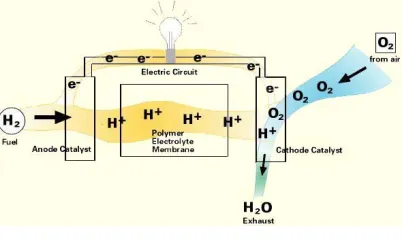
separating the component electrons and protons of the reactant fuel, and forcing the electrons to travel through a circuit, hence converting them to electrical power. The catalyst is typically comprised of a platinum group metal or alloy. Another catalytic process takes the electrons back in, combining them with the protons and the oxidant to form waste
products (typically simple compounds like water and carbon dioxide).In the archetypal hydrogen–oxygen proton exchange membrane fuel cell (PEMFC) design, a proton-conducting polymer membrane, (the electrolyte), separates the anode and cathode sides. This was called a “solid polymer electrolyte fuel cell” (SPEFC) in the early 1970s, before the
Fig. 2: Design of a PEM Fuel Cell
proton exchange mechanism was well-understood. (Notice that “polymer electrolyte membrane” and “proton exchange membrane” result in the same acronym.)
On the anode side, hydrogen diffuses to the anode catalyst where it later dissociates into protons and electrons. The protons are conducted through the membrane to the cathode, but the electrons are forced to travel in an external circuit (supplying power) because the membrane is electrically insulating. On the cathode catalyst, oxygen molecules react with the electrons (which have traveled through the external circuit) and protons to form water in this example, the only waste product, either liquid or vapor. In addition to this pure hydrogen type, there are hydrocarbon fuels for fuel cells, including diesel, methanol and chemical hydrides. The waste products with these types of fuel are carbon dioxide and water.
Applications
There are many uses for fuel cells right
now, all of the major automakers are working to commercialize a fuel cell car. Fuel cells are powering buses, boats, trains, planes, scooters, forklifts, even bicycles. There are fuel cell-powered vending machines, vacuum cleaners and highway road signs. Miniature fuel cells for cellular phones, laptop computers and portable electronics are on their way to market. Hospitals, credit card centers, police stations, and banks are all using fuel cells to provide power to their facilities. Wastewater treatment plants and landfills are using fuel cells to convert the methane gas they produce into electricity. Telecommunications companies are installing fuel cells at cell phone, radio and 911 towers. The possibilities are endless.
Telecommunications
or emissions, and are durable, providing power in sites that are either hard to access or are subject to inclement weather. Such systems would be used to provide primary or backup power for telecom switch nodes, cell towers, and other electronic systems that would benefit from on-site, direct DC power supply.
Transportation Cars
All the major automotive manufacturers have a fuel cell vehicle either in development or in testing right now and several have begun leasing and testing in larger quantities.
Buses
Over the last four years, more than 50 fuel cell buses have been demonstrated in North and South America, Europe, Asia and Australia. Fuel cells are highly efficient, so even if the hydrogen is produced from fossil fuels, fuel cell buses can reduce transit agencies’ CO2 emissions. And emissions are truly zero if the hydrogen is produced from renewable electricity, which greatly improves local air quality. Because the fuel cell system is so much quieter than a diesel engine, fuel cell buses.
Scooters
In spite of their small size, many scooters are pollution powerhouses. Gas-powered scooters, especially those with two-stroke engines, produce tailpipe emissions at a rate disproportionate to their small size. These two-stroke scooters produce almost as much particulate matter and significantly more hydrocarbons and carbon monoxide as a heavy diesel truck. Fuel cell scooters running on hydrogen will eliminate emissions in India and Asia where many of the population use them - this is a great application for fuel cells.
Forklifts/Materials Handling
Besides reducing emissions, fuel cell forklifts have potential to effectively lower total logistics cost since they require minimal refilling and significantly less maintenance than electric forklifts, whose batteries must be periodically charged, refilled with water, and replaced. Due to the frequent starting and stopping during use, electric forklifts also experience numerous interruptions in current input and output - fuel cells ensure constant power
delivery and performance, eliminating the reduction in voltage output that occurs as batteries discharge.
Auxiliary power units (APUs)
Today’s heavy-duty trucks are equipped with a large number of electrical appliances–from heaters and air conditioners to computers, televisions, stereos, even refr igerators and microwaves. To power these devices while the truck is parked, drivers often must idle the engine. The Department of Energy (DOE) has estimated the annual fuel and maintenance costs of idling a heavy-duty truck at over $1,800 and that using fuel cell APUs in Class 8 trucks would save 670 million gallons of diesel fuel per year and 4.64 million tons of CO2 per year.
Trains
Fuel cells are being developed for mining locomotives since they produce no emissions. An international consortium is developing the world’s largest fuel cell vehicle, a 109 metric-ton, and 1 MW locomotive for military and commercial railway applications.
Planes
Fuel cells are an attractive option for aviation since they produce zero or low emissions and make barely any noise. The militar y is especially interested in this application because of the low noise, low thermal signature and ability to attain high altitude. Companies like Boeing are heavily involved in developing a fuel cell plane.
Boats
For each liter of fuel consumed, the average outboard motor produces 140 times the hydrocarbons produced by the average modern car. Fuel cell engines have higher energy efficiencies than combustion engines, and therefore offer better range and significantly reduced emissions. Iceland has committed to converting its vast fishing fleet to use fuel cells to provide auxiliary power by 2015 and, eventually, to provide primary power in its boats.
Portable power
campsite would not only save emissions, but it won’t disturb nature, or your camping neighbors. Portable fuel cells are also being used in emergency backup power situations and military applications. They are much lighter than batteries and last a lot longer, especially important to soldiers carrying heavy equipment in the field.
Micro power
Consumer electronics
Fuel cells will change the telecommuting world, powering cellular phones, laptops and palm pilots hours longer than batteries. Companies have already demonstrated fuel cells that can power cell phones for 30 days with out recharging and laptops for 20 hours. Other applications for micro fuel cells include pagers, video recorders, portable power tools, and low power remote devices such as hearing aids, smoke detectors, burglar alarms, hotel locks and meter readers. These miniature fuel cells generally run on methanol, an inexpensive wood alcohol also used in windshield wiper fluid.
Benefits
No other energy generating technology carries the combination of benefits that fuel cells offer. These benefits include:
Low to zero emissions Stationary power
A fuel cell running on pure hydrogen is a zero-emission power source. Some stationary fuel cells use natural gas or hydrocarbons as a hydrogen feedstock, but even those produce far less emissions than conventional power plants. Fuel cell
power plants are so low in emissions that some areas of the United States have exempted them from air permit requirements. Fuel cells are also very quiet, which reduces noise pollution.
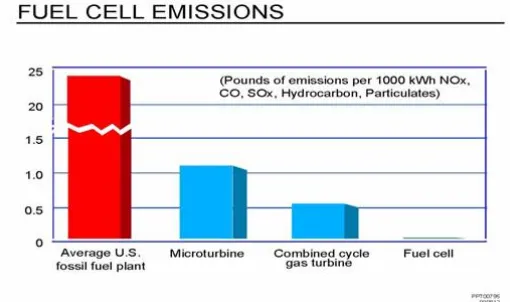
Based on measured data, a fuel cell power plant may create less than one ounce of pollution per 1,000 kilowatthours of electricity produced -compared to the 25 pounds of pollutants for conventional combustion generating systems.
Transportation
´ Fuel cell vehicles are the least polluting of all vehicles that consume fuel directly.
´ Fuel cell vehicles operating on hydrogen stored on-board the vehicles produce zero pollution in the conventional sense. Neither conventional pollutants nor green house gases are emitted. The only byproducts are water and heat.
´ The simple reaction that takes place inside the fuel cell is highly efficient. Even if the hydrogen is produced from fossil fuels, fuel cell vehicles can reduce emissions of carbon dioxide, a global warming concern, by more than half.
´ Fuel cells used as auxiliary power units (APUs) to power air conditioners and accessories in over-the-road trucks could reduce emissions by up to 45% from long haul vehicles, and deliver economic benefits to the truck owner in lower fuel use and less wear and tear. According to DOE, fuel cell APUs in Class 8 trucks can save 670 million gallons of diesel fuel per year and 4.64 million tons of CO2 per year.
Fig. 3: Fuel cell emissions
High efficiency
Because they make energy electrochemically, and do not burn fuel, fuel cells are fundamentally more efficient than combustion systems. When the fuel cell is sited near the point of use, its waste heat can be captured for beneficial purposes (cogeneration). In large-scale building systems, these fuel cell cogeneration systems can reduce facility energy service costs by 20% to 40% compared to conventional energy service. ´ Fuel cell power generation systems in
operation today achieve 40% to 50% fuel-to-electricity efficiency utilizing hydrocarbon fuels.
´ Systems fueled by hydrogen can consistently provide more than 50 percent efficiency. Even more efficient systems are under development.
´ In combination with a turbine, electrical efficiencies can exceed 60 percent. ´ When waste heat is put to use for heating
and cooling, fuel utilization can exceed 85 percent.
´ Fuel cell passenger vehicles are expected to be up to three times more efficient than internal combustion engines, which now operate at 10 to 16 percent efficiency.
Fuel flexibility
Most fuel cells run on hydrogen and will continue to generate power as long as fuel is supplied. The fuel cell doesn’t care where the hydrogen comes from, so a fuel cell system that includes a “fuel reformer” can generate hydrogen from diverse, domestic resources including fossil fuels, such as natural gas and coal; alcohol fuels, such as methanol or ethanol; from hydrogen compounds containing no carbon, such as ammonia or borohydride; or from biomass, methane, landfill gas or anaerobic digester gas from wastewater treatment plants. Hydrogen can also be produced from electricity from conventional, nuclear or renewable sources such as solar or wind.
Security
Hydrogen can be produced from domestic sources, eliminating the need to import foreign oil. Passenger vehicles alone consume 6 million barrels of oil every single day, equivalent to 85 percent of oil imports. If just 20 percent of cars used fuel cells, we
could cut oil imports by 1.5 million barrels every day.
Because they don’t have to be attached to the electric grid, fuel cells allow the country to move away from reliance on high voltage central station power generation which are the most likely terrorist targets in any attempt to cripple our energy infrastructure.
Lightweight/long-lastingbatteryalternative Fuel cells are being developed for portable electronic devices such as laptops, cellular phones, etc. Fuel cells are providing e a much longer operating life than a battery would, in a package of lighter or equal weight per unit of power output. The fuel cell doesn’t require “recharging;” a liquid, solid, or gaseous fuel canister could be replaced in a moment. Fuel cells also have an environmental advantage over batteries, since certain kinds of batteries require special disposal treatment. Fuel cells provide a much higher power density, packing more power in a smaller space.
Many organizations are working with the military to incorporate fuel cells into their equipment since soldiers are starting to carry a range of enabling electronic technologies, computers, personal radios, displays and thermal imaging, all intended to increase effectiveness, lethality and survivability. Fuel cells can operate 10 times longer than conventional batteries used to power hand-held battlefield computers, and are much lighter, have no heat signature and are more cost-effective
Future
REFERENCES
1. S. G. Meibuhr, Electrochim. Acta,11: 1301 (1966)
2. Lar minie, James., Fuel Cell Systems Explained, Second Edition. SAE International. ISBN 0768012597 (2003). 3. Ballard Power Systems: Commercially Viable
Fuel Cell Stack Technology Ready by 2010", March 29, Retrieved on 2007-05-27 (2005). 4. EP patent 0950075, “Electrolytic Membrane, Method of Manufacturing it and Use”, granted 2003-02-12, assigned to DSM
5. Ballard Uses Solupor., Retrieved on 2007-05-27 (2005).
6. History of Fuel Cells. Johnson Matthey plc.. Retrieved on 2007-05-27.
7. The PureCell 200 - Product Overview. UTC Power. Retrieved on 2007-05-27.
8. About Fuel Cells. MIT / NASA. Retrieved on 2007-05-27.
9. Fuel Cell Vehicles:Status 2007 (March 20, 2007). Retrieved on 2007-05-23.
10. Efficiency of Hydrogen PEFC, Diesel-SOFC-Hybrid and Battery Electric Vehicles (July 15, 2003). Retrieved on 2007-05-23.
11. "Round Trip Energy Efficiency of NASA Glenn Regenerative Fuel Cell System". Preprint. Retrieved on 2007-05-27 (2006).
12. Fuel Cell Basics: Benefits. Fuel Cells., Retrieved on 2007-05-27 (2000).