The Thirty-Third AAAI Conference on Artificial Intelligence (AAAI-19)
SepNE: Bringing Separability to Network Embedding
∗Ziyao Li,
1Liang Zhang,
1Guojie Song
2† 1Yuanpei College, Peking University, China2Key Laboratory of Machine Perception, Ministry of Education, Peking University, China {leeeezy, zl515, gjsong}@pku.edu.cn
Abstract
Many successful methods have been proposed for learn-ing low dimensional representations on large-scale networks, while almost all existing methods are designed in insepara-ble processes, learning embeddings for entire networks even when only a small proportion of nodes are of interest. This leads to great inconvenience, especially on super-large or dy-namic networks, where these methods become almost im-possible to implement. In this paper, we formalize the prob-lem of separated matrix factorization, based on which we elaborate a novel objective function that preserves both local and global information. We further propose SepNE, a simple and flexible network embedding algorithm which indepen-dently learns representations for different subsets of nodes in separated processes. By implementing separability, our algo-rithm reduces the redundant efforts to embed irrelevant nodes, yielding scalability to super-large networks, automatic im-plementation in distributed learning and further adaptations. We demonstrate the effectiveness of this approach on several real-world networks with different scales and subjects. With comparable accuracy, our approach significantly outperforms state-of-the-art baselines in running times on large networks.
1
Introduction
Learning low dimensional representations of network data, or network embedding (NE), is a challenging task on large networks, of which the scales can reach billion-level and is growing rapidly. For example, the number of monthly-active users of Facebook reaches2.23billion and increases
11%yearly.1At the same time, although sizes of networks
may infinitely grow as data accumulates, it is often the case that only small proportions of nodes are of interest in down-stream applications. This is the starting point of this paper: can we respectively learn representations for different sub-sets of nodes-very small compared to the collectivity-while preserving information of the entire network? If so, we can obtain good representations for the requested nodes without the redundant efforts to embed irrelevant ones.
∗
This work was supported by the National Natural Science Foundation of China (Grant No. 61876006 and No. 61572041).
†
Corresponding author. Email: [email protected]
Copyright c2019, Association for the Advancement of Artificial Intelligence (www.aaai.org). All rights reserved.
1
https://investor.fb.com/investor-news/
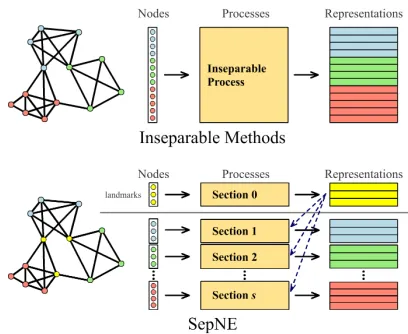
Figure 1: Inseparable and separable NE processes.
Efficiency is a major aspect of contemporary NE studies, and various methods that are applicable to large-scale net-works have been proposed (Perozzi, Al-Rfou, and Skiena 2014; Tang et al. 2015; Grover and Leskovec 2016). Almost all of these methods embed entire networks with inseparable processes, in which the representation of one node depends on represented outcomes of every other node. A globally-defined optimum can be achieved under this framework, while it also causes great inconvenience: the maximum net-work size such methods can handle is eventually limited. For example, it takes LINE (2015), one of the fastest algorithms, several hours to embed a million-level network. Thousands of hours may be spent to achieve equivalent performance on billion-level networks. Another type of methods learns mod-els in an inductive manner and conduct inferences over un-seen data (Hamilton, Ying, and Leskovec 2017). These mod-els have convenient inference processes, while they cannot variate over time and rely on large training data and time to achieve good performance.
without exchanging information and merging outputs. In plain words, a separable algorithm divides the original prob-lem into differentself-standingsub-problems and separately solves each, and the solution to the sub-problems are directly usable answers instead of intermediate results. As networks are naturally composed of nodes and their relationships, an instinctive way to design separable NE algorithms is to par-tition the entire node set into small subsets and to separably embed each set. The solutions to the sub-problems yield di-rect meanings as the representations of the corresponding set of nodes.
In this paper, we implement separability in NE problems under matrix-factorization-based framework. We formalize the problem of separated matrix factorization (SMF) and elaborate a novel loss function that preserves matrix infor-mation on local, global and landmark level. We then propose
SepNE (SEParated Network Embedding), a separable NE method based on SMF. Figure 1 illustrates the major differ-ence between SepNE and existing methods. SepNE first par-titions the node set into small subsets. A speciallandmark set is then established as references for partitioned subsets to implementcomparability, that representations of differ-ent sets lie in the same linear space. After the landmarks are embedded, representations of different subsets are derived from the objective function defined in SMF.
Separability in NE problems yields several specific ad-vantages. Firstly, separability makes it available to embed only the requested nodes and thus reduces the vain efforts in embedding irrelevant ones; in addition, the optimization complexity of SepNE is relevant only to the number of re-quested nodes instead of the entire network scale, leading to scalability to super-large networks. Secondly, even if en-tire networks are on request, SepNE shows higher speed than state-of-the-art algorithms due to its simplicity, while yielding comparable accuracy. Thirdly, separability leads to automatic implementations in multi-agent systems and fur-ther adaptations in dynamic networks. We evaluated SepNE with real-world networks of different sizes and topics. With equivalent or better accuracy, SepNE is at least 50% faster than current NE methods including DeepWalk (2014) and LINE.
A potentially more important contribution of this paper is the generalization of SMF. Maintaining competent perfor-mance, SMF reduces the complexity of MF problems from cubic to almost linear. This leads to intriguing further appli-cations in the massive collectivity of MF-based algorithms.
2
Separated Matrix Factorization
2.1
Preliminaries
Given a matrixM, matrix factorization (MF) aims to find two matrices W andC that both satisfy given constraints and minimize the residuals of reconstructingM withM˜ =
WTC. Denoted in formulas, we have
min
W,CkM−W
TCk. (1)
W, C have lower ranks than M. In the embedding task of an n-node network, M is of size (n×n), in which each entry indicates aproximitybetween the two corresponding
nodes. The proximities can be defined in various metrics, such as edge weights between nodes. Columns inW are de-sired representations. Columns inCare interpreted as rep-resentations of nodes when regarded ascontexts.
2.2
Problem Definition
Directly factorizing matrices of large-scale networks can be unacceptably time-costly. Therefore, we propose SMF, a new optimization problem, as a trade-off between speed and accuracy. To implement separability, SMF divides the prob-lem with a partition over the node set, and correspondingly partitions the proximity matrix. Below is a formal definition of separated matrix factorization (SMF) in NE scenarios.
SMF takes a network G = (V, E),|V| = n, its prox-imity matrix M, and a partition setupf : V 7→ V, V =
{V1,· · ·, Vs}as inputs. The task is to derive representations
(W1,· · ·, Ws)and(C1,· · ·, Cs)for the partitioned sets that
optimally reconstructM. The loss of the reconstruction is defined the same as Problem (1).2Without loss of
generos-ity, we permute and partitionM according toVas
M =
M11 · · · M1s
..
. . .. ... Ms1 · · · Mss
,
whereMij indicates the proximities betweenViandVj. To
achieve independence between sections, SMF restricts that the embedding section of every set is conducted (i) with only the proximities related to itself (the section of embedding Vi can leverage onlyMij andMji,j = 1,· · ·, s), and (ii)
without any outcomes of other sections.
2.3
Method
Partitioning the nodes is the first step to separability. How-ever, representations in the partitioned sets can be incompa-rable due to the limitation over the access to proximities. In another word, representations of different sets do not have a unified constraint that bounds them in the same linear space. To implement comparability, we establish landmarks with highly interactive nodes in the network, which serve as in-variant references for different subsets. For the factoriza-tion process, preserving only local informafactoriza-tion is a simple way to reconstructs micro-structures of networks at a loss of global references. Combining landmark solves the compara-bility problem, while it still ignores the interactions between different subsets. Therefore, we elaborate a novel objective function for SMF that preserves local, global and landmark information, which achieves state-of-the-art performances.
Local information. The proximities in the partitioned ma-trix are naturally divided into two types, namelylocal
infor-mationandglobal information. Local information refers to
the proximities within every set, or sub-matrices on the di-agonal; global information refers to the proximities between all pairs of different sets, or the off-diagonal sub-matrices.
2
We start modeling SMF with a na¨ıve simplification that pre-serves only local information by factorizing smatrices on the diagonal:
min
Wi,Ci
kMii−WiTCik, i= 1,· · ·, s.
This primitive approach discards all interactions between different sets, leading to incomparable representations.
Landmark information. To implement comparability, we resort to a third type of information,landmark information. Landmark information indicates the proximities between subsets and manually establishedlandmarks, a special set of nodes (denoted asV0) that are chosen as references for
different subsets. The improved approach sets a unified con-straint over landmark information in different sets and solves the problem in two stages, formulated as
min
Φ,ΨkM00−Φ
TΨk, (2)
min
Wi,Ci
M00 M0i
Mi0 Mii
−
ΦTΨ ΦTC i
WiTΨ WiTCi
,
i= 1,· · ·, s. (3)
The first stage embeds the landmarks (W0 = Φ,C0 = Ψ)
in Problem (2), and the second stage derives representations for rest sets by solving Problem (3) with calculatedΦand
Ψ. If Frobenius forms are used, the loss in Problem (3) can be explicitly decomposed into local and landmark loss as
Llc
i (W, C) =
1
2kMii−W
TCk2
F, (4)
Llm
i (W, C) =
1
2kM0i−Φ
TCk2 F
+1
2kMi0−W
TΨk2
F. (5)
Global information. To further combine global informa-tion into the objective funcinforma-tion, we elaborate a global loss by first transforming Problem (3) into an equivalent form. We denotek:=|V0|and assume calculatedΦ,Ψ∈R(d×k)
are of rankd.3W
i, Ci∈R(d×|Vi|)can then be represented
as linear combinations of columns in Φ,Ψ, formulated in matrix denotation as
Wi = ΦAi
Ci = ΨBi, i= 1,2,· · ·, s,
whereAi, Bi ∈R(k×|Vi|)are the coefficient matrices.
Consider a simple case wheres= 2,V0is the set of
land-marks andV1is the target subset to embed. After the
trans-formation, global information is preserved through
min
A1,B2
kM12−AT1Φ TΨB
2k (6)
min
A2,B1
kM21−AT2Φ TΨB
1k. (7)
Problem (6)(7) are not separable, for the results of embed-dingV2(A2,B2) exist inV1problem. However, a surprising
3
This can be guaranteed with SVD decomposition ifk≥d.
property emerges after the transformation, thatΦTΨB2 =
WT
0 C2 = ˜M02can be well-approximated withM02if
rep-resentations ofV2 are required to preserve landmark
infor-mation,AT
2ΦTΨsimilarly. Therefore, Problem (6)(7) can be
substituted as
min
A1 kM12−A T
1M02k (8)
min
B1 kM21−M20B1k, (9)
and separability is achieved.
The idea can be generalized to any givensandViby
sim-ply substituting all V2-related variables to V¯i-related ones,
whereV¯i = Sj /∈{0,i}Vj. The approximation still holds if
landmark information is preserved in all sets. For any setVi,
the global loss function is defined as
Lgbi (A, B) = 1
2(kMi¯i−A
TM
0¯ik2F+kM¯ii−M¯i0Bk2F).
2.4
Final Optimization Problem
Combined withλ-scaled global loss and regularization over A, B, the final loss function of SMF becomes
Li(A, B) = Llci (A, B) +L lm
i (A, B) (10)
+λLgbi (A, B) +η 2(kAk
2 F +kBk
2 F),
whereLlc
i andLlmi are redefined inA, B-denotation, namely
Llci (A, B) =
1
2kMii−A
TΦTΨB
k2F, (11)
Llmi (A, B) =
1
2kM0i−Φ
TΨB k2F
+1
2kMi0−A
TΦTΨk2
F. (12)
Accordingly, the final optimization problem of SMF is for-mulate as
W0= Φ, C0= Ψ.
Wi= ΦAi, Ci= ΨBi,
Ai, Bi= arg min
A,BLi(A, B), i= 1,2,· · ·, s.
3
SepNE: Separated Network Embedding
In this section, we propose SepNE, a simple and separable NE approach based on SMF. A general framework of SepNE is presented in Algorithm 1. We then illustrate the details of SepNE, including the partition setups, landmark-selecting approaches and optimization method.
Algorithm 1General framework of SepNE.
Input: G= (V, E),|V|=n.
Output: Node embeddings for partitioned sets of nodes. 1: Partition rest nodes in setV intossubsets asV; 2: Sampleklandmarks as setV0;
3: Conduct SVD on calculated proximity matrixM00and
calculateΦ,Ψ:
M00=UdΣdVdT,
Φ =Ud √
Σd,Ψ =Vd √
Σd;
4: W0= Φ;
5: fori= 1,2,· · ·, sdo
6: Calculate relevant proximity matricesM0i,Mi0,Mii,
Mi¯i,M¯ii;
7: Optimize the loss functions: Ai, Bi= arg min
A,BLi(A, B);
8: Calculate embeddings for setVi:
Wi= ΦAi, Ci= ΨBi
9: end for
10: return (W0, W1,· · ·, Ws)
For the proximity matrix to be factorized, two metrics are adopted in SepNE. The first metric definesM = A+A2, whereAis the transition matrix of PageRank (1999)4. The
second metric simplifies the first one with M = I+A. Our metrics are similar to TADW (2015), which proved an equivalency between factorizingAandA+A2and
Deep-Walk (2014) with very short walks. A more instinctive un-derstanding of the metrics can be derived from the perspec-tive ofproximity orders.Acan be interpreted as a measure-ment of first-order proximity, andA+A2a combination of
first-order and second-order proximity. These concepts were proposed and further discussed in (Tang et al. 2015).
3.1
Partition Setups
We propose three different partition setups for SepNE in this paper. SepNE-LP (Louvain Partition) partitions a net-work according to its communities using Louvain (2008). Leveraging community structures conformsmatrix local
in-formationtonetwork local information5, which serves as an
empirical approach to improve performance.
However, as SepNE leverages all the information of the proximity matrix, community-based partitions are not nec-essary. We further propose SepNE-RP (Random Patition) which randomly assigns nodes to sets, and SepNE-IO (In-terested Only) which simply puts the requested nodes into one or more sets and ignores all unrequested ones.
3.2
Landmark Selection
Landmark-selecting approaches influence not only represen-tations of the landmarks, but also the loss of all sets in the entire SMF problem. As the key intention of setting land-marks is to establish references for different sets, landland-marks
4A
ij = 1/di if(i, j) ∈ Eand0otherwise, wheredi is the
degree of nodei.
5
Which refers to connections within real-world communities.
are expected (i) to have as much connection with rest nodes as possible; (ii) to have the connection cover as many sets as possible.
Approaches that select nodes with high degrees gener-ally work well ifkis loosely controlled. However, on real-world networks, nodes with the highest degrees tend to dis-tribute in a few giant and highly connected communities. Whenkis strictly confined, choosing these nodes actually limits the number of sets these landmarks adjoin. To relieve this problem, we proposeGDS(Greedy Dominating Set), an approach that greedily maximizes the number of nodes the landmarks adjoins.
GDS first forms a maximum heap using degrees of nodes and initialize the landmark set as empty. After initialization, GDS iteratively examines the top of the heap. The top is simply removed if dominated by the current landmark set, otherwise added into the set and then removed. The pro-cess continues until the heap is empty or the size reachesk. Experiments show that GDS well captures the informative structure of a network whenkis strictly confined.
While serving as good references, landmarks selected with GDS are completely one-hop isolated. As a conse-quence, if only one-hop proximity is leveraged,M00of GDS
is supposed to be a diagonal matrix. Furthermore, ifk > d, SVD will generate null representations for some landmarks. Therefore, we only use GDS when higher order proximity is adopted ork = d. Otherwise, we implement degree-based approaches.
3.3
Optimization
The optimization problem in SepNE is solved similarly to (Yu et al. 2014), whereA, Bare iteratively optimized as
A(t+1) = arg min
A Li(A, B (t)),
B(t+1) = arg min
B Li(A
(t+1), B).
As explicit calculation of the loss function value involves large matrix multiplications,A, Bare calculated by solving the gradient-minimization problem ∂∂AL = ∂∂BL = 0in each iteration. Cholesky decomposition is adopted as the matrix in the gradient problem is always positive-definite.
3.4
Complexity Analysis
The complexity of the preparation stage isO(nlogn+k3),
while empirically the time expenses are low especially when random partitions are implemented. IfM =I+A, the av-erage complexity of each section is O(k×(deg+iter×
k)×ni), including both the time in calculating proximity
matrices and in optimization.
With separability implemented, SepNE is available to only embed a proportion of nodes. Besides, when small pro-portions of nodes are requested, the complexity of SepNE in the second stage is irrelevant to the entire scale of the net-work. This property yields strong scalability of SepNE to super-scale networks.
4
Experiments
Dataset Directed Nodes Links
Wiki directed 2,405 17,981
Cora directed 2,708 5,429
Citeseer directed 3,312 4,732
Flickr undirected 1,715,255 22,613,981 Youtube undirected 1,157,827 4,945,382
Wiki-Gen directed 2i ≈7.5×2i
Table 1: Statistics of datasets used in this paper.
three document networks and two social networks. Perfor-mances over three benchmark tasks were evaluated: (i) ma-trix reconstruction on document networks, (ii) multi-class classification tasks on document networks and (iii) multi-label classification tasks on social networks.
4.1
Experiment Setups
Datasets. Five real-world networks were used in this
pa-per. Wiki,CoraandCiteseer are thousand-level document
networks. 6 Wiki contains Wikipedia pages of19 classes;
Cora contains machine learning papers from 7 classes
and Citeseer contains publications from 6 classes. Links
between documents are pointers or citations. Flickr and
Youtubeare million-level social networks.7Users and their
relationships are represented as nodes and links on the net-works, and real-world communities are available.Wiki-Gens are a series of networks generated by implementing Kron-fit (2010) on Wiki. Table 1 shows the statistics of all datasets.
Comparison Algorithms and Parameters. Algorithms and their parameters are briefly introduced below. We did not compare SepNE with algorithms that are not scalable to large networks. Except otherwise noted, the representation dimension for all algorithms wasd= 128.
• SVDwas conducted over the full proximity matrices. As SVD theoretically generates the optimal rank-d approxi-mations in F-norm, it was proposed as the strongest pos-sible baseline for matrix reconstruction.
• Nystr¨om Method(Drineas and Mahoney 2005) is a fast monte-carlo method of approximating matrix multiplica-tions. It was taken as a representative of probabilistic MF algorithms. The number oflandmarksin Nystr¨om method is set the same as SepNE for fair comparison.
• LINE(2015) embeds a network by optimizing an objec-tive function of edge reconstruction. The parameters were set the same as the original paper, namelyρ0 = 0.025,
negative samplingK= 5and sample sizeT = 1010.
• DeepWalk (2014) embeds nodes by regarding them in random walk sequences as words in sentences. The pa-rameters were set as window sizewin= 10, walk length t= 40and walks per nodeγ= 40.
• SepNE was evaluated under all three partition setups (SepNE-LP, SepNE-RP and SepNE-IO). On document networks, parameters were set asiter = 100,λ = 0.4
6
Available at https://linqs.soe.ucsc.edu/data
7
Available at http://socialnetworks.mpi-sws.org/datasets.html
Table 2: Running time comparison over flickr.
SepNE-IO 6.2mins
SepNE-RP 43.8mins SepNE-LP 68.8mins LINE(1st) 138.1mins DeepWalk >24hrs
1XPEHURIHGJHV×107
7LPHKUV
D SepNE-IO SepNE-RP SepNE-LP
7LPHVHFV
E
Preparation Time
1XPEHURIHGJHV×107
7LPHVHFV
F
Optimization Time
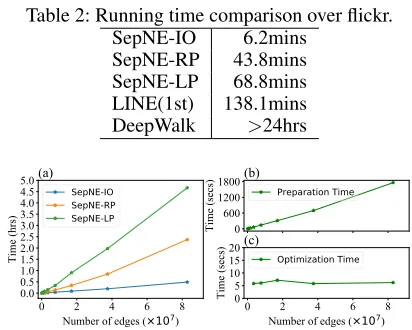
Figure 2: Scalability of SepNE, demonstrated on Wiki-Gens.
and η = 0.1, M = A+A2 andk = 200; on social
networks, parameters were iter = 5, λ = 50,η = 1, M =I+Aandk= 1000.
4.2
Running Time
To demonstrate the speed advantage of SepNE, we com-pared the running time of SepNE, LINE and DeepWalk on Flickr network.8 The nodes in the five biggest
communi-ties of Flickr (75,338 nodes, 4.39%) were regarded as inter-ested for SepNE-IO. Results are presented in Table 2. With better performance (introduced below), our method was sig-nificantly faster than LINE (for 50.2%) and DeepWalk even in embedding the entire network; when requested to embed only the nodes of interest, SepNE completed the task in a very short time.9
We also evaluated the trend of running time with network scales increasing on Wiki-Gens and the number of requested nodes for SepNE-IO fixed as 10,000. Figure 2 (a) shows a linear trend in all three setups. Figure 2 (b)(c) show the trends of preparation and optimization time in SepNE-IO. Preparation time increased linearly mainly due to the time used in reading data, while optimization time remained in-variant. The results all corroborate that SepNE is scalable to super-large networks.
4.3
Matrix Reconstruction
The performance of reconstructing proximity matrix is a di-rect metric of representation quality. We evaluated matrix reconstruction performances of different algorithms on all document datasets. As the results were similar, we took Wiki as a representative. Two metrics were used, including theR2
8
All efficiency experiments were conducted on a single ma-chine with128GB memory,32cores2.13GHz CPU with 16 work-ers.
9
ODQGPDUNVL]Hk
rall
D
Nystrom SVD SepNE
ODQGPDUNVL]Hk
rnz
E
Nystrom SVD SepNE
ODQGPDUNVL]Hk
rall
F
GDS DD DP UF
ODQGPDUNVL]Hk
rall
G
GDS DD DP UF
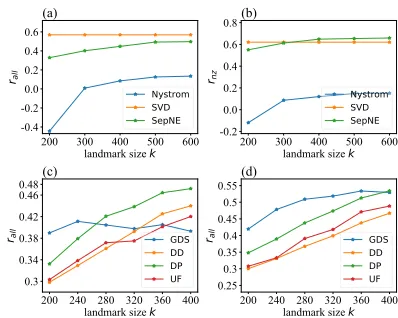
Figure 3: Performances of matrix preserving on Wiki net-work: (a)(b).rall andrnz of different algorithms versusk;
(c)(d).rall of different landmark-selecting approaches
ver-susk(d= 128in (c) and200in (d)).
score over all entries (rall) and non-zero entries (rnz):
rall = 1−
kM˜ −Mk2 F kMk2
F
,
rnz = 1−
k( ˜M−M)×Bk2 F kMk2
F
,
where×indicates element-wise multiplication andBij = 1
ifMij 6= 0otherwise0.
We evaluated Nystr¨om method, SVD and SepNE with differentk over both metrics. We then compared different landmark-selecting approaches with differentk andd, in-cluding four:DD (Degree Deterministic)picking nodes with thekhighest degrees;DP (Degree Probabilistic)sampling landmarks using degrees as weights; UF (Uniform) uni-formly selecting landmarks; and GDS.
According to Figure 3 (a)(b), SepNE significantly outper-forms Nystr¨om method for up to38.3%and shows compe-tent performance compared with SVD. SVD shows its ad-vantage on rall, while preserving non-zero entries can be
more important than zero entries on real-world networks due to the existence of unobserved links. Whenk is large enough, SepNE outperforms SVD onrnz. This is because
non-zero entries are more densely distributed inside com-munities and better reconstructed by SepNE.
In Figure 3 (c)(d), when k is slightly larger than d, or to say that k is strictly confined, GDS shows its signifi-cant advantages. However, therallof GDS decreases when
k > 2ddue to the null representations generated in SVD. At the same time, degree-based approaches gradually get rid of their biases askincreases, and therefore show continuous improvements of performance.
4.4
Classification
We implemented two types of classification tasks on docu-ment and social networks. A simple logistic regression was
LWHUDWLRQV 0.36
0.38 0.40 0.42 0.44 0.46 0.48 0.50
3HUIRUPDQFHPLFURI
D
d=64 d=128 d=256
ODQGPDUNVL]Hk E
d=64 d=128 d=256
0.36 0.38 0.40 0.42 0.44 0.46 0.48 0.50
3HUIRUPDQFHPLFURI
F
d=64 d=128 d=256
G
d=64 d=128 d=256
Figure 4: Performances of multi-label classification under different parameter settings on Flickr network.
used as the classifier for both tasks. The representations were all normalized before used as features. All results were av-eraged over 10 runs.
Multi-class classification. We implemented multi-class classification on three document networks which predicts the subject category a given document is in. Table 3 reports the performances. Macro F1 results are not shown due to the similarity. Despite the minimum information SepNE lever-ages, it outperforms DeepWalk in the majority (4 out of 6) of cases. This is because SepNE incorporates a more robust and elegant way to leverage proximities between nodes. LINE is struggling to capture information on smaller networks, while SepNE is as well competent.
Multi-label classification. The multi-label classification task on social networks was defined as predicting whether a given node is in each community. The five largest in Flickr and communities with more that 1,000 members in Youtube were extracted as labels. As labels were sparse, we con-ducted training and predicting processes over the nodes that have at least one label. The training percentage was varied from 1% to 90%. Table 4 and Table 5 show the results.
spar-Table 3: Multi-class prediction results over document networks(micro-averaged F1 scores). Best performances are bolded.
Wiki Cora Citeseer
%train 10% 90% 10% 90% 10% 90%
LINE(1st) 0.4488 0.5937 0.4657 0.6009 0.3206 0.4259 LINE(2nd) 0.3298 0.4787 0.2637 0.3297 0.2221 0.2561 DeepWalk 0.5737 0.6893 0.7509 0.8187 0.5086 0.5813
SepNE 0.5764 0.6867 0.7365 0.8220 0.5157 0.6072
Table 4: Multi-label prediction results over Flickr network(micro-averaged F1 scores). Best performances are bolded.
%train 1% 3% 5% 10% 20% 30% 50% 90%
LINE(1st) 0.3683 0.4118 0.4165 0.4219 0.4270 0.4273 0.4296 0.4274 LINE(2nd) 0.3450 0.3824 0.3955 0.3973 0.4032 0.4056 0.4069 0.4068 DeepWalk 0.4072 0.4353 0.4433 0.4481 0.4518 0.4564 0.4585 0.4592 SepNE-IO 0.4065 0.4341 0.4477 0.4562 0.4582 0.4607 0.4630 0.4622 SepNE-RP 0.4061 0.4388 0.4502 0.4601 0.4628 0.4634 0.4636 0.4658 SepNE-LP 0.4269 0.4468 0.4562 0.4623 0.4645 0.4656 0.4674 0.4677
Table 5: Multi-label prediction results over Youtube network(micro-averaged F1 scores). Best two performances are bolded.
%train 1% 3% 5% 10% 20% 30% 50% 90%
LINE(1st) 0.1031 0.2322 0.2745 0.3141 0.3410 0.3520 0.3594 0.3673 LINE(2nd) 0.0782 0.1839 0.2158 0.2643 0.2987 0.3159 0.3280 0.3350 DeepWalk 0.2037 0.3397 0.3739 0.4105 0.4355 0.4438 0.4501 0.4556
SepNE-IO 0.2035 0.3325 0.3574 0.3885 0.4041 0.4129 0.4170 0.4216 SepNE-RP 0.2256 0.3355 0.3633 0.3920 0.4115 0.4157 0.4214 0.4273 SepNE-LP 0.2253 0.3361 0.3620 0.3882 0.4118 0.4170 0.4218 0.4277
sity at the cost of much higher time expenses. SepNE out-performs both LINE(1st) and LINE(2nd), which again cor-roborates its stronger ability to leverage near proximities.
4.5
Parameter Sensitivity
Figure 4 shows the effect of iter, k,λ, η andd. Iter, k andη do not show significant influences. The performance of SepNE is good with even one iteration, probably indicat-ing that local information on Flickr is less important. Fig-ure 4 (c) shows that largerλgenerally leads to better perfor-mance, converging withλ≥100. The higher performances of larger λs, particularly compared with λ = 0, show the effectiveness of the elaborated global loss.
5
Related Work
There are massive literature proposed over NE problems. Traditional dimension reduction approaches (Roweis and Saul 2000; Tenenbaum, de Silva, and Langford 2000; Belkin and Niyogi 2002) are applicable on network data through Graph Laplacian Eigenmaps or proximity MF. Recently, various skip-gram-based NE models and applications were proposed (Perozzi, Al-Rfou, and Skiena 2014; Grover and Leskovec 2016; Du et al. 2018). Besides, the pioneering work of (Levy and Goldberg 2014) proved an equivalency between skip-gram models and matrix factorization, which further leads to new proximity metrics under the proximity MF framework (Yang et al. 2015; Cao, Lu, and Xu 2015; Qiu et al. 2018). Edge reconstruction algorithms (Tang et al. 2015) were proposed to gain scalability on large networks. Neural networks, including autoencoders (Wang, Cui, and Zhu 2016; Tu et al. 2018) and CNNs (Kipf and Welling
2016; Hamilton, Ying, and Leskovec 2017) were also lever-aged in NE problems. There is also a new trend (Ribeiro, Saverese, and Figueiredo 2017) that leverages structural in-formation instead of proximity in NE.
The most similar work to ours is (Ahmed et al. 2013), in which a similar partition was adopted to achieve separabil-ity, while other parts of the work had major differences with ours. Besides, it focused mainly on technical issues in dis-tributed learning and preserved only link information, while SepNE is more generalized idea with a more elaborated op-timization goal.
6
Conclusion
In this paper, we formalized the problem of separated matrix factorization, based on which we proposed SepNE, an sepa-rable network embedding method which outperforms strong baselines in both efficiency and performance.
The key contribution of SepNE is providing a novel per-spective of evaluating network embedding methods: sepa-rability. A separable method is stronger than a distributable one, as partly conducting a separable task provides meaning-ful outputs. This property provides an option of embedding only a proportion of nodes and yields strong significance in distributed learning, super-large network embedding and dy-namic network embedding. Furthermore, SMF reduces the complexity of MF from cubic to linear with the generaliz-ability over all MF-based algorithms.
reconstruction, and a more theoretical explanation of SMF can be extremely informative. Should there be such work, it will be theoretically-founded to apply SMF on all matrix-factorization-based algorithms.
References
Ahmed, A.; Shervashidze, N.; Narayanamurthy, S.; Josi-fovski, V.; and Smola, A. J. 2013. Distributed large-scale natural graph factorization. InProceedings of the 22th
In-ternational Conference on World Wide Web (WWW’13), 37–
48.
Belkin, M., and Niyogi, P. 2002. Laplacian eigenmaps and spectral techniques for embedding and clustering. In
Ad-vances in Neural Information Processing Systems 14. 585–
591.
Blondel, V. D.; Guillaume, J.-L.; Lambiotte, R.; and Lefeb-vre, E. 2008. Fast unfolding of communities in large net-works.Journal of Statistical Mechanics: Theory and
Exper-iment2008(10):P10008.
Cao, S.; Lu, W.; and Xu, Q. 2015. Grarep: Learning graph representations with global structural information. In Pro-ceedings of the 24th ACM International on Conference on
Information and Knowledge Management (CIKM’15), 891–
900.
Cui, P.; Wang, X.; Pei, J.; and Zhu, W. 2018. A survey on network embedding. IEEE Transactions on Knowledge and
Data Engineering.
Drineas, P., and Mahoney, M. 2005. On the nystr¨om method for approximating a gram matrix for improved kernel-based learning. Journal of Machine Learning Research6:2153– 2175.
Du, L.; Wang, Y.; Song, G.; Lu, Z.; and Wang, J. 2018. Dy-namic network embedding : An extended approach for skip-gram based network embedding. InProceedings of the 27th International Joint Conference on Artificial Intelligence
(IJ-CAI’18), 2086–2092.
Grover, A., and Leskovec, J. 2016. node2vec: Scalable fea-ture learning for networks. InProceedings of the 22nd ACM SIGKDD International Conference on Knowledge
Discov-ery and Data Mining (KDD’16), 855–864.
Hamilton, W.; Ying, Z.; and Leskovec, J. 2017. Inductive representation learning on large graphs. InAdvances in
Neu-ral Information Processing Systems 30. 1024–1034.
Kipf, T. N., and Welling, M. 2016. Semi-supervised classification with graph convolutional networks. CoRR abs/1609.02907.
Leskovec, J.; Chakrabarti, D.; Kleinberg, J.; Faloutsos, C.; and Ghahramani, Z. 2010. Kronecker graphs: An approach to modeling networks. Journal of Machine Learning
Re-search11:985–1042.
Levy, O., and Goldberg, Y. 2014. Neural word embedding as implicit matrix factorization. InAdvances in Neural
In-formation Processing Systems 27. 2177–2185.
Mislove, A.; Marcon, M.; Gummadi, K. P.; Druschel, P.; and Bhattacharjee, B. 2007. Measurement and analysis of
on-line social networks. InProceedings of the 5th ACM/Usenix
Internet Measurement Conference (IMC’07).
Page, L.; Brin, S.; Motwani, R.; and Winograd, T. 1999. The pagerank citation ranking: Bringing order to the web. Technical report, Stanford University.
Perozzi, B.; Al-Rfou, R.; and Skiena, S. 2014. Deepwalk: online learning of social representations. InProceedings of the 20th ACM SIGKDD International Conference on
Knowl-edge Discovery and Data Mining (KDD’14), 701–710.
Qiu, J.; Dong, Y.; Ma, H.; Li, J.; Wang, K.; and Tang, J. 2018. Network embedding as matrix factorization: Unify-ing deepwalk, line, pte, and node2vec. In Proceedings of the 11th ACM International Conference on Web Search and
Data Mining (WSDM’18), 459–467.
Ribeiro, L. F.; Saverese, P. H.; and Figueiredo, D. R. 2017. Struc2vec: Learning node representations from structural identity. InProceedings of the 23rd ACM SIGKDD Interna-tional Conference on Knowledge Discovery and Data
Min-ing (KDD’17), 385–394.
Roweis, S., and Saul, L. 2000. Nonlinear dimensionality reduction by locally linear embedding. Science2323–2326. Tang, J.; Qu, M.; Wang, M.; Zhang, M.; Yan, J.; and Mei, Q. 2015. Line:large-scale information network embedding. In Proceedings of the 24th International Conference on World
Wide Web (WWW’15), 1067–1077.
Tenenbaum, J. B.; de Silva, V.; and Langford, J. C. 2000. A global geometric framework for nonlinear dimensionality reduction. Science2319–2323.
Tu, K.; Cui, P.; Wang, X.; Yu, P. S.; and Zhu, W. Deep recur-sive network embedding with regular equivalence. In Pro-ceedings of the 24th ACM SIGKDD International
Confer-ence on Knowledge Discovery and Data Mining (KDD’18).
Tu, K.; Cui, P.; Wang, X.; Wang, F.; and Zhu, W. 2018. Structural deep embedding for hyper-networks. In Proceed-ings of the 32nd AAAI’s Conference on Artificial Intelligence
(AAAI’18).
Wang, D.; Cui, P.; and Zhu, W. 2016. Structural deep network embedding. In Proceedings of the 22nd ACM SIGKDD International Conference on Knowledge
Discov-ery and Data Mining (KDD’16), 1225–1234.
Yang, C.; Liu, Z.; Zhao, D.; Sun, M.; and Chang, E. 2015. Network representation learning with rich text information.
In Proceedings of the 24th International Joint Conference
on Artificial Intelligence (IJCAI’15), 2111–2117.
Yu, H.-F.; Jain, P.; Kar, P.; and Dhillon, I. 2014. Large-scale multi-label learning with missing labels. In Proceedings of the 31st International Conference on Machine Learning
(ICML’14), 593–601.
Zhang, Z.; Cui, P.; Wang, X.; Pei, J.; Yao, X.; and Zhu, W. 2018. Arbitrary-order proximity preserved network embed-ding. In Proceedings of the 24th ACM SIGKDD Interna-tional Conference on Knowledge Discovery and Data