Turkish Journal of Fisheries and Aquatic Sciences 13: 159-168 (2013)
www.trjfas.org ISSN 1303-2712 DOI: 10.4194/1303-2712-v13_1_19
© Published by Central Fisheries Research Institute (CFRI) Trabzon, Turkey in cooperation with Japan International Cooperation Agency (JICA), Japan
Comparative Analysis of Using Isozyme and Issr-Pcr Markers for
Population Differentiation of Cyprinid Fish
Introduction
Cyprinids, evolutionarily young group of fish, with a significant taxonomic diversity and the distribution, are of great interest for population-genetic studies. Due to the high frequency of natural hybridization (DeMarais et al., 1992), polyploidy (Mezhzherin and Lisetsky, 2004), wide phenotypic variability (Vasil'eva et al., 1993; Mitrofanov, 2001; Yadrenkina et al., 2005), they generate a large number of forms with an uncertain taxonomic status. Siberian representatives of the genera Leuciscus and
Rutilus are among such problematic groups (Mitrofanov, 1993). L. idus, R. rutilus and L. leuciscus baikalensis are numerous in reservoirs of the Ob-Irtysh river basin, and are commercial species. However, data on their phylogeography, population structure and genetic differentiation in reservoirs of Western Siberia are practically absent. These three species of Cyprinid fish have different aspects of life. Roach is an ecologically plastic species, it forms the most numerous population in the rivers and lakes. Dace is found throughout the river system, but always has a low number. Ide is a river fish species, it is the largest representative of Cyprinid fish in the region,
can migrate hundreds of kilometers. Different aspects of life cause different population genetic structure and different recommendations for the rational organization of the fishery.
Population genetic structure of Cyprinid fish was studied using the methods of allozymes (Rutledge et al., 1990; Alves et al., 1997; Baranyi et al., 1997; Imsiridou et al., 1997; Ketmaier et al., 1998; Brito and Coelho, 1999; Laroche et al., 1999; Häunfling
and Brandl, 2000; Hänfling et al., 2004), RAPD (Callejas and Ochando, 2002; Shivraman et al., 2010), mitochondrial DNA polymerase chain reaction-restriction-fragment length polymorphism (PCR-RFLP) (Fayazi et al., 2006) and nuclear DNA inter-simple sequence repeat (ISSR) assays (Durna et al., 2010), sequence variation within two mitochondrial genes, cytochrome b and the control region (Chappaz
et al., 1998; Costedoat et al., 2006), microsatellites (Barinova et al., 2004; Dubut et al., 2009). Using different techniques by different authors makes it difficult to compare data obtained. Although most studies show the congruence of data obtained using different types of genetic markers (Carmona et al., 2000; Durna et al., 2010; Kartavtsev and Hanzawa, 2007), each of the markers, however, reflects the
Oxana Nikolaevna Zhigileva
1,*, Oxana Georgievna Baranova
1, Viktor Valentinovich Pozhidaev
1,
Ivan Sergeevich Brol
1, Tatyana Ivanovna Moiseenko
21
Tyumen State University, Department of Ecology and Genetics, Pirogova St., 3, Tyumen, 625003 Russian Federation. 2
V.I. Vernadsky Institute of Geochemistry and Analytical Chemistry of RAS Kosygin Street 19, Moscow, Russian Federation
* Corresponding Author: Tel.:+73.3452 64 07 24; Fax: +73.3452 25 52 78 ; E-mail: [email protected]
Received 01 July 2012 Accepted 05 January 2013
Abstract
The article presents data on genetic variability and differentiation of three species of cyprinid fish – roach Rutilus rutilus, ide Leuciscus idus and dace Leuciscus leuciscus baikalensis in the rivers of Siberia, Russia. From the three species studied ide has the lowest indices of genetic variability and more pronounced population differentiation. About 40% of isozyme loci are polymorphic in this species and the same percent – for nuclear DNA inter-simple sequence repeat (ISSR) markers; interpopulation component accounts for 62% of genetic variability. In roach indicators of genetic variability are higher, especially for DNA markers (67%), and interpopulation differentiation is less pronounced (FST = 0.550; GST = 0.214). Dace has the most significant genetic diversity and low differentiation of populations. 48% of the isozyme loci and 83% of multilocus DNA markers are polymorphic in this species, the interpopulation component accounts for 27% and 19% for two types of markers, respectively. In comparison with allozymes, ISSR markers provide higher estimates of genetic distances while making intrageneric comparisons and similar or somewhat lower values – while making a comparison of different groups. Isozyme markers provide more precise geographical differences of population groups of fish.
variability of certain parts of the genome and has its own specifics (Teletchea, 2009). Differences in levels of genetic variation and differentiation, as well as the topology of trees obtained using different types of markers are known (DeMarais et al., 1992; Altukhov, 2003; Rubtsova et al., 2008). The object of this research is to compare the population differentiation of three species of cyprinids using allozymes and ISSR-PCR-markers.
Materials and Methods
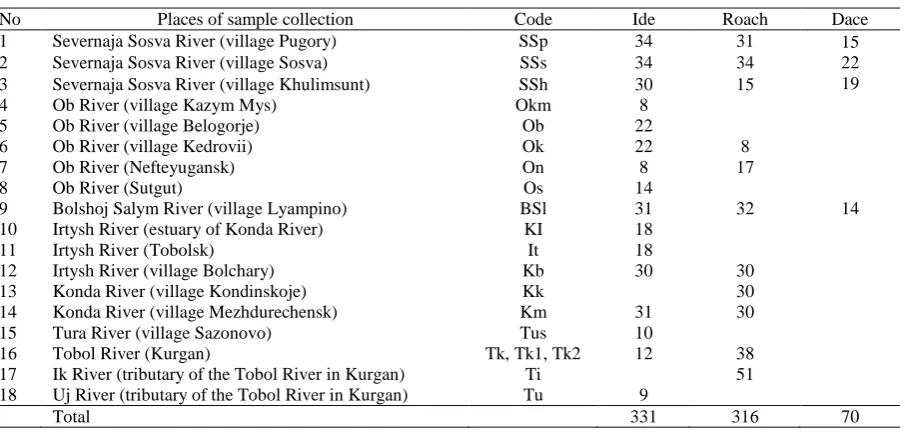
Fish were collected from 9 rivers of the Ob-Irtysh river basin, West Siberia, Russia, during the period November-January 2008-2010 (Figure 1). The roach Rutilus rutilus lacustris Pallas 1811 (Cypriniformes: Cyprinidae) was sampled from the 11 localities, the ide Leuciscus idus Linnaeus 1758 (Cypriniformes: Cyprinidae) – from 16 localities, the dace Leuciscus leuciscus baikalensis Dybowskii 1874 (Cypriniformes: Cyprinidae) – from 4 localities. The data on sample sizes and locality designation (names) are given in Table 1. A total number of 316 individuals of roach, 331 individuals of ide and 70 individuals of dace were sampled (Table 1). Roach sample included individuals of both sexes aged 2+–6+, weighing 75–354 g, with a body length of 165–257 mm. In dace at 2+–8+ body length varied from 125 to 233 mm with the weight 25–220 g. Ide had age 2+–6+, body length 190-375 mm, weight 130-1240 g.
Muscular tissue as the most stably stored were used to carry out the isoenzyme analysis. Tissue samples were stored frozen at -40°C. Proteins were
extracted in a standard way using Tris-HCl buffer (pH 8.0). Vertical electrophoresis in 7.5% polyacrylamide gel (Maurer, 1971) was used for protein separation. Electrophoresis was performed in Helicon electrophoretic chamber with current rate of 80 mA, voltage of 200 V for 2.5 hours. Histochemical identification of proteins was carried out in accordance with the guidelines (Korochkin et al., 1977; Richardson, 1986). Six enzyme systems were studied: NAD-dependent malate dehydrogenase (MDH, 1.1.1.37), lactate dehydrogenase (LDH, 1.1.1.27), aspartate aminotransferase (AAT, 2.6.1.1), superoxide dismutase (SOD, 1.15.1.1), nonspecific esterases (EST, 3.1.1.1, 3.1.1.2) and myogene system. The electrophoretic variant of the most widespread ide species was used as a marker for designation of alleles.
Total genomic DNA was extracted from cardiac muscle fixed in 70% ethanol using the technique of alkaline lysis (Bender et al., 1983). Amplification of sequences limited by simple repeats was carried out using 25 µl of reaction mixture containing PCR buffer (0.01 M Tris-НCl, 0.05 M KCl, 0.1 % triton X-100), 4 mM MgCl2, 0.2 mM of each dNTPs, 1 µl of total DNA solution, 2.5 mM of primer and 0.2 unit/µL of
Taq-polymerase (“Fermentas“) using Chromo-4 thermal cycler (“Bio-Rad”) in the following mode: 94°C - 7 min, then 94°C -30 sec, 52(56)°C -, 45 sec, 72°C -, 2 min (40 cycles), 72°C - 7 min. Three primers: (AG)8G, (AG)8T and (CA)8G were used for ISSR-PCR analysis. Analysis of ISSR-PCR-fragments was carried out on 2% agarose gel with using 1X Tris-EDTA-Borate buffer. The sizes of the
fragments were determined using 100 bp DNA molecular weight markers («Fermentas»). Electrophoretic gels were documented using VersaDoc system (Bio-Rad). Electrophoretic results were combined into binary matrices, where the presence of the band in gels was designated as "1" and was considered as a dominant allele, absence of the band was designated as "0" and considered as a recessive allele.
Standard population genetic characteristics were determined using POPGEN32 program (Yeh et al., 1999). Dendrograms were plotted on the basis of Nei's genetic distances (Nei, 1978) according to the allele frequency at all loci studied, including monomorphic ones. Unweighted Pair Group Method with Arithmetic Mean (UPGMA) was used to plot dendrograms.
Results
Genetic Differentiation Based on Allozyme Data
Isozyme profiles of the three fish species studied are rather similar. The less significant allelic diversity of the dace may be due to a smaller number of individuals studied and less extensive geography of samples (compared to ide and roach). The fixation of alternative alleles for any of the loci studied has been detected in none of the species. Species differences consist in the presence of low frequencies alleles, whereas the normal alleles are common to the three species (Table 2).
The diversity of isozyme loci in the ide, roach and dace living in some rivers of the Ob-Irtysh basin has been described previously (Zhigileva et al., 2010). The ide and the roach were studied more fully. Each of these species is divided into three groups: the southern (Tobol, Tura, Irtysh rivers), central (middle
stream of the Ob river, Konda river and Bolshoy Salym river) and northern (Severnaya Sosva river), which have considerable specificity of their genetic structure. It should be noted that the southern group of roach (Tobol River and Ik River) is distinct from the others significantly (the index of genetic identity (INei) between the northern-central and the southern groups is 0.65). The high level of divergence may indicate a different origin of these population groups of roach and may be resulted from the history of formation of hydrographic network of Western Siberia (Ecology, 2006). In freshwater fish historical patterns of stream colonisation can contrast with contemporary dispersal patterns (Lamphere and Blum, 2012). The highest rates of genetic identity in Kurgan population of roaches is observed when studying another sample from the river Tobol, but an index of genetic identity (INei = 0.83-0.86) is too low to classify them as one population. As for other rivers, most close to the Kurgan sample are the Ob samples, then the Konda samples, and the least indices of genetic identity are observed in Sosva groups of roaches. The Tobol samples of the roach form a common cluster in the dendrogram, which is rather clearly separated from samples from other rivers.
The central group of ide populations is genetically closer to the northern than to the southern one and forms a common cluster with it, but with a rather low level of genetic identity. Surgut ide is genetically close to ide from the Bolshoy Salym river, which is due to geographical proximity of these items. Ide groups from the rivers Tobol and Tura were genetically very similar, the rate of genetic identity (INei=0.99) indicating that they belong to one population, despite the fact that they live in different rivers. Together with ide from the river Uy, they form a common cluster in the dendrogram, which includes the remaining samples from the rivers Irtysh and Table 1. Places of sample collection and the amount of material
No Places of sample collection Code Ide Roach Dace
1 Severnaja Sosva River (village Pugory) SSp 34 31 15
22 19
2 Severnaja Sosva River (village Sosva) SSs 34 34
3 Severnaja Sosva River (village Khulimsunt) SSh 30 15
4 Ob River (village Kazym Mys) Okm 8
5 Ob River (village Belogorje) Ob 22
6 Ob River (village Kedrovii) Ok 22 8
7 Ob River (Nefteyugansk) On 8 17
8 Ob River (Sutgut) Os 14
9 Bolshoj Salym River (village Lyampino) BSl 31 32 14
10 Irtysh River (estuary of Konda River) KI 18
11 Irtysh River (Tobolsk) It 18
12 Irtysh River (village Bolchary) Kb 30 30
13 Konda River (village Kondinskoje) Kk 30
14 Konda River (village Mezhdurechensk) Km 31 30
15 Tura River (village Sazonovo) Tus 10
16 Tobol River (Kurgan) Tk, Tk1, Tk2 12 38
17 Ik River (tributary of the Tobol River in Kurgan) Ti 51
18 Uj River (tributary of the Tobol River in Kurgan) Tu 9
Tobol. Withinh the group, the samples from different rivers and sites of fishing out (within a river) are not combined by geographic criterion, which indicates a significant role of interpopulation exchange within population groups of fish.
We examined only two populations of the dace - from the rivers Severnaya Sosva and Bolshoy Salym. Genetic distance (DNei) between the populations reaches 0.1. Populations from the Severnaya Sosva River in all three species are clearly separated genetically, having similar rates of divergence (Figure 1).
Genetic Differentiation Based on Issr-Pcr Data
ISSR-PCR-patterns generated in the ide using 3 primers were relatively uniform (compared to the dace and the roach) and consisted of 21 bands, 8 of them were monomorphic. At the same time, in roach only 13 bands were identified, 11 of them were polymorphic. Dace is yet more polymorphic species compared with two previous ones. In dace 24 bands were identified, from which 16-22 were polymorphic in different samples, the rate of polymorphic bands (generally within a species) being up to 92%. Moreover, some individuals of the dace with ISSR-Table 2. Allele frequencies (min-max) of isozyme loci in three species of cyprinids
Loci Allele L. idus R. rutilus L. leuciscus
EST-1* 100
109 1.0 0 0.983-1.0 0-0.017 1.0 0
EST-2* 100
109 92 91 90 0-0.572 0 0 0 0.428-1.0 0.147-0.786 0.033-0.074 0.214-0.853 0-0.034 0 0-0.400 0 0.600-1.0 0 0
EST-3* 108
100 92 86 0 0.432-1.0 0-0.568 0 0.250-0.590 0.393-0.750 0-0.055 0-0.133 0.500-0.615 0.267-0.433 0-0.100
AAT-1* 100
70 0.750-1.0 0-0.250 0.206-1.0 0-0.794 1.0 0
MDH-1* 100
118 87 81 0.461-0.642 0.178-0.929 0.024-0.785 0.035-0.583 0.283-0.828 0-0.057 0.172-0.717 0 0.954-1.0 0.045 0 0
MDH-2* 100
112 90 87 0.763-1.0 0.071-0.077 0.065-0.237 0 0.941-1.0 0.050-0.059 0-0.026 0-0.017 0.045-0.308 0.692-0.954 0 0
LDH-1* 100
107 0.983-1.0 0-0.016 0.942-1.0 0-0.058 1.0 0
SOD-1* 100
92 88 75 0.035-0.348 0.019-0.565 0.087-0.964 0-0.056 0.017-0.214 0.786-1.0 0 0 0-0.023 0 0.977-1.0 0
SOD-2* 100
136 1.0 0 1.0 0 0.077-0.333 0.667-0.923
MY-1* 106
100 104 98 0.016-0.731 0.269-0.983 0 0-0.024 0.250-1.0 0.155-0.750 0-0.077 0 0-0.233 0.767-1.0 0 0
MY-2* 103
100 97 0 0.044-0.885 0.115-1.0 0 1.0 0 0.023-0.1 0.846-1.0 0-0.0233
MY-3* 100 1.0 1.0 1.0
MY-4* 102
100 0 95 0 0.357-1.0 0.044-0.691 0.038-0.139 0-0.069 0.845-1.0 0.071-0.231 0-0.086 0 1.0 0 0
MY-5* 100
76 67 90 0.524-1.0 0.038-0.083 0-0.038 0.056-0.476 0.667-1.0 0.017-0.259 0 0.074-0.294 0.909-1.0 0-0.091 0 0
MY-6* 100
PCR-patterns dramatically different from the rest of this species were found. The number of scales in lateral line in dace from the River Bolshoy Salym was greater compared to the population from the river Severnaya Sosva, exceeded typical scores for this species and overlapped with this measure in the ide (Table 3).
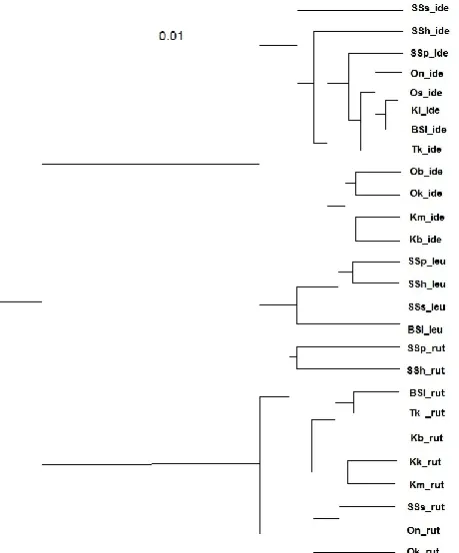
Results of cluster analysis of 26 samples of Cyprinids according to ISSR-PCR data are presented in Figure 2. Two clusters in the dendrogram correspond to the genera Leuciscus and Rutilus. The first cluster, in turn, is divided into two groups corresponding to two studied species – the ide and the dace. The clustering of dace samples is identical to that obtained using isozyme data. The ide has a high genetic similarity between samples from the Ob and Konda. The samples from the rivers Ob, Bolshoy Salym and Irtysh at the confluence of the Ob form a common cluster, which also adjoins the sample from the Tobol, but with lower rates of genetic similarity. The Sosva samples of the ide are rather isolated from the rest, but do not form a common cluster in the
dendrogram as it takes place when using allozyme data. According to the ISSR-PCR, only two samples of the roach from the upper reaches of the Severnaya Sosva form a separate cluster. The third Sosva sample of the roach is adjacent to the Ob sample. The Konda samples of roach may be combined with samples from the rivers Irtysh, Tobol and Bolshoy Salym.
In general, the division of population groups of fish of the Ob-Irtysh basin, based on isozyme and ISSR-PCR data is similar (Figure 3). The differences consist in the inability to differentiate the southern, central and northern groups of fish, especially in roach, in case of using multilocus DNA markers.
Indicators of Genetic Differentiation and Variability According two Methods
Nei's genetic distances calculated from allele frequencies of isozyme loci within the genus
Leuciscus were 0.065, for intergeneric comparisons –
Leuciscus-Rutilus – 0.400, the distance between the roach and the dace being a little larger (0.462) than
Table 3. The numbera of scales in lateral line in fish from various places of sample collection
Fish species SSp SSs SSh BSl
R. rutilus
L. leuciscus
L. idus
40-45 (42.3) 49-53 (50.3) 55-65 (58.7)
42-46 (44.1) 48-52 (49.4) 56-63 (59.4)
40-45 (42.9) 46-51 (49.9) 56-63 (59.1)
41-46 (43.1) 49-58 (53.3) 55-64 (59.6)
a minimum, maximum and average (in brackets) scores in different populations. Geographical localities codes are listed in Table 1.
between the roach and the ide (0.341). The ide has the highest level of genetic differentiation of populationswhile the dace – has the lowest one. This is confirmed by data obtained using both types of markers, although the estimates of interpopulation differentiation obtained using isoenzymes are higher, and the estimates of gene flow are lower than those obtained using ISSR-PCR (Table 4).
Based on data of two methods, the proportion of polymorphic loci was the greatest in the ide and the smallest – in the dace, and the difference is more marked in terms of isozyme data (Table 5). Since the variability index positively correlates with the sample size and the number of loci analysed, it proved to be higher among the most thoroughly studied species –
the ide and the roach. When calculating the average population proportion of polymorphic loci, as well as in terms of all other values, the dace was a more variable species.
Indices of variability in the ide, calculated using different markers, do not differ. According to ISSR-PCR data, the proportion of polymorphic loci in different populations ranged from 0.238 to 0.619, with an average being 0.432. The same value calculated based on the allozyme data varied in the range 0.125-0.588, with an average being of 0.407. The value of expected heterozygosity of isozyme loci was slightly lower than the similar item – gene diversity in terms of ISSR markers.
of multilocus DNA markers exceeded 1.5-2-fold the level of variability of isozyme loci. The proportion of polymorphic loci in populations of the roach in terms of isozyme markers ranged from 0.180-0.680, with an average being 0.436; expected heterozygosity – 0.089-0.198 (an average 0.142). The average values of genetic variability in the dace (according to ISSR-PCR data) were 0.670 and 0.356, respectively. According to isozyme analysis data, the average proportion of polymorphic loci in the dace was 0.484, the average heterozygosity – 0.173; according to the ISSR-PCR data – 0.83 and 0.325, respectively.
According to the ISSR-PCR, the indices genetic diversity (h) (Nei 1973) and proportion of polymorphic loci (P) in the roach and the dace significantly exceeded the same ones in the ide, while differences in allozymes variability of the three species were not significant. The correlation coefficients between indices of variability among populations obtained using different types of markers indicated the presence of weak relationship and in most cases were not significant.
Discussion
Three species of cyprinids – the ide, the dace and the roach from Western Siberia rivers – have relatively high levels of genetic variation, comparable to those of the representatives of these species from other parts of the range (Hänfling et al., 2004; Baranyi et al., 1997). From the three species studied ide has the lowest indices of genetic variability and more pronounced population differentiation within the Ob-Irtysh basin. About 40% of isozyme loci are polymorphic in this species and the same percent – for ISSR markers; interpopulation component accounts for 62% of genetic variability. In roach indicators of genetic variability are higher, especially for DNA markers (67%), and interpopulation differentiation is less pronounced (FST = 0.550; GST = 0.214). These differences may be due to both natural differences in
the biology of these species and different status in respect to the fishery. Life history is the most important variable explaining genetic diversity and population differentiation (Östergren and Nilsson, 2012). The roach is an ecologically plastic species, well adapted to different conditions, more numerous and therefore having more opportunities for gene flow. This species is not as valuable for fishery as larger ide. Spatial structures, such as habitat size and connectivity, are particularly important in river and freshwater networks because such ecosystems are highly vulnerable to human activities (Koizumi, 2011). Due to differences in population structure, we can note that the ide is a more vulnerable species in comparison to roach, and intensive uneven fishing could damage its genetic diversity.
Dace deserves special attention. It has the most significant genetic diversity and low differentiation of populations. 48% of the isozyme loci and 83% of ISSR-PCR-markers are polymorphic in this species, the interpopulation component accounts for 27% and 19% of the variability for different types of markers, respectively. These values are close to the estimates characteristic of widely migratory fish species (Vrijenhoek, 1998) and are indicative of a rather high gene flow, although far from panmixia. These findings are confirmed by other studies of the high variability of morphological characters of the dace due to mixing different forms as a result of migration (Kizhevatov and Kizhevatova, 2012). High migratory activity and heterogeneity of fish populations in the reservoirs of Siberia is an adaptation to fluctuating water levels in the spring and reducing of the concentration of oxygen in the winter (Yadrenkina et al., 2005).
Individuals of dace with original ISSR patterns and a large number of scales in lateral line were found. Since the latter sign has systematic importance, and multilocus markers are rather effective in the identification of hybrids (Chelomina et al., 2008), we suggested a hybrid origin of these individuals. There Table 4. Indices of genetic differentiation of cyprinids populations from Ob-Irtysh basin
Fish species ISSR-PCR data Allozymes data
HT HS GST Nm FIT FIS FST Nm
L. idus R. rutilus
L. leuciscus
0.257 0.357 0.403
0.175 0.281 0.325
0.319 0.214 0.194
1.069 1.835 2.072
0.816 0.738 0.636
0.509 0.416 0.502
0.625 0.550 0.270
0.150 0.204 0.677
Table 5. Indices of genetic variability of cyprinids populations from Ob-Irtysh basin
Fish species ISSR-PCR data Allozymes data
P (%) P(%) a h P (%) P (%)a HE HO
L. idus R. rutilus
L. leuciscus
85.7 84.6 83.3
24-62 (43) 18-68 (67) 67-92 (83)
0.262 0.356 0.325
87.5 81.2 75.0
12-58 (41) 18-68 (43) 38-63 (48)
0.136 0.142 0.173
0.055 0.073 0.083
are data on past and contemporary hybridization between dace and ide (Costedoat et al., 2006), as well as the roach and the dace (Chappaz et al., 1998). In Eastern Europe, at least one of the five lines of the dace is characterized by hybridization with ide (Costedoat et al., 2006). The genetic distance between these species, although it corresponds to the level of interspecific differences, is still not very big. According to our data, based on isozyme genes, DNei is 0.06, based on DNA-markers – 0.12. The low degree of differentiation in structural genes is a consequence of the phylogenetic relationships and can serve as the basis for easy hybridization of species (Wilson et al., 1974). Mitrofanov (2001) also pointed to the existence of dace groups differing in their morphological features in Central Asia. The author notes the tendency to increase the number of scales in lateral line of dace from the Irtysh basin which is partly consistent with our data. However, a comparison of unique DNA sequences and mesorepetitive DNA fraction of different forms of the dace, which differ mainly by the number of scales in the lateral line and the number of gill rakers, showed that they were practically identical (Mitrofanov, 1993). The status of the Siberian dace and its possible hybridization with the ide requires further investigation and is beyond the scope of this article. Most likely, the high level of genetic variability is characteristic of this polymorphic form with extensive habitat, apparently, which is the original ancestral form for the rest of the Asian dace (Mitrofanov, 1993).
Using of different types of genetic markers allowed receiving trees with slightly different topologies. The dendrogram plotted on the basis of allozyme data more clearly shows the geographical divisions of populations into northern, central and southern groups, which are more pronounced in the roach. For this ecologically plastic species, not only spatial separation but also the habitat type is important. In adaptation to them, some alleles of protein loci may play a role (Hänfling et al., 2004). Likely, clearer geographical differences in isozyme markers result from the adaptive significance of the alleles in different climatic and natural conditions. Clinal variation in allele frequencies of protein loci in the latitudinal direction is characteristic of many fish species (Sassaman et al., 1983; Savin et al., 2009) and may be due to selection of variants of enzymes with different temperature optima, which is an important mechanism of biochemical adaptation of poikilothermic organisms.
Indicators of interpopulation differentiation, based on isozymes data, are higher, and estimates of gene flow are lower compared to those obtained using ISSR-PCR. This may also be due to the adaptive value of biochemical polymorphism in comparison with the neutral multilocus DNA markers. Adaptation of populations to specific conditions may contribute to the variability of isozymes, while gene flow has a
greater influence on the distribution of selectively neutral ISSR markers. In comparison with isoenzymes, ISSR markers give higher estimates of genetic distances in intrageneric comparisons and similar or somewhat lower values – in comparison of species from different genera. For these highly polymorphic genetic markers (like ISSR), there is a high probability of accidental coincidence of the electrophoretic mobility of alleles, especially when unallied species are compared, so they give higher levels of genetic similarity in intergeneric comparisons (compared to isoenzymes).
In general, allozyme and ISSR-PCR data are comparable and can be used to describe the population structure of cyprinids. But ISSR markers (due to neutrality and a high rate of evolution), give higher values of genetic distances and variability, and lower values of interpopulation differentiation (compared with isoenzymes). Using ISSR-PCR markers can detect a high level of genetic variability using a smaller sample, which is especially important for rare and small species.
Acknowledgements
We are grateful to V.V. Ozhirel’ev who collected samples of fish. This research was supported by the Federal Target Program "Research and Scientific-pedagogical Cadres of Innovative Russia" for 2009-2013, the State Contract P712.
References
Altukhov, J.P. 2003. Genetic processes in populations. ICC Akademkniga, Moscow, 431 pp.
Alves, M.J., Coelho, M.M. and Collares-Pereira, M.J. 1997. The Rutilus alburnoides complex (Cyprinidae): evidence for a hybrid origin. Journal of Zoological Systematics and Evolutionary Research, 35(1): 1–10. doi: 10.1111/j.1439-0469.1997.tb00398.x
Baranyi, Ch., Gollmann, G. and Bobin, M. 1997. Genetic and morphological variability in roach Rutilus rutilus, from Austria. Hydrobiologia, 350(1-3): 13–23. doi: 10.1023/A:1003056311181
Barinova, A., Yadrenkina, E., Nakajima, M. and Taniguchi, N. 2004. Identification and characterization of microsatellite DNA markers developed in ide
Leuciscus idus and Siberian roach Rutilus rutilus.
Molecular Ecology Notes, 4(1): 86–88.
Bender, W., Pierre, S. and Hognes, D.S. 1983. Chromosomal walking and jumping to isolate DNA from Ace and rosy loci of bithorax complex in
Drosophila melanogaster. Journal of Molecular Biology, 168: 17–33. doi: 10.1016/S0022-2836(83)80320-9
Brito, R.M. and Coelho, M.M. 1999. Genetic structure of the Iberian chub, Leuciscus pyrenaicus, in the Tejo drainage. Hydrobiologia, 392(2): 169–178. doi: 10.1023/A:1003510909315
Carmona, J.A., Domínguez, J. and Doadrio, I. 2000. Congruence between allozyme and cytochrome b
gene sequence data in assessing genetic differentiation within the Iberian endemic Chondrostoma lemmingii
(Pisces: Cyprinidae). Heredity, 84: 721–732. doi: 10.1046/j.1365-2540.2000.00720.x
Chappaz, R., Gilles, A., Miquelis, A., Cavalli, L. and Martin, J.-F. 1998. Genetic differentiation and hybridization in cyprinid Leuciscus leuciscus. Comptes Rendus de l'Académie des Sciences - Series III - Sciences de la Vie. 321(11): 933–940. doi: 10.1016/S0764-4469(99)80008-0
Chelomina, G.N., Rozhkovan, K.V. and Ivanov, S.A. 2008. Discrimination of interspecies hybrids in natural populations of Amur sturgeon fish by means of multilocus RAPD markers. Cytology and Genetics, 5: 342-350.
Costedoat, C., Chappaz, R., Barascud, B., Guillard, O. and Gilles, A. 2006. Heterogeneous colonization pattern of European Cyprinids, as highlighted by the dace complex (Teleostei: Cyprinidae). Molecular Phylogenetics and Evolution, 41(1): 127–148. doi: 10.1016/j.ympev.2006.04.022
DeMarais, B.D., Dowling, T.E., Douglas, M.E., Minckley, W.L. and Marsh, P.C. 1992. Origin of Gila seminuda
(Teleostei: Cyprinidae) through introgressive hybridization: implications for evolution and conservation. Proceedings of the National Academy of Sciences of the United States of America, 89(7): 2747–2751.
Dubut, V., Martin, J.F., Gilles, A., van Houdt, J., Chappaz, R. and Costedoat, C. 2009. Isolation and characterization of polymorphic microsatellite loci for the dace complex: Leuciscus leuciscus (Teleostei: Cyprinidae). Molecular Ecology Resources, 9(4): 1179–83. doi: 10.1111/j.1755-0998.2009.02594.x. Durna, S., Bardakci, F. and Degerli, N. 2010. Genetic
diversity of Garra rufa Heckel, 1843 (Teleostei: Cyprinidae) in Anatolia. Biochemical Systematics and Ecology, 38(1): 83–92.
doi: 10.1016/j.bse.2009.12.009
Ecology of fishes of the Ob-Irtysh basin. 2006. KMK Scientific Publications Association, Moscow, 596 pp. Fayazi, J., Rahimi, G., Moradi, M., Ashtyani, R. and
Galledari, H. 2006. Genetic differentiation and phylogenetic relationships among Barbus xanthopterus (Cyprinidae) populations in southwest of Iran using mitochondrial DNA markers. Pakistan Journal of Biological Sciences, 9(12): 2249–2254. doi: 10.3923/pjbs.2006.2249.2254
Häunfling, B. and Brandl, R. 2000. Phylogenetics of European cyprinids: insights from allozymes. Journal of Fish Biology, 57(2): 265–276. doi: 10.1111/j.1095-8649.2000.tb02171.x
Hänfling, B., Durka, W. and Brandl, R. 2004. Impact of habitat fragmentation on genetic population structure of roach, Rutilus rutilus, in a riparian ecosystem. Conservation Genetics, 5: 247–257.
doi: 10.1023/B:COGE.0000030008.20492.2c Imsiridou, A., Karakousis, Y. and Triantaphyllidis, C. 1997.
Genetic polymorphism and differentiation among chub Leuciscus cephalus L. (Pisces, Cyprinidae) populations of Greece. Biochemical Systematics and Ecology, 25(6): 537–546. doi: 10.1016/S0305-1978(97)00043-4
Kartavtsev, Y.Ph. and Hanzawa, N. 2007. Inferences in
Leuciscinae (Pisces, Cyprinidae) phylogeny and taxonomy based on cytochrome b sequence distances and on enzyme loci diversity. Korean Journal of Genetics, 29(4): 427–435.
Ketmaier, V., Cobolli, M., De Matthaeis, E. and Bianco, P.G. 1998. Allozymic variability and biogeographic relationships in two Leuciscus species complexes (Cyprinidae) from southern Europe, with the rehabilitation of the genus Telestes Bonaparte. Italian Journal of Zoology, 65(S1): 41–48. doi: 10.1080/11250009809386793
Kizhevatov, Ya.A. and Kizhevatova A.A. 2012. The siberian dace (Leuciscus leuciscus baicalensis
Dubovski, 1874) of the Sob river (lower Ob). Vestnik AGTU. A series of Fish industry, 2: 46–52.
Koizumi, I. 2011. Integration of ecology, demography and genetics to reveal population structure and persistence: a mini review and case study of stream-dwelling Dolly Varden. Ecology of Freshwater Fish, 3: 352–363. doi:10.1111/j.1600-0633.2010.00480.x Korochkin, L.I., Serov, O.A., Pudovkin, A.I., Aronshtam,
A.A., Borkin, L.Y., Malecki, I., Polyakova, E. and Manchenko, G.P. 1977. Genetics of isoenzymes. Nauka, Moscow, 278 pp.
Lamphere, B.A. and Blum, M.J. 2012. Genetic estimates of population structure and dispersal in a benthic stream fish. Ecology of Freshwater Fish, 1: 75–86. doi: 10.1111/j.1600-0633.2011.00525.x
Laroche, J., Durand, D.J., Bouvet, Y., Guinand, B. and Brohon, B. 1999. Genetic structure and differentiation among populations of two cyprinids, Leuciscus cephalus and Rutilus rutilus, in a large European river. Canadian Journal of Fisheries and Aquatic Sciences, 56(9): 1659–1667.
Maurer, H. 1971. Disk-electrophoresis. Theory and practice of electrophoresis in polyacrylamide gel. Mir, Moscow, 243 pp.
Mezhzherin, S.V. and Lisetsky, I.L. 2004. Genetic structure of crucian carp (Сypriniformes, Cyprinidae, Carassius
L. 1758) populations of middle-Dnieper basin. Cytology and Genetics, 38(5): 35–44.
Mitrofanov, I.V. 1993. The origin and taxonomy of dace genus Leuciscus Agassiz (Cyprinidae) in Central Asia and Kazakhstan. Journal of Ichthyology, 33 (6): 763-768.
Mitrofanov, I.V. 2001. Phenetic relationships of Siberian and Kirghiz dace in Kazakhstan. Selevinia. Kazakhstan Journal of Zoology, 1–4: 19–25.
Nei, M. 1973. Analysis of gene diversity in subdivided populations. Proceedings of the National Academy of Sciences of the United States of America, 70: 3321– 3323.
Nei, M. 1978. Estimation of average heterozygosity and genetic distance from a small number of individuals. Genetics, 89: 583–590.
Östergren J. and Nilsson J. 2012. Importance of life-history and landscape characteristics for genetic structure and genetic diversity of brown trout (Salmo trutta L.). Ecology of Freshwater Fish, 1: 119–133. doi: 10.1111/j.1600-0633.2011.00529.x
Richardson, B.J. 1986. Allozyme Electrophoresis. A Handbook for Animal Systematics and Population Studies. Academie Press, London, 410 pp.
salmon Oncorhynchus keta Wallbaum populations as revealed with microsatellite and allozyme markers: A comparative study. Russian Journal of Genetics, 44(7): 841–848. doi:10.1134/S0016675808070126 Rutledge, C.J., Zimmerman, E.G. and Beitinger, Th.L.
1990. Population genetic responses of two minnow species (Cyprinidae) to seasonal stream intermittency. Genetica, 80(3): 209–219. doi: 10.1007/BF00137328 Sassaman, C., Yoshiyama, R.M. and Darling, J.D.S. 1983.
Temporal stability of lactate dehydrogenase A clines of the high cockscomb Anoplarchus purpurescens. Evolution, 37(3): 472–483. doi:10.2307/2408261 Savin, V.A., Varnavskaya, N.V. and Shaporev, R.A. 2009.
Patterns of genetic diversity in population complexes of pacific chum salmon Oncorhynchus keta
Walbaum, from Asia and America, inferred from allozyme polymorphism data. Russian Journal of Genetics, 45(6): 726–737. doi:10.1134/S0016675809060125 Shivraman, G.K., Barat, A., Ali, S., Pandey, N.N., Joshi,
K.D. and Mahanta, P.C. 2010. An analysis of genetic diversity among indian coldwater fishes (Pisces: Cyprinidae) using RAPD markers. The IUP Journal of Genetics and Evolution, 3(2), 31–40.
Teletchea, F. 2009. Molecular identification methods of fish species: reassessment and possible applications. Reviews in Fish Biology and Fisheries, 3: 265-293.
doi:10.1007/s11160-009-9107-4.
Wilson, A.C., Maxson, L.R. and Sarich V.M. 1974. Two types of molecular evolution: evidence from studies of interspecific hybridization. Proceedings of the National Academy of Sciences of the United States of America, 71: 2843–2847.
Vasil'eva, E.D., Mina, M.V. and Pavlinov, I.J. 1993. Analysis of the phenetic diversity in dace (subgenus
Leuciscus, Cyprinidae). Position of Leuciscus danilewskii. Journal of Ichthyology,33 (4): 475-485. Vrijenhoek, R.C. 1998. Conservation genetics of freshwater
fish. Journal of Fish Biology, 53: 394–412.
Yadrenkina, E.N., Interesova, E.A., Yadrenkin, A.V. and Khakimov, R.M. 2005. On the spatial differentiation of populations of cyprinid fish Chany Lake (Western Siberia). Siberian Journal of Ecology, 12(2): 293–304. Yeh, F.C., Yang, R. and Boyle, T. 1999. POPGENE. Version 1.31. / University of Alberta and Centre for International Forestry Research.