Milena Baczewska-Rej, Aleksandra A. Zasada, Natalia M. Rokosz,
Waldemar Rastawicki
Comparison of Sensitivity and Specificity of Three
Commercial Assays (Biotest EIA, BinaxNOW and
Uni-Gold) for Detection of
Legionella pneumophila
Serogroup 1 Antigen in Urine
Porównanie czułości i swoistości trzech dostępnych komercyjnie testów
(Biotest EIA, BinaxNOW i Uni-Gold) służących do wykrywania antygenu
L. pneumophila
sg 1 w moczu
National Institute of Public Health – National Institute of Hygiene, Warsaw, Poland
Abstract
Background. The advantages of diagnosing Legionnaires’ disease by urinary antigen detection are widely recog-nized, and include ease of specimen accessible, rapidity of testing and early detection.
Objectives. The authors compared specificity and sensitivity of three commercially available tests for Legionella pneumophila serogroup 1 antigen detection in urine samples.
Material and Methods. Urine specimens from patients and simulated samples spiked with L. pneumophila sero-group 1, non-L. pneumophila serogrup 1, Legionella strains as well as other pathogens of respiratory or urinary tracts were tested by one Enzyme-Immunoassay – EIA (Biotest), and two immunochromatographic test – ICT (BinaxNOW and Uni-Gold) urinary antigen kits for the detection of Legionella pneumophila serogroup 1.
Results. The highest level of sensitivity in the simulated samples was detected for Biotest EIA. The sensitivity of tested ICT assays, in relation to the reference Biotest EIA, depended from incubation time of the tests. Sensitivity after 15 and 45 minutes were as follows: BinaxNOW 66.7% and 88.9%, respectively; Uni-Gold 82.4% and 94.1%, respectively. Specificity for Uni-Gold was 100% but for BinaxNOW was 95.7% and 94.7%, respectively, when results were read after 15 and 45 minutes.
Conclusions. Extension of incubation time of ICT BinaxNOW and Uni-Gold tests till 45 minutes should be rec-ommended as it greatly improves the sensitivity without necessity of concentration of urine samples (Adv Clin Exp Med 2010, 19, 3, 323–327).
Key words: Legionella pneumophila, urinary antigen, immunochromatographic test, BinaxNOW, Uni-Gold.
Streszczenie
Wprowadzenie. Diagnozowanie choroby legionistów z wykorzystaniem wykrywania antygenu w moczu jest powszechnie znane i ma wiele zalet. Materiał do badań jest łatwo dostępny, test jest szybki, umożliwia także wcze-sne postawienie diagnozy.
Cel pracy. Oszacowanie czułości i swoistości wykrywania antygenu Legionella pneumophila serogrupa 1 w moczu z wykorzystaniem trzech dostępnych komercyjnie testów.
Materiał i metody. Badaniom poddano próbki pobrane od pacjentów oraz próbki sztucznie kontaminowane
L. pneumophila serogrupa 1, L. pneumophila należącymi do innych serogrup, innymi gatunkami Legionella oraz inny-mi patogenainny-mi wywołującyinny-mi choroby układu oddechowego i moczowego. Próbki badano testainny-mi wykrywającyinny-mi antygen w moczu EIA (Biotest) oraz dwoma testami immunochromatograficznymi – ICT (BinaxNOW i Uni-Gold).
Wyniki. Największą czułością wykrywania antygenu w próbkach kontaminowanych wykazał się Biotest EIA. Czułość badanych testów ICT, w porównaniu z Biotestem EIA, zależała od czasu inkubacji. Czułość, odpowiednio po 15 i 45 min, była następująca: dla Binax-NOW 66,7 i 88,9%, dla Uni-Gold 82,4 i 94,1%. Swoistość dla Uni-Gold wynosiła 100%, a dla Binax-NOW 95,7 i 94,7% w zależności od czasu inkubacji.
Wnioski. Wydłużenie czasu inkubacji do 45 min dla ICT BinaxNOW i Uni-Gold znacznie zwiększa czułość testów, bez potrzeby zagęszczania próbek (Adv Clin Exp Med 2010, 19, 3, 323–327).
Słowa kluczowe: Legionella pneumophila, antygen w moczu, test immunochromatograficzny, BinaxNOW, Uni-Gold.
Adv Clin Exp Med 2010, 19, 3, 323–327 ISSN 1230-025X
ORIGINAL PAPERS
Laboratory diagnosis of Legionella pneumo-phila infection is performed on the basis of the result of culture growth, direct immunofluores-cence, serologic testing and antigen detection in urine [1, 2]. Culture growth is still the gold stan-dard among the diagnostic methods for Legionella
infections. The sensitivity of culture for the diag-nosis of Legionnaires’ disease (LD) has been esti-mated to be approximately 60% with a range of 30–80%. Successful isolation strictly dependents on the type of clinical specimen used [3].
A urine antigen test for the diagnosis of LD caused by L. pneumophila serogroup 1 was made available in the early 1980s, and its use has increased considerably in recent years [4, 5]. Assay for the detection of soluble L. pneumophila sg 1 antigen in urine specimens is a rapid method that pro-vides an early diagnosis of Legionella infection.
Legionella antigenuria in urine samples can be detected as early as 1 day after onset of symptoms and persists for days to weeks [2]. Rapidity of diag-nosis is therefore an important advantage of the urine antigen test, providing early treatment deci-sions. The urine antigen test, however, is unable to detect the non-L. pneumophila sg 1 strains. This drawback is alleviated by the fact that this group is responsible for 30% or even less of the cases of legionellosis [6].
The aim of this study was to compare sensitiv-ity and specificsensitiv-ity of three commercially available tests for L. pneumophila sg 1 antigen detection in urine samples.
Material and Methods
A total of 34 urine specimens from patients with clinical symptoms of LD were used in the
study. This group comprised of 17 samples from patients with laboratory confirmed LD and 17 samples from patients with pneumonia of etiolo-gies other than Legionella. Fifty two artificial urine samples were used for the theoretical sensitivity studies. A total of 10 L. pneumophila strains belong-ing to different serogroups and 5 other Legionella
species, which were isolated from humans, were selected for preparing simulated urine samples. Strains are listed in Table 1. Additionally, the authors investigated the possibility of non-specif-ic cross-reactions in the analyzed tests, using the other respiratory and urine tract pathogens as:
Klebsiella pneumoniae, Streptococcus pneumoniae,
Escherichia coli, Pseudomonas aeruginosa, Proteus vulgaris, Citrobacter freundi, Enterobacter aero-genes, Staphylococcus aureus, Enterococcus faecalis.
All strains were grown as described by Helbig et al. [7]. Bacterial cells were harvested from the plates with an inoculating loop and suspended in 0.85% NaCl. The concentrations of the bacteria were adjusted to 1 × 10⁸ CFU/ml, as recommended
by Helbig et al. [7]. Then 1 ml of the bacterial sus-pension was added to 9 ml of a urine sample from a healthy person. The urine sample before addi-tion of bacterial suspension was negative in the reference assay (Biotest EIA). The samples of urine were diluted ten-fold and two-fold with the aim of finding a threshold of each kit. Simulated sam-ples containing L. pneumophila sg 1 were tested in 6 different dilutions. Other simulated samples were tested in 2 different dilutions. Before approach to the assay the samples were boiled for 10 min. In pilot studies several simulated urine samples were tested comparatively directly after boiling, and after boiling and sonication. Legionella antigen detection level for sonicated samples was almost two times lower than for non-sonicated. Due to
Table 1. Legionella strains used in the study
Tabela 1. Szczepy Legionella wykorzystane w badaniach Strains (Szczepy)
ATCC 33152 Legionella pneumophila serogroup 1 (Philadelphia-1) ATCC 33154 Legionella pneumophila serogroup 2 (Togus-1) ATCC 33155 Legionella pneumophila serogroup 3 (Bloomongton-2) ATCC 33156 Legionella pneumophila serogroup 4 (Los Angeles-1) ATCC 33216 Legionella pneumophila serogroup 5 (Dallas 1E) ATCC 33215 Legionella pneumophila serogroup 6 (Chicago-2) ATCC 33823 Legionella pneumophila serogroup 7 (Chicago 8) ATCC 35096 Legionella pneumophila serogroup 8 (Concord 3) ATCC 35289 Legionella pneumophila serogroup 9 (IN-23-G1-C2) ATCC 43290 Legionella pneumophila serogroup 12 (570-CO-H) ATCC 33217 Legionella bozemanii (WIGA)
ATCC 33218 Legionella micdadei (TATLOCK) ATCC 33462 Legionella longbeachae (Long Beach 4) ATCC 33623 Legionella jordanis (BL-540)
this results non-sonicated simulated urine samples were used for the tests.
For the detection of urinary antigen, three commercially available kits were used: Legionella Urine Antigen EIA (Biotest, Germany) as the refer-ence test, and two immunochromatographic tests (ICT): BinaxNOW Legionella Test (Binax, USA) and Uni-Gold Legionella Urinary Antigen Test (Trinity Biotech plc., Ireland), which were evalu-ated in this study. Tests were performed according to the manufacturer’s instruction. An additional test read was added after 45 minutes of incubation at room temperature.
Results
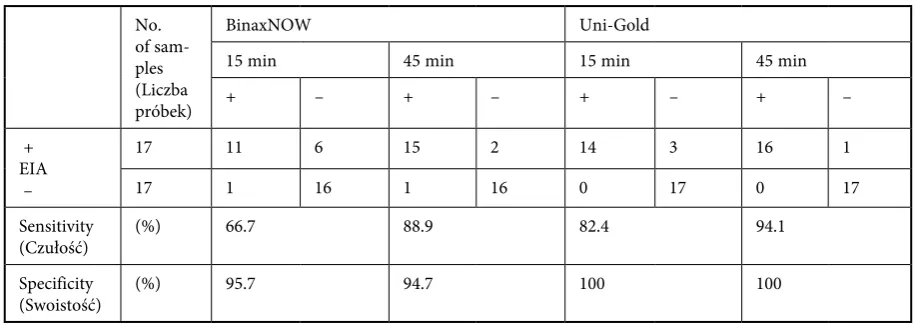
The both ICT urinary antigen tests are recom-mended reading after 15 minutes. In own investi-gation the authors, however, noticed an enhanced visibility sample line after 45 minutes of incuba-tion in samples from patients which were negative or weakly positive after 15 minutes. In a case of simulated urine samples both the ICT assays were able to detect lower bacterial cells concentration in urine after 45 minutes than those detected after 15 minutes. Positive results were detected only for L. pneumophila sg 1. No cross-reactions with other Legionella as well as other tested microor-ganisms were found for 15 and 45 minutes reads. The results of sensitivity and specificity of the BinaxNOW and UNI-Gold obtained for examined samples from patients are shown in Table 2. When compared with the reference Biotest EIA the sensi-tivity levels after 15 and 45 minutes were as follows: BinaxNOW 66.7% and 88.9%, respectively; Uni-Gold 82.4% and 94.1%, respectively. Specificity for Uni-Gold was 100% but for BinaxNOW ranged from 94.7% to 95.7% for 15 and 45 read, respec-tively. This was caused by the fact that one clini-cal sample was negative in Biotest EIA and
Uni-Gold and positive in BinaxNOW after 15 as well as 45 minutes. The smallest number of L.pneumophila
sg 1 cells detected (detection threshold) by Biotest EIA was 1.25 × 10⁵ CFU/ml, and by remaining two
ICT tests after 15 and 45 minutes was as follows: 2,5 × 10⁵ CFU/ml and 1.25 × 10⁵ CFU/ml,
respec-tively for Uni-Gold and 5 × 10⁵ CFU/ml and 2.5 ×
105 CFU/ml, respectively for BinaxNOW.
Discussion
Several authors compared the commercially available kits for L. pneumophila antigen detection in urine samples [1, 7–9]. Blanco et al. [8] showed that results in Uni-Gold and BinaxNOW tests were obtained in 15 minutes or less. The authors agree with this in case of strong positive samples. However, in this study the authors noticed weakly positive samples line after 15 minutes, which could be read as negative but were apparently positive after 45 minutes of incubation. Moreover, when the antigen in samples was in low concentration (simulated samples) it could be detected only after 45 minutes. It is worth to emphasize that – as it was shown by Yzerman et al. [10] and Helbig et al. [7] – urinary antigen is rarely detected in mild cases of LD probably because of a low concentra-tion of the antigen in urine samples. In these cases extension of the test incubation time to 45 minutes could be helpful. Own findings are in agreement with those of Guerrero et al. [1], who observed that the BinaxNOW sensitivity was significantly lower than Biotest EIA. However, as the authors showed, extension of incubation time to 45 minutes signif-icantly increased sensitivity of tested ICT assays. The same results were achieved by Diederen et al. [11]. They observed increase of sensitivity of BinaxNOW from 91.8% to 94.5%. Guerrero et al. [1] found that sensitivity of Biotest EIA was higher than BinaxNOW in patients with laboratory
con-Table 2. Evaluation of sensitivity and specificity of BinaxNOW and Uni-Gold in relation to Biotest EIA results Tabela 2. Czułość i swoistość testów BinaxNOW i Uni-Gold w porównaniu do Biotest EIA.
No. of sam-ples (Liczba próbek)
BinaxNOW Uni-Gold
15 min 45 min 15 min 45 min
+ – + – + – + –
+ EIA –
17 11 6 15 2 14 3 16 1
17 1 16 1 16 0 17 0 17
Sensitivity
(Czułość) (%) 66.7 88.9 82.4 94.1
Specificity
firmed LD. They showed that the sensitivity of BinaxNOW is considerable lower than Biotest EIA, 37% and 61.5%, respectively. Own results were similar when tests were read only after 15 minutes. However, the prolonged incubation time reduced the difference of sensitivity between BinaxNOW and Biotest EIA. The authors observed significant increase in BinaxNOW sensitivity when results were read after 15 and 45 minutes. These results are comparable with results obtained by Yzerman et al. [11], who observed that sensitivity of BinaxNOW is 72%. BinaxNOW revealed a little lower sensitiv-ity than Uni-Gold. As it was shown in own study, this is relevant to threshold of BinaxNOW, that is about ten-fold lower in relation to Uni-Gold.
According to results of Blanco et al. [8] BinaxNOW specificity is 100%. Although Bailleul et al. [12] described very weakly false positive reac-tion in the test. The authors found one clinical sample positive in ICT (BinaxNOW after 15 min) but negative in Biotest EIA. However, the authors did not find any positive or doubtful results of all the evaluated tests in simulated samples contain-ing microorganisms other than L. pneumophila
sg 1 even when the bacterial cells were in high concentrations. There are two questions: whether the ICT tests had lower specificity or the Biotest EIA had lower sensitivity in this case and what influenced the specificity/sensitivity. In own opin-ion there were two possibilities: the urine sample contained any factors that inhibited Biotest EIA or the factors caused false positive sample lines in BinaxNOW test. Both are possible because urine composition could be influenced by medication, diet, concomitant diseases, etc. Unfortunately, the authors did not have such information about the patient. This situation point at necessity for com-parable testing of high number of clinical samples in both methods.
In own research the authors indicated that simulated samples prepared using suspension of
whole Legionella cells in urine could be used as a one step of a method evaluation. It is important especially for estimation of cross-reactivity with
Legionella other than L. pneumophila sg 1 because very little urine samples from confirmed cases of LD caused by non-L. pneumophila sg 1 is avail-able all over the world [9–11]. Simulated samples enabled also to determine a detection threshold for antigen concentration. However, analyzing the results one has to keep in mind a possibility of any changes of Legionella cells and antigens during its way through a cardiovascular system and a uri-nary tract.
Although some authors described an increase in sensitivity of urinary antigen detection tests after urine sample concentration [8] the authors did not check this observation. Addition of a con-centration step before testing with ICT assays influence a rapidity of the tests which is its advan-tage. Moreover, the concentration step needs spe-cialized laboratory equipment what causes that the tests becoming not easy-to-use.
In conclusion, the Biotest EIA showed a level of sensitivity higher than the immunochromato-graphic assays if results of the ICT were read after 15 minutes. However, the extension of incubation time of the ICT till 45 minutes greatly improve the sensitivity. The L. pneumophila sg 1 antigen detec-tion thresholds for the BinaxNOW and the Uni-Gold tests were comparable if results were read after 45 minutes. Because both tests had excellent specificity regardless of incubation time the authors recommend extension of the tests incubation time till 45 minutes. Detection of soluble L. pneumophi-la sg 1 antigen in urine by the ICT assays is a very fast, easy and reliable method of LD diagnosis and makes possible an early start of appropriate treat-ment. The immunochromatographic tests are so easy-to-use that could be made directly in patient’s room without a necessity of sending a urine sam-ple to a laboratory what enables to save time.
References
[1] Guerrero C, Toldos CM, Yague G, Ramirez C, Rodriguez T, Segovia M: Comparison of Diagnostic Sensitivities of Three Assay (Bartels Enzyme Immunoassay (EIA), Biotest EIA, and Binax NOW Immunochromatographic Test) for Detection of Legionella pneumophila Serogroup 1 Antigen in Urine. J Clin Microbiol 2004, 42, 467–468.
[2] Murdoch DR: Diagnosis of Legionella Infection. Clin Infect Dis 2003, 36, 64–69.
[3] Mainwald M, Helbig JH, Luck C: Laboratory methods for the diagnosis of Legionella infections. J Microbiol Methods 1998, 33, 59–79.
[4] Berdal BP, Farshy CE, Feeley JC: Detection of Legionella pneumophila Antigen in Urine by Enzyme-Linked Immunospecific Assay. J Clin Microbiol 1979, 9, 575–578.
[5] Kohler RB, Zimmerman SE, Wilson E, Allen SD, Edelstein PH, Wheat LJ, White A: Rapid radioimmunoassay diagnosis of Legionnaires’ disease: detection and partial characterization of urinary antigen. Ann Inter Med 1981, 94, 601–605.
[7] Helbig JH, Uldum SA, Luck PC, Harrison TG: Detection of Legionella pneumophila antigen in urine samples by the BinaxNOW immunochromatographic assay and comparison with both Binax Legionella Urinary Enzyme Immunoassay (EIA) and Biotest Legionella Urin Antigen EIA. J Med Microbiol 2001, 50, 509–516.
[8] Blanco S, Lacoma A, Prat C, Cuesta MA, Fuenzalida L, Latorre I, Dominguez J: Detection of Legionella anti-gen in nonconcentrated and concentrated urine samples by a new immunochromatographic assay. Eur J Clin Microbiol Infect Dis 2008, 27, 1249–1251.
[9] Okada C, Kura F, Wada A, Inagawa H, Lee GH, Matsushita H: Cross-Reactivity and Sensitivity of Two Legionella Urinary Antigen Kits, Biotest EIA and Binax NOW, to Extracted Antigens from Various Serogroups of
L.pneumophila and Other Legionella Species. Microbiol Immunol 2001, 46, 51–54.
[10] Yzerman EPF, den Boer JW, Lettinga KD, Schellekens J, Dankert J, Peeters M: Sensitivity of Three Urinary Antigen Tests Assosciated with Clinical Severity in a Large Outbreak of Legionnaires’ Disease in The Netherlands. J Clin Microbiol 2002, 40, 3232–3236.
[11] Diederen BMW, Peeters MF: Evaluation of Two New Immunochromatographic Assays (Rapid U Legionella
Antigen Test and SD Bioline Legionella Antigen Test) for Detection of Legionella pneumophila Serogroup 1 Antigen in Urine. J Clin Microbiol 2006, 44, 2991–2993
[12] Bailleul E, Magerman K, Mewis A, Peeters V, Rummens JL, Cartuyvels R: False-positive result with BinaxNOW
Legionella Antigen immunochromatograhic (ICT) assay: response to Helbig et al. (2001). J Med Microbiol 2004, 53, 173 doi:10.1099/jmm.0.05000-0. (Letter.).
Address for correspondence:
Milena Baczewska-RejNational Institute of Public Health – National Institute of Hygiene Department of Bacteriology
Chocimska 24 00-791 Warsaw Poland
Tel.: +48 22 542 12 46
E-mail: [email protected]
Conflict of interest: None declared