© 2014 Ana M. Džamić et al. This is an open access article distributed under the terms of the Creative Commons Attribution License -NonCommercial-ShareAlike Unported License (http://creativecommons.org/licenses/by-nc-sa/3.0/).
Journal of Applied Pharmaceutical Science Vol. 4 (03), pp. 001-005, March, 2014 Available online at http://www.japsonline.com
DOI: 10.7324/JAPS.2014.40301 ISSN 2231-3354
Chemical composition, antifungal and antioxidant activity of
Pelargonium graveolens essential oil
Ana M. Džamić
1*, Marina D. Soković
2, Mihailo S. Ristić
3, Slavica M. Grujić
1, Ksenija S. Mileski
1, Petar D. Marin
1 1Department of Morphology and Systematics of Plants, Institute of Botany and Botanical Garden "Jevremovac", Faculty of Biology, University of Belgrade, Studentski trg 16, 11000 Belgrade, Serbia. 2Department of Plant Physiology, Institute for Biological Research "Siniša Stanković", University of Belgrade, Despota Stefana 142, 11000 Belgrade, Serbia. 3Institute for Medicinal Plant Research “Dr Josif Pančić”, Tadeuša Košćuška 1, 11000 Belgrade, Serbia.
ARTICLE INFO ABSTRACT
Article history:
Received on: 28/01/2014 Revised on: 14/02/2014 Accepted on: 16/03/2014 Available online: 30/03/2014
The present study describes the chemical composition, antifungal and antioxidant activity of Pelargonium graveolens essential oil. The essential oil profile was determined by GC and GC-MS. The main compounds were citronellol (24.54%), geraniol (15.33%), citronellyl formate (10.66%) and linalool (9.80%). Minimal inhibitory concentrations (MIC) and minimal fungicidal concentrations (MFC) were recorded using the microdilution and macrodilution methods. Commercial antimycotic bifonazol was used as a control. The concentration of 0.25-2.5 mg/ml showed fungicidal activity. The most resistant fungi were Mucor mucedo and Aspergillus species. The antioxidant activity of pure essential oil was evaluated by means of the 2,2-diphenyl-1-picrylhydrazil (DPPH) radical assay. The essential oil of P. graveolens was able to reduce DPPH radicals into the natural DPPH-H form, and this activity was dose-dependent. The oil exhibited antioxidant activity and reduced DPPH to 50% at EC50
value of 0.802 mg/ml of oil solution. Key words:
Pelargonium graveolens, essential oil, microdilution method, macrodilution method, DPPH
INTRODUCTION
Pelargonium graveolens L' Heritis an aromatic and hairy
herbaceous shrub, up to 1 m high. Leaves are prickly and carved,
flowers are small, usually pink. P. graveolens (geranium) is native
to South Africa (Comoros Islands) and it is widely cultivated in Russia, Egypt, Algeria, Morocco, Congo, Japan, Central America and Europe (Spain, Italy, France). There are three main regions for
the production of P. graveolens oil: Reunion, Egypt, Russia
(Lawless, 2001). Essential oil of P. graveolens is used as a
fragrant component in perfumery, food and beverages industry, also as antidepressant and antiseptic remedy. It has an astringent and chemostatic effect, also it regulates the bloodstream, stimulates the adrenal glands and lymphatic system which in combination with diuretic properties makes this essential oil excellent in the fight against cellulite and fluid retention in the
body. Due to the antiseptic effect it is used for the hygiene of the oral cavity and for treatment of various skin problems
.
* Corresponding Author
Ana M. Džamić
E-mail address: [email protected]. ac.rs; Tel: +381 113342114; Fax: +381 113243603
(Lavabre, 1998; Lawless, 2001). Lis-Balchin et al (1996, 2003)
studied the biological activity of few commercial geranium oil samples. They have been tested for their possible application in the food industry.
According to available data on chemical composition of
P. graveolens essential oil, dominant volatiles were citronellol,
geraniol and citronellyl formate (Jirovetz et al., 2006; Verma et al.,
2010; Ghannadi et al., 2012). Through several studies it was shown
thatessential oil and extracts of Pelargonium graveolens possess
antibacterial and antifungal activity (Baratta et al., 1998; Dorman
and Deans, 2000). Antimicrobial and antimalarial activity of P.
graveolens extracts can be attributed to significant cytotoxic effect
which this extracts provided and probably flavonoid derivatives have positive contribution to this biological activity (Lalli, 2005).
Antioxidant and antitermitic activity of P. graveolens has been
reported as well (Zheng and Wang, 2001; Fayed, 2009; Seo et al.,
2009; Čavar and Maksimović, 2012).
The purpose of this study was to determinate chemical
composition of P. graveolens essential oil and to evaluate
MATERIAL AND METHODS
Essential oil sample
The sample of Pelargonium graveolens essential oil was
obtained from the Institute for Medicinal Plant Research “Dr Josif Pančić“, Belgrade. The referent oil was provided from Haarmann & Reimer, Holzminden, Germany.
Gas chromatography (GC) and gas chromatography-mass spectrometry (GC-MS)
Qualitative and quantitative analyses of the essential oil were performed using GC and GC-MS. The GC analysis of the oil was carried out on a GC HP-5890 II apparatus, equipped with split-splitless injector, attached to HP-5 column (25 m x 0.32 mm, 0.52 µm film thickness) and fitted to FID. Carrier gas flow rate
(H2) was 1 ml/min, split ratio 1:30, injector temperature was 250
°C, detector temperature 300 °C, while column temperature was linearly programmed from 40-240 °C (at rate of 4°/min). The same analytical conditions were employed for GC-MS analysis, where HP G 1800C Series II GCD system equipped with HP-5MS column (30 m x 0.25 mm, 0.25 µm film thickness) was used. Transfer line was heated at 260 °C. Mass spectra were acquired in EI mode (70 eV), in m/z range 40-400. Identification of the individual oil components was accomplished by comparison of retention times with standard substances and by matching mass spectral data with MS libraries (NIST and Wiley 275.l) using a computer search and literature (Adams, 2007). For the purpose of quantitative analysis, area percents obtained by FID were used as base.
Tested fungal strains
The fungi used in this study were: Alternaria alternata
(ATCC 13963), Aspergillus flavus (ATCC 9170), A. niger (ATCC
6275), A. ochraceus (ATCC 12066), A. terreus (ATCC 16792), A.
versicolor (ATCC 11730), Aureobasidium pullulans (ATCC
9348), Candida albicans (clinical isolate), Cladosporium
cladosporioides (ATCC 13276), C. fulvum (TK 5318), Fusarium
sporotrichoides (ITM 496), F. tricinctum (CBS 514478), Mucor
mucedo (SBR 2000), Penicilliumfuniculosum (ATCC 10509), P.
ochrochloron (ATCC 9112), Phoma macdonaldii (CBS 38167),
Phomopsis helianthi (ATCC 201540), Trichoderma viride (IAM
5061) and Trichophyton menthagrophytes (human isolate). The
moulds were obtained from culture collection of the Mycological Laboratory, Department of Plant Physiology, Institute for
Biological Researches "Siniša Stanković", Belgrade. The fungi
were maintained on malt agar (MA) and Sabouraud dextrose agar
(SDA)(Booth, 1971).
Microdilution method
Modified microdilution technique was used to investigate the antifungal activity of essential oil (Hanel and Raether, 1988;
Daouk et al., 1995). The fungal spores were washed from the
surface of agar plates with sterile 0.85% saline containing 0.1% Tween 80 (v/v). Spore suspension was adjusted with sterile saline
to a concentration of approximately 1.0 × 10⁶ in a final volume of
100 μl per well. The inocula were stored at 4 C for further use.
Dilutions of the inocula were cultured on solid malt agar to verify the absence of contamination and to check the validity of the
inoculum. The minimal inhibitory concentration (MIC)
determination was performed by a serial dilution technique using 96-well microtitre plates. The investigated EO was dissolved in malt broth with fungal inoculum in a concentration of 0.25-5.00 mg/ml. The lowest concentrations without visible growth (under a binocular microscope) were defined as MICs. The fungicidal concentrations (MFCs) were determined by serial subcultivation of a 2 μl of tested essential oil dissolved in medium and inoculated
for 72 h, into microtiter plates containing 100 μl of broth per well
and further incubation for 72 h at 28 C. The lowest concentration
with no visible growth was defined as MFC indicating a 99.5% killing of the original inoculum. DMSO was used as a negative control, and commercial fungicide, bifonazole (Srbolek, Belgrade, Serbia) was used as a positive control (0.1–0.25 mg/ml). The test was done in triplicate and repeated two times.
Macrodilution method
In order to investigate antifungal activity of P.
graveolens essential oil, the modified mycelial growth method was
used (Ishii, 1995). Tested micromycetes were grown on malt agar
(MA) in Petri dishes at room temperature for 21 day and after that
the inoculation of fungi was done (inoculum density was 106
spores per ml) (Booth, 1971). Different concentrations of P.
graveolens essential oil were diluted in molten malt agar and
poured into Petri dishes. The minimal inhibitory concentrations (MICs) of tested essential oil were determined (concentrations of geranium oil which achieve the complete inhibition of the mycelial growth of fungi). Minimal fungicidal concentrations (MFCs) were determined by monitoring the growth zones of re-inoculated mycelial peripheral parts in pure medium (concentrations of geranium oil at which the re-growth of the inoculum did not occur were taken as MFCs). The tested fungi were inoculated at the centre of the plates. Plates were incubated for three weeks at room temperature and after this period MICs were determined. The test was done in triplicate and repeated two times. Commercial fungicide bifonazole was used as control and the following concentrations of this synthetic antimicotic were prepared: 10, 15,
20 l/ml, representing 0.1, 0.15 and 0.2 mg/ml of active substance
in solution.
Antioxidant activity
The antioxidant activity of EO was evaluated by means of the 2,2-diphenyl-1-picrylhydrazil (DPPH) radical scavenging method. This spectrophotometric assay uses stable DPPH radical as reagent (Blos, 1958). The methanol solution of the investigated EO (200 µl) (with starting concentrations of 200, 400, 600, 800 µl/ml of solution) was added to an 1800 µl methanol solution of DPPH radical (concentration of 0.04 mg/ml) and after shaking, the reaction mixture was left to react in the dark for 30 minutes at room temperature. The absorbance of the remaining DPPH radical
UV-VIS spectrophotometer. Every concentration was done in triplicate and the same was done with Trolox and BHT, known commercial antioxidants. The same procedure was used for extracts. Blank probes were done in the same way, using methanol
instead of the investigated solution (A0). The decrease in the
absorption of DPPH solution is calculated by the following equation:
I (%) = (A0-A1) × 100/A0
Concentrations which reduce the absorption of DPPH solution by
50% (EC50) were obtained from the curve dependence of
absorption of DPPH solution on 517 nm from the concentration for essential oil and standard antioxidant. Microsoft Excel was used to calculate these values. Tests were carried out in triplicate.
RESULTS AND DISCUSSION
The results of chemical analysis of Pelargonium
graveolens essential oil are presented in Table 1. It can be seen
that tested oil contain a significant amount of citronellol (24.54%), geraniol (15.33%), citronellyl formate (10.66%) and linalool (9.80%). Also, in noticeable amounts were present 6,9-guaiadiene, geranyl formate, menthone and isomenthone. Other constituents of tested oil were present in small quantities (less than 1%). In total, 55 compounds were identified representing 99.32% of the total oil weight. Oxygenated monoterpenes were the most dominant group
of oil constituents representing 59.74% of the total oil (Table 1),
while monoterpene hydrocarbons were present with two
compounds representing only 0.49% of the oil yield.
Table. 1: Chemical composition of Pelargonium graveolens essential oil.
Constituents KIE KIL %
α-Pinene 924.5 932 0.41
2,2,6-Trimethyl-6-vinyltetrahydropyran 963.9 972 0.03
Limonene 1022.0 1024 0.08
cis-Linalool oxide (furanoid) 1067.0 1067 0.09
trans-Linalool oxide (furanoid) 1082.7 1088 0.04
Linalool 1094.0 1095 9.80
cis-Rose oxide 1103.8 1106 1.17
trans-Rose oxide 1120.3 1122 0.37
Menthone 1145.0 1148 4.33
Isomenthone 1155.5 1158 2.86
Menthol 1176.2 1167 0.08
α-Terpineol 1185.6 1186 0.36
Citronellol 1224.2 1223 24.54
Neral 1236.5 1235 0.68
Geraniol 1249.9 1249 15.33
Geranial 1266.3 1264 0.06
Citronellyl formate 1268.6 1271 10.66
Neryl formate 1274.5 1280 0.41
Geranyl formate 1295.1 1298 5.61
α-Cubebene 1339.6 1345 0.07
Citronellyl acetate 1348.6 1350 0.28
α-Copaene 1365.1 1374 0.46
β-Bourbonene 1373.8 1387 1.38
β-Elemene 1382.3 1389 0.25
β-Caryophyllene 1407.5 1417 1.33
trans-α-Bergamotene 1425.8 1432 0.10
α-Guaiene 1427.9 1437 0.55
6,9-Guaiadiene 1432.7 1442 7.08
Aromadendrene 1441.4 1439 0.95
α-Humulene 1445.9 1452 0.42
allo-Aromadendrene 1453.0 1458 0.14
cis-Muurola-4(14),5-diene 1466.6 1465 0.09
γ-Muurolene 1465.9 1478 0.18
Geranyl propionate 1472.5 1476 0.86
γ-Gurjunene 1474.7 1475 0.35
β-Selinene 1484.1 1489 0.16
α-Muurolene 1493.7 1500 0.19
γ-Cadinene 1507.0 1513 0.16
Geranyl isobutanoate 1510.1 1514 0.28
δ-Cadinene 1516.8 1522 1.16
Citronellyl butanoate 1524.5 1530 0.68
Furopelargone A 1536.9 1538 0.50
Geranyl butanoate 1557.5 1562 0.76
Neryl isovalerate 1574.9 1582 0.05
Caryophyllene oxide 1578.8 1582 0.43
5,5,9,10-Tetramethyltricyclo
[7.3.0.0(1,6)]dodecan-11-one** 1577.6 n/a 0.46 2-Phenyl ethyl tiglate 1586.5 1584 0.24
Geranyl isovalerate 1601.9 1606 0.33
Humulene epoxide II 1605.2 1608 0.09
1,10-di-epi-Cubenol 1611.5 1618 0.20
1-epi-Cubenol 1624.9 1627 0.12
Cubenol 1636.4 1645 0.15
α-Cadinol 1649.4 1652 0.13
cis-Citronellyl tiglate 1662.9 1666 0.31
Geranyl tiglate 1697.8 1696 1.52
Grouped constituents
Monoterpene hydrocarbons 0.49
Oxygenated monoterpenes 59.74
Sesquiterpene hydrocarbons 15.02
Oxygenated sesquiterpenes 6.01
Others 18.06
Total 99.32
n/a – not available
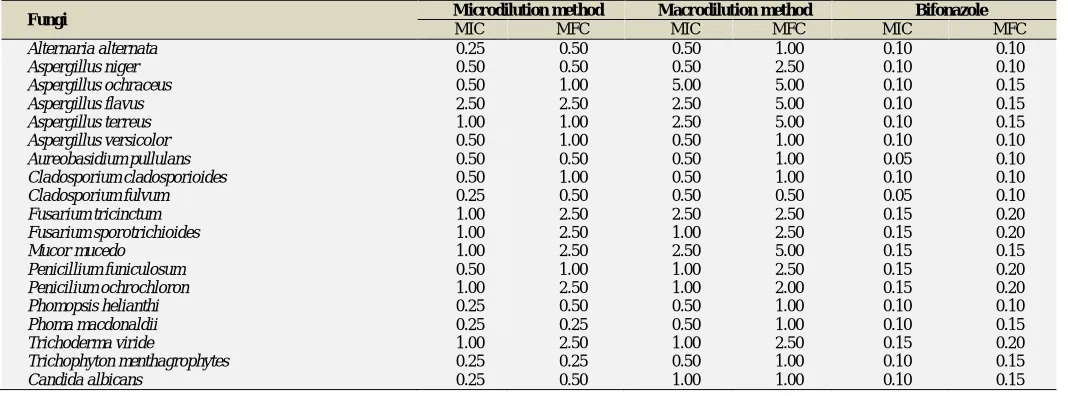
Pelargonium graveolens oil showed effectiveness at
concentrations of 0.25-2.5 mg/ml by serial dilution method, while according to results of macrodilution method, geranium oil was effective at concentrations of 0.5-5 mg/ml. When comparing the results of both, micro- and macrodilution tests, the most resistant
fungi in the presence of geranium oil were Mucor mucedo and
Aspergillus flavus. The most susceptible strains in this study were
Cladosporium fulvum, Phoma macdonaldii and Trichophyton
menthagrophytes. The sensitivity of tested micromycetes was
more pronounced in microdilution method (Table 2). P.
graveolens oil exhibited quite stronger antifungal potency
comparing to bifonazole (Table 2). Free radical scavenging
capacity of the tested oil was measured by DPPH assay and results
are shown in Fig 1.
According to presented results, P. graveolens oil was
found to possess slightly lower antioxidant activity (IC50 = 0.802
mg/ml) than synthetic antioxidant BHT (IC50 = 0.328 mg/ml). The
yield of P. graveolens essential oil (approximately 0.15%),
composition and constituent amounts may differ depending on the type and source of plant material (Lavabre, 1998; Lawless, 2001).
It was observed by Verma et al (2010) that under the same
climatic conditions, the composition of rose-scented geranium essential oil was significantly affected by crop duration and length of vegetation period. Lawrence (1999) provides a detailed research overview of the authors who analysed the geranium essential oil. Based on this study, it can be observed that the main components
of P. graveolens essential oil are geraniol and citronellol, while
Concentration of Essential oil in mg/ml of Solution
Fig. 1: Antioxidant activity of Pelargonium graveolens essential oil using
DPPH test (EC50 = 0.802 mg/ml).
According to Table 1 this data is in complete
compliance with results of our chemical analyses. Cis- and trans-
rose oxides are often identified as geranium oil constituents, although present in smaller amounts (Lawrence, 1999). In our
study only cis–rose oxide was identified but in irrelevant amount
(0.76%). The results on chemical analyses for Bourbon geranium
oil were similar (Yan et al., 1994; Lis-Balchin et al., 1996).
Alcohols geraniol and citronellol both originate from geranyl pyrophosphate, but the reason for their concentration variability is assumed to be production operated by different enzymes (Verma
et al., 2010). Recent research on P. graveolens oil revealed that it
manifests a strong inhibitory effect on Gram-positive bacterial
strains such as Bacillus cereus, Bacillus subtilis and
Staphylococcus aureus (Silva and Fernandes, 2010). In vitro
synergism was demonstrated between Pelargoniumgraveolens oil
and synthetic agent norfloxacin against B. cereus and S. aureus: oil
increased the antimicrobial activity of this synthetic agent (Rosato
et al., 2008).
Galea and Csedo (2007) have observed a complete
inhibition of Candida albicans growth regarding to anticandidal
activity of P. graveolens oil. The same results were achieved in
our study with concentration of 0.50 mg/ml in microdilution method and 1.00 mg/ml for geranium oil in macrodilution method (Table 2), with conclusion that tested oil exhibited strong
activity on pathogenic yeast C. albicans. It was found that a
combination of P. graveolens oil and amphotericin B in treatment
of Candida species can reduce the required dose of amphotericin B
and thereby, minimize its negative effects (Rosato et al., 2008).
Similar results were obtained by examining the effect of geranium
oil on the growth of Aspergillus species when it was observed that
the best activity had combination of P. graveolens oil,
amphotericin B and ketoconazole (Vuuren et al., 2009). Still,
according to the results that we obtained, P. graveolens oil itself
has very strong fungicidal effect against all five Aspergillus strains
that we used. Čavar and Maksimović (2012) published radical
-scavenging activity of extracts and essential oils of P. graveolens.
They measured antioxidant capacity by the DPPH method and get values ranged from 63.70 mg/ml (leaves) to 64.88 mg/ml (stems) for essential oils. In recent study antiradical activity of the geraniol oil was significantly stronger than activity of acetone extract of the
plant (EC50 value of 14.49 mg/ml, EC50 = 66.45 μg/ml,
respectively) (Fayed, 2009). Antioxidant effect of geranium oil was in positive correlation with anticancer activity which was determinated in the same research and both these properties could be attributed to the main ingredients of geranium oil, citronellol
and trans-geraniol (Fayed, 2009). Citronellol is an oil soluble
component with anticancer and anti-inflammatory properties. It was found that geraniol achieved significant inhibition (60-90%) of the growth of tumor cells of pancreas (Fayed, 2009).
y = 59.04x + 2.67 R2 = 0.9974
0 5 10 15 20 25 30
0 0.05 0.1 0.15 0.2 0.25 0.3 0.35 0.4 0.45
%
o
f
a
b
s
o
rp
ti
o
n
d
e
c
re
a
s
e
o
f
D
P
P
H
s
o
lu
ti
o
n
o
n
5
1
7
n
m
Table. 2: Antifungal activity of Pelargonium graveolens essential oil (MICs and MFCs mg/ml) using microdilution and macrodilution methods.
Fungi Microdilution method Macrodilution method Bifonazole
MIC MFC MIC MFC MIC MFC
Alternariaalternata 0.25 0.50 0.50 1.00 0.10 0.10
Aspergillus niger 0.50 0.50 0.50 2.50 0.10 0.10
Aspergillus ochraceus 0.50 1.00 5.00 5.00 0.10 0.15
Aspergillus flavus 2.50 2.50 2.50 5.00 0.10 0.15
Aspergillus terreus 1.00 1.00 2.50 5.00 0.10 0.15
Aspergillus versicolor 0.50 1.00 0.50 1.00 0.10 0.10
Aureobasidium pullulans 0.50 0.50 0.50 1.00 0.05 0.10
Cladosporium cladosporioides 0.50 1.00 0.50 1.00 0.10 0.10
Cladosporium fulvum 0.25 0.50 0.50 0.50 0.05 0.10
Fusarium tricinctum 1.00 2.50 2.50 2.50 0.15 0.20
Fusarium sporotrichioides 1.00 2.50 1.00 2.50 0.15 0.20
Mucor mucedo 1.00 2.50 2.50 5.00 0.15 0.15
Penicillium funiculosum 0.50 1.00 1.00 2.50 0.15 0.20
Penicilium ochrochloron 1.00 2.50 1.00 2.00 0.15 0.20
Phomopsis helianthi 0.25 0.50 0.50 1.00 0.10 0.10
Phoma macdonaldii 0.25 0.25 0.50 1.00 0.10 0.15
Trichoderma viride 1.00 2.50 1.00 2.50 0.15 0.20
Trichophyton menthagrophytes 0.25 0.25 0.50 1.00 0.10 0.15
CONCLUSION
The current study indicates that chemical composition of geranium oil is of high quality with alcohols citronellol and geraniol as dominant compounds. The oil expressed stronger antifungal activity compared to antioxidant results obtained for
tested oil. We can report that P.graveolens essential oil exhibited
high antifungal activity against various fungal strains which can be profitably explored. The biological properties manifested by geranium essential oil in this study substantiate its use in numerous health problems and medical conditions and validates its commercial exploitation in many industry branches.
ACKNOWLEDGMENTS
The authors are grateful to the Ministry of Serbia for financial support (Grant No. 173029 and No. 173032).
REFERENCES
Adams PR. 2007. Identification of essential oil components by gas chromatography/mass spectrometry, 4th Edn. Allured Publishing Corporation, Carol Stream, Illinois, USA.
Baratta MT, Dorman HJ, Deans SG, Figueiredo AC, Barroso JG, Ruberto G. Antimicrobial and antioxidant properties of some commercial essential oils. Flavour and Fragrance Journal,1998; 13: 235-244.
Blos MS. Antioxidant determination by the use of stabile free radical. Nature, 1958; 181: 1199-1200.
Booth C. 1971. Fungal Culture Media. In: Norris JR, Ribbons DW eds. Methods in Microbiology. Academic Press, London & New York, pp. 49-94.
Čavar S, Maksimović M. Antioxidant activity of essential oil and aqueous extract of Pelargonium graveolens L’Her. Food Control, 2012; 23: 263-267.
Daouk KD, Dagher MS, Sattout JE. Antifungal activity of the essential oil of Origanum syriacum L. Journal of Food Protection, 1995; 58: 1147-1149.
Dorman HJD, Deans SG. Antimicrobial agents from plants, antibacterial activity of plants volatile oils. Journal of Applied Microbiology, 2000; 88: 308-316.
Fayed SA. Antioxidant and anticancer activities of Citrus reticulatae (Petitgrain mandarin) and Pelargonium graveolens (Geranium) essential oil. Research Journal of Agriculture and Biological Sciences, 2009; 5: 740-747.
Galea C, Csedo C. Phytochemical study of the plant
Pelargonium roseum (P. radula). PhD Thesis. University of Medicine and Pharmacy 2007, Târgu Mureş, Romania.
Ghannadi A, Bagherinejad MR, Abedi D, Jalali M, Absalan B, Sadeghi N. Antibacterial activity and composition of oils from
Pelargoniumgraveolens L’Her and Vitexagnus-castus L. Iranian Journal of Microbiology, 2012; 4: 171–176.
Hanel H, Raether W. A more sophisticated method of determining the fungicidal effect of water-insoluble preparations with a cell harvester, using miconazole as an example. Mycoses, 1988; 31: 148-154.
Ishii H. 1995. Monitoring of fungicide resistance in fungi: biological to biochemical approaches. In: Singh SU, Singh PR, eds.
Molecular Methods in Plant Pathology. Lewis Publisher Boca Raton, Florida, pp. 483-495.
Jirovetz L, Eller G, Buchbauer G, Schmidt E, Denkova Z, Stoyanova AS, Nikolova R, Geissler M. Chemical composition, antimicrobial activities and odor descriptions of some essential oils with characteristic floral-rosy scent and of their principal aroma compounds. Recent Research Developments in Agronomy & Horticulture, 2006; 2: 1-12.
Lalli JYY. In vitro pharmacological properties and composition of leaf essential oils and extracts of selected indigenous Pelargonium
(Geraniaceae) species. PhD Thesis, Faculty of Health Sciences. University of the Witwatersrand 2005, Johannesburg.
Lavabre M. 1998. Aromaterapija. Belgrade, Esotheria.
Lawles J. 2001. The Enciklopedia of Essential Oils. Toronto, Thorsons.
Lawrence BM. Progres in Essential oils: Geranium oil. Parfumer & Flavorist, 1999; 24: 56-61.
Lis-Balchin M, Deans SG, Hart S. Bioactivity of geranium oils from different commercial sources. Journal of Essential Oil Research, 1996; 8: 281-290.
Lis-Balchin M, Steyrl H, Krenn E. The comparative effect of novel Pelagonium essential oils and their corresponding hydrosols as antimicrobial agents in a model food system. Phytotherapy Research, 2003; 17: 60-65.
Rosato A, Vitali C, Gallo D, Balenzano L, Mallamaci R. The inhibition of Candida species by selected essential oils and their synergism with amphotericin B. Phytomedicine, 2008; 15: 635-638.
Seo SM, Kim J, Lee SG, Shin CH, Shin SC, Park IK. Fumigant antitermitic activity of plant essential oils and components from ajowan (Trachyspermum ammi), allspice (Pimenta dioica), caraway (Carum carvi), dill (Anethum graveolens), geranium (Pelargonium graveolens), and litsea (Litsea cubeba) oils against Japanese termite (Reticulitermes speratus Kolbe). Journal of Agricultural and Food Chemistry, 2009; 57: 6596-6602.
Silva NCC, Fernandes AJ. Biological properties of medicinal plants: a review of their antimicrobial activity. Journal of Venomous Animals and Toxins including Tropical Diseases, 2010; 16: 402-413.
Verma RS, Verma RK, Yadav AK, Chauhan A. Changes in the essential oil composition of rose – scented geranium (Pelargonium graveolens L’Herit. ex Ait) due to date of transplanting under hill conditions of Uttarakhand. Indian Journal of Natural Products and Resources, 2010; 1: 367-370.
Vuuren van SF, Suliman S, Viljoen AM. The antimicrobial activity of four commercial essential oils in combination with conventional antmicrobials. Society for Applied Microbiology,2009; 48: 440-446.
Wei Z, Shiow YW. Antioxidant Activity and Phenolic Compounds in Selected Herbs. Journal of Agricultural and Food Chemistry, 2001; 49: 5165−5170.
Yan DW, Zhang ZJ, Ouyang N. Analysis of the chemical composition of essential oils from scented leaves of Pelargonium
hybrids acclimated in Yuan province. Fruits, 1994; 49: 22-23.
How to cite this article: