R E S E A R C H A R T I C L E
Open Access
Effects of an 18-week exercise programme
started early during breast cancer treatment:
a randomised controlled trial
Noémie Travier
1,2,3, Miranda J. Velthuis
4, Charlotte N. Steins Bisschop
1, Bram van den Buijs
5,
Evelyn M. Monninkhof
1, Frank Backx
5, Maartje Los
6, Frans Erdkamp
7, Haiko J. Bloemendal
8, Carla Rodenhuis
9,
Marnix A.J. de Roos
10, Marlies Verhaar
11, Daan ten Bokkel Huinink
12, Elsken van der Wall
13, Petra H.M. Peeters
1and Anne M. May
1*Abstract
Background:Exercise started shortly after breast cancer diagnosis might prevent or diminish fatigue complaints. The Physical Activity during Cancer Treatment (PACT) study was designed to primarily examine the effects of an 18-week exercise intervention, offered in the daily clinical practice setting and starting within 6 weeks after diagnosis, on preventing an increase in fatigue.
Methods:This multi-centre controlled trial randomly assigned 204 breast cancer patients to usual care (n = 102) or supervised aerobic and resistance exercise (n = 102). By design, all patients received chemotherapy between baseline and 18 weeks. Fatigue (i.e., primary outcome at 18 weeks), quality of life, anxiety, depression, and physical fitness were measured at 18 and 36 weeks.
Results:Intention-to-treat mixed linear model analyses showed that physical fatigue increased significantly less during cancer treatment in the intervention group compared to control (mean between-group differences at 18 weeks:−1.3; 95 % CI−2.5 to−0.1; effect size−0.30). Results for general fatigue were comparable but did not reach statistical significance (-1.0, 95%CI -2.1; 0.1; effect size -0.23). At 18 weeks, submaximal cardiorespiratory fitness and several muscle strength tests (leg extension and flexion) were significantly higher in the intervention group compared to control, whereas peak oxygen uptake did not differ between groups. At 36 weeks these differences were no longer statistically significant. Quality of life outcomes favoured the exercise group but were not significantly different between groups.
Conclusions:A supervised 18-week exercise programme offered early in routine care during adjuvant breast
cancer treatment showed positive effects on physical fatigue, submaximal cardiorespiratory fitness, and muscle strength. Exercise early during treatment of breast cancer can be recommended. At 36 weeks, these effects were no longer statistically significant. This might have been caused by the control participants’ high physical activity levels during follow-up.
Trial registration:Current Controlled Trials ISRCTN43801571, Dutch Trial Register NTR2138. Trial registered on December 9th, 2009.
Keywords:Breast cancer, Exercise therapy, Fatigue, Randomised controlled trial
* Correspondence:[email protected] 1
Julius Center for Health Sciences and Primary Care, University Medical Center Utrecht, PO Box 85500, STR 6.131, 3508 GA Utrecht, The Netherlands Full list of author information is available at the end of the article
Background
Among the treatment-related side effects experienced by breast cancer patients, fatigue is the most often reported [1] and the most distressing [2]. Fatigue is reported by up to 30 % to 60 % of cancer patients during treatment and up to 25 % to 30 % still report fatigue many years after treatment [3]. Recent research indicates that exer-cise training during and after treatment may prevent and reduce cancer-related fatigue complaints [4–7]. A meta-analysis including studies evaluating exercise ef-fects during adjuvant treatment for breast cancer found a small significant reduction of fatigue following exercise [8]. However, after excluding lower-quality studies that, for example, did not perform intention-to-treat analyses [9], the effect was no longer significant [8]. Recently, two new trials, not included in said meta-analysis, offering a 12-week supervised resistance exercise intervention to breast cancer patients, either during chemotherapy [10] or during radiotherapy [11], reported beneficial effects on fatigue. In both trials the control group received a progressive muscle relaxation intervention aiming at in-vestigating the pure physiological exercise effect isolated from psychosocial effects. In contrast, in order to meas-ure the effect in routine daily setting, we designed the Physical Activity during Cancer Treatment (PACT) trial relevant for facilitation of implementation of exercise training into clinical care [12].
In the PACT study, the effect of an 18-week aerobic and resistance exercise intervention was investigated. The intervention started as early as possible after breast cancer diagnosis and was offered at the patients’treating hospital. The exercise training was supervised by physio-therapists working in daily clinical routine. The primary outcome was fatigue at 18 weeks. Furthermore, fatigue at 36 weeks and short- and long-term effects on second-ary outcomes were assessed.
Methods
Setting and participants
The design of the two-arm randomised controlled PACT study has been published elsewhere [12]. In short, the present study was conducted in seven hospitals (one academic and six general hospitals) in the Netherlands between 2010 and 2013. Participants were invited by their clinician or oncological nurse during a regular out-patient clinic visit. The inclusion criteria were a defini-tive full histological breast cancer diagnosis <6 weeks before recruitment; stage M0 (i.e., no distant metastasis); scheduled for chemotherapy (as part of the treatment regime); aged 25 to 75 years; not treated for any cancer in the preceding 5 years (except basal skin cancer); able to read and understand the Dutch language; Karnovsky Performance Status of ≥60; and no contra-indications for physical activity. Inclusion was irrespective of the
patients’ current physical activity level. The 6-week period was extended to 10 weeks if patients had a mast-ectomy with immediate reconstruction involving the use of tissue expander (n = 19). In the Netherlands, if indi-cated, patients usually receive radiotherapy for 3 to 4.5 weeks before chemotherapy if they are at low risk of distant metastases (less than four positive lymph nodes). Otherwise radiotherapy is scheduled after chemotherapy. By starting the intervention within 6 weeks post-diagnosis, we made sure that all patients participated in the 18-week exercise program during (part of their) chemotherapy.
The study was approved by the Medical Ethics Committee of the University Medical Centre Utrecht and the local Ethical Boards of the participating hospitals (i.e., St. Antonius Hospital, Nieuwegein; Diakonessenhuis Hospital, Utrecht; Meander Medical Centre, Amersfoort; Rivierenland Hospital, Tiel; Orbis Medical Centre, Sittard; Zuwe Hofpoort Hospital, Woerden).
Breast cancer patients willing to participate were asked to visit the study centre to confirm eligibility and sign informed consent. A concealed computer-generated randomisation, following a 1:1 ratio, stratified per age, adjuvant treatment (radiotherapy yes/no before chemo-therapy), use of tissue expander, and hospital by sequen-tial balancing, was used to allocate participants to study groups. Blinding of participants was not possible due to the nature of the study, but outcome measures were assessed by researchers not involved with the partici-pants. Colon cancer patients were also included in the PACT study. Results for colon cancer patients will be presented separately to be able to address site-specific issues. Further, results of a formal cost-effectiveness ana-lysis will be reported elsewhere.
Intervention
An 18-week exercise programme was offered to patients randomised to the intervention group in addition to usual care. The programme included two aerobic and strength exercise sessions per week, supervised by a physiotherapist and incorporating cognitive behavioural principles of social Bandura’s cognitive theory [13]. The 60-min exercise classes included a warming-up (5 min), aerobic and muscle strength training (25 min each), and a cooling down (5 min) period. The exercise program was individualized to the patients’ preferences inventor-ied during the first exercise session and fitness level assessed by means of a cardiopulmonary exercise test and 1-repetition maximum muscle strength tests.
increasing to 2 × 7 min) or below (3 × 4 min decreasing to 1 × 7 min) ventilatory threshold. Heart rate and the Borg scale of perceived exertion were monitored during the aerobic training.
Muscle strength training was performed for all major muscle groups: arms, legs, shoulder, and trunk. The training started with 2 × 10 repetitions (65 % one-repetition maximum) and gradually increased to reach 1 × 10 repetitions (75 % one-repetition maximum) and 1 × 20 repetitions (45 % one-repetition maximum) by the end of the programme. Training intensity was re-evaluated every four weeks by a submaximal cardiopul-monary exercise test and by repeating the 1-repetition maximum muscle strength tests. In addition, the partici-pants of the intervention group were encouraged to be physically active for at least 30 min on at least three other days as recommended by the Dutch guidelines for physical activity [14]. This should include an aerobic component of moderate intensity in agreement with the participants’fitness and desires.
Participants randomised to control received usual care and were asked to maintain their habitual physical activ-ity pattern up to week 18. Then, they were allowed, for ethical reasons, to participate in exercise programmes, offered in the Netherlands to cancer patients after com-pletion of primary treatment for over 10 years and are thus part of usual care.
Outcome measures
Participants visited the study centre for outcome assess-ment at baseline, post-intervention (18 weeks), and after 36 weeks.
Fatigue, the primary outcome (at 18 weeks), was assessed using the Multidimensional Fatigue Inventory (MFI) and the Fatigue Quality List (FQL). The validated MFI is a 20-item questionnaire designed to measure general fatigue, physical fatigue, reduced activity, re-duced motivation, and mental fatigue [15]. Scores range from 4 to 20, with higher scores indicating more fatigue. The FQL consists of 28 adjectives, clustered in four sub-scales: frustrating, exhausting, pleasant, and frightening, addressing the perception of fatigue [16]. Participants were asked to indicate the adjectives that fit their experi-enced fatigue.
Quality of life (QoL) was assessed using the validated 30-item European Organisation for Research and Treat-ment of Cancer Quality of Life Questionnaire C30 [17] and the 36-item Short Form Health Survey (SF-36) [18, 19]. Anxiety and depression were assessed using the validated Dutch language version of the 20-items Hospital Anxiety and Depression Scale [20].
Aerobic capacity was determined using a cardiopulmo-nary exercise test with continuous breathing gas analysis. After a 1-min warm-up at 20 W, cycling workload was
increased every minute by a predetermined 10, 15, or 20 W until exhaustion or symptom limitation (dyspnoea and/or fatigue). Objective criteria for exhaustion were peak heart rate >85 % of age-predicted maximal HR, and respiratory exchange ratio >1.10. The load for each pa-tient was defined according to the papa-tient’s condition in order to reach exhaustion in about 10 min. The test was terminated on the basis of the patient’s symptoms or at the physician’s discretion. Peak oxygen uptake (VO2peak) was determined by taking the mean of VO2values of the last 30 s before exhaustion. In addition, VO2and power output were assessed at ventilatory threshold [21].
Thigh muscle strength was evaluated using a Cybex dynamometer at angular velocities of 60°/s and 180°/s. The highest peak torque of three repetitions was calcu-lated for both velocities and both legs.
Handgrip strength was obtained taking the best score of two attempts provided by a mechanical handgrip dynamometer for both hands.
Body weight and height were measured to the nearest 0.5 kg and 0.5 cm, respectively, with patients wearing light clothes and no shoes.
Physical activity level was evaluated using the validated Short QUestionnaire to ASsess Health enhancing phys-ical activity (SQUASH) [22]. This questionnaire contains questions on commuting activities, leisure-time and sports activities, household activities, and activities at work, and consists of three main queries: days per week, average time per day, and intensity referring to a normal week in the past months. We calculated the minutes per week of moderate to high intensity total physical activity and leisure and sport activity.
Adherence
The attendance rate for the exercise sessions and the compliance with the protocol of the exercise sessions were recorded in a Case Record Form. Adherence to the exercise recommendation was recorded by the patients in an exercise log.
Sample size calculation and statistical analysis
In order to detect a between-group change in fatigue of 2 units (±4 SD) at 18 weeks, corresponding to a medium effect size [23], we needed 75 participants in the inter-vention and control group (alpha = 0.05, power = 0.80) anticipating a drop-out of 10 %. With the current num-ber of participants (n = 204) we are even able to detect smaller effect sizes.
ER– and PR–/Her2Neu–, ER+ or PR+). Between-group effects were modelled using outcome measure-ments obtained at 18 and/or 36 weeks; participants with only baseline data were not included in this analysis.
Within-group changes were modelled using outcome measurements obtained at the three time points (i.e., at baseline, and at 18 and/or 36 weeks) so all patients with at least one measurement were included in this analysis.
A sensitivity analysis was performed to assess whether having started chemotherapy before randomisation modified the intervention effect on fatigue. Standardized effect sizes (ES) were calculated by dividing the adjusted between-group difference of the post-intervention means by the pooled baseline standard deviation. According to Cohen, effect sizes <0.2 indicate ‘no difference’, effect sizes of 0.2 to 0.5 indicate‘small differences’, effect sizes of 0.5 to 0.8 indicate ‘moderate differences’, and effect sizes≥0.8 indicate‘considerable differences’[23].
We performed per-protocol analyses among adherent participants, i.e., excluding intervention and control partic-ipants reporting physical activity levels, respectively, below or above the 210 min of moderate-to-vigorous physical
activity per week as assessed by the SQUASH question-naire expected from participation in the intervention.
Results Participants
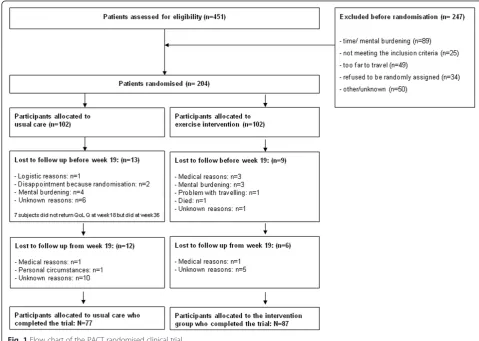
Between January 2010 and December 2012, 451 breast cancer patients were invited to participate in the study (Fig. 1); 204 signed informed consent. The reasons for non-participation (n = 247) were ineligibility (n = 25), time/mental burden (n = 89), travel distance to hospital (n = 49), problem with random assignment (n = 34), or unknown (n = 50).
Overall, 15 of 102 participants allocated to the inter-vention group and 25 of 102 control group participants were lost to follow-up during the 36-week study period. In general, participants who did not complete the study (participants who did not come for outcome assessment at week 36) were at baseline significantly heavier, more fatigued, and reported more anxiety (results not shown).
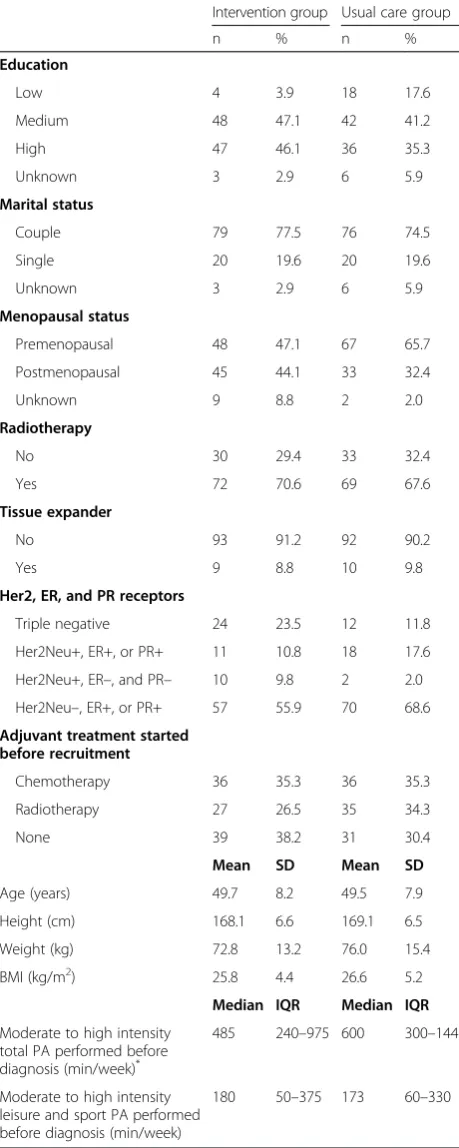
At baseline, participants in the intervention and usual care group were comparable on most characteristics (Table 1) except that more women in the intervention
group were highly educated (46.1 % vs. 35.3 %, respect-ively), had triple negative breast cancer (23.5 % vs. 11.8 %), and were post-menopausal (44.1 % vs. 32.4 %). Total physical activity levels (including activity at work) tended to be higher in the control group, whereas moderate-to-high leisure and sport physical activity levels were similar in both groups.
The PACT study with a duration of 18 weeks and a start within 6 weeks after diagnosis coincided with (all or part of ) chemotherapy treatment in all patients; 72 patients had already started chemotherapy at recruit-ment; 62 patients had not started chemotherapy yet, but had started radiotherapy; and 70 patients had not started any treatment yet, but would start with chemotherapy early during the intervention period. Neo-adjuvant chemotherapy was still rare, and was used in less than 5 % of PACT participants. Treatment status at baseline was balanced between groups (Table 1).
Adherence
Patients in the intervention group showed good adher-ence to the exercise programme: they participated in 83 % (interquartile range, 69 %–91 %) of the classes offered. Patients reported to be physically active ac-cording to the Dutch guideline for physical activity in 11 (interquartile range, 6–14) of the 18 weeks.
Main outcomes
Fatigue
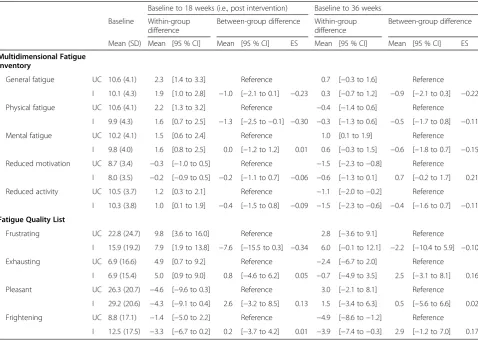
From pre- to post-intervention, participants in both groups reported significant increases in fatigue (Table 2). The increase in physical fatigue was significantly lower in the intervention group compared to control (mean between-group difference: −1.3; 95 % CI, −2.5 to −0.1; ES =−0.30). Although increases in general and mental fatigue, and in reduced activity were generally lower in the intervention group, no significant between-group differences were found. Over the same period, partici-pants of both groups rated, on average to a comparable extent, their fatigue as more frustrating and exhausting. At 36 weeks, women reported fatigue levels and fatigue-related feelings that were in general similar to those ob-served at baseline with the exception of mental fatigue in the usual care group, which was reported to be still higher (mean: 1.0; 95 % CI, 0.1 to 1.9). No significant differences between the exercise and the usual care groups were found. No interaction was found between group assignment and chemotherapy timing (P>0.05).
QoL and anxiety and depression
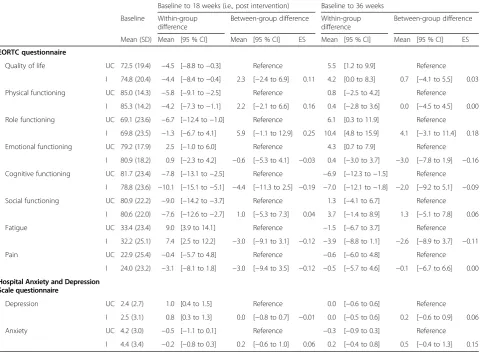
At 18 weeks, all participants generally reported signifi-cant decreases in QoL and in physical, cognitive, and so-cial functioning as well as an increase in depression score, but none of these effects differed significantly Table 1Baseline characteristics of the participants of the
PACT study
Intervention group Usual care group
n % n %
Education
Low 4 3.9 18 17.6
Medium 48 47.1 42 41.2
High 47 46.1 36 35.3
Unknown 3 2.9 6 5.9
Marital status
Couple 79 77.5 76 74.5
Single 20 19.6 20 19.6
Unknown 3 2.9 6 5.9
Menopausal status
Premenopausal 48 47.1 67 65.7
Postmenopausal 45 44.1 33 32.4
Unknown 9 8.8 2 2.0
Radiotherapy
No 30 29.4 33 32.4
Yes 72 70.6 69 67.6
Tissue expander
No 93 91.2 92 90.2
Yes 9 8.8 10 9.8
Her2, ER, and PR receptors
Triple negative 24 23.5 12 11.8
Her2Neu+, ER+, or PR+ 11 10.8 18 17.6
Her2Neu+, ER–, and PR– 10 9.8 2 2.0
Her2Neu–, ER+, or PR+ 57 55.9 70 68.6
Adjuvant treatment started before recruitment
Chemotherapy 36 35.3 36 35.3
Radiotherapy 27 26.5 35 34.3
None 39 38.2 31 30.4
Mean SD Mean SD
Age (years) 49.7 8.2 49.5 7.9
Height (cm) 168.1 6.6 169.1 6.5
Weight (kg) 72.8 13.2 76.0 15.4
BMI (kg/m2) 25.8 4.4 26.6 5.2
Median IQR Median IQR
Moderate to high intensity total PA performed before diagnosis (min/week)*
485 240–975 600 300–1440
Moderate to high intensity leisure and sport PA performed before diagnosis (min/week)
180 50–375 173 60–330
IQRinterquartile range,PAphysical activity
*
between groups (Table 3). At 36 weeks, participants’ QoL and role functioning in both groups had signifi-cantly increased compared to baseline while cognitive functioning had slightly decreased, but no significant dif-ferences were observed between groups. Using the SF-36 (Additional file 1: Table S1), a significant between-group difference was observed at 18 weeks for the item‘change in health’with a difference in favour of the intervention group (mean: 11.3; 95 % CI, 3.4 to 19.1; ES = 0.47). At 36 weeks, both groups report higher scores for mental health, and the improvement was significantly lower in the intervention group (mean: −4.0; 95 % CI, −7.8 to−0.1; ES =−0.26).
Physical fitness and body weight
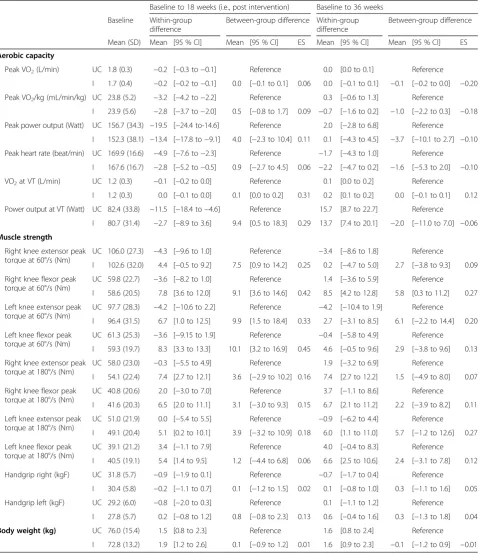
At 18 weeks no significant between-group differences in VO2peakand peak power output were observed. For VO2
and power output at ventilatory threshold significant dif-ferences in favour of the intervention group of 0.1 L/min (95 % CI, 0.0 to 0.2; ES = 0.31) and 9.4 W (95 % CI, 0.5 to 18.3; ES = 0.29) were respectively observed (Table 4). At 36 weeks, aerobic capacity did not differ between groups.
At 18 weeks, muscle strength in the intervention group was significantly higher for flexion and exten-sion of both legs at 60°/s when compared to control (ES = 0.25–0.45; Table 4). No significant differences between groups were observed at 180°/s and for hand grip strength. Body weight at 18 and 36 weeks was similarly increased in both groups (Table 4).
Per-protocol analyses
Overall, 89 % of intervention participants and 56 % of control participants reported being active with a Table 2Effect of exercise on fatigue based on an intention-to-treat analysis
Baseline to 18 weeks (i.e., post intervention) Baseline to 36 weeks
Baseline Within-group difference
Between-group difference Within-group difference
Between-group difference
Mean (SD) Mean [95 % CI] Mean [95 % CI] ES Mean [95 % CI] Mean [95 % CI] ES
Multidimensional Fatigue Inventory
General fatigue UC 10.6 (4.1) 2.3 [1.4 to 3.3] Reference 0.7 [−0.3 to 1.6] Reference
I 10.1 (4.3) 1.9 [1.0 to 2.8] −1.0 [−2.1 to 0.1] −0.23 0.3 [−0.7 to 1.2] −0.9 [−2.1 to 0.3] −0.22
Physical fatigue UC 10.6 (4.1) 2.2 [1.3 to 3.2] Reference −0.4 [−1.4 to 0.6] Reference
I 9.9 (4.3) 1.6 [0.7 to 2.5] −1.3 [−2.5 to−0.1] −0.30 −0.3 [−1.3 to 0.6] −0.5 [−1.7 to 0.8] −0.11
Mental fatigue UC 10.2 (4.1) 1.5 [0.6 to 2.4] Reference 1.0 [0.1 to 1.9] Reference
I 9.8 (4.0) 1.6 [0.8 to 2.5] 0.0 [−1.2 to 1.2] 0.01 0.6 [−0.3 to 1.5] −0.6 [−1.8 to 0.7] −0.15
Reduced motivation UC 8.7 (3.4) −0.3 [−1.0 to 0.5] Reference −1.5 [−2.3 to−0.8] Reference
I 8.0 (3.5) −0.2 [−0.9 to 0.5] −0.2 [−1.1 to 0.7] −0.06 −0.6 [−1.3 to 0.1] 0.7 [−0.2 to 1.7] 0.21
Reduced activity UC 10.5 (3.7) 1.2 [0.3 to 2.1] Reference −1.1 [−2.0 to−0.2] Reference
I 10.3 (3.8) 1.0 [0.1 to 1.9] −0.4 [−1.5 to 0.8] −0.09 −1.5 [−2.3 to−0.6] −0.4 [−1.6 to 0.7] −0.11
Fatigue Quality List
Frustrating UC 22.8 (24.7) 9.8 [3.6 to 16.0] Reference 2.8 [−3.6 to 9.1] Reference
I 15.9 (19.2) 7.9 [1.9 to 13.8] −7.6 [−15.5 to 0.3] −0.34 6.0 [−0.1 to 12.1] −2.2 [−10.4 to 5.9] −0.10
Exhausting UC 6.9 (16.6) 4.9 [0.7 to 9.2] Reference −2.4 [−6.7 to 2.0] Reference
I 6.9 (15.4) 5.0 [0.9 to 9.0] 0.8 [−4.6 to 6.2] 0.05 −0.7 [−4.9 to 3.5] 2.5 [−3.1 to 8.1] 0.16
Pleasant UC 26.3 (20.7) −4.6 [−9.6 to 0.3] Reference 3.0 [−2.1 to 8.1] Reference
I 29.2 (20.6) −4.3 [−9.1 to 0.4] 2.6 [−3.2 to 8.5] 0.13 1.5 [−3.4 to 6.3] 0.5 [−5.6 to 6.6] 0.02
Frightening UC 8.8 (17.1) −1.4 [−5.0 to 2.2] Reference −4.9 [−8.6 to−1.2] Reference
I 12.5 (17.5) −3.3 [−6.7 to 0.2] 0.2 [−3.7 to 4.2] 0.01 −3.9 [−7.4 to−0.3] 2.9 [−1.2 to 7.0] 0.17
ESeffect size,Iintervention group,UCusual care group
Except for the pleasant dimension of the Fatigue Quality List, negative ES for fatigue dimensions indicate effects in favour of the exercise intervention group Between-group effects were assessed using mixed models including the measurements obtained at 18 and 36 weeks, adjusted for age, hospital, radiotherapy, use of tissue expander, receptor status and the value of the outcome variable at baseline
Within-group effects were assessed using mixed models including the measurements obtained at baseline, 18 and 36 weeks, adjusted for age, hospital, radiotherapy, use of tissue expander, and receptor status
moderate-to-high intensity for ≥210 min per week (120 min of supervised exercise and at least 30 min of unsupervised exercise on three other days). Per-protocol analyses showed, for both general and physical fatigue, moderate significant differences between participants, in both the exercise and the usual care group, who adhered to the protocol in favour of the intervention group with ef-fect sizes of−0.54 and−0.77, respectively (Additional file 1: Table S2).
No serious adverse events related to exercise were ob-served during the study period.
Discussion
The PACT study shows that an 18-week exercise inter-vention offered in routine clinical practice and starting
shortly after breast cancer diagnosis has significant beneficial effects on physical fatigue, submaximal cardio-respiratory fitness, and muscle strength at 18 weeks compared to usual care. In the long-term, at 36 weeks, when adjuvant chemotherapy was completed, fatigue and fitness levels in both groups had returned to base-line levels. The intervention did not significantly affect QoL, anxiety, or depression.
The early start of our exercise intervention in breast cancer treatment coincided with adjuvant treatment. We therefore observed increased levels of fatigue at 18 weeks in both groups. However, the increase in the interven-tion group was significantly lower than for controls. The START trial, one large study comparable to our study, included 242 breast cancer patients receiving adjuvant Table 3Effect of exercise on quality of life, anxiety, and depression based on an intention-to-treat analysis
Baseline to 18 weeks (i.e., post intervention) Baseline to 36 weeks
Baseline Within-group difference
Between-group difference Within-group difference
Between-group difference
Mean (SD) Mean [95 % CI] Mean [95 % CI] ES Mean [95 % CI] Mean [95 % CI] ES
EORTC questionnaire
Quality of life UC 72.5 (19.4) −4.5 [−8.8 to−0.3] Reference 5.5 [1.2 to 9.9] Reference
I 74.8 (20.4) −4.4 [−8.4 to−0.4] 2.3 [−2.4 to 6.9] 0.11 4.2 [0.0 to 8.3] 0.7 [−4.1 to 5.5] 0.03
Physical functioning UC 85.0 (14.3) −5.8 [−9.1 to−2.5] Reference 0.8 [−2.5 to 4.2] Reference
I 85.3 (14.2) −4.2 [−7.3 to−1.1] 2.2 [−2.1 to 6.6] 0.16 0.4 [−2.8 to 3.6] 0.0 [−4.5 to 4.5] 0.00
Role functioning UC 69.1 (23.6) −6.7 [−12.4 to−1.0] Reference 6.1 [0.3 to 11.9] Reference
I 69.8 (23.5) −1.3 [−6.7 to 4.1] 5.9 [−1.1 to 12.9] 0.25 10.4 [4.8 to 15.9] 4.1 [−3.1 to 11.4] 0.18
Emotional functioning UC 79.2 (17.9) 2.5 [−1.0 to 6.0] Reference 4.3 [0.7 to 7.9] Reference
I 80.9 (18.2) 0.9 [−2.3 to 4.2] −0.6 [−5.3 to 4.1] −0.03 0.4 [−3.0 to 3.7] −3.0 [−7.8 to 1.9] −0.16
Cognitive functioning UC 81.7 (23.4) −7.8 [−13.1 to−2.5] Reference −6.9 [−12.3 to−1.5] Reference
I 78.8 (23.6) −10.1 [−15.1 to−5.1] −4.4 [−11.3 to 2.5] −0.19 −7.0 [−12.1 to−1.8] −2.0 [−9.2 to 5.1] −0.09
Social functioning UC 80.9 (22.2) −9.0 [−14.2 to−3.7] Reference 1.3 [−4.1 to 6.7] Reference
I 80.6 (22.0) −7.6 [−12.6 to−2.7] 1.0 [−5.3 to 7.3] 0.04 3.7 [−1.4 to 8.9] 1.3 [−5.1 to 7.8] 0.06
Fatigue UC 33.4 (23.4) 9.0 [3.9 to 14.1] Reference −1.5 [−6.7 to 3.7] Reference
I 32.2 (25.1) 7.4 [2.5 to 12.2] −3.0 [−9.1 to 3.1] −0.12 −3.9 [−8.8 to 1.1] −2.6 [−8.9 to 3.7] −0.11
Pain UC 22.9 (25.4) −0.4 [−5.7 to 4.8] Reference −0.6 [−6.0 to 4.8] Reference
I 24.0 (23.2) −3.1 [−8.1 to 1.8] −3.0 [−9.4 to 3.5] −0.12 −0.5 [−5.7 to 4.6] −0.1 [−6.7 to 6.6] 0.00
Hospital Anxiety and Depression Scale questionnaire
Depression UC 2.4 (2.7) 1.0 [0.4 to 1.5] Reference 0.0 [−0.6 to 0.6] Reference
I 2.5 (3.1) 0.8 [0.3 to 1.3] 0.0 [−0.8 to 0.7] −0.01 0.0 [−0.5 to 0.6] 0.2 [−0.6 to 0.9] 0.06
Anxiety UC 4.2 (3.0) −0.5 [−1.1 to 0.1] Reference −0.3 [−0.9 to 0.3] Reference
I 4.4 (3.4) −0.2 [−0.8 to 0.3] 0.2 [−0.6 to 1.0] 0.06 0.2 [−0.4 to 0.8] 0.5 [−0.4 to 1.3] 0.15
ESeffect size,Iintervention group,UCusual care group
Negative ES for fatigue, pain, anxiety, and depression and positive ES for quality of life, physical functioning, role functioning, emotional functioning, cognitive functioning and social functioning indicate effects in favour of the exercise intervention group
Between-group effects were assessed using mixed models including the measurements obtained at 18 and 36 weeks, adjusted for age, hospital, radiotherapy, use of tissue expander, receptor status and the value of the outcome variable at baseline
Within-group effects were assessed using mixed models including the measurements obtained at baseline, 18 and 36 weeks, adjusted for age, hospital, radiotherapy, use of tissue expander, and receptor status
Table 4Effect of exercise on aerobic capacity and muscle strength based on an intention-to-treat analysis
Baseline to 18 weeks (i.e., post intervention) Baseline to 36 weeks
Baseline Within-group difference
Between-group difference Within-group difference
Between-group difference
Mean (SD) Mean [95 % CI] Mean [95 % CI] ES Mean [95 % CI] Mean [95 % CI] ES
Aerobic capacity
Peak VO2(L/min) UC 1.8 (0.3) −0.2 [−0.3 to−0.1] Reference 0.0 [0.0 to 0.1] Reference
I 1.7 (0.4) −0.2 [−0.2 to−0.1] 0.0 [−0.1 to 0.1] 0.06 0.0 [−0.1 to 0.1] −0.1 [−0.2 to 0.0] −0.20
Peak VO2/kg (mL/min/kg) UC 23.8 (5.2) −3.2 [−4.2 to−2.2] Reference 0.3 [−0.6 to 1.3] Reference
I 23.9 (5.6) −2.8 [−3.7 to−2.0] 0.5 [−0.8 to 1.7] 0.09 −0.7 [−1.6 to 0.2] −1.0 [−2.2 to 0.3] −0.18
Peak power output (Watt) UC 156.7 (34.3) −19.5 [−24.4 to-14.6] Reference 2.0 [−2.8 to 6.8] Reference
I 152.3 (38.1) −13.4 [−17.8 to−9.1] 4.0 [−2.3 to 10.4] 0.11 0.1 [−4.3 to 4.5] −3.7 [−10.1 to 2.7] −0.10
Peak heart rate (beat/min) UC 169.9 (16.6) −4.9 [−7.6 to−2.3] Reference −1.7 [−4.3 to 1.0] Reference
I 167.6 (16.7) −2.8 [−5.2 to−0.5] 0.9 [−2.7 to 4.5] 0.06 −2.2 [−4.7 to 0.2] −1.6 [−5.3 to 2.0] −0.10
VO2at VT (L/min) UC 1.2 (0.3) −0.1 [−0.2 to 0.0] Reference 0.1 [0.0 to 0.2] Reference
I 1.2 (0.3) 0.0 [−0.1 to 0.0] 0.1 [0.0 to 0.2] 0.31 0.2 [0.1 to 0.2] 0.0 [−0.1 to 0.1] 0.12
Power output at VT (Watt) UC 82.4 (33.8) −11.5 [−18.4 to−4.6] Reference 15.7 [8.7 to 22.7] Reference
I 80.7 (31.4) −2.7 [−8.9 to 3.6] 9.4 [0.5 to 18.3] 0.29 13.7 [7.4 to 20.1] −2.0 [−11.0 to 7.0] −0.06
Muscle strength
Right knee extensor peak torque at 60°/s (Nm)
UC 106.0 (27.3) −4.3 [−9.6 to 1.0] Reference −3.4 [−8.6 to 1.8] Reference
I 102.6 (32.0) 4.4 [−0.5 to 9.2] 7.5 [0.9 to 14.2] 0.25 0.2 [−4.7 to 5.0] 2.7 [−3.8 to 9.3] 0.09
Right knee flexor peak torque at 60°/s (Nm)
UC 59.8 (22.7) −3.6 [−8.2 to 1.0] Reference 1.4 [−3.6 to 5.9] Reference
I 58.6 (20.5) 7.8 [3.6 to 12.0] 9.1 [3.6 to 14.6] 0.42 8.5 [4.2 to 12.8] 5.8 [0.3 to 11.2] 0.27
Left knee extensor peak torque at 60°/s (Nm)
UC 97.7 (28.3) −4.2 [−10.6 to 2.2] Reference −4.2 [−10.4 to 1.9] Reference
I 96.4 (31.5) 6.7 [1.0 to 12.5] 9.9 [1.5 to 18.4] 0.33 2.7 [−3.1 to 8.5] 6.1 [−2.2 to 14.4] 0.20
Left knee flexor peak torque at 60°/s (Nm)
UC 61.3 (25.3) −3.6 [−9.15 to 1.9] Reference −0.4 [−5.8 to 4.9] Reference
I 59.3 (19.7) 8.3 [3.3 to 13.3] 10.1 [3.2 to 16.9] 0.45 4.6 [−0.5 to 9.6] 2.9 [−3.8 to 9.6] 0.13
Right knee extensor peak torque at 180°/s (Nm)
UC 58.0 (23.0) −0.3 [−5.5 to 4.9] Reference 1.9 [−3.2 to 6.9] Reference
I 54.1 (22.4) 7.4 [2.7 to 12.1] 3.6 [−2.9 to 10.2] 0.16 7.4 [2.7 to 12.2] 1.5 [−4.9 to 8.0] 0.07
Right knee flexor peak torque at 180°/s (Nm)
UC 40.8 (20.6) 2.0 [−3.0 to 7.0] Reference 3.7 [−1.1 to 8.6] Reference
I 41.6 (20.3) 6.5 [2.0 to 11.1] 3.1 [−3.0 to 9.3] 0.15 6.7 [2.1 to 11.2] 2.2 [−3.9 to 8.2] 0.11
Left knee extensor peak torque at 180°/s (Nm)
UC 51.0 (21.9) 0.0 [−5.4 to 5.5] Reference −0.9 [−6.2 to 4.4] Reference
I 49.1 (20.4) 5.1 [0.2 to 10.1] 3.9 [−3.2 to 10.9] 0.18 6.0 [1.1 to 11.0] 5.7 [−1.2 to 12.6] 0.27
Left knee flexor peak torque at 180°/s (Nm)
UC 39.1 (21.2) 3.4 [−1.1 to 7.9] Reference 4.0 [−0.4 to 8.3] Reference
I 40.5 (19.1) 5.4 [1.4 to 9.5] 1.2 [−4.4 to 6.8] 0.06 6.6 [2.5 to 10.6] 2.4 [−3.1 to 7.8] 0.12
Handgrip right (kgF) UC 31.8 (5.7) −0.9 [−1.9 to 0.1] Reference −0.7 [−1.7 to 0.4] Reference
I 30.4 (5.8) −0.2 [−1.1 to 0.7] 0.1 [−1.2 to 1.5] 0.02 0.1 [−0.8 to 1.0] 0.3 [−1.1 to 1.6] 0.05
Handgrip left (kgF) UC 29.2 (6.0) −0.8 [−2.0 to 0.3] Reference 0.1 [−1.1 to 1.2] Reference
I 27.8 (5.7) 0.2 [−0.8 to 1.2] 0.8 [−0.8 to 2.3] 0.13 0.6 [−0.4 to 1.6] 0.3 [−1.3 to 1.8] 0.04
Body weight (kg) UC 76.0 (15.4) 1.5 [0.8 to 2.3] Reference 1.6 [0.8 to 2.4] Reference
I 72.8 (13.2) 1.9 [1.2 to 2.6] 0.1 [−0.9 to 1.2] 0.01 1.6 [0.9 to 2.3] −0.1 [−1.2 to 0.9] −0.01
VTventilatory threshold,ESeffect size,Iintervention group,UCusual care group
Between-group effects were assessed using mixed models including the measurements obtained at 18 and 36 weeks, adjusted for age, hospital, radiotherapy, use of tissue expander, tumour receptor status, and the value of the outcome variable at baseline
Within-group effects were assessed using mixed models including the measurements obtained at baseline, 18 and 36 weeks, adjusted for age, hospital, radiotherapy, use of tissue expander, and tumour receptor status
Baseline results and within-group differences were based on participants having baseline measurements: body weight: 102 intervention (I) and 102 usual care (UC), aerobic capacity: 101 (I) and 98 (UC), leg strength: 78 (I) and 79 (UC), and hand grip: 98 (I) and 100 (UC)
treatment and showed changes in fatigue, QoL, anxiety, and depression that favoured the exercise intervention group but results were not statistically significant [24]. A study by Mutrie et al. [25] included 203 women in a 12-week supervised group exercise programme starting on average 6 months after diagnosis and also found non-significant beneficial effects of the intervention on fa-tigue and QoL. In contrast with these trials, we used a multi-dimensional fatigue scale and found a beneficial effect of the intervention on physical fatigue. Physical fa-tigue might be the fafa-tigue dimension most sensitive to exercise. Indeed, Steindorf et al. [10] and Schmidt et al. [11], who compared the effects of resistance exercise and muscle relaxation on breast cancer patients’fatigue during adjuvant therapy, also found beneficial effects especially on physical fatigue (ES = 0.3).
At 36 weeks, fatigue levels were back to baseline in both groups. This lack of difference might be explained by the fact that, from week 18, for ethical reasons, controls were allowed to participate in exercise pro-grammes. Nevertheless, our results show long-term fa-tigue levels comparable across groups, and therefore it might be worth offering exercise interventions starting as early as possible after diagnosis to help breast cancer patients go through one of the most distressing periods of their life.
The non-significant changes in QoL corroborate the results of the START study [24]. The BEATE study also found no effect on QoL, but reported significant in-creases in role and social functioning after a resistance intervention offered during adjuvant chemotherapy [10]. These differences might be partly explained by the higher baseline scores observed in the present study or the exclusion of patients with baseline depression in the corresponding QoL analyses in the BEATE study.
The biological mechanisms that explain the beneficial effect of exercise on physical fatigue are not clear. Hy-potheses include involvement in neurotoxicity of cancer treatments, chronic stress affecting the hypothalamic-pituitary-adrenal axis, systemic inflammatory responses, hormonal changes, reduced anaemia, or immune activa-tion [2]. Skeletal muscles may act as an endocrine organ and induce myokine production associated with a re-duced production and release of pro-inflammatory cyto-kines [26, 27]. Furthermore, while a self-perpetuating detraining state induces fatigue, physical training may break this vicious cycle [28]. Additionally, psychosocial mechanisms might play a role. Buffart et al. [29] showed that a supervised exercise program resulted in increased physical activity, general self-efficacy, and mastery in pa-tients with cancer after treatment, which led to reduced fatigue and distress and consequently improved QoL.
The PACT exercise intervention also had beneficial effects on submaximal cardiorespiratory fitness and
muscle strength, which corroborates findings from pre-vious studies indicating that exercise during adjuvant treatment can prevent part of the deconditioning effect observed during cancer treatment [24, 30, 31]. Interest-ingly, in PACT, exercising during treatment did not only prevent losses but improved muscle strength. The sig-nificant results observed at submaximal level seem im-portant since most daily activities are performed at submaximal level.
Compared to previous related studies [10, 11, 24, 25], the PACT study differed in the timing (i.e., early in the treatment process) and location (i.e., at the treating hospitals) of the intervention. In previous studies, the intervention was mostly delivered by the same physio-therapist(s) at a well-equipped research centre. In daily practice, however, the intervention will be given at dif-ferent sites with difdif-ferent physiotherapists. The PACT study used this latter more pragmatic design. Although physiotherapists worked according to a standardized protocol the different locations may have added variabil-ity and reduced intervention effects. However, external generalizability is increased.
Strong features of the present study are the random-ized design, the large sample size, and the high adher-ence to a supervised intervention offered in different clinical settings by different physiotherapists. Another feature resembling daily practice is that the intervention started within 6 weeks after diagnosis irrespective of the start of adjuvant treatment. Although no significant interaction was observed between group assignment and chemotherapy timing, treatment side-effects may have added variability to outcome measurements. The present study also has some limitations. Participants in the current study reported, on average, a high pre-diagnosis physical activity level and might thus not be the ones who needed the program most. The high level of phys-ical activity reported by 56 % of the controls at 18 weeks may have led to an underestimation of the true effect. Indeed, per-protocol analyses showed that effects be-came stronger (e.g., ES =−0.77 for physical fatigue). However, per-protocol analyses should be interpreted with caution because of selective non-compliance. We offered a combined aerobic and strength exercise pro-gram to the patients. Therefore, we cannot distinguish what type of activity might have driven our results. Other limitations include the fact that physical activity was assessed by a questionnaire, as well as the relatively low participation rate and the lack of detailed informa-tion on patients who refused participainforma-tion hampering generalization of results.
Future directions
Women with low physical activity levels might benefit more from exercise programs, although they might also be less interested in participating. Future studies should elucidate patients’ attitude, motivation, and barriers towards participation in exercise programs in order to specifically design exercise programs for the less active patients.
Conclusions
The PACT trial shows that an exercise intervention of-fered in the daily clinical practice and starting early dur-ing adjuvant treatment is feasible and safe. The 18-week supervised exercise intervention reduces short-term physical fatigue and diminishment of cardiorespiratory fitness and improves muscle strength. At 36 weeks, ef-fects were no longer statistically significant, probably due to participants’high activity levels during follow-up. Exercise is beneficial during adjuvant breast cancer treat-ment by reducing the developtreat-ment of fatigue.
Additional file
Additional file 1: Table S1.Effect of exercise on quality of life assessed using the SF-36 based on an intention-to-treat analysis.Table S2.Effect of the intervention on fatigue and quality of life taking into account compliance to study protocol.
Abbreviations
ES:Effect size; FQL: Fatigue quality list; MFI: Multidimensional fatigue inventory; PACT: Physical activity during cancer treatment; QoL: Quality of life; SD: Standard deviation; SF-36: 36-Item short form health survey; SQUASH: Short questionnaire to assess health enhancing physical activity; VO2peak: Peak oxygen uptake.
Competing interests
The authors declare that they have no competing interests.
Authors’contributions
MJV, PHMP, EW, and AMM initiated the collaborative project. MJV, EMM, ML, FE, HJB, CR, MAJR, MV, DBH, PHMP, EW, and AMM planned the project. MJV, BB, CNSB, FB, and AMM collected the data. ML, FE, HJB, CR, MAJR, MV, DBH, and EW provided the clinical expertise. NT, MJV, CNSB, PHMP, EW, and AMM were responsible for data handling and data analyses. ML, FE, HJB, CR, MAJR, MV, and DBH recruited participants. NT, MJV, PHMP, and AMM wrote the first draft, and all authors contributed and approved the final version of the manuscript for publication.
Acknowledgements
We would like to thank the participants and the professional staff at St. Antonius Hospital, Nieuwegein and Utrecht; Diakonessen Hospital, Utrecht; Meander Medical Centre, Amersfoort; Rivierenland Hospital, Tiel; Orbis Medical Centre, Sittard; Zuwe Hofpoort Hospital, Woerden and University Medical Center Utrecht, The Netherlands. Their participation made this study possible.
This work was supported by The Netherlands Organisation for Health Research and Development (ZonMw, project number: 171002202), the Dutch Cancer Society (KWF Kankerbestrijding, Project number: UU 2009–4473), and the Dutch Pink Ribbon Foundation (2011.WO02.C100). The contribution of N Travier was supported by the Spanish Ministry of Health (Instituto de Salud Carlos III RTICC RD06/0020/0091 and RD12/0036/0018).
Author details
1
Julius Center for Health Sciences and Primary Care, University Medical Center Utrecht, PO Box 85500, STR 6.131, 3508 GA Utrecht, The Netherlands.
2Unit of Nutrition and Cancer, Catalan Institute of Oncology (ICO-IDIBELL), Barcelona 08907, Spain.3Department of Clinical Sciences, University of Barcelona, Barcelona 08907, Spain.4Comprehensive Cancer Organisation (IKNL), PO Box 19079, 3501 DB Utrecht, The Netherlands.5Department of Rehabilitation, Nursing Sciences and Sport, University Medical Center Utrecht, Heidelberglaan 100, 3584 CG Utrecht, The Netherlands.6Medical Oncology, St. Antonius Ziekenhuis, Koekoekslaan 1, 3435 CM Nieuwegein, The Netherlands.7Internal Medicine–Medical Oncology, Obis Medisch Centrum, Dr vander Hoffplein 1, 6166 BG Sittard-Geleen, The Netherlands.8Department of Internal Medicine, Medical Center, Maatweg 3, 3818 TZ Amersfoort, The Netherlands.9Department of Radiation Oncology, University Medical Center Utrecht, Heidelberglaan 100, 3584 CG Utrecht, The Netherlands.
10Department of Surgery, Ziekenhuis Rivierenland, President Kennedylaan 1, 4002 WP Tiel, The Netherlands.11Department of internal medicine, Hofpoort Ziekenhuis, Polanerbaan 2, 3447 GN Woerden, The Netherlands.12Internal Medicine, Diakonessenhuis, Bosboomstraat 1, 3582 KE Utrecht, The Netherlands.13Cancer Center, University Medical Center Utrecht, Heidelberglaan 100, 3584 CX Utrecht, The Netherlands.
Received: 21 January 2015 Accepted: 8 May 2015
References
1. Cleeland CS, Zhao F, Chang VT, Sloan JA, O’Mara AM, Gilman PB, et al. The symptom burden of cancer: evidence for a core set of cancer-related and treatment-related symptoms from the eastern cooperative oncology group symptom outcomes and practice patterns study. Cancer. 2013;119:4333–40. 2. Stan D, Loprinzi CL, Ruddy KJ. Breast cancer survivorship issues. Hematol
Oncol Clin North Am. 2013;27:805–27.
3. Bower JE. Cancer-related fatigue–mechanisms, risk factors, and treatments. Nat Rev Clin Oncol. 2014;11:597–609.
4. Speck RM, Courneya KS, Masse LC, Duval S, Schmitz KH. An update of controlled physical activity trials in cancer survivors: a systematic review and meta-analysis. J Cancer Surviv. 2010;4:87–100.
5. Cramp F, Byron-Daniel J. Exercise for the management of cancer-related fatigue in adults. Cochrane Database Syst Rev. 2012;11:CD006145. 6. Mishra SI, Scherer RW, Snyder C, Geigle PM, Berlanstein DR, Topaloglu O.
Exercise interventions on health-related quality of life for people with cancer during active treatment. Cochrane Database Syst Rev. 2012;8:CD008465.
7. Brown JC, Huedo-Medina TB, Pescatello LS, Pescatello SM, Ferrer RA, Johnson BT. Efficacy of exercise interventions in modulating cancer-related fatigue among adult cancer survivors: a meta-analysis. Cancer Epidemiol Biomarkers Prev. 2011;20:123–33.
8. Carayol M, Bernard P, Boiche J, Riou F, Mercier B, Cousson-Gélie F, et al. Psychological effect of exercise in women with breast cancer receiving adjuvant therapy: what is the optimal dose needed? Ann Oncol. 2013;24:291–300.
9. Carayol M, Delpierre C, Bernard P, Ninot G. Population-, intervention- and methodology-related characteristics of clinical trials impact exercise efficacy during adjuvant therapy for breast cancer: a meta-regression analysis. Psychooncology. 2014. Ahead of print.
10. Schmidt ME, Wiskemann J, Armbrust P, Schneeweiss A, Ulrich CM, Steindorf K. Effects of resistance exercise on fatigue and quality of life in breast cancer patients undergoing adjuvant chemotherapy: a randomized controlled trial. Int J Cancer. 2015;137:471–80. 11. Steindorf K, Schmidt ME, Klassen O, Ulrich CM, Oelmann J, Habermann N,
et al. Randomized, controlled trial of resistance training in breast cancer patients receiving adjuvant radiotherapy: results on cancer-related fatigue and quality of life. Ann Oncol. 2014;25:2237–43.
12. Velthuis MJ, May AM, Koppejan-Rensenbrink RA, Gijsen BC, van Breda E, de Wit GA, et al. Physical activity during cancer treatment (PACT) study: design of a randomised clinical trial. BMC Cancer. 2010;10:272.
13. Bandura A. Social foundations of thought and action: a social cognitive theory. Englewood Cliffs, NJ: Prentice-Hall; 1986.
14. Kemper H, Ooijendijk W, Stiggelbout M. Consensus about the Dutch physical activity guideline. Tijdschr Soc Geneeskunde. 2000;78:180–3. 15. Smets EM, Garssen B, Bonke B, de Haes JC. The Multidimensional Fatigue
16. Gielissen MF, Knoop H, Servaes P, Kalkman JS, Huibers MJ, Verhagen S, et al. Differences in the experience of fatigue in patients and healthy controls: patients’descriptions. Health Qual Life Outcomes. 2007;5:36.
17. Aaronson NK, Ahmedzai S, Bergman B, Bullinger M, Cull A, Duez NJ, et al. The European Organization for Research and Treatment of Cancer QLQ-C30: a quality-of-life instrument for use in international clinical trials in oncology. J Natl Cancer Inst. 1993;85:365–76.
18. Ware Jr JE, Sherbourne CD. The MOS 36-item short-form health survey (SF-36). I. Conceptual framework and item selection. Med Care. 1992;30:473–83. 19. Aaronson NK, Muller M, Cohen PD, Essink-Bot ML, Fekkes M, Sanderman R,
et al. Translation, validation, and norming of the Dutch language version of the SF-36 Health Survey in community and chronic disease populations. J Clin Epidemiol. 1998;51:1055–68.
20. Osborne RH, Elsworth GR, Sprangers MA, Oort FJ, Hopper JL. The value of the hospital anxiety and depression scale (HADS) for comparing women with early onset breast cancer with population-based reference women. Qual Life Res. 2004;13:191–206.
21. Wasserman K, Hansen J, Sue D, Stringer W, Whipp B. Principles of exercise testing and interpretation. 4th ed. Philadelphia: Lippincott Williams & Wilkins; 2004.
22. Wendel-Vos GC, Schuit AJ, Saris WH, Kromhout D. Reproducibility and relative validity of the short questionnaire to assess health-enhancing physical activity. J Clin Epidemiol. 2003;56:1163–9.
23. Cohen J. Statistical power analysis for the behavioral sciences. 2nd ed. Hillsdale, NJ: Lawrence Earlbaum; 1988.
24. Courneya KS, Segal RJ, Mackey JR, Gelmon K, Reid RD, Friedenreich CM, et al. Effects of aerobic and resistance exercise in breast cancer patients receiving adjuvant chemotherapy: a multicenter randomized controlled trial. J Clin Oncol. 2007;25:4396–404.
25. Mutrie N, Campbell AM, Whyte F, McConnachie A, Emslie C, Lee L, et al. Benefits of supervised group exercise programme for women being treated for early stage breast cancer: pragmatic randomised controlled trial. BMJ. 2007;334:517.
26. Beavers KM, Brinkley TE, Nicklas BJ. Effect of exercise training on chronic inflammation. Clin Chim Acta. 2010;411:785–93.
27. Gleeson M, Bishop NC, Stensel DJ, Lindley MR, Mastana SS, Nimmo MA. The anti-inflammatory effects of exercise: mechanisms and implications for the prevention and treatment of disease. Nat Rev Immunol. 2011;11:607–15. 28. Lucia A, Earnest C, Perez M. Cancer-related fatigue: can exercise physiology
assist oncologists? Lancet Oncol. 2003;4:616–25.
29. Buffart LM, Ros WJ, Chinapaw MJ, Brug J, Knol DL, Korstjens I, et al. Mediators of physical exercise for improvement in cancer survivors’quality of life. Psychooncology. 2014;23:330–8.
30. Markes M, Brockow T, Resch KL. Exercise for women receiving adjuvant therapy for breast cancer. Cochrane Database Syst Rev. 2006;4:CD005001. 31. Stene GB, Helbostad JL, Balstad TR, Riphagen II, Kaasa S, Oldervoll LM. Effect
of physical exercise on muscle mass and strength in cancer patients during treatment–a systematic review. Crit Rev Oncol Hematol. 2013;88:573–93.
Submit your next manuscript to BioMed Central and take full advantage of:
• Convenient online submission
• Thorough peer review
• No space constraints or color figure charges
• Immediate publication on acceptance
• Inclusion in PubMed, CAS, Scopus and Google Scholar
• Research which is freely available for redistribution