Application of Particle Swarm Optimization for
Extracting Global Maximum Power Point in PV
System under Partial Shadow Conditions
Ehtisham Lodhi, Rana Noman Shafqat, and Kerrouche K. D. E
School of Automation Science and Electrical Engineering, BeiHang University, Beijing 100191, China Email: [email protected]
Zeeshan Lodhi
Faculty of Electrical Engineering, COMSATS Institute of Information and Technology, Abbottabad 22060, Pakistan
Abstract—Partial Shadow Conditions (PSC) has great impact on the proficiency of Photovoltaic (PV) system. This causes a devaluation of power from PV module. So, Maximum Power Point Tracking (MPPT) performs an important role to enhance power of PV system under dynamic conditions of weather. During PSC V-P trajectory will become more distinct and very complex due to the availability of numerous peaks. Conventional MPPT methods are fail to reach the Global Maximum Power Point (GMPP), so usually stay in the local maximum peak power point (LMPP) which surely declines the efficiency and performance of the PV module. This paper demonstrates the Particle Swarm Optimization (PSO) approach for tracking of peak power point to identify the GMPP. The PSO approach provides very high proficiency, reliability and robustness towards Maximum Power Point (MPP). The exactness of proposed algorithm is authenticated by using MATLAB/Simulink and results has to be compared with Incremental Conductance (INC) algorithm to show the its enhanced performance in tracking GMMP for a PV system.
Index Terms—Partially Shaded Conditions (PSC), Photovoltaic (PV), Maximum Power Point (MPP), Maximum power Point Tracking (MPPT), Global Peak Power Point (GMPP), Local Maximum Power Point (LMMP), Particle Swarm Optimization (PSO), Incremental Conductance (INC)
I. INTRODUCTION
Currently, the PV system is rapidly flourishing technology worldwide as it exhibits many benefits such as it is free and vital source of energy, it is environmental friendly in nature and offer less maintenance cost. Although, with PV system still facing some challenging issues such as low efficiency conversion, huge installation cost and less accessible power [1]-[3]. It is important to acquire extreme amount of power from the PV system because of high investment cost on solar panel. The generation of power from PV system deliberately reliance on temperature and intensity of irradiance. But these constraints vary with respect to time; it is obligatory
Manuscript received March 3, 2017; revised June 29, 2017.
to propose a MPPT method that can trace the maximal power from system during real time.
Nowadays, the most severe concern of the PV system assumed to be Partial shadow conditions (PSC). This condition can be occurred because of obstacles alike clouds, trees, buildings, towers, and etc. PSC consequences in the origination of hot spot phenomena in the solar module [4] and [5]. In order to eliminate or reduce the self-heating of these modules, there is a need of bypass diode that are connected crosswise the array. Partial Shadow Conditions (PSC) has great impact on the proficiency of Photovoltaic (PV) system. This causes a devaluation of power from PV module, which reliance on arrangement of PV cells, amount of bypass diodes utilized and pattern of shading. Existence of bypass diode in system swings the PV trajectory into further complex shape and display numerous peaks [6] and [7]. So, the conventional algorithm puzzles among between global and local peak points, cannot distinguish LMPP from GMPP, which in turn decreases the proficiency towards the maximum power. P&O and INC is frequently used MPPT approach for most of PV systems [8]. P&O approach regularly adds or subtracts the assigned voltage value back on checking the last power pattern value for the sake of MPP. While INC approach can be extracted by differentiating two quantities i.e. power against voltage and keeping the resultant value equal to zero for achieving MPP. When PSC occur, these conventional methods only can detect the LMPP and causes reduction in power. Most of researchers also proposed two stage approaches, Artificial Neural Network (ANN), Direct search algorithm fuzzy logic control [9]-[13]. Nevertheless, these methods are so expensive, time consuming and complex in hardware design.
attained by trial and error method. Swarm intelligence includes Ant Optimization (ANO) and Particle Swarm Optimization (PSO). ANO helps in tracking GMPP but its convergence is slow and also user dependent [16]-[18]. PSO algorithm can also functional to resolve different engineering issue [19] and [20]. This paper utilizes the PSO approach to grip complicated and non-linearity issues of PV module and also for tracing the maximal power point to identify GMPP. The PSO approach provides very high proficiency, reliability and robustness towards GMPP. The accurateness of proposed algorithm is authenticated using MATLAB/Simulink and results has to be compared with Incremental conductance (INC) algorithm to show the its enhanced performance in tracking GMMP for a PV system.
II. PVSYSTEM FORMULATION
The solar cell is usually made up of crystalline silicon (Si) material, which conducts electricity when sunlight is made to fall on solar cell and converts radiations from sun to electrical energy. The proportionate model of a PV cell is presented in Fig. 1. By using Kirchhoff’s current rule (KCL), we can get the load current as shown in equation (1):
Figure 1. Single photovoltaic cell equivalent circuit diagram.
(I.RS V) . . .
[e 1] [ ]
q
I RS V A K T
I Isc IR
Rp
(1)
where
I: Output cell current (A) V: Output cell voltage (V) P: Cell’s power (W)
Isc: Short-circuit current of the cell (A) IR: Reverse saturation current (A) q: Electronic charge (C)
k: Boltzmann’s constant (1.38*10^-23 J / K) T: Temperature of Module (K)
A: Diode ideality factor (1.3)
As the value of bypass current (Ip) is nearly close to zero and the (Rp) that shows the resistance in parallel is huge in amount, so the equation (1) for the output current could be transformed as (2):
( . ) . .
[ 1]
q I RS V A K T I Isc IR e
(2)
Only one PV cell cannot yield sufficient power for different utilities. To obtain power that is acceptable for fulfillment of different demands, many PV cells are associated in parallel and series combination to manage
the maximum energy for utilization. These architecture of the cells are known as PV module. They have capability to produce power according to demand. Let assume (Np) is the quantity of cells arranged in parallel while (Ns) is the number of cells in series. So, now equation (2) will be transformed into (3).
( I.RS V)
. . .
. . [e 1]
Np q
Ns A K T Ns I Np Isc Np IR
(3)
III. BYPASS DIODE FOR PVSYSTEM
In open air, the entire or some portions of the module may be covered by trees, towers, clouds, tall buildings, shadow of arrays on one another and etc. The value of current supplied by means of the covered PV cells will be very less in amount than that of non-covered PV cells. But solar cell must have same current for each branch of PV module. Therefore, when the output is very zero or close to zero than cell starts working in a negative region of voltage, resultantly the voltage of the entire outlet will be decreased. During this time, cells start absorbing power and heat up, result in the origination of hot spot phenomenon [12]. Fig. 2 shows the non-uniform radiations intensity on the PV system because of clouds over some part of PV cells. The outcomes are a lot of power will be consumed and the extreme power of shaded PV array will be condensed with significant amount.
Figure 2. PSC caused by the clouds on PV system.
Figure 3. V-P curves of a PV system under PSC.
connected crosswise the array. Then, V-P trajectory establishes many maxima or peaks point and displays the difference of MPPs in the module. In Fig. 3 the red line shows the MPP with bypass diode while blue line demonstrates the NPP without presence of bypass diodes. It can be assumed that value of voltages crossways to bypass diodes of the partially shaded cell must be equal to zero.
IV. INFLUENCE OF PSC ON PVSYSTEM
There are two important impact of PSC on Solar modules. Firstly, due to origination of hot spot phenomena, PV cells are getting damaged and resultantly output power of the system will be reduced. Secondly, the presence of local peaks in P-V trajectory causes the conventional MPPT techniques alike INC, P&O and CI are usually failed to distinguish between LMPP and GMPP, so it remains in the LMPP. As a result, a lot of power will be lost. The limitation of the MPPT in multiple peak feature is illustrated by employing the case of Incremental conductance (INC) algorithm to track the MPP. During PSC, V-P trajectory of PV module displays numerous numbers of peaks, as shown in Fig. 3. If the initial conditions of the INC algorithm is situated near the point A in the graph, then MPP will be traced. If the initial conditions of the INC algorithm is positioned near the point B or C on the region, these circumstances will compel the PV module to stay in LMPP and resulting in a huge loss in power. So it is compulsory to implement the GMPP tracking algorithm which ignore the LMPP in PV system design [19]. This paper presents the dynamic PSO approach for the tracking of GMPP.
V. PSOALGORITHM FOR TRACKING GMPP
PSO is simple, intelligence optimization and meta heuristic approach. It was proposed by Eberhard and Kennedy in 1995 [20]. PSO is a type of Evolutionary Algorithm (EA) search optimization technique. This idea is originated by the attitude of the birds in group to solve the difficulties involved in optimization or search process. In PSO, every particle of the group evaluates at various positions in a N dimensional search space and travels with a velocity depending on its personal best position i.e. (Pbest) and the best position among the group i.e. (Gbest).
Every unit in a specified group exchange the information in its respective process of search. So, every particle tries to reach closer to optimum solution. The velocity and position of each particle can be expressed as (4-5) [20]:
( 1) ( ) ( ) ( ) ( ) ( ) ( ) ( )
. 1 1.( . - ) 2 2.( - )
k k k k k k k k
vi wg vi c r pb i si c r gb si
(4)
(k 1) ( )k (k 1)
s si vi (5)
where,
i: The number of particles. wg: The weighting function.
vik : The particle i velocity at iteration k.
cj : Time varying social and cognitive factor.
ri: The Random variables distributed uniformly (0 to 1). Sik: The Current position of agent i at iteration k.
pbi: The best position of agent i.
gb: The best position in the group.
Value of inertia weight must be kept low that can make the careful optimization and make the algorithm tracking capacity will be stronger enough to achieve precise solution. Its value ranges from 0.4-0.9.
( ) H ( H L)
H k
w k w w w
k
(6)
In (6),
w
H andw
L are the higher and lower value of w,and kH is the highest number of iterations.
Start
Select Constraints and variables
Intialize particle and velocity
Evaluate the fitness function (9)
Check the personal best and Global best
Update the particle position and velocity in (4) & (5)
Produce new Swarm of particles
Satisfy Termination
Output the Result No
Yes
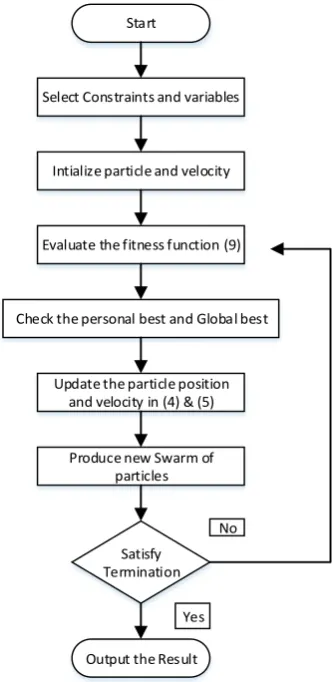
Figure 4. Flow diagram for GMMPT PSO algorithm.
1( ) 1. -H ( . -1H 1. )L H
k
c k c k c c (7)
2( ) 2L ( 2.H 2. )L L
k
c k c k c c (8)
In (3),
c
1 andc
2 can disturb the tracking capability ofPSO by influencing the direction of a different particle. The
c
1,c
2 ranges from 0-2. The PSO algorithm describedissue, the normal form of PSO must be changed to encounter the applied observation regarding to PV system. The flowchart for PSO algorithm that elaborates the working of proposed technique is presented in Fig. 4. The important constraints that are used for the PSO algorithm are listed in Table I. The offered PSO approach is very efficient, independent of the system and can be executed by means of controller. The fitness function of PSO algorithm for tracking GMPP can be expressed as (9):
( )
. .
( , ) ( 1)
q Vp I Rp s
A K T
fitness Vp Ip V Ip sc V Ip R e
(9)
TABLE I. CONSTRAINTS FOR PSOALGORITHM
Parameter Symbol Value
Quantity of particles N 20
Number of cycles CN 500
Weight of Inertia W 0.9
Cognitive Coefficient C1 1.5
Social Coefficient C2 2
The steps that are involved in PSO algorithm for extracting GMPP are as follow:
Initially, PSO originates random particles in a search space. So the velocity of each particle also randomly chosen.
For evaluation and obtaining the fitness value among the particles, provide the solution of candidates to fitness function (9).
Find out the particles personal and best global solution amongst entire particles.
Evaluate and inform the velocity and position of each particle using (4) and (5).
If the condition of convergence is fulfilled, go and stop the search process, if condition is not fulfilling then rise the iteration count and once again starts the evolution of fitness process.
VI. SIMULATIONRESULTS AND ANALYSIS
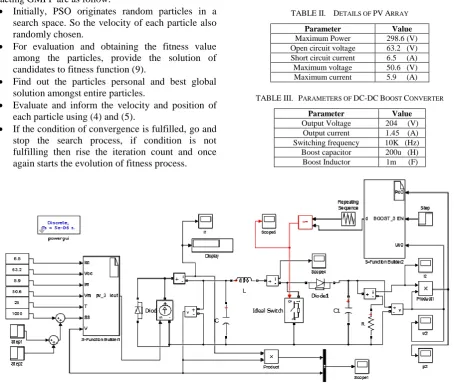
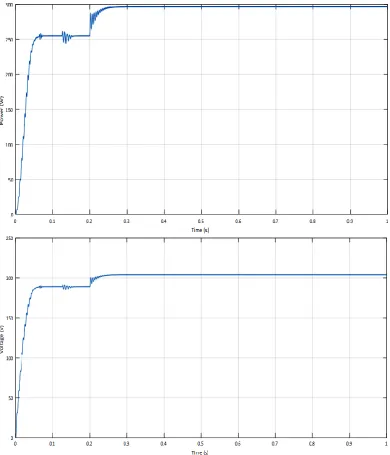
To evaluate the proficiency and robustness of the suggested GMPP tracking method, MATLAB /Simulink is hired. Modeling of solar Module, PSO algorithm and DC-DC converter is designed in MATLAB environment. The code for dynamic PSO algorithm is developed in S-function builder. The constraints of solar module are recorded in Table II while the parameters of DC-DC boost converter are shown in Table III respectively. The comparative examination of suggested PSO approach is made with INC algorithm during varying circumstances. Fig. 5 is used for the simulation layout of whole PV system. The Fig. 6 can be used to visualize the value of result of Power and Voltage by using PSO Algorithm. The maximum power achieved by PSO algorithm during PSC is 297 W, while the value of voltage at this instance is 204.8 V. Similarly, the Fig. 7 it can be seen from the result of Power, Voltage and Current by using INC Algorithm. The maximum power achieved by INC algorithm during PSC is 260 W, while the value of voltage at this instance is 108.3 V. The results obtained from simulation specify that PSO method takes about 0.23sec to attains steady condition in former as contrast with INC method which achieves very late i.e. after 0.7sec.
TABLE II. DETAILS OF PVARRAY
Parameter Value
Maximum Power 298.6 (V) Open circuit voltage 63.2 (V) Short circuit current 6.5 (A) Maximum voltage 50.6 (V) Maximum current 5.9 (A)
TABLE III. PARAMETERS OF DC-DCBOOST CONVERTER
Parameter Value
Output Voltage 204 (V) Output current 1.45 (A) Switching frequency 10K (Hz) Boost capacitor 200u (H) Boost Inductor 1m (F)
Figure 7. INC algorithm result for power and voltage of PV system.
In this paper, the detailed comparison of two (PSO & INC) algorithms in term of power is presented. Which shows that the PSO algorithm traces the GMPP around 298 W, while INC algorithm fails to differentiate between local and global maximum power point and gives power around the local maxima i.e. 260 W. This situation agrees that PSO algorithm is robust to PSC and also during sudden change in weather, however INC is significantly influenced and deviates from GMPP. Since INC technique adopts uniform radiations, owing to PSC that results in origination of multiple peaks, this technique failed to differentiate between GMPP and LMPP, so always give power around LMPP and in this way huge power will be lost.
VII. CONCLUSION
The principal objective of this paper is to present the MPPT method based PSO algorithm for extraction of GMPP for PV system. The suggested PSO technique could be performed appropriately during PSC, pointed the GMPP for achieving a better compare with INC method during PSC. The simulation results operation for PV system. The suggested algorithm also made to depict that PSO is more effectual, has high convergence rate and tracking efficiency of PSO is remarkable as matched to conventional INC algorithm. So, PSO algorithm is matchless in its performance.
REFERENCES
[1] D. J. Swider, et al., “Conditions and costs for renewables electricity grid connection: Examples in Europe,” Renew. Energy, vol. 33, no. 8, pp. 1832-1842, 2008.
[2] A. Elasser, M. Agamy, J. Sabate, R. Steigerwald, R. Fisher, and M. Harfman-Todorovic, “A comparative study of central and distributed MPPT architectures for megawatt utility and large scale commercial photovoltaic plants,” in Proc. 36th Annual Conference on IEEE Industrial Electronics Society, 2010, pp. 2753-2758.
[3] Solar Photovoltaics Fundamental, Technologies and Applications, 2nd ed., Chetan Singh Solanki, PHI Learning Private Limited, 2011, pp. 44-60.
[4] S. Silvestre, A. Boronat, and A. Chouder, “Study of bypass diodes configuration on PV modules,” Appl. Energy, vol. 86, pp. 1632-1640, 2009.
[5] H. Patel and V. Agarwal, “MATLAB-based modeling to study the effects of partial shading on PV array characteristics,” IEEE Trans. Energy Conversion. vol. 23, no. 1, pp. 302-310, Mar. 2008. [6] Y. J. Wang and P. C. Hsu, “Analytical modeling of partial shading
and different orientation of photovoltaic modules,” IET Renew. Power Generation, vol. 4, no. 3, pp. 272-282, May 2010. [7] K. Ishaque and Z. Salam, “The performance of perturb and
observe and incremental conductance maximum power point tracking method under dynamic weather conditions,” Applied Energy, vol. 119, pp. 228-236, 2014.
[8] T. L. Nguyen and K. S. Low, “A global maximum power point tracking scheme employing DIRECT search algorithm for photovoltaic systems,” IEEE Trans. Industrial Electronics, vol. 57, no. 10, pp. 3456-3467, Oct. 2010.
[9] M. Veerachary, T. Senjyu, and K. Uezato, “Neural network-based maximum power point tracking of coupled-inductor interleaved boost converter supplied PV system using fuzzy controller,” IEEE Trans. on Industrial Electronics, vol. 50, no. 4, pp. 749-758, August 2003.
[10] G. V. Quesada, F. G. Gispert, R. P. Lopez, M. R. Lumbreras, and A. C. Roca, “Electrical PV array reconfiguration strategy for energy extraction improvement in grid connected PV systems,” IEEE Trans. Ind. Electron. vol. 56, no. 11, pp. 4319-4331, July 2009.
[11] K. Kobayashi, I. Takano, and Y. Sawada, “A study of a two stage maximum power point tracking control of a photovoltaic system under partially shaded insolation conditions,” in Proc. IEEE Power Engineering Society General Meeting, 2003, p. 2617. [12] J. L. Yi, et al., “Solar hot spot phenomenon and its analysis,”
Chinese Journal of Power Sources, vol. 6, no. 2, pp. 816-818, 2012.
[13] Y. Shaiek and M. Smida, “Comparison between conventional methods and GA approach for MPPT of solar PV generators,” Article in Solar Energy, pp. 107-122, 2013.
[14] S. Gupta, S. Bhardwaj, and P. K. Bhatia, “A reminiscent study of nature inspired computation,” Int. J. Adv. Eng. Technol. IJAET, vol. 1, no. 2, pp. 117-125, 2011.
[15] Z. Salam, J. Ahmed, and B. S. Merugu, “The application of soft computing methods for MPPT of PV system: A technological and status review,” Applied Energy, vol. 107, pp. 135-148, 2013. [16] H. Taheri, Z. Salam, K. Ishaque, and Syafaruddin, “A novel
maximum power point tracking control of photovoltaic system under partial and rapidly fluctuating shadow conditions using differential evolution,” in Proc. IEEE Symposium on Industrial Electronics & Application, 2010, pp. 82-87.
[18] L. L. Jiang, D. L. Maskell, and J. C. Patra, “A novel ant colony optimization based maximum power point tracking for photovoltaic systems under partially shaded conditions,” Energy and Build, vol. 58, pp. 227-236, 2013.
[19] P. T. Sawant and C. L. Bhattar, “Optimization of PV system using particle swarm algorithm under dynamic weather conditions,” in Proc. IEEE 6th International Conference on Advanced Computing, 2016, pp. 208-213.
[20] M. Yunliang, G. Meifeng, and Z. Chaochao, “Research of PV MPPT control strategy based on particle swarm optimization,” Manufacturing Automation J-Global, vol. 37, pp. 52-54, July 2015.
Ehtisham Lodhi was born in 1992. He obtained his Bachelor degree during 2014 in Electrical (Electronics) Engineering from COMSATS institute of Information Technology, Abbottabad, Pakistan. Currently, he is pursuing his Post Graduation in Electrical (Power Electronics & Power Drives) Engineering from Beihang University, Beijing, China. His research interest includes power electronics and power drives, renewable technologies, photovoltaic system and power converters.
Zeeshan Lodhi was born in Pakistan, in 1989. He received his B.S. degree in Electronics Engineering from COMSATS Institute of Information Technology in 2011 and M.S degree in Electrical Engineering from University of Engineering and Technology, Lahore, Pakistan in 2015. Currently, he is the visiting faculty member in COMSATS Institute of Information Technology, Abbottabad, Pakistan. His research interest includes power electronics, renewable energy, electrical power system analysis, and power converters.
Rana Noman Shafqat was born in 1992. He received his B.S. degree in Electrical Engineering from Superior University, Lahore, Pakistan in 2013. Now, he is doing M.S. degree from Beihang University, Beijing, China. His fields of interest are power electronics, renewable energy resources and measurement of harmonic in electrical appliances.