http://www.sciencepublishinggroup.com/j/ijeedu doi: 10.11648/j.ijeedu.20190804.11
ISSN: 2328-7632 (Print); ISSN: 2328-7640 (Online)
The Effect of STEM Curriculum Based on Islamic
Perspective on 9
th
Grade Talented Female Students' Critical
Thinking in Gaza
Dawood Abed Al Malek Al-Hidabi
1, Mohammed Fuad Abu-Owda
21
Curriculum & Methodology, Faculty of Education, International Islamic University Malaysia, Kuala Lumpur, Malaysia 2Curriculum & Methodology, Faculty of Education, Islamic University, Gaza, Palestine
Email address:
To cite this article:
Dawood Abed Al Malek Al-Hidabi, Mohammed Fuad Abu-Owda. The Effect of STEM Curriculum Based on Islamic Perspective on 9th Grade Talented Female Students' Critical Thinking in Gaza. International Journal of Elementary Education. Vol. 8, No. 4, 2019, pp. 80-85. doi: 10.11648/j.ijeedu.20190804.11
Received: July 16, 2019; Accepted: September 4, 2019; Published: November 5, 2019
Abstract:
The study aimed to uncover the effect of using a Developed Science Curriculum Based on STEM approach with Islamic Perspective on Improving Critical Thinking Skills among 9th Grade Talented female students in Gaza. To achieve the study objectives, the two researchers analyzed the content "Human body organs" in science course to the ninth grade in the light of critical thinking skills, as its shown that critical thinking skills which are available in the unit are conclusion, deduction, interpretation, Arguments evaluation, and hypotheses. The researchers used the quasi-experimental approach. The study used critical thinking skills test as tool. The study was conducted on 21 female 9th grade talented students in west Gaza Directorate. Results of the study showed statistically significant differences at significance level (α = 0.01) between the average scores of the critical thinking skills of the experimental group in the pre/post application of critical thinking skills test. In addition, the results showed differences in the post application in all critical thinking skills, and that the a Developed Science Curriculum Based on STEM approach with Islamic Perspective has a significant impact (ƞ² = 0.61).Keywords:
STEM Approach with Islamic Perspective, Critical Thinking Skills, Talented Students1. Introduction
1.1. Literature Review
The world is witnessing a tremendous development in all plazas and fields, and an extraordinary accumulation of knowledge. It has become difficult to separate the branches of knowledge from one another, and the knowledge of the way of research and thinking cannot be separated. This presents us with great challenges in the various fields of life and in the field of education, Therefore, it is necessary to seek to introduce new ways in the education of your pupils in the curriculum to suit the needs of students on the one hand and with the changes in the field of education on the other hand, so as to provide students with sound thinking patterns that make them able to find solutions so that growth has become a problem for them in H Scientific and practical skills. This has become intellectual growth and thinking
skills of the primary goals of school education [27].
Education for thinking has become a major goal of education, which has become an urgent educational need for everyone [15]. Hence, there is a global interest in thinking and development through curricula, especially science curricula, and use appropriate scientific methods to access scientific knowledge and deal with available information. This emphasizes the importance of the development of scientific thinking, and the objectives of teaching science as well to teach students how to think rather than the preservation of information and knowledge without understanding and employment in different life situations, and use them to solve problems [11].
to practice different thinking skills that help to follow scientific developments, and take appropriate decisions in different life situations [12].
In the view of Raphael and Joseph, they state that critical thinking is one of the most important types of thinking that must be given attention before the educational process. In the same concern, critical thinking is one of the main objectives that must be sought to achieve through the use of strategies and methods as [16] confirms. The event helps students become critical thinkers with the ability to face different problems and situations [17].
There were many views on the concept of critical thinking. It is a process of several steps which leads to motivation to seek knowledge and its employment as [21] identified. Abdel Aziz considered it a method to neatly make judgments. [18] Defined it as contemplative thinking governed by rules of logic and analysis.
In the framework of a multiplicity of views on the concept of critical thinking, there were many categories of critical thinking skills. [8] Classified critical thinking skills: the skill of focusing on a particular question, analyzing arguments and evidence, determining the criteria for credibility and judgment of the source of information. Inductive thinking skills, deductive reasoning skills, and evaluative reasoning skills as [9] refer to. One of the most popular classification of critical thinking skills is the Watson and Glycer as [19] classification, which includes: recognition of assumptions, interpretation, reasoning, conclusion, and evaluation of arguments. The present research dealt with the five critical thinking skills: conclusion, interpretation, deduction, making hypotheses and evaluating arguments.
The researchers see that the development of critical thinking requires the use of new methods that help to discover knowledge and employ them in solving life problems. The integrative STEM approach is one of these ways that develop critical thinking skills.
The integrative STEM approach is an educational portal in which natural science, engineering and mathematics interact through experiential learning tools and experiences through which students design project-based products; employ and develop science concepts through the exercise of higher mental skills [3]. Shammari [24] defines STEM as an integrative approach combining the three main sciences (science, engineering, mathematics), using technological applications, and relying on its design to focus on mathematical concepts and abilities and employ them. The Maryland Education Council [14] the integration of the content and skills of science, technology, engineering and mathematics, through a set of standards related to the integrated activities of STEM to achieve specific goals, to reach students to creativity in the four branches of the study. Gerlach [7] defines it as a multidisciplinary approach, Scientific concepts of natural phenomena, the goal which is to enable students to apply science, technology, mathematics and engineering, in meaningful contexts, and integrate the different interdisciplinary approaches, including integration, mixing, linking, sequencing and integration. [10].
Considers [2] that the overall goal of the education system in accordance with the STEM approach is literacy. Additionally, the complementary STEM approach aims to provide students with the ability to identify problems through the use of various STEM disciplines [2].
STEM's publications are based on the objectives, they seek to achieve as well as the needs of STEM. Some publications added (STEM + Art) and others added computing (STEM + C) also, others have added environmental education (STEM + E), adapted to the circumstances of the twenty-first century [6].
The researchers added the Qur'anic miracles of the STEM. The current research presents a science-based approach based on the integrative STEM approach from an Islamic perspective. The researchers define the integrative STEM approach from an Islamic perspective as a trend that combines the content and skills of science, mathematics, technology and engineering with Qur'anic miracles through A range of integrated activities that seek to achieve learning goals.
Although the science curriculum is appropriate in terms of knowledge and skill in all its forms, it does not include a clear activity in the integration of scientific, engineering, technological, sports and Qur'anic miracles. The purpose of this study is to reveal the effect of teaching using the integrative STEM approach from an Islamic perspective, Qur'anic Science, Technology, Engineering and Mathematics.
Accordingly, the researchers see the importance of developing the critical thinking skills of talented students in the 9th grade. The researchers noticed through their contact in the field of education and the meeting of teachers of the science of the lack of clear use of critical thinking skills by students, which reflects on their achievement and mastery of the material and the importance of critical thinking in life in general, and in science in particular, and confirmed the recent trends the need to develop critical thinking skills and employ them in the survey and research, where there were numerous studies that stressed the need to develop critical thinking skills, a study of [1, 4, 15, 23]. The researchers believe that critical thinking skills can be developed using a science-based approach based on the integrative STEM approach from an Islamic perspective to talented 9th grade students. Therefore, the researchers have the motivation to provide advanced curriculum capable of developing thinking skills and critical thinking skills. The researchers noted that although there are many studies using STEM, STEAM, including [22, 25, 26], and E-STEM studies such as [6], no previous studies have used the STEM approach from an Islamic perspective. In the light of this information, the study is expected to contribute to providing new scientific knowledge.
1.2. Problem of the Reseach
critical thinking skills among talented female students of 9th Grade in Gaza.
This aim is translated to the following questions:
i. What are the critical thinking skills to be improved for talented students of the 9th grade talented female students in science?
ii. Are there any statistically significant differences at the level of (α≤ 0.05) between the average scores of the critical thinking skills of the students of the Pre/post group of the skills test?
1.3. Research Objectives
This research aimed to achieve the following objectives: i Introducing integrative STEM approach and Islamic
perspective in teaching science.
ii To improve critical thinking skills among the students through using integrative STEM approach with Islamic perspective.
iiiDetect the effect of the STEM approach with Islamic perspective in science to improving the critical thinking skills of students in the target group.
1.4. Research Hypotheses
There are no any statistically significant differences at the level of (α≤ 0.05) between the average scores of the critical
thinking skills of the students of the Pre/post group of the skills test?
1.5. Importance of Research
The importance of research may:
i Contribute in discovering the role of Science curriculum Based on STEM approach and Islamic Perspective in developing critical thinking skills. ii Provides a general framework for the teaching of
science in the basic stage according to the integrative STEM approach, with Islamic perspective, which benefits the teachers of science, technology, engineering and mathematics, curriculum designers and developers.
iiiProvide a model for the preparation of lessons according to integrative STEM approach and Islamic Perspective in the study of science for the 9th grade for talented students and which can be used for similar work lessons in different courses.
1.6. Delimitation of the Research
It's limited on the sample of talented female students of 9th grade in west Gaza Directorate, in the second semester of the year 2018-2019 AD.
1.7. Definition of Terms
The following definitions are developed by the researchers operationally to remove any ambiguity in understanding these terms through the research:
1.7.1. STEM Approach with Islamic Perspective
The researchers define it as an approach which combines between scientific knowledge, math, engineering, technology, and scientific miracles through a group of completed activities, that the researchers used in improving critical thinking skills.
1.7.2. Critical Thinking Skills
It is the expected skills that the students should acquire through their studying to integrative STEM approach from an Islamic perspective. These skills are Conclusion, Deduction, Interpretation, making hypotheses and arguments evaluation skills. These skills are measured according to the grade that the students obtain in the test of critical thinking skills.
1.7.3. Talented Students
The researchers define that it's the student of 9th grade that has the arrangements and special abilities in science, math, technology and thinking field.
2. Methods
The study research design was Quasi-experimental. A model of one experimental group was used for control (pre-Post). and this study was applied on (21) talented female students of 9th grade in the 2018-2019 education year.
2.1. Data Collection Instruments
One scales critical thinking skills Scale (CTS) is developed and used to collect data and measure the differences in the student's critical thinking skills before and after the study depending on the methods at instruction used.
2.2. Critical Thinking Skills (CTS)
Application of the Scales (Methodology):
After choosing the group, the critical thinking skills test was applied as a pre-test, then the taught Science Curriculum "Human body organs" it's a part of year 9 science curriculum, according to integrative STEM approach with Islamic Perspective was taught using Project Based Learning (PBL), Investigation and Problem-Solving strategies, inquiry, The instruction period for group was four weeks (15 h per week). At the end the test was applied as a post-test to compare between students results in pre and post application of critical thinking skills test.
2.3. Test Validity
The Validity the Internal Consistency to confirm the validity of the internal consistency of the test, the two researcher calculated correlation coefficient between each test paragraphs and its skills all each test paragraphs and it's skills, All correlation coefficients were statistically significant in (0.01, 0.05), This indicates that test paragraphs were highly valid.
2.4. Test Reliability
It means obtaining the same results when repeating measurement by using the same tool in the same conditions. Reliability correlation is calculated in several methods, and the two researchers used split-half methods to calculate reliability correlation and it was (0.69). This means that the test is reliable, and can be applied on the study sample.
2.5. Data Analysis
Data collected in the study were analyzed by using SPSS Statistics version 18 program: Paired Samples (T-test) was conducted to determine if the different between the pre-test and post-test was significant, Significance Level was decided by taking P values in to consideration P > 0.05, meant there was not a meaningful difference, P < 0.05 meant there was a meaningful difference, the value of ƞ² was computed to
determine the effect volume of Teaching science according to Integrative STEM approach with Islamic perspective.
3. Findings
Results of the first question: What are the critical thinking skills to be improved for talented students of the 9th grade talented female students in science?
To answer to this question, the two researchers analyzed the content "Human body organs" in science course to the ninth grade in the light of critical thinking skills, as its shown that critical thinking skills which are available in the unit are conclusion, deduction, interpretation, Arguments evaluation, and hypotheses, so by that, the two research answered the first question of the research question.
Results of the research question: Are there any statistically significant differences at the level of (α≤ 0.05) between the average scores of the critical thinking skills of the students of the Pre/post group of the skills test?
The researchers formulate the hypothesis: There are no any statistically significant differences at the level of (α≤ 0.05) between the average scores of the critical thinking skills of the students of the Pre/post group of the skills test?
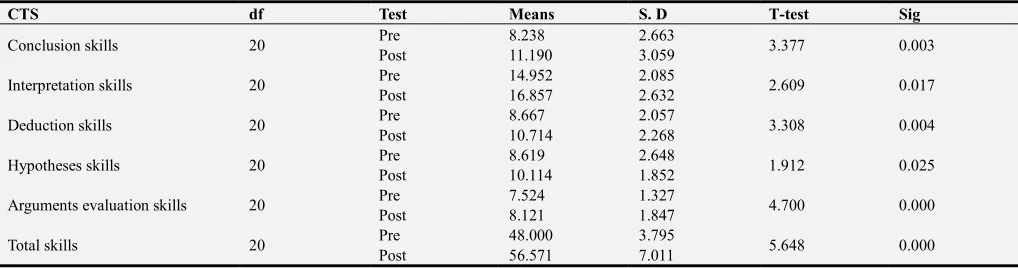
Table 1. Pre/post test result (Paired-Samples T Test).
CTS df Test Means S. D T-test Sig
Conclusion skills 20 Pre 8.238 2.663 3.377 0.003
Post 11.190 3.059
Interpretation skills 20 Pre 14.952 2.085 2.609 0.017 Post 16.857 2.632
Deduction skills 20 Pre 8.667 2.057 3.308 0.004
Post 10.714 2.268
Hypotheses skills 20 Pre 8.619 2.648 1.912 0.025
Post 10.114 1.852
Arguments evaluation skills 20 Pre 7.524 1.327 4.700 0.000 Post 8.121 1.847
Total skills 20 Pre 48.000 3.795 5.648 0.000
Post 56.571 7.011
Table 2. Effect Size ƞ².
CTS T-test t² df ƞ²
Conclusion skills 3.377 11.40 20 0.36 Interpretation skills 2.609 6.81 20 0.25 Deduction skills 3.308 10.94 20 0.35 Hypotheses skills 1.912 3.66 20 0.15 Arguments evaluation skills 4.700 22.09 20 0.52 Total skills 5.648 31.90 20 0.61
As indicated in table 1 there was a significant difference at level (α = 0.01) between female students' pre-test results and post-test result. The mean value of students before the experiment was (48) raise up to (56.571) after teaching human body organs Unit according to Integrative STEM approach with Islamic perspective, to determine the effect size the value of ƞ² was computed m as shown in table 2 the values of ƞ² for all the critical thinking skills were all more than (0.61) which means that teaching science according to Integrative STEM approach has a big effect size in
improving the critical thinking skills among ninth-grade female students.
4. Discussion
This study was conducted to determine the effect of the integrative STEM approach with Islamic perspective of critical thinking skills in human body organs unit as a part of science curricula to ninth grade students. Study results showed that there is a positive effect in raising the level of critical thinking skills of talented female students of the Pre-post group after the study of Developed Science Curriculum based on integrative STEM approach with Islamic perspective. The researchers think that the reason is that the integration STEM curriculum from an Islamic perspective has several characteristics such as:
environment that maintains learning motivation and the desire of the students.
2. Integrative STEM approach from an Islamic perspective can connect theoretical information with practical situations and projects that help talented to Conclusion, Deduction, Interpretation, and hypothesis. 3. Integrative STEM from an Islamic perspective depends
on modernity, as the curriculum combine between the four main sciences (Science, Technology, engineering and Math) and present them in the light of miracles scientific this leads to tighten the attention of the students and increase their arguments evaluation level so their critical thinking will be perfect.
4. Integrative STEM from an Islamic perspective contributes on changing scientific knowledge into active product able to take the students' needs and interests that leads to improve their critical thinking skills.
The results of this study are consistent with other studies that examined the impact of integrative STEM approach, The study [14, 21], in which the impact of teaching according to Integrative STEM approach with Islamic perspective in the improvement of critical thinking skills, such as a study of [1, 4, 15, 23].
5. Conclusion
This study aimed at investigating the effect of integrating STEM curriculum with an Islamic perspective on the development of 9th grade talented female students' critical thinking skills in Gaza. Students' critical thinking skills improved significantly which might be attributed to several factors among which are motivation, curriculum relevance to technology, culture, and religion.
The study recommended that if the schools are keen on developing critical thinking of school students, which might be important for creative and innovative skills, they have to integrate STEM curriculum with the Islamic view. This will ensure Students' motivation for learning science and technology. Future research is proposed to investigate STEM based on Islamic perspective with other variables such as creativity, problem solving, and motivation.
6. Recommendations
In the light of the results, the researchers recommend the following:
i Using the integrative STEM approach with Islamic perspective in the design of integrated detective teaching (science, technology, engineering, mathematics, Qur’anic miracles) in different educational stages.
ii Training teachers to teach in an integrated approach among them within the disciplines of STEM science, technology, engineering, mathematics and Qur’anic miracles.
References
[1] Ali, Kh. & others. (2019). The impact of using the web-based knowledge travel model to teach physical innovations in the development of critical thinking skills among pre-service science teachers, an Arab research journal in the field of specific education, 13, 93-140.
[2] Bybee, R. W. (2013). Scientific and Engineering Practices in K-12 classrooms: Understanding a framework education. Science and Children, 49 (4), 10-16.
[3] Daowd, H. M. (2017). A proposed teaching program based on the "STEM entry into education" in science course and its effectiveness in developing the habits of mind and decision-making skills among 3rd prep. Students. (Ph.D). Imam Muhammad bin Saud Islamic University, Faculty of Social Sciences: Riyadh, Saudi Arabia.
[4] Foqaihy, F. M. (2016). Effectiveness of the use of concept maps in the development of achievement and critical thinking skills of secondary secondary students, Society for Culture for Development, 16 (100), 241-312.
[5] Fraser, J., Gupta, R., Flinner, K., Rank, S., & Ardalan, N. (2013). Engaging young people in 21st century community challenges: linking environmental education with science, technology, engineering and mathematics, new knowledge report. New York: New Knowledge Organization.
[6] Ismail, H. & Sevcan, H. (2019). An Interdisciplinary Environmental Education Approach: Determining the Effects of E-STEM Activity on Environmental Awareness. Universal Journal of Educational Research, 7 (2), 337-346.
[7] Gerlach, J. (2015). All Teachers Are STEM Teachers. EDUCATION WEEK TEACHER.
[8] Giancarlo, C. A. & Facione, P. A. (2001). A look across four years at the disposition toward critical thinking among undergraduate students. Journal of General Education, 50 (1), 29-55.
[9] Gorwan, F. A. (2002). Teaching Thinking "Concepts and Applications". Amman: Dar Al Fikr for Printing and Publishing.
[10] Honey, M., Pearson, G. & Schweingruber H. (2014). STEM Integration in K-12 Education: Status, Prospects, and an Agenda for Research. Committee on Integrated STEM Education. National Academy of Engineering; National Research Council.
[11] Leatham, K. R, Peterson, B. E. Stockero, S. L., & Zoest, L. R. (2015). Conceptualizing Mathematically Significant Pedagogical Opportunities to Build on Student Thinking. Journal for research in Mathematics Education, 46 (1), 88-124.
[12] Levin, D. M. Hammer, D., & Coffey, J. E. (2009). Novice teacher's attention to student thinking. Journal of teacher Education, 60 (2), 142-154.
[13] Malki, M. (2018) The effectiveness of science teaching at the STEM entrance in the development of research skills in ISEF standards among primary students. International Journal of Educational and Psychological Studies, 4 (1), 113-135.
[15] Motawwa'a, I. A. I. (2018). Effectiveness of project-based learning in developing critical thinking skills and achievement in mathematics among middle school students, Educational Journal, Kuwait University, 32 (126), 169-227.
[16] Al-Naqa, S. & Saqer, N. (2019). The Effect of a program based on scamper model in developing critical thinking in science and life among fourth graders in Gaza. IUG Journal of Educational and Psychology sciences, 22 (2), 01-24.
[17] Al-Otaibi, N. (2007). Effectiveness of Using the "Learning Course" Method in Achieving Mathematics and Developing Critical Thinking Skills among Second Grade Students in Makkah Al Mukarramah, Master Thesis, College of Education, Umm Al Qura University, Saudi Arabia.
[18] Al-Otoum, A. & Al-Jarrah, A. (2009). Development of thinking skills (theoretical models and practical applications). Second Edition. Amman: Dar Al- Maseera.
[19] Al-Otoum, A. & others. (2007). Improving thinking skills. Oman: Dar Al- Maseera.
[20] Abu-Owda, M. & A. Abu-Mousa, A. (2019). Effect of a Science Unit "Light & Life" designed according to the Integrative STEM approach on the Improvement of Scientific Practices among 9th grade students. Journal of Research & Method in Education, 9 (3), 46-50, 2019.
[21] Owens, K. (2007). Classroom Critiques: Transforming Conformity in to Creativity. Industry and Higher Education, 21 (5), 345-351.
[22] Rehmat, A. P. (2015). Engineering the path to higher-order thinking in elementary education: A problem-based learning approach for STEM integration. Doctoral dissertation. University of Nevada, Las Vegas. UNLV Theses/ Dissertations/ Professional Papers/ Capstones. Paper 2497. Retrieved from http://digitalscholarship.unlv.edu/these sdissertations [Access Dec 01 2018]
[23] Sabri, M. & others. (2016). The effectiveness of a proposed program for the development of critical thinking skills among the students of different people in the Faculty of Education, Benha University, an Arab research journal in the fields of specific education, 3, 123-150.
[24] Shammari, M. M. (2018). Building an enrichment program based on STEM approach and its effectiveness in developing the athletic strength skills of talented students in the middle stage in Hail. (Ph.D). Imam Muhammad bin Saud Islamic University: Kingdom of Saudi Arabia.
[25] Tenaglia, T. (2017). STEAM curriculum: Arts education as an integral part of interdisciplinary learning. Messiah College Curriculum and Instruction Research Project, Parkway.
[26] Yıldırım, B. & Selvi, M. (2017). An experimental research on effects of STEM applications and mastery learning. Journal of Theory and Practice in Education, 13 (2), 183-210.