Performance Analysis of Secure and Trustable
Routing in Wireless Sensor Networks
S. Sahebzathi Mr. D. Pravin Kumar
PG Student Associate Professor
Department of Computer Science and Engineering Department of Computer Science and Engineering K.L.N College of Engineering, TamilNadu, India K.L.N College of Engineering, TamilNadu, India.
Abstract
Wireless sensor networks are emerging as a promising technology and are increasingly being deployed in security-critical applications. Because of their inherent resource-constrained characteristics, they are vulnerable to wide range of security attacks including routing attacks. A black hole attack is one of the most typical routing attacks that seriously affect data collections. A lot of research has been carried out for secure routing process using different mechanisms. This paper focuses on survey of various schemes to improve the routing protocols against various routing attacks and discusses the state-of-the-art. We also analytically investigate the security and performance of the various trust based schemes.
Keywords: Black hole attack, Network lifetime, security, Trust, Wireless Sensor Network
________________________________________________________________________________________________________
I. INTRODUCTION
Wireless sensor networks (WSN) are distributed autonomous sensors to monitor physical or environmental conditions, such as temperature, sound, pressure, etc. and to cooperatively pass their data through the network to base station. The development of wireless sensor networks was motivated by military applications such as battlefield surveillance[1]. Today wireless sensor networks are used in many applications, such as industrial process monitoring and control, machine health monitoring, and so on. In spite of all the advantages and applications of Wireless Sensor Networks, there are even some challenges and issues which have to be dealt with the WSN. The most key challenge is its security. There are various kinds of attacks in WSN like Grey hole attack, Wormhole attack, Sinkhole attack, Selective forwarding attack, Black hole attack, Denial of service attack etc. which will affect the data collection during routing process.
Routing Protocols [12] are generally classified into three types such as Proactive (Table Driven), Reactive (On Demand) and Hybrid based on route discovery process and their mechanism. The Proactive routing protocols select the routes to all destinations at beginning and maintain using periodic update process based on their mechanism. e.g. DSDV. The disadvantages of these algorithms are to update the routing tables often which take a large amount of memory, bandwidth and power. But, in the reactive routing protocol, there is no need to maintain the routing data in routing table by each node. The routes are selected and maintained only when they are required by the source for data transmission during route discovery process and the routing overhead has been reduced. e.g. Dynamic Source Routing (DSR) and Adhoc on Demand Distance Vector (AODV). The merits of both proactive and reactive protocols are combined and form a hybrid routing protocols e.g. ZRP, TORA.
The paper is organized as follows. In Section 2, Routing attacks in the WSN are reviewed. Security and performance analysis are provided in Section 3. We conclude in Section 4.
II. ROUTING ATTACKS IN WSN
There are different kinds of attacks [3], [8], [11] possible by malicious nodes to harm the network and make the network unreliable for communication and proper functioning. Some of such kinds of attacks are:
Wormhole Attack:
Wormhole attack is an attack on which the messages are Tunneling and replicating from one location to another through alternative low latency links, that connect two or more points (nodes) of the WSN by using more powerful communication resources than normal nodes and establishing better real communication channels (called tunnel). Wormhole nodes operate fully invisible.
Sinkhole Attack:
Selective Forwarding Attack:
In a selective forwarding attack, a compromised node refuses to forward some of the packets in its outstanding buffer, such as control information or data packets in order to cut off the packets propagation.
Black hole Attack:
A black hole is a attack in which malicious node attracts all the traffic in the network by advertising that it has the shortest path in the network. So, it creates a symbolic black hole with the malicious node or the adversary at the center. This black hole drops all the packets it receives from the other nodes.
Grey hole Attack:
A Grey hole is similar to the black hole attack except that the malicious node selectively or randomly forwards/drops only some of data packets that they are routed through it, at random intervals to protect from its forged/artificial path. Also a kind of Denial of Service attack that the attacker receives but does not forward all incoming messages.
Denial of Service Attack:
A Denial of Service (DoS) attack is one that attempts to prevent the victim from being able to use all or part of his/her network connection. DoS attack allows an adversary to subvert, disrupt, or destroy a network, and also to diminish a network’s capability to provide a service
III. PERFORMANCE ANALYSIS
TARF: A Trust-Aware Routing Framework:
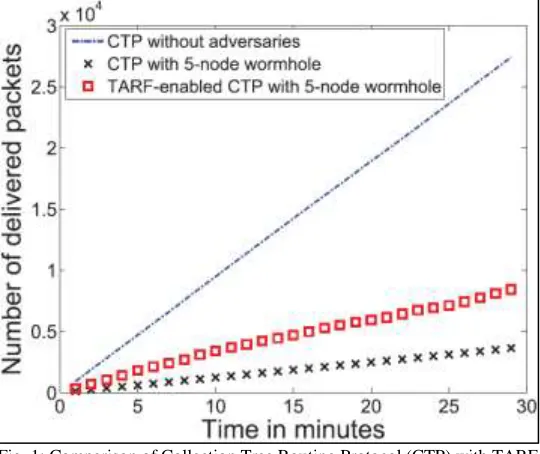
For a TARF [4] enabled node N to route a data packet to the base station, N only needs to decide to which neighboring node it should forward the data packet considering both the reliability and the energy efficiency. Once the data packet has been forwarded to the next-hop node, the remaining task to deliver the data to the base station is fully delegated to it, and N is totally unaware of what routing decisions are made by its next-hop node. The node N maintains a neighborhood table with trust level values and energy cost values for certain known neighbors.
EnergyWatcher is accountable for recording the energy cost for each known neighbor, based on N’s surveillance of one hop transmission to reach its neighbors and the energy cost report from those neighbors. TrustManager is responsible for tracking the neighbors trust level values based on network loop discovery process and broadcast messages from the base station about data delivery. Once N is able to choose its next-hop neighbor according to its neighborhood table, it sends out its energy report message. Its energy cost is broadcasted to all its neighbors to deliver a packet from the node to the base station.
Fig. 1: Comparison of Collection Tree Routing Protocol (CTP) with TARF
Hierarchical Trust Management:
Hierarchical trust management protocol [5] maintains two levels of trust: SN-level trust and CH-level trust. Each Sensor Node (SN) evaluates other SNs in the same cluster while each Cluster Head (CH) evaluates other CHs and SNs in its cluster. The peer-to-peer trust evaluation is updated periodically based on either direct observations or indirect observations. When two nodes are within radio range, they evaluate each other based on direct observations via snooping or overhearing. Each SN sends its trust evaluation results toward other SNs in the same cluster to its CH. Each CH performs trust evaluation for all its SNs within its cluster.
Similarly, each CH sends its trust evaluation results through other CHs in the WSN to a “CH commander” which may reside on the base station , or on a CH elected if a base station is not available. The CH commander performs trust evaluation toward all CHs in the system. Hierarchical trust management protocol can be applied to two applications namely Trust-based geographic routing and Trust-based intrusion detection application.
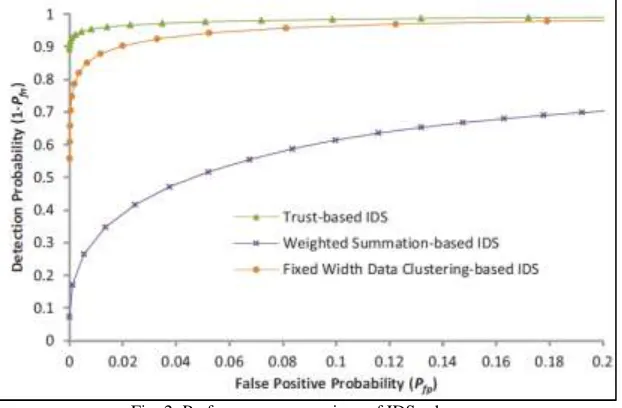
Fig. 2: Performance comparison of IDS schemes
Fig. 2 shows that as the false positive probability increases, the detection probability increases for all IDS schemes. Trust-based IDS algorithm outperforms both weighted summation-based IDS and fixed width data clustering-based IDS, especially when the false positive probability is limited to 5% which is considered desirable in intrusion detection. The strength of our trust-based IDS algorithm is especially pronounced when the false positive probability approaches zero.
Digital Signature-Based Secure Node Disjoint Multipath Routing Protocol:
In this work [7] the focus is on providing the security in routing protocol with concern to privacy, authentication and non-repudiation of the data in the network. The security in Energy Efficiency Node Disjoint Multipath Routing Protocol (EENDMRP) [6] is analyzed using RSA Public key crypto system. During the route construction phase, the sink node broadcasts Route Construction (RCON) packets to its neighbouring nodes. The neighbouring nodes receive the RCON packet from the sink node. A neighbouring node updates RCON packet with its public key. It rebroadcast the RCON packet to its neighbouring nodes. Similarly all the nodes update their routing table with the public key of their neighbouring nodes in the network. In the data transmission phase, the source node will select node-disjoint paths to the sink node and sends the data traffic through that path.
The source node picks M amount of data to send through the node-disjoint primary path to the sink. The MD5 hash function H is used to create message digest H(M) from the M amount of data at the source node. The source node generates the digital signature by encrypting the message digest H(M) with its private key. The source node forwards it to neighbouring node through the path it takes to reach sink. A neighbouring node verifies the digital signature by comparing decrypted value. If the generated H(M) by the receiver and the decrypted H(M) of digital signature is equal, then the receiver accepts the data. Otherwise rejects the data and informs the sender that the data is altered through by generating route error packet.
Fig. 3: Variation of PDF with number of nodes
TERP: A Trust and Energy Aware Routing Protocol:
The design of TERP [10] constitutes two major components: Trust Estimation and Trust-Energy aware Routing. The Trust Estimation evaluates the trustworthiness of nodes. The estimation involves trust database that stores all necessary information required in trust establishment such as Node ID, packet forwarding ratio and expected positive probability. The trust based routing is responsible for finding routes that contains all trusted nodes. The energy awareness is incorporated in route setup in a way that only those trusted nodes will be selected which has energy above than specified thresh hold. If at some later time some malicious, faulty or energy deficient node become part of active route, route maintenance process is initiated to inform source node to establish new trusted path.
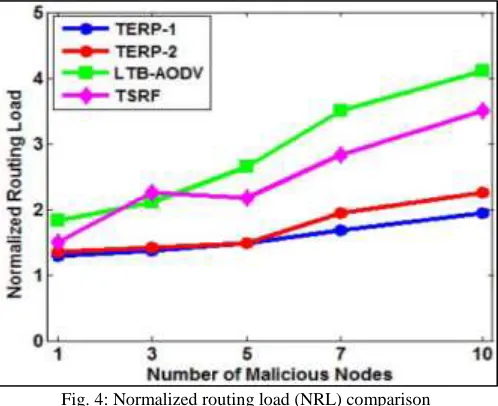
Fig. 4: Normalized routing load (NRL) comparison
Fig. 4 presents the evaluation results of three schemes in terms of NRL. TERP shows better performance in terms of NRL due to the fact that selected route remains stable for longer duration as nodes with relatively higher levels of energy are selected for routing the packets.
Activetrust: Secure and Trustable Routing:
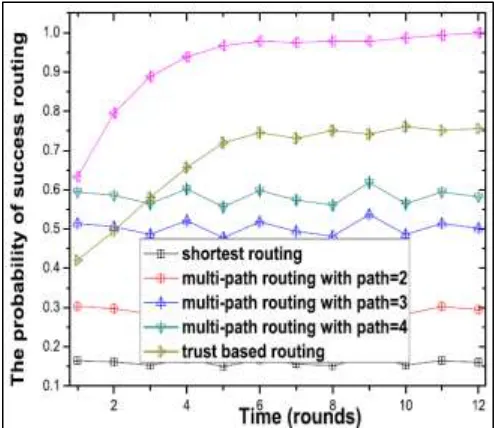
ActiveTrust scheme [1] is composed of an active detection routing protocol and data routing protocol. A detection route refers to a route without data packets whose goal is to convince the adversary to launch an attack so the system can identify the attack behavior and then mark the black hole location. Thus, the system can lower the trust of suspicious nodes and increment the trust of nodes in successful routing routes. Through active detection routing, nodal trust can be quickly obtained, and it can effectively guide the data route in choosing nodes with high trust to avoid black holes. In this scheme, the source node randomly selects an undetected neighbor node to create an active detection route.
trust as the next hop. If there is no node among all neighbors nearer the sink that has trust above the default threshold, it will report to the upper node that there is no path from a to the sink. The upper node will re-select a different node from among its neighbors nearer the sink.
Fig. 5: The probability of successful routing as the network operates
Table – 1
Comparison of various Trust based schemes
S.NO Paper Techniques /
Protocols Advantage Disadvantage
1
Design and Implementation of TARF: A Trust aware Routing Framework for WSNs [4]
Energywatcher and Trustmanager
1.Select a reliable route 2. Requires neither tight time
synchronization nor known geographic information. 3. Energy efficient, highly scalable, and well adaptable
TrustManager does not distinguish whether an error or an attack occurs to the next-hop node or other succeeding nodes
in the route.
2
Hierarchical Trust Management for Wireless Sensor Network and
its Applications to Trust Based Routing and Intrusion Detection
[5]
Sensor node (SN) level trust and Cluster
head(CH) level trust
1.Resilient to black/sink hole attacks , good and
bad-mounting attacks 2.Applied to trust based Geographical routing and
intrusion detection 3.Reduce communication
overhead
If the cluster head is failed or compromised, then this approach
will not work
3
Digital Signature-Based Secure Node Disjoint Multipath Routing
Protocol for Wireless Sensor Networks [7]
Public key cryptography and
digital signature generation
1. Packet delivery fraction: 7% , end-to-end delay: 28.6%, routing load : 67.56%, and
energy saving:19.1%. 2.Defends data tampered or
altered routing, selective forwarding, sink hole and
byzantine attacks
1. Limited to physical data routing
2.The signature generation is measured to be 8 times slower. 3.QoS with link reliability is not
designed.
4
TERP: A Trust and Energy Aware Routing Protocol for Wireless
Sensor Network [10]
Trust estimation and Trust energy aware
routing protocol
1.Forwards packets through shortest path routes 2. Select reliable and energy efficient route which is vital for
network lifetime of WSN
1.Suitable only for resource constrained sensor nodes 2. Its efficacy on real hardware platform needs to be confirmed.
5
ActiveTrust: Secure and Trustable Routing in Wireless Sensor
Networks [1]
Active detection routing and Data routing protocols
1.The ActiveTrust scheme is the first routing scheme that uses
active detection routing to address black hole attack 2.Achieves a nearly 100% successful routing probability 3.High security and scalability
4. High energy efficiency
In the ActiveTrust scheme, because the data Success route rate is higher, the
IV. CONCLUSION
In this paper, we have analyzed a various novel security and trust based routing scheme against black hole attack and presented their performance over the packet delivery ratio. From the above analysis, we can conclude that ActiveTrust scheme is the efficient scheme for detecting and preventing the black hole attack among other schemes. The ActiveTrust scheme has the following excellent properties: (1) High successful routing probability, security and scalability. The ActiveTrust scheme can quickly detect the nodal trust and then avoid suspicious nodes to quickly achieve a nearly 100% successful routing probability. (2) High energy efficiency. The ActiveTrust scheme fully uses residue energy to construct multiple detection routes. The theoretical analysis and experimental results have shown that this scheme improves the successful routing probability by more than 3 times, up to 10 times in some cases. Further, ActiveTrust scheme improves both the energy efficiency and the network security performance. It provides important significance for wireless sensor network security.
REFERENCES
[1] Yuxin Liu, Mianxiong Dong,Kaoru Ota, and Anfeng Liu, “ActiveTrust: Secure and Trustable Routing in Wireless Sensor Networks”, IEEE Transactions On Information Forensics And Security, Vol. 11, No. 9, PP. 2013 – 2027, September 2016.
[2] Tao Shu, Marwan Krunz, and Sisi Liu, “Secure Data Collection in Wireless Sensor Networks Using Randomized Dispersive Routes ,” IEEE Transactions on Mobile Computing, Vol.9,No.7,PP.941-954,July 2010.
[3] Ming-Yang Su, “Prevention of selective black hole attacks on mobile ad hoc networks through intrusion detection systems” ,Elsevier-Computer Communication,Vo;.34, pp-107-117, August 2010.
[4] Guoxing Zhan, Weisong Shi and Julia Deng, “Design and Implementation of TARF: A Trust-Aware Routing Framework for WSNs”, IEEE Transactions On Dependable And Secure Computing, Vol. 9, No. 2, PP.184-197, April 2012.
[5] Fenye Bao, Ing-Ray Chen, MoonJeong Chang, and Jin-Hee Cho, “Hierarchical Trust Management for Wireless Sensor Networks and its Applications to Trust-Based Routing and Intrusion Detection” , IEEE Transactions On Network And Service Management,Vol.9, No. 2, PP.169-183, June 2012. [6] Anfeng Liu, Zhongming Zheng, Chao Zhang, Zhigang Chen and Xuemin (Sherman) Shen, “Secure and Energy-Efficient Disjoint Multipath Routing for
WSNs,” IEEE Transactions On Vehicular Technology, Vol. 61, No. 7, PP. 3255-3265, September 2012.
[7] Shiva Murthy G, Robert John D’Souza, and Golla Varaprasad, “Digital Signature-Based Secure Node Disjoint Multipath Routing Protocol for Wireless Sensor Networks”, IEEE Sensors Journal, Vol. 12, No. 10, PP.2941 -2949, October 2012.
[8] M. Mohanapriya ⇑, Ilango Krishnamurthi, “Modified DSR protocol for detection and removal of selective black hole attack in MANET,” ELSEVIER Computers and Electrical Engineering,Vol.40, PP.530–538, June 2013.
[9] Abderrahmane Baadache , Ali Belmehdi, “ Struggling against simple and cooperative black hole attacks in multi-hop wireless ad hoc networks,” ELSEVIER Computer Networks, Vol.73, PP. 173–184, August 2014.
[10] Adnan Ahmed, Kamalrulnizam Abu Bakar, Muhammad Ibrahim Channa, Khalid Haseeb, and Abdul Waheed Khan, “TERP: A Trust and Energy Aware Routing Protocol for Wireless Sensor Network,” IEEE Sensors Journal, Vol. 15, No. 12, PP. 6962-6972, December 2015.
[11] Jian-Ming Chang, Po-Chun Tsou, Isaac Woungang, Han-Chieh Chao, and Chin-Feng Lai, “Defending Against Collaborative Attacks by Malicious Nodes in MANETs: A Cooperative Bait Detection Approach,” IEEE Systems Journal, Vol. 9, No. 1,PP.65-75, March 2015.