2336
A Hybrid Approach For Cost-Effective Routing
And Security For Manets Using BSSO-DSR And
AES-ECC Algorithms
Dr. P. Revathi, Dr. N. Karpagavalli, Dr. K. Juliet Catherine AngelAbstract: A versatile specially appointed system (MANET) is an assortment of portable hubs that are constantly self-structuring and work on establishment less system. An instrument for broadcasting is flooding where a solicitation is retransmitted by a hub in any event once, yet it is incapable regarding transmission capacity and vitality. Vitality the executives assumes a significant job in arrange. The effective course is set up utilizing Dynamic source directing (DSR) Routing Protocol. The Binary Social Spider Optimization (BSSO) algorithm is used for clustering of sensor nodes and maintaining load balancing in an efficient way. Efficient black hole detection using Malicious Node Detection Mechanism-TX/RX (MNS-TX/RX) with optimized routing algorithm is implemented in a secure environment by using Advanced Hybrid Advanced Encryption Standard (AES) cryptanalysis and Elliptic Curve Cryptosystems (ECC). Thus ―DSR-BSSO-MANETs‖ algorithm has precisely detected the black hole node and finds the proper solution for transmitting data for maintaining lifetime and Load- balancing by analyzing performance such as Through-put, routing overhead, packet delivery ratio (PDR), drop, delay and energy consumption in a secure environment.
Index Terms: Advanced Encryption Standard, Binary Social Spider Optimization (BSSO), Dynamic source routing, efficient black hole detection, Elliptic Curve Cryptosystems, Malicious Node Detection Mechanism and mobile ad hoc network.
—————————— ——————————
1.
INTRODUCTION
A Movable Ad-Hoc Network (MANET) is a self-designing system of versatile hubs which are associated by remote connections, to frame a clueless topology. The hubs are allowed to move aimlessly. In this way the remote system topology might be eccentric and may change quickly. What's more, it might be in least model, quick abuse and absence of a focal driving power to make specially appointed systems fit for crisis circumstances like cataclysmic events, military clashes, and crisis therapeutic circumstances and so on. Portable Ad-hoc Network (MANET) is a system where and each hub in a versatile used to speak with one another utilizing remote media, thus MANETs with each other using wireless media, hence MANETs [1] are flexible to change the number of nodes in the network i.e. it will repeatedly adjust when the number of nodes increase or decrease. In simple words, in MANET portable devices bears random mobility patterns. This indeterminate nature of pattern in mobility devices are MANETs arises various challenges to maintain the network stability and overall system security. In such kind of network, each node plays dual nature i.e. host as well as router which manages route for from one node to the other and also include other dual nature entities of the network to transmit the data. This dual nature depends that whether the node in sender or receiver or an intermediate node which participate in completing the topology. If the node in sender or receiver it is known as host & if it is an intermediate node then it will act as router.
Specially appointed systems [2] associate their substances in unique topology as the hubs are in versatile and may join or leave the system with no hint. Presently a day's Ad-hoc organizes application zones have wide range, for example, observing submerged life, checking untamed life, observing seismic exercises, make a system of officers embedded in a war locate All of these situation have elements which are in versatile and dynamic in nature, yet they additionally share some normal highlights because of which they dwell close to one another yet they aren't orchestrated under any foundation, they give the availability by sending parcels over themselves. To help this network, hubs utilize some steering conventions, for example, Bellman Ford, DSR and WRP. The system contains just versatile hubs, which makes topology in air and move information to one another. As the system is versatile so it doesn't rely upon any single hub, it naturally modify when at least one hub leave or join the system Thus, this property of the system makes it both adaptable and hearty. A directing convention [3] which is expected for MANET must join the extraordinary method to manage two thing unique condition separated from the typical steering highlights for example step by step instructions to manage a circumstance when hubs are in no fixed topology and second is that how to manage the circumstance when hubs may join or leave the system with no suggestion.
Because of this situation designing routing protocols for MANET are quiet challenging. Quality of Service [4] routing in MANETs is relatively untouched area. If a protocol wants to ensure quality-of-service, the protocol not only needs tomap a route but also have to ensure the security of message as well as the resources required for transmission. Because of the availability of limited resources in terms of bandwidth & absence of any supreme which will handle all the issues related to routing & availability of resources, nodes have to devise a proper plan for resource management to ensure Quality of Service. Even if nodes somehow manage for a single time, the problem will again arise due to change in topology when a node enters or leave the network. Because of such limitations, Quality of Service routing is more demanding than best effort routing. To overcome the existing security and roughing problem in this paper DSR-BSSO-MANETs method ————————————————
Dr. P. Revathi, Department of Computer Science, Holy Cross College (Autonomous), Tiruchirappalli – 620 002 , E-mail: [email protected]
Dr. N. Karpagavalli , Department of Computer Science, Holy Cross College (Autonomous), Tiruchirappalli – 620 002
is introduced
2
LITERATURE
SURVEY
Y. Wang. et.al. [5] has proposed a dynamic and surrounded need fulfillment the issue is utilized to shape benefits in unavoidable frameworks. Blocked associations are seen and recomposed utilizing heuristic calculations. Right when association isn't open or leaves from the local it adjusts associations without restarting association sythesis process from each time. Necessity of this strategy is Multi skip sythesis and change was not considered. F. Cervantes. et.al. [6] has proposed a decentralized a power based merged self-making help sythesis approach. This framework methodicallly takes the mix of five times of association piece into a solitary compound stage. It is a decentralized and self-evolvable way of thinking. This system isn't well appropriate where the computational asset is constrained particularly for MANETs. N. B. Mabrouk. et.al [7] has present QASSA, a convincing assistance affirmation figuring which offers ground to QoS-cautious help course of action in omnipresent conditions. They portray generally speaking QoS necessities for association choice as a set-based streamlining issue. Sirisala et.al [8], is displayed a MANET is appeared as a FPN, where focuses look like spots and remote affiliations take after advances. The quality parameters are utilized to ascertain the sureness factor in consummation of progress. The reliable course is surveyed by applying FPN models in MANETs. The course revelation fragment is additionally examined for multicast organizing. The course recuperation portion is in like way clarified with the assistance of CRA figuring. Ye, Dayong, et al. [9] proposes ace based self-making help affiliation approach. Five times of creation process are joined and consider all stages a solitary framework. It is a decentralized self-making framework and studies association relationship among change and association movement. This technique is reasonable for wired system, at any rate not appropriate for MANETs since it is solidified into multiple times of associations game-plan process in one focus become in-cumbrance in MANET which contains constrained computational limit focuses. In MANETs, keeping up of specialists is fundamental errand because of dynamic improvement of focuses. For papers perceived for creation, it is basic that the electronic change of the sythesis and gem encourage the printed copy accurately! The quality and precision of the substance of the electronic material submitted is fundamental since the substance isn't copied, anyway fairly changed over into the last flowed structure.
3
DSR-
BSSO-MANET
S METHODOLOGYThe ―DSR-BSSO-MANETs‖ is used to identify the malicious mobile node, while network communication. The information safety is the major thing in the mobile network. Hybrid AES and ECC cryptography is used to avoid security issues in the complete network. DSR routing protocols are used for efficient route establishment, once there is a petition for a route in the network. A BHA is known as false node, which delays for
others nodes to transfer Route Request (RREQ)
communications. The BH attack is identified using MND-TX/RX. When the statistics is really started transmitting it absorbs all the packets and conduct to the destination. In this work, DSR-BSSO-MANETs methodology consists of eight steps such as.
1. Deployment of Sensor Nodes
2. Groping/clustering of different networks
3. Routing process starts
4. Secure transmission using HAESECC and BH
identification using Malicious Node Detection TX/RX (MND-TX/RX).
3.1 OPTIMIZED DYNAMIC SOURCE ROUTING
ODSR is a dynamic source routing protocol and BCS optimization algorithm. The ODSR algorithm is simple and efficient protocol for routing which allows the multiple hop communication between mobile nodes that are not within communication range. Normally the mobile network topology changes frequently, so the routs are also change at any time. Over various jumps the ODSR permits to discover the source of course to the goal by the hubs powerfully. The each arranged information bundle conveys by having a header which is sent through the hubs. Therefor by incorporating the source course in the header of every datum bundle, different hubs, which are sending or catching of these information parcels can likewise reserve this steering data for some time later. There is no intermittent trade of information parcels happens in ODSR convention. The Single Route Discovery system permits of a hub to store different courses for any goal in light of the fact that the reserving of numerous courses of a hub is valuable to discover another course on the off chance that one course fall flat. The ODSR protocol is based on three mechanisms that work together to allow the discovery, optimization and maintenance of source routes.
3.2 Optimization using BSSO
ODSR algorithm helps for create the multiple routes among the transmitter and receiver. The major objective of this work is to improve the route in the MANET with the help of BSSO. The BSSO helps to select the optimal route depends on average delay. Population of multiple paths discovered is by BSSO. Fitness value of each particle is evaluated based on average delay.
3.3 Binary Social Spider Optimization algorithm (BSSO): In the original copy, a BSSO calculation is defined for band choice. A portion of the key highlights of the proposed calculation are:
1 The male and female creepy crawly are utilized in a parallel inquiry space [0, 1]. Assorted variety is presented in the inquiry procedure as the producing normal for each gathering is extraordinary.
2 Design of data trade depends on the idleness (weight) of the creepy crawly and its separation (hamming) from the communicator. Through, this development and area every molecule is controlled as for the nearby ( ) and worldwide ( ) insect.
3 The calculation keeps up an equalization among investigation and misuse of search space by a creepy crawly concerning its neighbors. It is enlivened by the wonder that a bug can see the space around itself alongside an inclination to move towards the best arachnid.
2338 3.4 Route Maintenance
Due to the topology change source mobile node can’t make the route but which can able to identify the data envelop. Whenever the neighboring node is disconnected at the time an error message RERR will generate and which transferred to route transmitter node. After receiving RERR the source node disconnect all the links and start the new route prediction
3.5 Hybrid AES-ECC
AES and ECC are the two most regularly utilized symmetric and hilter kilter encryption calculations. In this work, AES and ECC algorithm are combined, which can solve the problem such as password system speed and security, which can't proficiently understand the data, information encryption, mark and personality check. What's more, the cross breed encryption is connected into the email framework to improve the system security of data transmission. Hybrid AES-ECC Encryption and Decryption Frameworks are shown in figure.1. And figure.2.
Fig. 1.Hybrid AES-ECC Encryption Framework.
Fig. 2 .Hybrid AES-ECC Decryption Framework.
3.6 BHA DETECTION
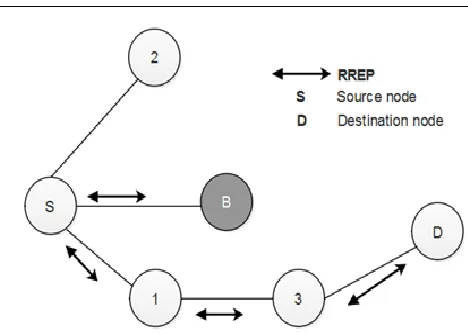
The fake node respond the direction-finding the request through a large series to the quantity of least hop. The foundation node transmit the information to the receiver over the black-hole movable node. By this method a black-hole movable node divert the majority of the traffic to the network by itself and it drop the information formative a black-hole attack is a challenging work mainly if the mean node uses the series amount associated to the ones that is used in the system. The shady gap attack plays mainly to the impact of the system execution, which can make an organization to carry similar to false framework. The stable increment in system overhead abatements the hub lifespan finally it prompt the systematize decimation. Figure.3. Shows the way to the demand and route respond in the detection of black hole node in the System. The classification of copied node in the system will be discuss below in 3.2 Session.
3.7 Malicious Node Detection Mechanism (MNS) The MNS device has be planned for the active and flexible nature of sensor hub, in which sensor hubs are supplant one time they have exhausted their energy In sensor networks, one node performance monitor the node to verify whether there is occurrence of malicious node. The inspection hub utilize the function as pursue right away after Node A makes and feeling on Node B, it make a change over by itself to an observe hub, alluded at this time the monitor Node-Transmitter\Receiver (MN-TX/RX), and screen the behavior of Node When Node B transmit the information to the next node, MN-TX/RX listens and compare this message with the one it has sent to Node B, thus the establishment of the original and real communication On the off opportunity to the message that transmitted by Node B it is equivalent to the initial next hub MN-TX/RX overlook it and proceed with its own errands; in some case, if there is a distinction between the first and real messages which is more famous than an exact limit, the message is view as suspicious and the Node B is currently viewed as suspicious as a result in Node B. The institution of Routing Path through presence of MN-TX/RX is given in Figure.4.
Figure. 4. Establishment of Routing Path with Presence of MN-TX/RX
The figure.5. Define the current direction-finding technique that has a limited amount of portable nodes is organized in the specific area where initially transmitter and receiver are allocated. Previously transmitter and receiver are exact the transmitter mobile node broadcast an RREQ to all the near mobile nodes. The route established that the method is done using AODV routing protocol. If any black hole node occur in the structure then it will take action to transmitter demand with Route respond Packet (RREP), in advance that cover the transmitter that will put the answering to the mobile node as black list. On one occasion it is put on the black list, then the information established study has been applied for validation of the malicious node. Now approximately all node get authentication whether black hole transportable nodes are modern in the network
4.
RESULT AND DISCUSSION
The DSR-BSSO-MANETs method was implemented in Matlab 2018 to detect the black hole detection and obtain the optimized clustering and maintaining load balancing for data communication using DSR-BSSO system. The entire work is completed with the help of I3 computer with 2 GB RAM. The BSSO calculation is utilized to acquire the improved way and HAES-EEC for the secure transmission through the versatile hubs. That area gives a point by point perspective on the outcomes that are gotten utilize DSR-BSSO and HAES-EEC framework. DSR-BSSO-MANETs calculation is utilized for giving security to the messages controlled in the hubs. The recreation parameters are appeared in Table 1. Various velocities (running from 1 to 6 m/s) are utilized to show the hub versatility utilizing an irregular waypoint model which shows no impact on execution. The reproduction was completed on various hubs (15, 25, 50, 75, 100) over a fixed region of 350*250m. The reenactment is 900 s. The accompanying measurements were utilized to assess proposed convention in MANET.
ROUTE REPLY IN THE OCCURRENCE OF BLACK HOLE NODE B ROUTE REPLY IN THE OCCURRENCE OF BLACK HOLE NODE B ROUTE REPLY IN THE OCCURRENCE OF BLACK HOLE NODE B
2340 Table.1.Simulation parameters of the proposed protocol
Parameters Values
Number of mobile nodes 15, 25, 50, 75, 100
Topology size 350*250 Transmission range 250 m
Packet size 512 bytes
Bandwidth 2 Mb/s
Simulation time 900 s
Pause time 100 s
Node speed 1–6 m/s
Steering Overhead: It is the all out number of bundles transmitted for course revelation and support expected to convey the information parcel. Parcel Delivery Ratio: It is the proportion of bundles got by the goal to the parcels started by the source. Throughput: It is the proportion of the measure of information that is gotten by the goal to the reproduction time Vitality utilization: The colossal number of bobs is equivalent to the gigantic proportion of got essentialness use. A center point drop a particular proportion of imperativeness for each bundle communicate and tolerating. Deferral: Different among the envelope transmitting time and envelope accepting time is named as postponement. Bundle drop: Total amount of envelopes send and envelope got is known as the parcel or encompass drop proportion. The accompanying figures show the exhibition assessment of proposed convention with number of hubs taken as 100. Every datum point is a normal of five reenactment runs on the diagram. The proposed framework is additionally contrasted and the other existing framework. The current DSR-PSO-MANET framework is likewise executed for correlation reason.
Fig. 5. Simulation of the proposed protocol in a scenario of 100 nodes
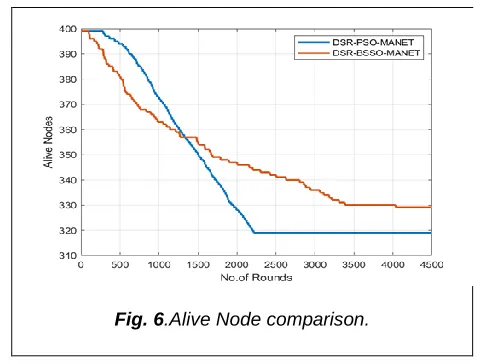
Fig. 6.Alive Node comparison.
The Comparison of Alive nodes and Number of rounds mobile nodes between DSR-BSSO-MANETs and DSR-PSO-MANET is defined in figure.6. The alive is less in DSR-BSSO-MANETs method, when compared with the DSR-PSO-MANET method.
Figure.7.Alive Node comparison
Figure.8.Throughput comparison.
The Comparison of Nodes vs. throughput between DSR-BSSO-MANETs and DSR-PSO-MANET is defined in figure.8. The Throughput value is improved in DSR-BSSO-MANETs MANETs method, when compared with the DSR-PSO-MANET method
Figure.9.Energy comparison.
The Comparison of Nodes vs. Energy between DSR-BSSO-MANETs and DSR-PSO-MANET is defined in figure.9. The Throughput value is improved in DSR-BSSO-MANETs method, when compared with the DSR-PSO-MANET method.
The Comparison of Nodes vs. Total pocket sent between DSR-BSSO-MANETs and DSR-PSO-MANET is defined in figure.9.
CONCLUSION
In DSR-BSSO-MANETs algorithm used to detect the malicious attack in the MANET by isolating the improved path using BSSO clustering algorithm for energy consumption and maintaining load balancing. The blackhole attack is recognized using MND-TX/RX Mechanism. From achieved results, we conclude that the DSR-BSSO-MANETs method has provide the better routing results. And also the proposed system provides better Routing Overhead, PDR, Through-put, energy Consumption and pocket delay compared to other existing systems.
REFERENCES
[1] AbdalftahKaid Said Ali, Dr. U.V. Kulkarni, " Comparing and Analyzing Reactive Routing Protocols (AODV, DSR and TORA) in QoS of MANET" published in 2017 IEEE 7th International Advance Computing Conference.
[2] A. Al-Maashri, M. Ould-Khaoua, Performance analysis of MANET Routing protocols in the presence of self-similar traffic, in: 31st IEEE Conference on Local Computer Networks, Tampa, Florida, USA, 2006, pp. 811–818.
[3] Charles E. Perkins and Elizabeth M. Royer, ―Performance Comparison of Two On-Demand Routing Protocols for Ad Hoc Networks" in IEEE INFOCOM 2000 conference.
[4] Arindrajit Pal, Jyoti Prakash Singh, Paramartha Dutta, ―The Effect of speed variation on different Traffic Patterns in Mobile Ad Hoc Network‖ Published by Elsevier Ltd. Selection and/or peer-review under responsibility of C3IT. Procedia Technology 4 2012 pp. 743 – 748 doi:10.1016/jprotcy.2012.05.121.
[5] Y. Wang, I. R. Chen, J. H. Cho, A. Swami and K. S. Chan, "Trust-Based Service Composition and Binding with Multiple Objective Optimization in Service-Oriented Mobile Ad Hoc Networks," in IEEE Transactions on Services Computing, vol. 10, no. 4, pp. 660-672, July-Aug. 1 2017.
[4] F. Cervantes, F. Ramos, L. F. Gutirrez, M. Occello, and J. P. Jamont. ―A new approach for the composition of adaptive pervasive systems.‖ IEEE Systems Journal, PP(99):1–13, 2017. [5] N. B. Mabrouk, N. Georgantas, and V. Issarny. ―Set-based bi-level optimization for qos-aware service composition in ubiquitous environments‖, In Web Services (ICWS), 2015 IEEE International Conference on, pages 25–32, June 2015.
[6] Sirisala, Nageswara Rao, and C. ShobaBindu. "A Novel QoS
2342 Trust Computation in MANETs Using Fuzzy Petri Nets.", INASS,
Volume 10 Issue 2: Pages 116-125, 2017