Volume 10, Issue 11 (November 2014), PP.06-16
Seamless Transitions between Grid-Connected and Stand-Alone
Operations of Distributed Generation in Microgrids
Irvin J. Balaguer-Álvarez
1, Uthane Supatti
2, Jorge G. Cintrón-Rivera
3,
Fang Z. Peng
41
University of Puerto Rico-Aguadilla Campus, Aguadilla, Puerto Rico
2
Kasetsart University at Si Racha, Chonburi, Thailand
3General Motors, Detroit, Michigan, USA
1,4Michigan State University, East Lansing, Michigan, USA.
Abstract:- Control of the Distributed Generation (DG) system is important in both grid-connected and stand-alone modes and the system stability becomes very crucial during the transfer between these two modes. If the system does not have a proper transfer procedure, severe transient voltages or currents will occur, which may damage the entire system. A seamless transfer can ensure smooth operation and quick attainment of steady state. In order to solve these transition problems, this paper presents the development and test of a control strategy for DG capable of working in grid-connected and intentional islanding connection modes with seamless transitions from both operational modes.
Keywords:- Distributed generation, grid-connected operation, stand-alone operation, islanding detection, seamless transitions
I.
INTRODUCTION
The current model for electricity generation and distribution in the United States is dominated by centralized power plants. The power at these plants is typically combustion (coal, oil, and natural) or nuclear generated. Centralized power models like this require distribution from the center to outlying consumers. This system of centralized power plants has many disadvantages. Electric utilities are becoming more and more stressed since existing transmission and distribution systems are facing their operating constraints with growing load. Greenhouse gas emissions have resulted in a call for cleaner renewable power sources. Under such circumstances, distributed generation (DG) with alternative sources such as fuel-cell, wind-turbine, bio-mass, micro-turbine and solar-cell systems, has been considered as a promising solution to the above problems [1-3].
DG is defined as small, modular electricity generators located close to the end customer's load connection point. DGs can enable utilities to decrease investment costs in transmission and distribution system upgrades while still meeting increasing power demands. Also, DGs provide customers with improved quality and reliability of energy supplies without imposing undesirable effects on environment [4-5]. In general, DG can be intended as small sized power plants that are designed to be installed and operated within a local load center.
Control of the DG system is important in both grid-connected and stand-alone modes and the system stability becomes very crucial during the transfer between these two modes. If the system does not have a proper transfer procedure, severe transient voltages or currents will occur, which may damage the entire system [6]. A seamless transfer can ensure smooth operation and quick attainment of steady state.
This paper presents the development and test of a control strategy for DG capable of working in both intentional islanding (stand-alone) and grid-connected modes. The stand-alone control features an output voltage controller capable of loss of main detection and seamless transition from grid-connected to stand-alone operation modes with minimum interruption to the load. The grid-connected mode with current control is also enabled for the case of power grid connection. This grid-connected control features an output current controller capable of synchronization with the grid and re-synchronization for grid reconnection with minimum interruption to the load.
The operational principle and control methods of the proposed system are explained in detail. A DG inverter system has been designed, built and set up for testing. Simulation and experimental results are provided in order to verify the validity of the developed DG system.
II.
SYSTEM
DESCRIPTION
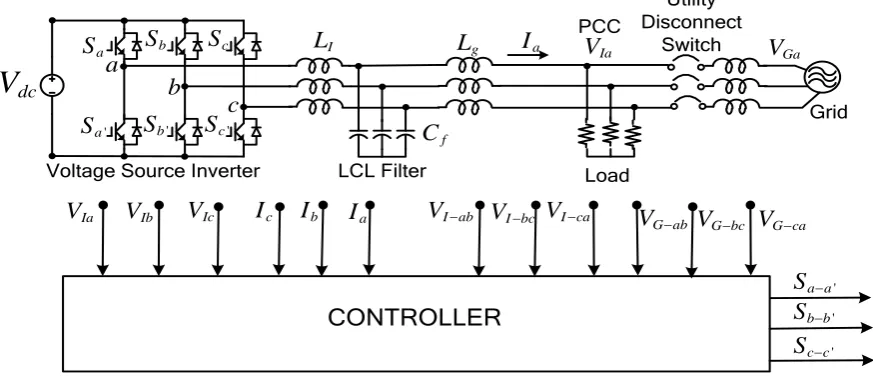
ripple that causes harmonics in the output voltage [1, 7-10], a parallel load, and the controller needed to implement grid connected and stand-alone operations with seamless transition between both modes of operation.
The controller includes control for grid-connected and stand-alone operations, PLL, coordinate transforms, parallel interconnection to the grid (represented by ideal, sinusoidal voltage sources behind line impedances) through the Point of Common Coupling (PCC) breakers. The loss of main detection, seamless transition from grid-connected to stand alone, and re-connection to the grid for seamless transition from stand alone to grid-connected are also included.
I
L
fC
dcV
a
c
b
aS
Grid ' aS
bS
' bS
cS
' cS
gL
I
aLoad PCC
Ia
V
V
GaCONTROLLER
' a aS
' b bS
' c cS
aI
bI
cI
IaV
V
IbV
IcV
I abV
I bcV
I caG ab
V
V
G bcV
G caVoltage Source Inverter LCL Filter
Utility Disconnect
Switch
Fig. 1: Schematic diagram of the grid-connected inverter system.
III.
PROPOSED
CONTROL
FOR
INTENTIONAL
ISLANDING
OPERATION
WITH
SEAMLESS
TRANSITION
FROM
GRID-CONNECTED
OPERATION
Control of the DG system is important in both grid-connected and stand-alone modes, moreover the system stability becomes very crucial during the transfer between these two modes. If the system does not have a proper transfer procedure, severe transient voltages or currents will occur, which may damage the entire system [6]. A seamless transfer can ensure smooth operation and quick attainment of steady state.
In order to solve this transition problem, this section presents the development and test of a control strategy for DG capable of working in intentional islanding connection mode with a seamless transition from grid-connected to stand-alone operation modes. The control scheme proposed is based on a voltage-controlled method for the stand-alone DG inverter [11-12]. The stand-alone mode with voltage control features a grid condition detection algorithm to detect the instant at which the DG is cut from the main grid and a controller with seamless transition from grid-connected to stand-alone operation modes.
A. Transitions from Grid-connected to Stand-alone
The proposed voltage closed loop control for stand-alone operation with seamless transition is shown in Fig. 2. The control works as voltage regulation through current compensation. The controller uses voltage compensators to generate current references for the current regulation.
As shown, the load voltage, VD and VQ, are forced to track their references (VDref and VQref) by using a voltage regulator (PI compensator). The outputs of this compensator, IDref and IQref, are compared with the load current (ID and IQ), and the error is fed to a current regulator (PI compensator). The output of the current regulator acts as the voltage reference signal that is fed to the sinusoidal pulse-width modulator (SPWM) to generate the high frequency gating signals for driving the three-phase voltage source inverter. The current loop is included to stabilize the system and to improve the system dynamic response by rapidly compensating for near-future variations in the load voltages [13]. In order to get a good dynamic response VDQ is fed forward. This is done because the terminal voltage of the inverter is treated as a disturbance and the feed-forward is used to compensate for it [14].
Current Regulator
V
D QV
+ + + + IQref IDref + + -DQ ABC Da Db Dc
SPWM Sa-a’
Sb-b’ Sc-c’ Voltage Regulator VQref VDref + + -ABC V
Ia IbV IcV
ID IQ
Ia
Ic Ib
V D V Q PLL Synchronization controller ABC DQ _ _ K K new old new
new
new
V V
Fig. 2: Voltage controlled inverter.
IV.
PROPOSED
CONTROL
FOR
GRID-CONNECTED
OPERATION
WITH
SEAMLESS
TRANSITION
FROM
INTENTIONAL
ISLANDING
OPERATION
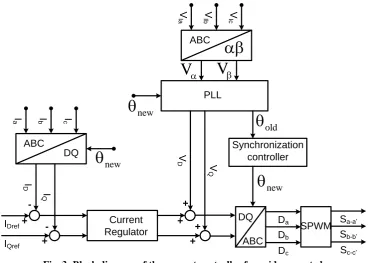
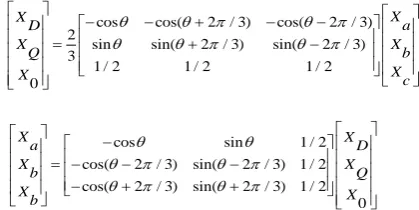
For grid-connected operation, the controller shown in Fig. 1 is designed to supply constant current output in order to provide a pre-set power to the main grid [11]. An important aspect to consider in grid-connected operation is the synchronization with the grid voltage [15-16]. For unity power factor operation, it is essential that the grid current reference signal be in phase with the grid voltage. This grid synchronization can be carried out by using a PLL [17]. Also, the PLL is used to determine the frequency and angle reference of the PCC. Fig. 3 shows the control topology used. When using the current control, the output current from the filter, which has been transformed into a synchronous frame by Park’s transformation (Eq. 1) and regulated in DC-quantity [18-19], is fed back and compared with reference currents IDQref.
ABC
ABC
DQ
V
Ia IbV IcV
I D I Q PLL I
a bI cI
V D V Q Current Regulator + + + + IQref IDref+
+ -- DQ ABC Da Db Dc
SPWM Sa-a’ Sb-b’ Sc-c’ Synchronization controller old
new
new
new
V
V
Fig. 3: Block diagram of the current controller for grid-connected.
18-19]. The voltage references in DC-quantities, VDQref, are transformed into a stationary frame by the inverse of Park’s transformation (Eq. 2) and utilized as command voltages for generating high frequency pulse width modulated (PWM) voltages.
cos cos( 2 / 3) cos( 2 / 3) 2
sin sin( 2 / 3) sin( 2 / 3) 3
1 / 2 1 / 2 1 / 2
0 X X a D X X Q b X X c
(1)
cos sin 1 / 2
cos( 2 / 3) sin( 2 / 3) 1 / 2 cos( 2 / 3) sin( 2 / 3) 1 / 2
0
X X
a D
X X
b Q
Xb X
(2)
A. Synchronization Controller for Grid Reconnection: Proposed Algorithm
When the DG is in islanded mode operation and the grid-disconnection cause disappears, the transition from stand-alone to grid-connected mode can be started [20]. To avoid hard transients in the reconnection, the DG has to be synchronized with the grid voltage [11, 15-16]. The DG is operated in synchronous island mode until both systems are synchronized.
Once the voltage in the DG is synchronized with the utility voltage, the DG is reconnected to the grid and the controller will pass from voltage control mode to current control mode.
This synchronization is achieved by implementing the following algorithm:
o Assume that the phase difference between grid voltage and inverter voltage is given by:
V V
G I
(3)
o In order to obtain information of
, two sets of voltage values are used:
3 cos( ) 2 k V V V V V V
Ia Ga Ib Gb Ic Gc
(4)
3
cos( ) 3 sin( ) 4
g V V V V V V
Ia Gb Ib Gc Ic Ga
(5)
where,
sin( )
V V t
Ga Gm sin( 120 )o
V V t
Gb Gm sin( 120 )o
V V t
Gc Gm sin( )
V V t
Ia Im sin( 120o )
V V t
Ib Im
sin( 120o )
V V t
Ic Im
Using the variables k and g, sin( ) can be found as:
4 2
3 3
sin( ) 3
g k
(6)
Fig. 4: Synchronization controller
V.
SIMULATION
RESULTS
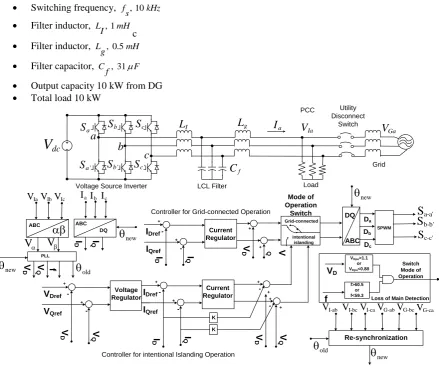
The performance of the proposed control strategies was evaluated by computer simulation using SABER. Fig. 5 shows the simulated system. This system was tested under the following conditions:
Switching frequency, f , 10 kHz s
Filter inductor, L , 1 mH
I c
Filter inductor, L , 0.5 mH g
Filter capacitor, C , 31 F
f
Output capacity 10 kW from DG
Total load 10 kW
I
L
fC
dcV
a
c
b
aS
Grid ' aS
bS
' bS
cS
' cS
gL
I
aLoad PCC
Ia
V
V
GaVoltage Source Inverter LCL Filter
Utility Disconnect
Switch
Loss of Main Detection
VD
f
VDpu>1.1 or VDpu<0.88
f>60.5 or f<59.3 Switch Mode of Operation Re-synchronization I-bc
V VI-caVG-abVG-bcVG-ca
SPWM DQ ABC Da Db Dc Mode of Operation Switch Grid-connected intentional islanding I Q I D IQref IDref + + -Current Regulator V
D + Q V
+ Voltage Regulator K I Q I D IQref IDref + + -Current Regulator V
D QV
+ + K -+ + V Q V D VQref VDref + + -ABC DQ I
D QI
PLL
V
D QV f
a
I Ib Ic Ia
V VIbVIc
ABC
c-c'
S
b-b'
S
S
a-a'I-ab
V Controller for Grid-connected Operation
Controller for intentional Islanding Operation
new
new
new
new
old
old
V
V
Fig. 5: Simulated system.
The load was adjusted to consume 10 kW. The DG system was simulated to supply 10 kW and zero reactive power. The system was operated initially in grid-connected operation. After the island was detected the control mode was changed from current controlled to voltage controlled operation.
Fig. 6: From grid-connected to stand-alone operation with severe transients
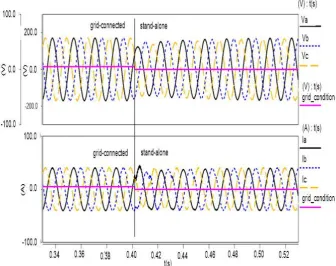
Fig. 7: From grid-connected to stand-alone operation without severe transients.
Fig. 8: From grid-connected to stand-alone operation without severe transients.
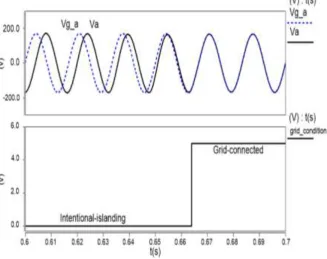
When the grid-disconnection cause disappears, the transition from stand-alone mode to grid-connected mode can be started. The DG was operated in synchronous island mode until both systems were re-synchronized. While in synchronous island mode, the synchronization controller decreases the frequency to a limited value, as seen in Fig. 9.
Fig. 9: Synchronization for grid re-connection.
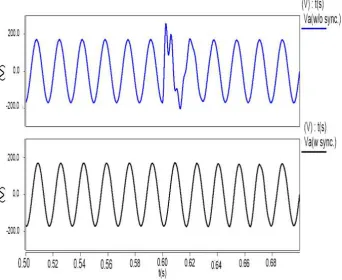
Once the synchronization was completed, the DG was reconnected to the grid and the controller was switched from voltage control mode to current control mode. Fig. 10 shows the phase voltage V
a without and with the synchronization algorithm implemented. As can be noticed, the transients are minimal and virtually negligible indicating that the algorithm avoids a hard transient in the reconnection from stand-alone operation to grid-connected operation.
Fig. 10: Phase voltage without (top) and with (bottom) synchronization
VI.
EXPERIMENTAL
RESULTS
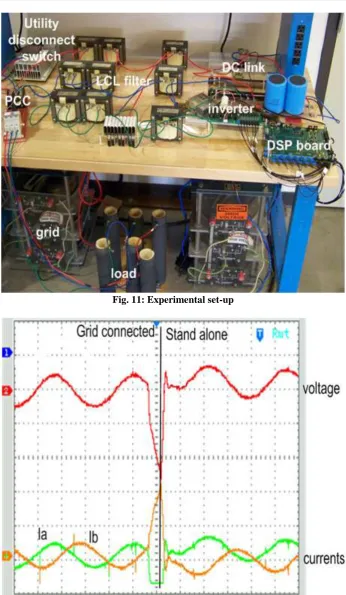
The hardware prototype of Fig. 5 was implemented for experimental verification. The control, PLL, grid condition detection, and re-closure algorithms were programmed using a universal DSP control board developed at the Power Electronics and Motor Drives Laboratory at the University. The system was tested under the following conditions to experimentally verify the simulation results:
Switching frequency, f , 10 kHz s
Dead time 3μs
Filter inductor, L , 1 mH I
Filter inductor, L , 0.5 mH g
Filter capacitor, C , 50 F
f
Simulated Output voltage 104 V , 3 @ 60 Hz
RMSLL grid connection, with Vdc 200 V
Output capacity 2.5 kW from DG
Total load 2.5 kW
The reason for simulating the output voltage is to ensure the algorithms and controllers are functioning properly under low-power tests; such that there is a reduced risk of operator and equipment damage if the system fails.
Fig. 11: Experimental set-up
Fig. 12: Transition from grid-connected to stand-alone operation with severe transients.
Fig. 13: Transition from grid-connected to intentional islanding operation without severe transients.
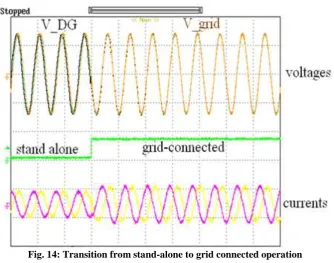
Fig. 14 shows the process of synchronization where the line to line voltage at both ends of the separation device is illustrated. At the beginning of the synchronization, both voltages are out of phase. As can be seen, the proposed algorithm successfully forces the voltage at the DG to track the voltage at the grid until the synchronization process is completed. Also shown is the smooth transition of the currents.
Fig. 14: Transition from stand-alone to grid connected operation
VII.
CONCLUSIONS
switch between the two controllers, was presented. The detailed process of a seamless transition between grid-connected and stand-alone modes has been illustrated. The proposed algorithm is able to switch the inverter operation from voltage-controlled mode to current-controlled mode and vice versa with no interruption to the load. The simulation and experimental results show that the seamless transfers have been achieved.
REFERENCES
[1]. Qingchun Zhang; Callanan, R.; Das, M.K.; Sei-Hyung Ryu; Agarwal, A.K.; Palmour, J.W., "SiC Power Devices for Microgrids," Power Electronics, IEEE Transactions on , vol.25, no.12, pp.2889,2896, Dec. 2010.
[2]. Y. Bo, et al., "Design and Analysis of a Grid-Connected Photovoltaic Power System," Power Electronics, IEEE Transactions on, vol. 25, pp. 992-1000, 2010.
[3]. I. J. Balaguer, et al., "Control for Grid-Connected and Intentional Islanding Operations of Distributed Power Generation," Industrial Electronics, IEEE Transactions on, vol. 58, pp. 147-157, 2011.
[4]. A. Ajaja, "Reinventing electric distribution," Potentials, IEEE, vol. 29, pp. 29-31, 2010.
[5]. Saber, A.Y.; Venayagamoorthy, G.K., "Plug-in Vehicles and Renewable Energy Sources for Cost and Emission Reductions," Industrial Electronics, IEEE Transactions on, vol.58, no.4, pp.1229, 1238, April 2011.
[6]. Tai-Sik Hwang; Sung-Yeul Park, "A seamless control strategy of distributed generation inverter for critical load safety under strict grid disturbance," Applied Power Electronics Conference and Exposition (APEC), 2012 Twenty-Seventh Annual IEEE , vol., no., pp.254,261, 5-9 Feb. 2012.
[7]. J. Hea-Gwang, et al., "Performance Improvement of LCL-Filter-Based Grid-Connected Inverters Using PQR Power Transformation," Power Electronics, IEEE Transactions on, vol. 25, pp. 1320-1330, 2010. [8]. Y. Shuitao, et al., "A Robust Control Scheme for Grid-Connected Voltage-Source Inverters," Industrial
Electronics, IEEE Transactions on, vol. 58, pp. 202-212, 2011.
[9]. P. Channegowda and V. John, "Filter Optimization for Grid Interactive Voltage Source Inverters,"
Industrial Electronics, IEEE Transactions on, vol. 57, pp. 4106-4114, 2010.
[10]. D. C. Patel, et al., "Three-Dimensional Flux Vector Modulation of Four-Leg Sine-Wave Output Inverters," Industrial Electronics, IEEE Transactions on, vol. 57, pp. 1261-1269, 2010.
[11]. C. Chien-Liang, et al., "Design of Parallel Inverters for Smooth Mode Transfer Microgrid Applications," Power Electronics, IEEE Transactions on, vol. 25, pp. 6-15, 2010.
[12]. M. E. Haque, et al., "A Novel Control Strategy for a Variable-Speed Wind Turbine With a Permanent-Magnet Synchronous Generator," Industry Applications, IEEE Transactions on, vol. 46, pp. 331-339, 2010.
[13]. L. Yunwei, "Development of power conditioners and controllers for Microgrids," DOCTOR OF PHILOSOPHY, School of Electrical and Electronic Engineering, Nanyang Technological University, 2005.
[14]. J. M. Espi Huerta, et al., "A Synchronous Reference Frame Robust Predictive Current Control for Three-Phase Grid-Connected Inverters," Industrial Electronics, IEEE Transactions on, vol. 57, pp. 954-962, 2010.
[15]. D. N. Gaonkar, et al., "Seamless Transfer of Microturbine Generation System Operation Between Grid-connected and Islanding Modes," Electric Power Components and Systems, vol. 37, pp. 174 - 188, 2009.
[16]. G. Iwanski and W. Koczara, "DFIG-Based Power Generation System With UPS Function for Variable-Speed Applications," Industrial Electronics, IEEE Transactions on, vol. 55, pp. 3047-3054, 2008. [17]. H. Karimi, et al., "Negative-Sequence Current Injection for Fast Islanding Detection of a Distributed
Resource Unit," Power Electronics, IEEE Transactions on, vol. 23, pp. 298-307, 2008.
[18]. Y. Sozer and D. A. Torrey, "Modeling and Control of Utility Interactive Inverters," Power Electronics, IEEE Transactions on, vol. 24, pp. 2475-2483, 2009.
[19]. A. Timbus, et al., "Evaluation of Current Controllers for Distributed Power Generation Systems,"
Power Electronics, IEEE Transactions on, vol. 24, pp. 654-664, 2009.