Licensed under Creative Common Page 481
http://ijecm.co.uk/
ISSN 2348 0386
THE EFFECT OF PSYCHOLOGICAL EMPOWERMENT OF
EMPLOYEES ON THE DEVELOPMENT OF
A LEARNING ORGANIZATION
Mehdi Nemati Davijani
MA Commercial Management, Islamic Azad University, Arak Branch, Arak, Iran
Ahmad Reza Mohammadian
MA Management, Islamic Azad University, Karaj Science and Research Branch, Karaj, Iran
Teymour Saedi
MA Public Management, Islamic Azad University, Chalous Branch, Chalous, Iran
Alireza Kazemi
MBA, PayameNour University, Tehran, Iran [email protected]
Abstract
Development of organizational learning requires suitable situation. Meantime, the role of
human-social factors is crucial in creating a learning organization. Thus organization should
have competent employees so it can help to prepare for the development of a learning
organization. Therefore, this study examines the role of empowerment of employees in
developing a learning organization and five main dimensions of empowerment (the sense of
meaningfulness of jobs, job competence, the authority, effectiveness in job, and trusting
colleagues) with four main aspects of the learning organization (corporate culture,
organizational structure and strategy and vision) are considered. The research is descriptive
and correlational. The statistical population includes 574 administrative employees of National
Iranian Oil Products Distribution Company who were selected randomly and 250 of them were
Licensed under Creative Common Page 482 correlation test shows that empowering employees has a large direct impact on the
development of a learning organization, and there is a positive correlation between all aspects
and learning organization. Thus, empowerment of employees can provide appropriate
human-social context for the development of a learning organization. The proposals will be presented to
managers and researchers.
Keywords: Organizational learning, Learning organization, Employee empowerment, HRD
INTRODUCTION
The organization's environment is constantly changing; today large and complex organizations of past decades are efficient and these organizations are like dinosaurs that could not adapt themselves to their environment and were doomed. Large organizations with traditional structures have no power and flexibility for being in line with changes in the environment and they have no way but change their own structure in order to survive, or they have to be equipped with the tools to be able to deal with these global changes. One of the tools to create and internalization is organizational learning (Mohammadi, 2003).
Many researchers believe that, the learning ability of organizations is the only competitive advantage and only way to survive in future. and the only way to survive their only competitive advantage in the future. From the perspective of Peter Synge, "In today's complex and dynamic world , organizations can maintain their competitive advantage if they learn faster than their competitor in the form of single integrated entities". To make the learning ability, he defends the idea of organization development to become a learning organization. The development of organizational learning ability prepares organizations to work in the real world due to the paradigm shift of management and increases their ability of self-determination and is and allows to achieve organizational efficiency factors in order to survive and to sustain in possible competitive position (Veten et al., 2004). Organizations as a collection of individuals and groups of people acquire lessons in the face of widespread and rapid environmental changes over time in terms of their actions and of activities. In other words, organizations should have learning ability just like people. Thus, we can conclude that one of the major challenges in the various layers of management is to increase organizational learning (Mohammadi, 1998).
Licensed under Creative Common Page 483 leadership, organizational culture, environment, information technology, and organizational structure are effective and they should have appropriate characteristics and conditions (Kalantari, 2008). All of organization themselves and the same are not ready for development organizational learning. The key to understanding success and failure in the development of a learning organization is to identify and to provide sufficient context to implement organizational learning processes effectively. One of these amplifiers, is to have capable employees who have appropriate learning ability. In the present study, it is considered to explain how and to what extend is he effect of empowerment aspects of employees on the development of a learning organization.
There are prerequisites and sufficient infrastructures to develop a learning organization such as leadership, organizational culture, environment, information technology and organizational structure (Kalantari, 2008). But I should be noted that the organizational learning has human nature more than any other aspect; Organizations learn through the way of employees’ learning. Peter Synge in his book "The Fifth Command" indicates a learning organization the one that uses individuals, values, sub-systems and lessons and experience to improve its performance continuously (Mohammadi, 2003).
Therefore, in this study among various infrastructure and enablers of the organization, the crucial and decisive role of employees in the development of a learning organization has been considered and we try to have a valid and reliable description about the effect of different aspects of the empowerment of employees on the development of learning organizations.
LITERATURE REVIEW
Learning Organization
Learning means relatively stable change in behavior or attitude of individual that occurs as a result of experience. Learning has a few layers: individual, group, sector, inter-organizational and inter-organizational learning. At the last layer, organization acquires long-term vision from itself and environment in which it operates. Future horizon is not easy to predict, it can be very difficult or impossible for managers who have not done it before.
Licensed under Creative Common Page 484 Between two related constructs-organizational learning and learning organization- there is difference (Jafari Ghushchi, 2001). Learning organization is defined a form of the organization, while organizational learning explains processes and activities of the organization (Babaei et al., 2002).
The concept of a learning organization refers to organizations that show features such as continuous learning and adaptation and they work on establishment of such features. In contrast, organizational learning represents the collective learning experiences and is used to acquire knowledge and develop skills (Mohammadi, 2003).
The learning organization is a type of organization that is improved continually through creation and refinement of necessary abilities for success. In other words, learning organization is an organization that facilitates the learning of all its members and improves itself continually (Denton, 1998). There is consensus on importance of organizational learning and learning organizations, but there is no model or theory about organizational learning and learning organizations which is accepted by all experts (Armstrong, 2003).
However, today there is consensus on five main characteristics of learning organization scholars (JafariGhushchi, 2001): 1. Learning organization is not against individuals who learn; learning is done simultaneously at three levels: individual, group and organizational. 2. Learning organization sows organization's ability to change. The more learning organization is and more and better and more consistent with the environment, it enhances the effectiveness and dynamism. 3. Learning organization not only facilitates individual learning but also optimizes structure, culture, business design and the mental models in organization. 4. Learning organization allows wide participation of employees and clients (customers) in decision-making, dialogue and knowledge sharing. 5. Learning Organization extends systematic thinking and organizational memory and then emphasizes training and development of human resources along with better performance in line with collective goals of organization.
Empowering employees
Environmental challenges of the current era, such as the rapid development of technology, increased customer expectations and the need for flexibility have forced organizations to seek a way to sustain their survival. Many of these organizations, therefore, have adopted plans for empowerment of employees and are trying to enhance the ability of organization to improve performance and organizational development by developing capable and motivated human resources.
Licensed under Creative Common Page 485 role and responsibility in the organization. Empowerment, is not giving power to people. They clearly have their own great power (as the capital of knowledge and motivation) that do their job excellent. Empowerment means freeing this power. In fact, empowerment is different from strengthening and giving power to people. Power is transferred directly to the people, but the conditions must be created for empowerment in which people can empower themselves. The concept of empowerment is beyond the transfer of authority to employees. When empowering not only the tasks are assigned to employees, but also there are conditions provided so that employees can decide to do these tasks (Aghayari, 2003).
Reasons of empowerment can be divided into two categories: increasing motivation and improving productivity of employees and quality of services provided to customers (Babaei, 2002). As a result, employee empowerment changes attitude and behavior of employees. Increasing job satisfaction, reducing stress, increasing self-confidence, choosing the best way to do things, increasing compliance, and increasing the speed of response to customer needs are of attitudinal and behavioral changes (Mohammadi, 2003).
Cognitive dimensions of psychological empowerment of employees
In one of the most famous experimental studies about empowerment, Spritzer (1992) mentioned four cognitive dimensions (factors) for empowerment. In this study, based on research by Mishra (1992) a dimension has been added to these aspects.
A) Sense of competency: When people are empowered, they feel self-efficacy, they feel to have the ability and skills needed for their successful work. Some authors consider this as the main factor of empowerment; because this is a sense of competency to determine whether people will try to do hard work and have perseverance or not.
B) Sense of having a right to choose: Empowered people have a sense of self-organization. "Being self-organized" means a sense of having a right to choose in doing personal tasks. They see themselves to be self-initiated and can do their own initiative, to take independent decisions and put new ideas to the test.
C) Sense of effectiveness: people feel strong personal control over their results. They believe they can influence and change the environment in which they work, and believe that they can control barriers of external environment and make it in line with their own requirements.
Licensed under Creative Common Page 486 E) Sense of trust in others: Empowered people feel that they will be treated fairly and equally. They are ensured that their final result, not damage or loss, but will be justice and peace. In other words, trust means having a sense of personal security. Having this feeling that the behavior of others is reliable, the information is reliable and can trust promises of colleagues, all affect a sense of empowerment (Veten et al., 2004).
Theoretical framework
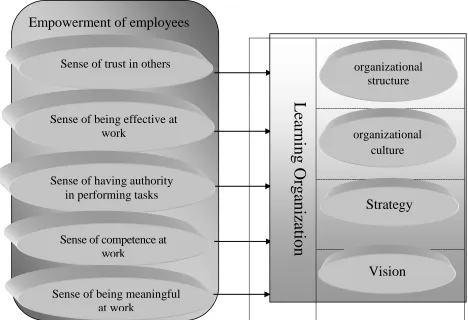
In this study, there are five dimensions of empowerment of employees considered as independent variables and learning organization as dependent variable based on aforementioned literature. Dimensions of psychological empowerment of the study are: a sense of meaningful jobs, professional competence, having authority, being effective at work and trusting colleagues. The various studies conducted in the field of learning organization: vision, organizational culture, organizational structure and strategy are considered as key dimensions of learning organization that dependent variable (i.e. learning organization) can be evaluated using them.
Figure 1: Theoretical framework
Empowerment of employees
Sense of trust in others
Sense of being effective at
work
Sense of having authority
in performing tasks
Sense of competence at
work
Sense of being meaningful
at work
Learni
ng
O
rgani
zat
ion
organizational
structure
organizational
culture
Strategy
Licensed under Creative Common Page 487
Research hypotheses
With respect to the issues discussed and the conceptual model of impact employees ‘empowerment on development of a learning organization, the main hypothesis and Sub- hypotheses developed in this study are as follows:
Main hypothesis
Empowerment of employees has a positive impact on the development of a learning organization.
Sub-hypotheses
1. There is positive relationship between sense of being meaningful at work and development of learning organization.
2 .There is positive relationship between sense of being competent at work and development of learning organization.
3 .There is positive relationship between having authority in performing tasks and development of learning organization.
4. There is positive relationship between sense of being effective at work and development of learning organization.
5. There is positive relationship between sense of trust in others and development of learning organization.
RESEARCH METHODOLOGY
This study is an applied one in terms of its objectives; because its results are used to solve specific problems within the organization. From the perspective of how to collect data, it is descriptive-survey; because it tries to obtain information needed from status quo of sample by using the questionnaire. Also in terms of time, it is cross-sectional and in terms of data type, it is a quantitative research.
Statistical territory
Licensed under Creative Common Page 488
Data collection tools
Tools to collect field primary data is a 37-item questionnaire that was used as a 5-level Likert scale. To test the reliability of questionnaire, the initial sample of 30 respondents was pre-tested and using SPSS software, confidence coefficient was calculated by using Cronbach's alpha as 96%. Content validity of this questionnaire has been confirmed by several members of experts.
Data analysis approach
In this study, to analyze the data and study the relationships between concepts and dimensions, factor analysis was used and for the presence or absence of appropriate conditions for empowerment and organizational learning, binomial test was used, structural equation modeling was used in order to test main hypothesis of this study and for sub-hypotheses, Spearman correlation coefficient was used. Statistical software used for SEM analysis was Lisrel.
ANALYSIS AND RESULTS
Confirmatory factor analysis
To investigate the association between indicators and concepts, confirmatory factor analysis was used in two stages. At first stage, quality and extend of relationship between each of the measured parameters (questions) and dimensions have been studied and at second stage, quality and extend of relationship between each main concepts and dimensions (empowerment and organization learning) were evaluated. In other words, at first stage the extend these indicators can explain dimension under study and then to what extend these dimensions are in relation to each concept and can explain it. The results of the factor analysis of the constituent dimensions of empowerment and learning organization is shown in table 1.
Table 1: Factor analysis of the constituent dimensions of empowerment and learning organization
Factor Dimensions Standard
rate
Significant
number Result
Empowering employees
Sense of being meaningful at work .59 11.05 Confirmed
Sense of being competent at work .29 10.18 Confirmed
Sense of having authority .72 7.18 Confirmed
Sense of being effective .58 6.78 Confirmed
Sense of trust in others .56 6.16 Confirmed
Learning Organization
Organizational structure .83 8.67 Confirmed Organizational Culture .81 11.03 Confirmed
Strategy .85 9.65 Confirmed
Licensed under Creative Common Page 489 According to the results presented in table 1, significance of impact of all considered variables is confirmed for empowerment and learning organization, because their amount is not between 1.96 and -1.96.
Studying the presence of appropriate conditions for empowerment and organizational learning
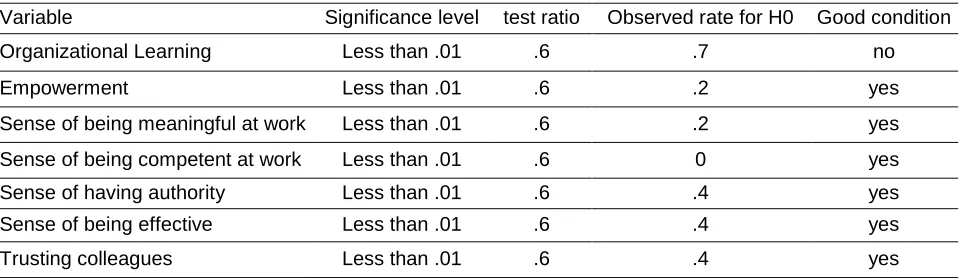
Due to abnormal distribution of data, binominal test was used to assess the presence or absence of appropriate conditions for the development of a learning organization and empowerment of employees. In this test, if the likelihood of test is greater than or equal to observed likelihood, H0 is rejected and H1 is confirmed (H0 represents the absence of appropriate conditions and H1 represents the presence of appropriate conditions) (Table 2).
Table 2: The results of the Binomial test
Variable Significance level test ratio Observed rate for H0 Good condition
Organizational Learning Less than .01 .6 .7 no
Empowerment Less than .01 .6 .2 yes
Sense of being meaningful at work Less than .01 .6 .2 yes
Sense of being competent at work Less than .01 .6 0 yes
Sense of having authority Less than .01 .6 .4 yes
Sense of being effective Less than .01 .6 .4 yes
Trusting colleagues Less than .01 .6 .4 yes
As binomial test results show, in studied population the current situation is not suitable for learning organizations, but there are suitable situation for empowerment and all dimensions. Hence it can be concluded that, given the relatively high correlation between dimensions of employees’ empowerment and the development of a learning organization (see Table 2) can provide favorable conditions for the development of learning organization by empowering employees more.
Testing of the research hypotheses
Test of Main hypothesis
Licensed under Creative Common Page 490 questions) and six latent variables (expressed dependent and independent variables). After modeling to assess the validity of model, specific indicators are used including ratio of chi two to less degree of freedom as allowable amount of 3, the root mean square error of approximation that must be smaller than .08 and p-value must be smaller than .05, and average fitness index must be greater than .9.
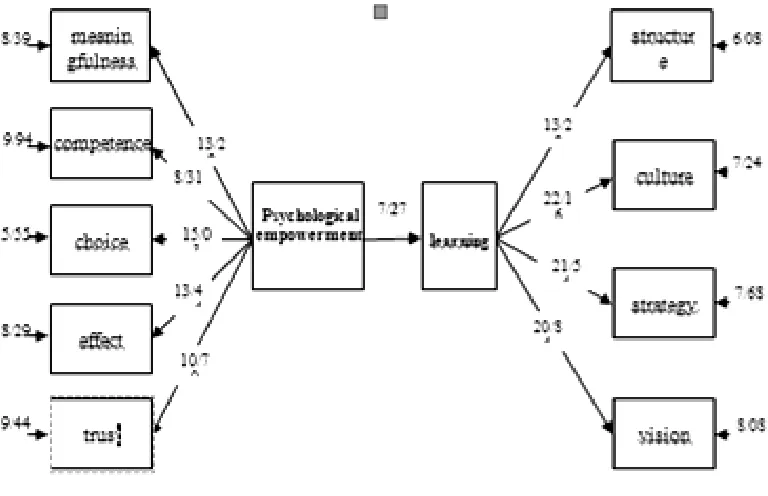
To determine the significance of mentioned impact, significance modeling and to assess the quality and extend of this impact, standard model have been used. About significance of obtained numbers in the model, because hypothesis test is performed with a confidence level of 0.95, then those numbers will be significant that are not between 1.96 and -1.96. This means those numbers in this interval will not be significant.
Figure 2 shows the significance of impact of employees’ empowerment on development of learning organization.
Figure 2: The impact model of empowering employees on development of learning organization in significant mode
Licensed under Creative Common Page 491 Table 3: Fitness indexes of impact of empowering employees on development
of learning organization
Indexes Allowed amount Obtained
numbers result
Chi two to degrees of freedom ratio
2/df<3 2.94 Proper fitnessP-Value <0.05 0.0000 proper fitness
RMSEA 0.08> RMSEA>
0.05 0.094 Improper fitness
Fitness index (GFI) More than 0.9 0.92 Proper fitness
Average fitness index (AGFI) More than 0.9 0.89 Relative proper fitness
CFI More than 0.9 0.92 Proper fitness
Fitness indexes show the properness of measuring model of related variables; because the ratio of chi two to degrees of freedom is 3.94 and less than allowed amount of 0.05. Also given this model, the impact of empowering employees on development of learning organization is 7.27 and more than 1.96 and this means this impact is significant. Using standard model, we can study extend of this impact.
Licensed under Creative Common Page 492 The model showed the impact of empowering employees on development of a learning organization is significant. In standard mode, it also showed that leadership of this process (empowerment of employees) explains 51% of changes in development of a learning organization. Therefore, the main hypothesis i.e. positive and significant impact of employees’ empowerment on development of a learning organization is confirmed. Also among various dimensions of empowerment, a sense of having authority has had the highest determining impact.
Test of sub-hypotheses
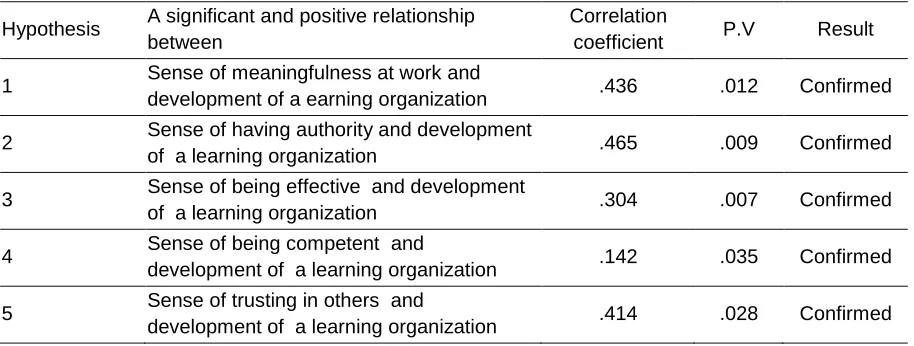
After confirming the explaining impact of empowerment of employees on development of a learning organization, the study of quality and the extend of relationship between each dimensions are considered (sub-hypotheses); To this end, Pearson correlation coefficient has been used that its results are provided in table 4. This review has been done at confidence level of ninety-five percent, if a significant level is greater than %5, H0 will be confirmed. This means the existence of significant relationship between variables; otherwise the existence of such relationship will be confirmed. The obtained results are provided in table 4 and are analyzed and concluded based on this trend.
Table 4: The results of the study hypothesis of a subsidiary (the correlation between employee empowerment and organizational aspects of learning)
According to the results presented in table 4,the significance of the relationship between all dimensions of employees’ empowerment and development of a learning organization has been confirmed; because the value of significance number was smaller than 0.05. These results show that as predicted in H1-H5, there is a positive and significant relationship between dimensions of employees’ empowerment and development of a learning organization. This
Hypothesis A significant and positive relationship between
Correlation
coefficient P.V Result
1 Sense of meaningfulness at work and
development of a earning organization .436 .012 Confirmed
2 Sense of having authority and development
of a learning organization .465 .009 Confirmed
3 Sense of being effective and development
of a learning organization .304 .007 Confirmed
4 Sense of being competent and
development of a learning organization .142 .035 Confirmed
5 Sense of trusting in others and
Licensed under Creative Common Page 493 means the improvement of status quo of each of these dimensions can help to develop a learning organization more. Also among these dimensions, sense of having authority has had the highest relationship with development of a learning organization (46 percent).
CONCLUSIONS AND RECOMMENDATIONS
The general pattern of relationships between dependent and independent variables in structural model and correlation test were consistent with the stated hypotheses; each of 6 relationships was significant and important. Based on the obtained results, the positive impact of employees’ empowerment on development of a learning organization and positive relationship of all dimensions with development of a learning organization has been confirmed. Hence we can say that the development of a learning organization can be accomplished in those organizations have empowered employees and managers and its employees feel they have an important and significant job, the have a sense of being competent and effective, having necessary authorities to make decision about job affairs and trust in capabilities and goodwill of their own colleagues. In such organizations, employees are free to think and act about what they are doing. Encouraging employees to exchange their knowledge and experiences with each, holding group meetings in order to exchange ideas and viewpoints, creating a friendly and reliable atmosphere between employees, group discussion in order to decide ,specifically, increasing interaction between managers and employees, facilitating employees’ access to information related to their job, increasing interactions between employees who work in connection with each other , are considered of measures that can be taken for empowering employees more. In the following, there are recommendations for the development of a learning organization in the company with the approach of paying more attention to empower employees.
- One of the characteristics of a learning organization is a shared goal about the prospects and desired future of organization among members. Therefore, managers should try to picture desired to employees and show how it can be achieved; some measures are helpful in this regard such as: forecasting future needs, thinking about the future, creating a clear picture of the future of the organization for employees, setting high and accessible goals for the future of the organization and benchmarking of internal and external leading and successful organizations .
Licensed under Creative Common Page 494 development of group decisions culture and strengthening the team spirit, strengthening the spirit of innovation and creativity, ensuring the development of creative people, aligning goals of employees and managers with organizational goals - the development of a culture of shared responsibility taking, the strengthening of mutual trust, making commitments to learning among managers and employees and accepting mistakes and failures as a natural phenomenon in the processes of organizational learning, changing and development .
- With respect to the necessity of cooperative management for building appropriate structure for learning organization, it is needed to strengthen and reform participation system more than ever before, and improve its methods through re-engineering initiatives. It is required to create more horizontal, team-oriented, unfocused, and dynamic structure in this company. Re-engineering processes is one of the improvement approach in this field that make fundamental changes simultaneously in structure, culture and technology to implement in field such as customer service, improving quality, reducing costs and speeding up the necessary reforms and, as a result the performance of organization will be improved .
- In general it can be said, the existence of empowered human resource is necessary with regard to human- social nature of organizational learning processes to develop organizational learning and moving to a learning organization model. Empowered employees can help organization in order to become learning organization. As a result, the empowerment of employees can provide a good platform and improve process and the results of organizational learning activities. Therefore, managers can improve capacity and capability of organizational learning through empowering employees and providing learning opportunities for subordinates.
REFERENCES
Aghayari, S ,(2003),"Empowerment :a new method in competitive environment" , TadbirMonthly , Issue. 135.
Al-Badawi, A; Shafa'ii, R.,(2002), "Introduction to strategies for creating learning organizations in Iran", Journal of Knowledge Management, Issue 57
Amrollahi, N,(2001), "Learning organization", TadbirMonthly , Issue. 114
ArbabShirani, B ,(2000), "Literature review of organizational learning " , Special newsletter of 8th Student Congress of Industrial Engineering , Azad University of Qazvin
Argyris, Chris,Donald,A.schon, "organizational learning: A theory of action Perspective", reading , mass: addison – Wesley publishing company, 1978.
Armstrong , A, folr,p, "foundations for a learning organization : organization learning mechanisms " , the learning organization: ,volume 10. NO 3, 2003.
Babaei, A. (2002), "Employee empowerment : non-alternative investment", TadbirMonthly ,Issue. 129
Licensed under Creative Common Page 495 Baron, J. N, Hannan ,M.T, Burtoon , M.D," labor pains: changing in organizational models and employee turnover in young , high tech firms " , American journal of socoliogy,2001.
Benins,W,andNanus , B, " leaders : the strategies for taking charge”, New york : Harper & Row, 1985. Blanchard, heresy, John Soonkennth , Dewey, "Management of behavior" , organizational prentice. 1996.
Brown, B.L, "knowledge worker", trend and issues- alert, NO4, 1999.
Byham, W,C, "Zapp! The lightning of empowerment" New York, harmony Books, 1988.
Daft, Richard L, "organization theory and design",south-western college publishing, Seven edition, 2001. Denton, john, "organizational learning and effectiveness", New York ,Routhedge, 1998.
Deutsch, M, "the resolution of conflict : constructive and destructive processes" , New Haven : Yale university press, 1973.
Dover , K, "avoiding empowerment traps", management review, volume 88 Issue, 1999.
Egan, T,M, Yang ,B, Bartlett, K," the effects of organizational learning culture & job satisfaction on motivation to transfer learning & turnover intention ", human resource development quarterly , Volume 15. NO 3, 2004.
Fiol ,C.M,Lyles,M.A, "organizational learning". Academy of management review , volume 10, 1985. Garvin, “Bulding a learning organization”, Harward business Review, 1993.
Gloet ,Marianne , Mika, Berrell, "the dual paradingm nature of knowledge management for achieving quality outcomes in human resource management" , journal of knowledge management ",Volume 7. NO 3, 2003.
Griego , O.V Gerog ,G . D, Wringht P.C, "predictors of learning organization : a human resource development practioner’s perspective", the learning organization , Volume 7. NO , 2000.
Guns , Bob, "the faster learning organization’, Pfeffer company, 1996.
Hackman , J.R , and Oldham , G.R, "work design" , Reading mass: add ison – Wesley, 1980.
Hite, james, "learning in chaos : improving human performance in today s fast changing ,volatile organization ", Gulf publishing company, 1999.
Hitt ,William .D, "the learning organization : some reflections on organization renewal",leradership and organization development journal, volume 16, 1995.
Holland, P .j , Hecker , R , Steen, J, " human resource strategies & organizational structures for managing gold –collar workers", journal of European industrial training , Volume 26.NO2, 2002.
Holland ,P.J, Hecker ,R ,Steen, J, "Human resource strategies and organization structure for managing gold – collar workers", journal of European, 2002.
Hong J.C, Kuo,C,L, "knowledge management in the learning organization", the leadership & organization development journal, Volume 20.NO4, 1999.
Jafari Ghushchi, B. (2001), “Methods to empower employees " , Tad birMonthly, Issue. 119
Kalantari, Kh. (2008), "The structural equation model in socio-economic research", landscape and design consultants publication
KhaliliIraqi, M. (2003), "learning organizations: necessity for change and development", Tadbir Monthly, Issue. 137
Mohammadi, M. (1998), "Learning organizations are revived" ,Tadbir Monthly , Issue. 90
Licensed under Creative Common Page 496 Rahmanpour, L. (2002), "Empowerment: concepts, structure and strategies" Journal of Management development, Issue. 41
Rahnavard, F. (2003), "Empowerment: a step toward being consumer-oriented", Quarterly of development and management process , Issue. 59
Synge, Peter, (2001), "Fifth Command : The creation of a comprehensive organization", translated by Kamal Hedayat H. and Roshan M., Tehran , Industrial management organization press, Third Edition
Veten, David&Cameron, Kim S. (2004), "Empowerment and transferring authority", translate ehran, publication of the Institute of management Research and Training Manager, Second Edition