Editorial | 9 |
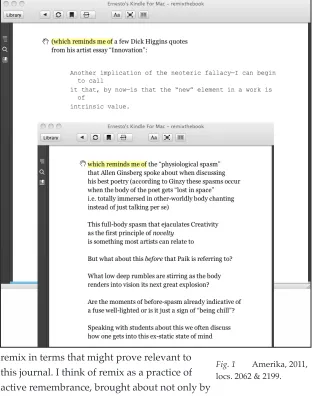
remix in terms that might prove relevant to this journal. I think of remix as a practice of active remembrance, brought about not only by
engaging and rearranging existing pieces of culture (songs, advertise -ments, lesson plans, civilizations) but by recognizing in them—being reminded of—the universe of references and potential relationships that each artifact holds within. When I remix, the resulting, new creative blends I make (Knobel & Lankshear, 2008) respond to embed -ded influences, actualize implicit relationships and attest to this very process both in form and content. These are of course the type of re-mixological endeavors that the socially networked Web 2.0 has turned into an everyday practice (Caplan, 2014) by virtually collapsing each
Editorial Introduction
Elizabeth Garber & León De la Rosa-Carrillo Past Editor Guest Editor
The Journal of Cultural Research in Art Education’s volume 32 features a group of three articles on the topic of remix and another seven on a range of critical cultural topics in contemporary art and visual culture and its education. The editorial for the remix mini-theme, penned by guest co-editor León de la Rosa-Carrillo, suggests remix as a way of thinking about the workings of cultures (past, present, diverse across ethnicities, races, nations, genders, abilities and interests, beliefs, and other factors that contribute to the weaving of cultures and their many derivations) that involves active and knowing re-creation. León dynamically brought to life for colleagues and faculty many of the concepts of remix during his time at the University of Arizona, and fills out the editorial background on remix for this issue.1 Following this, readers will find an overview of the seven articles outside the theme, but still very much in the center of this journal’s focus on cul-tural studies research. But first, remix.
The mini-themed issue from Volume 32 of the Journal of Cultural Research in Art Education focuses on Remix, which reminds me of two passages from Mark Amerika’s Remixthebook (2011, locs. 2062 & 2199) where the author forgoes any sense of detachment and announces what he is reminded of by his own writing. But regardless of what Amerika recalls it is his very act of recalling, and calling attention to it, what has since become an essential part of how I understand remix and, it occurs to me, an adequate point of departure to talk about
1 Readers interested in remix will enjoy (yes, enjoy) the experience of reading Dr. de la Rosa-Carrillo’s very visual dissertation, On the Language of Internet Memes, an intelligent and playful look at internet memes such as image macros and animated GIFs made by students. He analyzes these productions through remix theory, actor-network theory, object oriented ontology, and glitch studies, arguing that internet memes can be understood as an actor-network in which the elements of memes come to interact among themselves, aside from human interplay. The form the dissertation takes moves from scholarly written word to remixed images in providing readers with more than an understanding of these concepts, but with experiences of remixing digital memes.
| 10 | Journal of Cultural Research in Art Education Vol. 32 2015 Editorial | 11 | reference, every
point of depar-ture and all con-tent into an end-less stream of posts, hashtags and trending topics. Remix then, it seems, is but a click or a keyword search away. But remix is by no means wholly dependent on digital technology, social media nor the algorithms that fuel them, rather when Rome remixed Greece (Manovich, 2005) the resulting empire was a blend of manipulated customs, mythologies and ideals that embodied an active and dynam -ic remembrance of Greek culture.
Similarly Ferguson, in his Everything is a
Remix (2012) video series, equates Remix to a type of folk art that
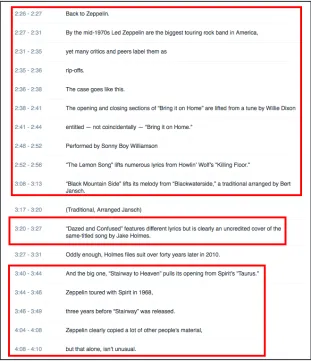
anybody can engage through a Copy-Transform-Combine process. His quick look into Led Zeppelin’s well-documented penchant for lifting riffs and lyrics from old blues songs speaks to the nature of remix as a process that shows through even when uncredited and, arguably, unintended. In this case, even if Zeppelin meant for these compositions to pass off as wholly original, the songs themselves reveal their source material and can’t help but shine a light on every blues tune that the band ripped off, or channeled, or actively recalled during their writing/remixing sessions.
Fig. 2 Knobel & Lankshear, 2008, p.1
Fig. 3 Caplan, 2014, Remix section
Fig. 4 Manovich, 2005, p.1
Editorial | 13 |
Bradshaw and Bergstrom, whose article opens this mini-themed issue, make note of a similar instance when one of the authors recognizes a song from the ‘80s even through it’s a new, remixed guise that her 15-year-old daughter believes to be new. This particular song’s remix however claims much older source material as Bradshaw is then made to recall a similar experience with her own mother regarding the same song originally, it turns out, from the ‘60s. As Bradshaw and Bergstrom struggle and get tangled up searching for the significance of remix as a practice, a philosophy, and a concept their article splin-ters into two columns, each voicing one author and allowing readers to perform a remix of their own as they dart from one side to the other examining the arguments that each writer advances and the anec -dotes they tell.
Wolfgang and Ivashkevich’s article is a visually engaging piece that focuses on the sense of agency afforded to remixers by appropriat -ing and rewrit-ing consumer culture. Not only do the authors share a handful of collages and video mashups generated by teenage girls during a juvenile arbitration program, but they also offer their own feminist readings and reactions to these pieces of remixed content adding yet another layer of messy complexity to the remix process. The work by Wolfgang, Ivashkevich, and their teenage learners brings into focus a significant aspect of remix culture: the inherent fluidity of the line that separates a media producer from a consumer of mediated messages. Lessig (2008) has coined the notion of an RW culture where
readers are just as likely to become writers by developing the necessary skills, engaging the available tools and immersing themselves in an environment that encourages remix.
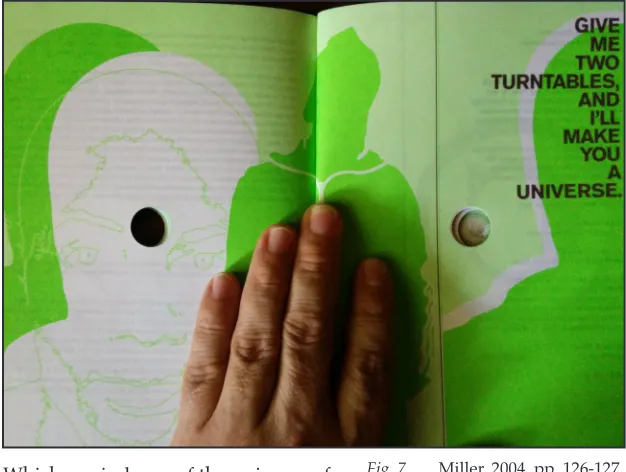
Denmead’s article, which closes out the remix-themed portion of this issue, explores yet another aspect of remix culture, as he revisits no-tions of community that once shaped his own practice as an art educa-tor. In remixing Greene’s seminal Releasing the Imagination (2005) with Pope L.’s Skin Set (2013) he creates a new text that is equal parts found poem and DJ-inpired literary mix that propels the source material into previously unrealized depths of interrelational complexities. Perhaps this is what Miller (2004), a DJ and an academic himself, means when he asks for two turntables and offers a universe in return.
Which reminds me of the universe of cultural research in art education that
exists beyond remix. A universe that this JCRAE issue samples in the form of seven other articles that explore non-remix themes but can equally be remixed if readers choose to. Happy remixing.
Outside the active and knowing employment of the remix theme, Manisha Sharma, in her article “Mythical Beings and Becoming,” Fig. 6 Lessig, 2011, p.28
| 14 | Journal of Cultural Research in Art Education Vol. 32 2015 Editorial | 15 |
and Nurit Cohen Evron, in “Stories of Becoming an Art Educator,” both provide research on becoming art educators from, respectively, Indian- and Israeli-influenced perspectives. Sharma interviewed 17 art educators in India to understand the influence of social construc -tions of gender on the educators’ decisions to join the profession. These stories are analyzed through Barthes’ theoretical concepts of myths as originary stories—she describes the myth of Laxmana-rekha as an originary story of gender in India—and Deleuze and Guattari’s idea of becoming as an endless state. Cohen Evron revisits her own becoming as an art educator based on personal, professional, and institutional experiences amidst the continuing conflicts within and around the borders of Israel. She describes how these experiences come to bear on teaching art as critical pedagogy.
Cala Coats presents a case study of a community of makers who turned a decommissioned missile base into an art and community space and a residence. Far beyond the description of the work, she helps us understand the space and the social relations of the partici-pants through Guattari’s three ecosophies, the psychic, the social, and the environmental. “Transversalizing Ecologies of Control” is accom -panied by Coats’ images of the re-purposed base.
In “The Spaces in Which We Appear to Each Other,” Cathlin Goulding presents resistance stories of Asian American Riot Grrrls through their zines. The zine authors (including Goulding) examine identity and self, gender norms, stereotypes of Asians, mixed-identity and racial binaries, white privilege, invisibilities and hyper-visibilities, language and family, and social in/justice. Goulding argues that zines are a type of pedagogy that foster active voice and self-learning in makers and teach fellow zinesters and readers in an informal yet penetrating manner, through text and visuals.
Ruth Smith worked with Somali women living in the Midwest to deepen understanding of the wearing of hijab. The five women made photographs and wrote narratives that show their process of deci -sion in choosing if and when to wear hijab. Smith’s article on this participatory action research project, “Dumarka Soomaaliyeed Voices
Unveiled,” is accompanied by the women’s photographs and narra -tives. She argues that, when exhibited, they activated public space to interrupt misperceptions of Somali women and presented multiple stories through which to understand women and modesty in Somali culture.
Kay Kok Chung Oi created five paintings about prostitutes and prostitution in early Singapore that were shown in an exhibition in Singapore. The paintings were interpretations of a scholarly work on the subject by historian James Frances Warren. In her article “Art as Exhibition,” she provides a context for understanding what the paintings have to teach us about the cultural contributions made by these immigrant women from China and Japan to building Singapore and the personal sacrifices involved. Reproductions of the paintings accompany the text.
Rounding out this issue is Mary Stokrocki’s ’s article on a case study of San Carlos Apache students’ visual responses to a prompt she gave them to share their “special mountain home.” Place, animals, and sa -cred ceremonies were found to be culturally derived themes, whereas inclusion of a pick-up truck, fishing and hunting scenes, and domestic and social life suggested slow social change.
Volume 32 is a strong sampling of cultural aspects of research in art and visual culture education today, with several articles enhanced by theoretical analysis that helps us not only deepen our understanding of issues important to our field but to re-think them. The issue is also strongly visual, indicating a very positive trend in our field to incor -porate the visual elements of what we do.
Tangling in Remix | 17 | issue critical. Layout for this issue is the work of León de la
Rosa-Carrillo (also Guest Editor): profound thanks to him for this undertak -ing. Thanks to University of Arizona Interim Director Martina Shenal for support of Managing Editor Chun-Chieh Chen’s position and to jCRAE’s parent organization, USSEA, and especially President Alice Wexler, Past President Steve Willis, and the USSEA Board for their support of the journal. A continuing thanks to readers for their inter -est in and support of cultural research in art education. We invite your contributions, and hope you will join or renew your membership with USSEA at ussea.net.
References
Amerika, M. (2011). Remixthebook (Kindle ed.). Minneapolis: University of Minnesota Press.
Caplan, P. (2013, October 19). Everyday Remix - Remix [App-Book]. Retrieved from http://www.theinternationale.com/everydayremix/#remix
Everything is a Remix with subtitles. (2011, November 22). Retrieved from http://www.amara.org/en/videos/1YEcplHRVXz2/en/9204/
Ferguson, K. (Director). (2010) Everything is a Remix [Video Series] USA. Avail-able: https://vimeo.com/14912890
Knobel, M., & Lankshear, C. (2008). The Art and Craft of Endless Hybridiza-tion. Journal of Adolescent & Adult Literacy, 52(1), 22-33. Retrieved from http:// www.jstor.org/stable/30139647
Lessig, L. (2008). Remix: Making art and commerce thrive in the hybrid economy
(PDF ed.). New York, NY: Penguin Press.
Miller, P. (2004). Rhythm Science. Cambridge, MA: The MIT Press.
Tangling in Remix
R. Darden Bradshaw PhD., University of Dayton Barbara Bergstrom PhD., Bowling Green State University1
AbSTRAcT
This project illustrates an alternative, or remixed, method of writing about a collaborative inquiry of two art educators. Their journey comprised searching, identifying, quarreling, and ultimately, proceeding forward on issues related to gaining relevant relationships with the culture of remix and the authors’ prac-tices as art educators. The layout used to illustrate the discourse between the authors presents a philosophically as well as emotionally labor-intensive de/ reconstruction of personal and professional issues related to using concepts of remix with students in art education classrooms. The journey itself enlight-ened the authors and energized a challenge to come to grips with topics they didn’t understand but wanted to understand in order to more fully connect with the media-rich lives of their students. This document shares lessons learned around a process of being transparent about differences, modeling rigorous discourse about the unknown, and sustaining a curiosity for meaningfully hon-oring the lives of our students.
The term remix has been flowing in and out of our awareness for years. A colleague in graduate school used the term to describe his research. Darden used the term with her mother when discussing a partially failed piecrust recipe. Her daughter, laughing with a friend in the backseat, used remix to describe a song that has been reinter -preted by a new contemporary artist. Despite such recollections, we, authors Darden and Barbara, discovered that our understanding of remix was vague and fleeting, and that we much preferred analog to digital remixes. Through research and discourse we investigated the relationship between remix and art education. At times, we struggled to communicate as we realized how we teach from places very dif-ferent from one another, as well as from where our students come. Compounded with our discomfort and anxiety about remix, our