Efficient Implementation for QUAD Stream Cipher
with GPUs
Satoshi Tanaka1, Takashi Nishide2, and Kouichi Sakurai2 1 Graduate School of Information Science and Electrical Engineering,
744 Motooka, Nishi-ku, Fukuoka, Japan [email protected]
2 Faculty of Information Science and Electrical Engineering, 744 Motooka, Nishi-ku, Fukuoka, Japan
{nishide@inf, sakurai@csce}.kyushu-u.ac.jp
Abstract. QUAD stream cipher uses multivariate polynomial systems. It has provable security based on the computational hardness assumption. More specifically, the security of QUAD depends on hardness of solv-ing non-linear multivariate systems over a finite field, and it is known as an NP-complete problem. However, QUAD is slower than other stream ciphers, and an efficient implementation, which has a reduced computa-tional cost, is required.
In this paper, we propose an efficient implementation of computing mul-tivariate polynomial systems for mulmul-tivariate cryptography on GPU and evaluate efficiency of the proposal. GPU is considered to be a commodity parallel arithmetic unit. Moreover, we give an evaluation of our proposal. Our proposal parallelizes an algorithm of multivariate cryptography, and makes it efficient by optimizing the algorithm with GPU.
Keywords:stream cipher, efficient implementation, Multivariate Cryptog-raphy, GPGPU.
1.
Introduction
1.1. Background
Nowadays cryptography is a necessary technology for network communication. Multivariate cryptography uses multivariate polynominals system as a public key. The security of multivariate cryptography is based on the hardness of solv-ing non-linear multivariate polynomial systems over a finite field [2]. Multivariate cryptography is considered to be a promising tool for fast digital signature, be-cause it requires just computing multivariate polynomial system.
1.2. Related Works
Berbain et al. [3] provided efficient implementation techniques for multivariate cryptography including QUAD stream cipher on CPUs. They implemented 3 cases of QUAD instances, over GF(2), GF(24), and GF(28). Arditti et al. [1] showed FPGA implementations of QUAD for 128, 160, 256 bits blocks over GF(2). Chen et al. [6] presented throughputs of a GPU implementation of QUAD for 320 bits blocks overGF(2). However the results show that GPU im-plementations are slower than ideal CPU implementaitons.
Most of these related works just implemented several QUAD instances. They did not evaluate computational costs of QUAD stream ciphers. Only Berbain et al. [3] showed the computational costs of QUAD withnunkonowns andm mul-tivariate quadratics, which are O(mn2). We extended several implementation strategies for multivariate quadratic of Berbain et al. to GPU implementations and evaluated the computational cost of QUAD [12].
This is an extension work of our previous result [12]. We present extended GPU implementation results from GF(2)case to GF(2p)cases, and compar-isons with other works. Moreover, we refine the evaluations of computational costs of QUAD for general cases and optimizedGF(2)cases.
1.3. Motivation
Our goal is to implement efficient QUAD stream cipher. Since QUAD has a rigorous security proof as public key cryptography, we can use a fast and secure cipher when QUAD becomes fast like other stream ciphers.
1.4. Our Contribution
We provide two techniques to implemnt QUAD stream cipher. One is a parallel implementation for computing multivariate polynomials. The other is an opti-mization technique for implementing QUAD on GPUs.
In this paper, we discuss the computational time for generating keystreams of QUAD in more detail than [12]. Moreover, we report results of implementation of QUAD stream cipher overGF(2),GF(22),GF(24), andGF(28)on GPU.
2.
CUDA Computing
2.1. GPGPU
Originally, Graphical Processing Units (GPUs) are process units for drawing the computer graphics. Recently, some online network games and simulators require very high level computer graphics. The GPU performance is growing to satisfy such requirements. Therefore, GPU has a large amount of power for computation.
an implementation of AES on GPU, which is 15 times faster than an imple-mentation on CPU, in 2007 [7]. Moreover, Osvik et al. presented a result of an over 30 Gbps GPU implementations of AES, in 2010 [9]. On the other hand, the GPGPU technique is also used for cryptanalysis. Bonenberger et al. used a GPU to generating polynomials of the General Number Field Sieve [5].
Because GPUs are designed based on SIMD, it is better to handle several simple tasks simultaneously. On the other hand, the performance of a GPU core is not higher than CPU. Therefore, if we use GPU for sequencial processing, it is not effective. In the GPGPU techniques, how to parallelize algorithms is an important issue.
2.2. CUDA API
CUDA is a development environment for GPU, based on C language and pro-vided by NVIDIA. Pregnancy tools for using GPU have existed before CUDA is proposed. However, such tools as OpenGL and DirectX need to output com-puter graphics while processing work. Therefore, these tools are not efficient. CUDA is efficient, because CUDA uses computational core of GPU directly.
In CUDA, hosts correspond to computers, and devices correspond to graphic cards. CUDA works by making the host control the device. Kernel is a function the host uses to control the device. Because only one kernel can work at a time, a program requires parallelizing processes in a kernel. A kernel handles some blocks in parallel. A block also handles some threads in parallel. Therefore a kernel can handle many threads simultaneously.
NVIDIA GeForce GTX 480 In this paper, we use a GPU, which is named GeForce GTX 480 by NVIDIA. It is a high-end GPU of GeForce 400 series released in March 2010. GTX 480 is constructed by a Fermi architecture which is a new architecture. GTX 480 uses 15 streaming multiprocessors(SMs), which are constructed by 32 cuda cores instead of by 8 cuda cores.
3.
Multivariate Cryptography
3.1. Cryptography
Cryptography is a technique to prevent data from being leaked by adversaries. Mainly, we use it on network communication. Cryptography is categorized into two types, one is symmetric key cryptography and the other is asymmetric key cryptography.
Asymmetric Key Cryptography Asymmetric key cryptography has two types of keys. One is a public key, which is used for encryption. The other is a private key for decryption.
3.2. Multivariate Polynomial Systems
Multivariate Polynomials We use a finite fieldGF(q). LetX = (x1, . . . , xn)be an-tuple variable ofGF(q), we describe monomials asα(sk1),...,sk
∏k
i=1xsi, where k≥0,1≤s1≤ · · · ≤sk ≤n.α
(k)
s1,...,skis a coefficient of ak-dimensional mono-mial. Therefore, they consist of a coefficient andkvariables. If a dimension of a monomial is 0, it is called a constant.
Multivariate polynomials contain a sum of monomials. Letf(d)(X)be a d-dimensional multivariate polynomial. It is denoted as Formula (1),
f(d)(X) =α(0)+
d ∑
k=1
∑
1≤s1≤···≤sk≤n αks
1,...,sk k ∏
i=1
xsi. (1)
Especially whenk = 2, polynomials are called quadratics. Let Q(X) be a multivariate quadratics, and Formula (2) presentsQ(X)withnunknowns,
Q(X) = ∑
1≤i≤j≤n
αi,jxixj+ ∑
1≤i≤n
βixi+γ, (2)
whereαi,j=α (2)
i,j,βi=α (1)
i andγ=α(0).
Multivariate Polynomials Systems and MP Problem A multivariate polyno-mial f(X) can be considered as a multivariate function, which computes re-sults with some given variables. A multivariate polynomial system is a group of such functions. The multivariate polynomial system M P(X) which is con-structed withnunknowns andm d-dimensional polynomials is given in Formula (3).
M P(X) ={f1(d)(X), . . . , fm(d)(X)} (3) A multivariate quadratic system is a special case of the multivariate polyno-mial system, which uses quadratic functionsQ(X). The multivariate quadratic systemM Q(X)which is constructed withnunknowns andmquadratics is also given in Formula (4).
M Q(X) ={Q1(X), . . . , Qm(X)} (4) We assume thatM P(X)is constructed withm d-dimensional polynomials. MP problem is to findX = (x1, . . . , xn)wheref
(d)
3.3. QUAD Stream Cipher
QUAD is a stream cipher which is proposed by Berbain et al. [4]. However, it is a stream cipher, and the security of it is based on the MQ assumption.
Constructions QUAD uses a n-tuple internal state value X = (x1, . . . , xn) and a random multivariate quadratic systemS(x1, . . . , xn) withm multivariate quadratic functionQ(X):GF(q)n7→GF(q), such that
S(X) ={Q1(X),· · · , Qm(X)}, (5)
as a pseudorandom number generator. It is denoted by QUAD(q, n, r), wherer is a number of output keystreams, andr=m−n. Usually,mis set tokn, where k≥2, and thereforer= (k−1)n.
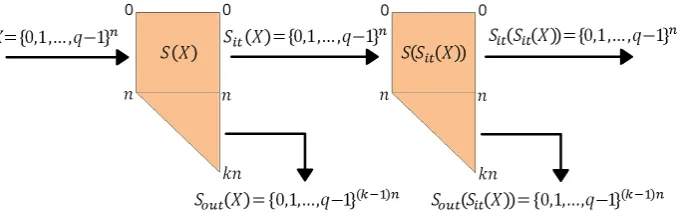
Keystream Generation Letm=knandS(X) ={Q1(X), . . . , Qkn(X)}be
di-vided two parts asSit(X) ={Q1(X), . . . , Qn(X)}andSout(X) ={Qn+1(X), . . . , Qkn(X)}. The keystream generator of QUAD follows three steps, such that,
Computation Step
The generator computes values of systemS(X), whereX = (x1, . . . , xn)is a current internal value.
Output Step
The generator outputs keystreamsSout(X) ={Qn+1(X), . . . , Qkn(X)}from values ofS(X).
Update Step
The current internal value X = (x1, . . . , xn)is updated to a next internal value with an-tuple valueSit(X) ={Q1(X), . . . , Qn(X)}fromS(X).
The sketch illustrating the keystream generation algorithm is shown in Fig. 1. It indicates that the generator outputs keystreams by repeating the above three steps.
Fig. 1.Generating keystream of QUAD
Key and Initialization of Current State Berbain et al. [4] also provides a tech-nique for initialization of the internal stateX = (x1, . . . , xn). For QUAD(q, n, r), we use the key K ∈ GF(q)n, the initialization vectorIV ={0,1}|IV| and two carefully randomly chosen multivariate quadratic systems S0(X) and S1(X), mappingGF(q)n7→GF(q)nto initializeX.
The initialization of the internal stateX follows two steps, such that,
Initially Set Step
We set the internal state valueX to the keyK.
Initially Update Step
We updateX for|IV|times. Letibe a number of iterating initially update andIVi={0,1}be a value ofi-th element ofIV, and we change the value ofX to
– S0(X), whereIVi= 0, and
– S1(X), whereIVi= 1.
Computational Cost of QUAD The computational cost of multivariate quadrat-ics depends on computing quadratic terms. The summation of quadratic terms requiresn(n+ 1)/2 multiplications and additions. Therefore the computational costs of one multivariate quadratic isO(n2). QUAD(q, n, r)requires to compute mmultivariate quadratics. Sincem=kn, the computational cost of generating key stream isO(n3).
Security Level of QUAD The security level of QUAD is based on the MQ assumption. Berbain et al. [4] prove that solving QUAD needs solving MQ prob-lem. However, according to the analysis of QUAD using the XL-Wiedemann algorithm which was proposed by Yang et al. [14], QUAD(256,20,20)has 45-bit security, QUAD(16,40,40)has 71-bit security, and QUAD(2,160,160)has less than 140-bit security. Actually, secure QUAD requires larger constructions such as QUAD(2,256,256), QUAD(2,320,320).
4.
Strategy
4.1. Existing Methods of Berbain et al.
Berbain et al. [3] provided efficent implementation techniques of computing mul-tivariate polynomial systems for mulmul-tivariate cryptography. In this paper, we use these strategies from [3].
– Variables are used as vectors. For example, C language defines int as a 32-bit integer variable. Therefore, we can use int as a 32-vector of boolean.
– We precompute each quadratic term. Because in multivariate quadratic sys-tems, we must compute the samexixjfor every polynomials, we can make efficient implementation by precomputing quadratic terms.
4.2. Parallelizing on the GPU
In the GPGPU, the most important point is the parallelization of algorithms. Because the performance of GPU cores is worse than that of CPU, serial im-plementations with GPU are expected to be slower than CPU imim-plementations. Since all the polynomials of a multivariate quadratic system are independent of each other, parallelization of system is easy. We discuss how to parallelize a multivariate quadratics of system.
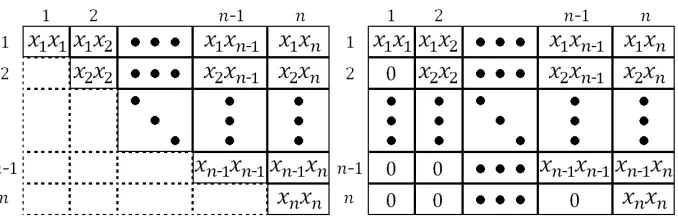
Summation of quadratic terms can be considered as summation of every element of a triangular matrix as the left side of Fig. 2. We assume that other elements of matrix are zero. Therefore we can compute summation of quadratic terms as summation of regular matrix as the right side of Fig. 2. Then, we can compute the summation as∑ni=1∑nj=1αi,jxixj in the following method.
1. We computeSk(x) = ∑n
i=1αk,ixkxifor allkin parallel. 2. We compute∑nk=1Sk(x).
However computations increase trivial computations; we can make efficient im-plementations by parallelization with GPU.
Fig. 2.Left: handling as a triangular matrix. Right: handling as a rectangle matrix with trivial 0 elements.
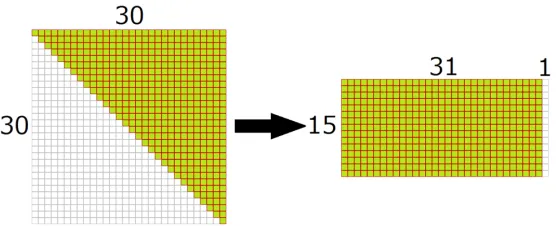
Next we reduce trivial computations of that way. We reshape a triangular matrix to a rectangular matrix as in Fig. 3, which presents the method of re-shaping matrix. By this rere-shaping, we can reduce efficiently about 25%of the cost for computing an equation of a multivariate quadratic system.
4.3. Optimization on GPU architectures
Fig. 3.Reshaping triangle to rectangle
Optimization of Matrix Calculation NVIDIA GeForce GTX 480 has 15 SMs, and every SM has 32 cuda cores. Since every SM handle 32 threads at a time, a process, which handles 32 threads, is not suitable for GPU implementations. Therefore, we should make sure that the number of threads in a process is divisible by 32. In the same way, we should make sure that an algorithm can be handled by 15 SMs in parallel. Finally, an algorithm should be paralleled as a multiple of32×15.
Ann-dimensional triangular matrix has n(n+ 1)/2 elements. Then a long side of a rectangle matrix, which is reshaped by an n-dimensional triangular matrix, hasnorn+ 1elements. However inGF(2), a number of a long side’s elements can be counted in a process, counting is a cost of computing a matrix. Therefore, we assume thatn= 30kwhere k is a natural number. In this way, a rectangle matrix is constructed by15k×(31k+ 1)in Fig. 4, and we can handle the rectangle matrix as15k×32k. Moreover, computingk-dimensional square submatrix from the matrix in parallel, we can reduce the15k×32kmatrix to a
15×32matrix. Thus we can parallelize calculating of a matrix by 15 SMs and 32 cuda cores per SM.
Optimizing in Processes For realizing an efficient GPU implementation, we must design an algorithm as a chunk of similar small computings. Moreover, conditional branches are not suited to processing on GPU. Then we handle conditional branches as difference of kernels, and implement them by process-ing on CPU. In this case, we make kernels by difference of a number of non-zero terms. However, making all kernels every number of non-zero temrs is a heavy cost of implementaions. Therefore, we make kernels just every number ofk. E.g. QUAD(2,320,320), the maximum ofkis11, thus we have to make only11
kernels.
4.4. Evaluation of GPU Implementation
Accelerating by strategies of Berbain et al. Originally, QUAD(q, n, n) re-quiresn(n+1)(n+2)additions and2n2(n+2)multiplications. Moreover, QUAD(q, n, n) requires2ntimes computation of equations.
By the strategy of Berbain et al. [4], we can reduce multiplications of mono-mials. A monomialxixj is a common value for each polynomial. Then we need to calculate monomials only once. Since it takesn(n+ 1)/2multiplications, we reduce multiplications from2n2(n+ 2)times ton2(n+ 3) +n(n+ 1)/2times.
Moreover, we can compute some polynomials at a time by vectorization of variables. In case of q = 2t, i.e. using GF(2t), a 32-bit integer variable handles32/tpolynomials. Therefore QUAD(q, n, n)(=QUAD(2t, n, n)) requires ⌈t/16n⌉(n+ 1)(n+ 2)additions and⌈t/16n⌉n(n+ 3)/2 +n(n+ 1)/2 multiplica-tions.
Accelerating by parallelization In GPU implementations, we can parallelize some computational steps of evaluating multivariate polynomial systems.
By computingxixj in parallel for eachi’s, it takesnmultiplications.
The computational cost of summations of row elements in a matrix requires
(n+ 1)(n+ 2)/2additions and multiplications for64n/tpolynomials. By paral-lelization usingC cores in GPU, it takes⌈tn(n+ 2)/32C⌉(n+ 1)additions and multiplications. Also, the computational cost of summations of column elements in a matrix can be reduced from⌈tn/16⌉(n+ 2)additions to⌈tn/16C⌉(n+ 2)/2
additions.
Actually, GTX 480 has480cores. Then it computes all the polynoimals at a time overGF(2t)field, wheretn/32≤480. Therefore, QUAD(2t, n, n)requires ⌈(n+ 2)/P⌉(n+1)+(n+2)/2additions and⌈(n+ 2)/P⌉(n+1)+nmultiplications for generating keys, whereP = 32C/tn.
Acclerating forGF(2) By the strategy of Berbain et al. [4], we can compute only non-zero terms in GF(2). Because the probability of xi = 0 is 1/2 the probability ofxixj = 0is3/4. Therefore, we can reduce computational cost to
Then we can compute an equation of QUAD(2, n, n) by ⌈(n+ 4)/4P⌉(n+ 2)/2 + (n+ 4)/4 additions and ⌈(n+ 4)/4P⌉(n+ 2)/2 +n/2 multiplications, whereP = 32C/tn.
Suppose the number of non-zero variables is30k. Thenk-dimensional sub-matrix requiresk×kadditions. Using our strategy, we can compute the sum-mations of QUAD(2, n, n) by (⌈(15×32nk)/16C⌉+⌈15×32n/16C⌉)k+ 15 + 32 additions. Since the GTX 480 has 480 cores (i.e., C = 480), it requires
(⌈nk/16⌉+⌈n/16⌉)k+ 47additions. For example, QUAD(2,320,320) requires
20k2+ 20k+ 47additions.
5.
Experiments
In this section, we present and discuss results of experiments. We used NVIDIA GeForce 480 GTX as a GPU, and also used Intel Core i7 875K as a CPU. Moreover, the memory of implementation environment was 8GB.
5.1. Experimentations of Encryption
We implement QUAD(2, n, n)on CPU and GPU; setn= 32,64,128,160,256,320,512, and measure the time of encrypting 5MB file. Also, we implement QUAD(2t, n, n) on GPU; sett = 2,4,8andn= 32,64,128,160,256,320,512, and measure the time of encrypting messages 1000 times.
Moreover, we optimized GPU implementation of QUAD(2, n, n)by our opti-mization strategies, and also measure the time of encrypting 5MB file.
5.2. Results
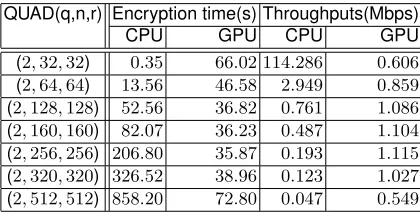
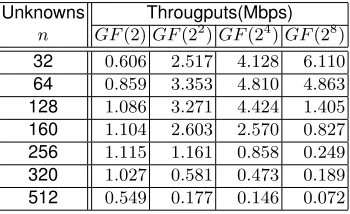
We present the results of QUAD(2, n, n)implementations in Table 1, and QUAD(2t, n, n) in Table 2. Table 1 presents the time of encrypting 5MB files and throughputs of implementations of each QUADs. In Table 2 we compared our implementations of QUAD(2p, n, n), wherep= 1,2,4,8.
Table 1.Results of QUAD implementations.
QUAD(q,n,r) Encryption time(s) Throughputs(Mbps)
CPU GPU CPU GPU
(2,32,32) 0.35 66.02 114.286 0.606
(2,64,64) 13.56 46.58 2.949 0.859
(2,128,128) 52.56 36.82 0.761 1.086
(2,160,160) 82.07 36.23 0.487 1.104
(2,256,256) 206.80 35.87 0.193 1.115
(2,320,320) 326.52 38.96 0.123 1.027
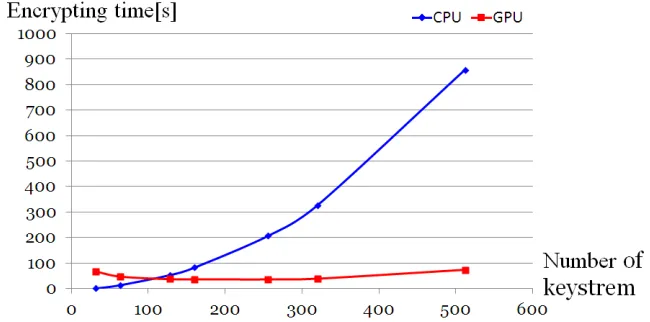
The image results of QUAD(2, n, n)are shown in Fig. 5. Encryption time of CPU implementations follows square ofn. However the computational cost of generating keystream isO(n3), number of generating keystream followsn.
On the other side, the results of GPU Implementations are not almost differ-ent. NVIDIA GeForce GTX480can use15blocks, and every block can use 32 threads, programs can handle480processes at the same time. QUAD(2, n, n)
requires ⌈(n+ 4)/4P⌉(n+ 2)/2 + (n+ 4)/4 additions and ⌈(n+ 4)/4P⌉(n+ 2)/2 +n/2multiplications for generating keystreams, whereP = 32C/tn. How-ever when(n+ 4)/4P ≤1(i.e.,tn(n+4) = 128C), we can generate keystreams of QUAD(2, n, n)by only(3n+ 8)/4additions andn+ 1multiplications. On the GTX 480, we can setC= 480. Then we have thatn≤247. Therefore the com-putational cost of QUAD(2, n, n)is proportional to the number of unknowns n, and it generates keystreams in stable throughputs, whenn≤247. Actually, we can see the decrease of the throughput of QUAD(2, n, n)betweenn= 256and
320.
Fig. 5.Comparison of encryption time between CPU and GPU.
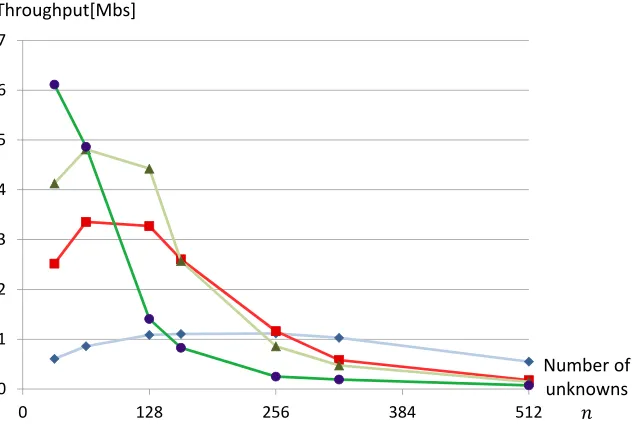
Table 2 and Fig. 6 also show the decrease of throughputs of QUAD(2t, n, n), where t = 1,2,4,8 and n = 32,64,128,160,256,320,512. Especially, Fig. 6 shows that the higher the degree ofGF(2t)is, the more drastic the decrease of the throughput of QUAD is. For example, when n > 44, the computational cost of QUAD overGF(28) followsO(n3). Therefore the larger the number of unknownsnis, the slower the throughput of QUAD is.
Table 2.Implementation of QUAD(2t, n, n).
Unknowns Througputs(Mbps) n GF(2)GF(22)GF(24)GF(28)
32 0.606 2.517 4.128 6.110
64 0.859 3.353 4.810 4.863
128 1.086 3.271 4.424 1.405
160 1.104 2.603 2.570 0.827
256 1.115 1.161 0.858 0.249
320 1.027 0.581 0.473 0.189
512 0.549 0.177 0.146 0.072
was improved compared with the non-optimized implementation. Our optimized implementations are2.0to4.4times faster than non-optimized implementation. We infer that the main cause of accelerated encryption time is due to the opti-mizations to handlen= 30k. Because computingnelements in serial is heavy to GPU, we can reduce serial computation by such handling.
Table 3. Throughputs of QUAD Implementations with Optimization and Non-Optimization.
QUAD(q,n,r) Throughputs(Mbps) Speed Up Non-optimized Optimized Rate(times) (2,32,32) 0.606 1.234 x2.037
(2,64,64) 0.859 2.319 x2.699
(2,128,128) 1.086 4.132 x3.805
(2,160,160) 1.104 4.872 x4.413
(2,256,256) 1.115 4.115 x3.691
(2,320,320) 1.027 3.656 x3.560
(2,512,512) 0.549 1.494 x2.722
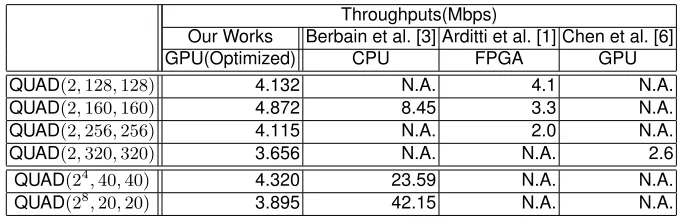
In Table 4, we compared related works Berbain et al. [3], Arditti et al. [1], and Chen et al. [6] for QUAD(2, n, n), where n = 128,160,256,320,512, and com-pared throughputs of QUAD(24,40,40)and QUAD(216,20,20)with Berbain et al. [3]. According to Table 4 although our optimized implementation of QUAD(2,160,160)
is slower than Berbain et al. [3], our optimized implementation of QUAD(2,256,256)
and QUAD(2,320,320)is faster than the GPU implementation of Arditti et al. [1] and Chen et al. [6].3These results show that our optimized GPU implementa-tion technique is suited to large QUAD construcimplementa-tions.
3
0 1 2 3 4 5 6 7
0 128 256 384 512
QUAD(2,n,n) QUAD(4,n,n) QUAD(16,n,n) QUAD(256,n,n)
Throughput[Mbs]
Number of unknowns
݊
Fig. 6.Throughputs of QUAD implementations overGF(2t) (t= 1,2,4,8)
On the other hand, Table 4 shows that both of our GPU implementation both for QUAD(24,40,40)and QUAD(28,20,20)are slower than Berbain et al. [3]. We infer that our implementation strategies are very specialized toGF(2).
6.
Conclusion
We presented and evaluated the GPU implementation techniques for QUAD stream cipher. Also we provided optimization techniques of QUAD to suit NVIDIA GeForce GTX 480.
Moreover, we carried out the experiments on the implementations of QUAD over GF(2), GF(22), GF(24) and GF(28). As a result, the larger the num-ber of unknowns nis, the slower the throughput of QUAD is. However, when tn(n+ 2)≤32C, it is stable. The condition for stable throughputs depends on the number of cores C. Although the GTX 480 has only 480 cores, the GTX
Table 4.Comparison QUAD Implementations with Related Works.
Throughputs(Mbps)
Our Works Berbain et al. [3] Arditti et al. [1] Chen et al. [6]
GPU(Optimized) CPU FPGA GPU
QUAD(2,128,128) 4.132 N.A. 4.1 N.A.
QUAD(2,160,160) 4.872 8.45 3.3 N.A.
QUAD(2,256,256) 4.115 N.A. 2.0 N.A.
QUAD(2,320,320) 3.656 N.A. N.A. 2.6
QUAD(24,40,40) 4.320 23.59 N.A. N.A.
QUAD(28,20,20) 3.895 42.15 N.A. N.A.
Acknowledgments. This work is partially supported by Japan Science and Technol-ogy agency (JST), Strategic Japanese-Indian Cooperative Programme on Multidisci-plinary Research Field, which combines Information and Communications Technology with Other Fields, entitled ”Analysis of Cryptographic Algorithms and Evaluation on En-hancing Network Security Based on Mathematical Science.” The authors are grateful to three anonymous referees of ComSIS-2013 for improving this article.
References
1. Arditti, D., Berbain, C., Billet, O., Gilbert, H.: Compact fpga implementations of quad. In: Proceedings of the 2nd ACM symposium on Information, computer and commu-nications security. pp. 347–349. ACM (2007)
2. Bard, G.: Algebraic cryptanalysis. Springer (2009)
3. Berbain, C., Billet, O., Gilbert, H.: Efficient implementations of multivariate quadratic systems. In: Selected Areas in Cryptography. pp. 174–187. Springer (2007) 4. Berbain, C., Gilbert, H., Patarin, J.: Quad: A practical stream cipher with provable
security. Advances in Cryptology-EUROCRYPT 2006 pp. 109–128 (2006)
5. Bonenberger, D., Krone, M.: Factorization of rsa-170. Tech. rep., Tech. rep., Ostfalia University of Applied Sciences (2010)
6. Chen, M.S., Chen, T.R., Cheng, C.M., Hsiao, C.H., R., N., Yan, B.Y.: What price a provably secure stream cipher? (2010)
7. Manavski, S.: Cuda compatible gpu as an efficient hardware accelerator for aes cryptography. In: Signal Processing and Communications, 2007. ICSPC 2007. IEEE International Conference on. pp. 65–68. Ieee (2007)
8. Miyaji, A., Rahman, M.S., Soshi, M.: Efficient and low-cost rfid authentication schemes. Journal of Wireless Mobile Networks, Ubiquitous Computing, and De-pendable Applications 2(3), 4–25 (2011)
9. Osvik, D., Bos, J., Stefan, D., Canright, D.: Fast software aes encryption. In: Fast Software Encryption. pp. 75–93. Springer (2010)
10. Pakniat, N., Eslami, Z.: A proxy e-raffle protocol based on proxy signatures. Journal of Wireless Mobile Networks, Ubiquitous Computing, and Dependable Applications 2(3), 74–84 (2011)
12. Tanaka, S., Nishide, T., Sakurai, K.: Efficient implementation of evaluating multi-variate quadratic system with gpus. In: Innovative Mobile and Internet Services in Ubiquitous Computing (IMIS), 2012 Sixth International Conference on. pp. 660–664. IEEE (2012)
13. Yang, B.Y.: (private communicate) (2011)
14. Yang, B., Chen, O., Bernstein, D., Chen, J.: Analysis of quad. In: Fast Software Encryption. pp. 290–308. Springer (2007)
Satoshi Tanakareceived a B.E. degree from National Institution for Academic Degrees and University Evaluation, Japan in 2010, and an M.E. degree from Kyushu University, Japan in 2012. Currently he is a candidate for the Ph.D. in Kyushu University. His primary research is in the areas of cryptography and in-formation security.
Takashi Nishidereceived a B.S. degree from the University of Tokyo in 1997, an M.S. degree from the University of Southern California in 2003, and a Dr.E. degree from the University of Electro-Communications in 2008. From 1997 to 2009, he had worked at Hitachi Software Engineering Co., Ltd. developing se-curity products. Since 2009, he has been an assistant professor in Kyushu Uni-versity. His primary research is in the areas of cryptography and information security.
Kouichi Sakuraiis Professor of Department of Computer Science and Commu-nication Engineering, Kyushu University, Japan since 2002. He received B.E., M.E., and D.E. of Mathematics, Applied Mathematics, and Computer Science from Kyushu University in 1982, 1986, and 1993, respectively. He is interested in cryptography and information security. He is a member of IPSJ, IEEE and ACM.