with Ad Exchange
Santiago R. BalseiroFuqua School of Business, Duke University, 100 Fuqua Drive, NC 27708, [email protected] Jon Feldman, Vahab Mirrokni, S. Muthukrishnan
Google Research, New York, NY 10011, [email protected], [email protected], [email protected] Forthcoming inManagement Science
It is clear from the growing role of Ad Exchanges in the real-time sale of advertising slots that web publishers are considering a new alternative to their more traditional reservation-based ad contracts. To make this choice, the publisher must trade-off, in real-time, the short-term revenue from Ad Exchange with the long-term benefits of delivering good quality spots to the reservation ads. In this paper we formalize this combined optimization problem as a multi-objective stochastic control problem and derive an efficient policy for online ad allocation in settings with general joint distribution over placement quality and exchange prices. We prove asymptotic optimality of this policy in terms of any arbitrary trade-off between quality of delivered reservation ads and revenue from the exchange, and show that our policy approximates any Pareto-optimal point on the quality vs. revenue curve. Experimental results on data derived from real publisher inventory confirm that there are significant benefits for publishers if they jointly optimize over both channels.
1.
Introduction
Internet Display Advertising refers generally to the graphical and video ads that are now ubiquitous on the web. These types of ads generated about 11 billion dollars in the US in 2012, and analysts see a clear rising trend (Internet Advertising Bureau 2013). Traditionally, an advertiser would buy display ad placements by negotiating deals directly with a publisher (the owner of the web page), and signing an agreement, called a guaranteed contract. These deals usually take the form of a specific number of ad impressions reserved over a particular time horizon (e.g., one million impressions over a month). A publisher can make many such deals with different advertisers, with potentially sophisticated relationships between the advertisers’ targeting criteria. The publisher would then need to assign arriving impressions to the matching reservations so as to maximize the placement quality of the contracts. Typically, the probability that a user clicks on an ad (known as click-trough rate) is used as a metric of placement quality.
Guaranteed contracts can suffer in efficiency: since slots are booked in advance, both parties cannot react to instantaneous changes to traffic patterns or market conditions. However, this has changed in the last couple of years. Advertisers may now purchase ad placements through spot markets for the real-time sale of online ad slots, called Ad Exchanges. Prominent examples of exchanges are Yahoo’s
RightMedia, Microsoft’s AdECN, Google’s DoubleClick and OpenX. While exchanges differ in their implementations, in a generic Ad Exchange (AdX), publishers post an ad slot with a reservation price, advertisers post bids, and an auction is run; this happens between the time a user visits a page and the ad is displayed (Muthukrishnan 2009). Ad Exchanges allow advertisers to bid in real time and pay only for valuable customers, instead of bulk buying impressions and targeting large audiences.
In presence of Ad Exchanges, publishers face the multi-objective problem of maximizing the overall placement quality of the impressions assigned to the reservations together with the total revenue obtained from AdX, while complying with the contractual obligations. These two objectives are potentially con-flicting; in the short-term, the publisher might boost the revenue stream from AdX at the expense of assigning lower quality impressions to the advertisers. In the long term, however, it may be convenient for the publisher to prioritize her advertisers in view of attracting future contracts. So for a given piece of ad inventory, the publisher must quickly decide whether to send the inventory to AdX (and at what price), or to assign it to an advertiser with a reservation. In this paper, we study the problem faced by the publisher, jointly optimizing over AdX and the reservations.
1.1. Main Contributions
The contributions of this paper are as follows:
• Firstly, we bring to bear techniques of Revenue Management (RM), and model the publisher’s problem as a combination of a capacity allocation problem to handle the guaranteed contracts together with a dynamic pricing problem to handle the reserve price optimization in the Ad Exchange. We tackle the publisher’s multi-objective problem by taking a weighted sum of (i) the revenue from AdX, and (ii) the placement quality of the contracts, and show how to construct the Pareto efficient frontier of attainable objectives. Using data derived from real publisher inventory, we show empirically that the Pareto efficient frontier is highly concave and that there are significant benefits for publishers if they jointly optimize over both channels.
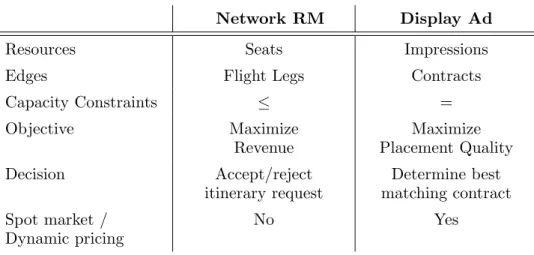
The publisher’s problem can be thought of as a parallel-flight Network RM problem (see, e.g., Talluri and van Ryzin (1998)) in which users’ click probabilities are requests for itineraries, and advertisers are edges in the network. As in the prototypical RM problem, we look for a policy maximizing the ex-ante expected revenue, which can be obtained using dynamic programming (DP). There are three differences, however, with the traditional Network RM problem. First, we aim to satisfy all contracts, or completely deplete all resources by the end of the horizon. Second, in the traditional problem requests are for only one itinerary (which can be accepted or rejected), while in our model each impression can be potentially assigned to any contract and the publisher needs to decide whom to assign the impression based on possibly correlated placement qualities. Finally, publishers in display advertising may submit impressions to a spot market to increase their revenues, which adds a dynamic pricing dimension to the problem. To this end we introduce a general model of targeting based on the user’s attributes that takes into account
Network RM Display Ad
Resources Seats Impressions
Edges Flight Legs Contracts
Capacity Constraints ≤ = Objective Maximize Revenue Maximize Placement Quality Decision Accept/reject itinerary request Determine best matching contract Spot market / Dynamic pricing No Yes
Table 1 Comparison of the Display Ad and Network Revenue Management problems.
the potential correlation between guaranteed contracts’ placement quality and exchange’s bids. Table 1 summarizes these points.
• Secondly, because of the so-called “curse of dimensionality” the optimal policy cannot be computed efficiently in most real-world problems, and instead we aim for a deterministic approximation in which stochastic quantities are replaced by their expected values and quantities are assumed to be continu-ous (Gallego and van Ryzin 1994). As a result, we derive a provably good stationary policy that resembles a bid-price control but extended with a pricing function to take into account for AdX (Theorem 1). Our policy assigns each guaranteed contract a bid-price (or dual variable), which may be interpreted as the opportunity cost of assigning one additional impression to the reservation. When a user arrives, the pricing function quotes a reserve price to submit to the exchange that depends on the opportunity cost of assigning the impression to an advertiser (and potentially on the impression’s attributes). If no AdX bid exceeds this reserve price, the impression is immediately assigned to the advertiser whose placement quality exceeds its bid-price by the largest amount. A salient feature of our policy from the managerial standpoint is its simplicity: the publisher only needs to keep track of a single pricing function for the exchange, and one bid-price for each contract that are obtained, in turn, by solving a convex stochastic minimization problem.
The optimal policy always tests the exchange before assigning an impression to a guaranteed contract because the loss of not assigning an impression of high quality to the reservation can be compensated by choosing a high enough reserve price. This result implicitly hinges upon (i) the absence of a fixed cost for accessing the exchange, and (ii) the publisher’s ability to dynamically adjust the reserve price for each impression based on the user attributes. In the presence of a fixed cost, the publisher tests the exchange only if the contracts’ opportunity cost is less or equal than a fixed threshold; while in the case of static pricing, when the expected revenue from AdX exceeds the contracts’ opportunity cost.
• Thirdly, we introduce a novel probabilistic tie-breaking rule to handle the possibility of multiple advertisers attaining the maximum bid-price adjusted placement quality. The rule break ties by ran-domizing according to a fixed probability distribution, which is predetermined by solving an assignment
problem. Combining ideas from combinatorial optimization and convex analysis we show that such a tie-breaking rule always exists (Proposition 2). This tie-breaking rule is a novelty from the bid-price perspective, and allows one to consider general distributions of placement quality. Numerical experiments confirm that ties are real concern in practical problems; if the publisher fails to take them into account, she can incur significant losses in yield.
• Fourthly, we provide a rigorous bound on the convergence rate of our policy to the optimal online policy (Theorem 2).1. Our theoretical analysis captures the multi-objective nature of our problem, and shows that any Pareto optimal policy can be approximated by a simple modified bid-price policy that performs asymptotically close both in terms of AdX’s revenue and contract’s quality. The loss of our policy in terms of quality and revenue relative to the optimal one converges to zero at a rate ofO(N−1/2) where
N is the number of impressions in the horizon. The deterministic approximation is thus suitable when the number of impressions in the horizon is large; which fits well in the context of internet advertising. From a computational stand-point we provide an efficient and simple method to compute the dual variables that is applicable to large instances with many contracts.
• Finally, we numerically compare the performance of our policy with two alternative heuristics that are common in practice. The first heuristic is a Greedy Policy that disregards the opportunity cost of capacity and assigns the impression to the advertiser with maximum placement quality. The second is a Static Price Policy that sets a constant reserve price for the exchange throughout the horizon. Our results on actual publisher data show that these heuristics significantly underperform when compared to the optimal policy. From a managerial perspective, these results stress the importance of pondering the opportunity cost of capacity in performing the assignment to the guaranteed contracts, and of pricing dynamically in the exchange to react to the users’ attributes and the value of the reservations.
1.2. Related Work
Our works draws on three streams of literature, namely, that of Display Advertising with Ad Exchange, Revenue Management, and Online Allocation. Rather than attempting to exhaustively survey the liter-ature on each area, we focus on the work more closely related to ours.
Display Advertising with Ad Exchange. There has been recent work on display ad allocation with both contract-based advertisers and spot market advertisers. McAfee et al. (2009) focus on “fair” representative bidding strategies in which the publisher bids on behalf of the contract-based advertisers competing with the spot market bidders. This line of work is mainly concerned with computing such fair representative bidding strategies for contract-based advertisers. Chen (2011) considers the case when the publisher runs the exchange, and employing a mechanism design approach he characterizes, through dynamic 1
Typically ad allocation research employs the optimal offline policy in hindsight as a benchmark. While in the absence of the spot market the performance of the offline and online policies are asymptotically equivalent (see, e.g., Talluri and van Ryzin (1998)), in the presence of the spot market this is not longer the case if we assume that the oracle is aware of bids’ realizations.
programming, the optimal dynamic auction for the spot market. In this model both bids from the spot market and the total number of impressions are stochastic. We focus, instead, on combined yield optimization and present a model and an algorithm taking into account any trade-off between quality delivered to reservation ads and revenue from the spot market. Yang et al. (2012) studied the problem faced by the publisher of allocating between the two markets using multi-objective programming. As in our work, they consider different objectives for the publisher, such as, minimizing the penalty of under-delivery, maximizing the revenue from the spot market and the representativeness of the allocation. However, they employ a deterministic model with no uncertainty in which future inventory and contracts are nodes in a bipartite graph. Alaei et al. (2009) proposed an utility model that accounts for two types of advertisers: one oriented towards campaigns and seeking to create brand equity, and the other oriented towards the spot market and seeking to transform impressions to sales. Here impressions are commodities which can be assigned interchangeably to any advertisers. In this setting they look for offline and online algorithms aiming to maximize the utility of their contracts.
Revenue Management. Another stream of relevant work is that of RM. Even though RM is typically applied to airlines, car rentals, hotels and retailing (Talluri and van Ryzin 2004), our problem formula-tion and analysis is inspired by RM techniques. A popular method for controlling the sale of inventory in revenue management applications is the use of bid-price controls. These were originally introduced by Simpson (1989), and thoroughly analyzed by Talluri and van Ryzin (1998). In this setting, a bid-price control sets a threshold or bid price for each advertiser, which may be interpreted as the opportunity cost of assigning one additional impression to the advertiser. This approach is standard in the context of revenue maximization, e.g. the stochastic knapsack problem by Levi and Radovanovic (2010). From this perspective, our contribution is the inclusion of a spot market, the exchange, as an new sales channel.
There is some body of literature on display advertising from a revenue management angle that focuses exclusively on guaranteed contracts (see, e.g., Araman and Fridgeirsdottir (2011), Fridgeirsdottir and Najafi (2010), Roels and Fridgeirsdottir (2009), and Turner (2012)). These papers, however, do not consider the spot market. In the related area of TV broadcasting, Araman and Popescu (2010) study the allocation of advertising space between forward contracts and the spot market when the planner faces supply uncertainty.
Finally, in terms of multi-objective optimization in revenue management, Levin et al. (2008) employ a weighted sum approach to determine, in a dynamic pricing setting, the Pareto efficient frontier between revenue and the probability that total revenue falls below a minimum acceptable level. Phillips (2012) uses a similar approach to determine the efficient frontier between any two goals that are linear in load (such as revenue and profits) in a single-leg revenue management problem.
Online Allocation. Our work is closely related to online ad allocation problems, including the Display Ads Allocation (DA) problem, and the AdWords (AW) problem. In both problems, the publisher must
assign online impressions to advertisers, optimizing the efficiency or revenue of the allocation, while respecting pre-specified contracts.
In the DA problem, advertisers demand a maximum number of eligible impressions, and the publisher must allocate impressions that arrive online to them. Each impression has a potentially different value for every advertiser. The goal of the publisher is to maximize the value of all the assigned impressions. The adversarial online DA problem was considered in Feldman et al. (2009), which showed that the problem is inapproximable without exploiting free disposal; using this property (that advertisers are at worst indifferent to receiving more impressions than required by their contract), a simple greedy algorithm is 1
2-competitive, which is optimal. When the demand of each advertiser is large, a (1− 1
e)-competitive algorithm exists (Feldman et al. 2009), and it is tight. The stochastic model of the DA problem is more related to our problem. Following a based dual algorithm by Devanur and Hayes (2009), training-based (1−)-competitive algorithms have been developed for the DA problem and its generalization to various packing linear programs (Feldman et al. 2010, Vee et al. 2010, Agrawal et al. 2009).
In the AW problem, the publisher allocates impressions resulting from search queries. Here each adver-tiser has a budget on the total spend instead of a bound on the number of impressions. Other than training-based dual algorithms and primal-dual algorithms that get similar bounds as in the DA prob-lem, online adaptive optimization techniques have been applied to online stochastic ad allocation (Tan and Srikant 2012). Such control-based adaptive algorithms achieve asymptotic optimality following an updating rule inspired by the primal-dual algorithms.
Our work differs from all the above in three main aspects. (i) Instead of using the framework of competitive analysis and comparing the solution with the optimum solution in hindsight, we compare the performance of our algorithm with the optimal online policy. In contrast to the online ad allocation literature, our work assumes that the decision-maker maintains probabilistic priors on the primitives. (ii) None of the above work considers the simultaneous allocation of reservations and AdX. In particular, these papers do not consider the trade-off between the revenue from a spot market based on real-time bidding and the efficiency of reservation-based allocation. (iii) Previous work fail to take into account the possibility of ties between contracts, which can result in significant yield losses. Our policy explicitly handles ties by introducing a novel probabilistic tie-breaking rule. Regarding the last two points, in Appendix EC.5 we introduce a prior-free policy that learns in a non-parametric fashion its underlying parameters, and we theoretically analyze the expected performance of this policy by borrowing tools from statistical learning theory.
2.
Model
Consider a publisher displaying ads in a web page. The web page has a single slot for display ads, and each user is shown at most one impression per page. The publisher has signed contracts with A
advertisers under which she agrees to deliver exactlyCa impressions to advertisera∈ A, where we denote by A={1, . . . , A} the set of advertisers. Neither over-delivery nor under-delivery is allowed.
Even though the number of users visiting a web page is uncertain, publishers usually have fairly good estimates of the total number of expected users that arrive in a given horizon. In this model time periods correspond to users’ arrivals, and we assume that the total number of users is fixed and equal to N
(random number of users can be accommodated in our model by considering dummy arrivals). Time periods are indexed backwards in time by n=N, . . . ,1. Each user is identified by a vector of attributes
Un ∈ U, where U is some finite subset of RM. The vector of attributes contains information that is relevant to the advertisers’ targeting such as (i) the web address or URL; (ii) keywords related to the content of the web-page; (iii) the dimension and position of the slot in the page; (iv) user’s geographical information, that is, where is the user located; (v) user’s demographics, such as education level, gender, age or income; (vi) user’s device and operating system; and (vii) cookie-based behavioral information, which allows bidders to track the user’s past activity in the web. We assume that the vectors of attributes {Un}n=1,...,N are random, independent and identically distributed.
Based on the vector of attributes for the impressionUn, the publisher determines a vector of placement qualitiesQn={Qn,a}a∈A, whereQn,ais the predicted quality advertiserawould perceive if the impression is assigned to her. Qualities lie in some compact space Ω⊆RA. A typical measure of placement quality is the estimated probability that the user clicks on each ad. In practice, such measure of quality is learned by performing, for example, a logistic regression based on the vector attributes as explanatory variables. Here we abstract from the learning problem and assume that the qualities are deterministically determined from the impression attributes (to simplify the notation we omit this dependence). We do allow, however, for qualities to be jointly distributed across advertisers. This captures the fact that advertisers might have similar target criteria, and hence the qualities perceived might be correlated. We do not impose any further restrictions on the qualities, other than bounded support. Notice that the publisher observes the realization of the placement quality before showing the ad.
We assume that the number of arriving impressions suffices to satisfy the contracts, or equivalently
P
a∈Aρa≤1, where ρa =CNa denotes the capacity-to-impression ratio of an advertiser. An assumption of this general model is that any user can be potentially assigned to any advertiser. In practice each advertiser may be interested in a particular group of user types. It is important to note that this is not a limitation of our results, but rather a modeling choice; in §5 we show how to handle targeting criteria by forcing the publisher to pay a good will penalty to the advertisers each time an undesired impression is incorrectly assigned.
Arriving impressions may either be assigned to the advertisers, discarded or auctioned in AdX for profit. In a general AdX (Muthukrishnan 2009), the publisher contacts the exchange with a minimum price she is willing to take for the slot. Additionally, the publisher may submit some partial information of the user visiting the website. User information allows bidders in the exchange to target more effectively, which may in turn result in higher bids (see, e.g., Milgrom and Weber (1982)). Internally the exchange contacts different ad networks, and in turn they return bids for the slot. The exchange determines the
Impression n-th arrives with qualityQn
Assign to an advertiser or discard
Submit to AdX with pricep Obtain payment Assign to an advertiser or discard accept reject
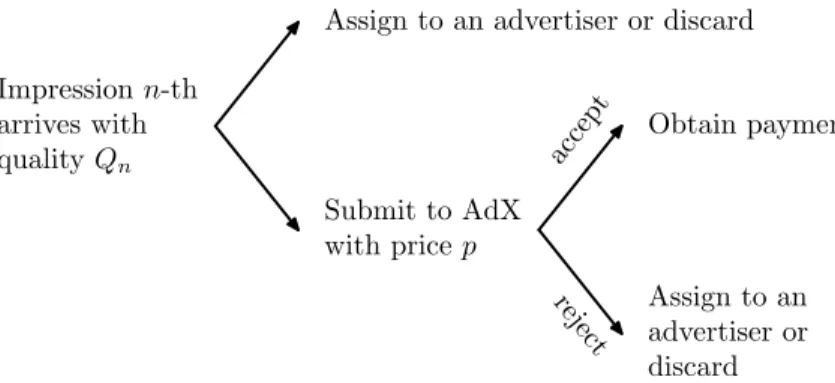
Figure 1 Publisher’s decision tree for a new impression. In the absence of a fixed cost for accessing the exchange, the upper branch is never taken because the publisher is always better off testing AdX with a sufficiently high price that
compensates for the yield loss of not assigning the impression.
winning bid among those that exceed the reserve price via a second-price auction, and returns a payment to the publisher. In this case we say that the impressions is accepted, and the publisher is contractually obligated to display the winning impression. In the case that no bid attains the reserve price, no payment is made and the impression is rejected. We present the formal model of the exchange in§2.2. The entire operation above is executed before the page is rendered in the user’s screen. Thus, in the event that the impression is rejected by the exchange, the publisher may still be able to assign it to some advertiser. Figure 1 summarizes the decisions involved.
Note. Proofs of selected statements are presented in the main appendix, while the remaining proofs are available in the supplementary appendix. Random variables are denoted with upper case letters, while realizations with their lower case counterparts. For notational simplicity we extend the set of advertisers to A0={0} ∪ A by including an outside option 0 that represents discarding an impression. We set the quality of the outside option identically to zero, i.e. Qn,0= 0 for all impressions n= 1, . . . , N. We set
ρ0= 1−
P
a∈Aρa to be the fraction of impressions that are not assigned to any advertiser (either accepted by AdX or effectively discarded).
2.1. Objective
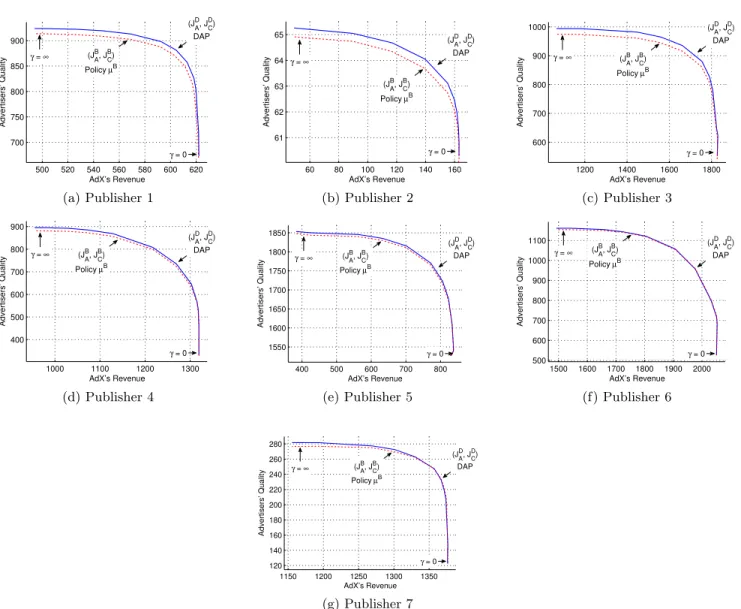
The publisher’s problem is to maximize the overall placement quality of the impressions assigned to the advertisers together with the total revenue obtained with AdX, while complying with the contractual obligations. These objectives are conflicting and there exists potentially many Pareto optimal solutions. Figure 2 shows the efficient frontier of attainable objectives for a given publisher. We attack the multi-objective problem by taking a weighted sum of both multi-objectives: the publisher has at her disposal a parameterγ≥0, and by adjusting this parameter she can construct the convex hull of the Pareto efficient frontier of attainable revenue from AdX and quality for the advertisers. The aggregated objective is given by
400 500 600 700 800 900 1000 350 370 390 410 430 450 Qu ali ty Ad ve rt is ers Revenue AdX γ = ∞ γ = 0 Pareto efficient frontier
Figure 2 Efficient frontier of attainable AdX’s revenue and guaranteed contracts’ quality for a given publisher. The Pareto optimal solutions are computed by varying the trade-off parameterγ in the weighted objective.
In §6.2 we study experimentally the impact of the choice of γ on both objectives, and determine the Pareto frontier for real publisher data.
The parameter γ can be understood as a trade-off between units of quality and units of revenue, and by picking the right value for γ the publisher can balance these conflicting objectives. A large γ
(i.e., contracts’ placement quality more valuable than AdX’s revenue) gives priority to assigning high quality impressions to the advertisers; while a smallγ(i.e., contracts’ placement quality less valuable than AdX’s revenue) would prioritize the revenue from AdX. The publisher may even set different trade-off parameters for each contract.
When the choice of the trade-off parameter is not clear, the publisher may impose a lower bound on the overall quality of the impressions, and then maximize the total revenue from AdX. This may have a more natural interpretation for some publishers, and might be simpler than having to setγ. Here the efficient frontier provides the maximum attainable revenue for each target quality, and the proper γ to achieve the quality constraint. Alternatively one can interpretγas the Lagrange multiplier of the quality of service constraint, and our problem as the Lagrange relaxation of the constrained program. In§EC.1.3 we analyze the implications of this formulation.
2.2. AdX Model with User Information
For ease of exposition, we assume that there is one bidder in the exchange. In §EC.1.1 we drop this assumption and show that all results hold under a more general second-price auction with multiple bidders. The publisher submits an impression to AdX with the minimum price it is willing to take, denoted by p≥0. The impression is accepted if there is a bid of value p or more, and the publisher is paid the minimum price p when the impression is accepted. In practice, bids from the exchange may be correlated with the user information disclosed, and publishers maintain different estimates of the bids’ distribution as a function of the attributes. We assume that conditional on the user information
Hence, when the publisher discloses some information u the impression is accepted with probability 1−F(p;u) = ¯F(p;u).
Suppose the publisher has computed anopportunity costcfor selling this inventory in the exchange; that is, the publisher stands to gaincif the impression is given to a reservation advertiser. Given opportunity cost c≥0 the publisher picks the price that maximizes its expected revenue by solving the optimization problemR(c;u) = maxp≥0F¯(p;u)p+F(p;u)c. Changing variables, we definer(s;u) =sF¯−1(s;u) to be the expected revenue under acceptance probabilitysand user information u, and rewrite this as2
R(c;u) = max
s∈[0,1]r(s;u) + (1
−s)c. (1)
Also, let s∗(c;u) be the least maximizer of (1), and p∗(c;u) = ¯F−1(s∗(c;u);u) be the price that verifies
the maximum.
Assumption 1. The expected revenuer(s;u) is continuous ins, concave in s, non-negative, bounded,
and satisfies lims→0r(s;u) = 0 for every user information u∈ U. We call a function that satisfies all of the assumptions above a regular revenue function.
These assumptions are common in RM literature (see, e.g., Gallego and van Ryzin (1994)). A sufficient condition for the concavity of the revenue is that bids have increasing failure rates (Lariviere 2006). Regularity implies, among other things, the existence of anull pricep∞(u) such that limp→p∞(u)F¯(p;u)p= 0. Additionally, it allows us to characterize the value function R(c;u). In §EC.1.1 we show that the revenue function remains regular in the presence of multiple bidders in AdX by considering the joint density of the highest and second-highest bids.
Proposition 1. Suppose that r is regular revenue function. Then, for fixed user information u we
have that R(c;u) is non-decreasing in c, convex in c, continuous in c, and R(c;u)≥c. Additionally,
R(c;u)−c is non-increasing in c, s∗(c;u) is non-increasing in c, and p∗(c;u) is non-decreasing in c. An important consequence of above is that the maximum revenue expected from submitting an impres-sion to AdX is always greater than the opportunity cost. This should not be surprising, since the publisher can pick a price high enough to compensate for the revenue loss of not assigning the impression. Hence, assigning an impression directly to an advertiser (rather than first testing the exchange) is never the right decision, and in Figure 1 the upper branch is never taken.
2.3. Discussion of the Assumptions
In the absence of a fixed cost, the optimal policy tests the exchange before assigning the impression to the contracts. Such result depends strongly on the publisher’s ability to dynamically adjust the reserve to take into account the opportunity cost of “losing” an impression of high quality to the exchange. If 2We define the generalized inverse distribution function as ¯F−1(s;u) = inf{p≥0 : ¯F(p;u)≤s}to take into account the case
the publisher lacks the ability to price dynamically, then she would only test the exchange when the expected revenue from AdX exceeds the contracts’ opportunity cost. In §6.3 we numerically study the performance of a static price policy that sets a constant reserve price throughout the horizon.
Publishers usually receive a revenue share of all impressions sold in the exchange. Under such arevenue sharing scheme the exchange keeps a fraction α of the bidder’s payment p, and the publisher receives the amount (1−α)p for the impression. Our model can accommodate this scheme by increasing the impression’s opportunity cost to c/(1−α). It is straightforward to show that the publisher’s AdX value function is now given by Rα(c;u) = (1−α)R(c/(1−α);u) and the optimal price is p∗α(c;u) =p
∗(c/(1− α);u), where R and p∗ denote the value function and optimal price in the case of no revenue sharing, respectively.
Publishers typically are not charged a fixed cost each time they access AdX. However, a publisher may still assign the exchange a fixed cost ` >0 to take into account, for example, the negative effect of latency in the user experience or the opportunity cost of capacity when bandwidth is limited. In this case the publisher would access the exchange only if the marginal expected contribution from the exchange exceeds the fixed cost, that is,R(c;u)−c≥`. In view of Proposition 1, the marginal expected contribution
R(c;u)−c is non-increasing inc and one can show that the publisher accesses the exchange only if the opportunity cost is less or equal to the thresholdc∗(`;u) = sup{c:R(c;u)−c≥`}. When the opportunity
cost is higher than the threshold the publisher stands to gain little from accessing the exchange, and in the presence of the fixed cost, she decides to bypass the spot market.
Two final assumptions of our model, which are pervasive in the RM literature, are the stationarity and independence of the user arrival process. The former assumption is not entirely realistic because traffic patterns typically vary through the day. For example, a online newspaper may observe a spike of traffic in the mornings due to office users and another in the night from home users. Our model can accommodate non-stationary traffic patterns in a straightforward way by allowing the distributions of placement qualities and bids to be time-dependent as done in Talluri and van Ryzin (1998). The latter assumption is not very restrictive because unique user visiting the website arrive essentially at random, so inter-temporal correlation should be expected to be weak.
3.
Problem Formulation
In this section we start by formulating an optimal control policy for yield maximization based on dynamic programming (DP), and then proceed to discuss the impact on the publisher’s problem of positive cor-relation between the placement quality of the contracts and the bids from the exchange.
3.1. Dynamic Programming Formulation
Let (n, x)∈Z×ZA be the state of the system, where we denoted by n the total number of
impres-sions remaining to arrive, and by x={xa}a∈A the number of impressions needed to comply with each
obtainable under state (n, x). Using the fact that is optimal to first test the exchange, we obtain the following Bellman equation
Jn(x) =EUn h max p≥0 n ¯ F(p;Un)(p+Jn−1(x)) + (1−F¯(p;Un)) max a∈A0 {γQn,a+Jn−1(x−1a)} oi =Jn−1(x) +EUn R max a∈A0 {γQn,a−∆aJn−1(x)};Un , (2)
where we defined 1a as a vector with a one in entry a and zero elsewhere, 10= 0, and ∆aJn(x) =
Jn(x)−Jn(x−1a) as the expected marginal yield of one extra impression for advertiser a. In (2) the objective accounts for the yield obtained from attempting to send the impression to AdX. The first term in the outer maximand accounts for the expected revenue from the exchange, while the second term accounts for the decision of assigning the impression to a reservation or discarding it (whena= 0). In (2) we used the fact that assigning an impression directly to an advertiser is never the right decision (except in boundary conditions, see below). The publisher, however, may choose to discard impressions with low quality after being rejected by AdX.
Our objective is to compute J∗ =J
N(C). Let M be an upper-bound on the expected yield.3 The boundary conditions are Jn(x) =−M for all x s.t. xa<0 for some a∈ A, and Jn(x) =−M for all
n <P
a∈Axa. Recall that when the contract with an advertiser is fulfilled, no extra yield is obtained from assigning more impressions to her. This is the case of the first boundary condition, which guarantees that advertisers whose contract is fulfilled are excluded from the assignment. In particular, when x= 0 all remaining impressions are sent to AdX with the yield maximizing price p∗(0). The second boundary condition guarantees that contracts are always fulfilled. When P
a∈Axa=nAdX must be bypassed, and impressions should be assigned directly to the advertisers. The optimal policy is described in Policy 1.
Policy 1 Optimal dynamic programming policy.
1: Observe state (n, x), and the vector of attributes un.
2: Determine the vector of placement qualitiesqn.
3: Let an= arg maxa∈A0{γqn,a−∆aJn−1(x)}.
4: Submit to AdX with price p∗(γq
n,an−∆anJn−1(x);un).
5: if impression rejected by AdX and an6= 0then
6: Assign to advertiser an.
7: end if
When the impression is submitted to AdX, the optimal price ponders an opportunity cost ofγqn,an−
∆anJn−1(x). This opportunity cost, when positive, is just the value of the impression adjusted by the loss
of potential yield from assigning the impression right now. Note that the two boundary conditions are 3
implicit in the optimal policy. This guarantees that the policy complies with the contracts. It is routine to check that the value functionJn(x) is finite for all feasible states and that Policy 1 is optimal for the dynamic program in (2). It is worth noting that in order to implement the optimal policy one needs to pre-compute the value function, which is intractable in most real instances.
AdX’s Revenue as Primary Objective. To provide some insights into the structure of the problem it is of interest to consider the limiting choices ofγ= 0 andγ=∞, which can be understood as the solution of a bilevel approach to the problem.4In the first case the publisher’s primary problem amounts to maximizing the revenue from AdX subject to the constraint that the total number of impressions sold in the exchange is less than N−P
a∈ACa, which guarantees that there are enough impressions remaining to satisfy the contracts. The resulting primary problem is a traditional one-product dynamic pricing problem as in Gallego and van Ryzin (1994). The secondary problem amounts to assigning the impressions rejected by the exchange to the contracts so as to maximize placement quality.
Contracts’ Quality as Primary Objective. The limiting case of γ=∞ corresponds to the publisher prioritizing the quality of the impressions assigned to contracts, and submitting the remanent inventory to AdX. In this case the primary problem amounts to maximizing the quality of the impressions assigned, and is similar to the capacity allocation problem in Talluri and van Ryzin (1998). The secondary problem involves maximizing the revenue from AdX by picking a reserve for those impressions that are not assigned to any contract. The publisher prices all remnant impressions according to the revenue maximizing price, collecting in the process an expected revenue of (N−P
a∈ACa)R(0).
3.2. Impact of User Attributes
Publishers typically disclose some of the users’ attributes to the exchange, which allows advertisers to bid strategically based on this information. Similar targeting criteria across both channels can result in positive correlation between the placement quality of the contracts and the bids from the exchange. To obtain some managerial insights on the impact of user information, in the remaining of this section we discuss the effect of correlation on the publisher’s joint allocation problem.
Positive correlation creates two interdependent effects – a diversification loss effect and a price dis-crimination effect. The former is a negative effect. The benefit of jointly optimizing over both channels is derived, to a great extent, from the publisher’s ability to exploit the exchange to extract rent from impressions that are less attractive to the guaranteed contracts. This diversification effect is severely undermined when the targeting criteria in both channels are in perfect synchrony, and advertisers com-pete for the same inventory. The latter is a positive effect. Because the publisher has imperfect knowledge about AdX’s bids, she can not fully extract the AdX surplus. However, in the presence of correlation, the publisher can exploit the placement quality (or user’s attributes) as a covariate to predict bids, adjust the reserve price accordingly, and extract a higher surplus from the exchange.
4
0 0.2 0.4 0.6 0.8 1 1.4 1.6 1.8 2 2.2 2.4 2.6 γ= 0.1 rq,b(correlation) y ie ld 0 0.2 0.4 0.6 0.8 1 3.1 3.15 3.2 3.25 3.3 γ= 1 rq,b(correlation) y ie ld 0 0.2 0.4 0.6 0.8 1 24.35 24.4 24.45 24.5 γ= 10 rq,b(correlation) y ie ld
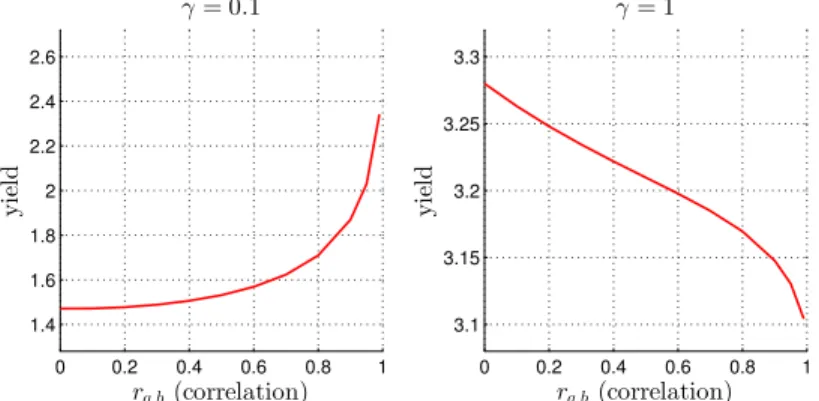
Figure 3 Publisher’s expected yield as a function of the correlationrq,b for trade-off parametersγ= 0.1,1. The publisher in consideration has signed one contract with capacityρ= 0.6and has one bidder in the exchange. The distribution of the placement quality and the bid from the exchange is a bivariate log-normal distribution with means
µq=µb= 1, variancesσ2q=σb2=12, and correlationrq,b. The solid curve denotes the publisher’s yield.
The total contribution of these antagonistic effects is indeterminate, and in some cases, the price discrimination effect may even dominate, resulting in yield increasing with correlation. Figure 3 plots the expected yield as a function of correlation for a publisher with one contract and one bidder in the exchange. Notably, when the publisher prioritizes the contracts (γ is high), yield is decreasing with correlation. However, when the publisher assigns a higher priority to the revenue from AdX (γ is low), yield increases with correlation. There the detrimental consequences of positive correlation on channel diversification are compensated, to some extent, by the publisher’s ability to price more effectively in the exchange by exploiting the user’s attributes.
As a final remark, there are several reason why the correlation between these channels might not be perfect. First, publishers usually do not disclose all user attributes to the spot market, thus rendering the targeting in the latter coarser. For example, registered users disclose personal information that the publisher exploits, due to privacy issues, solely to improve the targeting of guaranteed contracts. Second, advertisers in the spot market are increasingly targeting users based on cookies, which are private bits of information stored in the users’ computers that allow to track the past activity of users on the web. Cookies are dropped by advertisers when users visit their own web-sites, and are only accessible to them. Thus, a strong component of the spot market bids is based on private information. In§5.3 we empirically explore the correlation between the bids from the exchange and the placement quality, and show that the dependence is statistically weak.
4.
Deterministic Approximation
Unfortunately, the state space of the DP in (2) has size O(NA+1), and in most real-world problems the number of impressions in a single horizon can be in the order of millions. So the DP is not efficiently solvable. We give, instead, an approximation in which stochastic quantities are replaced by their expected values, and are assumed to be continuous. Such “deterministic approximation problems (DAP)” are
popular in RM (see, e.g., Talluri and van Ryzin (1998)). In our setting, the approximation we make is to enforce contracts to be satisfied only in expectation. We formulate the problem based on this assumption and obtain an infinite-dimensional program. This DAP is solved by considering its dual problem, which turns out to be a more tractable finite-dimensional convex program. Finally, we wrap a full stochastic policy around it (one that always meets the contracts, not just in expectation), and show that this policy is asymptotically optimal when the number of impressions and capacity are scaled up proportionally.
4.1. Formulation of Deterministic Problem
We aim for an approximation in which (i) the policy is independent of the history but dependent on the realization of the vector of attributesun(recall that placement qualities are deterministically determined based on the attributes), (ii) capacity constraints are met in expectation, and (iii) controls are allowed to randomize. These approximations turn out to be reasonable when the number of impressions is large. When an impression arrives, the publisher controls the reserve price submitted to AdX, and the advertiser to whom the impression is assigned, if rejected by AdX. Alternatively, in this formulation we state the controls in terms of total probabilities, where each control is a function from the attribute space U to [0,1]. Let~s={sn(·)}n=1,...,N and~ı={in(·)}n=1,...,N be vectors of functions from U toR, such that when
the nth impression arrives with attributes u the impression is accepted by AdX with probability s n(u), and with probability in,a(u) it is assigned to advertiser a. From these controls, one can determine the conditional probability of an impression being assigned to advertiseragiven that it has been rejected by AdX byIn,a(u) =in,a(u)/(1−sn(u)), and the reserve price to be posted in the exchange by ¯F−1(sn(u);u). When it is clear from the context, we simplify notation by eliminating the dependence on u from the controls.
A control is feasible for the DAP if (i) it satisfies the contractual constraints in expectation, (ii) the individual controls are non-negative, and (iii) for every realization of the qualities the probabilities sum up to at most one. We denote by P the set of controls for one impression that satisfy the latter two conditions. That is,P={(s, i)∈ U →[0,1]A+1:P
a∈Aia+s≤1, s≥0, i≥0}. The objective of the DAP is to find a sequence of real-valued measurable functions that maximize the expected yield, or equivalently
JD , max (sn,in)∈PE " N X n=1 r(sn;Un) +γ X a∈A in,aQn,a # s.t. E " N X n=1 in,a # =Ca, ∀a∈ A. (3a)
The first term of the objective accounts for the revenue from AdX, while the second accounts for the quality perceived by the advertisers. In order to compute the DAP’s optimal solution, we consider its dual problem, which we derive next.
Derivation of the Dual to DAP. To find the dual, we introduce Lagrange multipliers v={va}a∈A for
the capacity constraints (3a). The Lagrangian, denoted by L(~s,~ı;v) is L(~s,~ı;v) =E " N X n=1 r(sn;Un) +γ X a∈A in,aQn,a− X a∈A va(in,a−ρa) # ,
where we used that Ca=N ρa. The dual function, denoted byψ(v), is the supremum of the Lagrangian over the setP. Thus, we have that
ψ(v) = sup (sn,in)∈P L(~s,~ı;v) =N sup (s,i)∈P E " r(s;U) +γX a∈A iaQa− X a∈A va(ia−ρa) # =Nsup s≥0 ( E[r(s;U)] + sup i≥0,P a∈Aia≤1−s E " X a∈A ia(γQa−va) #) +NX a∈A vaρa =Nsup s≥0E r(s;U) + (1−s) max a∈A0 {γQa−va} +NX a∈A vaρa =NE R max a∈A0 {γQa−va};U +NX a∈A vaρa
where the second equation follows from the fact that the objective is separable in the impressions and the stationarity of the user attributes, the third from partitioning the optimization between AdX accep-tance and the assignment probability controls, the fourth from optimizing over the advertiser assignment controls i, and the last equation from solving the AdX variational problem. Note that R is convex and non-decreasing in its first argument and the maximum is convex w.r.t v, hence the composite function within the expectation is convex. Using the fact that expectation preserves convexity, we obtain that the objective ψ(v) is convex in v.
Next, the dual problem is infvψ(v). When the revenue function is regular, the DAP’s objective is concave and bounded from above. Moreover, the constraints of the primal problem are linear, and the feasible setP convex. Hence, by the Strong Duality Theorem (p.224 in Luenberger (1969)) the dual prob-lem attains the primal objective value, and the dual probprob-lem is given by the following convex stochastic problem JD=Nmin v E R max a∈A0 {γQa−va};U +X a∈A vaρa . (4)
Deterministic optimal control. Once the optimal dual variablesvare known, the primal solution can be constructed from plugging the optimal Lagrange multipliers inL(~s,~ı;v). Following the derivation of the dual, we obtain that the optimal survival probability iss∗(max
a∈A0{γqa−va};u). Hence, the impression has a value of maxa∈A0{γqa−va} for the publisher, and she picks the reserve price that maximizes her revenue given that value. From the optimization over the assignment controls, we see that an impression is assigned to an advertiser a only if she maximizes the contract adjusted quality γqa−va, where the dual variables va act as the bid-prices of the guaranteed contracts. Additionally, the impression can be
discarded only if the maximum is not verified by an advertiser (i.e. all contract adjusted qualities are non-positive). Finally, the resulting control is stationary, that is, the control is independent of the number of impressions left in the horizon.
Notice that optimizing the Lagrangian does not specify how the impression should be assigned when –multiple– advertisers attain the maximum. In the case when the probability of a tie occurring is zero, the problem admits a simple solution: assign the impression to the unique maximizer of γqa−va. We formalize this discussion in the following theorem.
Theorem 1. Suppose that the revenue function is regular, and there is zero probability of a tie
occur-ring, i.e.P{γQa−va=γQ0a−va0}= 0for all distincta, a0∈ A0. Then, the optimal controls for the DAP are
s(u) =s∗(maxa∈A0{γqa−va};u), and Ia(u) =1{γqa−va> γqa0−va0∀a
0∈ A
0}, that is, the impression is assigned to the unique advertiser maximizing the contract adjusted quality. Furthermore, the optimal dual variables solve the equations
E h 1−s∗(γQa−va;U) 1{γQa−va> γQa0−va0∀a0∈ A0} i =ρa, ∀a∈ A.
4.2. The Stochastic Policy
The solution of the DAP suggests a policy for the stochastic control problem, but we must deal with two technical issues: (i) when more than one advertiser maximizes γqa−va we need to decide how to break the tie, and (ii) we are only guaranteed to meet the contracts in expectation, whereas we must meet them exactly. We defer the first issue until§4.3, where we give an algorithm for generalizing the controls to the case where ties are possible.
We propose a bid-price control extended with a pricing function for AdX given byp∗. The policy, which
we denote byµB, is defined in Policy 2. In there we letvto be the optimal solution of (4). Impressions are only assigned to advertisers with contracts that have yet to be fulfilled. When all contracts are fulfilled, impressions are sent to AdX with the revenue maximizing price p∗(0;u
n). Moreover, when the total number of impressions left is equal to the number of impressions necessary to fulfill the contracts, the exchange is bypassed and all incoming impressions are directly assigned to advertisers (no impression is discarded). Hence, the stochastic policyµB satisfies the contracts for every sample path.
The proposed stochastic policy shares some resemblance with the optimal dynamic programming policy. The intuition is that, when the number of impressions is large, the actual state of the system becomes irrelevant because ∆aJm−1(x) is approximately constant (for states in likely trajectories), and equal to va. In that case both policies are equivalent.
The policy can be alternatively interpreted as the publisher bidding on behalf of the guaranteed contracts in a sequence of repeated auctions run by the exchange as in McAfee et al. (2009). The pricing function and the bid-prices determine a reserve price or “bid” for the contracts that takes into account the value of assigning the impression to a reservation together with option value of future opportunities.
Policy 2 Bid-Price Policy with Dynamic Pricing µB.
1: Observe state (n, x), and the vector of attributes un.
2: Determine the vector of placement qualitiesqn.
3: Let An={a∈ A : xn,a>0} be the set of ads yet to be satisfied.
4: if P
a∈Axn,a< nthen
5: Let a∗n= arg maxa∈An∪{0}{γqn,a−va}. 6: Submit to AdX with price p∗(γqn,a∗
n−va∗n;un). 7: if impression rejected by AdX anda∗
n6= 0 thenassign to advertiser a∗n,elsediscard.
8: else
9: Assign to advertiser a∗
n= arg maxa∈An{γqn,a−va}.
10: end if
In this dual interpretation the spot market lies in the spotlight while the guaranteed contracts are pushed to the background, in sharp contrast to the current practice of first aiming to fulfill the reservations and then submitting the remnant inventory to AdX. Our original interpretation is more appealing because it does not rely so heavily on the publisher always testing the exchange, which may not be optimal, for example, in the presence of a fixed-cost.
4.3. Handling ties
Theorem 1 assumes that there are no ties between advertisers verifying the maximum contract adjusted quality. In this section we show how to construct a primal optimal solution to the DAP and the corre-sponding stochastic policy in the general case (for example, when the distribution of placement quality is discrete or has atoms). Devanur and Hayes (2009) proposed introducing small random and independent perturbations to the qualities, or smoothing the dual problem to break ties. We provide an alternate method that directly attacks ties, and provides a randomized tie-breaking rule. Computing the param-eters of the tie-breaking rule requires solving an assignment problem on a graph of size at most 2A. In §6 we argue that, in practice, the number of ties is roughly linear in the number of advertisers and the problem is tractable. Additionally, if the publisher fails to take into account ties she can incur significant losses.
A modified bid-price solution with tie-breaking for the DAP is defined by a pair (v, p) with v∈RA the vector of dual variables and p: 2A0→[0,1]A+1 the tie-breaking probabilities. For any non-empty subset
S⊆ A0, the tie-breaking probability pa(S) determines the probability that the impression is assigned to contract a∈ A0 when the maximum is verified exactly by all the advertisers in S, and the impression is rejected by AdX. In the case that exactly one advertiser verifies the maximum the tie is a singleton. Given a vector of dual variablesv∈RAthe tie-breaking probabilities are obtained by solving the following
assignment problem
X
S⊆A0:a∈S
X
a∈S
pa(S) = 1, ∀S⊆ A0, (5b)
pa(S)≥0, ∀S⊆ A0, a∈S , (5c)
where we letP(S-tie) =E
h
1−s∗(max
a∈A0{γQa−va};U)
1
S= arg maxa∈A0{γQa−va}
i
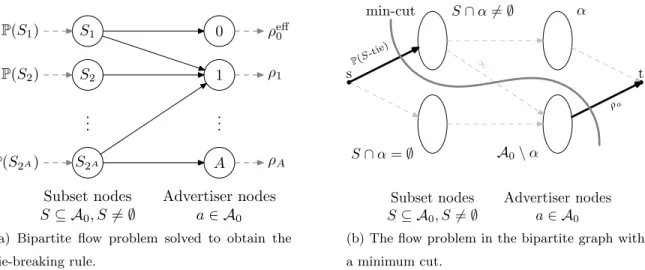
be the prob-ability that the maximum is verified exactly by all the advertisers inS, and the impression is rejected by AdX. Equation (5a) guarantees that contract a is assigned exactly ρa impressions, while equation (5b) guarantees that for each tieS the probabilities sum up to one.
An important question is whether the previous problem admits a feasible solution. The next result proves that the answer is affirmative when the dual variablesv are optimal for the dual problem (4), and characterizes the optimal solution for the DAP.
Proposition 2. Suppose thatv∈RAis an optimal solution for the dual problem (4). Then, there exists
a tie-breaking rule p: 2A0→[0,1]A+1 solving problem (5). Additionally, the optimal solution for the DAP prices in AdX according to the survival probabilitys(u) =s∗(max
a∈A0{γqa−va};u)and, if rejected, assigns the impression to contract a with probabilityIa(u) =
P
S⊆A0:a∈Spa(S)1{S= arg maxa0∈A0{γqa0−va0}}. The proof proceeds by casting the problem as a maximum flow problem in a bipartite graph, and then exploits the optimality conditions ofvin the dual problem to lower bound every cut in the bipartite graph. Feasibility of the proposed solution follows from constraints (5a) and (5b). In order to prove optimality it suffices to show that it attains the dual objective value, or that it satisfies the complementary slackness conditions. The latter follows trivially.
Once the optimal controls are calculated, we construct our stochastic policy as follows. When
P
a∈Axn,a< nwe let Sn= arg maxa∈An∪{0}{qn,a−va}be the set of advertisers that attain the maximum
within advertisers with contracts that have yet to be fulfilled. Now, if the impression is rejected by AdX, we assign it to advertiser a∈Sn with probability pa(Sn). Similar corrections as before are applied when the total number of impressions left is equal to the number of impressions necessary to fulfill the contracts.
4.4. Asymptotic Analysis
In this section we show that the heuristic policy constructed from the DAP is asymptotically optimal for the stochastic problem when the number of impressions and capacities are scaled up proportionally. To this end we extend the analysis of Gallego and van Ryzin (1994) and Talluri and van Ryzin (1998) to capture the multi-objective nature of our problem. We prove that any Pareto optimal policy of the stochastic control can be approximated by a simple modified bid-price policy that performs asymptotically close both in terms of the AdX’s revenue and contract’s quality. We prove this result in two steps.
The first result (Proposition 3) shows that every policy of the stochastic control problem is Pareto dominated by a solution to the DAP, which implies that the efficient frontier of the stochastic control problem is dominated by that of the DAP. Because the DAP is convex, its efficient frontier is concave and the publisher can achieve any Pareto efficient point by picking a suitable trade-off parameter γ. Let
Jµ A and J
µ
C be the expected AdX’s revenue and contract’s quality associated to a stochastic policyµ. Let JD(γ)
A andJ
D(γ)
C be the expected AdX’s revenue and contract’s quality of the DAP for trade-off parameter
γ≥0. We have the following result.
Proposition 3. For every feasible stochastic policyµthere exist a trade-off parameterγ≥0 such that
JAµ≤J D(γ) A andJ µ C≤J D(γ) C .
The proof of the previous result is as follows. First, we proceed by taking any feasible stochastic control policy, and constructing a feasible solution for the DAP by taking expectations over the history. Later, we exploit the concavity of the objective and apply Jensen’s inequality to show that this new solution attains a greater revenue and quality in the DAP. We conclude by showing that the efficient frontier of the DAP is concave, and then invoking a supporting hyperplane argument to prove that any Pareto point can be achieved by optimizing a weighted combination of the objectives.
The second result (Theorem 2) shows that for any trade-off parameter γ, the performance of the modified bid-price policy derived from the respective optimal solution of the DAP is asymptotically close, both in terms of AdX’s revenue and contract’s quality, to that predicted by the DAP. In other words these results imply that the efficient frontier achieved by the proposed heuristic is asymptotically “close” to that of the stochastic control problem. In the following letJB(γ)=JB(γ)
A +γJ B(γ)
C be the expected yield, JAB(γ) the expected AdX’s revenue, and J
B(γ)
C the expected contracts’ quality under the stochastic policy µB(γ).
Theorem 2. Fix the trade-off parameter γ. Let K =
q A A+1 P a∈A0 1−ρa
ρa . Then, the expected
perfor-mance of µB(γ) relative to the objective value of the deterministic approximation is lower bounded (i) in terms of AdX’s revenue byJAB(γ)/J
D(γ)
A ≥1−K/
√
N ,
(ii) in terms of contract’s quality by JCB(γ)/J D(γ)
C ≥1−K/
√
N , and (iii) in terms of yield by JB(γ)/JD(γ)≥1−K/√N .
Fix the capacity-to-impression ratio of each advertiser, and consider a sequence of problems in which capacity and impressions are scaled up proportionally according toρ. Then the two previous results imply that the performance under policy µB(γ) converges to the performance of the optimal online policy asN goes to infinity. In proving the previous bounds, we look atN∗, the first time that any advertisers contract
is fulfilled or the point is reached where all arriving impressions need to be assigned to the advertisers. We refer to the time after N∗ as the left-over regime. The first key observation in the proof is that
before timeN∗, the controls of the stochastic policy behave exactly as the optimal deterministic controls
and the expected performance of the policy coincides with that predicted by the DAP. The second key observation is that the expected number of impressions in the left-over regime isO(√N), and the left-over regime has a small impact on the objective. In fact, using a Chernoff bound, it is straightforward to show that the probability that the number of impressions in the left-over regime exceeds a fixed fraction of the total impressions decays exponentially fast.
The policy described in §4.2 is stationary in the sense that it does not react to changes in supply: the dual variables v and the tie-breaking probabilities p are computed at the beginning and remain fixed throughout the horizon (prices in the exchange, however, are dynamically adjusted to account for the opportunity cost of not assigning an impression to a guaranteed contract). To address this issue, in practice, one would periodically resolve the deterministic approximation (4). Recently, Jasin and Kumar (2012) showed that carefully chosen periodic resolving schemes together with probabilistic allocation controls can achieve bounded yield loss w.r.t. the optimal online policy. It is worth noting that those results do not directly apply to our setting: they consider a network RM problem with discrete choice, while our model deals with jointly distributed (and possibly continuous) placement qualities and AdX. Nevertheless, by periodically resolving the DAP one should be able to obtain similar performance guarantees for the yield loss of the control.
5.
Data Model and Estimation
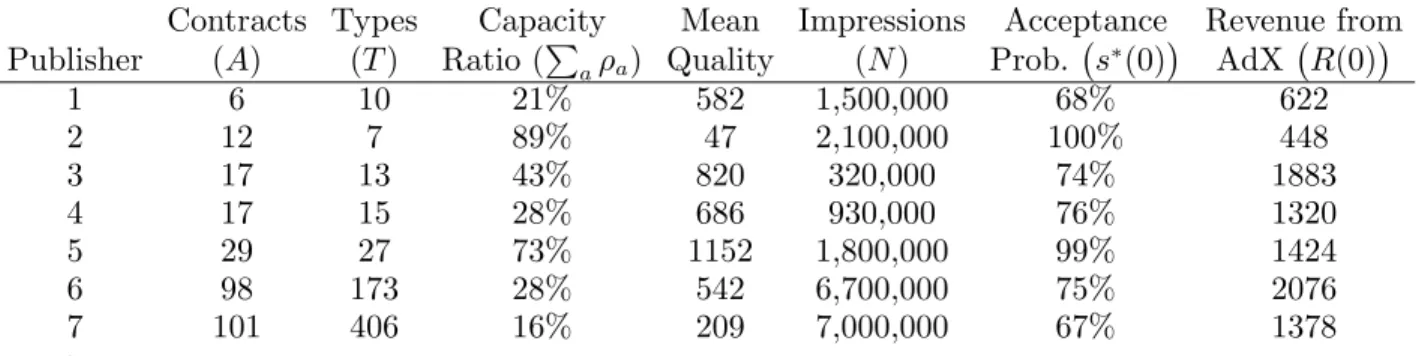
In order to study the performance of our algorithm on display ads we introduce a data model based on our observation of actual publisher inventory, and then present data sets from 7 anonymous publishers. We selected representative publishers of different size: two small publishers with around 10 contracts, two large with around 100 contracts, and three medium size publishers in between. The publishers are mostly online gaming websites, and news websites. The data sets were collected over a period of one week during March of 2010, and the number of impressions in each data set ranges from 300 thousand to 7 million. Additionally, the fraction of impressions reserved for contracts as given byP
a∈Aρa varies across publishers, with two publisher highly constrained, one moderately constrained and the remaining lowly constrained. Publishers’ characteristics are given in Table 2.
5.1. Guaranteed Contracts
We have thus far assumed that any user could be potentially assigned to any advertiser. In practice, however, advertisers have specific targeting criteria. The targeting criteria of the guaranteed contracts is based on the URL, the geographic location, the type of browser or operating system used by the users, time of the day, and contextual features of web pages. Instead of grouping user types according to their attributes, we aggregate user types that match the criteria of the same subset of advertisers. This has the advantage of reducing the space of types to a function of the number of advertisers (which is typically small in practice) rather then the number of possible types (which is potentially large). Hence, a user type is characterized by the subset of advertisersT⊆ Athat are interested in it. In the following, we let T be the support of the type distribution, and π(T) the probability of an arriving impression being of typeT.
The measure of placement quality for a contract is the predicted click-through-rate to each impression, which is learned via a system that uses the impression’s attributes and features of the ad creative (such as the text of the ad) as explanatory variables. We refer the reader to McMahan et al. (2013) for a
Contracts Types Capacity Mean Impressions Acceptance Revenue from Publisher (A) (T) Ratio (P aρa) Quality (N) Prob. s∗(0) AdX R(0) 1 6 10 21% 582 1,500,000 68% 622 2 12 7 89% 47 2,100,000 100% 448 3 17 13 43% 820 320,000 74% 1883 4 17 15 28% 686 930,000 76% 1320 5 29 27 73% 1152 1,800,000 99% 1424 6 98 173 28% 542 6,700,000 75% 2076 7 101 406 16% 209 7,000,000 67% 1378
Table 2 Characteristics of the different publishers. The mean quality is defined as expected quality given that the contract matches averaged over all contracts, that is, P
aρaE[Qa(T)|T3a].
detailed description of the methods employed to predict click-trough-rates in online advertising. Given a particular type T, the predicted quality perceived by the advertisers within the type is modeled by the non-negative random vector Q(T) ={Qa(T)}a∈T. Thus, the ex-ante distribution of quality is given by the mixture of the types distribution with mixing probabilities π(T). All our previous results hold for the mixture distribution.
Even if the total number of impressions suffices to satisfy the contracts, i.e.P
a∈Aρa≤1, the inventory may not be enough to satisfy the contracts targeting criteria. Our algorithm guarantees that the total number of impressionsCais always respected, yet some advertisers may be assigned impressions outside of their criteria. If an impression of typeT happens to be assigned to an advertisera6∈T, the publishers pays a non-negative goodwill penaltyτa. These penalties allow the publisher to prioritize certain reservations, specially when contracts are not feasible.5
5.2. Estimation of Placement Qualities
Our policy can be applied both in a parametric and non-parametric fashion. In the former, a paramet-ric model of placement qualities is postulated, the underlying parameters are estimated using sample data, and the policy’s parameters are determined by solving problems (4) and (5) with the estimated distribution. In the latter, problems (4) and (5) are solved directly over sample data by replacing expec-tations with sample averages. In the remainder of the paper we describe the parametric case, while the non-parametric approach is described in §EC.5.
Given a particular type T, we observe that the predicted quality perceived by the advertisers within a type is approximately log-normal. This can be seen in §EC.3, where the empirical distribution of log-quality is graphically represented for all types of Publisher 3. We postulate that quality follows a multivariate log-normal with mean vector µT and covariance matrix ΣT for the advertisers in the type, and takes a value of−τa for advertisers not in the type. The total distribution of quality is given by the mixture of these types distribution with mixing probabilities π(T). Thus, we have that
Q∼
(
lnN(µT,ΣT), fora∈T, −τa, fora6∈T,
w.p. π(T).
5In§EC.6 we show that by picking suitably large penalties the publisher can avoid delivering impressions outside of the
Logs were analyzed to estimate the types’ frequencies, and the parameters of the underlying log-normal distributions (using maximum likelihood estimation). The parameters for the publishers are available at the web-page of the first author (for confidentiality reasons all placement qualities were linearly perturbed by common a random factor). Table 2 shows the mean placement quality for the publishers in the data set, which varies significatively across publishers.
5.3. Estimation of AdX Bids
Bidding data from the same period of time was used to estimate the primitives of AdX. With multiple bidders, AdX runs a sealed bid second-price auction. We analyze the first and second highest bids for the inventory submitted to AdX independently of the impression’s attributes and placement qualities. Sample data is used to compute the two primitives of our model: (i) the complement of the quantile of the highest bid p(s), and (ii) the revenue function r(s). Both functions are estimated on a uniform grid {sj}1001 of survival probabilities in the [0,1] range as follows. Let {(b1,m, b2,m)}m=1,...,M be the sampled highest and second highest bids from the exchange. First, for each point in the gridj, the pricepj=p(sj) is estimated as the (1−sj)-th population quantile of the highest bid. Then, using sampled bids, we estimate the revenue function w.r.t. to prices at the grid points as
r(pj) = 1 M M X m=1 1{b1,m≥pj}max{b2,m, pj} (6) Finally, the revenue function is obtained by composing (6) and p(s). Bids were linearly perturbed by common a random factor for confidentiality.
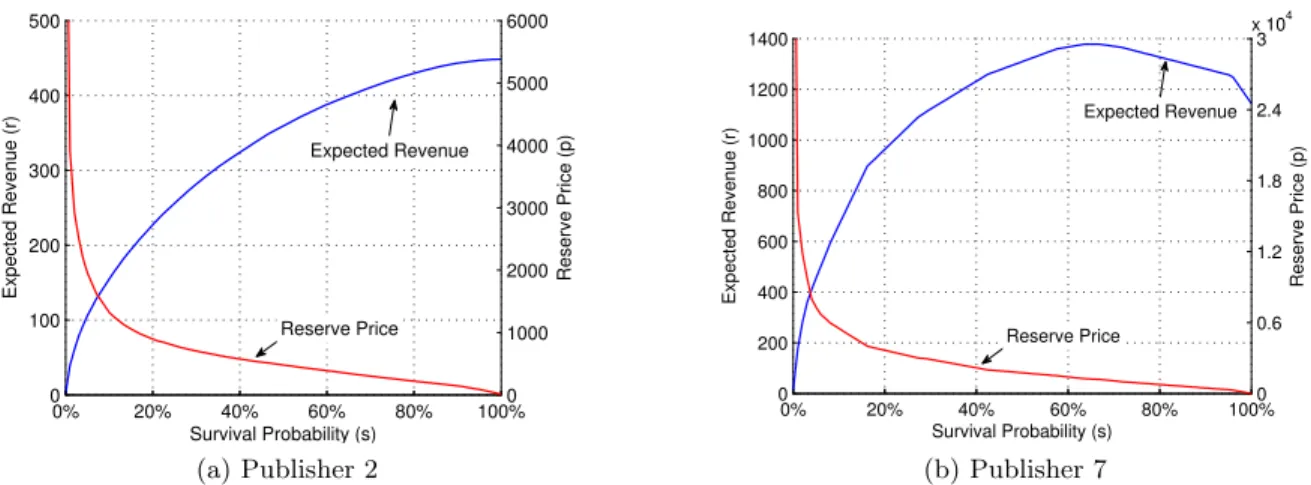
Table 2 provides the optimal revenueR(0) and acceptance probabilitys∗(0) when the opportunity cost is zero for the different publishers. The distribution of the maximum bid and the resulting optimal revenue function varies significantly across publishers. Interestingly, for some publishers the optimal acceptance probability in the absence of an opportunity cost is close to 1, and the publisher is better-off setting no reserve price at all. For these publishers the exchange market is competitive with highly correlated bids, and the probability of not selling the item by setting a reserve price outweighs the benefit of raising the floor price. Figure 4 exhibits the estimated AdX’s survival probability and revenue function for publisher 2, which has a very high optimal acceptance probability, and publisher 7, which has an optimal acceptance probability in the high sixties.
We provide some insight into the dependence structure between the guaranteed contracts’ placement qualities and AdX bids by studying the Pearson’s correlation between these two quantities over two publishers. The setup is as follows. First, we aggregate impressions byad slot, where an ad slot refers to a given position in a publisher’s web-page and is defined by the triplel= (position,web-page,publisher). The total number of ad slots L is in the order of thousands. Second, we compute the average value of maximum bids and average value of maximum placement qualities (predicted click-through-rates) over all impressions corresponding to each ad slot. Letting Ml be the number of impressions in ad slot l, the
0% 20% 40% 60% 80% 100% 0 100 200 300 400 500 Survival Probability (s) Expected Revenue (r) 0 1000 2000 3000 4000 5000 6000 Reserve Price (p) Reserve Price Expected Revenue (a) Publisher 2 0% 20% 40% 60% 80% 100% 0 200 400 600 800 1000 1200 1400 Survival Probability (s) Expected Revenue (r) 0 0.6 1.2 1.8 2.4 3 x 10⁴ Reserve Price (p) Expected Revenue Reserve Price (b) Publisher 7
Figure 4 Estimated survival probability and revenue function for AdX from two different publishers.
average value of maximum bids for the slot is bl= M1
l P
m∈lb1,m, and the average value of maximum placement quality is ql=M1
l P
m∈lmaxa∈A{qm,a}. Finally, we compute the sample correlation coefficient,
denoted by rq,b, between the vectors of placement qualities {ql}Ll=1 and slot bids {bl} L
l=1. We find that the correlation of these two vectors is rq,b≈ −2%, and therefore conclude that correlation between the highest bid of an ad slot and the average placement quality is weak. As discussed earlier, this lack of correlation may be the result of advertisers’ in AdX determining their bids using different signals from the publisher. The usual “lack of correlation does not imply independence” warning must apply here, and this finding should not be interpreted as a statement of independence between these two channels.
6.
Experimental Results
In this section we present two numerical experiments conducted to study our model. First, we analyze the impact on the publisher’s yield of jointly optimizing over both channels using actual publisher data. Second, we compare the performance of our policy with those of two popular heuristics. Before discussing the experimental results we present an efficient method to compute the dual variables in the presence of large-scale instances.
6.1. Solution Method
A difficulty of solving the stochastic optimization problem (4) is that the involved multidimensional integral cannot be computed with high accuracy when the publisher has many contracts. We tackle this problem by performing a Sample Average Approximation (SAA), which relies on approximating the underlying stochastic program via sampling, and then solving the approximate problem via a Sub-gradient Descent Method (SDM).
The basic idea of the SAA is simple: a random sample of placement qualities is generated and the expectation is approximated by the sample average function (Shapiro et al. 2009). Letting {qm}M
m=1 be an i.i.d. sample of M vectors of placement qualities, the SAA is given by
min v 1 M M X m=1 Rmax a∈A0 {γqm,a−va} +X a∈A ρava, (7)