Universitat Politècnica de Catalunya (UPC) - BarcelonaTech
Facultat d’Informàtica de Barcelona (FIB)
Final Master Thesis (FMT)
Master in Innovation and Research in Informatics (MIRI)
High Performance Computing (HPC)
Enhancing the Interoperability between
Distributed-Memory and Task-Based
Programming Models
Kevin Sala Penadés
Advisors:
Vicenç Beltran Querol
([email protected])Eduard Ayguadé Parra
([email protected])Computer Architecture Department (DAC)
Acknowledgments
I would like to thank my advisors, Vicen¸c Beltran and Eduard Ayguad´e, for offering me the opportunity of working with them on several interesting and motivating projects. Also, thanks for the support that I have received and thanks for facilitating my way in the field of research.
Thanks to Josep M. Perez and Xavier Teruel, since this project would not be possible without all their help.
I would like to thank all my family and friends, especially my parents, for supporting me during all this project. Every day, they encourage me to improve both professionally and personally.
I would like to especially thank my friends Toni Navarro and Marc Mar´ı, who have supported and helped me unconditionally every day. They always make me smile and they make me take things more humorously. Thanks for all, fellas.
Last but not least, I would like to thank all my colleagues at the BSC Programming Models group for creating a very nice working environment.
Abstract
Current high-performance computing architecture trends suggest that exascale com-puting systems will consist of several distributed memory nodes, where each will con-tain a large number of compute cores. Following these trends, HPC users usually develop hybrid applications combining both distributed-memory and shared-memory programming models to exploit the inter-node and intra-node parallelism, respectively. However the common parallelization strategies limit the performance and the pro-grammability of hybrid applications, since these programming models were not de-signed to be combined. When trying to enhance the performance of hybrid application by applying more advanced techniques, such as double-buffering, the complexity of the code increases dramatically, and in addition, they still continue to be suboptimal. There are several proposals which improve the interoperability between MPI and OpenMP. Some of them propose the taskification of communications along with an interoperability mechanism. However, most of them are specific to a particular task-based programming model.
We propose the enhancement of the interoperability between distributed-memory and task-based programming models in order to (1) improve the programmability of user applications, to (2) improve significantly their performance and (3) being compatible with any task-based programming model. We enhance an existing interoperability mechanism for MPI and we propose a similar mechanism for the GASPI programming model.
Our results, which include the evaluation of some benchmarks in different architectures, reveal that our approaches for both MPI and GASPI programming models improve the performance and programmability of hybrid applications. We also demonstrate that the mechanism can be easily integrated into any distributed-memory programming model, or even into any blocking service not related to programming models.
Table of Contents
1 Introduction . . . 1 1.1 Objectives . . . 2 1.2 Contributions . . . 3 1.3 Document Structure . . . 4 2 Related Work . . . 53 Message-Passing Interface (MPI) . . . 7
3.1 History . . . 8 3.2 Basic Concepts . . . 8 3.3 Initialization . . . 9 3.4 Data Messages . . . 10 3.5 Point-to-Point Communication . . . 10 3.5.1 Blocking Operations . . . 11 3.5.2 Non-Blocking Operations . . . 11 3.6 Collective Communication . . . 12
4 Global Address Space Programming Interface (GASPI) . . . 13
4.1 History . . . 14
4.2 Remote Direct Memory Access . . . 14
4.3 Basic Concepts . . . 15
4.4 Initialization . . . 16
4.5 Groups . . . 16
4.6 Memory Segments . . . 17
4.7.1 Write & Read Operations . . . 18
4.7.2 Notify Operation . . . 19
4.7.3 Waiting Notifications . . . 19
4.8 Queues . . . 20
4.9 Other Functionalities . . . 21
5 OmpSs-2 Task-based Programming Model . . . 22
5.1 Basic Concepts . . . 22 5.2 Influencing OpenMP . . . 23 5.3 Annotating Programs . . . 24 5.4 Execution Model . . . 24 5.4.1 Tasks . . . 25 5.4.2 Loops . . . 25 5.4.3 Nesting . . . 26 5.4.4 Explicit Synchronization . . . 26 5.4.5 Example . . . 26 5.5 Dependency Model . . . 27 5.5.1 Region Dependencies . . . 28
5.5.2 Fine-Grained Early Release . . . 28
5.5.3 Weak Dependencies . . . 29
5.6 Task Scheduling . . . 30
5.7 Reference Implementation . . . 30
6 MPI+OmpSs Interoperability Library . . . 31
6.1 Taskifying Communications . . . 32
6.1.1 Risk of Deadlock . . . 33
6.2 Benefits . . . 33
6.3 Software Requirements . . . 33
6.3.1 Task Condition Variable API . . . 34
6.3.2 Polling Service API . . . 34
7 Tools and Methodology . . . 37 7.1 Tools . . . 37 7.1.1 Mercurium . . . 37 7.1.2 Nanos6 . . . 38 7.1.3 MPICH . . . 39 7.1.4 GPI-2 . . . 40
7.1.5 MPI+OmpSs Interoperability Library . . . 40
7.1.6 Extrae . . . 40 7.1.7 Paraver . . . 41 7.2 Methodology . . . 41 7.2.1 Relevance Cycle . . . 41 7.2.2 Rigor Cycle . . . 42 7.2.3 Design Cycle . . . 43
8 Enhancing the MPI Interoperability . . . 44
8.1 New Level of Thread Support . . . 44
8.2 Generalizing the API . . . 46
8.3 Bringing the Mechanism to Users . . . 48
8.4 Implementation Details . . . 49
9 Enhancing the GASPI Interoperability . . . 52
9.1 Main Ideas . . . 52
9.2 Initialization Modes . . . 53
9.3 New Blocking/Timeout Mode . . . 54
9.4 Local Completion . . . 55
9.5 Remote Completion . . . 56
9.6 Queue Groups . . . 56
9.7 Implementation Details . . . 58
9.7.1 Original Implementation . . . 59
9.7.2 Extendinggaspi wait . . . 59
9.7.3 Extendinggaspi notify waitsome . . . 62
10 Proposing a Non-blocking Interoperability Mechanism . . . 65
10.1 Task Event Counter API . . . 66
10.2 Implementation Details . . . 67
11 Evaluation . . . 70
11.1 Environment . . . 70
11.2 Gauss–Seidel . . . 71
11.2.1 GASPI Versions . . . 74
11.2.2 Non-blocking Interoperability Variant . . . 75
11.3 IFSker . . . 75
11.4 Evaluation and Discussion . . . 76
11.4.1 Gauss–Seidel in Marenostrum4 . . . 77 11.4.2 Gauss–Seidel in Nord3 . . . 80 11.4.3 IFSker in Marenostrum4 . . . 82 12 Conclusions . . . 85 13 Future Work . . . 86 Bibliography . . . 87
Appendix A Gauss–Seidel: Complete Code . . . 89
A.1 Taskified MPI+OmpSs-2 Gauss–Seidel . . . 89
List of Figures
4.1 GASPI overview in a heterogeneous architecture . . . 14
5.1 OmpSs features introduced into the OpenMP programming model. . . 24
5.2 Snippet of code highlighting tasking constructs. . . 27
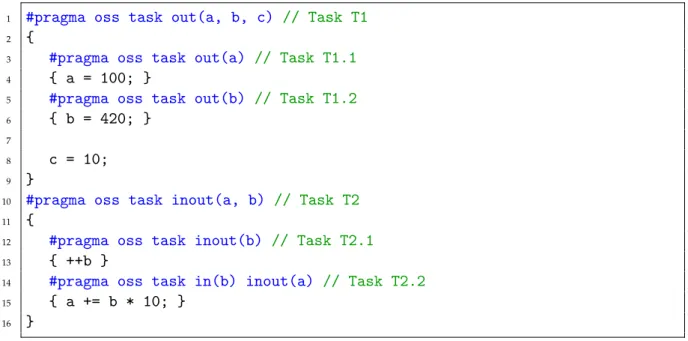
5.3 Snippet of code combining nesting and dependencies. . . 29
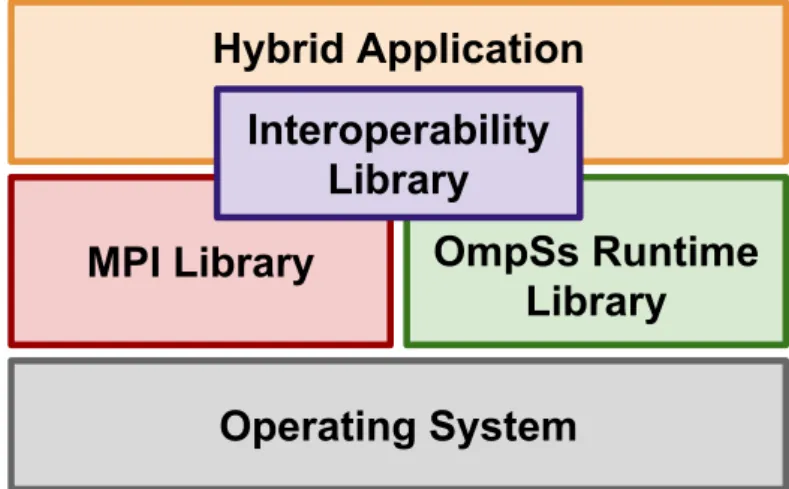
6.1 Software stack in a hybrid MPI+OmpSs+Interoperability application. . 31
6.2 Dependency graph with both computation and communication tasks. . 32
6.3 Deadlock situation between 2 processes and 2 CPUs per process. . . 32
6.4 OmpSs task condition variable API. . . 34
6.5 OmpSs polling service API. . . 35
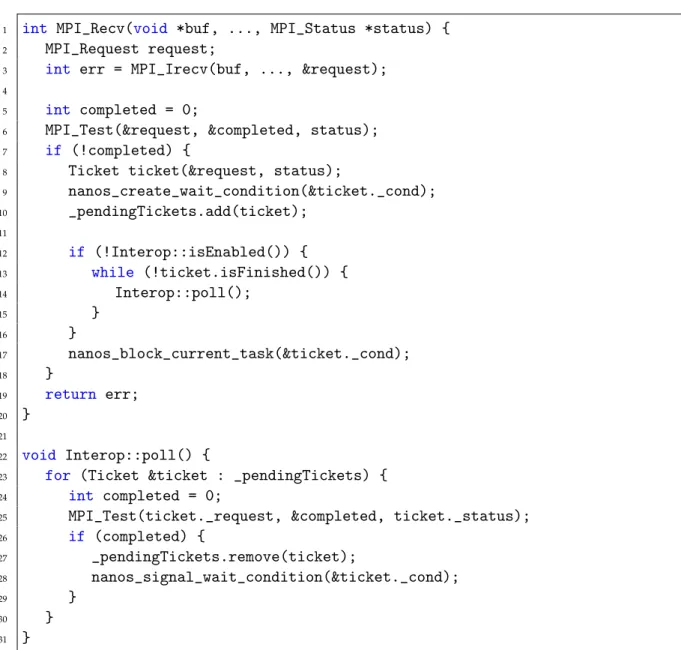
6.6 Original interception of the MPI Recv routine and implementation of the polling function in the interoperability library. . . 36
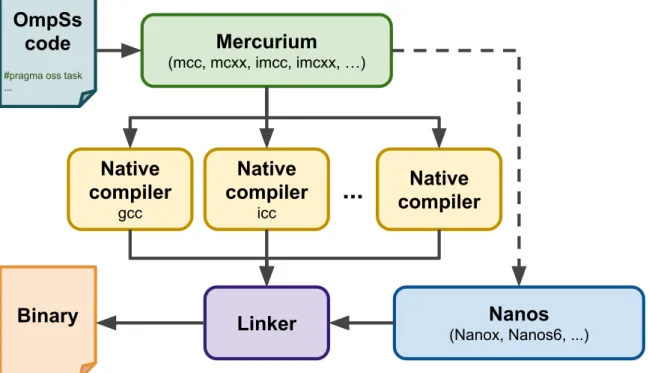
7.1 Mercurium workflow for OmpSs source codes. . . 38
7.2 Nanos6 runtime system structure. . . 39
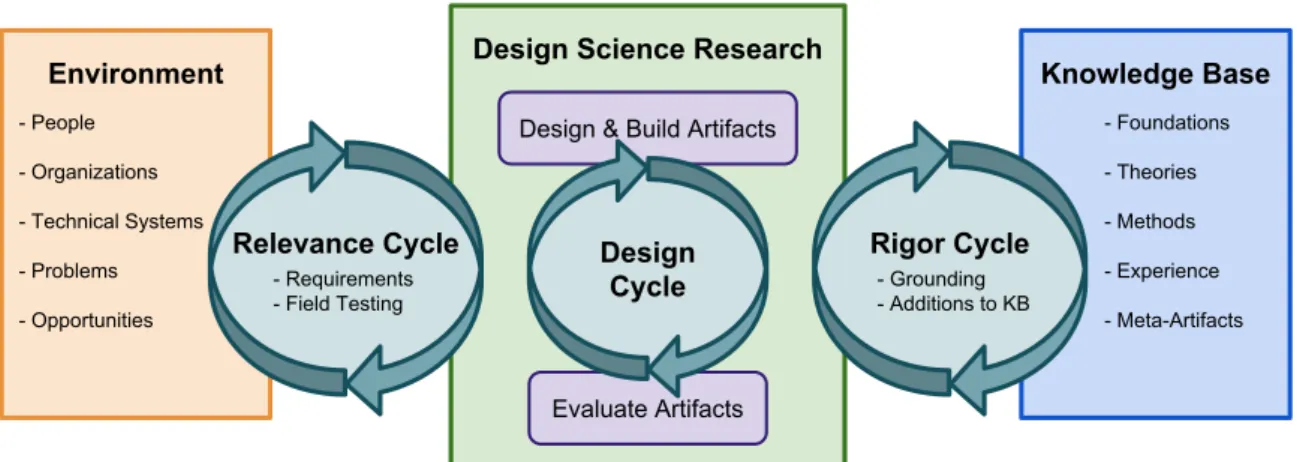
7.3 Design Science Research Cycles. . . 42
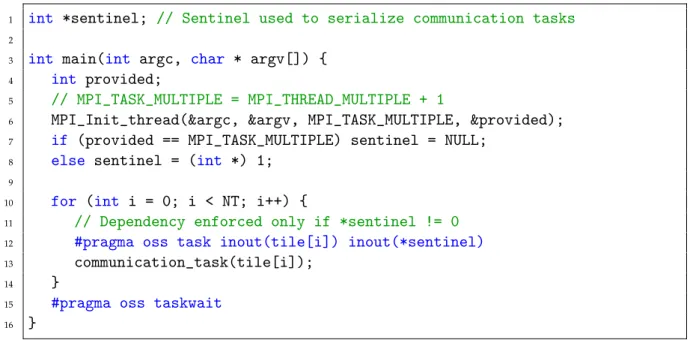
8.1 Example of a portable MPI initialization usingMPI TASK MULTIPLE. 45 8.2 Task block/unblock API. . . 46
8.3 Code that performs the block operation. . . 47
8.4 Body of the code that handles the unblocking of the operation. . . 47
8.5 Callback code that handles multiple operations. . . 47
8.6 Callback code that handles a single operation. . . 48
8.7 Modified blocking code to use one callback per operation. . . 48
8.9 New interception of the MPI Recv routine and implementation of the
polling function in the interoperability library. . . 50
9.1 Example of a common GASPI+OmpSs parallelization strategy. . . 53
9.2 Example of the proposed GASPI+OmpSs parallelization strategy. . . . 54
9.3 Example of sending and receiving data with the pause/resume interop-erability. . . 57
9.4 Proposed GASPI routines for managing queue groups. . . 58
9.5 Task flow when callinggaspi wait with GASPI BLOCK TASK. . . 60
9.6 Pseudocode of the pause/resume mechanism ingaspi wait. . . 61
9.7 Task flow when callinggaspi notify waitsome with GASPI BLOCK TASK. 62 9.8 Pseudocode of the pause/resume mechanism ingaspi notify waitsome. . 64
10.1 Example of the non-blocking interoperability mechanism. . . 66
10.2 Task event counter API. . . 67
10.3 Implementation of theMPI Iwaitroutine and the polling function in the interoperability library. . . 68
11.1 2-D matrix of 3×12blocks split in four ranks. On the hybrid versions, for each iteration a task is created to update each block using values of both current (top and left blocks) and previous (current, right and bottom blocks) iterations. . . 72
11.2 Above: dependency graph for Pure and Fork-Join. Below: dependency graph forN-Buffer,Sentinel (with red deps) and Interop (no red deps). . 73
11.3 Modified receiveUpperBorder to use the non-blocking interoperability mechanism. . . 75
11.4 Gauss–Seidel strong scaling in Marenosturm4 with 64K x 64K total elements and 1000 timesteps. . . 77
11.5 Execution traces with 4 nodes of Marenostrum4 with a 32K x 32K matrix. The Y axis shows MPI ranks/OmpSs threads, while the X axis shows the time-line. . . 79
11.6 Gauss–Seidel weak scaling in Marenosturm4 with 32K x 32K elements per node and 1000 timesteps. . . 80
11.7 Gauss–Seidel strong scaling in Nord3 with 32K x 32K total elements and 1000 timesteps. . . 81
11.8 Gauss–Seidel weak scaling in Nord3 with 32K x 32K elements per node and 500 timesteps. . . 81
11.9 Gauss–Seidel strong scaling in Nord3 with 16K x 16K total elements and 2000 timesteps. . . 82
11.10IFSker strong scaling in Marenostrum4 with 653K total grid-points and 200 timesteps. . . 83
11.11IFSker weak scaling in Marenostrum4 with 82K grid-points per node and 500 timesteps. . . 83
List of Tables
11.1 Table describing the software used to perform the experiments and their versions. . . 71
List of Code Samples
A.1 Gauss–Seidel code of the MPI+OmpSs-2 Sentinel and Interopversions. . 89
1
|
Introduction
Current near-term and mid-term high-performance computing (HPC) architecture trends suggest that the first generation of exascale computing systems will consist of distributed memory nodes, where each node contains a large number of compute cores that provide a high computing capacity.
Following this idea, the most common practice in the HPC community is to develop hy-brid applications combining programming models specialized in exploiting inter-node and intra-node parallelism [1–3]. Usually, distributed-memory programming models, such as MPI [4] or GASPI [5], are used for inter-node parallelism, while shared-memory programming models, such as OpenMP [6] or OmpSs [7], are used for exploiting the parallelism within each node.
Although these programming models were not originally designed to be combined in hybrid applications, they have evolved to provide some interoperability support. How-ever, this minimal support only determines how both models can be safely combined in order to develop hybrid applications, and also, they usually introduce some overhead when enabling the interoperability modes.
In the case of MPI, the standard guarantees that point-to-point communications among two ranks are always ordered as long as these leverage the same tag and communi-cator. However, when multiple threads communicate simultaneously, operations can be re-ordered causing a deadlock in the execution of the application. To avoid this kind of problems, most hybrid applications use the MPI’s thread funneled mode, and then, they serialize communication phases, while computation phases are performed in parallel. Therefore, these applications follow a fork-join parallelization strategy, which opens the parallelism when entering computation phases and closes it before entering a communication phase.
Although this is an easy approach, it presents some programmability and performance problems. Firstly, parallelism may be potentially hindered due to the strict synchro-nization enforced among computation phases and across nodes. Secondly, usually this synchronization point introduces some overhead by itself. Finally, it is very difficult to overlap computation and communication phases with this kind of approaches. Occasionally, more advanced strategies are implemented in hybrid applications which require the restructuring of the application code to manually overlap computation and communication phases of the algorithm. These techniques, such as double-buffering, use asynchronous communication primitives to start communication operations, and
while these operations do not complete, the application is able to perform some com-putations. However, they require complex code modifications, which could be even infeasible depending on the application. Moreover, most times this technique is ap-plied, the performance achieved is still suboptimal.
An easy solution for the previous issues would be to use tasks to implement both com-putation and communication phases, relying on task dependencies to deal with inter-node and intra-inter-node synchronization. However, this approach cannot be efficiently implemented with current MPI, GASPI and OpenMP specifications. MPI provides the MPI THREAD MULTIPLE mode that supports the concurrent invocation of MPI functions from multiple threads, while GASPI allows concurrent calls to its proce-dures by default. Nevertheless, this is not sufficient to efficiently support task-based programming models such as OpenMP or OmpSs.
The main issue is that tasks are not aware of the synchronous MPI/GASPI operations, which might block not only the task but also the underlying hardware thread that runs it. Even if the MPI/GASPI implementation does not rely on busy-waiting to check for operation completion and the hardware thread becomes idle, the task runtime has no means to discover that the hardware thread is available without an explicit notification from the MPI/GASPI side. Without this notification mechanism, if the number of in-flight operations blocked reaches the number of available hardware threads, the application will hang due to lack of progress [8]. With the current specifications, the user is responsible for avoiding this situation, and therefore, it severely limits their ability to benefit from task-based programming models.
The interoperability between the MPI and OpenMP programming models has been discussed for several years. Most of the proposed approaches require significant changes in both hybrid applications and involved programming models. Moreover, many of these approaches are designed specifically for a particular task-based programming model.
In order to solve these problems, in this project we propose the enhancement of an existing interoperability approach for MPI [9] by (1) improving the programmability in hybrid applications, by (2) increasing their performance and by (3) generalizing the interface between both distributed-memory and task-based programming models. Furthermore, we propose a new interoperability approach for GASPI by using the same interface and trying to follow a similar strategy.
In the following sections we explain the specific objectives and contributions of our project, and finally, we describe the organization of this document.
1.1
Objectives
The main objective of this project is to provide a well-defined mechanism for allowing the interoperation between distributed-memory programming models, such as MPI, and task-based programming models, such as OmpSs and OpenMP, in hybrid ap-plication environments. In a task-based ecosystem where tasks perform synchronous
operations, which are provided by a distributed-memory programming model, the in-teroperability mechanism prevents the underlying hardware threads that execute those tasks from being blocked inside these synchronous operation procedures. Thus these threads can execute other ready tasks while the operations do not complete.
This project aims to properly integrate the interoperability mechanism into both MPI and GASPI distributed-memory programming models. However, it should be applica-ble to any kind of API featuring blocking or synchronous operations, even APIs not related to distributed-memory programming models (e.g. file accesses). Similarly, the mechanism is designed having in mind the OmpSs programming model, however it should work with any task-based programming model.
More specifically, the objectives of this project are the following:
• Generalize the interoperability mechanism in order to be applicable to any syn-chronous API and to any task-based programming model.
• Enhance an existing interoperability approach for the MPI programming model. • Design and develop a new interoperability approach for the GASPI programming
model.
By introducing these functionalities, users could improve the performance of their hybrid applications in an easy and portable way. Furthermore, it could facilitate the task of developing a similar interoperability mechanism for other blocking APIs.
1.2
Contributions
With the interoperability mechanism presented in this project we are able to:
1. Taskify both computation and communication phases in hybrid applications, allowing multiple communication tasks to run in parallel, without the risk of generating a deadlock. This can result in the overlap of computations and com-munications, and also, the overlap of different application’s timesteps.
2. Provide a consistent and portable way to enable the aforementioned mechanism in hybrid applications (i.e. MPI and GASPI).
3. Facilitate the integration of the mechanism into other synchronous APIs, thanks to a generic API to block/unblock tasks, and also, thanks to the experience gained by integrating it into both MPI and GASPI programming models.
1.3
Document Structure
This document starts with the current Chapter, which presents the motivations and the general objectives of this thesis. Chapters 3 and 4 introduce the MPI and GASPI distributed-memory programming models, respectively. Although this project does not target any specific task-based programming model, we use the OmpSs-2 programming model in order to exemplify the interoperability mechanism. This programming model is introduced in Chapter 5. Chapter 6 explains the existing MPI+OmpSs interoper-ability library, which will be the base of our contributions to the MPI interoperinteroper-ability. Finally, Chapter 7 explains the tools used and the methodology followed to successfully complete this project.
The previous chapters explaining the background are followed by the chapters defining our proposals. Firstly, Chapter 8 explains in detail our proposal for the enhancement of the interoperability mechanism between MPI and task-based programming models. Similarly, Chapter 9 describes our proposal for the development of an interoperability mechanism for GASPI and task-based programming models. Then, Chapter 10 pro-poses a non-blocking interoperability mechanism, which does not block communication tasks, and aims to improve the previous interoperability mechanism.
Chapter 11 explains the evaluation that we have performed using two applications, which are also analyzed in detail. Finally, Chapter 12 presents the conclusions of this thesis, followed by Chapter 13, which proposes the next steps for this project.
2
|
Related Work
One of the objectives of this project is to allow the overlap between computation and communication phases of hybrid MPI/GASPI applications in an efficient, clear and comfortable way. The topic of overlapping computation and communication has been studied for a long time and in several contexts.
[10, 11] propose the development of a threading library for the Cell B.E. processor, which transparently overlaps the computation and communication phases of different threads running on the same SPU (Synergistic Processor Unit in the Cell B.E. archi-tecture). When a running thread is about to block on a DMA operation, the thread execution is suspended until the DMA operation completes. Meanwhile, the execution of another thread is resumed on the SPU, thus the communication phase of the sus-pended thread overlaps with the computation phase of the currently executing thread. Other techniques such as double and multi-buffering are studied. These techniques also allow overlapping but are limited to applications with a regular and static communi-cation patterns, while the approach based on threads supports irregular applicommuni-cations with a dynamic communication pattern.
The study of hybrid approaches [1–3] combining communication libraries and shared memory programming models has been considered over the last years both in research and in performance analysis publications.
[8] proposes the use of the comm thread approach from the hybrid MPI+SMPSs pro-gramming model, which allows to exploit distant parallelism separated by taskified MPI calls. These tasks are identified ascommunication tasks and are executed by an additional thread called communication thread. With this information, the scheduler of the runtime system can reorder the execution of computation and communication tasks so that communication can happen as soon as possible, increasing the parallelism within and across MPI processes. This proposal requires changes to the programming model in order to identify the tasks that perform blocking MPI operations, and also, these are executed sequentially by the communication thread. In contrast, we propose an approach which does not require any change in the task-based programming model, there is no need to identify communication tasks and it supports multiple communi-cations in parallel and out of order.
In the Habanero-C MPI (HCMPI) proposal [12], MPI calls are tightly integrated with the task dependency system. HCMPI treats all MPI calls as tasks, which brings well-known issues inherent to excessively fine-grained tasking, such as increased scheduling
overhead and load imbalance. In contrast, the approach we propose is orthogonal to the dependency system and does not require to taskify every MPI operation. In addition, it is especially well suited to parallelize legacy and library code, as it does not require to taskify every MPI operation, resulting in a more natural and flexible approach.
An interoperability library for the MPI and OmpSs programming models is proposed in [9]. This library reproduces a behavior similar to the one proposed in [10, 11] but for MPI. It intercepts blocking MPI calls and blocks the calling task until the operation is complete, so the underlying hardware thread is able to execute other ready tasks. Our project takes this library as the base for enhancing the interoperability with MPI by introducing some extensions. The original version of the library is explained in detail in Chapter 6.
To the best of our knowledge, this is the first approach which aims to develop an interoperability mechanism for the GASPI and shared-memory programming models. The usual parallelization strategy in hybrid applications (e.g. GASPI+OpenMP) is to start RDMA operations concurrently (e.g. within aparallel for), and then, to wait for the completion of all these operations from the master thread. The next computation phase is started once all operations complete. However, this approach is extremely suboptimal since most communication is serialized, the synchronization point after the parallel region introduces overhead and does not allow the overlap of computation and communication. Other techniques such as double buffering are also recommended, but as mentioned above, these techniques are limited to applications with regular and static patterns and they usually require several changes in the application.
In addition, there are some articles about the interoperability between GASPI and MPI programming models, but they are out of the scope of our project.
3
|
Message-Passing Interface (MPI)
MPI [4] stands for Message Passing Interface and is a well-known message-passing library interface specification. This specification has been defined through an open process by a community of parallel computing vendors, computer scientists and appli-cation developers. MPI addresses mainly the message-passing parallel programming model, in which data is moved from the address space of one process to that of another process through cooperative operations on each process. Extensions to this classical message-passing model are also provided in collective operations, remote-memory ac-cess (RMA) operations, dynamic proac-cess creation and parallel I/O.
This specification is for a library interface. MPI is not a language and all MPI opera-tions are expressed as funcopera-tions, subroutines, or methods, according to the appropriate language bindings. The MPI standard includes support for C and Fortran bindings. The main advantages of establishing a message-passing standard are portability and ease of use. In a distributed-memory communication environment in which the higher level routines and/or abstractions are built upon the lower level message-passing rou-tines, the benefits of standardization are particularly apparent. Moreover, a message-passing standard helps vendors since it defines a clear base set of routines which they can implement efficiently, for instance, targeting their system platforms.
The main objectives of the Message-Passing Interface are: • Design an application programming interface.
• Allow efficient communication: avoiding memory-to-memory copying, allowing the overlap of computation and communication and offload as much as possible to communication co-processors, when available.
• Support for heterogeneous environments.
• Allow convenient C and Fortran bindings for the interface.
• Assume a reliable communication interface. The user does not need to take care of communication failures, since they are managed by the underlying communi-cation infrastructure.
• Define an interface that can be implemented on many vendor’s platforms. • The semantics of the interface should be language independent.
• The interface should be designed to allow several thread safety modes.
3.1
History
A preliminary draft proposal, known as MPI-1.0, was presented in November 1992 and a revised version was complete in February 1993. It originated aiming the standard-ization of all message-passing systems in order to facilitate the task of both system vendors and users. MPI was designed to use the most attractive features from sev-eral existing message-passing libraries. Some of the most important influencers were the work performed at the IBM T. J. Watson Research Center, the Intel’s NX/2 and Chameleon [4].
The MPI standardization effort involved about 60 people from 40 organizations, mainly from the US and Europe. Most of the major vendors of parallel computers were in-volved along with researchers from universities, government laboratories and indus-try. The standardization process started in the Workshop on Standards for Message-Passing in a Distributed Memory Environment. The basic features of a message-passing interface were discussed at this workshop. The standardization process con-tinued by a working group after that workshop [4].
Since 1992 MPI has been evolving and it has been enhanced with several new func-tionalities. The first standard, MPI-1.0, was followed by MPI-1.1, MPI-1.2, MPI-1.3, MPI-2.0, MPI-2.1, MPI-2.2, MPI-3.0, and finally, MPI-3.1, which is the current stan-dard and the one we describe in this project. At this moment, the MPI Forum members are working on the new MPI-4.0.
3.2
Basic Concepts
In this section we briefly introduce the basic concepts of the MPI standard. In the next sections we will explain more in detail the main functionalities of the standard. MPI programs consist of autonomous processes executing their own code in a multiple instruction multiple data (MIMD) style. Typically, each process executes in its own address space and communicates by calling MPI operations or primitives. Each process is identified by a unique rank throughout the execution.
MPI has two main types of communication. On the one hand, the point-to-point communication is the one that involves two MPI processes: the process that sends the data and the process which receives it. Both processes are required to call the corresponding function (i.e. send or receive) in order to successfully complete this communication. That is why it is also referred to as two-sided communication. On the other hand, the collective communication is the one that involves a whole subset of MPI processes. All processes in the group are required to call the collective procedure in order to successfully complete the operation. In addition, the MPI standard provides
one-sided communication operations, which are based on Random Memory Access (RMA).
Communicators (MPI Comm) bring together the concept of process groups and context. A communicator contains a group of valid participant processes. MPI communication operations require a specific communicator to determine the scope and the commu-nication universe in which a point-to-point or collective operates. In point-to-point operations, both source and destination ranks of a message are identified by the pro-cess rank within the group. In collective communication, the communicator specifies the set of processes that participate in the collective operation. In this project we will only use the default communicator (MPI COMM WORLD), which encompasses all processes.
In addition to the communication types mentioned above, both point-to-point and col-lective operations can also be blocking or non-blocking. A blocking operation blocks the calling thread inside the MPI library until the corresponding operation completes. In contrast, non-blocking operations return immediately, whilst the operation may not be completed yet. Non-blocking procedures return a handle to the communica-tion request (MPI Request), which can be used later to check the completeness of the operation, either with a blocking or non-blocking procedure. Thus, non-blocking op-erations can be used to perform other useful computation while the MPI operation is not finished, allowing the overlap of computation and communication.
Lastly, it is important to highlight that MPI provides the user with a reliable interface. A sent message is always received correctly, and the user does not need to check for transmission errors, connection time-outs, or other network errors. In fact, users are only responsible for using the interface correctly. All MPI functions return an error code. In case the function completes correctly, it returns MPI SUCCESS. Otherwise, it returns the specific code of the error.
3.3
Initialization
The first step in an MPI application is to initialize the MPI library. MPI offers a simple procedure named MPI Init which initializes the MPI library. As can be seen below, the function just takes the arguments of the main function as parameters.
int MPI_Init(int *argc, char ***argv);
As mentioned previously, MPI allows different thread safety levels. For that reason, MPI can be initialized with several levels of thread support (or threading levels), which are described in the following list:
• MPI_THREAD_SINGLEindicates that only one thread is executed. It is equiv-alent to calling toMPI Init.
• MPI_THREAD_FUNNELEDindicates that the process may be multi-threaded, but the application ensures that only the main thread makes MPI calls.
• MPI_THREAD_SERIALIZED indicates that multiple threads in the process can make MPI calls, but only one at a time.
• MPI_THREAD_MULTIPLEindicates that multiple threads in the process can make MPI calls, with no restrictions.
Threading levels are only allowed in the MPI Init thread initialization function, which is shown below. It takes themain’s arguments along with the threading level required by the user. The communication library will enable the threading level returned in the providedparameter. If possible, the library will provide therequiredmode. Failing this, it will return the least supported level such thatprovided >required(thus providing a higher mode than the required by the user). If the user requirement cannot be satisfied, then it will provide the highest supported mode.
int MPI_Init_thread(int *argc, char ***argv, int desired, int *provided);
In addition, MPI provides a couple of functions to retrieve the process rank and the total number of processes within a given communicator. They are shown below.
int MPI_Comm_rank(MPI_Comm comm, int *rank);
int MPI_Comm_size(MPI_Comm comm, int *size);
3.4
Data Messages
In MPI communication operations, processes are required to indicate the involved source/destination buffer. Memory buffers are defined by its starting memory address, the number of elements to be transmitted from the buffer and the elements’ datatype. MPI offers several predefined types of data, e.g. MPI INT for integers, MPI DOUBLE for double-precision floating-points and MPI BYTE for raw bytes. In addition, MPI allows the creation of new data types. Users can specify which data fields comprise their custom data types, the strides between elements in an array, etc.
3.5
Point-to-Point Communication
As mentioned previously, one of the main MPI functionalities is the point-to-point communication. Point-to-point operations involve both the source and the destination processes. The former must call the send procedure (e.g. MPI Send), while the latter has to call the receive procedure (e.g. MPI Recv). Otherwise, the communication may not complete properly. In addition, point-to-point messages are identified by the sender’s rank, an integer tag and the involved communicator. Thus the receiver process can distinguish multiple messages from the same sender.
In the following subsections we show the main procedures for sending an receiving data in both blocking and non-blocking modes.
3.5.1
Blocking Operations
The MPI Sendand MPI Recv functions are the blocking point-to-point operations par excellence. Both are the most common MPI primitives in user applications.
On the one hand, the MPI Sendfunction, shown below, sends a data message labeled with tagto a remote process with rankdest. The message’s data consist of a memory buffer withcountelements of the type datatype, starting at address buf. This function returns once it is safe to modify the source memory buffer. Note that it does not guar-antee that the remote process has already received the data or that the transmission has begun [4].
int MPI_Send(void *buf, int count, MPI_Datatype datatype, int dest,
int tag, MPI_Comm comm);
On the other hand, the destination process must call to MPI Recv to receive the mes-sage. This function is shown below. It stores the message’s data into the receive buffer which consists of countelements of the type datatype, starting at address buf.
The receiving procedure must select a message matching with the specified tag, the sourcerank and thecommcommunicator. However, users can specify theMPI ANY TAG and/or MPI ANY SOURCE constants to match a message with any tag and/or from any source process, respectively.
MPI Recv returns once the data has been received in the receive buffer and can be actually consumed by the application. Finally, thestatuscan be used to get information about the message (e.g. the source rank and the tag).
int MPI_Recv(void *buf, int count, MPI_Datatype datatype, int source,
int tag, MPI_Comm comm, MPI_Status *status);
3.5.2
Non-Blocking Operations
The non-blocking counterparts are similar to the previous functions, as can be seen below. Both MPI Isendand MPI Irecvregister a new communication request and they returnimmediately, thus the operation may not be completed. A handle to the request is returned through the requestparameter.
int MPI_Isend(void *buf, int count, MPI_Datatype datatype, int dest,
int tag, MPI_Comm comm, MPI_Request *request);
int MPI_Irecv(void *buf, int count, MPI_Datatype datatype, int source,
int tag, MPI_Comm comm, MPI_Request *request);
Later, users can check the completeness of pending requests using non-blocking or blocking checking procedures. These are the MPI Test and MPI Wait procedures, re-spectively, which are shown below. MPI Testjust tests the completeness of the request
and returns whether it has completed or not through theflag parameter. In contrast, MPI Wait blocks until the request is completed.
int MPI_Test(MPI_Request *request, int *flag, MPI_Status *status);
int MPI_Wait(MPI_Request *request, MPI_Status *status);
In addition, MPI offers other procedures to test or wait for multiple requests, e.g. MPI Testall and MPI Waitall. More information about them can be found in [4]. Normally, users issue multiple non-blocking operations in order to perform useful com-putation while the MPI requests do not complete, thus overlapping comcom-putation and communication.
3.6
Collective Communication
MPI offers several collective operations which involve all processes from a specific communicator. All processes from the communicator must call the same collective procedure to successfully complete the operation.
There are many collective operations in the MPI standard. For instance, theMPI Barrier blocks until all processes have called the barrier procedure and the MPI Bcast is the procedure which a specific process known asrootsends the same data to all participat-ing processes. Both procedures are shown below. More information about collective operations can be found in [4].
int MPI_Barrier(MPI_Comm comm);
int MPI_Bcast(void *buf, int count, MPI_Datatype datatype, int root, MPI_Comm comm);
In addition, MPI offers the non-blocking counterparts, which work in the same way as the non-blocking point-to-point communications. They also return a handle to the request, so they can be checked with MPI Testand MPI Wait procedures.
It is worth noting that MPI does not support tags for collective operations. Since the communicator is the only operation’s identifier, users can issue multiple collectives at the same time only when each collective uses a different communicator.
4
|
Global Address Space Programming
Interface (GASPI)
GASPI [5] stands for Global Address Space Programming Interface and is a Parti-tioned Global Address Space (PGAS) API. Generally, PGAS approaches offer the developer an abstract shared address space which simplifies the programming task, and at the same time, it facilitates the data-locality, thread-based programming and asynchronous communication. Besides the general benefits of being a PGAS approach, GASPI is designed specifically to provide an extreme scalability, high flexibility and failure tolerance in distributed-memory environments.
The main objective of GASPI is to introduce a paradigm shift from bulk-synchronous two-sided communication patterns towards an asynchronous communication and exe-cution model. In order to achieve this objective, GASPI provides remote completion and one-sided RDMA driven communication in a Partitioned Global Address Space. It is worth noting that GASPI is neither a new language (e.g. Chapel from Cray), nor an extension to a language (e.g. Unified Parallel C). In fact, GASPI follows the spirit of MPI by complementing existing languages (i.e. C, C++ and Fortran) with a PGAS API which allows the user application to take benefit from the PGAS approach. Nevertheless, GASPI is not just a memory model, but also provides a way to dynam-ically allocate and configure RDMA PGAS memory segments. It allows users to map the memory heterogeneity of a modern supercomputer node to these PGAS segments. For instance, GASPI allows users to map the main memory of a GPGPU or an Intel Xeon Phi to a specific segment or to map Non-Volatile RAM to another segment. Then, all these segments can be directly read and written from any node, either from the same node or from a remote one [5].
Figure 4.1 shows the Partitioned Global Address Space supported by GASPI in a heterogeneous architecture. In this case, there are two usual compute nodes (NUMA systems) and two co-processors (e.g. Intel Xeon Phi) connected through an intercon-nection network supporting RDMA operations.
In addition to the main features explained above, GASPI defines more interesting mechanisms. As mentioned above, this standard is failure tolerant since it allows the use of timeout mechanisms for all non-local operations, failure detection and the possibility of adapting to shrinking or growing node sets. It also provides asynchronous collectives and atomic operations for groups of processes. In addition, GASPI is very
Fig. 4.1: GASPI overview in a heterogeneous architecture [5].
flexible in the number of message queues (to read/write data from/to remote segments) and the size of these queues.
Last but not least, GASPI provides a clean, consistent and convenient standard API, which is relatively easy to use from user applications targeting distributed-memory systems. Furthermore, it gives the maximum freedom to GASPI implementors by leaving many details to the implementation.
4.1
History
The GASPI specification originates from the PGAS API of the Fraunhofer ITWM (Fraunhofer Virtual Machine or FVM), which has been developed since 2005. Starting from 2007 this PGAS API has evolved into a robust commercial product (named GPI) which is used in the industry projects of the Fraunhofer ITWM. GPI is a highly efficient and scalable programming model for Partitioned Global Address Spaces. In 2011, the partners of Fraunhofer ITWM launched the GASPI project to define a novel specification for a PGAS API (GASPI, based on GPI) and to make this novel GASPI specification a reliable, scalable and universal tool for the HPC community [5].
4.2
Remote Direct Memory Access
The only requirement of GASPI is the availability of an interconnection network sup-porting Remote Direct Memory Access (RDMA). If that is the case, the underlying network infrastructure manages the actual data transfers in one-sided operations, al-lowing these operations to be fully asynchronous and non-blocking. Since the CPU is excluded from the data transfer, the user application can continue its execution,
thus allowing the overlap between computation (CPU) and communication (network infrastructure) [5].
4.3
Basic Concepts
Similarly to the previous chapter, in this section we just describe briefly the basic concepts of GASPI. In the subsequent sections, we will explain more in detail the functionalities showing the most important API procedures.
The most basic concepts of GASPI are the processes and the groups of processes. GASPI preserves the concept of ranks present in the MPI standard, so each process is identified by a unique rank throughout the execution. At the same time, processes can be grouped allowing collective operations across member processes [5].
As stated previously, GASPI is a communication API that implements a Partitioned Global Address Space or PGAS model. Each GASPI process can host several parts of the global address space, also known as segments. Segments are useful for mapping a large variety of hardware layer (e.g. SSD and GPU memory) to the software layer [5]. Moreover, segments are accessible from every thread of every process, facilitating the use of other parallel programming models within every process (e.g. OpenMP). Once explained the basics of segments, it is time to describe their main utility: the one-sided asynchronous communication between processes by reading and writing to segments. Local segments can be accessed with the usual load/store operations and remote segments can be accessed using the GASPI read and write operations.
Write operations in GASPI apply the concept of remote completion in the form of notifications. For instance, the user is able to write to a remote segment by posting the write request along with a notification for the remote process. Once the remote process receives the notification, it knows that the write operation has completed. In addition, GASPI defines a timeout mechanism for its potentially blocking proce-dures, which is very useful for failure tolerant applications. Timeouts are specified in milliseconds, but there are also a couple of predefined values. These areGASPI BLOCK, which indicates the procedure to block until it completes, andGASPI TEST, which in-dicates the procedure to block the shortest time possible (e.g. processing a portion of the work).
Lastly, all GASPI procedures have a return value which specifies the state of the operation after returning from the procedure. Thus, user programs should always check the return value of procedure calls to know whether they successfully completed (i.e. GASPI SUCCESS), they detected an error (i.e. GASPI ERROR) or they ran into a timeout (i.e. GASPI TIMEOUT). If a procedure call returns a timeout, the procedure should be invoked subsequently in order to complete the operation.
4.4
Initialization
The first phase in a GASPI application is the setup & initialization of the GASPI library. GASPI gives the option to the user to change some parameters of the library configuration before actually initialize it. Some of these parameters are the maximum number of allowed queues, the maximum number of allowed memory segments or the number of precreated queues.
In order to change these parameters, GASPI provides a function to retrieve a configu-ration structure with the default values. Then, users can change some of these values directly in that structure and set it back to the library with a setter function. These two functions are:
gaspi_return_t gaspi_config_get(gaspi_config_t *config);
gaspi_return_t gaspi_config_set(gaspi_config_t config);
Once the user has changed (or maintained) the default configuration, the library is ready to be initialized. Similarly to MPI, GASPI provides the following functions to initialize and finalize the GASPI process, both with a timeout parameter.
gaspi_return_t gaspi_proc_init(gaspi_timeout_t timeout);
gaspi_return_t gaspi_proc_term(gaspi_timeout_t timeout);
In the same way as MPI, GASPI has the following two procedures to get the rank which identifies the current process and the total number of processes being used, respectively.
gaspi_return_t gaspi_proc_rank(gaspi_rank_t *rank);
gaspi_return_t gaspi_proc_num(gaspi_rank_t *proc_num);
Once the library is initialized, users can create groups of processes, register memory segments, communicate with other processes, etc. It is worth noting that no GASPI functions should be called before the initialization or after the finalization (unless configuration functions).
4.5
Groups
Users have the possibility to create custom groups, which are subsets of all pro-cesses. Groups have to be created by invoking thegaspi group createprocedure, which creates an empty group. Processes can be added into the group by calling to the gaspi group add function, which adds the corresponding process rank into the group. After adding all participating processes, groups must be committed by invokinggaspi -group commit, which is a collective operation that actually establishes the correspond-ing group. In fact, all processes in the group have to perform the same steps to establish
the group. Moreover, the group must be identical in all participating processes. Once the group is committed, group members are allowed to perform collective operations within the group.
Finally, groups can be deleted by calling to gaspi group delete.
gaspi_return_t gaspi_group_create(gaspi_group_t *group);
gaspi_return_t gaspi_group_add(gaspi_group_t group, gaspi_rank_t rank);
gaspi_return_t gaspi_group_commit(gaspi_group_t group, gaspi_timeout_t to);
gaspi_return_t gaspi_group_delete(gaspi_group_t group);
In addition, GASPI predefines a global group containing all processes, namedGASPI -GROUP ALL, which is similar to the concept ofMPI COMM WORLDin MPI. This pre-defined group can be used after being committed by also calling togaspi group commit and passingGASPI GROUP ALL as the group parameter.
4.6
Memory Segments
As stated previously, GASPI provides the functionality of creating and registering memory segments. The API contains a function named gaspi segment create, which allocates and registers a memory segment with a specific segment identifier, the seg-ment size (in bytes), the group of processes related to the segseg-ment and an allocation policy (not covered in this project). This function allocates a local memory buffer (e.g. withmalloc) with the given size and then registers it as a GASPI segment. The actual pointer to the local memory buffer can be retrieved with the functiongaspi segment ptr.
gaspi_return_t gaspi_segment_create(
gaspi_segment_id_t segment_id, gaspi_size_t size,
gaspi_group_t group, gaspi_timeout_t timeout,
gaspi_alloc_t alloc_policy);
gaspi_return_t gaspi_segment_ptr(
gaspi_segment_id_t segment_id, gaspi_pointer_t *ptr);
The API also defines a function named gaspi segment use, which registers an existing local memory buffer as a memory segment with a specific segment identifier, the pointer to the buffer, the segment size and the group of processes. Bothgaspi segment create and gaspi segment use perform collective operations, thus the assigned group must be already established. A segment is ready to be written from a remote process once the segment is registered.
gaspi_return_t gaspi_segment_use(
gaspi_segment_id_t segment_id, gaspi_pointer_t ptr,
gaspi_size_t size, gaspi_group_t group, gaspi_timeout_t timeout,
Finally, thegaspi segment deletefunction deletes a segment passing its segment identi-fier, regardless of whether it was registered withgaspi segment createorgaspi segment use.
gaspi_return_t gaspi_segment_delete(gaspi_segment_id_t segment_id);
Users are responsible for not calling to the registration/deletion procedures more than once with the same identifier.
4.7
One-Sided Communication
In this section we describe the GASPI procedures to perform one-sided read/write operations, to notify remote processes and to wait for these notifications.
4.7.1
Write & Read Operations
GASPI provides several procedures to perform one-sided read/write operations. Write operations transfer data from a local segment to a remote segment, while read opera-tions transfer data from a remote segment to a local segment.
On the one hand, write operations support four variants that allow different commu-nication patterns. They are 1) gaspi write, 2) gaspi write notify, 3) gaspi write list and 4)gaspi write list notify. The first two variants post a write request to a specific queue in order to write a chunk of data from a local segment to a remote segment. In ad-dition, the second variant posts a notification along with the write request, therefore the remote process is notified once the write operation is completed.
The third and fourth variants are an extension of the first two. They submit multiple write requests in order to write multiple chunks of data to the remote segment. In the fourth variant, the remote process is notified once all write operations are completed. Bothgaspi write and gaspi write notify are shown below; the rest has been omitted.
gaspi_return_t gaspi_write(gaspi_segment_id_t segment_local,
gaspi_offset_t offset_local, gaspi_rank_t rank,
gaspi_segment_id_t segment_remote,
gaspi_offset_t offset_remote, gaspi_size_t size,
gaspi_queue_id_t queue, gaspi_timeout_t timeout);
gaspi_return_t gaspi_write_notify(gaspi_segment_id_t segment_local,
gaspi_offset_t offset_local, gaspi_rank_t rank,
gaspi_segment_id_t segment_remote,
gaspi_offset_t offset_remote, gaspi_size_t size,
gaspi_notification_id_t notification_id,
gaspi_notification_t notification_value,
On the other hand, read operations do not support notification variants. This is due to the fact that a notification can only be transferred after ensuring that the communication request has been processed. This would imply that a subsequent wait call has to be invoked directly after invoking the read operation. However, this can be managed more effectively by the application [5].
The only two variants that read operations support are gaspi read and gaspi read list. The former posts a read request to a specific queue in order to read a chunk of data from a remote segment to a local segment. Similarly, gaspi read list submits multiple read requests in order to read multiple chunks of data from a remote segment.
Once again, only gaspi read is shown below, while gaspi read list has been omitted.
gaspi_return_t gaspi_read(gaspi_segment_id_t segment_local,
gaspi_offset_t offset_local, gaspi_rank_t rank,
gaspi_segment_id_t segment_remote,
gaspi_offset_t offset_remote, gaspi_size_t size,
gaspi_queue_id_t queue, gaspi_timeout_t timeout);
A chunk of data in GASPI is defined by the segment that contains it, the offset within the segment and the chunk size (both in bytes). As can be seen above, all variants require the local segment and the local offset. Similarly, they also require the remote segment and the remote offset. Furthermore, they need the destination rank, the target queue and the timeout.
Finally, notify variants require the notification id and the notification value. We explain more in detail both parameters in the next subsection.
4.7.2
Notify Operation
Besides the write & notify procedures, GASPI has an explicit function to notify a remote process. The procedure shown below posts a notification to a remote process, which will set the notification value in the notification id of the given remote segment. A similar behavior is also observed in write & notify procedures. It is worth noting that multiple calls to gaspi write or gaspi write list followed by a call to gaspi notify implies that the remote process will be notified once all writes are completed.
gaspi_return_t gaspi_notify(gaspi_segment_id_t segment_remote,
gaspi_rank_t rank, gaspi_notification_id_t notification_id,
gaspi_notification_t notification_value,
gaspi_queue_id_t queue, gaspi_timeout_t timeout);
4.7.3
Waiting Notifications
In order to wait for notifications from remote processes, GASPI provides the function shown below. The gaspi notify waitsome function waits until a notification id within
the range [notification begin, notification begin+notification num) is notified. Once a notification id from the range has been notified, its id is returned through thefirst id parameter. Since it is a blocking procedure, it requires a timeout. It is worth noting that multiple threads can wait for the same range of notification, so all of them may return from the procedure when a notification is received.
gaspi_return_t gaspi_notify_waitsome(gaspi_segment_id_t segment_local,
gaspi_notification_id_t notification_begin,
gaspi_number_t notification_num,
gaspi_notification_id_t *first_id,
gaspi_timeout_t timeout);
To solve the risk of multiple threads waiting the same notification range, GASPI pro-vides the function shown below to reset a notification. The gaspi notify resetfunction atomically resets the value of thenotification idto zero and returns the old value before the reset. Therefore, only one thread will get the actual notification value, while the rest will get a zero. This is very useful in applications where multiple threads wait for the same notifications and perform some actions when one of them is notified. It is important to mention that a notification id has to be reset before receiving another notification in that position.
gaspi_return_t gaspi_notify_reset(gaspi_segment_id_t segment_local,
gaspi_notification_id_t notification_id,
gaspi_notification_t *old_notification_value);
4.8
Queues
As explained in the previous section, one-sided read/write requests are posted to a specific queue. GASPI offers to users the possibility to create multiple queues, which are totally independent of each other. The specification recommends the use of several queues to multiplex the different types of requests, so users can maximize the scalability of their programs.
To do so, the API contains two functions to create and delete GASPI queues. On the one hand, gaspi queue create creates a new queue and assigns an identifier to it. On the other hand, gaspi queue delete deletes a queue given its identifier. The maximum number of allowed queues is relatively limited in order to keep resources requirements low. Users are recommended to keep the lifetime of queues as long as possible, since the creation of a queue is an expensive operation.
gaspi_return_t gaspi_queue_create(
gaspi_queue_id_t *queue_id, gaspi_timeout_t timeout);
One of the most important GASPI procedures is thegaspi wait function. It waits until all requests posted to a specific queue have been processed by the network infrastruc-ture. The successful completion of this procedures does not mean that write requests have already completed on the remote side, but only indicates their local completion. It is worth noting that this procedure is thread exclusive and it needs privileged access to the queue. Thus other threads calling to this procedure with the same queue or posting read/write operations to that queue may block. Notice that threads calling to gaspi wait passing different queues can run totally in parallel.
In addition, a timeout can be used to wait for the local completion of the requests.
gaspi_return_t gaspi_wait(gaspi_queue_id_t queue, gaspi_timeout_t timeout);
4.9
Other Functionalities
In addition to the previous features, GASPI provides several functionalities that we will not cover in detail. The API includes some collective operations involving groups of processes, such asgaspi barrier which block the caller until all group members have invoked the procedure and gaspi allreduce which performs a reduction across all par-ticipating processes, and in which everyone gets the final result.
Moreover, GASPI provides two-sided communication procedures to send and receive data, which aregaspi passive sendandgaspi passive receive, respectively. Furthermore, it defines some procedures to deal with global atomic variables.
5
|
OmpSs-2 Task-based Programming
Model
OmpSs-2 [13] is the second generation of the OmpSs programming model [7], both developed at the Barcelona Supercomputing Center (BSC). The name originates from merging the name of the OpenMP and StarSs programming models. The design prin-ciples of both programming models constitute the fundamental ideas used to conceive the OmpSs philosophy [13].
On the one hand, OmpSs takes from OpenMP the main idea of providing a way to produce a parallel version of a sequential program by introducing compiler annotations (or directives) in the source code. These annotations do not imply an explicit effect on the semantics of the program, but they allow the compiler to produce a parallel version of it. This functionality allows users to parallelize their applications incrementally by adding new OmpSs directives to different parts of the application [13].
On the other hand, Star SuperScalar (StarSs) is a family of programming models that also offers implicit parallelism through a set of compiler annotations. StarSs differs from OpenMP in some important areas. Firstly, StarSs uses a thread-pool execution model, whilst OpenMP implements a fork-join parallelism model. Secondly, StarSs provides an environment where parallelism is implicitly created from the beginning of the execution, thus users can omit the declaration of parallel regions. Parallelism is de-fined by tasks, which are pieces of code that can be executed asynchronously. Thirdly, StarSs provides a dependency mechanism to define data dependencies between tasks, allowing tasks to be run in the correct order. Finally, StarSs targets heterogeneous architectures through leveraging native kernel implementations.
5.1
Basic Concepts
OmpSs-2 is a programming model composed of several directives and library routines which can be used along with a high level programming language (C, C++ and For-tran) in order to develop concurrent applications. OmpSs-2 extends the tasking model of OmpSs and OpenMP to support both task nesting and fine-grained dependencies across different nesting levels.
The main goal of OmpSs-2 is to provide a productive environment to develop par-allel applications for modern HPC systems. In order to achieve it, the programming model should provide a competitive performance, but also and more important, it must be easy to use for all users. Furthermore, OmpSs-2 aspires to extend the OpenMP standard with new directives, clauses and API services.
As mentioned previously, OmpSs-2 is a task-based programming model, in which the elementary units of work are the tasks. Tasks represent pieces of code which can be executed asynchronously. In addition, OmpSs-2 defines a powerful dependency model for tasks. Users annotate tasks using dependencies in order to determine the data flow of their applications. This information is then analyzed at runtime to determine if the parallel execution of any two tasks may cause data races.
There are several functionalities supported by the OmpSs-2 programming model. The most distinguished features are:
• The lifetime of task data environment. A task is completed once the last statement of its code is executed, and it becomes deeply completed once all its children tasks become deeply completed. The data environment of a task, which refers to the variables captured at task creation, is preserved until the task is deeply completed. Note that the stack is lost when the task completes.
• Thenested dependency domain connection. Incoming dependencies of a task are propagated to its children. When a task finishes, its outgoing dependencies are replaced by those generated by its children.
• The early release of dependencies. When a task completes, it releases all de-pendencies that are not included on any uncompleted children task. In addition, a wait clause specified in a task declaration makes all its dependencies to be released once the task is deeply completed.
• Theweak dependencies. Theweakin/weakoutclauses specifies potential depen-dencies only required by children tasks. Thus, these annotations do not delay the execution of the task.
• The native offload API. An asynchronous API to execute OmpSs-2 kernels on a specified set of CPUs from any kind of application.
5.2
Influencing OpenMP
Over the years, OmpSs and StarSs have introduced several ideas into the OpenMP programming model. Figure 5.1 shows the main contributions in each OpenMP stan-dard. Asynchronous tasks, task dependencies, taskloops and task priorities are some of these contributions. Upcoming OpenMP versions will include multi-dependencies, task reductions and commutative dependencies, among others [13].
Fig. 5.1: OmpSs features introduced into the OpenMP programming model [13].
5.3
Annotating Programs
In this section, we describe how to annotate programs in order to enable OmpSs-2 functionalities. For the sake of simplicity, from now on we just show the annotations for C/C++. More information about Fortran annotations is presented in [13].
OmpSs-2 annotations must be written following a specific format. Directives are spec-ified with the sentinelossfollowed by the directive name and the clauses applied to it, as shown below.
#pragma oss directive-name [clause[ [,] clause] ...]
5.4
Execution Model
One of the most notable differences between OpenMP and OmpSs-2 is that the latter does not require a parallel directive in the user application. Since OpenMP has a fork-join execution model, users have to indicate where starts and ends the parallel region by using that directive. In contrast, OmpSs-2, following the ideas of StarSs, implements a thread-pool execution model, so it implicitly creates the parallelism at the beginning of the application. Parallel resources can be seen as a pool of threads that the underlying runtime system will use to execute user tasks. However, the user is not able to control the pool of threads, since it is efficiently managed by the runtime system.
At the beginning of the execution, the OmpSs-2 runtime system creates an initial pool of worker threads (i.e. there is no master thread in OmpSs-2). The main function is wrapped in an implicit task, which is called the main task, and it is added into the queue of ready tasks. Then, once one of the worker threads gets that task from the
queue, it starts to execute it. Meanwhile, the rest of threads wait for more ready tasks, which could be instantiated by the main task, or even by other running tasks.
Multiple threads execute tasks defined explicitly or implicitly by OmpSs-2 directives. In the next sections, we explain the functionalities of creating tasks, OmpSs-2 loops and the explicit synchronization points.
5.4.1
Tasks
OmpSs-2 allows the expression of parallelism through tasks, which are independent pieces of code that are executed by parallel resources at runtime. Once the program flow reaches a task declaration, it does not execute the task code, but it creates an instance of a task and delegates its execution to the OmpSs-2 runtime system. The runtime system uses the dependency information provided by the user to compute the dependencies with the previously created tasks, allowing the runtime to know the correct execution order of tasks. Once all dependencies of a task are satisfied, the task becomes ready and it will be eventually executed on a parallel resource. The execution can be immediate or deferred until later, according to task scheduling constraints and thread availability. In addition, a task execution blocks yielding the resources to another ready task once atask scheduling point (e.g. a taskwait) is reached.
In a program, users can declare a task using the following syntax:
#pragma oss task [clauses...]
{ ... }
Tasks allow multiple clauses in their declaration, e.g. the variable’s data-sharings. The privatedata-sharing privatizes the variable with an uninitialized value. firstprivatealso privatizes the variable, but it is initialized with the original value when the construct was encountered. Finally, the shared data-sharing makes the task to work with the original variable.
Since some tasks can depend on data produced by other tasks, OmpSs-2 allows dencies to be added into the task’s clauses. Input, output and input-output depen-dencies on multiple variables can be defined for a task with the clausesin(variable-list), out(variable-list) and inout(variable-list), respectively. Dependencies are explained in more detail in Section 5.5.
In addition, other clauses can be specified likepriority,finalandif, among others. More information can be found in [13].
5.4.2
Loops
In addition to tasks, parallelism can be also explicitly defined by OmpSs-2 loops. The OmpSs-2 loop construct is similar to an OpenMP/OmpSs taskloop, however, it does not explicitly create a specific number of tasks. In contrast, the runtime system creates
as many internal tasks as the number of CPUs involved in the loop computation. These internal tasks execute chunks of consecutive iterations, so it is a similar concept to the OpenMP for clause. The chunk size can be specified using the clausechunksize(size). Dependencies can be also added into the loop’s clauses. The dependency is over the whole iteration space, so loop iterations can be executed once all its dependencies are satisfied. Notice that loop iterations must be independent of each other.
The syntax to define a loop covering one or more for loops is the following:
#pragma oss loop [clauses...]
for (int i = 0; i < N; ++i) { ...
}
5.4.3
Nesting
Any directive that defines a task or a series of tasks can also appear within a task definition, allowing multiple levels of parallelism. The definition of multiple levels of parallelism can lead to a better performance of applications, since the OmpSs-2 runtime system can exploit factors like data or temporal locality between tasks. This functionality allows the implementation of recursive algorithms, e.g. the Fibonacci program.
5.4.4
Explicit Synchronization
OmpSs-2 also allows explicit synchronization points with the taskwait stand-alone di-rective. It specifies a wait on the deep completion of children tasks. Its use should be avoided as much as possible, since it totally cuts the parallelism of the parallel context from which is called. In addition, the OmpSs-2 dependency model provides alternative techniques to avoid the use of taskwait’s, which are discussed in Section 5.5.
5.4.5
Example
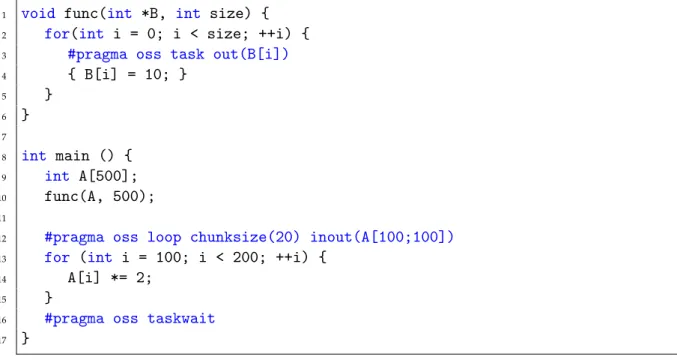
An example of the previously explained concepts can be seen in Figure 5.2. In the example, the main function creates 500 individual tasks which initialize all positions of the array A. Then, it creates an OmpSs-2 loop which updates the values from the 100th to the 199th position in chunks of 20 positions (5 chunks). Both tasks and loop declare their corresponding dependencies defining a correct execution order. Finally, a taskwait is executed in order to wait for the previous tasks before returning from the main function. Note that this code is just an example to show the basic tasking constructs.
1 void func(int *B, int size) { 2 for(int i = 0; i < size; ++i) {
3 #pragma oss task out(B[i])
4 { B[i] = 10; } 5 } 6 } 7 8 int main () { 9 int A[500]; 10 func(A, 500); 11
12 #pragma oss loop chunksize(20) inout(A[100;100])
13 for (int i = 100; i < 200; ++i) {
14 A[i] *= 2;
15 }
16 #pragma oss taskwait
17 }
Fig. 5.2: Snippet of code highlighting tasking constructs.
5.5
Dependency Model
In OmpSs-2, asynchronous parallelism is enabled by the use of data-dependencies between the different tasks of the application. Tasks usually require data in order to perform useful computation. For instance, a task could use some input data to do computation, producing new data that could be the input of other tasks.
When an OmpSs-2 program is being executed, the runtime system uses the information of data dependencies and the creation order of each task. Both information is used to produce execution-order constraints between tasks, which result in a correct execution order of the program. These execution-order constraints are called task dependencies. When a new task is created, its dependencies are matched against of those of existing tasks. If a dependency, either Read-after-Write (RaW), Write-after-Write (WaW) or Write-after-Read(WaR), is found the task becomes a successor of the corresponding existing tasks. Tasks are scheduled once all their predecessors have finished or at creation if no predecessors have been found [13].
Dependencies allow the user to indicate which data is waiting for and producing each task. Notice that the user is the responsible for correctly setting the dependencies in each task. OmpSs-2 offers four basic types of dependencies:
• A task with in(variable-list) will not be able to run until all out, inout and con-currentpredecessors are finished.
• A task with out(variable-list) will not be able to run until all in, out, inout and concurrent predecessors are finished.
• Declaring a task withinout(variable-list)is the same as declaring bothin andout dependencies.
• A task withconcurrent(variable-list) will not be able to run until all in, out and inout predecessors are finished. It is able to run concurrently with concurrent predecessors.
In addition, OmpSs-2 allows the declaration of a dependency on a memory position pointed by a pointer. Note that if the pointer is NULL, the dependency is ignored. For instance, the following example actually declares an output dependency on the a variable.
int a =
![Fig. 4.1: GASPI overview in a heterogeneous architecture [5].](https://thumb-us.123doks.com/thumbv2/123dok_us/386872.2542901/26.892.127.772.107.379/fig-gaspi-overview-heterogeneous-architecture.webp)
![Fig. 5.1: OmpSs features introduced into the OpenMP programming model [13].](https://thumb-us.123doks.com/thumbv2/123dok_us/386872.2542901/36.892.122.775.117.358/fig-ompss-features-introduced-openmp-programming-model.webp)