IST Transactions of Control Engineering‐Theory and Applications, Vol. x, No. y (z) ISSN 1913‐8784, pp. first‐last (leave this section unchanged)
Their Application to Controller Design for
Flexible Structure Systems
M.O.
Tokhi
1and
M.S.
Alam
2
1Department of Automatic Control and Systems Engineering, The University of Sheffield, UK
2Department of Applied Physics, Electronics and Communication Engineering,, The University of Dhaka, Bangladesh.
Email: [email protected], [email protected]
Abstract: Particle swarm optimisation (PSO) is one of the relatively new optimisation techniques, which has become increasingly
popular in tuning and designing controllers for different applications. A major problem is that simple PSO have a tendency to
converge to local optima, mainly, due to lack of diversity in the particles as the algorithm proceeds and improper selection of other
parameters. Maintaining diversity within a population is challenging for PSO, especially for dynamic problems. In order to increase
diversity in the search space and to improve convergence, a new variant of PSO is proposed. The increased interest from industry
and real‐world applications has led to several modifications in the conventional algorithms so as to deal with multiple conflicting
objectives and constraints. A modified multi‐objective PSO (MOPSO) proposal is made which will allow the algorithm to deal with
multi‐objective optimisation problems. The main challenge, in designing a MOPSO algorithm, is to select local and global best for
each particle so as to obtain a wide range of solutions that trade‐off among the conflicting objectives. In the proposed algorithm, a
new technique is introduced that combines external archive and non‐dominated fronts of the current population in order to select the
global best for each particle. The effectiveness of the proposed algorithm is assessed with two examples in controller design for
vibration control of flexible structure systems and satisfactory results have been obtained.
Keywords: command shaper, multi‐objective particle swarm algorithm, Pareto optimal set, twin rotor system, vibration control
1.
Introduction
In recent years, optimisation algorithms have received
increasing attention by the research community as well as the
industry to solve various complex control problems as an
alternative or complement to the conventional methods. Particle
swarm optimisation (PSO) is a relatively recent heuristic search
method whose mechanics are inspired by the swarming or
collaborative behaviour of biological populations. PSO was
invented by Kennedy and Eberhart in the mid 1990s while
attempting to simulate the choreographed, graceful motion of
swarms of birds as part of a socio‐cognitive study investigating
the notion of “collective intelligence” in biological populations [1,
2]. In PSO, a set of randomly generated solutions (initial swarm)
propagates in the design space towards the optimal solution over
a number of iterations based on large amount of information
about the design space that is assimilated and shared by all
members of the swarm. PSO is highly relevant for research and
industrial applications, because they are capable of handling
problems with multimodal characteristics, non‐linear constraints,
multiple objectives and dynamic properties that frequently
appear in real‐world problems.
A major problem is that simple PSO has a tendency to
converge to local optima. Lack of diversity in the particles
(population) is one of the most important factors that may lead
the PSO algorithm to premature convergence. Diversity is a key
element of the biological theory of natural selection and is used in
these algorithms to describe structural or behavioural variety in
the population [3]. The term diversity is often used without
definition and the implicit assumption is the diversity of
genotypes [3]. Genetic diversity helps a population adapt quickly
to changes in the environment, and it allows the population to
continue searching for productive niches, thus avoiding to get
trapped at local optima [4]. Maintaining diversity of individuals
within a population is challenging for PSO algorithms, especially
for dynamic problems. In order to increase diversity in the search
space and to improve convergence, a new variant of PSO is
proposed.
The wide range of real‐world problems poses several
challenges where multiple design objectives and constraints
which are often competing in nature are required to be satisfied
simultaneously [5]. The ideal solution for such problems is one
that optimises all conflicting criteria simultaneously, which can
never be obtained in practical applications. In recent years,
particularly after Goldberg [6] proposed the Pareto‐based fitness
assignment, a relatively new set of algorithms has emerged,
commonly known as multi‐objective evolutionary algorithms
(MOEAs) [5]. Unlike conventional algorithms, these MOEAs
provide a set of trade‐off solutions to the problem’s conflicting
objectives in a single run. PSO seems particularly suitable for
multi‐objective optimisation mainly because of the high speed of
convergence that the algorithm presents for single‐objective
optimisation [2], but until recently very few attempts have been
made to modify PSO so as to deal with multiple objectives.
Although a number of approaches have been proposed to deal
with multiple objectives using PSO, diversity in the solution set
and convergence to true Pareto front are still open areas in the
research of multi‐objective PSO (MOPSO) algorithms. A MOPSO
proposal is made, which will allow the algorithm to deal with
PSO has become increasingly popular in tuning and designing
controllers for power systems, robotics, industrial electronics,
communication networking, etc., and has been applied to a wide
range of applications [7‐13]. Although PSO algorithms have been
successfully used for different types of problems, their application
in vibration reduction of flexible structure systems is rather
limited.
This paper presents a new variant of PSO and a new MOPSO
algorithm with two controller design examples for vibration
reduction of flexible structure systems; one using the proposed
variant of PSO and another using the proposed MOPSO. A scaled
and simplified version of a practical helicopter, namely twin rotor
multi‐input multi‐output system (TRMS), is used as a flexible
structure system for control experiments [14]. The TRMS can be
perceived as an unconventional and complex “air vehicle” with a
flexible main body and is being used as an interesting ‘test rig’ for
aerodynamic modelling and control problems.
The paper is organised as follows. The basic PSO
algorithm, some of its variants and a new variant of PSO
are presented in section II. Simple formulation of multi‐
objective optimisation and a modified MOPSO algorithm
are described in section III. Section IV describes the
TRMS. Design examples and results are provided in
section V. Section VI provides conclusions of this work.
2.
Particle
swarm
optimisation
PSO was first designed to simulate birds seeking food, defined
as a “cornfield vector” [15]. PSO is a population‐based search
algorithm and is initialised with a population of random
solutions, called particles and each particle in the PSO has an
associated velocity. Particles fly through the search space with
velocities which are dynamically adjusted according to their
historical behaviours. The original PSO algorithm [15] is described
as:
gd id
id id id id x p Rand c x p rand c v v 2 1 (1) id id id x v x (2)where c1 and c2 are positive constants, rand
and
Rand are two random functions in the range [0,1],
i i id
i x x x
X 1, 2,..., represents the i‐th particle,
i i id
i p p p
P 1, 2,..., represents the best previous position (the
position giving the best fitness value) of the i‐th particle, the
symbol g represents the index of the best particle among all the
particles in the population, and Vi
vi1,vi2,...,vid
representsthe rate of the position change (velocity) for particle i. Equation
(1) describes the flying trajectory of a population of particles. It
describes how the velocity is dynamically updated and (2) gives
the position update of the “flying” particles.
An example movement of a single particle (index=i), at time
step t, is illustrated in a two‐dimensional search space in Fig. 1. At
time step t, the position, velocity, personal best and global best are
indicated as
x
i t,v
i t ,p
i t andp
g t , respectively. Fig. 1illustrates, geometrically, how the particle moves to the new
position
x
i t1, based on three components; momentum,cognitive and social.
Fig. 1. Geometric illustration of a particle’s movement in PSO
The velocity,
v
i t , which serves as a memory of the previousflight direction, can be seen as momentum, which prevents the
particle from drastically changing direction, and to bias towards
the current direction. This component is also referred to as the
inertia component. The cognitive
component,
c
1rand
p
id x
id
, quantifies theperformance of particle i relative to past performances. The social
component,
c
2
Rand
p
gd
x
id
, in the case of gbestPSO, quantifies the performance of particle i relative to a group of
particles, or neighbours. The effect of the social component is that
each particle is also drawn towards the best position found by the
particle’s neighbourhood.
In (1), if the sum of the three parts on the right side
exceeds a constant value specified by the user, then the
velocity in that dimension is assigned to be
V
max, that is,particlesʹ velocities in each dimension are clamped to a
maximum velocity
V
max, which is an importantparameter, and originally is the only parameter required
to be adjusted by users. A large
V
max leads to particleswith the potential to fly far past good solution areas while
a small
V
max leads to particles with the potential to betrapped in local optima, therefore unable to fly into better
solution areas. Usually a fixed constant value is used as
the
V
max, but a well designed dynamically changingV
maxmight improve the PSOʹs performance [16].
2.1. Topologies
The commonly used PSOs are either global version or local
version of PSO [2]. In the global version of PSO, each particle flies
through the search space with a velocity that is dynamically
adjusted according to the particle’s personal best performance
achieved so far and the best performance achieved so far by all the
particles. While in the local version of PSO, each particle’s velocity
is adjusted according to its personal best and the best performance
achieved so far within its neighbourhood. The neighbourhood of
each particle is generally defined as topologically nearest particles
to the particle on each side. Kennedy and Mendes tested PSOs Momentum t g
p
Cognitive component
t1 iv
t i p
t iv
t ix
t1 ix
Social componentwith regular shaped neighbourhoods, such as global version,
local version, pyramid structure, star structure, “small” structure,
von Neumann, and PSOs with randomly generated
neighbourhoods [17]. It has been suggested that the global version
of PSO converges fast, but with the potential to converge to the
local optimum, while the local version of PSO might have more
chances to find better solutions slowly [2].
2.2. Some Variants of PSO
The first new parameter added into the original PSO algorithm
is the inertia weight [18]. The dynamic equation of PSO with
inertia weight is modified as:
gd id
id id id id x p Rand c x p rand c v v 2 1
(3) id id id x v x (4)Equation (3) is the same as (1) except for a new inertia weight,
,parameter. The inertia weight is introduced to balance between
the global and local search abilities. A large inertia weight
facilitates global search while a small inertia weight facilitates local
search. The introduction of the inertia weight also eliminates the
requirement of carefully setting the maximum velocity Vmax. The max
V can be simply set to the value of the dynamic range of each
variable and the PSO algorithm will still perform well. Shi and
Eberhart first introduced a linearly decreasing inertia weight to
the PSO over the course of PSO [18], then they further designed
fuzzy systems to nonlinearly change the inertia weight [19].
Ratnaweera et al. introduced time‐varying acceleration
coefficients (TVAC) in addition to the time‐varying inertia weight
factor in PSO to improve its performance after a predefined
number of generations [20]. The mathematical representations of
, c1 and c2 for this modified PSO are given as:
c c
iter MAXITER c c MAXITER iter c c c c MAXITER iter MAXITER i f i i f i 2 2 2 2 1 1 1 1 2 1 2
(5)where
1 and
2 are the initial and final values of the inertiaweight, respectively,
c
1i,
c
1f,
c
2i andc
2f are constants, iter isthe current iteration number and MAXITER is the maximum
number of allowable iterations.
2.3. Proposed variant of PSO
The proposed algorithm is a global version of PSO with time
varying inertia coefficient and variable acceleration coefficient
based on fitness sharing method. The algorithm works as a
conventional gbest version of PSO with time varying inertia
coefficient,
, and constant acceleration coefficients c1 and c2.After a certain number of generations, shared fitness of each
solution is calculated. The method of fitness sharing is probably
the best known and also used among niching techniques [5].
Fitness sharing modifies the search landscape by reducing the
payoff in densely populated regions. Fitness sharing lowers the
fitness of each element of the population by an amount nearly
equal to the number of similar individuals in the population.
Typically, the shared fitness fi of an individual i with fitness i f is simply [5] i i i f m f (6)
where mi is the niche count which measures the approximate
number of individuals with whom the fitness fi is shared.
Further details on fitness sharing method and calculation method
may be found in [5]. The first and second acceleration coefficients
of
k
th
element of particlei
,c
1ik andc
2ik, are calculated as:
c
f
x
rand
c
1ik 1 i (7)
c
f
x
Rand
c
2ik 2 i (8)where
c
1 andc
2 are constant acceleration coefficients,f
x
i isthe shared fitness of particle
x
i andrand
andRand
aretwo random functions in the range [0,1]. In a
d
dimensionalproblem. The first acceleration coefficient of each element for
particle
i
can be calculated using (7) with k1,2,..,d . The firstacceleration coefficient vector
c
1i, for particlei
, can berepresented as:
i i id
i
c
c
c
c
1
11,
12,...,
1 (9)In the same way, The second acceleration coefficient vector
c
2i,for particle
i
, can be represented as:
i i id
i
c
c
c
c
2
21,
22,...,
2 (10)For a swarm of
N
particles (population =N
), the first andsecond acceleration vectors
c
1i andc
2i are calculated in a similarway, where
i
1
,
2
,...,
N
. The introduction of random functionsin the above equations is two fold; first, to limit the value of each
element of acceleration coefficient vectors
c
1i andc
2i so as torestrict abrupt exploration. Second, to add randomness to the
elements of coefficient vectors
c
1i andc
2i so as to allow theparticles explore new areas in the search space. Velocities of
particles are updated using the conventional expression, but with
the newly calculated acceleration coefficients, as:
gd id
i id id i id id x p Rand c x p rand c v v 2 1
(11)This process is repeated after every predefined number
of generations, say
GEN
rep. The global best solution,gbest, is always preserved and passed to the next
generation for usual computations. Thus, this algorithm,
works as an elitist evolutionary optimisation process.
Since the acceleration coefficients are different for each
element of each particle, this method can add huge
diversity in the swarm, which, in turn, allows the
particles to explore more in the optimisation process.
reduced and the particles can converge to global solution
with higher probability. The main steps of the proposed
variant of PSO are as follows:
1) Initialise population,
X
, velocity of particles,V
;For
i
1
to
N
;N
= number of particlesInitialise X
i , V
i ; within a range of
X
min,
X
max
and
V
min,
V
max
respectively. InitialiseGEN
rep2) Set acceleration constants
c
1
c
2
1
.
5
;3) Set the limiting value of inertia coefficient,
, as4
.
1
max
and
min
0
.
1
;
is decreased withgeneration within these limiting values.
4) Evaluate each of the particles in X
i5) Initialise the memory of particles, P
iFor i
1
to
N; P
i = X
i6) Identify the particle in the neighbourhood with the
best success so far, and assign its index to the variable
g
.7) Set maximum generation,MAXITER, and initialise
generation counter, iter
1
8) WHILE
iter
MAXITER
DOa) Set acceleration constants c1
c2
1
.
5
;b) Calculate the inertia coefficient,
, using equation(6)
c) Calculate velocity of the particles using equation (3)
d) Limit the velocity of particles,V
i , within thepredefined range
Vmin,
Vmax
.e) Calculate the new positions using equation (4)
f) Limit the positions of,X
i , within the predefinedrange
Xmin,
Xmax
so that the particles remainwithin the valid search space.
g) Evaluate each particle in X
ih) Compare particleʹs fitness evaluation with its pbest.
If the current value is better than pbest, then set
pbest equal to the current value, and
P
i to thecurrent location Xi in the D‐dimensional space.
i) Identify the particle in the neighbourhood with the
best success so far and update
P
g.j) IF
iterMODGENrep
0
DO(i) Calculate the shared fitness of each particle [5]
(ii) Save the
P
g solution, found so far in order tofollow an elitist strategy.
(iii) Calculate the acceleration coefficients c1i and i
c2 for each particle according to equations (7) ‐
(10).
(iv) Update velocities of particles V
i according toequation (11)
(v) Limit the velocity of particles,V
i , within thepredefined range
Vmin,
Vmax
.(vi) Calculate the new positions using equation (4)
END
k) Increment the loop counter,
iter
END
3.
Multi
‐
objective
optimisation
Multi‐objective optimisation is the search for feasible solutions
to problems comprising multiple objectives, which are often in
conflict with one other. It can be defined as the problem of finding
a vector of decision variables which satisfies constraints and
optimises a vector function whose elements represent the
objective functions. The multi‐objective optimisation problem can
be expressed as:
Find the vector x
[
x1,
x2,...,
xn]
, which satisfies the minequality constraints: gi
(
x)
0
;i
1
,
2
,...,
m
, the kequality constraints hi
(
x)
0
; i1,2,...,k, andoptimises the vector function )] ( ),..., ( ), ( [ ) (x f1 x f2 x f x
f n , where n is the number of
objectives to be considered, x[x1,x2,...,xn] is the vector
of decision variables, p is the number of decision
variables that comprise the complete solution. Practical
problems are often characterized by several competing
objectives. The multi‐objective optimisation problem is,
without loss of generality, the problem of simultaneously
minimizing the
n
components fk,k1,...,n, of apossibly nonlinear vector function f of a general
decision variable
x
in a universe U where )) ( ),..., ( ( ) (x f1 x f xf n . The problem usually has no
unique, perfect solution, but a set of non‐dominated
solutions, known as the Pareto‐optimal set [5].
Assuming a minimisation problem, dominance is defined as
follows:
Definition‐1 (Pareto dominance): A given vector )
,...,
(u1 un
u is said to dominate v(v1,....,vn) if and only
if
u
is partially less thanv
(upv), i.e., i{1,...,n},} ,..., 1 { n i v ui i , uivi
Definition‐2 (Pareto optimality): A solution uU is said to
be Pareto‐optimal if and only if there is no vU for which ) ,..., ( ) ( v v1 vn f v dominates u f(u)(u1,...,un).
Pareto‐optimal solutions are also called efficient, non‐
dominated, and non‐inferior solutions. The corresponding
objective vectors are simply called non‐dominated. The set of all
non‐dominated vectors is known as the non‐dominated set, or the
trade off surface, of the problem. In the general case, it is
impossible to find an analytical expression of the line or the
surface that contains these points. The normal procedure to
generate the Pareto front is to compute the feasible points and
their corresponding points f(). When there are sufficient
number of these, it is then possible to determine the non‐
dominated points and to produce the Pareto front.
3.1. Multi‐objective PSO
The basic PSO algorithm and its variants deal with only one
needed in the operation of a single objective PSO. The solution of
any multi‐objective optimisation is not a single solution, rather a
wide range of non‐dominated solutions, commonly known as
Pareto optimal set. So, a single objective PSO formulation, such as
(1), cannot be used in its original form for multi‐objective
optimisation problems. The reason is that the fitness of any
particle in a multi‐objective optimisation problem can no longer
be related or expressed in terms of a single objective because an
optimal performance in one objective domain may result
unacceptably low performance in one or more of the remaining
objectives. Most of the algorithms usually vary in the manner
pbest and gbest are selected in a multi‐objective domain. A brief
review of different multi‐objective PSO algorithms can be found
in [21], where an approach that adopts a Pareto‐based selection
scheme combined with an adaptive grid (similar to Pareto
archived evolution strategy [22]) has been presented. The
adaptive grid is adopted both to store the non‐dominated
solutions found during the search and to distribute them
uniformly along the Pareto front. It also uses a mutation operator
that acts both on the particles of the swarm, and on the range of
each design variable of the problem to be solved. Toscano and
Coello adopted clustering techniques in order to divide the
population of particles into several swarms in order to have a
better distribution of solutions in the decision variable space [23].
3.2. Description of the Proposed Approach
The main challenge, in designing a MOPSO algorithm, is to
select pbest and gbest for each particle so as to obtain a wide
range of solutions that trade‐off among the conflicting objectives.
The selection methods of gbest and pbest for each particle are
discussed in this section.
a) Selection Method of gbest: In [21], gbest for each particle is
selected from an external archive that contains non‐dominated
solutions. The archive is controlled by an adaptive grid
mechanism and gbest for each particle is selected based on fitness
sharing and roulette wheel selection method. In the proposed
algorithm, a new technique is introduced that combines external
archive and non‐dominated fronts of the current population in
order to select gbest for each particle. An external archive and
associated control mechanism, as used in [21], is also employed
here, which will be discussed later. Fig. 2 shows the state of the
external archive and solutions of the current particles in the
objective domain for a two‐objective optimisation problem. The
dark circles inside a 2D grid structure indicate the non‐dominated
solutions found so far in the optimisation process while circles on
the right represent solutions of current particles in a 2D objective
domain and the number associated with them indicates index of
the particles in the initial population. The current solutions are
sorted based on Pareto dominance and several non‐dominated
(ND) fronts are formed as shown in Fig. 3. For example, solutions
of particles: 5, 10, 9, 14 and 13 form ND front‐1. If these solutions
are removed from the objective domain, then particles: 7, 1, 12 and
2 form the next non‐dominated front, which is represented as ND
front‐2. In a similar manner, other ND fronts are formed for the
remaining solutions/particles. It is noted that a single particle may
form one ND front as it happens in case of ND front‐3 (particle‐
11) and ND front‐5 (particle‐4). Once all the ND fronts are formed
the selection procedure of gbest for each particle can effectively
begin.
For each particle on ND front‐1, the corresponding gbest is
selected from the external archive based on fitness sharing and
roulette wheel selection method (see Fig. 3). This method can be
elaborated in the following way: The external archive is divided
into grid like structures. For a two‐objective optimisation problem,
a single may be called a hyperparallelpid. Each hyperparallelpid
is assigned fitness equal to the result of dividing any number (20
in the following experiments) by the number of particles that they
contain. This aims to decrease the fitness of those
hyperparallelpids that contain more particles and it can be seen as
a form of fitness sharing [24]. Based on these fitness values, then a
hypercube is selected by roulette‐wheel selection method [6]. If
the selected hyperparallelpid contains more than one particle,
then a particle is selected randomly. If the hypercube contains
only one particle, then it is selected automatically. For particles on
the remaining fronts, i.e., ND front‐2, 3, 4 and 5: gbest of each
particle is selected in the following way:
Fig. 2. External archive and solutions of current particles in a 2D
objective domain
Fig. 3. Schematic diagram for finding gbest guide for particles in
the MOPSO
At first, shared fitness of each particle in the current population
is calculated based on the exact non‐dominated sorting GA
(NSGA) fitness assignment scheme, which was adopted in [25. In
this scheme, fitness is assigned according to non‐dominated sets
13 5 10 9 14 2 12 1 7 11 6 8 3 4 Objective-2 Objective-2 ND front-1 ND front-2 ND front-3 ND front-4 Archive of
non-dominated solutions Solutions of current particles ND front-5 Objective-1 Objective-1 2 12 4 8 6 3 1 11 7 5 10 9 14 13 Archive of
non-dominated solutions Solutions of current particles Objective-1 Objective-1
Objective-2
and better non‐dominated sets are emphasised. Moreover,
performing sharing in the solution space allows maintaining
phenotypically diversity among the particles [5]. Then, for each
particle on ND fron‐2, corresponding gbest is selected from
particles lying on the immediate lower front (better solutions), i.e.,
ND front‐1, based on shared fitness and roulette wheel selection
method (see Fig. 3). Widely spaced solutions on any ND front
usually have higher shared fitness values compared to crowded
ones and have higher probability to be selected as gbests for
particles lying on immediate higher ND front. This process
continues for particles residing on the remaining ND fronts. If
there is only one particle on any ND front, for example, ND front‐
3 (particle 11), then this is selected as gbest for particles lying on
the immediate higher front, for example, ND front‐4 (particles 8, 6
and 3).
The external archive keeps non‐dominated solutions found
through the optimisation process. The number of solutions that
this archive can contain is limited. In order to maintain diversity
within limited number of solutions and not to leave out any better
solutions generated through the optimisation process, an
adaptive grid mechanism and an archive controller are utilised.
b) Selection Method of pbest: Local guide or pbest for each
particle is selected based on Pareto‐dominance in this case.
Assume that, at generation t a particle
X
ti with objectivefunction vector
k
it
X
f
1,
2,...,
, where k is the numberof objectives to be optimised, has local guide, i i t p pbest . At
generation t1, the particle and corresponding objective
function vector are Xti1 and
k
it X
f 1
1,
2,...,
,respectively. If the solution at generation t1 totally dominates
the solution previously obtained at generation t, i.e.
j
j (forminimisation problem) where j1,2,...,k then pbestti1 is
updated with
X
ti1, otherwise it remains the same. This can beshown as:
1 1 ifotherwise 1 i i t i t i t i t Xp f X f X pbest (12)Here, the symbol ‘
’ indicates dominance.c) The Archive Controller: The external archive keeps non‐
dominated solutions, found through the optimisation process
and, at any stage, and these are usually considered as the output.
The number of solutions that this archive can contain is limited. In
order to maintain diversity within limited number of solutions
and not to leave out any better solutions generated, an adaptive
grid mechanism [26] and an archive controller are utilised. The
function of the archive controller is to decide whether a certain
solution should be added to the archive or not. In order to
produce well‐distributed non‐dominated solution set, an
adaptive grid mechanism is utilised as used in [21].
d) Steps of the proposed MOPSO algorithm
1) Initialise population, X, speed of particles, V ;
For i1 to N; N= number of particles
Initialise X
i and V
i within the ranges
Xmin,Xmax
and
V
min,
V
max
respectively.2) Set acceleration constants c1c2 1.5;
3) Set the limiting value of inertia coefficient,
, as 4. 1 max
and
min 0.1.
is decreased with generation within these limitingvalues.
4) Evaluate each of the particles in X
i5) Store the nondominated solutions in the external
archive
6) Initialise the memory of particles (local guides),
i pbest For i1 to Npbest
i
= X
i7) Calculate the global guide,
gbest
i
, for each particleusing external archive and nondominated fronts of the
current population.
8) Set maximum generation,MAXITER, and initialise
generation counter,
iter
1
9) WHILE
iterMAXITER
DOa) Calculate the speed of the particles, V
i , usingequation (3) where the inertia coefficient,
,decreases with increasing generation and is
calculated as:
MAXITERiter
MAXITER min max min
(13)
b) Limit the speed of particles,V
i , within thepredefined range
Vmin,Vmax
.c) Calculate the new positions of the particles adding
speed, V
i , with previous positions as:
i X
i ViX (14)
d) Limit the positions of aprticles, X
i , within thepredefined range
Xmin,Xmax
so that the particlesremain within the valid search space.
e) Evaluate each particle in X
if) Update the external archive and invoke the
adaptive grid controller, if necessary.
g) Calculate the global guide,gbest
i , for eachparticle using external archive and nondominated
fronts of the current population.
h) Update or calculate the local guide,pbest
i , of eachparticle based on the dominance principle.
i) Increment the loop counter,
iter
END
e) Constraints Handling: A relatively simple method is applied
to handle constraints. If an objective of a particle falls outside the
acceptable pre‐set range, then that solution is penalised by adding
a very big number to the objective value. Thus, the probability of
this solution to be selected as local guide in the following
the probability of acceptable solutions to be selected as local
guides and as a result, can guide the optimisation process
towards feasible solution region.
4.
The
Flexible
Structure
System
The TRMS consists of a beam pivoted on its base in such a way
that it can rotate freely in both its horizontal and vertical planes
producing two rotating movements around yaw and pitch axes,
respectively. Although the dynamics of the TRMS are simpler
than those of a real helicopter, they retain the most important
helicopter features such as couplings and strong nonlinearities.
Due to size, cost, ease of operation and interfacing facilities with
personal computer, the TRMS has attracted many researchers and
is being used as a ‘test rig’ for aerodynamic control problems. The
experimental TRMS is shown in Fig. 4.
Fig. 4. The twin rotor MIMO system
At both ends of a beam, joined to its base with an articulation,
there are two propellers driven by DC motors. The articulated
joint allows the beam to rotate in such a way that its ends move
on spherical surfaces. There is a counter‐weight fixed to the beam
and it determines a stable equilibrium position. The system is
balanced in such a way that when the motors are switched off the
main rotor end of the beam is lowered. Although, the TRMS does
not fly, in certain aspects its behaviour resembles that of a
helicopter. For example, like a helicopter there is a strong cross
coupling between the main rotor and the tail rotor. In a typical
helicopter, the aerodynamic force is controlled by changing the
angle of attack of the blades. However, in the TRMS the angle of
attack of the blades is fixed and the aerodynamic force is
controlled by varying the speed of the motors. Therefore, the
control inputs are the supply voltages of the DC motors. A change
in the voltage value results in a change in the rotational speed of
the propeller, which in turn results in a change in the
corresponding position of the beam. The system is interfaced with
a personal computer through a data acquisition board, PCL‐
812PG. The measured signals are: angular positions of the beam
in the horizontal and vertical planes and angular velocities of the
rotors. Angular velocities of the beam are obtained through
software by differentiating and filtering the measured position
angles of the beam.
5.
Controller
Design
The flexible motion of the TRMS, due to asymmetrical mass
distribution in the system, causes structural vibration while in
operation. Moreover, when the rotors move the rig structure
undergoes deflection in the horizontal or vertical or both
directions, due to aerodynamic forces, and as a result it may prove
difficult to track a desired trajectory. Furthermore, once the
system has reached a set point, the residual vibration will degrade
the positioning accuracy and may cause a delay in system
response. As far as vibration control of the system is concerned,
the vertical channel (motion in the vertical plane) poses more
challenges compared to horizontal channel due to higher physical
diameter of the main rotor and higher aerodynamic force.
Operation of the TRMS in the vertical plane resembles the
behaviour of a practical helicopter in the hovering mode, which is
vital for a variety of flight missions such as load delivery, air‐sea
rescue etc. Accordingly, this mode of operation of the TRMS is
considered in this paper. A 4th order continuous transfer function,
sH , characterising the vertical movement of the TRMS was
extracted offline [27] and utilised in this work. This is given as:
2189 95 . 35 6 . 519 469 . 3 1 . 595 57 . 45 249 . 2 08927 . 0 ) ( ) ( 2 3 4 2 3 s s s s s s s s u s y s H (15)A number of techniques have previously been proposed to
effectively control flexible structure systems. A feedforward
control scheme based on input command shaping, introduced in
[28], has created considerable interest among the researchers.
Since its introduction, the method has been applied to the control
of different types of flexible systems for vibration reduction or
trajectory tracking or occasionally both. The command shaping
method involves convolving a desired command with a sequence
of impulses. However, designing an effective command shaper
requires a priori knowledge of the system, such as resonance
frequencies and corresponding damping ratios. The command
shaping technique has widely been employed in aircraft [29] and
helicopter control [30]. Singh and Vadali presented a method to
minimise residual vibration of structures or lightly damped
servomechanisms using multiple time delays in conjunction with
a proportional part [31]. In another work the authors presented a
design procedure of open‐loop controllers to reduce residual
vibration in flexible structures using multiple step inputs delayed
in time [32]. The controller attenuated the residual vibration by
cancelling the complex poles of the system and robustness was
achieved by locating additional zeros at the cancelled poles of the
system. Moreover, a design method for minimum time‐delay
controller was also proposed where, step input magnitude values
were constrained within 0 and 1 [32].
5.1. Command Shaping Using Gain and Delay Units
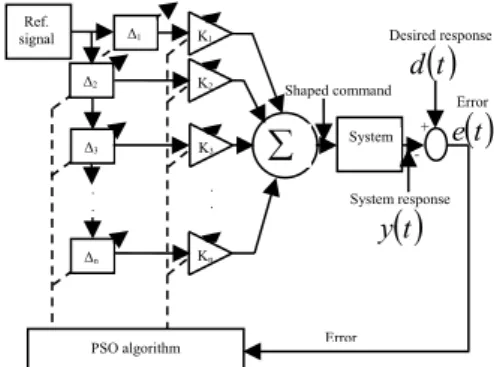
A command shaping method is proposed using gain and
diagram of the command shaping method is shown in Fig. 5. The
unshaped reference signal is passed through multiple delay
units,i, and then multiplied with gain factors, Ki. The shaped
command is formed by summing up the delayed and weighted
components. The effectiveness of the proposed method depends
on a suitable selection of number of delay and gain elements and
their corresponding values. For reasons of simplicity, the number
of delay units and gain elements are kept the same. Assume that
the number of gain elements and delay units are each represented
by
n
. In order to achieve the same level in the system’s responsewith the shaped command as with the unshaped reference, the
gain values are selected in such a way that their sum is equal to
unity [28, 34], i.e.
n i i K 1 1 (16)In order to minimise the delay in system’s response, the first
delay unit is set to zero, i.e.,10. The values of the remaining
delay units, 2,3,...n and all gain values, K1,K2,...,Kn may
be derived analytically, as in a conventional command shaper [28,
34].
Fig. 5. PSO‐based command shaping scheme using gain and
delay elements
Assuming that, no a priori information is available about the
natural frequencies and associated damping ratios of the system,
the proposed PSO algorithms are used to optimise the values of
the gain and delay units so as to reduce vibration of the system.
The error signal is calculated as: e
t d t yt ; where d
t ,is the desired response and y
t is the system actual response.An objective function is formed using the error signal, as:
x f
e
tf . This section presents two design examples, one
with the proposed PSO and one with the MOPSO to demonstrate
their effectiveness in designing controllers for flexible systems.
5.2. Design Example‐1: Design of Command Shaping using PSO
The control strategy was implemented in Simulink [35]
environment as shown in Fig. 6. The PSO process was encoded in
Matlab .m files [36]. An interface was created so that the gain and
delay values were calculated with PSO and passed to the
Simulink environment and, after completion of the simulation,
the system response was recorded and again passed to the PSO
for further computation, and the process was repeated based on
the initial population and total generation of the optimisation
process. For n3, the number of gain elements is 3 and number
of delay units is effectively 2, since the first delay unit is set to zero.
The three gain units are termed as Gain 1, Gain 2 and Gain 3 and
the corresponding values are indicated as K1, K2 and K3. The
two delay units, associated with Gain 2 and Gain 3, are indicated
as Delay 1 and Delay 2, respectively. The value of
n
was selectedintuitively to keep resemblance with the number of impulses in a
zero vibration derivative (ZVD) [34] type command shaper. The
transfer function, as indicated in equation (15), is used in the
Simulink model to characterise the vertical movement of the
TRMS.
For an evolutionary based design procedure, the searching
capability of the algorithm is directly affected by the objective
function. Moreover the design objective can only be achieved
upon suitable selection of the objective function of the
optimisation process. In the optimisation process, mean squared
error (MSE) was used as the objective function. The main aim of
the optimisation process is to reduce vibration in the vertical plane
while the TRMS is in operation. In this example, feedforward
control strategy is chosen where command shaping can be
considered as the only controller. In such a case, the desired
response of the system, d
t , is set to zero in order to achievezero vibration while the system is in operation. So the system
response, y
t , is in fact considered as the error signal, e
t ,which in turn is used to formulate the objective function, MSE, in
the PSO optimisation process.
Fig. 6. Simulink model of command shaping using gain and
delay units
a) Parameter Encoding: The PSO algorithm begins with a
population of real numbers, called swarm. Each row represents a
solution set, called particle. A swarm of ten particles with five
elements each, i.e., 10 × 5 is created randomly within the range of
[0, +1]. The first three elements of each individual are normalised
and assigned to K1, K2 and K3. In Matlab/Simulink [35, 36],
the delay units are usually represented in terms of number of
samples, which is an integer value. Thus, the remaining two
elements of each individual are converted into integer numbers
with a conversion factor of 0.01 followed by rounding operation
and then assigned to Delay 1 and Delay 2 as indicated above. In
the proposed PSO algorithm, the acceleration coefficients c1 and 2
c were initially set to 1.5 whereas the inertia coefficient,
, wasgradually decreased from 1.4 to 0.1 with generation. The
acceleration coefficients, c1 and c2, of each element of each
particle are adjusted after every
GEN
rep generations based on theError
t e System response
t y Shaped command + -· · Ref. signal Δ1 Δ2 Δ3 Δn Kn · ·
System K3 K2 K1PSO algorithm Error
Desired response
t dshared fitness values of the particles. The value of
GEN
rep wasset as 10 in this case. The process was run for a maximum
generation of 200. The algorithm was run for a maximum
number of 200 generations and the values of gain and delay units
of Simulink model (see Fig. 6) thus obtained with different values
of
s are presented in Table 1. Note that delay is calculated interms of number of samples.
Table 1. Values of gain and delay units* with different niche radii
for PSO Niche radius (s) 1 K K2 K3 1 2 3 0.1 0.378 0.372 0.249 0 90 190 0.5 0.264 0.472 0.263 0 80 160 0.9 0.287 0.347 0.364 0 100 190
Time‐domain performance measures of system response with
shaped commands derived with different niche radii are shown
in Table 2. The output response varies with the niche radius. The
output response due to shaped command obtained at
s 0.5produced better results compared to that with other values in
terms of overshoot and settling time although there was a little
increase in rise time. Among all these, the output response due to
shaped command obtained with
s= 0.5 seemed to be better asfar as overall performance measures were concerned; zero
overshoot with satisfactory rise time, settling time and steady‐
state error.
Table 2. Performance measures of output response due to shaped
commands designed with different niche radii
Niche radius (s) Overshoot (%) Rise time (sec) Settling time (sec) Steady‐ state error 0.1 4.445 1.5 18.7 0 0.5 1.53 1.6 2.0 0 0.9 3.489 1.5 13.6 0
The convergence of the algorithm is shown in Fig. 7. The
objective function of the best solution seems to either decrease or
remain unchanged with generation due to the elitist property of
the algorithm.
Fig. 7. Convergence of the proposed variant of PSO
The ‘mean objective function’ of the population decreases as
the algorithm proceeds, although small peaks appear that
decrease with increasing generations. The occurrence of these
peaks is attributed to the change in acceleration coefficients as
discussed earlier. This change in acceleration coefficients after
every 10 generations adds more diversity in the population which
may extend the searching space in the optimisation process. The
extra diversity in the swarm due to changes in c1 and c2 may
lead to better solution.
b) Results: The proposed variant of PSO was used to find the
optimum values of gain and delay units. The algorithm was run
for 200 generations and the gain values obtained are: 264
. 0 1
K , K20.472, K30.263 and delay units are: 80
2
and 3 160 (1 is set to zero). Here the delay units
are represented in terms of number of samples. These values
were obtained using MSE as objective function with
s0.5.When the reference signal (bang‐bang) is passed through the gain
and delay units and then added by a summation unit, the shaped
signal is formed. Both the bang‐bang input and its corresponding
shaped signal due to the above gain and delay values are shown
in Fig. 8. For clarity, the leading edge is enlarged in Fig. 8, which
also resembles a ZVD‐based shaped signal.
Fig. 8. Bang‐bang input and shaped command input (time‐
domain)
The time‐domain responses of the vertical channel due to
bang‐bang input and shaped input are shown in Fig. 9. In order to
highlight the differences in rise times, the leading edges of time‐
domain responses of the vertical channel due to bang‐bang input
and shaped input are enlarged and shown in Fig. 10. It is noted
that, speed of response of the vertical channel due to shaped
command is slower compared to that due to bang‐bang input. It
is observed that oscillation of the system was completely
eliminated with shaped command and the system settled quickly
to the steady‐state. Thus, the shaped command could improve
several time domain performance measures, such as, overshoot
and settling time with a slight decrease in system’s response. The
frequency‐domain representation of the bang‐bang input and the
shaped command are shown in Fig. 11 and the corresponding
system responses are shown in Fig. 12. As noted, several troughs
occur in the frequency‐domain representation indicating a
decrease in energy level at those frequencies. Most importantly,
the first trough occurs exactly at 0.7 Hz, where the main resonance
at dominant mode to a large extent which in turn reduces the
system vibration significantly (see Fig. 12). At the dominant mode
(0.7 Hz) of the system, approximately 20dB attenuation was
recorded with shaped command as the input relative to the
response due to bang‐bang input.
Fig. 9. Response of vertical channel due to bang‐bang signal and
shaped command
Fig. 10. Leading edges of time domain responses due to bang‐
bang signal and shaped command
Fig. 11. Bang‐bang input and shaped command input (frequency‐
domain)
5.3. Design Example‐2: Design of Command Shaping using
MOPSO
For the TRMS, the command shaping technique, as designed
with a single‐objective PSO causes a long delay in system’s
response while it reduces vibration (see Fig. 10.). For a flexible
structure system, design objectives such as, the speed of system’s
response and amount of vibration reduction are usually in conflict
due to its construction and mode of operation. In practical design
problems, a certain allowable range is specified for each objective
and theoretical design method or a single‐objective optimisation
process can hardly provide a solution satisfying both conflicting
objectives simultaneously. The single‐objective based design
method can hardly provide good solutions where several (often
conflicting) design objectives are to be met. In this section, taking
the amount of vibration reduction and rise time as two competing
objectives, the proposed MOPSO is used to design gain‐delay
units based command shaper for the TRMS.
Fig. 12. Response of vertical channel due to bang‐bang signal and
shaped command
a) Implementation and MOPSO Solutions: Root mean squared of
error (RMSE) can be taken as a quantitative measure of overall
vibration of the system in the time domain. Rise time of the
system and RMSE are chosen as two objectives in the MOPSO
process. The solution of MOPSO is not a single point, rather a set
of solutions that trade off between these two conflicting objectives.
For open loop response with a bang‐bang input signal, the rise‐
time and RMSE were recorded as 0.3 sec and 0.3241 respectively.
The goal values of the design were chosen as less than or equal to
0.3 for RMSE (objvective‐1) and less than or equal to 1.0 sec for
rise‐time (objective‐2). The two objectives and the corresponding
goal values are shown in Table 3.
Table 3. Two objectives and goal values
Objective Parameter Goal value
Objective‐1 RMSE ≤ 0.3
Objective‐2 Rise‐time ≤ 1 sec
The control strategy was implemented in the Simulink [35]
environment as shown in Fig. 6 and the MOPSO process was
encoded in Matlab .m files [36]. The MOPSO algorithm begins
with a population of real numbers called swarm. Each row
represents a solution set called particle. A swarm of 20 particles
with five elements each, i.e., 20 × 5 is created randomly within the
range [0, +1]. The first 3 elements of each individual are
normalized and assigned to gain elements, to K1, K2 and K3
Matlab/Simulink, the delay units are usually represented in terms
of number of samples which are integer numbers. Thus, the
remaining 2 elements of the each individual are converted into
integer numbers by a conversion factor of 0.01 using a ‘round’
operation and then assigned to 2 and 3 of the Simulink
model.
The acceleration coefficients were set as,c1c21.5, and
inertia coefficient,
, was gradually decreased from 1.4 to 0.1with generation. The process was run for a maximum generation
of 500. The maximum number of solutions that the external
archive can keep is limited to 50. In order to maintain diversity
among the solutions in the external archive, an adaptive grid
mechanism was employed. For a two‐objective optimisation
problem, the objective domain was divided into 49 (7×7) regions,
called hyperparallelpids, as shown in Fig. 3. The MOPSO
algorithm with a population size of 20 individuals was run
separately on this problem 6 times, each time for 500 generations.
The number of non‐dominated solutions thus obtained with the
algorithm at different runs is shown in Fig. 13. 0 2 4 6 8 10 12 14
run-1 run2 run-3 run-4 run-5 run-6
N o . of nondom in at ed s o lu ti ons
Fig. 13. Numbers of non‐dominated solutions for proposed
MOPSO algorithm at different runs
Out of a total of 10000 points evaluated in each run, an average
of only 10 were found to be non‐dominated relative to each other.
In order to assess the performance of the MOPSO algorithm in
this problem, the Pareto optimal set, obtained at run‐6, as shown
in Fig. 14 is considered. In this plot, objective‐1 is represented on
the horizontal axis and objective‐2 on the vertical axis. The
number of non‐dominated solutions is 11 and 9 out of 11
solutions remain within the range allowable for both objectives.
Fig. 14. Pareto optimal set for MOPSO at run‐6
b) Results: To validate the design approach as well as solution
sets, one example solution is selected on the Pareto front as shown
in Fig. 14. The example solution‐1 was chosen in such a way that
the solution could yield satisfactory performance along both
objective domains. If any particular objective is given priority in
decision making, the designer can pick a solution from the non‐
dominated solution sets that satisfies the desired goal value along
that objective domain. Two objective values for this solution are
recorded as; RMSE = 0.3 and rise‐time = 0.4 sec. Here the RMSE is
lower than that of open loop response with bang‐bang input
whereas the rise‐time is slightly higher than that. Unshaped bang‐
bang input and shaped signal based on this example solution are
shown in Fig. 15, where for clarity, the leading edge has been
enlarged. The response of the vertical channel for unshaped bang‐
bang and shaped signal based on the example solution is
presented in Fig. 16. A large oscillation is observed in the system
response in the vertical channel with bang‐bang signal used as the
input and the system takes long time to settle to a steady position.
It is observed that oscillation of the system is significantly reduced
with shaped command and the system settles quickly to the
steady‐state. Thus, the shaped command could improve several
time‐domain performance measures, such as, overshoot and
settling‐time with a slight decrease in system’s response.
Fig. 15. Bang‐bang input and shaped command input (time‐
domain)
Fig. 16. Response of vertical channel due to bang‐bang signal and
shaped command
Although the reduction of oscillation in system’s response is
directly related to the reduction of vibration, frequency‐domain
modes of the system and corresponding reduction at those
modes. The frequency‐domain representation of the bang‐bang
input and the shaped command is shown in Fig. 17 and the
corresponding system response is shown in Fig. 18.
It is observed from the system’s response due to bang‐bang
signal that the system has only one dominant mode (peak in the
frequency‐domain representation) which appears at 0.7 Hz. For
bang‐bang input, the total energy seems to be evenly distributed
throughout the band although it is higher near the DC level. On
the contrary, several troughs occur in the frequency domain
representation of