WIRELESS SENSOR NETWORK
By
Huma Javed
A thesis submitted in partial fulfilment of the requirements of the
Liverpool John Moores University
for the degree of Doctor of Philosophy
Supervised by
Prof. Madjid Merabti and Dr. Bob Askwith
School of Computing and Mathematical Sciences
Liverpool John Moores University
Advances in wireless and Micro-Electro-Mechanical Systems (MEMS) technology has given birth to a new technology field sensor networks. These new technologies along with pervasive computing have made the dream of a smart environment come true. Sensors being small and capable of sensing, processing and communicating data has opened a whole new era of applications from medicine to military and from indoors to outdoors. Sensor networks although exciting have very limited resources, for example, memory, processing power and bandwidth, with energy being the most precious resource as they are battery operated. However, these amazing devices can collaborate in order to perform a task. Due to these limitations and specific characteristics being application specific and heterogeneous there is a need to devise techniques and software which would utilize the meager resources efficiently keeping in view the unique characteristics of this network.
This thesis presents a lightweight, flexible and energy-efficient middleware framework called MidWSeN which combines aspects of queries, events and context of WSN in a single system. It provides a combination of core and optional services which could be adjusted according to the resources available and specific requirements of the application. The availability of multiple copies of services distributed across the network helps in making the system robust. This middleware framework introduces a new Persistent Storage Service which saves data within the sensor network on the nodes for lifetime of the network to provide historical data. A Priority algorithm is being also presented in this thesis to ensure that enough memory is always available. A novel context enhanced aggregation has also been presented in this thesis which aggregates data with respect to context. Application management service (AMS) provides Service optimization within the network is another novel aspect of the proposed framework. To evaluate the functionality of the work presented, different parts of the framework have also been implemented. The tests and results are detailed to prove the ideas presented in the framework. The work has also been evaluated against a set of requirements and compared against existing works to indicate the novel aspects of framework. Finally some ideas are presented for the future works.
I am really thankful to Allah the most gracious and most merciful. I would like to express my deep felt gratitude to both my supervisors Prof. Madjid Merabti and Dr. Robert J. Askwith for their patience and guidance. I would also take this opportunity to thank my mother without whose guidance and support I would not have reached this stage of my life. I am also very thankful to my husband Javed Anwar and three children Saad, Fahad and Leena for their continuous love and support through a difficult and trying period of our lives. I want to appreciate the efforts of my brother and sisters to help take care of my children during the last part of my studies. I also want to acknowledge my office mates Gurleen Arora, and Jasim Saeed for their encouragement and support. I want to thank Dr. Paul Fergus, Dr. David Llewellyn- Jones, and Dr. Faycal Bouhafs for those long discussions which helped me a lot in my difficult moments in studies. I would also take this opportunity to thank my fellow student Muhammad Arshad for his support through out my stay in Liverpool. I also want to acknowledge the cooperation of Amjad Shaheed, Sareer Badshah and Kashif Kifayat. I am really grateful to all these people mentioned above in particular and all others that I have not mentioned but have helped me a lot for their sincere and continuous support through out the course of my Ph. D.
I want to dedicate this thesis to my mother who has been a source of inspiration, selfless love and devotion all my life and my daughter Leena who was born at the start of Ph. D studies, grew up with it and is joy of my life.
Abstract
... i
Acknowledgements ... ii
Table of Contents ... iii
List of Figures ... vi
List of Tables ... vii
Chapter 1 INTRODUCTION ... I 1.1 Preamble ... 1
1.2 Sensors and Wireless Networks ... 3
1.3 Middleware ... 5 1.4 Problem Definition ... 8 1.5 Design Goals ... 10 1.6 Novel Contributions ... 11 1.7 Thesis Structure ... 14 1.8 Summary ... 15
Chapter 2 WIRELESS SENSOR NETWORKS ... 17 2.1 Introduction ... 17 2.2 Pervasive/Ubiquitous Computing ... 17 2.3 Wireless Networks ... 18 2.3.1 Wireless Architecture ... 18
2.3.2 Types of Wireless Networks ... 19
2.4 Wireless Sensor Networks ... 21
2.4.1 Basic Operation ... 22
2.4.2 Hardware ... 22
2.4.3 Characteristics of Wireless Sensor Networks ... 24
2.4.4 Technologies ... 24
2.4.5 Operating System ... 25
2.4.6 Design Principles ... 26
2.4.7 Applications of Wireless Sensor Networks ... 27
2.4.8 Research Areas in Wireless Sensor Networks ... 30
2.5 Summary ... 33
Chapter 3 BUILDING SENSOR NETWORKS MIDDLE WARE ... 34
3.1 Introduction ... 34
3.1.1 Traditional Middleware Approaches ... 35
3.1.2 Types of Middleware ... 37
3.2 Differences between Traditional Networks and WSN's ... 38
3.3 C urrent Middleware Approaches for WSN ... 39 3.3.1 Data-Centric Approach ... 39 3.3.2 3.3.3 3.3.4 3.3.5 Database Approach ... Event Based Approach ... Cluster Based Approach ... Mobile Agent Approach ... 41 41 42 43 3.3.6 Service-Oriented Approach ... 43 3.3.7 3.3.8 3.3.9 3.3.10 Other Approaches ... Context-Awareness ... Aggregation ... Discussion ... 44 45 47 48
51 4.1 Introduction
... .. 51
4.2
Requirement
Analysis
...
..
52
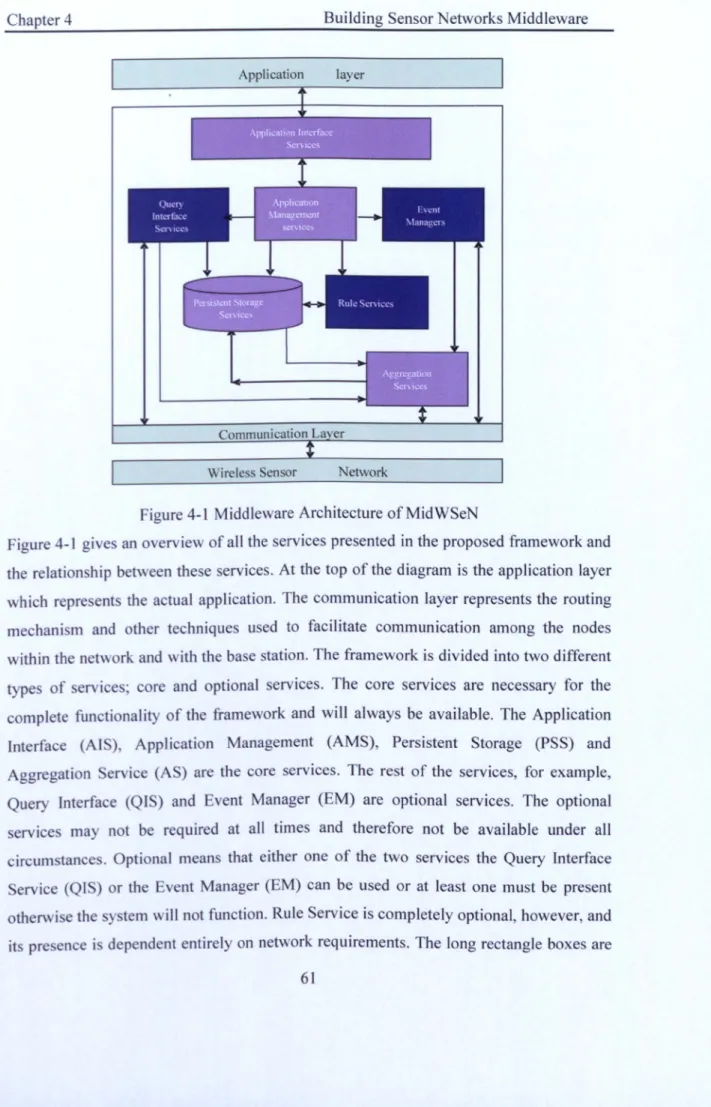
4.3 An Overview of Proposed Framework ... .. 56
4.4 Core Services ... .. 62
4.4.1 Application Interface Service ... .. 63
4.4.2 Application Management Service ... .. 65
4.4.3 Persistent Storage Service ... .. 67 4.4.4 Aggregation Service ... .. 68 4.5 Optional Services ... .. 68 4.5.1 Rule Service ... .. 69
4.5.2 Query Interface Service ... .. 70
4.5.3 Event Manager ... .. 72
4.6 Summary ... .. 73
Chapter 5 MIDLLEWARE PERSISTENT STORAGE SERVICE ... .. 76
5.1 Introduction ... .. 76
5.2
Persistent
Storage
as a Middleware Service ...
..
78
5.3 Persistent Storage ... .. 79
5.3.1 Data-Centric Storage ... .. 80
5.3.2 Interaction of other services with PSS ...
..
84
5.3.3 Design ... .. 85 5.4 Case Study ... .. 91 5.5 Prioritization ... .. 93 5.5.1 Prioritization Algorithm ... .. 94 5.6 Summary ... .. 96
Chapter 6 MIDDLEWARE AGGREGATION SERVICE ... .. 98
6.1 Introduction ... .. 98
6.2 Aggregation as a middleware Service ... .. 99
6.3 Aggregation service ... 101
6.3.1 Design
...
103
6.3.2 Adding Context
...
105
6.3.3 Snooping Technique ... 106
6.3.4 Interaction of Other Services with AS ...
108
6.4 Case Study ... 110
6.5 Summary ... 113
Chapter 7 PERFORMANCE EVALUATION AND IMPLEMENTATION ... 115
7.1 Introduction ... 115 7.2 Implementation ... 116 7.3 Evaluation ... 123 7.4 Project Evaluation ... 133
7.5 Comparison with Related Works ... 136
7.6 Summary ... 13 8
Chapter 8 CONCLUSIONS AND FUTURE WORK
...
140
8.1 Introduction ... 140 8.2 Thesis Outline ... 141 8.2.1 Introduction ... 1418.2.2 Background
...
141
8.2.3 8.2.4 8.3 8.4 8.4.1 8.4.2 8.4.3 8.5
Design of a New Middleware Framework MidWSeN ... .... 143
Evaluation and Results ... Contributions ... Future Work ... Security ... Self-Managing Sensor Networks ... n+L. o.. D--4 Teciiae ... ... 144 ... 144 ... 147 ... 147 ... 149 V LI IG1 1\V JV ü1 V... ... ... Final Remarks ... References ... Appendix A ... ... 150 ... 150 1 ') ... 163
Figure 2-1 A medical Body Sensor Network ... 28
Figure 2-2 CodeBlue Medical application for Sensor Networks ... 28
Figure 3-1 OMG Reference Model Architecture ... 35
Figure 3-2 NET new framework ... 36
Figure 4-1 Middleware Architecture of MidWSeN ... 61
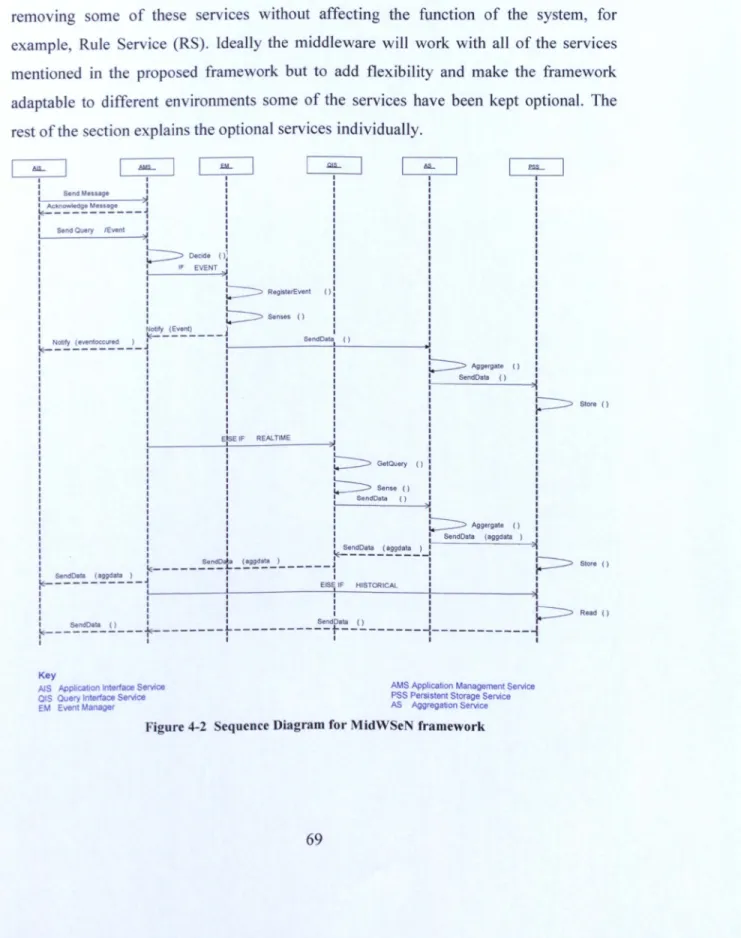
Figure 4-2 Sequence Diagram for MidWSeN framework ... 69
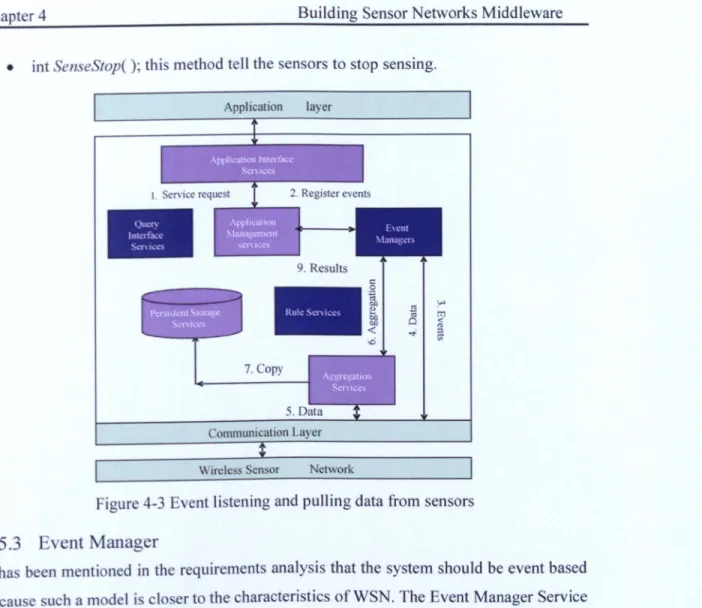
Figure 4-3 Event listening and pulling data from sensors ... .. 72
Figure 5-1 Interaction of other services with Persistent storage service ... .. 84
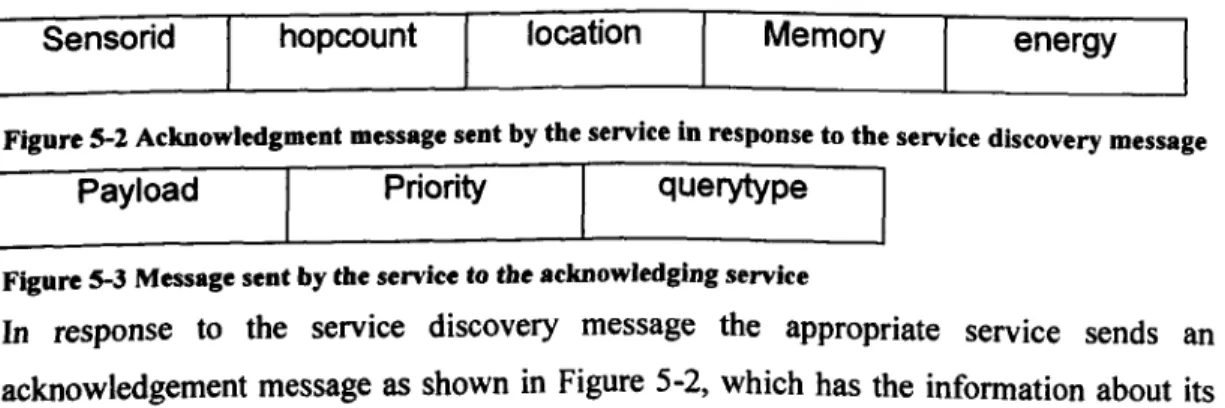
Figure 5-2 Acknowledgment message sent by the service in response to the service discovery message ... .. 87
Figure 5-3 Message sent by the service to the acknowledging service ... .. 87
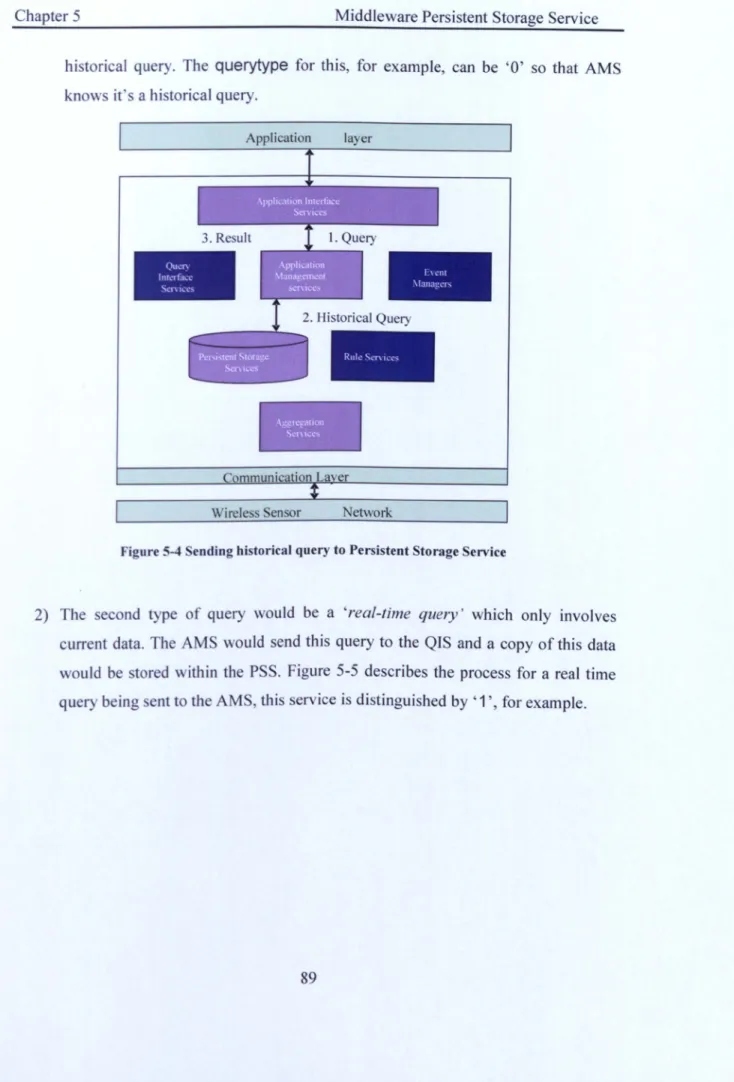
Figure 5-4 Sending historical query to Persistent Storage Service ... .. 89
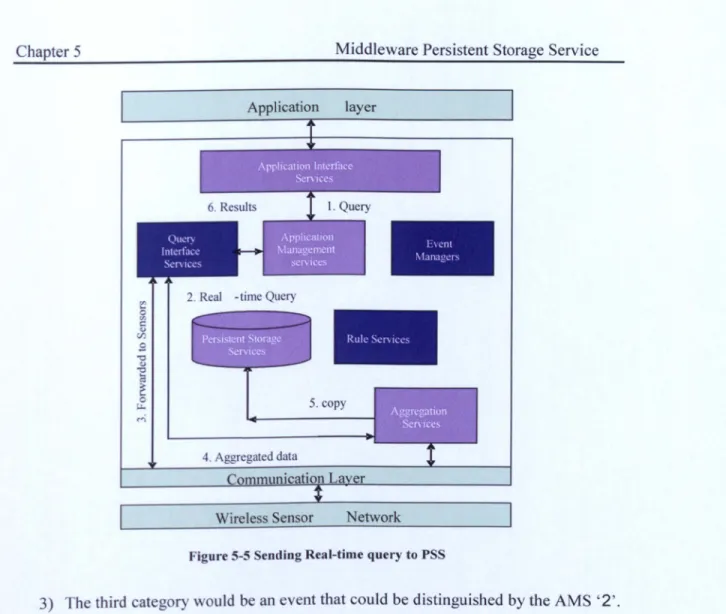
Figure 5-5 Sending Real-time query to PSS ... .. 90
Figure 5-6 Event Listening and pulling data from sensors ... .. 91
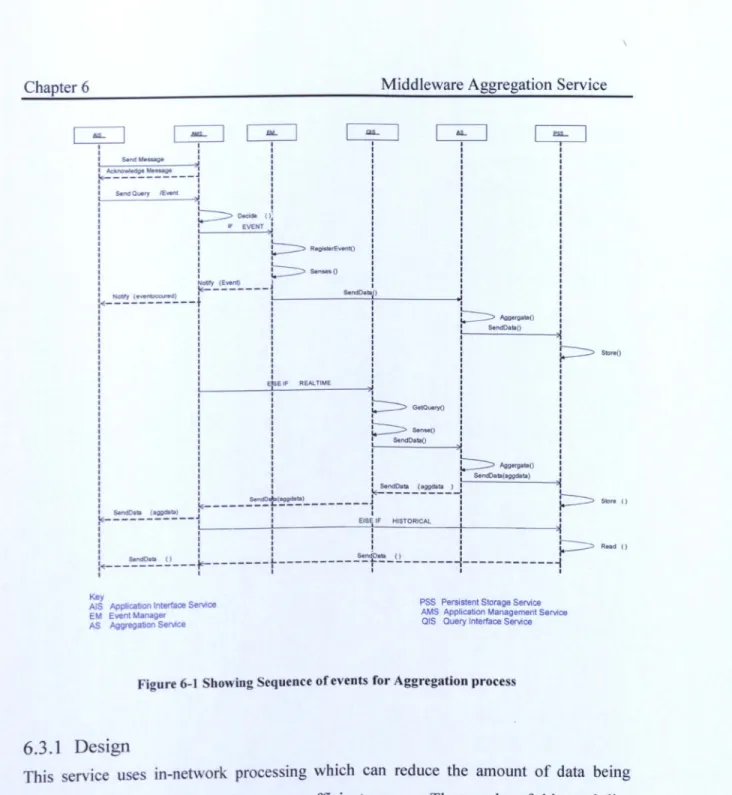
Figure 6-1 Showing Sequence of events for Aggregation process ... 104
Figure 6-2 Interaction of other services with Aggregation service ... III Figure 7-1 Code to illustrate data being written to the Logger ... 118
Figure 7-2 Code to illustrate data being saved to the mote ... jig Figure 7-3 Code for Priority algorithm ... 119
Figure 7-4 Priority assigned to data by application ... 121
Figure 7-5 Aggregating data according to priority ... 122
Figure 7-6 Query without context ... 123
Table I Acknowledgment message sent by the AMS ... 92
Table 2 Message sent by the AIS to the AMS ... 93
Table 3 Showing confidence interval for 3 copies of data in a sensor network ... 126
Table 4 Showing confidence interval for 4 copies in a sensor network ... 127
Table 5 Showing confidence interval for 5 copies in a sensor network ... 127
Table 6 Uniform topology 250x250 grid ... 129
Table 7 Uniform topology 200x200 grid ... 129
Table 8 Effects of Distance on Snooping ... 130
Chapter 1 INTRODUCTION
1.1 Preamble
Internet technology has connected people to the wealth of knowledge in almost every field of life but there was still one important aspect missing the physical dimension because of their ability to sense small changes in the physical quantities. Sensors have been able to fulfill this criterion and have provided the physical dimension missing from this existing wealth of knowledge. The existing technologies combined with sensors have made it possible to make the dream of a smart space come true. Terms like ubiquitous computing and wireless technology is becoming very common and is being used in consumer products, for example, mobile phones, broad band, Internet.
There was a pre Internet phase and the world is going through the Internet phase in the recent years. After further advancements in the field of networking and computing there will be a post Internet phase which is leading us to the Sensor Net which means sensors connected to the Internet providing real time physical quantities (Tavakoli et al. 2007). One of the important events of the pre Internet phase, apart from the advent of computers, which starts the era, is wireless technology because it leads the world to the post Internet phase.
The history of wireless technology can be dated back as far as the 19`h century when Marconi was able to conduct his first experiment(Carovillano 2003). It has led us to the present day technologies and terms which are widely used, for example, wireless LAN (Local Area Networks) (Cisco Systems 2004) in the 1990s which was a breakthrough for wireless networks, Global System for Mobile Communication (GSM) (GSM 2007) which made mobile phones possible. In addition to the previous works we have Wi-Fi, enables connection to the Internet or other machines that have Wi-Fi functionality through a wireless network. It conforms to the IEEE 802.11 standards. The most recent addition to
wireless telecommunications is WiMAX, defined as Worldwide Interoperability for Microwave Access to promote conformance and interoperability of the IEEE 802.16 standards. WiMAX provides broadband access as an alternative to DSL or cable for the final phase or mile delivering connectivity from a service provider to a customer. WiMax can connect several Wi-Fi hotspots which cover one or more acess points. Through these technologies the world becomes well connected and people can connect to each other easily no matter which part of the world they are placed.
The history of networking can be connected to the creation of ARPA, or Advanced Research Projects Agency (ARPA's now known as DARPA) (DARPA 2007) in 1957 which led to the advent of networks and later the Internet which was marked by the first packet sent over the network in 1969 starting the exciting phase of the Internet era. ARPANET (Hauben 2006) stands for ARPA-network is a network that was specially designed to connect universities and other research centres on a network. The concept conceived in the 1960s was implemented in 1969 on four nodes (Griffiths 2002; Griffiths 2002; Hauben 2006). One was at the University of California Santa Barbara, one at UCLA, one at SRI International, and the last one at the University of Utah. The Internet is a worldwide collection of publicly accessible interconnected computer networks. The advent of internet led to email in 1972 and World Wide Web (WWW) the worlds first browser in early 1990s. Since its advent, the Internet has grown at a phenomenal speed both in volume and complexity. It has made it possible to connect anyone to almost anything for example other computers, telephones, mobile phones and even common house hold appliances. The Internet has been able to realize the dream of connectivity and has turned the world into global village.
As mentioned earlier there was one important aspect still missing, the physical dimension. Imagine while en route to your office in the morning, there is an accident ahead and that information is automatically transferred to your car which can then take an
alternate route. In a different scenario while shopping in the super market you can
connect to your refrigerator to find out what items you need to pick. This is the dream of
a smart world or Smart space in which one can interact with the environment and help people in finding what they require easily. This dream is possible by combining the
present day wireless communication technologies and sensors. The next section provides
a historical perspective of sensors.
1.2 Sensors and Wireless Networks
The sensor age starts in 1967 when Honeywell Research Centre in Minneapolis, USA applied for patent for the edge-constrained silicon diaphragm by ART R. Zias and John Egan (Copidate Technical Publicity 2006). In 1999 the industry realized that sensors can go wireless which opened a new world of applications that was never imagined before. A Wireless Sensor Network (WSN) is a collection of small, low-cost devices capable of sensing, computation, storage and communication, called sensors. These sensors,
although limited in their resources, can be combined together to perform complex
operations.
Wireless sensors first use was for military applications (Chong et al. 2003). Sensors have been used in the wired environment previously, with success in industrial applications like automobile manufacturing, but the combination of wireless technology and sensors
has opened a whole new exciting avenue of applications. It has made possible to access
difficult terrains where human intervention was impossible or very difficult. These
sensors can be deployed anywhere and can work independently for months without any
maintenance. It is possible to throw these small compact devices called sensors into
difficult terrains in large quantities where they organize themselves and start functioning
by establishing contact with their immediate neighbours and start sending data for months
or as long as their batteries last.
Sensors have made the dream of a smart world come true through embedded technology being small in size they can be embedded on any object or creature. This will make it possible to connect anything with everything any where. For example, our body network will be connected to our car network or home/office network and they can communicate with each other. It means a fully integrated and connected environment.
The different prospects of wireless sensors are exciting and are possible with existing
wireless technologies but all this makes WSN very unique and difficult as well. Real
world applications mean that sensors have to operate in harsh conditions where they
battery operated so the batteries may run out very easily. As there will be no maintenance or network administrator, the network will have to manage itself. Presently the wireless sensors are sensing and sending raw data which is difficult with limited resources. Handling such a huge amount of data is a big issue and needs to be resolved. There are security issues especially in military applications and more generally because of the data- centric nature of this network. This network also communicates with wired or traditional networks which means that the protocols developed for this network will also have to consider issues related to communication with wired networks too.
In general, WSN is a very challenging and promising field for researchers because it has so much potential but there are a lot of issues that still need to be addressed. The aim of this research is to address some of the above mentioned issues in order to facilitate the dream of Smart Space in which humans can interact with the surrounding environment easily.
Looking at the previous history of these technologies shows how fast they have grown individually, especially in the later half of the 20th century, and worked collectively to give birth to new fields, for example, grid computing (Grandinetti 2005), peer-to-peer (Subramanian et al. 2005), ubiquitous/pervasive computing (Burkhardt et al. 2002) or ad hoc (Ferrari 2006) and sensor networks etc. The idea of pervasive or ubiquitous computing is to connect anything with everything seamlessly without the user being even aware of it. The goal of pervasive computing is to provide unobtrusive and continuous connectivity using the current networks and wireless technology. It has not only improved interconnectivity and transfer of knowledge but helped identify new avenues like smart spaces and embedded technology. This technology takes computing beyond the traditional desk top computer to consumer devices like the fridge, TV, our home security systems or electric systems, cars or even our clothes or coffee mugs (Burkhardt et al. 2002). First it was just data and information which was flowing now sensors have added physical dimension to it directly from the real world. It's like creating a virtual world using the real world parameters.
Taking a short tour of history in the previous sections also reveals that a lot of different types of hardware and technologies are working together which means a heterogeneous
environment. Networking not only means connecting computers but also electronic devices and through embedded technology everything or every device. As the size of a chip is becoming smaller it is possible to embed them on any object or creature, which makes it possible to connect everything. It is not only possible to connect devices but bodies, clothes, etc. anything that can be thought of. As already mentioned above connectivity means heterogeneity too because everything is connected to anything meaning different types of hardware and software. It also means heterogeneous technologies communicating and working with each other. For all these heterogeneous technologies to work together seamlessly, smoothly hiding the complexities of underlying platform details there is a need for another layer of software which can relieve the user of the burden of resolving complex issues related to heterogeneous hardware and software. The developer does not have to be aware of the underlying system because everyone cannot be an expert or computer scientist. The end user is only interested in getting his work done with out hindrance. However, the underlying system might be very complex combining different technologies, software and hardware. Operating systems could not handle this complexity because there may be more than one operating system involved. Therefore to handle heterogeneity and its related issues researchers came up
with another layer of abstraction called middleware. The next section introduces this
aspect of research.
1.3 Middleware
The term middleware gained popularity in the 1990s although there are claims that it has been around since 1968 (Naur et al. 1968). The popular definition of the term is that it is an additional layer of software between the application and the operating system which deals with issues not being handled by the operating system. Middleware is used to hide the low level system programming from the developer so that he can concentrate on his
actual application. With the advent of the Internet and World Wide Web, so many
different types of new software are being introduced in a short period of time. On the other hand technology is also advancing fast as we have already observed in the previous section, therefore new and more sophisticated hardware is flooding the market. To bridge
the gap between heterogeneous software and hardware, middleware comes in which hides the lower abstractions from the user.
The term middleware has also been referred to as a distributed platform of interfaces and services that reside between the application and the operating system in order to facilitate the development, deployment and management of distributed applications. It can work as glue between two applications, an application program and a network, more than two software systems (applications, operating system and network). Generally it is a communication link between two or more software and for hardware systems (Coulson 2004) e. g. OMG'S CORBA (Vinoski 1997; Wang et al. 2001), Microsoft's DCOM (Karp et al. 2000) or Java RMI (Satyanarayanan et al. 1999). These are the most popular middleware software available in the market since the advent of the term middleware. Common Object Request Broker Architecture commonly known as CORBA was introduced by the Object Management Group (OMG). It is an open, vendor-independent architecture and infrastructure to be used by computer applications to work together over networks. It details the Object Request Broker (ORB) component of the object management architecture (OMA) (Vinoski 1997). The ORB component facilitates communication between clients and objects.
Distributed Component Object Model (DCOM) extended Microsoft's COM and has now been replaced by. NET in 2002. The . NET framework (Microsoft 2007) included in both Windows Server 2003 and Windows Vista is software that has been developed for Microsoft Windows. It provides solutions to common program requirements, and
manages the execution of programs written specifically for the . NET framework
Java Remote Method Invocation (Java RMI) helps in creating distributed Java to Java applications. It is based on Remote Procedure Call (RPC) mechanism which allows a
program to execute a subroutine in a different address space with out explicit instructions
(Grosso 2001).
All the above are examples of popular middleware systems used in traditional or wired networks. The existing middleware techniques for wired or traditional networks cannot be applied to WSN due to the following reasons.
" The existing wired and traditional networks have more resources therefore the middleware developed for these are resource intensive whereas in sensor networks the resources are very limited. Energy is probably the most precious resource because wireless sensors are battery operated. Similarly, other resources like memory, processing power, bandwidth etc., are all very limited and constrained.
" Sensor networks usually works without any human intervention or network
administrator. Self-organization and self-management is one of the characteristics of this type of networks. Sensor networks might have to operate in difficult terrains with limited resources without the help of any kind of human intervention
or infrastructure. These sensors could just be thrown into harsh terrains randomly
and have to self-organize and start functioning as a network. Where as the
traditional networks are operated by humans and needs constant human intervention.
Usually sensor networks are connected to the traditional wired networks also or
they might be part of a heterogeneous network having different capabilities,
functionalities and characteristics.
" Deployment in real time situations in difficult terrains and random deployment means that these sensors are exposed to harsh conditions with limited resources. Therefore they could be easily damaged or unavailable or run out of batteries which mean dynamically changing topologies and reorganization of the network.
" Sensor networks are application specific which means application requirements
play a major role in the dynamics of the network organization and functioning.
" The operating systems for sensor networks are not well developed. Therefore they
do not provide the full functionality of operating systems as in traditional
networks. There may be different reasons for not having fully developed
operating systems which is beyond the scope of this text but due to these reasons
developers have extra burden of worrying about the underlying hardware.
Therefore, due to the above mentioned reasons the researchers and scientists face a number of challenges in developing lightweight middleware which could cope with the
unique characteristics of a WSN.
In order to realize the dream of integrated Smart world in which humans can interact with the environment any time any where the researchers are trying to use the limited resources of WSN in an efficient way to make the most of this network. The work done
so far has mainly concentrated on how to transfer most of the data to a powerful base
station and then manipulate or process that data to gain useful information. However, the
problem is that transmission is the most expensive activity in terms of resources in WSN.
The techniques used so far focus on simple data gathering-style applications, and in most
cases support one application per network. Therefore, network protocols and applications
are usually closely coupled. These procedures are usually ad hoc and do not provide a
good solution to the vision of Smart World in which the sensors are able to talk to each
other and dynamically discover services whenever required.
The goal of this work is to systematically design services and portable abstractions of the
system for diverse applications and sensor reuse. In addition, the system should also be
able to support and coordinate mechanisms to efficiently adapt to changing environment.
In order to achieve this . goal there is a need for middleware which can interconnect
wireless sensors quickly requiring minimum software and hardware without any problem.
The middleware presented in this thesis will adapt and provide services under different
circumstances with minimum hardware or software requirements. This middleware will
sit between the operating system and application in order to support the development,
maintenance, deployment, and execution of sensing-based solutions (Shen et at. 2001). In
addition it will also provide abstractions and mechanisms for dealing with heterogeneity
of sensor nodes. Middleware for WSN should be energy efficient, easy to use, robust and
scalable.
1.4 Problem Definition
The challenge facing the researchers in WSN'S is how to seamlessly integrate and bind
the sensors together with limited resources. Sensors are light, low cost and can be deployed easily. Stringent resources mean that they have limited power being battery
operated, small memory, low bandwidth and less processing capabilities. With limited resources the problem of handling a huge amount of data is a big challenge because WSN'S are data-centric. The whole network activity is focused on gathering data and transmitting it to the base station.
The middleware systems developed so far are restricted because they are application specific in order to make them efficient. They are either event-based (Dunkels et al. 2004; Dunkels et al. 2004b; Janakiram et al. 2005; Nicopolitidis et al. 2003), query-based (Bonnet et al. 2000; Gummadi et al. 2005; Madden et al. 2005; Woo et al. 2004; Yao et al. 2003), or context-aware (Choi et al. 2005; Gu et al. 2004; Huebscher et al. 2004) etc.. The sensors are only used for specific applications and the same sensors cannot be reused for different applications. Application dependant middleware is problematic because, for
each different application, new middleware has to be implemented. For more than one
application working together there will be more than one middleware. This makes it difficult for different sensors to talk to each other. In order to bind and integrate the sensors a strong need is felt for a generic and flexible middleware which would be able to utilize the same sensors for different applications and also be able to provide context aware information to the end user within the restricted resources of WSN.
Middleware for WSN should be event-based because they may be deployed in difficult terrains to listen to different events which are likely or expected to happen. In addition it saves energy because unless the event occurs they are in a sleep mode or low energy
mode which conserves energy the most precious resource being powered by battery.
Therefore it is also close to WSN characteristics (Römer et al. 2002). The main problem is that if there is an emergency or real time situation where the user might want to investigate further there is no provision in the existing event-based systems which would
enable the user to immediately query the sensors directly or indirectly for further
information. Therefore there should also be a provision for querying the system in a real time situation or any time the user wants to investigate or collect additional information. Another challenge that is confronting the sensor community is how to handle data within the network. Previously two approaches have been deployed to handle data. The first approach was to sense and just send all the data to the base station or sink. The second
approach which is mostly employed by the current systems is to store data temporarily and perform certain calculations within the network and then this semi processed data is sent to the base station for further processing. The reason for this shift is the fact that research has proved that transmission is the most costly activity in terms of resources, especially energy which is the most precious resource in this kind of network. Although the second approach is an improvement but still all data is transferred, stored and mostly processed outside the sensor networks which means a lot of transmissions.
Researchers found that in-network processing was more cost effective in terms of resources. For example, in a real time deployment of wireless sensor networks on a volcano the researcher had to face real difficulty in transferring data from the sensors to the laptop which acted as a base station because one minute of collected data took several minutes to be transmitted along the radio channel (Werner-Allen et al. 2006). The authors proposed local buffering of event data to overcome the problems they faced. Now further research has proved that storage utilizes even less energy (Mathur et al. 2006) therefore researchers are exploring this very new and exciting prospect of saving the data within the network permanently or for longer period of time.
This new development is possible with the advancement of technology, for example, the advent of new NAND flash memory technologies which has increased the capacity and energy efficiency of local flash storage dramatically (Mathur et al. 2006) and also other advances, for example, Irrotes introduced by Intel which has 32 MB memory or SPOT developed by Sun Micro Systems which has 4MB of flash memory or the tiny wireless memory chip developed by Hewlett-Packard (Hewlett-Packard 2007) which can store up to 512KB, only 2-4mm square of size and can transfer data at a speed of 10 megabits per second. Therefore it now seems possible to save the data within the network using flash memory process it and then send out processed information on request. This means less transmissions and also availability of data whenever required which ensures better
utilization of the limited resources.
1.5 Design Goals
Sensors have so many indoor and outdoor applications which are beyond any one person's imagination. Such a varied scenario requires a middleware which would be able
to adapt to changing circumstances and enable the heterogeneous sensors to communicate with each other to provide services under different conditions with the minimum
requirement of hardware or software. It should interconnect wireless sensors quickly without any problem.
The main objective of this research is to create a middleware that would work with different applications. This middleware will sit between the network and application in
order to support the development, maintenance, deployment, and execution of sensing-
based applications (Römer et al. 2002). It should be generic and flexible enough to facilitate different applications and acquire context-aware data. In addition it should also provide abstractions and mechanisms for dealing with heterogeneity of sensor nodes. Main characteristics of WSN's are heterogeneity, small-scale devices, low-energy-usage,
dynamic, restricted-resources. In view of its special characteristics middleware for should, however, be designed to be energy efficient, robust and scalable.
In order to achieve the above mentioned goals we are introducing a novel generic and
flexible middleware framework for WSN'S which will not only provide context-aware information but also be both event-based and query-based. This framework can be implemented as a whole or in parts depending on applications requirements. It has a distributed, service-oriented architecture which means services can be discovered dynamically within the network. No other framework to the best of knowledge of the
author has combined both events and queries. The use of queries also provides an
opportunity to handle real-time situations. Giving the concept of sensor reuse for multiple
applications and application independence because so far sensor networks are only
restricted to a single application.
1.6 Novel Contributions
Motivated by the advances in sensor networks and based on the above mentioned problems this thesis presents a novel middleware framework called MidWSeN. The contributions provided in thesis are detailed as follows.
"A detailed literature survey was conducted to have a thorough understanding of
the area and provide a set of requirements. Based on the literature survey a fresh
set of requirements has been proposed in the thesis in order to address the issues which are important to develop a better middleware for WSN.
" This thesis presents a lightweight and energy efficient middleware framework
(Javed et at. 2005) which combines most important aspects of WSN in a single system. No other work to the best of author's knowledge so far has presented such a holistic view of different aspects of WSN. This framework can be used by both query based and event based applications. This makes it more generic because applications can both query and register events as well. It also has the ability to work efficiently under normal as well as emergency situation. Due to service- oriented architecture it can be used in heterogeneous environment as well as pure
sensor based environment because the framework does not bind the user to any
specific protocols or data structure. Furthermore, the user does not have to worry about heterogeneous underlying platforms. Simple and easy to use framework in addition to loosely coupled architecture, provides a layer of abstraction between the application and the operating system which relieves the user from worrying about the under lying hardware. The framework does not concentrate on a single aspect of middleware it is providing query, event and context. The framework is
flexible and can be customized to an application's needs, keeping in accordance
with the application specific character of WSN.
o The framework provides a combination of core and optional services which could be adjusted according to the resources available and specific requirements of the application. The availability of multiple copies of services distributed across the network helps in making the system robust. Due to the loosely coupled architecture new services could easily be added to the system which makes it more scalable.
" Storage and processing of data within the network consumes fewer resources (Javed et al. 2007b), as has been already mentioned above. Therefore our framework provides services and techniques which ensure that data is not only stored but also processed within the network in order to make it more energy efficient. This middleware framework introduces a new persistent storage service
which saves data within the network. This service stores data within the network for lifetime of the network which provides historical data. This not only helps in creating spatial and temporal relationship between data but also provides implicit relationships. It has been mentioned that previously data was either directly sent to the base station or kept temporarily for initial processing and then transmitted back to the base station which consumed a lot of precious resources. Storing and processing data within the network saves precious resources, for example,
bandwidth and energy.
o Memory in WSN'S is very limited and storing data within the network might result in utilization of all the memory available in the network therefore to handle such a situation a Priority algorithm is being also
presented in this thesis. This algorithm will prioritize the data and
whenever the need for more storage space arises it will aggregate the lowest priority data to create more space. This will ensure that enough memory is always available when required and not all of the data is erased.
" Aggregation is a very important technique which helps in combining redundant
but related data (Javed et at. 2007a). It also helps in reducing the amount of data being transmitted back to the base station. A context enhanced aggregation has been presented in this thesis. The data is being aggregated with respect to context
and is sent to the Persistent Storage to be stored along with the context. This
service also has an added advantage in our framework that it helps in saving memory or storage space. This service also provides the opportunity to the developer to tailor or customize it to applications specific needs thus making it more flexible.
" Application management service (AMS) is an important service which not only works as a link between the sink and WSN but also helps in managing the framework. The novel aspect of this service is that it provides Service optimization within the network. When a query or event is sent to the network it will help in locating the correct service and deciding which are the most
appropriate location and efficient path through which to send it. This service will also inform the user if an emergency situation occurs with the help of the Rule service if a rule or set of rule fires.
1.7 Thesis Structure
The rest of the thesis is structured as follows:
Chapter 2 gives an overview of sensors and sensor networks. It describes in detail
the characteristics, design principles, applications sensors. It also gives a brief description of the hardware, technologies and software related to WSN.
Chapter 3 gives the background of the significant works already done in middleware in WSN and also why traditional networks middleware cannot be applied to sensor networks. Further, it discusses the existing works and their drawbacks in terms of flexibility, ease of usage and efficiency.
Chapter 4 gives a new set of requirements considered important for a better and
efficient middleware. It also presents the design of a novel middleware framework. It further gives some detail of the novel core services and optional
services included in the framework and their individual contribution to the overall
structure.
Chapter 5 explains the persistent storage service in greater detail. This novel
service is used to store data within the network on the sensors. This chapter
explains why and how the data is being stored within the network. It presents a novel algorithm for prioritization. It also explains how other services within the framework interact with this service in order to provide an efficient system.
Chapter 6 explains the aggregation service in detail. The aggregation service is
also used to save memory and add context to data in addition to the traditional
way of compressing or filtering data and saving resources which is a new concept. This chapter also explains why it is necessary to keep aggregation as a
middleware service and how it functions within the framework to provide
" Chapter 7 provides the evaluation of the framework and the implementation details. It gives an evaluation against the requirements given in chapter 4 and a comparison against the existing works.
Chapter 8 provides the conclusion and suggestions for future work.
1.8 Summary
This chapter has underlined the need for having a generic middleware for WSN's. In the beginning of the chapter the evolution process of the existing technologies has been given. Through the evolution process of these technologies now a stage is reached where dreams like smart homes or smart spaces can be realized. It has also been iterated that wireless technology and sensors combined together with other existing technologies is able to realize this dream of Smart environment which means humans can interact with the environment intelligently.
Taking a short tour of history also reveals that a lot of different types of hardware and technologies are working together which means heterogeneous environment. Therefore, to handle heterogeneity and its related issues the researchers came up with another layer of abstraction called middleware. The existing middleware techniques for wired or traditional networks, however, cannot be applied to WSN'S because they are resource intensive. Wireless sensor networks have unique characteristics, for example, they have very limited resources and operate without human intervention in harsh terrains. They have to be self organized and self manage over long periods of time. Therefore there is a need for new middleware strategies in order to cope with the unique characteristics of the
WSN
The challenge facing the researchers in WSN's is how to seamlessly integrate and bind the sensors together with limited resources. Sensors are light, low cost and can be deployed easily. The middleware systems developed so far are restricted because they are application specific in order to make them efficient. They are event-based, query- based or context-aware. The sensors are only used for specific applications and the same sensors cannot be reutilized for different applications. With limited resources the problem of handling a huge amount of data is a big challenge because WSN'S are data centric. Researchers found that in-network processing is more cost effective in terms of
resources. Further research has proved that storage utilizes even less energy therefore
researchers are exploring this very new and exciting prospect of saving the data within
Chapter 2 WIRELESS SENSOR NETWORKS
2.1 Introduction
Data networking technologies have a come along way since the 1980s. It has changed by leaps and bounds in the last few decades and the coming decade or two promise more changes thanks to wireless sensor networks. A brief tour of the history of these technologies was given in the last chapter. This chapter gives a comprehensive overview of what the related technologies are and how WSN's progressing. This chapter talks about wireless networks in general and Wireless Sensor Networks (WSN's) in particular. The following section introduces wireless networks and its different types. Section 2.3 explains WSN's in some detail the basic operations, hardware, characteristics and technologies. This section also explains the different operating systems, applications, design principles and also different research areas.
2.2
Pervasive/Ubiquitous Computing
Pervasive computing, also called ubiquitous computing is taking the world beyond
computers to embedded technology (Estrin et al. 2002). Pervasive computing can be
defined as embedding computing into the environment in such a way that the user will not have to think for utilizing this technology. Pervasive computing is making use of the existing wireless and other technologies (Ou et al. 2007). Research is going on in the area of embedded technology and it is leading towards an integrated Smart world where there
may be a chip everywhere on human body, clothes, and equipment that is being used in
daily lives at home, office, car etc. The goal is that each and every thing used in daily life is always connected to a network of devices without any hindrance and can be used casually. The integration of already existing technologies like wireless communications and sensors has made it possible to make this fantasy real (Microsoft 2007).
2.3
Wireless Networks
Wireless technology helps two or more computers to communicate using standard network protocols, without cabling. Any technology that does this could be called wireless networking but often, however, the term refers to wireless LANs. This technology has produced a number of popular wireless solutions using the IEEE 802.11 standards. These solutions are being used in business and schools as well as sophisticated applications where network wiring is impossible, such as in warehousing or point-of-sale handheld equipment.
2.3.1 Wireless Architecture
Wireless Networks includes different components which could be broadly divided into
computer devices and a wireless infrastructure. " Computer Devices:
There can be many different types of computer devices ranging from small to large devices for example sensors, PDA, laptop, desktops etc. These computer devices are equipped with wireless networking interface cards which provides an interface between the computer device and the wireless network infrastructure. Individual computers can communicate directly with all of the other wireless enabled computers. The computer devices can work as clients or servers. The client requests for a service and the servers which are also sometimes referred to as end systems satisfy the clients request or provide the service. They can share files and printers dynamically with the support of appropriate software. They can also access wired LAN resources, using one of the computer devices as a bridge to the wired LAN having special software. (This is called "bridging").
" Wireless Infrastructure:
In the second type of architecture the wireless network can use an access point, or base station to access data and resources of the wired network. The access point acts like a hub, providing connectivity for the wireless computers and connects the wireless LAN to a wired LAN. This, with appropriate networking software support,
allows users on the wireless network to access wired LAN resources, such as file servers or existing Internet connectivity and vice versa (Akkaya et al. 2005; Frodigh et al. 2001; Nicopolitidis et al. 2003; Varshney et al. 2000).
2.3.2 Types of Wireless Networks
This section briefly explains that wireless networks are networks without connecting cables that rely on radio waves for transmission of data. The previous section explained the two main components of wireless networks. One of the two main components are computer devices which uses interface cards to communicate with other devices whereas the second component is the wireless infrastructure which uses a common access point to communicate.
While the term wireless network may technically be used to refer to any type of network that is wireless, the term is most commonly used to refer to a communications network whose interconnections between nodes is implemented without the use of wires, such as a
computer network (which is a type of communications network). Wireless
telecommunications networks are generally implemented with some type of remote information transmission system that uses electromagnetic waves, such as radio waves, for the carrier and this implementation usually takes place at the physical level or "layer" of the network. (For example, see the Physical Layer of the OSI Model).
" Personal Area Network
A personal area network (PAN) is a network to communicate among computer devices, for example, computers, phones or PDAs within a few meters space. With the help of wireless network technologies, for example, Infrared, Bluetooth, and ZigBee wireless personal area network (WPAN) is also possible.
o One type of wireless network uses Infrared to connect small devices over
very short range in WPAN (Wireless Personal Area Netork) having a small range. Infrared is limited to line of sight and used for point to point communication. One example of Infrared communication protocol is IrDA (Infrared Data Association) which is physical specification standard for short range data exchange over infrared light.
o Another type of network used for WPAN is Bluetooth (Bluetooth 2007; Ferro et al. 2005) for short range communiction of data. Bluetooth sends and receives signals from all directions and has greater communication range than infrared. It follows the IEEE 802.15 standards.
o Another type of network technology used for WPAN which is simpler and cheaper than other similar technologies mentioned above is ZigBee. ZigBee uses small, low-power digital radios conforming to IEEE 802.15.4 standard.
o Ultra-wideband (UWB, ultra-wide band, ultraband, etc. ) is also used for WPAN as a radio technology. It can also be used for short-range high- bandwidth communications at very low energy levels. Ultraband is using pulse coded information with sharp carrier pulses at a bunch of center frequencies in logical connex.
" Wireless Local Area Network
o One type of wireless network is a WLAN or Wireless Local Area Network. Similar to other wireless devices, it uses radio instead of wires to
transmit data back and forth between computers on the same network. It is
based on IEEE 802.11 standards for example IEEE 802.1la/llb. Wi-Fi
(Ferro et at. 2005) is a commonly used wireless network in computer systems which enable connection to the Internet or other machines that have Wi-Fi functionalities. Wi-Fi networks broadcast radio waves that can
be picked up by Wi-Fi receivers that are attached to different computers. " Wireless Metropolitan Area Networks
o This type of network that could connect many wireless LANs. WiMAX,
the Worldwide Interoperability for Microwave Access (Agapioy et al. 2006), is a telecommunications technology aimed at providing wireless data over long distances in a variety of ways, from point-to-point links to full mobile cellular type access. It is based on the IEEE 802.16 standards, which is also called WirelessMAN.
" Wireless Wide Area Networks
o This type of network can cover a wider range than a LAN and can make use of cellular technologies, for example, GSM. The proposed IEEE standard for WWAN is 802.20. The WWAN could also be called mobile device networks.
o Global System for Mobile Communications (GSM) network is divided into three major systems which are the switching system, the base station system, and the operation and support system. This is used for cellular phones, is the most common standard used for a majority of cellular providers.
This section briefly explained that networks without cables are known as wireless networks and mainly has two types of architecture. The first architecture uses network interface cards for communication whereas the second uses a common access point to communicate. Sensor networks can make use of both types of architectures.
Different types of commonly used wireless networks have also been mentioned above. There are many other types and varieties of wireless networks therefore it is difficult to
compare and categorize all of them. The main focus in this chapter is wireless sensor networks which are a network of small devices connected over a short range as already mentioned above. The next section gives detailed information about these types of wireless networks.
2.4 Wireless Sensor Networks
This section provides information about wireless sensor networks in detail which is the main focus of attention in this research. It explains the architecture, its unique characteristics and applications which make this research more exciting and challenging. This network basically consists of a base station and large number of small-scale cooperative nodes capable of limited computation, wireless communication and sensing. By correlating the sensor output of multiple nodes, the whole network can provide functionality that an individual node cannot (Römer et al. 2002). As already mentioned in the previous section WSN can make use of both architectures. It can connect with it
neighbors using on-demand multi-hop communication as in peer to peer communication to reach a base station to communicate with wired networks. On the other hand it can also have a single hop communication with its base station which in turn may be connected to a wired network.
2.4.1 Basic Operation
The basic operation of a sensor network is to deploy sensors in a target area to collect
information or monitor and track certain specific phenomena. This deployment could be
of a continuous process in order to replace nodes which have been unavailable or have depleted batteries due to environmental effects. These sensors can equip any object, creature or place with information-processing capabilities. They could either establish associations by a one- to-one relationship or by just throwing these nodes into an area of interest, where they have to function on their own.
After the successful deployment of nodes they can start functioning. They can either be assigned a task by an external source (for example. a vehicle passing by) or they could be self sufficient isolated networks which are capable of fulfilling a certain task themselves (for example sensing temperature) sending the information to other nodes which are controlling the results as part of the network. However, these controlling result sensing nodes might also be reporting to some external source for a more detailed monitoring of certain phenomena.
In order to obtain a high level result the sensor nodes have to coordinate and divide the task among themselves because they have limited functionality taking into account the individual characteristics of the nodes (for example attached sensors, location, and energy level).
2.4.2 Hardware
The hardware structure of the most commonly used motes or sensors consists of the following four parts.
" Sensing unit
The sensing unit is the main part and is made of two components sensors which are used for actual sensing and analog to digital converters (ADCs). The sensor unit
senses in the form of analog signals produced by the sensors based on the observed phenomenon which are then converted to digital signals by the ADC, and sent to the
processing unit (Akyildiz et al. 2002).
" Processing unit
The processor runs or processes the procedures that make the sensor node function, for example, collaboration with other nodes to carry out the assigned sensing tasks. It also has a limited storage or memory to, facilitate in the task of processing by storing intermediate results of a query or, store the programs associated to application management.
" Transceiver unit
A transceiver unit or Radio is used for communication and connects the node to the
network. Communication which is mainly sending and receiving depends on at least three different layers: physical, media access control (MAC), and network. The physical layer handles the communication between transmitters and receivers which includes signal modulation and coding of data. The MAC Layer is responsible for efficient use of energy, changes in network size, node density, topology and bandwidth. MAC (Demirkol et al. 2006). Finally, the network layer is responsible for determining the routing path that a message has to take through the nodes of the
network in order to travel from its source to the destination (Feng et al. 2002).
" Power unit
Energy is most vital for sensors therefore one of the most important components of a
sensor node is the power unit. Two types of batteries might be used for the power unit
one can be rechargeable and the other may be normal Alkaline batteries. Power units may also be supported by a power scavenging unit such as solar cells (Feng et al. 2002).
The above mentioned units are the basic parts which any sensor node will have however there may be other parts depending on the application they are used for.
2.4.3 Characteristics of Wireless Sensor Networks
A WSN has different unique characteristics which makes it more challenging and different from other types of networks. They consume less energy because they are small and therefore can be used in difficult terrains where human intervention is not possible. The most important characteristic is that they are small-scale devices with restricted resources like energy, CPU performance, memory, wireless communication bandwidth and range (Römer et al. 2002). This scarcity of resources especially very limited energy resource makes it more challenging. They are battery-operated and die if these batteries run out which means the energy has to be used very efficiently in order for them to work for longer periods of time.
When sensors are used for outdoor applications they are subjected to harsh conditions, for example, they may be carried away by wind or trampled by animals. They are prone to failure being battery-operated and used in difficult terrains. Due to dynamic conditions and power failure being frequent as they are battery-operated the topology can change
frequently. So, constantly changing topology has become another important characteristic to consider while designing a sensor network.
They are also application dependent which is another unique characteristic of this network. For example, in indoor applications the sensors are accessible but in outdoor
applications the sensors may not be accessible or highly unlikely to access which will
have a deep impact on the design of the network in choice of protocols being used for different activities.
They may also be heterogeneous in terms of computing power and memory. Sensors may be used in collaboration with other equipment, for example, PDA, Laptops etc., within the same network. Such a heterogeneous network means a combination of more capable
and less capable devices.
2.4.4 Technologies
In this section the different technologies associated with WSN's are introduced. Micro- Electro-Mechanical Systems (MEMS) are the integration of mechanical elements, sensors, actuators and electronics on a common silicon substrate through micro- fabrication technology. The MEMS is an enabling technology which can enable a smart
environment with micro-sensors and micro-actuators ubiquitously. It helps in the realization of complete systems-on-a-chip dream.
The most common communication technologies being used for WSN's are Bluetooth and ZigBee. Both of these are used for short range wireless communications. BlueTooth is an
industrial specification which uses low-power radio communications to wirelessly connect and exchange data between phones, computers and other network devices over short distances. It is being named "Bluetooth" after a Danish king more than 1,000 years ago Harald Bluetooth. It can transmit signals over short distances wirelessly up to 10 meters and generally communicate at less than 1 Mbps. A master Bluetooth device can communicate with up to 7 more devices which are called piconet in a PAN. It conforms to IEEE 802.15.1 standards (Nachman et al. 2005).
ZigBee (Eady 2007) was created as a new standard (IEEE 802.15.4) to support relatively simple, low power wireless communications, primarily home and industrial automation applications. ZigBee is being used in wireless sensor and grid networks. Some early examples of ZigBee networking include monitoring your washing machine for leaks or controlling the heating of buildings which are both indoors applications.
2.4.5 Operating System
There have been several attempts to make a specialized operating system for sensor networks. But these efforts are still at an early stage. The difficulty lies in the unique characteristics of sensor networks, especially the resource constraints and their application dependant nature. One of the first and probably the most important attempts is TinyOS (Du et at. 2004; Levis 2006; Levis 2006). It has been developed in nesC (Gay et at. 2003) also specifically designed for embedded systems and programming component based applications. It is an extension of C which is well known for programming at the physical level. TinyOS is based on an event-driven model which is very close to sensor networks. It uses event handlers and tasks to handle an external event or, for example, a sensor reading. These events or tasks will always be processed to completion. Tasks can be posted to be processed later. Race condition can be detected at an early stage through
Other operating systems developed for WSN also use C programming. They are Contiki (Dunkels et al. 2004a), MANTIS (Bhatti et al. 2005), SOS (Han et al. 2005) and NanoRK (Eswaran et al. 2005). Contiki and SOS are both also event driven operating systems where as MANTIS and Nano-RK are based on preemptive multithreading.
2.4.6 Design Principles
A survey of literature reveals three main design principles for WSN; Localized Algorithms (Estrin et al. 1999; Rosenstein et al. 1997; Tsuchiya 1988), Adaptive fidelity (Estrin et al. 1999), and Data-centric communication (Akyildiz et al. 2002; Ratnasamy et al. 2003). Localized algorithms are a distributed algorithm which utilizes only a subset of nodes for a specific task (Meguerdichian et al. 2001; Qi et al. 2002). They are scalable,
robust, and can utilize resources more efficiently by distributing tasks among
coordinating sensors. They are difficult to design because their behavior depends on global knowledge converting this global knowledge to local behavior means changing it completely. Also, different types of localized algorithms may have different types of parameter choices which may lead to conflicting global behavior. Thus energy insensitive design may utilize more battery power or more resources. In comparison adaptive fidelity the other design principle is more energy efficient because there is a trade-off between the quality (fidelity) of the output and resources, for example, battery lifetime or bandwidth etc.
The adaptive fidelity algorithms are resource efficient but again not without problems, the implication to introduce multi-fidelity algorithm is that, different fidelities consume a different level of resources; the most important ones are time, computing power and network bandwidth, which are extremely scarce in mobile computing environments. Most of the time, especially in the case of interactive applications, people would rather see a less-than-ideal result within constraints of time and power. Multi-fidelity algorithm allows the trade-off between output quality and resources consumed, which is an essential theme in adaptive application design.
In a data-centric (Akyildiz et al. 2002; Ratnasamy et al. 2002) approach the applications are not interested in the identity of a particular node rather it requires the attribute of the phenomena. For example, if an application queries about the temperature reading it will
require the location at which it exceeds a certain limit rather than the temperature of a specific node. Therefore it has proven to be a more energy efficient data dissemination method due to its application knowledge.
Another important technique related to design is the in-network (Fasolo et al. 2007) processing which is popular among researchers. In in-network processing some of the calculations are done within the network and only the final result is communicated to the user. This means fewer transmissions to the sink which saves energy because transmission is the most costly activity in terms of resources than processing data within the network especially energy.
2.4.7 Applications of Wireless Sensor Networks
As mentioned before WSN's have a wide range of applications. Examples include
military and national security surveillance (Abdelzaher et al. 2004; Lim 2001),
geophysical monitoring which involves monitoring air, soil and water, condition based maintenance, habitat monitoring like studying birds and plants (Cerpa et al. 2001; Mainwaring et al. 2002), smart spaces, traffic surveillance, medical application (Heinzelman et al. 2004), business processes etc. There is a long list of applications in short sensors will be used everywhere. Below a list is given of a few real world examples of WSN's already being deployed and working.